


Community hub
Recent from talks
Contribute something
Nothing was collected or created yet.
Geghard
View on Wikipedia | This article includes a list of general references, but it lacks sufficient corresponding inline citations. (July 2016) |
.jpg)
Key Information


Geghard (Armenian: Գեղարդ, meaning "spear") is a medieval monastery in the Kotayk province of Armenia, being partially carved out of the adjacent mountain, surrounded by cliffs. It is listed as a UNESCO World Heritage Site with enhanced protection[1] status.
While the main chapel was built in 1215, the monastery complex was founded in the 4th century by Gregory the Illuminator at the site of a sacred spring inside a cave. The monastery had thus been originally named Ayrivank (Այրիվանք), meaning "the Monastery of the Cave". The name commonly used for the monastery today, Geghard, or more fully Geghardavank (Գեղարդավանք), meaning "the Monastery of the Spear", originates from the spear which had wounded Jesus at the Crucifixion, allegedly brought to Armenia by Apostle Jude, called here Thaddeus, and stored amongst many other relics. Now it is displayed in the Echmiadzin treasury.
The spectacular towering cliffs surrounding the monastery are part of the Azat River gorge, and are included together with the monastery in the World Heritage Site listing. Some of the churches within the monastery complex are entirely dug out of the cliff rocks, others are little more than caves, while others are elaborate structures, with both architecturally complex walled sections and rooms deep inside the cliff. The combination, together with numerous engraved and free-standing khachkars is a unique sight, being one of the most frequented tourist destinations in Armenia.
Most visitors to Geghard also choose to visit the nearby pagan Temple of Garni, located further down the Azat River. Visiting both sites in one trip is so common that they are often referred to in unison as Garni-Geghard.
History
[edit]The monastery was founded in the 4th century, according to tradition by Gregory the Illuminator. The site is that of a spring arising in a cave which had been sacred in pre-Christian times, hence one of the names by which it was known, Ayrivank (the Monastery of the Cave). The first monastery was destroyed by Arabs in the 9th century.
Nothing has remained of the structures of Ayrivank. According to Armenian historians of the 4th, 8th and 10th centuries the monastery comprised, apart from religious buildings, well-appointed residential and service installations. Ayrivank suffered greatly in 923 from Nasr, a vice-regent of an Arabian caliph in Armenia, who plundered its valuable property, including unique manuscripts, and burned down the magnificent structures of the monastery. Earthquakes also did it no small damage.
Though there are inscriptions dating to the 1160s, the main church was built in 1215 under the auspices of the brothers Zakare and Ivane, the Zakarid generals of Queen Tamar of Georgia, who took back most of Armenia from the Turks.[2] The gavit, partly free-standing, partly carved in the cliff, dates to before 1225, and a series of chapels hewn into the rock dates from the mid-13th century following the purchase of the monastery by Prince Prosh Khaghbakian, vassal of the Zakarians and founder of the Proshian principality. Over a short period the Proshyans built the cave structures which brought Geghard well-merited fame — the second cave church, the family sepulcher of zhamatun Papak and Ruzukan, a hall for gatherings and studies (collapsed in the middle of the 20th century) and numerous cells. The chamber reached from the North East of the gavit became Prince Prosh Khaghbakian’s tomb in 1283. The adjacent chamber has carved in the rock the arms of the Proshian family, including an eagle with a lamb in its claws. A stairway W of the gavit leads up to a funerary chamber carved out in 1288 for Papak Proshian and his wife Ruzukan. The Proshyan princes provided Geghard with an irrigation system in the 13th century. At this time it was also known as the Monastery of the Seven Churches and the Monastery of the Forty Altars. All around the monastery are caves and khachkars. The monastery was defunct, the main church used to shelter the flocks of the Karapapakh nomads in winter, until resettled by a few monks from Ejmiatsin after the Russian conquest. Restored for tourist purposes but now with a small ecclesiastical presence, the site is still a major place of pilgrimage.
The monastery was famous because of the relics that it housed. The most celebrated of these was the spear which had wounded Christ on the Cross, allegedly brought there by the Apostle Thaddeus, from which comes its present name, Geghard-avank ("the Monastery of the Spear"), first recorded in a document of 1250. This made it a popular place of pilgrimage for Armenian Christians over many centuries. Relics of the Apostles Andrew and John were donated in the 12th century, and pious visitors made numerous grants of land, money, manuscripts, etc., over the succeeding centuries. In one of the cave cells there lived, in the 13th century, Mkhitar Ayrivanetsi, the well-known Armenian historian.
No works of applied art have survived in Geghard, except for the legendary spear (geghard). The shaft has a diamond-shaped plate attached to its end; a Greek cross with flared ends is cut through the plate. A special case was made for it in 1687, now kept in the museum of Echmiadzin monastery. The gilded silver case is an ordinary handicraft article of 17th-century Armenia.
Complex
[edit]
Today the monastery complex is located at the end of the paved road, and the walk up from the parking lot is lined with women selling sweet bread, sheets of dried fruit (fruit lavash), sweet sujukh (grape molasses covered strings of walnuts) and various souvenirs. A group of musicians usually plays for a few seconds as visitors approach, perhaps willing to play longer for money.
At the approach to the main entrance on the west there are small caves, chapels, carvings and constructions on the hillside. Right before the entrance are some shallow shelves in the cliff onto which people try to throw pebbles in order to make their wish come true. Just inside the entrance to the compound are the 12th–13th century ramparts protecting three sides of the complex, and the cliffs behind protect the fourth. Walking across the complex will take one to the secondary entrance on the east, outside of which is a table for ritual animal offerings (matagh), and a bridge over the stream.
The one- and two-storey residential and service structures situated on the perimeter of the monastery's yard were repeatedly reconstructed, sometimes from their foundations, as happened in the 17th century and in 1968–1971. It is known that most of the monks lived in cells excavated into the rock-face outside the main enceinte, which have been preserved, along with some simple oratories. The rock-faces over the whole area bear elaborate crosses (khatchkar) carved in relief. More than twenty spaces, varying in shape and size, were carved, at different levels, in solid rock massifs surrounding the main cave structures. Those in the western part of the complex were for service purposes, and the rest are small rectangular chapels with a semicircular apse and an altar. There are twin and triple chapels with one entrance, some of the entrances ornamented with carvings. There are many often richly ornamented khachkars cut on rock surfaces and on the walls of the structures or put up on the grounds of Geghard in memory of a deceased or in commemoration of someone's donation to the monastery.
The main church (Katoghike, 1215)
[edit]
Though there are inscriptions dating to the 1160s, the main church "Kathoghike" was built in 1215 under the auspices of the brothers Zakare and Ivane (of the Zakarid-Mkhargrzeli family), the generals of Queen Tamar of Georgia, who took back most of Armenia from the Turks.[3]
,_Kotayk,_Armenia.jpg)
This is the main church of the complex, and traditional in most respects. This church is built against the mountain, which is not exposed even in the interior. The plan forms an equal-armed cross, inscribed in a square and covered with a dome on a square base. In the corners there are small barrel-vaulted two-storey chapels with steps protruding from the wall. The internal walls have many inscriptions recording donations.
The southern facade of the Katoghike has a portal with fine carvings.[4] The tympanum is decorated with a representation of trees with pomegranates hanging from their branches, and of leaves intertwining with grapes. The pictures of doves are placed between the arch and the outside frame; the doves’ heads are turned to the axis of the portal. Above the portal is carved a lion attacking an ox, symbolizing the prince's power.
The arched top of the arcature of the cupola's drum has detailed reliefs showing birds, human masks, animals heads, various rosettes and jars.
The vestry, gavit (1215-1225)
[edit].jpg)
West of the main temple there is a rock-attached vestry, in Armenian gavit (Latin narthex) built between 1215 and 1225, linked to the main church. Four massive free-standing columns in the centre support a roof of stone with a hole in the centre to admit light. The peripheral spaces resulting from the location of the columns are variously roofed, whilst the central space is crowned by a dome with stalactites, the best example of this technique anywhere in Armenia. This style of "stalactite vault" with a central hole for natural light is thought to have been derived from the muqarnas of Islamic architecture, starting from the 11th century in Armenia.[5] They are very similar to the muqarnas of the Seljuk Sultan Han caravanserai in Aksaray (dated to 1229). The gavit was used for teaching and meetings, and for receiving pilgrims and visitors.
The western portal differs from other portals of those times by van-shaped door bands, decorated with a fine floral pattern. The ornamentation of the tympanum consists of large flowers with petals of various shapes in the interlaced branches and oblong leaves.
Rock-cut church with spring (c.1240)
[edit]
The first cave chamber, Avazan (basin), situated north-west of the vestry, was hewn in the 1240s in an ancient cave with a spring. It was built during the reign of Avag (died in 1250), son of Ivane and nephew of the Amirspasalar (Commander in chief) of the Zakarid army, nicknamed "Long Arm" (Zakare II Zakarian).[6] There is an inscription "Remember Archimandrite Galdzag", recording the construction of the architect for the caves.[7]
It is entirely dug out of the rock and has an equal-armed cruciform plan. The interior is lined by two crossed arches with a central stalactite dome. An inscription records that it was the work of the architect Galdzak, who also constructed the other rock-cut church and the jhamatuns within a period of some forty years. His name is inscribed at the base of the tent decorated with reliefs showing pomegranates.
The main rectangular space of the church is crowned with a tent and complicated with an altar apse and two deep niches, which gave the interior an incomplete cross-cupola shape. Two pairs of intersecting pointed arches, forming the base of the tent, rest on the half-columns of the walls. Just as in the vestry, the inner surface of the tent is hewn in the graceful shape of stalactites which also decorate the capitals of the half-columns and the conch of the altar apse. The decoration of the southern wall is most interesting compositionally. Carved on it are small triple arches with conchs of various shapes, connected at the top and at the bottom by a complicated and finely carved floral ornament.
The main zhamatun (1283)
[edit]
After Prosh Khaghbakian acquired the monastery from the Zakarids, he transformed it in the Proshyans’ family monastery and mausoleum. The sepulchre and the second cave church of Astvatsatsin situated east of Avazan, were hewn in 1283, presumably by the same Galdzak, too. These are also accessed through the gavit. The "main zhamatun" is a roughly square chamber cut into the rock, with deeply cut reliefs in the walls. Of interest is a rather primitive high relief on the northern wall, above the archways. In the center, there is a ram's head with a chain in its jaws; the chain is wound around the necks of two lions with their heads turned to the onlooker. Instead of the tail tufts there are heads of upward looking dragons — symbolic images gong all the way back to heathen times. Between the lions and below the chain there is an eagle with half-spread wings and a lamb in its claws. This is likely the coat-of-arms of the Proshian Princes.
The reliefs of the eastern wall are no less picturesque. The entrances to a small chapel and to Astvatsatsin church have rectangular platbands connected by two relief crosses. Cut on the portals of the chapel are sirens (fantasy harpy-like birds with women's crowned heads) and on the church walls there appear human figures with their elbows bent, wearing long attires and having nimbuses around their heads. These are probably members of the princely family who had these structures built. In its floor there are burial vaults.
Proshyan chapel (1283)
[edit],_Kotayk,_Armenia.jpg)
The rock-cut tomb gives access to the second rock-cut church, the "Chapel of the Proshians". This church is known from an inscription to have been built in 1283, the donation of Prince Prosh.[12] It is cruciform in plan. The corners are curved and the drum is lined with semi-columns alternating with blind windows. The dome is decorated, with a circular opening in the centre. The walls have relief decoration depicting animals, warriors, crosses, and floral motifs.
Apart from stalactites in the shape of trefoils and quatrefoils, the decoration of Astvatsatsin church features ornaments of rosettes and various geometrical figures. The front wall of the altar dais is decorated with a pattern of squares and diamonds. A realistic representation of a goat is found at the butt of the altar stair. Men's figures are found on a khachkar left of the altar apse. The man with a staff in his right hand and in the same attitude as that of the figures on the portal may be Prince Prosh, a founder of the church. Another figure, holding a spear in the left hand, point down, and blowing an uplifted horn, is depicted almost in profile.
Upper Zhamatun (1288)
[edit]
The "Upper Zhamatun", was the tomb of Papak Proshyan and his wife Ruzukana, as known from an inscription, but their tombstones have disappeared.[13] It was hewn in 1288 on a second level, north of the Proshians’ burial-vault, by way of an external staircase (near the door to the gavit). Also carved into the rock, its form reproduces that of a gavit. It contains the tombs of the princes Merik and Grigor, and others are known to have been there but have now disappeared. An inscription shows it to have been completed in 1288.
On the southern side of the corridor leading to this jhamatun, numerous crosses are cut. The columns hewn in solid rock support rather low semicircular arches fitted into trapeziform frames which, forming a square in the plan, serve as a foundation for the spherical cupola above them with a light opening in its zenith. A hole in the back right corner gives a view of the tomb downstairs.
The acoustics in this chamber are extraordinary.
Chapel of S. Grigor
[edit]The chapel of S. Gregory the Illuminator (formerly the Chapel of the Mother of God – St Astvatzatzin), built before 1177, stands high above the road, a hundred meters away from the entrance to the monastery. It is partly hewed in massive solid rock; its composition was, in all probability, largely influenced by the shape of the cave which existed there. The chapel, rectangular in plan and having a horseshoe-shaped apse, is adjoined, from the east and from the northeast, by passages and annexes hewed at various levels and even one on top of another.
Traces of plaster with remnants of dark frescoes indicate there were murals inside the chapel. Khachkars with various ornaments are inserted into the exterior walls and hewn on the adjacent rock surfaces.
Gallery
[edit]-

-

-

-

-
![Rock-cut chamber: tomb of Prosh Khaghbakian (1283).[14]](//upload.wikimedia.org/wikipedia/commons/thumb/5/5b/Beautiful_Geghard_Monastery.jpg/330px-Beautiful_Geghard_Monastery.jpg) Rock-cut chamber: tomb of Prosh Khaghbakian (1283).[14]
Rock-cut chamber: tomb of Prosh Khaghbakian (1283).[14] -
 Emblem of the Proshyan family.
 -
 17th-century service buildings (foreground)
 -
 Arched entrance to the caves adjacent to the monastery.
 -
 Khachkars inset in rock outcropping
 -
 Geghard in the snow
 -
![Cupola on arches. Proshyan chapel (1283).[15]](//upload.wikimedia.org/wikipedia/commons/thumb/f/f3/Monasterio_de_Geghard%2C_Armenia%2C_2016-10-02%2C_DD_85-86_HDR.jpg/330px-Monasterio_de_Geghard%2C_Armenia%2C_2016-10-02%2C_DD_85-86_HDR.jpg) Cupola on arches. Proshyan chapel (1283).[15]
Cupola on arches. Proshyan chapel (1283).[15] -
![Cupola on arches. Proshyan chapel (1283).[16]](//upload.wikimedia.org/wikipedia/commons/thumb/f/f6/-%D4%B3%D5%A5%D5%B2%D5%A1%D6%80%D5%A4%D5%AB_%D5%BE%D5%A1%D5%B6%D5%A1%D5%AF%D5%A1%D5%B6_%D5%B0%D5%A1%D5%B4%D5%A1%D5%AC%D5%AB%D6%80_8.jpg/330px--%D4%B3%D5%A5%D5%B2%D5%A1%D6%80%D5%A4%D5%AB_%D5%BE%D5%A1%D5%B6%D5%A1%D5%AF%D5%A1%D5%B6_%D5%B0%D5%A1%D5%B4%D5%A1%D5%AC%D5%AB%D6%80_8.jpg) Cupola on arches. Proshyan chapel (1283).[16]
Cupola on arches. Proshyan chapel (1283).[16] -
![Entrance to the Proshyan chapel (1283).[17]](//upload.wikimedia.org/wikipedia/commons/thumb/a/a5/-%D4%B3%D5%A5%D5%B2%D5%A1%D6%80%D5%A4%D5%AB_%D5%BE%D5%A1%D5%B6%D5%A1%D5%AF%D5%A1%D5%B6_%D5%B0%D5%A1%D5%B4%D5%A1%D5%AC%D5%AB%D6%80_6.jpg/250px--%D4%B3%D5%A5%D5%B2%D5%A1%D6%80%D5%A4%D5%AB_%D5%BE%D5%A1%D5%B6%D5%A1%D5%AF%D5%A1%D5%B6_%D5%B0%D5%A1%D5%B4%D5%A1%D5%AC%D5%AB%D6%80_6.jpg) Entrance to the Proshyan chapel (1283).[17]
Entrance to the Proshyan chapel (1283).[17] -
 Muqarna Vault of the First church in the rock, 13th century.
 -
 Column from the gavit
 -
![Column, tomb of Papak Proshyan, 1288.[18]](//upload.wikimedia.org/wikipedia/commons/thumb/9/9f/Geghard-Column2.jpg/250px-Geghard-Column2.jpg) Column, tomb of Papak Proshyan, 1288.[18]
Column, tomb of Papak Proshyan, 1288.[18] -
![Ceiling and Muqarna vault of the gavit.[19]](//upload.wikimedia.org/wikipedia/commons/thumb/7/7b/Geghard-Ceiling.jpg/250px-Geghard-Ceiling.jpg)
-
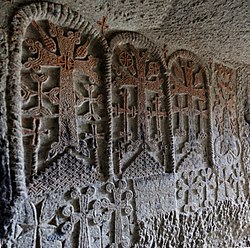 Engraved crosses on the cave church wall in the Geghard Monastery.


.jpg)
.jpg)
![Rock-cut chamber: tomb of Prosh Khaghbakian (1283).[14]](https://en.wikipedia.org/wiki/File:Beautiful_Geghard_Monastery.jpg)


![Cupola on arches. Proshyan chapel (1283).[15]](https://en.wikipedia.org/wiki/File:Monasterio_de_Geghard,_Armenia,_2016-10-02,_DD_85-86_HDR.jpg)
![Cupola on arches. Proshyan chapel (1283).[16]](https://en.wikipedia.org/wiki/File:-%D4%B3%D5%A5%D5%B2%D5%A1%D6%80%D5%A4%D5%AB_%D5%BE%D5%A1%D5%B6%D5%A1%D5%AF%D5%A1%D5%B6_%D5%B0%D5%A1%D5%B4%D5%A1%D5%AC%D5%AB%D6%80_8.jpg)
![Entrance to the Proshyan chapel (1283).[17]](https://en.wikipedia.org/wiki/File:-%D4%B3%D5%A5%D5%B2%D5%A1%D6%80%D5%A4%D5%AB_%D5%BE%D5%A1%D5%B6%D5%A1%D5%AF%D5%A1%D5%B6_%D5%B0%D5%A1%D5%B4%D5%A1%D5%AC%D5%AB%D6%80_6.jpg)


![Column, tomb of Papak Proshyan, 1288.[18]](https://en.wikipedia.org/wiki/File:Geghard-Column2.jpg)
![Ceiling and Muqarna vault of the gavit.[19]](https://en.wikipedia.org/wiki/File:Geghard-Ceiling.jpg)


-

-

-

-

-

-

-
 Copies of khachars at the Armenian cemetery in Julfa, Nakhichevan destroyed by Azerbaijan
 -

-

-

-

-

-

-


_05.jpg)
_06.jpg)
_07.jpg)
_08.jpg)


.jpg)
.jpg)


-
 From James Justinian Morier's 1818 book
 -

_monastery_Morier.png)

See also
[edit]References
[edit]- ^ "UNESCO grants Monastery of Geghard status of Enhanced protection". armenpress.am. 7 December 2018. Retrieved 2018-12-09.
- ^ Mathews, Thomas F.; Sanjian, Avedis Krikor (1991). Armenian Gospel Iconography: The Tradition of the Glajor Gospel. Dumbarton Oaks. pp. 14–16. ISBN 978-0-88402-183-4.
- ^ Geghard. p. 6.
The main church (Kathoghike) (5, 8, 9, 10) According to the inscription above the West entrance the church was built in 1215, during the Zakarian reign. The architectural scheme follows that of the many domed buildings in use in Armenia during the XII-XIII centuries. The plan, in the shape of a cross, is inscribed in a slightly extended square, and is covered by a dome on a square base in line with the building axis. The drum is linked to the base by means of curved vaulting. The East arm of the cross terminates in an apse while the others are square. In the four corners are small chapels on two levels with apses to the East and covered with barrel vaults. On the internal walls one can read the donators' inscriptions. The external walls are built with particular care, the stones are precisely cut and connected together. The building is characterised by a noticeable unity between the internal space and the external volume.
- ^ Ara Baliozian Armenia observed – 1979 "Katoghike is the only church built in the usual way with outside walls and an outside dome. ... The underground passages, the outside walls of Katoghike and the adjacent rocks are carved with innumerable crosses (khachkars) of the most.."
- ^ Guidetti, Mattia (2017). "7 - The 'Islamicness' of Some Decorative Patterns in the Church of Tigran Honents in Ani". Architecture and landscape in medieval Anatolia, 1100-1500. Edinburgh: Edinburgh University Press. pp. 170–177. ISBN 9781474411301.
- ^ Geghard. p. 8.
The first stone church is situated to the north-west of the "Kathoghikd" church, and according to the inscription on the south wall, was built during the Avang reign (died in 1250) son of Ivan and nephew of the Amirspahsalar - (commander in chief of the army) Zaccaria nicknamed Long Arm. In the church interior exists a natural spring, anciently worshipped, and today scrupulously conserved.
- ^ "GEGHARDAVANK". Service for the Protection of Historical Environment and Cultural Museum-Reservations.
- ^ Geghard. p. 8.
The inscription carved on the north wall of the church, shows the date of foundation in 1283, and the name of the donator, Prince Prosh.
- ^ "Unesco. Geghard Monastery" (PDF).
The prosperity of the monastery in the thirteenth century was due to the patronage of the Proshyan prince, who carved out the second cave church in 1283, reached through a rock-cut antechamber which served as their mausoleum. The burials are in a recess behind twin arches, over which two felines on leashes and an eagle with a lamb in its talons, the family's armoured bearings have been sculpted in bold relief.
- ^ Geghard. p. 42.
- ^ Geghard. p. 8.
The inscription carved on the north wall of the church, shows the date of foundation In 1283, and the name of the donator, Prince Prosh
- ^ Geghard. p. 8.
The inscription carved on the north wall of the church, shows the date of foundation In 1283, and the name of the donator, Prince Prosh
- ^ Geghard. p. 8.
According to the inscription on one of the central columns, it was built in the year 1288. during the epoche of Papak (son of Prince Prosh) and his wife Rousakan The plan is typical of the Armenian gavits: a square space with a domed roof supported by four freestanding central columns. It is interesting to note that several Khatchkar carved into the rock face, are not carved but painted. In the interior there are the tombs carrying the inscriptions "Merik" and "G(h)rig(h)or"; however the tombs of Papak and Rousakan have disappeared.
- ^ Geghard. p. 42.
- ^ Geghard. p. 35, image 18.
- ^ Geghard. p. 35, image 18.
- ^ Geghard. p. 35, image 18.
- ^ Geghard. p. 36, image 21.
- ^ Geghard. p. image 13.
Sources
[edit]- "Architectural Ensembles of Armenia", by O. Khalpakhchian, published in Moscow by Iskusstvo Publishers in 1980.
External links
[edit]
- Armeniapedia.org: Geghard Monastery
- Monastery of Geghard and the Upper Azat Valley UNESCO collection on Google Arts and Culture
- About Geghard Monastery
- UNESCO entry on Geghard – See "Advisory Body Evaluation" for detailed history.
- Worldy.info: Geghard Monastery Archived 2019-06-09 at the Wayback Machine



|  | |

Geghard
View on GrokipediaGeghard (Armenian: Գեղարդ, meaning "spear") is a medieval monastery in Armenia's Kotayk Province, partially carved into the adjacent mountain and set amid dramatic cliffs in the Upper Azat Valley.[1][2]
Founded in the 4th century by Gregory the Illuminator at the site of a sacred spring within a cave, the complex originally bore the name Ayrivank ("cave monastery") before being renamed Geghardavank in reference to the Holy Lance—the spear reputed to have pierced Christ's side—which was housed there for approximately 500 years starting in the 13th century.[1][2]
The main structures, including the 1215 Katoghike Church with its cruciform plan and the adjacent rock-cut chapels and tombs, were constructed primarily in the 13th century under the patronage of Armenian nobility such as the Proshyan princes, showcasing peak Armenian medieval rock-hewn architecture with intricate carvings, khachkars, and defensive elements.[1][2]
As a UNESCO World Heritage Site inscribed in 2000 for its outstanding example of regional architectural influence (Criterion ii), Geghard functioned as a major ecclesiastical and cultural hub, hosting a school, scriptorium, library, and relics associated with Apostles Andrew and John, underscoring its enduring spiritual and scholarly importance.[1]
Location and Setting
Geographical Position
Geghard Monastery is located in the Upper Azat Valley of Kotayk Province, Republic of Armenia.[1] The site occupies a position approximately 40 kilometers southeast of the capital Yerevan, along the right bank of the Azat River.[3][4] Its geographic coordinates are 40°08′26″N 44°49′07″E, at an elevation of 1,650 meters above sea level amid steep cliffs that integrate the complex into the surrounding mountainous terrain.[5] The monastery lies in close proximity to the Garni Temple, situated about 7 to 11 kilometers away, within the Azat River gorge.[6][4] As part of the UNESCO World Heritage property "Monastery of Geghard and the Upper Azat Valley," inscribed in 2000, the area includes a designated buffer zone encompassing the valley's natural and cultural features.[1] Accessibility today is provided via paved roads from Yerevan, passing through Garni, highlighting its remote yet elevated placement in the landscape.[3]Environmental and Strategic Context
Geghard Monastery occupies a commanding position at the entrance to the Upper Azat Valley in Armenia's Kotayk Province, enveloped by steep volcanic basalt cliffs rising over 100 meters that form a natural amphitheater.[1] [7] These geological formations, remnants of ancient volcanic activity in the Gegham Ridge, not only dictated the site's rock-carving feasibility but also channeled the Azat River through the gorge below, fostering a microclimate supportive of perennial water sources like the sacred spring emerging from cave recesses.[1] The river's proximity ensured hydrological stability in a semi-arid highland terrain at approximately 1,700 meters elevation, where sparse vegetation and rugged outcrops limited agricultural self-sufficiency, emphasizing reliance on natural aquifers for endurance.[1] The local temperate continental climate features hot, dry summers with average highs of 25°C in July and freezing winters dipping to -5°C in January, accompanied by snowfall and frequent frost events. These seasonal extremes drive freeze-thaw cycles, wherein moisture seeps into cliff fissures, expands upon freezing, and exerts pressure that can fracture basalt and tuff over time, contributing to gradual erosion of exposed surfaces despite the rock's inherent durability.[7] Empirical observations of Armenian highland geology indicate such processes accelerate in unsealed rock faces, underscoring the causal role of climatic variability in long-term site maintenance challenges. From a strategic perspective, the encircling cliffs provided inherent defensibility by constricting access routes into narrow, elevated passes, rendering large invading forces vulnerable to ambushes while enabling small garrisons to hold positions effectively against historical threats.[1] This topography balanced monastic seclusion—facilitating ascetic isolation amid remote ravines—with oversight of the fertile Azat Valley below, allowing early inhabitants to monitor caravan paths and potential incursions from southern routes without compromising spiritual withdrawal.[1] The interplay of isolation and vantage likely influenced site selection, as the terrain's barriers deterred opportunistic raids common in medieval Armenia, preserving continuity amid regional instabilities.[7]Historical Development
Pre-Monastic Origins and Founding
The Upper Azat Valley, encompassing the Geghard site, exhibits traces of pre-Christian religious activity, including veneration of natural features like springs emerging from caves, which local pagan inhabitants held sacred prior to Armenia's Christianization. Nearby, the Garni temple complex, constructed around 77 AD under Hellenistic and Roman influences, exemplifies the dominant pagan worship in the region until the early 4th century. Archaeological remains in the valley indicate continuous habitation from Urartian times (8th-6th centuries BCE), underscoring a landscape conducive to ritual use before Christian dominance.[4][8][9] Armenia's official adoption of Christianity as the state religion in 301 AD, under King Tiridates III following his conversion by Gregory the Illuminator, marked a causal shift from pagan to Christian practices, with epigraphic and textual records documenting the suppression of temples like Garni and the establishment of monastic sites. Tradition attributes Geghard's founding to Gregory during this period (circa 301-326 AD), initially as Ayrivank ("Cave Monastery"), leveraging the site's natural cave and spring for early ascetic hermitages rather than formal architecture. This aligns with Gregory's broader role in institutionalizing Christianity through monastic foundations, though direct contemporary evidence for Geghard remains traditional rather than archaeological.[1][2][10] The site's early Christian significance stemmed from its caves serving as hermitages for ascetics, predating any constructed structures and linking to pilgrimage traditions rooted in Armenia's apostolic heritage of conversions by figures like Thaddeus and Bartholomew in the 1st century AD. Verifiable material evidence, such as inscriptions, emerges later, with the earliest dated examples from 1177 and 1181 AD, suggesting informal use persisted until medieval formalization. This pre-monastic phase reflects a pragmatic adaptation of pre-existing natural shelters for Christian eremitic life, empirically evidenced by the enduring cave features amid the valley's transition.[1][11]Medieval Expansion Under Proshyan Patronage
The Proshyan princely family, also known as the Khaghbakians, initiated a significant expansion of Geghard Monastery in the mid-13th century after acquiring the site around the 1240s.[5] This patronage facilitated the construction of multiple rock-cut chambers and assembly halls, transforming the complex from earlier wooden and simpler stone structures into a more elaborate ensemble of carved architecture integrated with the cliff face.[5] The shift reflected economic prosperity in the region following the stabilization after Seljuk Turkic incursions, enabled by Armenian lords under Mongol suzerainty who invested in religious foundations to assert cultural continuity.[1] Key donations are attested by dedicatory inscriptions and khachkars, directly linking specific princes to constructions. Prince Prosh sponsored the second rock-cut church in 1283, as recorded in an inscription on its north wall, while the adjacent Jamatoun served as a Proshyan family mausoleum.[5] [12] His son Papak and wife Rousakan funded the Upper Jamatoun in 1288, which housed tombs including those of princes Merik and Grigor, Prosh's uncle who had earlier ties to the family before his death around 1220–1223.[5] [1] These dated reliefs and epigraphic evidence demonstrate the causal role of Proshyan funding in the rapid proliferation of structures between the 1240s and 1288, concentrating patronage effects within a few decades.[5] Amid Mongol overlordship, which introduced relative administrative stability after decades of upheaval, Geghard under Proshyan support functioned as a center for Armenian ecclesiastical and cultural preservation, hosting a school, scriptorium, and library that sustained literacy and religious practice.[1] The family's investments, verifiable through heraldic motifs like their emblem on tombs and khachkars, underscored a strategic consolidation of Armenian identity via monumental rock-cut piety, countering external pressures without overt political confrontation.[12] This era marked the peak of medieval development at Geghard before later declines.[5]Post-Medieval Decline and Ottoman Period
The Monastery of Geghard underwent significant decline after its medieval zenith in the 13th and 14th centuries, marked by invasions and regional instability. Timurid forces under Tamerlane sacked the site in the early 15th century, contributing to depopulation and disruption of monastic life, as part of broader devastation across Armenian ecclesiastical centers. Subsequent Ottoman-Safavid wars from the 16th to 17th centuries further exacerbated these challenges through recurring military campaigns that led to temporary abandonment phases and loss of inhabitants in eastern Armenia's contested territories.[13] A major 1679 earthquake caused extensive structural damage to Geghard, displacing architectural elements such as carved stones and compromising rock-cut chambers, as documented in historical accounts of the event's impact on regional monuments. Neglect followed, with the complex suffering deterioration from exposure and lack of maintenance amid ongoing turmoil, though core relics like the Holy Lance were safeguarded by relocating them during periods of threat. Manuscript collections faced attrition from looting incidental to invasions, diminishing the site's scholarly resources.[14] By the 18th century, limited repopulation by monks enabled modest restorations, including the addition of cells along the eastern and southern walls, signaling a partial revival amid persistent foreign dominion. These efforts, however, did not restore the monastery's former prominence, reflecting the cumulative toll of invasions, seismic events, and administrative neglect under Persian and Ottoman influences.[5]19th-20th Century Rediscovery and Soviet Era
During the late 18th century, prior to full Russian incorporation of the region, the Holy Lance associated with Geghard—believed by tradition to be the spear that pierced Christ's side—was transferred from the monastery complex to the Mother See of Holy Etchmiadzin for safekeeping, where it has remained as a key relic of the Armenian Apostolic Church.[15] This move reflected ongoing efforts to centralize sacred artifacts amid regional instability, though the site's name retained its etymological link to the spear ("geghard" meaning spear in Armenian). In the 19th century, as Eastern Armenia came under Russian imperial control following the Russo-Persian Wars (1804–1813 and 1826–1828), Geghard benefited from increased administrative oversight of historical sites, preserving its structures amid broader documentation of Armenian ecclesiastical heritage, despite limited specific surveys recorded for the monastery itself. The Soviet era (1920–1991) marked a period of enforced secularization, with Geghard closed as an active monastery shortly after the Bolshevik consolidation in Armenia, in line with state policies suppressing religious institutions to promote atheism and materialism.[16] Monastic life ceased, and the complex was repurposed as a cultural monument under state protection, undergoing minimal archaeological interventions focused on structural integrity rather than religious restoration, which helped avert widespread decay but highlighted ideological tensions between heritage preservation and anti-clerical campaigns that affected many Armenian sites. Limited excavations and maintenance occurred, prioritizing the site's value as a medieval architectural exemplar over its spiritual function. Following Armenia's declaration of independence in 1991, Geghard experienced a resurgence in cultural and national significance, reintegrating into active religious use under the Armenian Apostolic Church and symbolizing post-Soviet revival of ethnic identity.[1] Tourism spiked as domestic and international visitors flocked to the site, drawn by its UNESCO World Heritage status granted in 2000 for its rock-cut architecture and historical role, with visitor numbers reflecting broader trends in heritage-driven travel amid economic recovery and diaspora reconnection.[1] This period underscored Geghard's enduring role in Armenian consciousness, transitioning from Soviet-era stasis to a focal point of national pride and pilgrimage.Architectural Complex
Main Church (Katoghike, 1215)
The Katoghike serves as the principal freestanding church of the Geghard complex, constructed in 1215 under the patronage of the Zakarid princes Zakare and Ivane. This structure adheres to the classic medieval Armenian cross-in-square design, featuring an equal-armed cross inscribed within a square plan and capped by a dome supported on a square base through squinches. The form distinguishes it from the contemporaneous rock-hewn chapels, emphasizing precision-cut masonry over excavation.[2][1][17] Erected using local volcanic tuff in ashlar technique, the church's walls exhibit tightly fitted blocks with minimal mortar, a method that bolsters structural integrity in Armenia's earthquake-prone terrain. Such interlocking joints distribute seismic loads effectively, reflecting empirical adaptations in regional building practices honed over centuries to mitigate tectonic stresses without reliance on later reinforcements. The dome's engineering, centered over four robust piers, elevates the interior space while maintaining proportional stability, as evidenced by the church's endurance through subsequent quakes.[18][19] Interior surfaces bear detailed reliefs of geometric motifs, floral elements, and animal figures, carved directly into the tuff to enhance acoustic and liturgical functions. Externally, the unadorned facade prioritizes functional solidity, with arched windows and portals framed in smooth dressings that underscore the masons' command of load-bearing distribution distinct from the site's cavernous extensions.[2]Gavit Assembly Hall (1215-1225)
The Gavit Assembly Hall at Geghard Monastery, built between 1215 and 1225, exemplifies a hypostyle design typical of medieval Armenian architecture, characterized by four massive freestanding columns that divide the interior into nine bays and bear the load of the overlying stone roof.[20][21] The central bay features a muqarnas vault—a stalactite-like dome of seven concentric stone rings—allowing for a central oculus that admits natural light while integrating Islamic-influenced decorative elements adapted into local stonework traditions.[20][21] Each column varies in base design, girth, and ornamentation, contributing to the hall's structural stability and aesthetic diversity without reliance on uniform templating.[20] This multifunctional space primarily functioned as a communal gathering area for meetings, teaching sessions, and receiving pilgrims, distinct from the adjacent Katoghike Church's liturgical focus.[21][22] It also served as a burial site for nobility, underscoring its role in Proshyan patronage during the monastery's medieval expansion.[20] Positioned as a transitional vestibule, the gavit's western facade merges with the natural cliff, providing arched doorways that link the freestanding masonry to the rock-hewn cave churches, enhancing spatial continuity between built and carved environments.[20][22] The hall's enclosed volume and stone acoustics amplify chants and echoes, facilitating ritual and communal activities with resonant clarity, a feature inherent to its load-bearing masonry configuration.[20]Astvatsatsin Chapel with Spring (c. 1240)
The Astvatsatsin Chapel with Spring, known as Avazan or the Church of the Fountain, was hewn into the cliff northwest of the gavit around 1240, making it one of the earliest rock-cut structures in the Geghard complex.[23] Entirely excavated from monolithic rock, it exemplifies medieval Armenian rupestrian architecture through its vertical carving technique, where masons worked downward from the surface to create interior spaces up to several meters deep.[12] The chapel's layout follows an equal-armed cruciform plan, with arms measuring approximately 5-6 meters in length, centered on a dome supported by four columns carved in situ.[12] Access to the chapel is via a narrow tunnel from the gavit, leading to the main nave where an altar niche is recessed into the eastern wall.[12] Beyond this, a deeper eastern apse-like chamber houses the sacred spring, fed by natural groundwater seepage through rock fissures, which emerges into a stone basin for ritual use.[12] Hydrological analysis of the site's karstic geology confirms the spring's perennial flow from aquifer recharge in the surrounding Azat Valley limestone formations, sustaining its role as a focal point for ablutions and symbolizing eternal life in Christian liturgy.[24] This integration of the natural water source, venerated since pagan times for fertility rites, underscores the chapel's continuity of sanctity, repurposed to evoke baptismal rebirth within the womb-like enclosure of the rock.[25] Remnants of frescoes, including faded cross motifs and possible Marian iconography, adorn portions of the vaulted ceiling and walls, though erosion and overpainting have obscured details; these decorations likely date to the 13th century, aligning with the chapel's construction phase.[23] The absence of external masonry and reliance on raw rock surfaces highlight the chapel's ascetic character, prioritizing spiritual immersion over ornate embellishment. Commissioned under Proshyan or Zakarian patronage during a period of regional stability, the structure reflects engineering prowess in stabilizing the overhead rock mass against potential collapses from seismic activity common in the region.[12]Lower Zhamatun (1283)
The Lower Zhamatun, also known as the Jamatoun of the Proshians, was built in 1283 as a square burial chamber adjacent to the earlier gavit assembly hall at Geghard Monastery.[5] It was commissioned and dedicated by Prince Prosh Khaghbakian of the Proshyan dynasty, whose inscription on the north wall confirms the date and patronage.[5] Accessed via the northeast door of the gavit, the structure functioned as a vestibule controlling entry to the inner rock-cut complex, with twin arched portals featuring decorative elements such as a central cross relief, harpy figures in the right spandrel, saints in the left, and the Proshyan coat-of-arms depicting a bull tethered to lions and an eagle with a sheep.[5] Internally, the zhamatun housed tombs for the Proshyan family, though these are no longer preserved, underscoring its ceremonial role in elite burials and monastic commemorations.[5] Its arched facades and strategic positioning contributed to a defensive character, forming a gated threshold that regulated access amid the monastery's remote, cliff-enclosed setting vulnerable to incursions during the 13th-century Mongol-influenced era.[5] Unlike the rock-hewn Astvatsatsin Chapel focused on spring veneration, this surface-level entry emphasized transitional space with potential side recesses for chapels or ancillary tombs, though primary evidence points to its primary mausoleum function.[5]Proshyan Family Chapel (1283)
The Proshyan Family Chapel, excavated into the rock in 1283, functions primarily as an aristocratic mausoleum attached to the eastern wall of the lower zhamatun, distinguishing it from broader monastic spaces by its focus on elite burial and familial commemoration.[22][5] Commissioned by Prince Prosh Khaghbakian of the Proshyan dynasty shortly before his death that year, the chapel reflects the feudal patronage typical of 13th-century Armenian nobility, who funded rock-cut extensions to assert lineage and piety amid regional instability. An inscription on the north wall explicitly dates the structure to 1283 and identifies Prosh as the founder, underscoring direct princely involvement rather than anonymous monastic initiative.[5] Architecturally, the compact chamber adopts a cruciform plan with gently curved arms converging under a barrel vault, optimizing the confined rock medium for symbolic cross geometry central to Armenian sacred design.[22] The floor houses burial vaults marked by rough stone slabs covering the graves of Prince Prosh and his wife Ruzan, establishing the chapel as a dedicated dynastic tomb rather than a communal ossuary.[22] Walls feature intricate relief carvings, including human figures likely portraying donors in postures of prayer—emblematic of feudal devotion—and motifs such as sirens, eagles clutching lambs, and lions, which blend Christian iconography with pre-Christian folklore to evoke protection and eternal vigilance for the interred.[26] These elements prioritize commemorative inscriptions and donor representations over liturgical functionality, highlighting the Proshyans' role in sustaining Geghard's prestige through targeted benefaction.Upper Zhamatun (1288)
The Upper Zhamatun, completed in 1288, functions as a secondary assembly hall and mausoleum within the Geghard monastic complex, carved predominantly into the rock face in an elevated position above the Lower Zhamatun.[27] An inscription on one of its central columns attributes the construction to the era of Papak, son of Prince Prosh of the Proshyan dynasty, verifying patronage through epigraphic evidence.[28] This structure incorporates natural rock overhangs to provide additional shelter, enhancing its integration with the mountainous terrain while demonstrating refinements in late medieval expansion techniques.[22] Accessed via a separate exterior entrance, the Upper Zhamatun exhibits a larger scale compared to its 1283 predecessor, reflecting evolving needs for communal and funerary spaces in the monastery.[27] [29] It served primarily as the tomb for Papak Proshyan and his wife Ruzan, underscoring the Proshyan family's ongoing investment in the site's development during the 13th century.[22] [29] Epigraphic details suggest iterative construction phases, with the chamber's completion marked explicitly in 1288, indicating phased rock-hewing and structural additions to accommodate its expanded dimensions and dual-purpose design.[27]Papak and Ruzan Chapel
The Papak and Ruzan Chapel, excavated into the cliff face in 1288, functions as a tomb for Proshyan prince Papak and his wife Ruzan, as indicated by contemporary inscriptions.[30] Its remote position high above the main complex demands navigation via a steep, narrow path carved into the rock, underscoring the physical and spiritual effort required for access and reinforcing the site's emphasis on ascetic devotion over communal utility.[31] Adopting a basic cruciform layout hewn directly from the monolithic rock, the chapel features four freestanding columns sculpted in situ supporting a hemispherical dome pierced by a central oculus for natural illumination.[31] This austere design eschews ornate frescoes or sculptural embellishments common in contemporaneous structures, prioritizing structural integrity amid the challenging excavation of hard basalt and the symbolic purity of unadorned stone.[30] Perched on the precipice, the chapel commands sweeping vistas across the Azat Valley, evoking themes of elevation and transcendence that align with medieval Armenian monastic ideals of detachment from worldly concerns.[1] The deliberate isolation and upward orientation highlight a devotional ascent, distinct from the more accessible tombs and halls lower in the ensemble.Artistic and Epigraphic Features
Khachkars and Sculptural Reliefs
The Monastery of Geghard features numerous khachkars, both free-standing and engraved into rock surfaces and walls, primarily dating to the 12th and 13th centuries. These cross-stones, typically around 1.5 meters tall, center a prominent cross often set within a sun or wheel symbol, surrounded by intricate geometric patterns, floral designs, depictions of animals, plants, and occasionally saints. A notable example is a 1213 khachkar carved by masters Timot and Mkhitar, exemplifying the high artistry of the period with its detailed motifs.[2][32][1] Sculptural reliefs at Geghard adorn interiors and structural elements, showcasing high-relief carvings of animals, flora, and geometric forms carved from local tufa stone. In the Katoghike church's interior, motifs include a scene of a lion attacking an ox, symbolizing princely authority through naturalistic animal representation. Biblical imagery appears in reliefs such as the Virgin Mary holding the infant Jesus above a doorway, integrating devotional iconography into the architecture. Donor-related sculptures, like the large family crest of the Proshyan princes in their tomb-chapel, highlight patronage with heraldic emblems carved in relief.[2][33] Tufa, a soft volcanic tuff prevalent in the region, allows for fine detailing in these khachkars and reliefs but is susceptible to erosion from environmental exposure, but many examples remain well-preserved due to the site's sheltered cliff integration, demonstrating the material's relative durability in protected contexts. Typologically, Geghard's khachkars and reliefs emphasize cross-centric designs evolving from earlier stelae, with 13th-century pieces featuring denser, more elaborate interlaces and figural elements compared to plainer 12th-century forms.[2][1]Inscriptions and Patron Dedications
The epigraphic record at Geghard consists predominantly of Armenian-language inscriptions carved into the interior walls and structural elements of the monastery, documenting patronage, construction dates, and dedicatory intentions by medieval Armenian nobles. These texts, executed in classical Armenian (Grabar) script, provide direct evidence of the site's development during the 12th and 13th centuries, with paleographic features such as letter forms and stylistic flourishes aligning with dated medieval Armenian epigraphy to authenticate their 13th-century origins.[5][1] Among the earliest surviving inscriptions are those on the walls of the St. Astvatsatsin Chapel, dated to 1177 and 1181 CE, which record initial rock-cut expansions and donations prior to the main 13th-century phase.[1] The Kathoghike Church bears donor inscriptions attributing its construction in 1215 CE to the Zakarid brothers Zakare and Ivane, powerful Armenian military leaders under Queen Tamar of Georgia, who funded the structure as a fortified ecclesiastical center.[5] Subsequent inscriptions name specific patrons from the Proshyan princely family, who acquired the monastery from the Zakarids in the 1240s CE and sponsored multiple cave-hewn chapels and assembly halls. A south wall inscription in the first rock-cut church references patronage during the reign of Avang (died 1250 CE) and credits the architect Varpet Ghaldzak with its dome. The second rock-cut church features a north wall inscription dated 1283 CE, explicitly dedicating it as a Proshyan family mausoleum founded by Prince Prosh Khaghbakian. An adjacent upper zhamatun (assembly hall) inscription on a column dates its construction to 1288 CE and attributes it to Prosh's relatives Papak and Ruzakan, including tombs for princes Merik and Grigor. These dedications underscore the Proshyans' role in transforming Geghard into a dynastic spiritual enclave, with texts invoking monastic welfare through land grants and structural endowments rather than supernatural protections.[5][1]Symbolic Iconography and Cross Motifs
Cross motifs dominate the iconography of Geghard Monastery, appearing ubiquitously in carved forms on rock-hewn walls, vaulted ceilings, facades, and freestanding khachkars. These crosses, often of the Armenian blossoming variety with flared arms evoking blooming flowers, symbolize Christ's resurrection and the promise of eternal life, reflecting core Christian doctrine where the cross signifies victory over death rather than mere execution.[34][35] In Geghard's cave chapels, such as the Astvatsatsin, dense clusters of engraved crosses adorn interior surfaces, serving as visual affirmations of faith amid the site's monastic isolation.[2] Accompanying the central cross on khachkars and architectural elements are rosettes or solar discs, positioned beneath or integrated around the cross arms, denoting divine light and cyclical renewal tied to resurrection theology. Pomegranate motifs, carved in reliefs like those on tympana, further evoke eternity through their abundant seeds, paralleling patristic interpretations of fertility and immortality in Christian exegesis of biblical imagery.[36][37] These vegetal symbols contrast with contemporaneous Islamic art's emphasis on non-figural geometry, underscoring Armenian Christianity's doctrinal insistence on overt cruciform and life-affirming iconography as markers of distinct theological realism.[38]Religious and Cultural Significance
Association with the Holy Lance Relic
The Geghard Monastery acquired its name, meaning "spear" in Armenian, from its role as custodian of the Holy Lance (Geghard), claimed to be the spear used by the Roman centurion Longinus to pierce Jesus Christ's side during the Crucifixion, as described in the Gospel of John (19:34). Armenian ecclesiastical tradition asserts the relic arrived in the region via the apostle Thaddaeus in the 1st century AD, but the first documented references to its presence at Geghard appear in 12th-century texts, such as the History of Armenia by Matthew of Edessa, which links it to the monastery's founding lore. The site housed the lance continuously from the medieval era through the early modern period, serving as a focal point for veneration until its relocation.[39][40] Custody records indicate the relic's transfer from Geghard to the Mother See of Holy Etchmiadzin occurred in the second half of the 18th century, coinciding with Russian imperial administration over eastern Armenia following the 1828 Treaty of Turkmenchay, which centralized control of major religious artifacts to prevent Ottoman incursions and streamline ecclesiastical governance. Archival accounts from the period, including Russian oversight documents, confirm the move aimed at safeguarding high-value relics amid regional instability, with the lance subsequently stored in Etchmiadzin's treasury. In 2011, it was briefly returned to Geghard for the first time in approximately 200 years during a ceremonial procession, underscoring the transfer's enduring impact on the monastery's relic status.[41][42] The relic's presence empirically elevated Geghard's profile as a pilgrimage destination from the 12th to 19th centuries, with visitor accounts—such as those from medieval European travelers—noting donations of land, funds, and labor that funded expansions like rock-hewn chapels. This influx correlates with the monastery's documented growth in endowments and inscriptions praising princely patrons drawn by the site's sanctity.[43][44] Authenticity claims rest on hagiographic traditions rather than verifiable provenance; while Armenian Church sources affirm its apostolic origins, independent analyses of comparable Holy Lance relics—such as the Vienna specimen—via metallurgical testing (e.g., X-ray fluorescence and carbon dating proxies) have yielded dates from the 7th century onward, inconsistent with 1st-century Roman ironworking. No peer-reviewed archaeometallurgical study of the Armenian lance has publicly confirmed biblical-era composition, leaving its status as a matter of faith amid broader skepticism toward unprovenanced relics amplified by medieval relic trade dynamics.[45][46]Role in Armenian Monastic Tradition
Geghard exemplified the synthesis of eremitic and cenobitic monasticism in medieval Armenia, with its rock-cut hermitages enabling solitary asceticism while communal structures supported shared spiritual life.[1] Numerous excavated cells in the adjacent cliffs accommodated monks pursuing contemplative withdrawal, a hallmark of Armenian eremitic practices rooted in early Christian traditions of mountain seclusion.[47] This arrangement allowed for disciplined prayer regimens, distinct from Byzantine hesychasm yet aligned with indigenous emphases on vigilance and scriptural meditation amid isolation.[1] The monastery functioned as a scriptorium, where copying manuscripts served as a devotional act integral to monastic discipline, preserving theological texts against cultural disruptions.[48] Surviving colophons link specific volumes, such as the Gospels of Gladzor, to Geghard through abbatial oversight; for instance, Abbot Simeon Vardapet arranged its deposit there in the late 13th or early 14th century, underscoring the site's role in textual continuity.[49][50] These activities reinforced doctrinal fidelity to miaphysite christology, countering intermittent Byzantine Chalcedonian pressures on Armenian institutions during the Bagratid era.[1] Liturgical integration extended to the laity, as Geghard's status as a pilgrimage hub drew pilgrims for feasts, fostering communal worship that bridged monastic rigor with popular devotion.[2] Records of such gatherings, tied to the site's relic associations, highlight how monks mediated sacred rites, including processions and vigils, without diluting eremitic focus.[1] This pattern reflects broader Armenian monasticism's causal role in sustaining ecclesiastical identity under foreign dominions, prioritizing empirical liturgical continuity over speculative hagiographies.[48]Educational and Scriptorial Functions
Geghard Monastery operated as a prominent educational and scriptorial center in medieval Armenia, housing a school dedicated to clergy training, a scriptorium for manuscript transcription, and a library supported by ongoing pious donations from patrons. These institutions facilitated the instruction of monks in theological and liturgical studies within rock-cut dwelling cells, enhancing clerical proficiency and doctrinal continuity in the Armenian Apostolic Church. The presence of multiple schools during the monastery's peak from approximately 1200 to 1400 CE elevated the site's role in fostering specialized knowledge among religious practitioners.[1][4] In the scriptorium, particularly active during the 13th-century expansion under Proshyan patronage, scholars such as Mkhitar Ayrivanetsi and Simeon Ayrivanetsi advanced Armenian manuscript traditions through their historical chronicles and contributions to artistic techniques in textual production. These efforts involved copying and embellishing religious works, aligning with broader medieval Armenian practices of illuminated Gospel creation, though surviving catalogs attribute few specific outputs directly to Geghard. The library's collections, replenished via endowments, underscored the monastery's function in curating texts for scholarly use, directly supporting clergy education and regional ecclesiastical networks.[1][4] Geghard's remote mountainous location and later fortifications enabled the recovery of scriptorial activities following Arab invasions in the 9th and 10th centuries, which had previously razed predecessor structures at Ayvirank and destroyed numerous manuscripts. By recopying essential religious and historical texts post-devastation, the monastery played a causal role in preserving Armenian cultural and linguistic heritage against existential threats from conquests, ensuring transmission of knowledge to subsequent generations despite intermittent losses.[4][1]Architectural Influence and Legacy
Geghard's rock-cut churches and tombs, developed primarily in the 13th century under architects like Galdzak, exemplify the zenith of Armenian medieval excavation techniques, blending monolithic carving with free-standing masonry to create integrated sacred spaces. This harmonious fusion influenced subsequent regional monastic architecture by demonstrating feasible methods for adapting natural topography into functional ecclesiastical complexes, as evidenced by comparable rock integration in later sites such as Tatev's foundational cave structures (originally termed Ayrivank) and Noravank's canyon-embedded chapels, where stylistic parallels in cross-plan layouts and ornamental reliefs suggest typological transmission through shared regional mason guilds.[1][51] The monastery's gavit (zhamatun), built in 1225 with its innovative four-column support and stalactite-inspired vaulting mimicking vernacular hut roofs, advanced the multifunctional narthex form beyond earlier examples like Horomos (1038), establishing a template for assembly halls in Armenian church ensembles that emphasized acoustic and liturgical versatility. While direct export to diaspora monasteries lacks explicit documentation, the gavit's evolution contributed to the broader dissemination of enclosed vestibule designs in Armenian communities abroad, facilitating cultural continuity amid migrations.[12][51] As a UNESCO World Heritage site inscribed in 2000 under criteria (i) and (ii) for outstanding universal value and exchanges of architectural influences, Geghard endures as a prototypical model for recognizing Armenian medieval heritage, informing the evaluation of analogous complexes like Haghpat and Sanahin through its criteria-defining rock-cut mastery and decorative synthesis. Its legacy underscores causal chains in stylistic diffusion, prioritizing empirical adaptation of local geology over imported forms, though modern interpretations must account for potential overattribution amid sparse inscriptional evidence of mason mobility.[1][12]Preservation and Contemporary Issues
UNESCO World Heritage Status
The Monastery of Geghard and the Upper Azat Valley was inscribed on the UNESCO World Heritage List on November 30, 2000, during the 24th session of the World Heritage Committee held in Cairns, Australia.[1] The designation recognizes the site's outstanding universal value under criterion (ii), which highlights Geghard as an exceptionally well-preserved example of medieval Armenian monastic architecture and decorative art, demonstrated through its rock-cut churches and tombs that exerted profound influence on subsequent regional ensembles.[1] This criterion underscores the empirical uniqueness of the site's integration of freestanding and excavated structures, adapting to the rugged cliffs while preserving structural integrity amid seismic risks and natural erosion.[1] The inscribed property spans 2.7 hectares, with a buffer zone of 40 hectares that incorporates the upper Azat Valley to maintain visual and contextual integrity, shielding the monastery from urban encroachment and ensuring the authenticity of its dramatic natural setting against towering rock faces.[52] UNESCO's evaluation affirmed the site's completeness, noting that the buffer zone's delineation—established prior in 1986—adequately protects the ensemble's authenticity, derived from original 4th- to 13th-century fabric with minimal later alterations.[1] In 2018, the site received enhanced protection status under the Convention for the Protection of Cultural Property in the Event of Armed Conflict, reflecting UNESCO's assessment of vulnerabilities to conflict-related threats while bolstering international safeguards.[53]Restoration and Conservation Efforts
Restoration efforts at Geghard Monastery intensified following its 2000 inscription on the UNESCO World Heritage List, with the Armenian Ministry of Culture overseeing renovations such as the 2006-2007 reconstruction of a collapsed wall adjacent to auxiliary structures using original materials to preserve authenticity.[1] Designs for comprehensive interventions, including water isolation systems for the rock-hewn chambers and structural strengthening of the complex, have been developed to counteract environmental degradation and seismic vulnerabilities exacerbated by historical earthquakes.[1][54] Reinforcement strategies for the rock-cut elements emphasize compatibility with the site's volcanic tuff and sandstone, incorporating methods like drainage channels with basalt-fiber anchors, crack injection using water-repellent mortars such as Mapegrout, and attachment of unstable rock masses via groove anchors filled with non-shrinking concrete to mitigate water-induced erosion, freeze-thaw cycles, and seismic risks.[54] These measures prioritize minimal intervention to retain the original fabric, avoiding extensive reconstruction that could alter the monument's integrity, while addressing challenges like material thermal expansion mismatches and corrosion in a high-moisture environment.[54] Preventive conservation has advanced through recent non-invasive surveys, notably the 2024 multi-disciplinary analysis of internal stone surfaces in the 13th-century Proshian family room, which employed visual inspections, environmental monitoring, water absorption tests, and ultrasonic pulse velocity measurements to establish a baseline for tracking moisture-driven degradation phenomena.[55] The study highlights moisture as a dominant factor in surface deterioration and recommends ongoing monitoring protocols to inform targeted interventions, ensuring long-term stability without compromising the site's carved architectural features.[55] These efforts, funded primarily through state budgets and supported by international expertise, complement earlier digital documentation projects like the 2015 CyArk initiative, which used 3D laser scanning to create preservation records aiding physical conservation planning.[2]Tourism Impacts and Management Challenges
The Monastery of Geghard attracts tens of thousands of visitors annually as a key component of Armenia's cultural tourism circuit, often bundled with the adjacent Garni Temple, which records over 200,000 visitors per year.[56] This volume contributes to physical strain on the site's rock-hewn paths, cave interiors, and ancient inscriptions through increased foot traffic, dust deposition, and micro-abrasion, exacerbating natural erosion processes in the vulnerable tuff and basalt formations.[1] UNESCO assessments highlight the "active tourism route" as a contributing factor to environmental degradation, including localized pollution from vehicles and litter, which indirectly affects the structural integrity of exposed medieval carvings.[1] Tourism provides economic inflows that fund local conservation initiatives, such as site maintenance and community development programs, aligning with national strategies to leverage heritage for regional growth.[57] However, challenges persist from inconsistent oversight of informal guides and group tours, which can lead to off-path access and overcrowding in confined rock-cut chambers, heightening risks to fragile surfaces.[58] Management responses include periodic reporting and planning frameworks under UNESCO guidelines, emphasizing visitor flow regulation and non-invasive monitoring of internal microclimates to quantify human-induced wear, such as humidity fluctuations from crowds.[59] Efforts also incorporate sustainable tourism protocols, like designated pathways and educational signage, to balance access with preservation, though implementation gaps remain due to limited on-site enforcement capacity.[60]Ongoing Threats and Debates on Authenticity
The rock-hewn structures of Geghard, carved into vulnerable volcanic tuff, are susceptible to ongoing erosion from weathering and freeze-thaw cycles in the high-altitude Azat Valley, accelerating degradation of facades and cave interiors despite protective overhangs.[1] Armenia's position on the Alpine-Himalayan seismic belt exposes the site to earthquake risks, as evidenced by the 7.2-magnitude 1988 Spitak quake that devastated nearby regions and underscored the fragility of tuff-based monuments through cracking and rockfalls.[61] Conservation assessments highlight geomorphological processes like landslides as persistent threats, compounded by potential climate shifts increasing precipitation intensity.[62] Historiographic scrutiny challenges traditional claims of a 4th-century foundation by Gregory the Illuminator, with no extant archaeological remains predating the 13th century; primary chambers and inscriptions date to 1215 under Proshyan patronage, suggesting earlier monastic presence at the spring site was likely exaggerated in hagiographic chronicles for legitimacy.[1] The Holy Lance, purportedly housed at Geghard from apostolic times until its 19th-century transfer to Etchmiadzin, lacks verifiable chain-of-custody beyond 11th-century records, with forensic evaluations of similar relics indicating medieval fabrication over 1st-century provenance rooted in apocryphal narratives.[63] Regional geopolitical frictions, including Armenia-Azerbaijan border skirmishes since 2020, indirectly imperil Geghard through disrupted monitoring and funding amid national security priorities, though the site remains outside active conflict zones.[64] Such instability fosters opportunistic neglect, mirroring threats to Armenian heritage elsewhere from cross-border rhetoric and resource diversion.[65]References
- https://commons.wikimedia.org/wiki/Category:Upper_Jhamatun_in_Geghard