


Community hub
Recent from talks
Contribute something
Nothing was collected or created yet.
Gelati Monastery
View on WikipediaGelati (Georgian: გელათის მონასტერი [g̊e̞ɫät̪ʰi]) is a medieval monastic complex near Kutaisi in the Imereti region of western Georgia. One of the first monasteries in Georgia,[2] it was founded in 1106 by King David IV of Georgia as a monastic and educational center.
Key Information


The monastery is a UNESCO World Heritage Site and was a cultural, educational and scientific center in medieval Georgia. It is an exemplar of the Georgian Golden Age and a gold aesthetic is employed in the paintings and buildings.[3] It was built to celebrate the Orthodox Christian faith in Georgia;[4] some murals found inside the Gelati Monastery church date back to the 12th century.[5]
Overview and description
[edit]The monastery is located on a hill several kilometers to the northeast of Kutaisi. It also overlooks the Tskaltsitela Gorge. It is constructed of solid stone, with full archways. The plan of the main monastery was designed in the shape of a cross, the symbol of Jesus's crucifixion and of Christianity.[6] The monastery was designed to be visible over much of the country, with its stone walls constructed to reflect sunlight. There are archways throughout the monastery, including the bell tower.
History
[edit]Construction began on the Gelati Monastery in 1106, under the direction of King David IV of Georgia, at which time Kutaisi was the capital of Georgia.[7] It was constructed during the reign of the Byzantine Empire; in this period Christianity was the ruling religion throughout the empire. The monastery's main church, known as the Church of the Blessed Virgin, was completed in 1130, under the reign of David IV's successor, Demetrius I of Georgia, and was dedicated to the Virgin Mary. The monastery is also the burial site of King David IV, near which the Ancient Gates of Ganja, which were taken by King Demetrius I in 1138, can be found. The smaller chapels within the monastery date to the 13th century.
In addition to its religious purpose, the monastery was also constructed to function as an academy of science and education in Georgia: King David IV employed many Georgian scientists, theologians, and philosophers, many of whom had previously been active at various Orthodox monasteries abroad, such as the Mangana Monastery in Constantinople.[7][8] Among its notable scholars were Ioane Petritsi, who translated several classics of philosophy but is best known for his commentaries on Proclus; and Arsen Ikaltoeli, known for his Dogmatikon, or book of teachings, influenced by Aristotle. The Gelati Academy employed scribes to compile manuscript copies of important works,[7] and people of the time called it "a new Hellas" and "a second Athos".[9]
Art
[edit]Triptychs
[edit]Triptychs were popular during the Byzantine Empire and important in Georgian culture.[10] The triptychs represented another form of contribution to the church. Triptychs were a form of iconography for the congregation.
One of the most valuable icons housed in the monastery was the Khakhuli triptych, which was enshrined in the Gelati Monastery from the 12th century until being stolen in 1859. Although returned in 1923, it was in a reduced condition.[11]
Mosaics
[edit]The interiors of the monastery hold mosaics in classic Byzantine style illustrating aspects of Christian belief. The largest, a 12th-century masterpiece depicting the Virgin Mary holding the baby Jesus, dominates the apse of the main church, and is an artwork of cultural importance in Georgia.[12] Above the altar is situated a statue of the Virgin Mary, looking down at the baby Jesus she is holding.
Conservation
[edit]In 1994, it was inscribed as a World Heritage Site by UNESCO, together with Bagrati Cathedral under a single listing.[3]
The monastery is still active and its churches continue to be regularly used for religious service. Under the supervision of UNESCO the site is being continually restored and protected. All the original structures of the monastery are intact and functional.
The mosaics and murals were damaged prior to UNESCO conservation,[13] but halted when the roof of the academy building was replaced by Georgian conservators.[7] By presidential decree, the monastery was added to the National Register of Monuments for protection and restoration in 2006.
In 2010, the World Heritage Site listing was inscribed on the List of World Heritage in Danger. In 2017, Bagrati Cathedral was delisted from the World Heritage Site, whereas the monastery was removed from the List of World Heritage in Danger and retained its World Heritage status.[7][3]
Burials
[edit]Gallery
[edit]-

-

-
 Mother of God, mosaic fresco
 -
 Archangel Michael, mosaic fresco
 -
 The Ascension, mural (16th century)
 -
 David IV of Georgia, mural
 -
-
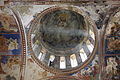 Gelati monastery, church of Virgin Mary the Blessed. Mural of Christ Pantokrator on ceiling of the central dome (12th century)
 -

-
 Gelati monastery, Church of Virgin the Blessed. Mural on north wall. From left to right: Queen Rusudan, Prince Bagrat, King George II, Queen Helen, King Bagrat III of Imereti, Catholicos Yevdemon Chetidze, David the Builder
 -
 Gelati monastery. Church of Virgin the Blessed. Mural.
 -
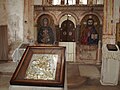
 Shrine in the monastery church
 -
 Gelati Monastery
 -
 Gelati Monastery
 -
 Gelati Monastery
 -
 Gelati Monastery
 -
 Gelati Monastery
 -
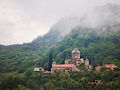 Gelati Monastery
 -
 St. George church
 -
 St. Nicholas church
 -
 Belfry
 -
 Cathedral of the Nativity of the Virgin
 -
 Portal in the cathedral
 -
 Frescoes in the cathedral
 -
 Frescoes in the cathedral
 -
 Gelati Monastery

.jpg)


.jpg)


.PNG)

.jpg)
.jpg)


.jpg)
.jpg)
.jpg)
.jpg)
.jpg)
.jpg)
.jpg)

See also
[edit]References
[edit]- ^ Europe and North America, UNESCO, 2021
- ^ Kaufhold, Hubert (2011). "Gelati Monastery". Religion Past and Present. doi:10.1163/1877-5888_rpp_SIM_08287.
- ^ a b c "Gelati Monastery, Georgia, removed from UNESCO's List of World Heritage in Danger". UNESCO World Heritage Centre. Retrieved 2025-06-01.
- ^ Calma, Dragos (2020). Reading Proclus and the Book of Causes, Volume 2. Dublin: University College Dublin.
- ^ "World Heritage Site". 1997–2020.
- ^ McClymond, Michael (2015). "Christianity". Worldmark Encyclopedia of Religious Practices. 1: 119–168.
- ^ a b c d e "Gelati Monastery". UNESCO. Retrieved 2025-06-01.
- ^ Reinis Fischer. (2015). Gelati Monastery in Georgia. [online] Available at: https://www.reinisfischer.com/gelati-monastery-georgia
- ^ Chatzidakis, Nano. Byzantine Mosaics, Volume 7. Athens, Greece: Ekdotike Athenon, 1994, p.22
- ^ Dzhindzhikhashvili, Zoia (1996). Encyclopedia of World Cultures, vol. 6: Russia and Eurasia/China. NY: Macmillan Reference USA.
- ^ Eastmond, Antony (2001), Eastern approaches to Byzantium: papers from the Thirty-third Spring Symposium of Byzantine Studies, University of Warwick, Coventry, March 1999, pp. 216-217. Ashgate/Variorum, ISBN 0-7546-0322-9, ISBN 978-0-7546-0322-1
- ^ Most, W.G (2003). "Canon, Biblical". New Catholic Encyclopedia. 3: 20–34.
- ^ Riggs, Thomas (2015). Worldmark Encyclopedia of Religious Practices. 2nd ed., vol. 2: Countries, Afghanistan to Ghana. Farmington Hills: Gale.
- Attribution
- Adapted from the Wikinfo article Gelati Monastery by Levan Urushadze, licensed under the GNU Free Documentation License.
Further reading
[edit]- Chichinadze, Nina. "Some Compositional Characteristics of Georgian Triptychs of the Thirteenth Through Fifteenth Centuries". Gesta, vol. 35, no. 1, 1996, pp. 66–76. doi:10.2307/767227. JSTOR 767227.
- Derlemenko I︠E︡vhen Anatoliĭovych, and Gigilashvili Ėduard. Gelati : Arkhitektura, Mozaika, Freski (Fotoalʹbom]=Gelati : Architecture, Mosaic, Frescoes. Tbilisi, Khelovneba, 1982.
- Hubert Kaufhold, Brill. Georgian Monasteries.
- Mepʻisašvili, R. Gelati. "Sabčotʻa Sakʻartʻvelo", 1965.
External links
[edit]
- Gelati Monastery—UNESCO World Heritage Centre
- Byzantine Art at Le site sur l'Art Roman en Bourgogne
|  | |
| International | |
|---|---|
| National | |
| Other | |

Gelati Monastery
View on GrokipediaIntroduction and Location
Overview
The Gelati Monastery is a medieval Georgian Orthodox monastery complex located near the city of Kutaisi in western Georgia, on a wooded hill above the Tskaltsitela River in the lower southern slopes of the Northern Caucasus mountains.[1] Founded in 1106 by King David IV, known as "the Builder," during the height of Georgia's Golden Age—a period of political consolidation and cultural flourishing—the monastery served as a royal foundation and became a pivotal center for religious, educational, and artistic activities.[1][7] King David intended it as his burial place, reflecting its status as a symbol of national revival following victories over invading forces, and it quickly amassed vast lands, treasures, and a renowned scriptorium for manuscript production.[7][3] Architecturally, the monastery exemplifies the cross-in-square church design prevalent in medieval Georgian architecture, with the main Church of the Nativity of the Virgin constructed between 1106 and 1130 using smoothly hewn stone blocks, balanced proportions, and decorative blind arches.[1] Later additions include the 12th-century Academy, 13th-century churches dedicated to St. George and St. Nicholas, a bell tower, and an eastern porch from the early 14th century, creating a cohesive ensemble that highlights the era's mastery of form and ornamentation.[7] The site's artistic heritage is particularly notable for its rare 12th-century mosaic of the Virgin and Child in the main church—one of the finest examples of Byzantine-influenced mosaics in the region—and extensive fresco cycles spanning the 12th to 17th centuries, including over 40 royal portraits that underscore its ties to the Bagrationi dynasty.[1] These elements position Gelati as an unparalleled repository of medieval Georgian cultural expression.[7] Historically, Gelati functioned as an intellectual hub, often dubbed "a second Jerusalem" and "another Athens" for blending ecclesiastical and secular learning; its Academy attracted scholars such as the philosopher Johannes Petritzi and fostered theological and scientific advancements until its decline in the late Middle Ages.[1][7] As a royal necropolis for Bagrationi and Imeretian rulers, it symbolized Georgia's medieval sovereignty and Orthodox identity.[7] Inscribed on the UNESCO World Heritage List in 1994 under criterion (iv) for its outstanding representation of the Golden Age's architectural achievements, the site faced conservation challenges, including structural damage and environmental threats, leading to its temporary inclusion on the List of World Heritage in Danger from 2010 to 2017; ongoing efforts, including temporary roofing in 2024 and wall painting conservation as of late 2024, have helped stabilize its integrity.[1][3][4][5]Geographical Setting
The Gelati Monastery is situated in the Imereti region of western Georgia, approximately 11 kilometers northeast of Kutaisi, the regional capital.[1] This location places it within the historical heartland of medieval Georgian kingdoms, amid the undulating foothills of the Greater Caucasus mountain range.[1] The monastery occupies a wooded hillside at an elevation of around 250 meters above sea level, overlooking the valley of the Tskaltsitela River, a tributary of the Rioni River system.[1][8] The terrain features gentle slopes rising from the river canyon below, providing a naturally fortified and scenic perch that integrates the complex into its forested surroundings. Dense deciduous and coniferous woods envelop the site, contributing to a humid microclimate that has influenced the preservation of its structures over centuries.[1][9] The broader geographical context includes a buffer zone encompassing the Tskaltsitela River valley and adjacent canyons, which safeguards the monastery's visual and ecological integrity from urban encroachment.[1] Proximity to the Caucasus Mountains to the north enhances the site's dramatic landscape, with panoramic views extending toward the Colchis Lowland plains in the west, underscoring Gelati's role as a harmonious blend of human architecture and natural topography.[1]Architecture and Layout
Main Church and Structures
The main church of the Gelati Monastery, dedicated to the Nativity of the Virgin Mary, stands as the central structure of the complex, founded in 1106 by King David IV and consecrated in 1130 under his successor, King Demetrius I.[1][10] This edifice exemplifies the cross-in-square architectural plan prevalent in East Christian church design, featuring an inscribed cross layout with three projecting apses, a central dome supported by four piers, and a narthex at the western entrance.[1][10] Constructed from smoothly hewn large stone blocks, its exterior is adorned with blind arches that enhance rhythmic proportions, while the interior preserves a rare 12th-century mosaic in the apse depicting the Virgin and Child flanked by archangels—a work comparable to Byzantine artistry and restored in the 1970s and 1980s.[1][11] Wall paintings from the 12th to 17th centuries adorn the interiors.[1][11] Within the church, integrated chapels honor St. Andrew the First-Called, the Saviour, and St. Marina (two instances), underscoring its role as a royal pantheon and spiritual hub. Adjacent to the main church, the 13th-century Church of St. George, a domed structure built to the east, served as a prayer and burial chapel for queens, featuring murals from the 16th century added after renovations following 1510 damage.[10][11] To the west lies the late 13th-century Church of St. Nicholas, a distinctive two-storeyed gate-church (measuring approximately 6.5m by 5m) with a croix-libre plan, niche-like concavities, and an arched passage evoking the Anastasis rotunda of the Holy Sepulchre, symbolizing a bridge between the main church and the adjacent academy.[11][12] The complex is further defined by a late 13th-century bell tower near St. Nicholas—one of Georgia's oldest surviving examples—and enclosing stone walls, with the southern gate incorporating King David IV's tomb and a 1062 iron door captured as a trophy in 1139.[10][11] These elements, erected during Georgia's Golden Age, collectively embody the monastery's foundational vision as a "second Jerusalem" and dynastic necropolis.[12]Academy and Environs
The Gelati Academy, established in 1106 by King David IV (r. 1089–1125) alongside the monastery, served as a premier center of higher education and intellectual activity in medieval Georgia during the Golden Age (11th–13th centuries).[1] It functioned as a scriptorium and scholarly hub, where King David IV assembled prominent thinkers, including the Neo-Platonic philosopher Johannes Petritzi, renowned for translating Proclus's works into Georgian, and the theologian Arsen Ikaltoeli, who contributed to religious literature translations.[1] The curriculum encompassed geometry, arithmetic, music, philosophy, rhetoric, and astronomy, fostering advancements in Georgian literature, sciences, and theology.[11] Often dubbed a "second Athens" for its emphasis on divine law and learning, the academy hosted ecclesiastic councils under David IV to affirm Georgian Orthodox orthodoxy against heresies.[11] Its influence extended across Eastern Christianity, producing illuminated manuscripts such as a 12th-century Gospel, though it declined in the late Middle Ages and was repurposed as a refectory while the monastery continued operating.[1][3] The academy's environs form an integral part of the monastery's UNESCO World Heritage designation, emphasizing the site's harmonious integration with its natural landscape. Situated on a wooded hill overlooking the Tskaltsitela River in western Georgia, near Kutaisi on the southern slopes of the Northern Caucasus mountains, the complex benefits from an intact buffer zone that preserves its seclusion and scenic isolation.[1] The monastic layout includes the main Church of the Nativity of the Virgin (completed 1130), the smaller Church of St. George, the Church of St. Nicholas, a bell tower, and remnants of a surrounding defensive wall with a south gate housing David IV's tomb.[11][3] This fortified enclosure, amid forested terrain and river valleys, not only provided strategic protection but also symbolized the spiritual and cultural elevation of Gelati as a "second Jerusalem."[11] Recent conservation initiatives, including 2024 wall painting treatments and a 2023-2025 management plan, address ongoing challenges such as water infiltration and biological agents to support preservation amid active religious use.[13][5][14]Historical Development
Foundation and Early Construction
The Gelati Monastery was founded in 1106 by King David IV, known as David the Builder, during the height of Georgia's Golden Age, a period marked by political unification, military victories, and cultural flourishing, including the defeat of the Seljuk Turks at the Battle of Didgori in 1121.[1] David IV selected a strategic location on a wooded hill above the Tskaltsitela River near Kutaisi, the then-capital, to establish not only a religious site but also an intellectual center, reflecting his vision for a unified Christian kingdom.[7] The founding was documented in the contemporary chronicle Vitae of King of Kings David, which describes the site as divinely chosen and the church as "like another heaven," emphasizing its role in attracting scholars and relics from across the Christian world.[12] Construction of the main church, dedicated to the Nativity of the Virgin, began immediately in 1106 under David's direct patronage and architectural oversight, incorporating Byzantine influences adapted to Georgian traditions.[1] The structure featured a cross-in-square plan typical of medieval Georgian architecture, with a central dome symbolizing the heavens, and was built using local limestone for durability against the region's seismic activity.[3] Although David IV did not live to see its completion—he died in 1125—the project advanced under his son and successor, Demetrius I, who consecrated the church in 1130, marking the monastery's early operational phase as a royal pantheon and educational hub.[7] Parallel to the church, the Gelati Academy was established in 1106 as one of medieval Europe's pioneering higher education institutions, focusing on theology, philosophy, and sciences, with monks and invited scholars from Antioch and Constantinople contributing to its intellectual foundations.[3] Early auxiliary structures, including a spring shelter and the southern gate, were completed during this initial phase, integrating monastic life with scholarly pursuits and underscoring the monastery's dual religious and cultural purpose from inception.[12]Medieval Expansion and Influence
During the medieval period, particularly in the 12th and 13th centuries, the Gelati Monastery underwent significant expansion under the patronage of Georgia's Bagratid rulers, transforming it into a premier ecclesiastical and cultural complex. Founded in 1106 by King David IV (r. 1089–1125) as part of the Georgian Golden Age—a era of political consolidation and cultural flourishing—the monastery's core structure, the Church of the Nativity of the Virgin, was completed by around 1130 during the reign of David's son, Demetre I (r. 1125–1156).[1] Further expansions in the 13th century included the addition of the Churches of St. George and St. Nicholas, along with a bell tower, while an eastern porch to the adjacent academy was constructed in the early 14th century, enhancing the site's multifunctional layout that encompassed monastic cells, a hospice, and educational facilities.[7] These developments reflected the Bagratid kingdom's growing resources and ambition, with the monastery serving as a repository for royal war spoils, such as the necklace from the Battle of Didgori (1121) and the gates of Ganja captured by Demetre I, symbolizing military triumphs and sovereignty.[15] The monastery's influence extended profoundly into Georgia's intellectual and religious spheres, establishing it as a vital center of learning and Orthodox Christianity. The Gelati Academy, founded concurrently with the monastery in 1106, attracted scholars like the Neo-Platonic philosopher Johannes Petritzi and the translator-monk Arsen Iqaltoeli, who bridged Byzantine theological traditions with Georgian scholarship through translations of Greek texts on philosophy, rhetoric, and astronomy.[1] Dubbed a "second Jerusalem" and "new Athens" by contemporaries, the academy and its scriptorium produced illuminated manuscripts, including a 12th-century Gospel (Q-908), fostering a synthesis of Eastern Christian art and learning that influenced regional monastic traditions.[7] Politically, Gelati bolstered Bagratid legitimacy, as seen in Queen Tamar's (r. 1184–1213) 1193 charter granting lands and privileges, and in frescoes portraying David IV as a "new Constantine" alongside imperial figures, drawing on Byzantine models to propagate royal ideology and ecclesiastical reforms.[15] As a royal necropolis—per David IV's will—and holder of extensive estates, Gelati wielded considerable socio-economic power, embodying the Golden Age's zenith until the Mongol invasions of the 13th century curtailed further growth.[1] Its Byzantine-inspired architecture and murals, depicting ecumenical councils and over 40 portraits of rulers and clerics, not only preserved Orthodox doctrine but also projected Georgia's cultural prestige across the Caucasus, with ties to Constantinopolitan centers via Georgian monks educated in the empire.[15] This influence persisted through the production of theological works and the monastery's role in church councils, solidifying its status as a cornerstone of medieval Georgian identity.[7]Decline and Modern Revival
Following the Golden Age of medieval Georgia, the Gelati Monastery entered a prolonged period of decline beginning in the 13th century with the Mongol invasions, which contributed to the broader political and economic fragmentation of the kingdom, followed by Timur's invasions in the late 14th century that further damaged the site.[10] Subsequent Ottoman and Persian incursions in the 16th to 18th centuries exacerbated the decay, with Turkish forces looting and setting the complex ablaze in 1510, leading to significant structural damage and loss of artifacts.[16][17] By the 19th century, after Georgia's annexation by the Russian Empire, the monastery lost much of its autonomy, transitioning from a church seminary to a state institution and further diminishing its religious and educational roles.[16] The most severe interruption occurred during the Soviet era, when the monastery was closed from 1923 to 1988, halting monastic life entirely as part of the broader suppression of religious institutions in the USSR.[10] Valuable icons and applied art objects were seized and redistributed to museums, stripping the site of key cultural treasures, though it retained protected status as a Monument of National Significance.[18][1] Post-Soviet revival began in 1988 with the monastery's reopening as a functioning religious center, aligning with Georgia's broader resurgence of Orthodox Christianity after decades of state atheism.[10] Monastic activities resumed in the 1990s, and the site was inscribed on the UNESCO World Heritage List in 1994, recognizing its architectural and cultural significance from the medieval period.[1] Conservation efforts intensified in the late 20th century, including initial measurements and studies in 1952–1954, followed by a major re-roofing of the Academy building in 2009 using reversible materials to protect frescoes.[19][1] A comprehensive Management Plan for 2017–2021 addressed structural stability, visitor management, and community involvement, leading to the site's removal from UNESCO's List of World Heritage in Danger in 2017 after earlier concerns tied to regional reconstruction projects.[20] However, modern restoration has faced challenges, including water damage to murals from 2015–2019 roofing works and ongoing debates over conservation expertise as recently as 2023–2024. In 2024, temporary roofing works on the main church were completed to mitigate water damage to the murals.[21][22][4]Artistic Heritage
Mosaics and Frescoes
The Gelati Monastery's artistic heritage is epitomized by its mosaics and frescoes, which blend Byzantine influences with Georgian innovations, dating primarily from the 12th to 17th centuries.[23][3] The most renowned mosaic adorns the apse of the main Church of the Nativity of the Virgin, depicting the Virgin Nikopeia (the "Bringer of Victory") holding the Christ Child, flanked by archangels Michael and Gabriel against a shimmering gold background.[10][23] Crafted with gold, silver, and polychrome tesserae, this work exemplifies the monastery’s role as a center of medieval art, evoking a "heavenly Jerusalem" through its luminous quality and theological symbolism.[12][10] Created between 1125 and 1130 during the reign of King David IV's successors, the mosaic measures approximately 4 meters in height and integrates seamlessly with the church's architecture, crowning the altar as a focal point for liturgy.[23][10] Its style draws direct parallels to imperial Byzantine mosaics, such as those in Constantinople's Hagia Sophia, yet incorporates local Georgian elements in the figures' expressions and proportions, highlighting the cultural synthesis of the Georgian Golden Age.[10] Restorations occurred in the 16th and 19th centuries, with major conservation from 1984 to 1990 addressing lacunae and overpainting, though ongoing challenges like water infiltration persist.[23][24] Complementing the mosaic, the monastery's frescoes span multiple eras and spaces, illustrating biblical narratives, saints, and historical figures. In the narthex, 12th- to 14th-century wall paintings depict scenes from the life of Christ and the Virgin, though they now exhibit pink discoloration from microclimate shifts.[3] A 16th-century fresco in the main church portrays the Heavenly Jerusalem, reinforcing Gelati's epithet as a "second Jerusalem."[12] The north-west chapel features elaborate 17th-century murals (1637–1657), commissioned under Catholicos Zakaria Kvariani, organized in three registers: prophets on the vault, upper walls showing the Annunciation and Nativity, and a lower tier with saints and archangels, including a unique "Amnos" composition of the Infant Jesus on an altar beside St. Nicholas.[25] These include the patron's portrait, blending iconography from Eastern Orthodox traditions to affirm doctrinal continuity amid regional turmoil.[25] Overall, these artworks underscore Gelati's status as a pinnacle of medieval Christian art, with mosaics and frescoes serving both devotional and educational purposes in the monastery's academy.[10][3] Their preservation, threatened by environmental degradation and structural issues, has prompted international efforts, including UNESCO monitoring since 1994, to safeguard this irreplaceable ensemble.[3][24]Triptychs and Sculpture
The Gelati Monastery is renowned for its association with the Khakhuli Triptych, a monumental repoussé icon of the Theotokos (Virgin Mary) that exemplifies medieval Georgian metalwork and religious art. Originally from the Khakhuli Monastery, the triptych was transferred to Gelati in 1106 by King David IV the Builder, enhancing the site's status as a royal Bagrationi mausoleum and spiritual center. The central panel features a 10th-century cloisonné enamel image of the supplicating Virgin Orans, surrounded by over 115 smaller enamels depicting Christ, apostles, saints, and Byzantine imperial figures such as Emperor Michael VII Doukas. The wings, crafted in the early 12th century from gilt silver and gold repoussé, were commissioned by King Demetre I specifically for installation near the sanctuary at Gelati, adorned with vine-scroll motifs symbolizing Paradise and inlaid with precious stones. Measuring approximately 1.5 meters high and 2 meters wide when open, the triptych served as a portable altar and processional icon, reflecting Byzantine influences adapted to Georgian Orthodox traditions. It remained enshrined at Gelati until its theft in 1859, after which it was recovered and is now preserved in the Georgian National Museum in Tbilisi.[26] While no other complete triptychs are documented as originating from Gelati, the monastery's treasury historically housed related icons and metal artifacts that complemented such works, underscoring its role in preserving high-status religious objects. The Khakhuli Triptych's intricate enameling and goldwork highlight the technical mastery of Georgian artisans during the Bagratid Golden Age, with its narrative scenes and symbolic ornamentation serving devotional and liturgical purposes.[1] Sculptural elements at Gelati primarily manifest in architectural reliefs and metalworks, blending Byzantine and local Georgian styles to adorn the monastery's structures. The facades of the main Cathedral of the Nativity feature detailed stone carvings, including ornamental motifs, crosses, and figurative scenes executed in low relief on the smoothly hewn limestone blocks. These include blind arches and decorative panels on the porticos, with the southern and northern wings preserving historical stone reliefs that depict geometric patterns and Christian symbols, contributing to the ensemble's balanced proportions and exterior harmony. Entrance portals, such as that of the Cathedral of the Nativity, showcase intricate carvings of floral and vine motifs, animals, and saintly figures, exemplifying 12th-century masonry techniques that integrated sculpture with architecture.[27][28][29] A standout example of Gelati's sculptural heritage is the Gelati Tondo, a rare gilded silver bas-relief medallion depicting Saint Mamas (also known as Mamai) riding a lion, a motif unique to Georgian iconography symbolizing the saint's triumph over evil. Dating to the 14th-15th centuries, this circular piece (diameter approximately 20 cm) represents an early pinnacle of Georgian metal sculpture, marking the emergence of a distinct school of bas-relief work in the region. Crafted with repoussé techniques and gilding, it was likely used as a liturgical object or donor's gift within the monastery, now housed in the Georgian National Museum.[30] Such metal sculptures, alongside the stone reliefs, illustrate Gelati's contribution to the evolution of three-dimensional religious art in medieval Georgia, prioritizing symbolic depth over naturalistic form.Religious and Cultural Role
Burials and Memorials
The Gelati Monastery, established as a royal necropolis by its founder King David IV (known as David the Builder), served as the primary burial site for members of the Bagrationi dynasty and later Imeretian rulers, underscoring its central role in Georgian royal and religious history during the medieval period.[9] David's will explicitly designated the monastery as his resting place and a crypt for his descendants, transforming it into a dynastic vault that symbolized the unity and piety of Georgia's Golden Age.[9] The most prominent burial is that of King David IV himself (r. 1089–1125), located at the southern gate of the monastery complex, often referred to as King David the Builder's Gate. His tombstone bears an inscription in Georgian: "This is my resting place forever: here will I dwell for I desired so," reflecting his deep personal attachment to the site he founded in 1106. Canonized by the Georgian Orthodox Church, David's grave draws pilgrims and tourists, highlighting the monastery's enduring spiritual significance.[9] Another notable interment is that of King David VI Narin (r. 1245–1293), buried in the Chapel of St. Andrew within the monastery grounds, though the precise location of his grave remains identified amid the chapel's historical layers. The main church and surrounding chapels also house the tombs of numerous other Georgian monarchs, including Demetrius I (r. 1125–1156), George III (r. 1156–1184), Queen Tamar (r. 1184–1213), George IV (r. 1213–1223), Queen Rusudan (r. 1223–1245), Vakhtang II (r. 1288–1295), David IX (r. 1346–1360), and Bagrat VI (r. 1466–1478), as well as Imeretian kings such as Rostom I (r. 1633–1648), George III (r. 1703–1712), Alexander III (r. 1716), George VI (r. 1720–1726), Solomon I (r. 1752–1784), and Solomon II (r. 1784–1810). However, due to centuries of invasions, reconstructions, and natural decay, the exact positions of most of these royal graves have been lost, with only fragmentary archaeological evidence surviving to confirm their presence.[9] These burials not only preserved the physical remains of Georgia's rulers but also reinforced the monastery's status as a sacred space intertwined with national identity, where memorials to the Bagrationi lineage evoked themes of divine kingship and historical continuity. Ongoing conservation efforts prioritize the protection of these sites to prevent further erosion from environmental factors and tourism.[9]Educational and Intellectual Center
The Gelati Monastery served as a pivotal educational and intellectual hub in medieval Georgia, particularly through the Gelati Academy established in 1106 by King David IV (David the Builder) adjacent to the monastery complex. This institution emerged during Georgia's Golden Age (11th–13th centuries), functioning as one of the most significant centers of learning in the Christian East, often likened to a "second Athens" for its scholarly pursuits and a "second Jerusalem" for its theological depth. The academy attracted eminent theologians, philosophers, and scholars from across Georgia and beyond, fostering a synthesis of Byzantine, classical, and local intellectual traditions that elevated the monastery's role beyond mere religious observance.[1][31] The curriculum at the Gelati Academy encompassed a broad spectrum of disciplines, integrating the classical trivium (grammar, rhetoric, and logic) with elements of the quadrivium (arithmetic, geometry, music, and astronomy), alongside advanced studies in philosophy, theology, and rhetoric. This educational framework emphasized both secular and sacred knowledge, drawing on Aristotelian and Neoplatonic sources to train monks and lay scholars in scriptural exegesis, dogmatic theology, and philosophical inquiry. The monastery's scriptorium played a crucial role in this endeavor, producing illuminated manuscripts and theological treatises that preserved and disseminated Georgian intellectual heritage, including a notable 12th-century Gospel now held in the National Centre of Manuscripts in Tbilisi. Such activities underscored Gelati's contributions to the broader Orthodox world, influencing ecclesiastical thought and cultural exchange in the Caucasus region.[1][31][7] Prominent scholars associated with the academy included Ioane Petritsi, a Neoplatonic philosopher who translated and commented on Proclus's Elements of Theology, establishing a systematic philosophy curriculum that bridged classical pagan thought with Christian doctrine. Petritsi's work introduced Neoplatonic concepts of eros and divine hierarchy to Georgian theology, impacting later figures like the poet Shota Rustaveli. Another key contributor was Arsen of Ikalto (Arsen Ikaltoeli), a monk who compiled the Dogmatikon, a comprehensive theological compendium influenced by Aristotelianism, which synthesized patristic writings and defended Orthodox dogma against contemporary challenges. These scholars' efforts not only enriched Georgian literature and philosophy but also positioned Gelati as a beacon of intellectual revival, with its legacy enduring through preserved manuscripts and its recognition as a UNESCO World Heritage site.[1][32][33]Conservation and Management
Past Preservation Efforts
In the 19th century, preservation efforts at Gelati Monastery focused on restoring peripheral buildings, including work overseen by Bishop Gabriel Kikodze, which addressed structural decay in auxiliary structures around the main churches.[34] These interventions laid early groundwork for maintaining the site's architectural integrity amid Ottoman and Russian imperial influences that had previously caused damage.[16] During the Soviet era, the monastery faced significant challenges after its closure in 1923 under Bolshevik rule, remaining shuttered until 1988 and leading to periods of neglect that accelerated deterioration of frescoes and masonry.[35] Despite this, targeted restorations occurred, such as the installation of tin roofs on secular and peripheral buildings to protect against weathering, and the conservation of the apse mosaic in the Church of the Virgin during the 1980s, which stabilized key artistic elements.[34] These efforts, though limited by the era's ideological constraints on religious sites, prevented total collapse and preserved much of the 12th-century fabric.[36] Following Georgia's independence and Gelati's inscription as a UNESCO World Heritage Site in 1994, systematic preservation intensified with international support. In 2003, a diagnostic study of the 12th- to 18th-century frescoes in the Church of the Virgin identified issues like fungal growth and salt accumulation, informing subsequent interventions funded by the U.S. Ambassadors Fund for Cultural Preservation.[37] By 2008, a major rehabilitation project began, including cleaning and roofing the upper gate of King David IV's tomb, replacement of Soviet-era tin roofs with traditional red clay tiles on peripheral structures, and archaeological work uncovering historical features like glazed tile roofing and ancient corridors at the Gelati Academy site.[34] The 2010s saw focused conservation of artistic heritage, with the 2012 stabilization of 15th-16th-century frescoes in St. Marine Chapel involving plaster consolidation and salt removal to halt delamination.[37] In 2013, architectural rehabilitation of the Church of the Virgin included a $600,000 project for ceramic tile roofing, stone cleaning, cornice conservation, window glazing, and vegetation control, enhancing overall site management.[37] Subsequent efforts in 2014 conserved mosaics in the dome and drum of the same church, incorporating bird-proofing measures, while 2016 addressed stone conservation across 615 m² of chapels and the narthex to mitigate masonry threats to interiors.[37] These projects, often guided by UNESCO reactive monitoring missions starting in 2012, emphasized reversible techniques and authenticity preservation, averting further loss from seismic activity and environmental exposure.[38] However, the 2016-2019 reconstructions have been criticized for poor quality leading to water damage and fresco deterioration, sparking debates between the Georgian Orthodox Church and the Ministry of Culture over standards and responsibility.[39]Contemporary Restoration Initiatives
In response to urgent threats to the Gelati Monastery's structural integrity and artistic heritage, the Georgian government established the Gelati Rehabilitation Committee in 2023, comprising the National Scientific Council of local experts and an International Advisory Board of global specialists, to oversee comprehensive conservation efforts in line with UNESCO World Heritage guidelines.[6][40] This initiative followed a 2024 joint World Heritage Centre/ICOMOS/ICCROM reactive monitoring mission, which recommended immediate protective measures, including temporary roofing and detailed conservation programs for wall paintings and mosaics.[41] The committee's work is guided by UNESCO's 47 COM 7B.106 decision, emphasizing scientific research, non-invasive interventions, and long-term management planning to preserve the site's 12th-century Byzantine-influenced features.[40] Ongoing controversies include concerns over transparency in funding allocation and reporting, as well as coordination between state agencies and the Church.[22] A flagship project has been the installation of integrated temporary roofing over the main cathedral, including its dome and arms, to prevent further water infiltration that had damaged frescoes since a 2022 storm. Initiated in April 2024 with foundation works and executed by German firms Quadrex and Layer, the roofing was fully completed by mid-2025, as announced by Georgia's Ministry of Culture, enhancing the monument's protection while allowing for ongoing assessments.[42][43][4] This measure addressed vulnerabilities exposed by prior 2016-2019 reconstructions and supports subsequent phases like geotechnical investigations conducted in 2025.[44][22] Parallel efforts focus on the wall paintings and mosaics, with conservation beginning in March 2023 through emergency interventions on 21 critical areas in the Church of the Nativity of the Virgin Mary. Led by British conservators Lisa Shekede and Stephen Rickerby since September 2023, the program involves stabilization, consolidation of plaster layers, salt crystallization monitoring, and development of treatment methodologies based on non-invasive analyses.[45][5] Work resumed in Spring 2025 after a winter pause, incorporating contributions from experts like Professor Steffen Laue on environmental factors.[5] For the mosaics, Italian specialist Roberto Nardi initiated a preventive conservation program in 2023, with staged implementation—including Eastern Apse treatments in November 2024—projected to conclude by late 2025 under Patriarchate oversight.[46][47] A November 2025 international working mission confirmed the mosaic conservation is proceeding in stages and on track to conclude by the end of 2025.[48] The committee presented a comprehensive 2023-2025 report in June 2025, detailing these advances alongside an updated site management plan, underscoring international collaboration with UNESCO and funding from the Georgian state totaling over 8.5 million GEL.[49][22] UNESCO's 2025 State of Conservation report commended the significant efforts and financial investments, noting the updated management plan includes new monitoring indicators for the site's attributes.[50]References
- https://commons.wikimedia.org/wiki/File:St_Mamas_tondo,_Georgia.JPG