Hubbry Logo
Gilberto FreyreGilberto FreyreMain
Open search
Gilberto Freyre
Community hub
Gilberto Freyre
logo
8 pages, 0 posts
0 subscribers
Be the first to start a discussion here.
Contribute something
Gilberto Freyre
Gilberto Freyre
from Wikipedia

Key Information

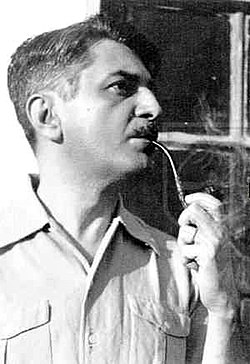
Gilberto de Mello Freyre (March 15, 1900 – July 18, 1987) was a Brazilian sociologist, anthropologist, historian, writer, painter, journalist and congressman born in Recife. Considered one of the most important sociologists of the 20th century, his best-known work is a sociological treatise named Casa-Grande & Senzala (literally, "The main house and the slave quarters", usually translated into English as The Masters and the Slaves).

Life and work

[edit]

Freyre had an internationalist academic career, having studied at Baylor University, Texas from the age of eighteen and then at Columbia University, where he got his master's degree under the tutelage of William Shepperd.[1] At Columbia, Freyre was a student of the anthropologist Franz Boas.[2] After coming back to Recife in 1923, Freyre spearheaded a handful of writers in a Brazilian regionalist movement. After working extensively as a journalist, he was made head of cabinet of the Governor of the State of Pernambuco, Estácio Coimbra. With the 1930 revolution and the rise of Getúlio Vargas, both Coimbra and Freyre went into exile. Freyre went first to Portugal and then to the US, where he worked as visiting professor at Stanford.[3] By 1932, Freyre had returned to Brazil. In 1933, Freyre's best-known work, The Masters and the Slaves was published and was well received.[citation needed] In 1946, Freyre was elected to the federal Congress.[4] At various times, Freyre also served as director of the newspapers A Província and Diário de Pernambuco.[5]

In 1962, Freyre was awarded the Prêmio Machado de Assis by the Brazilian Academy of Letters, one of the most prestigious awards in the field of Brazilian literature.[6] That same year, he was elected to the American Philosophical Society.[7] Over the course of his long career, Freyre received numerous other awards, honorary degrees, and other honors both in Brazil and internationally. Examples include admission to L'ordre des Arts et Lettres (France), investiture as Grand Officier de La Légion d'Honneur (France), the Gran-Cruz of the Ordem do Infante Dom Henrique (Portugal), and honorary doctorates at Columbia University and the Sorbonne.[8]

Freyre's most widely known work is The Masters and the Slaves (1933). At the time, this was a revolutionary work for the study of races and cultures in Brazil. As Lucia Lippi Oliveira notes, "In the 1930s and 1940s, Freyre was praised as being the creator of a new, positive self-image of Brazil, one that overcame the racism present in authors like Sílvio Romero, Euclides da Cunha, and Oliveira Viana."[9] The book misrepresents slavery in Brazil as a mild form of servitude and has served to consolidate the Brazilian myth of racial democracy. Freyre’s romanticization of racial mixture and disavowal of his society’s racism is comparable to the approach of other Latin American eugenicists, such as Fernando Ortiz in Cuba (Contrapunteo Cubano de Tobacco y Azúcar, 1940), and José Vasconcelos in Mexico (La Raza Cosmica, 1926).[10][11] Since its publication and initial reception, this work has also been criticized for how its "focus on a single identity in modern Brazil resulted not only in factual inaccuracies and distortions of reality but also in a larger societal refusal to acknowledge racism in modern Brazil,"[12] for example.

The Masters and the Slaves is the first of a series of three books, which also included The Mansions and the Shanties: The Making of Modern Brazil (1938) and Order and Progress: Brazil from Monarchy to Republic (1957). The trilogy is generally considered a classic of modern cultural anthropology and social history. Other very important contributions of Freyre's were The Northeast (1937) and The English in Brazil (1948).

The actions of Freyre as a public intellectual are rather controversial. Labeled as a communist in the 1930s, he later moved to the political Right. He supported Portugal's Salazar government in the 1950s, and after 1964, defended the military dictatorship of Brazil's Humberto Castelo Branco. Freyre is considered to be the "father" of lusotropicalism: the theory whereby miscegenation had been a positive force in Brazil. "Miscegenation" at that time tended to be viewed in a negative way, as in the theories of Eugen Fischer and Charles Davenport.[13]

Freyre was acclaimed for his literary style.[citation needed] Of his poem "Bahia of all saints and of almost all sins," Brazilian poet Manuel Bandeira wrote: "Your poem, Gilberto, will be an eternal source of jealousy to me"(cf. Manuel Bandeira, Poesia e Prosa. Rio de Janeiro: Aguilar, 1958, v. II: Prose, p. 1398).[14] Freyre wrote this long poem inspired by his first visit to Salvador.[citation needed]

Freyre died on July 18, 1987, in Recife.

Selected bibliography

[edit]

See also

[edit]

References

[edit]

Bibliography

[edit]
[edit]
Revisions and contributorsEdit on WikipediaRead on Wikipedia
from Grokipedia
Gilberto Freyre (15 March 1900 – 18 July 1987) was a Brazilian sociologist, anthropologist, writer, and politician whose work focused on the formation of Brazilian society through the lens of colonial-era racial mixing, family structures, and cultural adaptations. Born in Recife, Pernambuco, he studied at Baylor University and Columbia University under Franz Boas before returning to Brazil in 1923. His breakthrough publication, Casa-Grande e Senzala (1933, translated as The Masters and the Slaves), empirically examined how Portuguese settlers, African slaves, and indigenous peoples intermingled in the Northeast's plantation economy, arguing that this hybridity—rather than rigid hierarchies—shaped Brazil's distinctive social fabric. Freyre extended these ideas in later volumes like Sobrados e Mucambos (1936, The Mansions and the Shanties) and Ordem e Progresso (1959, Order and Progress), developing the concept of Luso-tropicalism to describe Portuguese colonialism's relatively fluid approach to race and environment compared to Northern European models. Politically active, he opposed Getúlio Vargas's dictatorship, served in Brazil's Constituent Assembly in 1946, founded the Joaquim Nabuco Institute for Social Sciences, and later endorsed the 1964 military coup, influencing debates on national identity and development. While celebrated for pioneering regional sociology and challenging scientific racism through firsthand observations of miscegenation's prevalence, Freyre's interpretations faced criticism for portraying slavery too indulgently, relying on anecdotal rather than systematic methods, embedding patriarchal biases, and including statements affirming biological racial differences despite his anti-segregation stance. His framework, which informed Brazil's "racial democracy" mythos, has been revisited for underemphasizing persistent inequalities while accurately highlighting causal contrasts with U.S.-style dualism.

Early Life and Education

Family Background and Upbringing in

Gilberto de Mello Freyre was born on March 15, 1900, in , the capital of in Brazil's Northeast region, into a family of established urban professionals with deep roots in the colonial agrarian elite. His father, Alfredo Freyre, served as a and held a professorship in at the Law School, reflecting the family's transition from rural landownership to intellectual and judicial pursuits in the early . His mother, Francisca de Mello Freyre, came from lineages tied to 's sugar economy, with grandmothers who owned cane plantations, underscoring the Freyre clan's historical embedding in the patriarchal structures of the region's export-oriented agriculture. This background positioned Freyre within a middle-class urban milieu informed by aristocratic rural heritage, characterized by Catholic traditions and Portuguese settler origins dating to the colony's formative sugar boom. Freyre's upbringing blended the cosmopolitan influences of —a port city with a diverse population shaped by , African, and indigenous intermixtures—with periodic exposure to the countryside's plantation world. His family's recent shift from rural estates to the city did not sever ties to the engenhos (sugar mills), where Freyre encountered the intimate dynamics of the casa-grande (big house) and senzala (slave quarters), elements central to his later sociological analyses. Raised in a household emphasizing intellectual rigor—evident in his father's academic role—Freyre developed an early fascination with regional history and social customs, drawing from familial anecdotes and observations of Pernambuco's hierarchical, racially fluid society. This environment, marked by the legacy of slavery's abolition in and the persistence of planter dominance, fostered his critique of Eurocentric models in favor of Brazil-specific cultural formations grounded in empirical family and regional experience. The Freyres' status as descendants of Pernambuco's senhorial aristocracy provided Freyre with privileged access to libraries, , and oral traditions that informed his worldview, while the Northeast's economic decline post-abolition highlighted contrasts between opulent heritage and modern challenges. Unlike purely urban elites, his upbringing retained a visceral connection to agrarian , where family authority mirrored broader societal patterns of and adaptation through miscegenation, unfiltered by later ideological overlays. This formative context in , rather than abstract theory, seeded Freyre's emphasis on lived, causal interconnections in Brazilian identity formation.

Formal Education in Brazil and the United States

Freyre received his early formal education in , , enrolling in 1908 at the Colégio Americano Batista Gilreath, a Baptist institution where his father served as a teacher. There, he encountered English-language literature introduced by his father, Alfredo Freyre, and immersed himself in a Protestant environment that initially shaped his worldview before later influences led to a shift. He graduated from the college around 1917 as the class orator, having completed secondary studies equivalent to a bacharelado em letras. At age 18 in 1918, Freyre departed for the to pursue undergraduate studies at in , a Baptist institution aligned with his early religious upbringing. He earned a B.A. there, focusing on subjects that bridged his Brazilian roots with American academic approaches to social sciences. In 1921, he transferred to in New York, where he completed a in and social sciences in 1923, emphasizing and under influences that redirected his intellectual trajectory away from strict toward empirical . This period in the U.S. exposed him to interdisciplinary methods, including those from , which informed his later critiques of rigid racial hierarchies through observations of American segregation contrasted with Brazilian miscegenation.

Intellectual Formation and Career

Key Influences from Sociology, Anthropology, and History

Freyre's intellectual development in , , and was profoundly shaped by his graduate studies at from 1922 to 1923, where he earned a in political science and social sciences. There, he encountered the anthropologist , whose emphasis on and rejection of in racial explanations influenced Freyre's shift toward viewing Brazilian miscegenation as a cultural strength rather than a source of inferiority. Boas's teachings, drawn from empirical fieldwork and environmental factors in human variation, provided Freyre with tools to analyze Brazil's patriarchal society through interdisciplinary lenses, integrating anthropological data with historical narratives. In history, Freyre drew from the Brazilian diplomat and historian Manuel de Oliveira Lima, who mentored him during his time in the United States and facilitated his access to Columbia through personal connections established around 1921. Oliveira Lima's works on Luso-Brazilian and regional identities in resonated with Freyre's upbringing, encouraging a focus on Brazil's colonial legacies and tropical adaptations over Eurocentric models. This influence complemented Freyre's earlier exposure at (B.A., 1920), where initial sociological readings began blending American progressivism with Brazilian regionalism. Sociologically, Freyre's approach echoed impressionistic methods akin to Georg Simmel's, prioritizing holistic synthesis of social forms over rigid quantification, though he adapted these to Brazil's agrarian structures informed by . His rejection of specialized silos—favoring instead the interplay of sociology's structural insights with anthropology's cultural and history's archival depth—stemmed from Boas's interdisciplinary seminars, enabling analyses of slavery's enduring social patterns without deterministic racial hierarchies. These influences culminated in Freyre's methodological innovation: grounding Brazilian exceptionalism in verifiable regional data, such as plantation records and ethnographic observations, rather than abstract theories.

Academic Positions and Early Writings

Upon returning to Brazil in 1924 after completing his at , Freyre eschewed traditional tenure-track academic roles, opting instead for intermittent teaching and public intellectual pursuits. From 1926 to 1930, he served as personal secretary and assistant to the governor of , Estácio de Lima Coimbra, a position that afforded him insight into regional administration while allowing time for writing. In 1929, concurrent with this governmental role, he was appointed professor of at the Normal School of , where he instructed future educators on adapted to Brazilian contexts. Freyre's early academic engagements emphasized practical, regionally oriented instruction over abstract theorizing. By 1935, he delivered a course on regional at the Law Faculty of , integrating anthropological observations from his travels with critiques of centralized Brazilian . These sporadic positions reflected his broader aversion to institutionalized academia, as he later refused multiple permanent appointments in and abroad, prioritizing independent research. Freyre's early writings laid empirical foundations for his later analyses of Brazilian society, drawing on archival data and personal observations. His 1922 master's thesis, "Social Life in Brazil in the Middle of the Nineteenth Century," published that year in the Hispanic American Historical Review, dissected patriarchal family structures, racial intermixtures, and economic dependencies in the Northeast, using primary sources like travelers' accounts and estate records to challenge Eurocentric models of social evolution. In 1926, amid his governmental duties, he penned the Manifesto Regionalista, an essay advocating the valorization of local customs, dialects, and agrarian traditions against São Paulo-led modernist , which he viewed as alienating from its organic cultural roots. These pieces, often serialized in regional journals, prefigured his holistic approach to , blending , , and economics to explain 's hybrid formations without recourse to deterministic racial hierarchies.

Major Works and Theoretical Innovations

The Masters and the Slaves (1933) and Its Core Arguments

The Masters and the Slaves, originally published in Portuguese as Casa-Grande & Senzala in 1933, represents Gilberto Freyre's foundational analysis of Brazilian colonial society, centering on the sugar plantation system as the cradle of national formation. Freyre portrayed the plantation not merely as an economic unit but as a patriarchal microcosm where the casa-grande (big house of the masters) and senzala (slave quarters) embodied intimate, hierarchical relations blending coercion, affection, and cultural exchange. This structure, he argued, engendered a distinctive Brazilian civilization through the fusion of Iberian, African, and indigenous elements, rejecting Eurocentric models of linear progress or racial purity. At the core of Freyre's lies the patriarchal as the primary social , adapting Portuguese feudal traditions to tropical conditions via a flexible, absorbent domestic economy. The master (senhor de engenho) functioned as a benevolent , extending authority over slaves in ways that blurred strict boundaries, fostering dependency and rather than outright alienation. Freyre emphasized how this integrated enslaved Africans not as mere labor but as participants in household rituals, , and child-rearing, with maternal figures from the senzala influencing white . Such dynamics, he contended, mitigated the dehumanizing effects of compared to Anglo-American models, attributing slaves' perceived traits—like docility or sensuality—to environmental and institutional conditioning rather than innate racial inferiority. Freyre's most influential argument advanced miscegenation as a constructive force in Brazilian identity, positing extensive interbreeding among settlers, African slaves (numbering over 4 million imported by 1850), and indigenous groups as yielding a resilient, hybrid populace. Unlike rigid systems elsewhere, this "" prototype celebrated colonizers' predisposition to mixture—rooted in their Mediterranean-Iberian heritage—as enabling harmonious synthesis, with Freyre claiming Brazil's approach to the "racial question" proved "smarter, more promising, and above all, more humane." He highlighted biological and cultural amalgamation, such as African-derived sensuality permeating family life and tolerance averting genocidal conflicts with natives. Environmental determinism further underpinned Freyre's framework, with tropical climates and agrarian rhythms shaping somatic and behavioral adaptations across races, diminishing biological . Slaves, for instance, developed resilience through dietary and sexual liberties absent in temperate-zone chattel systems, contributing to a syncretic evident in , , and . While Freyre's narrative romanticized these processes, it grounded Brazilian exceptionalism in empirical observations of archives and oral histories, influencing subsequent volumes on urban extensions of this rural .

Extensions in Subsequent Publications like The Mansions and the Shanties

"Sobrados e Mucambos" (translated as The Mansions and the Shanties: The Making of Modern ), published in , formed the second volume of Freyre's trilogy on Brazilian , extending the foundational arguments of Casa-Grande & Senzala (1933) by examining the transition from colonial rural to nineteenth-century urban society. Where the earlier work centered on the sugar plantation's casa-grande (big house) and senzala (slave quarters) as sites of intimate racial and cultural mixing under patriarchal dominance, Sobrados e Mucambos shifted focus to the decay of agrarian elites amid coffee economy expansion and abolition (), highlighting urban sobrados (elite townhouses) and mucambos (informal shanties) as new arenas of social hybridization. Freyre detailed how these spaces reflected evolving family dynamics, with patriarchal authority fragmenting into more nuclear bourgeois units influenced by European yet tempered by persistent Luso-Brazilian sensuality and miscegenation. Freyre's analysis in this extension emphasized continuity in Brazil's adaptive , portraying urban growth—from to Rio de Janeiro—as an organic outgrowth of colonial intimacy rather than a rupture, with , , and bodily practices serving as empirical markers of flux. He critiqued deterministic racial theories by illustrating how settlers' tolerance for intermixture enabled resilient social forms, contrasting this with Anglo-Saxon rigidity, and used from diaries, travelogues, and inventories to argue that urban and refinement coexisted in symbiotic tension, fostering national cohesion. This approach reinforced his broader thesis of Brazil's "" through environmental and relational factors, though Freyre expressed nostalgia for rural vitality amid urban "decadence," evidenced in his depictions of refined yet sterile interiors versus vibrant shanty . The trilogy's culmination in Ordem e Progresso (1959) further prolonged these extensions into the Republican era (post-1889), integrating positivist with Freyre's organicist view of hybrid traditions, where coffee barons and immigrant waves sustained patriarchal residues under modern governance. Across these works, Freyre amassed over 1,000 pages of interdisciplinary synthesis—drawing from , , and —to posit Brazil's as a tropical variant of Western progress, rooted in pre-modern intimacies rather than imported abstractions, a framework that influenced mid-century interpretations of despite later empirical challenges to its optimism.

Political Engagement and Public Role

Alignment with Getúlio Vargas and Conservative Politics

Freyre initially opposed the centralizing tendencies of 's 1930 Revolution, which overthrew the oligarchic regime in where he had served as secretary to Carlos Coimbra da Silva Campos; the upheaval led to Freyre's brief in and the before his return to in 1931. Despite this, his 1933 publication Casa-Grande & Senzala resonated with Vargas's nationalist agenda by portraying 's patriarchal system and racial mixture as foundational to a unique national character, providing intellectual ammunition against European models of racial purity or whitening policies. The regime under Estado Novo (1937–1945) selectively adopted Freyrean concepts of mestiçagem to forge a unified Brazilian identity, enshrinning them in cultural propaganda that emphasized organic social harmony over class conflict. Freyre's relationship with Vargas remained ambiguous: in 1937, he campaigned for opposition candidate José Américo de Almeida in the that Vargas preempted by declaring the Estado Novo , yet Freyre dedicated his book Nordeste to Vargas that same year, commending his attention to regional social issues. While never formally aligned with the regime's , Freyre contributed indirectly through cultural influence, as his regionalist emphasis on Brazil's tropical adaptations complemented Vargas's efforts to legitimize centralized rule via folkloric and anthropological narratives. Freyre's broader political outlook embodied , prioritizing the preservation of traditional Iberian-Catholic family structures, patriarchal hierarchies, and regional diversity against the disruptions of industrial modernization and ideological extremes like . He self-described his views variably as "non-party," "anarchist," or "," reflecting a rejection of rigid partisanship in favor of organic social evolution rooted in Brazil's historical formations. Elected as a federal deputy for the center-right National Democratic Union (UDN) in the mid-1950s, Freyre advocated for decentralized governance and warned against Marxist threats, later endorsing the 1964 military intervention as a bulwark against communist subversion. This stance positioned him against progressive universalism, favoring instead a contextual attuned to Brazil's hybrid cultural realities.

Congressional Service and Advocacy for Regionalism

Freyre was elected as a federal deputy for in Brazil's 1946 , serving from 1946 to 1950 under the banner of the National Democratic Union (UDN), a party opposing the centralizing tendencies of the prior Vargas regime. His capitalized on his prominence and regional ties, positioning him to represent Northeastern interests in the assembly tasked with drafting the 1946 Constitution. During this period, Freyre focused on legislative efforts to integrate into national policy, protesting policies that favored uniform centralization over regional diversity. In , Freyre advocated for recognition of Brazil's African cultural heritage in the Northeast, arguing against racial "whitening" programs reliant on European immigration and instead promoting targeted health and education initiatives for the poor to foster organic social development. This stance extended his pre-political regionalist framework, which critiqued metropolitan dominance and emphasized preserving local customs, , and economies like Pernambuco's plantations. He viewed excessive federal intervention as eroding regional vitality, a position that influenced debates on in the new . In 1949, Freyre represented as a delegate to the , where he further projected his cultural-regional perspectives internationally. Freyre's congressional tenure ended in 1950, after which he withdrew from active electoral politics, though his advocacy shaped subsequent discussions on balancing national cohesion with regional . His efforts underscored a conservative wary of modernization's homogenizing effects, prioritizing empirical appreciation of Brazil's variegated social formations over ideological uniformity.

Criticisms, Controversies, and Empirical Challenges

Romanticization of Plantation Society and

Freyre portrayed the Brazilian casa grande e senzala (big house and slave quarters) as a cohesive patriarchal unit where planters extended paternalistic care to slaves, treating them as dependents in a " of children" who were well-fed and medically attended, fostering mutual rather than the rigid antagonism of North American slavery. In The Masters and the Slaves (1933), he emphasized sexual intimacy and miscegenation between masters and enslaved women as evidence of organic racial fusion, arguing that Portuguese colonizers' "Iberian" sensuality mitigated the dehumanizing effects of bondage compared to Protestant rigor elsewhere. This framework idealized the as a cradle of Brazilian , downplaying systemic in favor of cultural . Critics, including historians Charles Boxer, have faulted Freyre's analysis for its selective, elite-centric sources—such as planter memoirs and European travelers' impressions—which provided limited insight into slaves' lived experiences of brutality, including routine corporal punishments and forced labor. Empirical archival research post-1933, drawing on plantation ledgers and ecclesiastical records, reveals sugar estates in and sustained high slave mortality rates—often 5-10% annually from , mill accidents, and disease—with infant death rates surpassing 50% and negligible natural , necessitating the importation of over 4 million Africans to by 1850 to replace losses. These data underscore exploitation over benevolence, as slaves comprised disposable capital in export-driven monocultures, with owners investing minimally in reproduction or welfare beyond basic sustenance to maximize output. Freyre's imputation of some slavery's pathologies to slaves' "African" traits or alleged complicity in their own sexual exploitation has drawn charges of victim-blaming, obscuring masters' absolute power and the era's documented resistances, such as the century-long Palmares quilombo (1600s) and urban revolts like the 1835 Malê uprising in Salvador, which involved thousands and highlighted organized defiance against the purported harmony. Later scholars like Stuart Schwartz, using quantitative demography from Bahian engenhos (mills), demonstrate that while limited provisioning and plot allotments occurred, these served coercive ends—binding laborers to estates amid flight risks—rather than evidencing genuine reciprocity, thus challenging Freyre's narrative as an ideological construct rooted in regionalist nostalgia amid 1930s nation-building. Freyre defended his views by citing personal recollections from Recife plantations, insisting not all enslavement equated to unrelenting cruelty, yet this anecdotal basis yields to broader evidentiary consensus on slavery's foundational violence in shaping Brazil's inequalities.

Debunking the Racial Democracy Thesis with Post-War Data

Empirical studies emerging after systematically challenged Freyre's thesis of racial harmony in , revealing entrenched disparities in socioeconomic outcomes correlated with race. Sociologist Florestan Fernandes, through fieldwork in during the 1950s, documented pervasive against in employment and , finding that employers preferentially hired whites for skilled positions even when nonwhites possessed comparable qualifications and that residential segregation limited access to better schools and neighborhoods. His analysis, detailed in O Negro no Mundo dos Brancos (1957) and expanded in A Integração do Negro à Sociedade de Classes (1965), posited that 's racial relations operated through a "prejudice of having no prejudice," where denial of overt obscured structural exclusion, contradicting Freyre's emphasis on fluid, prejudice-free mixing. Census and survey data from the period reinforced these observations, highlighting quantifiable gaps unattributable solely to class or regional factors. The 1950 IBGE showed nonwhites (pretos and pardos, over 51% of the ) with rates of approximately 25.7%, far below those of whites, alongside higher concentrations in manual labor and . By the , urban nonwhites remained overrepresented in low-wage sectors, with whites dominating professional and administrative roles; ' data indicated nonwhite unemployment rates in exceeding whites by factors of 2-3 times during economic expansions. These patterns persisted into the , as evidenced by the inaugural 1976 PNAD survey, which revealed nonwhites earning 36.9-49.6% of white incomes in equivalent occupations after controlling for and experience, signaling ongoing barriers to mobility. Subsequent analyses by scholars like Carlos Hasenbalg interpreted these metrics as of a racial stratification system, where miscegenation coexisted with whitening preferences and discriminatory practices, undermining Freyre's causal claim that colonial intimacy had eradicated . UNESCO-sponsored research in the late 1950s, involving and collaborators, further corroborated this by identifying "cordial racism"—subtle biases in interpersonal and institutional settings—that perpetuated inequality without the legal segregation seen elsewhere. Collectively, this shifted scholarly consensus toward viewing Freyre's framework as ideological rather than descriptive, prioritizing observable outcomes over anecdotal harmony.

Legacy, Influence, and Reassessments

Shaping Brazilian National Identity and Luso-Tropicalism

Freyre's seminal work Casa-Grande & Senzala (1933) portrayed Brazilian national identity as emerging from the patriarchal dynamics of the colonial sugar plantation, where settlers, African slaves, and intermingled through familial, sexual, and cultural exchanges, fostering a uniquely adaptive and syncretic society rather than one marred by racial antagonism. This framework emphasized the colonizer's purported sensuality and flexibility—rooted in Iberian history—as enabling harmonious miscegenation and cultural fusion, which Freyre contrasted with the more segregationist Anglo-Saxon models in . By reframing racial mixture not as degeneration but as a source of vitality and resilience, Freyre's analysis instilled a sense of pride in Brazil's hybrid heritage, countering contemporaneous eugenicist views that deemed mixed populations inferior. This vision profoundly influenced Brazil's self-conception during the mid-20th century, particularly under Getúlio Vargas's Estado Novo regime (1937–1945), where it aligned with state efforts to forge national unity amid regional and ethnic diversity by celebrating "Brazilianness" (brasilidade) as a product of organic cultural synthesis rather than imposed homogeneity. Freyre's ideas underpinned the notion of "," a term later popularized to describe Brazil's supposed absence of systemic racial prejudice through fluid social interactions, though Freyre himself focused more on cultural interpenetration than explicit equality. His emphasis on the as a microcosm of national formation permeated , , and public discourse, helping to construct a narrative of that positioned Brazil as a tropical success story of convivial . Luso-Tropicalism, formalized by Freyre in a in , , extended these arguments to a broader theory of Portuguese overseas expansion, positing that the "Luso" variant of tropical excelled due to the Portuguese aptitude for environmental adaptation, racial interbreeding, and , with as the paradigmatic example. Unlike harsher empires, Freyre claimed, Portugal's approach minimized conflict by integrating colonized peoples into a shared civilizational orbit, evidenced by 's demographic and cultural mosaics. This doctrine not only bolstered Brazilian identity by valorizing its Lusophone roots but also informed foreign policy, such as Brazil's diplomatic overtures toward and , framing the nation as a bridge between and the . While adopted by Portugal's Estado Novo to legitimize its African holdings until 1974, in it reinforced a foundational of benevolent that endured in cultural institutions and imagery, shaping despite subsequent empirical revelations of persistent socioeconomic disparities along racial lines.

Contemporary Scholarship and Balanced Evaluations

Contemporary scholars continue to reassess Freyre's contributions, recognizing his pioneering emphasis on Brazil's cultural and sensory dimensions of while critiquing his methodological reliance on and ideological tendencies toward romanticization. In a analysis, Andrews highlights Freyre's contrast of Brazilian racial mixing with Nazi as a key rhetorical move, yet notes ongoing debates about the empirical validity of his claims, with reassessments emphasizing both innovative descriptive depth and selective portrayal of social relations. Balanced evaluations acknowledge Freyre's enduring relevance for interpreting regional identities, such as in the Northeast, where his 1937 work Nordeste provided foundational insights into agrarian structures and cultural persistence, influencing subsequent studies on peripheral economies. A 2017 study praises this as an original framework for understanding Brazil's socio-economic disparities without reductive , though it cautions against overgeneralizing Northeastern patterns to national scales, a frequent scholarly . Recent works on Luso-Tropicalism, such as the 2021 edited volume Luso-Tropicalism and Its Discontents, evaluate Freyre's legacy through its global appropriations and limitations, crediting him with challenging purist racial narratives but faulting the framework for underplaying colonial power asymmetries and enabling authoritarian cooptations, as seen in Portuguese Salazar's regime. Empirical post-1950s data from UNESCO's project, which Freyre influenced but which revealed persistent , underscores these tensions, prompting scholars to view his thesis as heuristically valuable yet empirically overstated. Scholars like those in 2024 interdisciplinary projects on miscegenation affirm Freyre's role in shaping discussions of Brazilian identity, balancing his poetic historiography—praised for humanizing historical actors—with calls for integrating quantitative data on inequality, such as persistent Black-white income gaps documented in IBGE censuses from onward, to refine rather than discard his insights. This approach positions Freyre as a foundational but revisable thinker, whose and regional focus invite critical extension rather than wholesale rejection.

References

Add your contribution
Related Hubs
Contribute something
User Avatar
No comments yet.