Hubbry Logo
logo
Gluon
Community hub

Gluon

logo
0 subscribers
Read side by side
from Wikipedia
Gluon
Diagram 1: In Feynman diagrams, emitted gluons are represented as helices. This diagram depicts the annihilation of an electron and positron.
CompositionElementary particle
StatisticsBose–Einstein statistics
FamilyGauge boson
InteractionsStrong interaction
Symbolg
TheorizedMurray Gell-Mann (1962)[1]
Discoverede+e → Υ(9.46) → 3g: 1978 at DORIS (DESY) by PLUTO experiments (see diagram 2 and recollection[2])

and

e+e → qqg: 1979 at PETRA (DESY) by TASSO, MARK-J, JADE and PLUTO experiments (see diagram 1 and review[3])
Types8[4]
Mass0 (theoretical value)[5]
< 1.3 MeV/c2 (experimental limit)[6][5]
Electric chargee[5]
Color chargeoctet (8 linearly independent types)
Spinħ
Parity−1

A gluon (/ˈɡlɒn/ GLOO-on) is a type of massless elementary particle that mediates the strong interaction between quarks, acting as the exchange particle for the interaction. Gluons are massless vector bosons, thereby having a spin of 1.[7] Through the strong interaction, gluons bind quarks into groups according to quantum chromodynamics (QCD), forming hadrons such as protons and neutrons.

Gluons carry the color charge of the strong interaction, thereby participating in the strong interaction as well as mediating it. Because gluons carry the color charge, QCD is more difficult to analyze compared to quantum electrodynamics (QED) where the photon carries no electric charge.

The term was coined by Murray Gell-Mann in 1962[a] for being similar to an adhesive or glue that keeps the nucleus together.[9] Together with the quarks, these particles were referred to as partons by Richard Feynman.[10]

Properties

[edit]

The gluon is a vector boson, which means it has a spin of 1 ħ. While massive spin-1 particles have three polarization states, massless gauge bosons like the gluon have only two polarization states because gauge invariance requires the field polarization to be transverse to the direction that the gluon is traveling. In quantum field theory, unbroken gauge invariance requires that gauge bosons have zero mass. Experiments limit the gluon's rest mass (if any) to less than a few MeV/c2. The gluon has negative intrinsic parity.

Counting gluons

[edit]

There are eight independent types of gluons in QCD. This is unlike the photon of QED or the three W and Z bosons of the weak interaction.

Additionally, gluons are subject to the color charge phenomena. Quarks carry three types of color charge; antiquarks carry three types of anticolor. Gluons carry both color and anticolor. This gives nine possible combinations of color and anticolor in gluons. The following is a list of those combinations (and their schematic names):

  • red–antired (rr), red–antigreen (rg), red–antiblue (rb)
  • green–antired (gr), green–antigreen (gg), green–antiblue (gb)
  • blue–antired (br), blue–antigreen (bg), blue–antiblue (bb)
Diagram 2: e+e → Υ(9.46) → 3g

These possible combinations are only effective states, not the actual observed color states of gluons. To understand how they are combined, it is necessary to consider the mathematics of color charge in more detail.

Color singlet states

[edit]

The stable strongly interacting particles, including hadrons like the proton or the neutron, are observed to be "colorless". More precisely, they are in a "color singlet" state, and mathematically analogous to a spin singlet state.[11] The states allow interaction with other color singlets, but not other color states; because long-range gluon interactions do not exist, this illustrates that gluons in the singlet state do not exist either.[11]

The color singlet state is:[11]

If one could measure the color of the state, there would be equal probabilities of it being red–antired, blue–antiblue, or green–antigreen.

Eight color states

[edit]

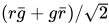
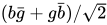
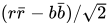
There are eight remaining independent color states corresponding to the "eight types" or "eight colors" of gluons. Since the states can be mixed together, there are multiple ways of presenting these states. These are known as the "color octet", and a commonly used list for each is:[11]
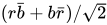

      

These are equivalent to the Gell-Mann matrices. The critical feature of these particular eight states is that they are linearly independent, and also independent of the singlet state, hence 32 − 1 or 23. There is no way to add any combination of these states to produce any others. It is also impossible to add them to make rr, gg, or bb[12] the forbidden singlet state. There are many other possible choices, but all are mathematically equivalent, at least equally complicated, and give the same physical results.

Group theory details

[edit]

Formally, QCD is a gauge theory with SU(3) gauge symmetry. Quarks are introduced as spinors in Nf flavors, each in the fundamental representation (triplet, denoted 3) of the color gauge group, SU(3). The gluons are vectors in the adjoint representation (octets, denoted 8) of color SU(3). For a general gauge group, the number of force-carriers, like photons or gluons, is always equal to the dimension of the adjoint representation. For the simple case of SU(n), the dimension of this representation is n2 − 1.

In group theory, there are no color singlet gluons because quantum chromodynamics has an SU(3) rather than a U(3) symmetry. There is no known a priori reason for one group to be preferred over the other, but as discussed above, the experimental evidence supports SU(3).[11] If the group were U(3), the ninth (colorless singlet) gluon would behave like a "second photon" and not like the other eight gluons.[13]

Confinement

[edit]

Since gluons themselves carry color charge, they participate in strong interactions. These gluon–gluon interactions constrain color fields to string-like objects called "flux tubes", which exert constant force when stretched. Due to this force, quarks are confined within composite particles called hadrons. This effectively limits the range of the strong interaction to 10−15 m, roughly the size of a nucleon. Beyond a certain distance, the energy of the flux tube binding two quarks increases linearly. At a large enough distance, it becomes energetically more favorable to pull a quark–antiquark pair out of the vacuum rather than increase the length of the flux tube.

One consequence of the hadron-confinement property of gluons is that they are not directly involved in the nuclear forces between hadrons. The force mediators for these are other hadrons called mesons.

Although in the normal phase of QCD single gluons may not travel freely, it is predicted that there exist hadrons that are formed entirely of gluons — called glueballs. There are also conjectures about other exotic hadrons in which real gluons (as opposed to virtual ones found in ordinary hadrons) would be primary constituents. Beyond the normal phase of QCD (at extreme temperatures and pressures), quark–gluon plasma forms. In such a plasma there are no hadrons; quarks and gluons become free particles.

Experimental observations

[edit]

Quarks and gluons (colored) manifest themselves by fragmenting into more quarks and gluons, which in turn hadronize into normal (colorless) particles, correlated in jets. As revealed in 1978 summer conferences,[2] the PLUTO detector at the electron-positron collider DORIS (DESY) produced the first evidence that the hadronic decays of the very narrow resonance Υ(9.46) could be interpreted as three-jet event topologies produced by three gluons. Later, published analyses by the same experiment confirmed this interpretation and also the spin = 1 nature of the gluon[14][15] (see also the recollection[2] and PLUTO experiments).

In summer 1979, at higher energies at the electron-positron collider PETRA (DESY), again three-jet topologies were observed, now clearly visible and interpreted as qq gluon bremsstrahlung, by TASSO,[16] MARK-J[17] and PLUTO experiments[18] (later in 1980 also by JADE[19]). The spin = 1 property of the gluon was confirmed in 1980 by TASSO[20] and PLUTO experiments[21] (see also the review[3]). In 1991 a subsequent experiment at the LEP storage ring at CERN again confirmed this result.[22]

The gluons play an important role in the elementary strong interactions between quarks and gluons, described by QCD and studied particularly at the electron-proton collider HERA at DESY. The number and momentum distribution of the gluons in the proton (gluon density) have been measured by two experiments, H1 and ZEUS,[23] in the years 1996–2007. The gluon contribution to the proton spin has been studied by the HERMES experiment at HERA.[24] The gluon density in the proton (when behaving hadronically) also has been measured.[25]

Color confinement is verified by the failure of free quark searches (searches of fractional charges). Quarks are normally produced in pairs (quark + antiquark) to compensate the quantum color and flavor numbers; however at Fermilab single production of top quarks has been shown.[b][26] No glueball has been demonstrated.

Deconfinement was claimed in 2000 at CERN SPS[27] in heavy-ion collisions, and it implies a new state of matter: quark–gluon plasma, less interactive than in the nucleus, almost as in a liquid. It was found at the Relativistic Heavy Ion Collider (RHIC) at Brookhaven in the years 2004–2010 by four contemporaneous experiments.[28] A quark–gluon plasma state has been confirmed at the CERN Large Hadron Collider (LHC) by the three experiments ALICE, ATLAS and CMS in 2010.[29]

Jefferson Lab's Continuous Electron Beam Accelerator Facility, in Newport News, Virginia,[c] is one of 10 Department of Energy facilities doing research on gluons. The Virginia lab was competing with another facility – Brookhaven National Laboratory, on Long Island, New York – for funds to build a new electron-ion collider.[30] In December 2019, the US Department of Energy selected the Brookhaven National Laboratory to host the electron-ion collider.[31]

See also

[edit]

Footnotes

[edit]

References

[edit]

Further reading

[edit]

External resources

[edit]
Revisions and contributorsEdit on WikipediaRead on Wikipedia
from Grokipedia
A gluon is a massless elementary particle that acts as the gauge boson mediating the strong nuclear force, the fundamental interaction responsible for binding quarks together to form composite particles known as hadrons, including protons and neutrons.[1][2] In the framework of quantum chromodynamics (QCD), the SU(3) gauge theory within the Standard Model that describes strong interactions, gluons are vector bosons with spin 1 and belong to the color octet representation, carrying both color and anticolor charges analogous to electric charge in electromagnetism.[1][3] This non-Abelian nature distinguishes gluons from photons, enabling self-interactions among gluons themselves, which contribute to the theory's unique behaviors such as asymptotic freedom—where the strong force weakens at high energies—and color confinement, preventing free quarks or gluons from existing in isolation.[4][2] Gluons were theoretically predicted in the development of QCD during the early 1970s as the carriers of the color force between quarks, with their properties arising from the gauge symmetry of the theory.[4] Experimental confirmation came in 1979 at the PETRA electron-positron collider at DESY in Germany, where detectors including TASSO observed three-jet events consistent with the production and fragmentation of a quark-antiquark pair plus a gluon, providing direct evidence for the particle's existence.[5][6] These observations aligned with QCD predictions and marked a pivotal validation of the Standard Model's strong sector.[4] Beyond hadron structure, gluons play a central role in high-energy phenomena, such as the quark-gluon plasma—a state of deconfined quarks and gluons produced in heavy-ion collisions at facilities like the LHC—offering insights into the early universe shortly after the Big Bang. Their theoretically massless nature, together with asymptotic freedom at short distances and color confinement at long distances, underpins QCD's success in explaining a wide array of particle physics data.[1][4]

Fundamental Properties

Basic Characteristics

Gluons are elementary particles classified as massless vector bosons with a spin of 1, serving as the mediators of the strong nuclear force in quantum chromodynamics (QCD).[7] This spin value aligns them with other gauge bosons, enabling them to carry angular momentum in interactions between quarks. Their masslessness, theoretically zero with possible upper limits around a few MeV, allows gluons to propagate at the speed of light, facilitating long-range effects at high energies within the strong interaction framework.[7] The gluon's quantum numbers include isospin I = 0 and parity P = −1, resulting in J^P = 1^−, while its charge conjugation parity is C = −1, yielding an overall J^{PC} = 1^{−−}.[7] These properties mirror those of the photon in many respects but are adapted to the non-Abelian structure of the strong force. Unlike neutral particles such as the photon, gluons possess both color and anticolor charges, forming an SU(3) color octet with eight distinct combinations (e.g., red-antiblue, green-antired), which distinguishes them fundamentally from the color-neutral photon.[3] This dual charge nature enables gluons to couple to quarks as well as to themselves, a feature absent in electromagnetic interactions. In typical QCD processes, gluons exist as virtual particles, off-shell and short-lived, exchanged to bind quarks into hadrons without direct observation. However, in high-energy scattering events, such as those at particle colliders, gluons can become effectively on-shell, propagating as real particles and fragmenting into collimated sprays of hadrons known as gluon jets.[8] This behavior underscores their role in perturbative QCD regimes where the strong coupling is weak. Gluons differ from other gauge bosons in their force mediation: while the massless photon handles electromagnetic interactions between charged particles, and the massive W and Z bosons (with masses around 80 and 91 GeV/c², respectively) govern the short-range weak force, gluons exclusively mediate the strong force, confining quarks at low energies and enabling asymptotic freedom at high energies.[9] Their color-charged status precludes free propagation over macroscopic distances, in contrast to the photon's neutrality.

Color Charge and Interactions

In quantum chromodynamics (QCD), gluons are the gauge bosons that mediate the strong interaction, and unlike photons in quantum electrodynamics, which are neutral with respect to electric charge, gluons themselves carry color charge.[4] This color charge arises from the SU(3) gauge symmetry of QCD, where quarks possess one of three color charges—conventionally labeled red, green, or blue—and gluons carry a combination of one color and one anticolor (antired, antigreen, or antiblue).[10] The possible combinations yield nine potential states, but the requirement of color singlet overall states in physical systems excludes the fully symmetric color-anticolor singlet, resulting in exactly eight distinct gluon color states.[10] These color-charged gluons facilitate the strong force by enabling the exchange of color between quarks, analogous to how photons exchange electric charge between charged particles, but with the crucial difference that gluons' own color charge allows them to couple directly to quarks and other gluons.[4] The fundamental interaction between quarks and gluons is described by the QCD Lagrangian's interaction term:
Lint=gsqˉγμtaGμaq \mathcal{L}_{\text{int}} = -g_s \bar{q} \gamma^\mu t^a G_\mu^a q
where $ g_s $ is the strong coupling constant, $ q $ represents the quark fields, $ \gamma^\mu $ are the Dirac matrices, $ t^a $ (for $ a = 1, \dots, 8 $) are the generators of the SU(3) color group (the Gell-Mann matrices normalized as $ \text{Tr}(t^a t^b) = \frac{1}{2} \delta^{ab} $), and $ G_\mu^a $ denotes the gluon field.[4] This term encodes how gluons transfer color charge, binding quarks into hadrons. The color charge of gluons also permits direct gluon-gluon interactions, manifesting as the triple-gluon vertex in Feynman diagrams, where three gluons meet due to the non-Abelian nature of the SU(3) gauge group.[11] This self-coupling leads to nonlinear behavior in the strong force, distinguishing it from the linear Coulomb-like force in QED. The presence of color charge in the force carrier is thus central to the strong interaction's dynamics, including gluon self-interactions that contribute to phenomena like asymptotic freedom.[11] Consequently, the strong force mediated by these color-charged gluons is extraordinarily intense at short distances—approximately 100 times stronger than the electromagnetic force at nuclear scales of about 1 fm—but becomes effectively short-range due to color confinement, preventing free quarks or gluons from existing beyond these distances.[4]

Theoretical Framework in QCD

Role in Quantum Chromodynamics

Quantum chromodynamics (QCD) is the quantum field theory describing the strong nuclear force within the Standard Model of particle physics, formulated as a non-Abelian gauge theory based on the SU(3)c color symmetry group.[4] In this framework, gluons act as the mediating gauge bosons, with eight massless vector particles transforming under the eight-dimensional adjoint representation of SU(3)c, enabling the exchange that generates the strong interaction between color-charged quarks.[12] These gluons bind quarks into color-singlet hadrons, such as protons and neutrons, which constitute the building blocks of atomic nuclei.[4] The concept of gluons as color-octet mediators was introduced in 1973 by Harald Fritzsch, Murray Gell-Mann, and Heinrich Leutwyler as part of the foundational formulation of QCD, resolving issues with quark statistics and the structure of hadronic wave functions.[12] Within the Standard Model, QCD integrates seamlessly with the electroweak sector, where gluons handle color interactions exclusively, ensuring that free quarks and gluons are not observed due to color confinement, while the theory unifies all fundamental forces except gravity.[4] Gluons also underlie the residual strong force between nucleons, arising from quark-gluon exchanges that manifest as meson-mediated interactions in effective low-energy descriptions.[13] QCD operates in perturbative and non-perturbative regimes: at high energies or short distances, the strong coupling αs is weak, allowing perturbative QCD (pQCD) calculations dominated by gluon propagators and vertices to predict processes like deep inelastic scattering.[4] The dynamics of QCD are encoded in its Lagrangian density:
LQCD=qˉ(iγμDμm)q14GμνaGaμν, \mathcal{L}_{\mathrm{QCD}} = \bar{q} (i \gamma^\mu D_\mu - m) q - \frac{1}{4} G_{\mu\nu}^a G^{a\mu\nu},
where $ q $ represents the quark fields, $ m $ their masses, $ D_\mu = \partial_\mu - i g_s A_\mu^a t^a $ is the covariant derivative with gluon fields $ A_\mu^a $ and SU(3) generators $ t^a $, $ g_s $ the strong coupling, and $ G_{\mu\nu}^a $ the gluon field-strength tensor.[4] This structure captures both quark kinetic terms and the pure-glue Yang-Mills sector, with gluons playing a central role in the non-Abelian nature of the theory.[4]

Gluon Self-Interactions and Non-Abelian Nature

In quantum chromodynamics (QCD), the gauge group SU(3)c is non-Abelian, which distinguishes it fundamentally from the Abelian U(1) gauge symmetry of quantum electrodynamics (QED).[14] This non-Abelian structure implies that the gluons, which mediate the strong force, carry color charge and thus interact with one another, leading to gluon self-interactions that have no counterpart in QED where photons do not self-couple.[14] These self-interactions arise directly from the SU(3)c symmetry and are essential to the dynamics of the strong interaction.[15] The self-interactions manifest in perturbative QCD through specific Feynman diagram vertices: the triple-gluon vertex involving three gluons (ggg) and the quartic-gluon vertex involving four gluons (gggg).[16] Both vertices are governed by the strong coupling constant $ g_s $, with the triple-gluon vertex proportional to $ g_s $ and the quartic to $ g_s^2 $.[16] The momentum structure of the triple-gluon vertex is given by
Vμνρabc(p,q,r)=gsfabc[(pq)ρgμν+(qr)μgνρ+(rp)νgρμ], V^{abc}_{\mu\nu\rho}(p,q,r) = g_s f^{abc} \left[ (p - q)_\rho g_{\mu\nu} + (q - r)_\mu g_{\nu\rho} + (r - p)_\nu g_{\rho\mu} \right],
where $ f^{abc} $ are the SU(3) structure constants, $ a,b,c $ label the gluon color indices, and $ p,q,r $ are the incoming momenta satisfying $ p + q + r = 0 $.[17] This antisymmetric form ensures gauge invariance and illustrates how momentum flows between the gluons, enabling processes like gluon splitting and merging.[17] These self-interactions have significant consequences for QCD phenomenology. In high-energy collisions, they allow gluons to branch into quark-antiquark pairs or additional gluons, producing collimated sprays of particles known as gluon jets, which provide direct evidence for the three- and four-gluon couplings.[18] Moreover, the proliferation of gluon loops and vertices due to self-coupling complicates perturbation theory, as it generates an increasing number of diagrams at higher orders, making calculations more intricate compared to the simpler structure in QED.[19] The non-Abelian self-interactions also underpin the running of the strong coupling $ \alpha_s(Q^2) = g_s^2 / (4\pi) $, where gluon loops contribute a negative term to the beta function, causing $ \alpha_s $ to decrease at high momentum transfers $ Q^2 $.[20] This behavior, known as asymptotic freedom, allows perturbative QCD to be applicable at short distances despite the strong coupling at long distances.[20] Recent lattice QCD simulations have confirmed the strengths of these self-interactions in non-perturbative regimes. For instance, studies of the three-gluon vertex in Landau gauge with dynamical quarks reveal its momentum-dependent form and suppression at low momenta, consistent with the expected non-perturbative dynamics.[21] Further analyses, including those exploring Schwinger poles in the vertex, validate the role of self-interactions in generating effective gluon masses without violating color confinement.[22]

Recent Discoveries in Gluon Amplitudes

In February 2026, researchers affiliated with OpenAI published a finding that single-minus helicity tree-level amplitudes for n-gluon scattering in QCD, previously assumed to vanish due to helicity conservation, are nonzero in the half-collinear regime. This regime occurs when gluons' momenta are partially collinear, particularly in Klein space or with complexified momenta, where all spinor products ⟨ij⟩ = 0 for the involved particles.[23] The discovery involved AI assistance: OpenAI's GPT-5.2 Pro model initially conjectured the central formula for the amplitude in this regime, which was then rigorously proven using a specialized internal OpenAI model for mathematical derivations. Human physicists subsequently verified and expanded on the results, deriving a piecewise-constant closed-form expression for the amplitude, specifically for the decay of a single negative-helicity gluon into n-1 positive-helicity gluons. The expression satisfies consistency checks, including Weinberg's soft gluon theorem.[23] This finding has significant implications for quantum field theory, potentially refining perturbative QCD calculations in high-energy physics, such as those at the Large Hadron Collider (LHC). It provides new insights into gluon interactions in near-collinear configurations, which could enhance understanding of non-perturbative effects, jet physics, and effective field theories.[24]

Gluon States and Enumeration

Color Singlet States

In quantum chromodynamics (QCD), physical, observable particles must form color singlet states with total color charge zero, as color-charged configurations are confined and cannot propagate freely. This requirement arises from the non-Abelian nature of the strong interaction, ensuring that all hadrons are color-neutral combinations of quarks, antiquarks, and gluons.[25] The simplest color singlet state composed purely of gluons is the two-gluon singlet, achievable through symmetric combinations in the adjoint representation of SU(3)c. This configuration is central to the hypothesis of glueballs, bound states of two or more gluons predicted as a direct consequence of gluon self-interactions in QCD. The color wave function for the two-gluon singlet is projected using the Kronecker delta over the gluon color indices a and b, normalized as follows:
18δab \frac{1}{\sqrt{8}} \delta^{ab}
where the factor of 8\sqrt{8} accounts for the dimension of the adjoint representation. Glueballs in this state are expected to mix with nearby quark-antiquark mesons, influencing the hadron spectrum.[26] Higher-order multi-gluon color singlets, such as three-gluon configurations, extend this framework to exotic hadrons beyond conventional mesons and baryons. These states involve more complex color couplings that still yield overall neutrality, potentially contributing to structures like hybrid mesons or tetraquarks with embedded gluonic excitations. Theoretical predictions indicate that such singlets, while challenging to isolate due to confinement, play a key role in hadron spectroscopy by populating scalar and tensor channels observable in lattice QCD simulations.[27] Recent experimental progress, including LHCb observations in 2023 of new tetraquark candidates in B-meson decays, has provided indirect evidence for gluon-rich components in exotic states, with models suggesting contributions from multi-gluon singlets to explain decay patterns and masses. These findings highlight the potential detectability of gluonic degrees of freedom in high-energy collisions.[28]

Eightfold Color Octet States

In quantum chromodynamics (QCD), the eight gluons correspond to the eight generators of the SU(3) color gauge group and are labeled by color-anticolor pairs, such as red-antiblue, red-antigreen, and blue-antigreen, along with more complex combinations like (red-antired - blue-antiblue)/√2. These generators, analogous to the Pauli matrices in SU(2), ensure the local SU(3) invariance of the QCD Lagrangian, with each gluon mediating the strong force between color-charged particles. The specific labeling arises from the traceless Hermitian nature of the generators, which decompose the 3 × 3 = 9 possible color-anticolor combinations into a color singlet (physically irrelevant for force mediation) and the active octet. Gluons transform under the adjoint representation of SU(3), an 8-dimensional irreducible representation (irrep) that captures their vector-like behavior in color space. This representation dictates how gluons couple to quarks and to each other, distinguishing QCD from abelian theories like QED, where photons are neutral. Physically, the octet nature implies that gluons carry color charge, rendering them confined within hadrons and preventing their observation as free particles; instead, they perpetually interact to bind quarks into color-neutral states. The interactions among octet gluons are governed by the SU(3) structure constants $ f^{abc} $, which appear in the QCD Lagrangian term $ f^{abc} A_\mu^b A_\nu^c \partial^\mu A^{\nu a} $ (where $ A_\mu^a $ are the gluon fields) and define the non-Abelian vertex. These constants are totally antisymmetric and real, with non-zero values for specific index triples, such as $ f^{123} = 1 $, $ f^{147} = \frac{1}{2} $, $ f^{156} = -\frac{1}{2} $, $ f^{246} = \frac{1}{2} $, $ f^{257} = \frac{1}{2} $, $ f^{345} = \frac{1}{2} $, $ f^{367} = -\frac{1}{2} $, $ f^{458} = \frac{\sqrt{3}}{2} $, and $ f^{678} = \frac{\sqrt{3}}{2} $.[29][30] These values encode the color flow in gluon self-interactions, enabling phenomena like asymptotic freedom at short distances. Recent studies of quark-gluon plasma (QGP) at the Relativistic Heavy Ion Collider (RHIC), bolstered by 2024 upgrades including the sPHENIX detector's enhanced jet and heavy-flavor tracking, have begun probing octet gluon distributions through jet quenching and nuclear modification factors in heavy-ion collisions. These experiments reveal how octet gluons dominate the medium's response, with gluon jets showing broader quenching patterns than quark jets due to their color charge, providing insights into the QGP's color dynamics at temperatures exceeding 2 trillion Kelvin.[31]

Gluon Confinement

Gluon confinement refers to the phenomenon in quantum chromodynamics (QCD) where gluons, carrying color charge, are unable to exist freely but are instead perpetually bound within hadrons, alongside quarks. This arises from the non-Abelian nature of the strong force, leading to a complex vacuum structure that prevents the isolation of individual color-charged particles. The confinement hypothesis posits that color charges between quarks and antiquarks form narrow flux tubes of chromoelectric field, resulting in a linear potential that grows with separation distance, $ V(r) \approx \sigma r $, where $ \sigma $ is the string tension, approximately 1 GeV/fm in QCD simulations.[32] This linear confinement contrasts with the Coulomb-like potential of electromagnetism and ensures that the energy required to separate color charges increases indefinitely, making free gluons unobservable. The hypothesis was central to early QCD developments and remains a cornerstone of its success in describing hadron spectroscopy. The dual Meissner effect provides an analogy for this confinement, where the QCD vacuum behaves like a dual superconductor, expelling color-electric fields through the condensation of magnetic monopoles. In this picture, the vacuum permeates with color-magnetic monopoles, analogous to Cooper pairs in superconductivity, which squeeze color fields into flux tubes between color sources, mirroring the Meissner effect but in a dual form. This mechanism was independently proposed by Gerard 't Hooft and Stanley Mandelstam in the mid-1970s, building on Polyakov's earlier work on monopoles in non-Abelian gauge theories, and it elegantly explains the topological aspects of confinement without invoking new particles.[33] Lattice QCD simulations offer strong numerical evidence for confinement at low energies, demonstrating that large Wilson loops—gauge-invariant operators measuring the potential between static color sources—exhibit an area-law decay, W(C)exp(σA)\langle W(C) \rangle \sim \exp(-\sigma A), where $ A $ is the minimal area enclosed by the loop $ C $, directly implying the linear potential and flux tube formation.[34] These computations, performed on discretized spacetime lattices, confirm the string tension and tube profiles consistent with the dual superconductivity model. Gluons play a pivotal role in this confining vacuum through non-perturbative effects like instantons—topological gluon configurations—and gluon condensates, αsπG20.012GeV4\langle \frac{\alpha_s}{\pi} G^2 \rangle \approx 0.012 \, \mathrm{GeV}^4, which contribute to chiral symmetry breaking and the overall vacuum energy, enhancing the stability of the confined state.[4] Recent advances in the AdS/CFT correspondence have modeled gluon confinement holographically, treating QCD-like theories as gravity duals in anti-de Sitter space, where confinement emerges from the geometry of confining backgrounds and black hole transitions. For instance, studies from 2022 to 2025 have explored holographic QFTs on curved spaces, reproducing the linear potential and string tension via probe branes and revealing phase transitions between confined and deconfined phases.[35] These models provide qualitative insights into gluon dynamics in the infrared regime, complementing lattice results without direct QCD computation.

Asymptotic Freedom

Asymptotic freedom is a fundamental property of quantum chromodynamics (QCD) in which the strong coupling constant αs(Q2)=gs24π\alpha_s(Q^2) = \frac{g_s^2}{4\pi} decreases as the momentum transfer Q2Q^2 increases, approaching zero at asymptotically high energies or short distances. This behavior arises from the non-Abelian nature of the SU(3) gauge theory underlying QCD, where gluon self-interactions dominate the ultraviolet dynamics, enabling perturbative calculations at high energies. The running of the coupling is governed by the renormalization group beta function, which at one-loop order is given by
β(gs)=113Ncgs3(4π)2+23nfgs3(4π)2, \beta(g_s) = -\frac{11}{3} N_c \frac{g_s^3}{(4\pi)^2} + \frac{2}{3} n_f \frac{g_s^3}{(4\pi)^2},
with Nc=3N_c = 3 for the number of colors and nfn_f the number of active quark flavors. The negative contribution from the gluons overwhelms the positive fermion term for nf<16.5n_f < 16.5, leading to the decrease in αs\alpha_s. This discovery was independently made by David Gross and Frank Wilczek, and by Hugh David Politzer in 1973, resolving a key paradox in strong interaction theories and establishing QCD as a viable framework. In QCD, unlike quantum electrodynamics (QED), the gluons carry color charge and participate in self-interactions, producing an anti-screening effect that reduces the effective charge at short distances. Virtual gluon exchanges effectively "anti-screen" the color charges of quarks, countering the screening from quark loops and resulting in weaker interactions at high energies. This non-Abelian feature is essential for asymptotic freedom, as pure Abelian theories like QED exhibit screening and increasing coupling at short distances. Asymptotic freedom underpins perturbative QCD calculations for high-energy processes, such as deep inelastic scattering (DIS), where scaling violations in structure functions match predictions from the running coupling. It also enables reliable computations of jet production in electron-positron annihilation and hadron collisions, where quark and gluon jets emerge as collimated sprays due to the weak coupling at the hard scale. Higher-order corrections, including two-loop and beyond, refine these predictions; recent lattice QCD simulations in the 2020s provide non-perturbative determinations of αs\alpha_s across scales, improving agreement with experimental values and constraining the beta function coefficients. This high-energy regime contrasts with the confinement at long distances, where the coupling grows strong.

Experimental Observations

Historical Discovery

The concept of gluons as the mediators of the strong force in quantum chromodynamics (QCD) was theoretically predicted in 1973 through the discovery of asymptotic freedom in non-Abelian gauge theories.[36] David Gross and Frank Wilczek at Princeton, along with David Politzer at Harvard, independently demonstrated that quarks interact via color-charged gluons, whose self-interactions lead to a weakening of the strong coupling at short distances, resolving the puzzle of scaling in deep inelastic scattering.[37] This breakthrough, which earned them the 2004 Nobel Prize in Physics, established gluons as essential for QCD's predictive power. Early indirect evidence for gluons emerged from the "November Revolution" of 1974, when the simultaneous discoveries of the J/ψ meson by teams at SLAC and Brookhaven confirmed the existence of the charm quark, supporting QCD's framework of flavored quarks bound by gluons.[38] The narrow width of charmonium states aligned with potential models incorporating one-gluon exchange, validating the theory's color dynamics.[39] Key conceptual foundations were laid by earlier pioneers: James Bjorken's 1968 derivation of scaling in deep inelastic scattering anticipated point-like constituents, while Richard Feynman's 1969 parton model provided an intuitive picture of quarks and their gluon-mediated interactions within hadrons.[40] The first direct observation of gluons occurred in 1979 at the PETRA collider in Hamburg, where e⁺e⁻ annihilation experiments by the MARK-J and TASSO collaborations detected three-jet events.[41] These events, characterized by coplanar energy distributions, were interpreted as quark-antiquark pairs radiating a gluon, forming distinct hadronic jets, in line with perturbative QCD calculations.[6] Further evidence came later in 1979 from deep inelastic electron-proton scattering experiments at SLAC, which revealed scaling violations—deviations from Bjorken scaling that matched QCD predictions of gluon radiation altering quark momentum distributions at higher energies.[42] These logarithmic corrections to structure functions provided quantitative support for gluons as active participants in proton dynamics.[43] Recent historical reviews marking 50 years of QCD underscore the central role of gluons in the theory's success, from their prediction to experimental validation, highlighting how their non-Abelian nature underpins phenomena like jet production and confinement.[44]

Key Experimental Confirmations

The UA1 and UA2 experiments at CERN's Super Proton Synchrotron (SPS) in the 1980s provided key evidence for gluon jets in proton-antiproton collisions, through the observation of three-jet events consistent with quark-gluon-quark final states.[45] These multijet topologies, with energies up to hundreds of GeV, matched QCD predictions for gluon radiation, distinguishing gluon-initiated jets by their broader angular distributions and higher particle multiplicities compared to quark jets.[46] Experiments at the Large Electron-Positron Collider (LEP), operating from 1989 to 2000, delivered precise measurements of the strong coupling constant via electron-positron annihilation into hadronic events, yielding αs(mZ)0.118\alpha_s(m_Z) \approx 0.118 from analyses of event shapes and jet rates. This value, extracted from processes like three-jet production dominated by gluon emission, confirmed the running of αs\alpha_s as predicted by QCD and provided a benchmark for perturbative calculations at the Z-boson mass scale. At the Tevatron and later the Large Hadron Collider (LHC), gluon fusion emerged as the dominant mechanism for Higgs boson production, underpinning the 2012 discovery by ATLAS and CMS collaborations through the observation of Higgs decays in gluon-initiated events. The measured cross-section σ(ggH)\sigma(gg \to H) at 7-8 TeV, aligning with theoretical predictions of approximately 20-50 pb depending on the Higgs mass around 125 GeV, validated the top-quark loop contribution in the gluon fusion process and reinforced QCD's role in electroweak symmetry breaking.[47] Heavy-ion collisions at the Relativistic Heavy Ion Collider (RHIC) and LHC have demonstrated the formation of quark-gluon plasma (QGP) since 2005, with signatures of gluon saturation in the initial state and deconfinement in the equilibrated medium. RHIC's gold-gold collisions at sNN=200\sqrt{s_{NN}} = 200 GeV revealed jet quenching and elliptic flow patterns indicative of a deconfined gluon-dominated plasma, while LHC's lead-lead runs at higher energies confirmed gluon saturation via forward di-hadron correlations, supporting the transition to a strongly interacting QGP phase. Data from LHC Run 3, commencing in 2022 with analyses published in 2023, have refined gluon parton distribution functions (PDFs) in protons through high-precision measurements of jet production and heavy-flavor decays, updating global fits like CT18 and NNPDF to better constrain the gluon momentum fraction at medium-to-high xx. These updates have reduced uncertainties in gluon PDFs in key kinematic regions, enhancing predictions for processes reliant on gluon densities.[48] Looking ahead, the Electron-Ion Collider (EIC), under construction with key milestones in 2024-2025 including detector prototyping and beamline designs, plans to image gluon distributions in nuclei via deeply virtual Compton scattering and exclusive J/ψ production, probing saturation effects inaccessible at hadron colliders. This facility, slated for operations in the early 2030s, will map the three-dimensional gluon structure, addressing gaps in nuclear shadowing and small-x dynamics.[49]

References

User Avatar
No comments yet.