Hubbry Logo
Grace MooreGrace MooreMain
Open search
Grace Moore
Community hub
Grace Moore
logo
8 pages, 0 posts
0 subscribers
Be the first to start a discussion here.
Grace Moore
Grace Moore
from Wikipedia

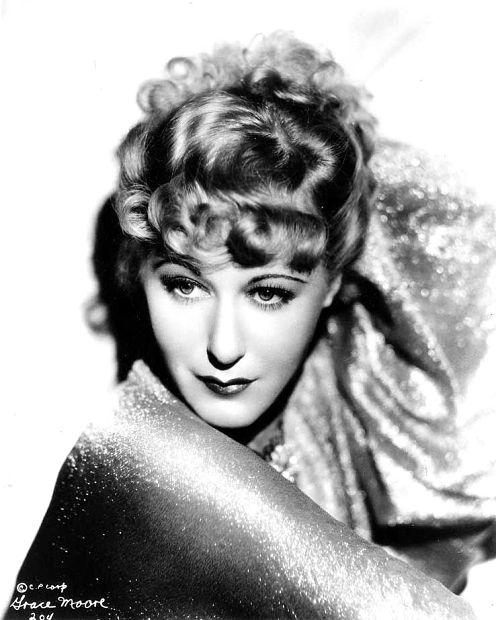
Grace Moore in the 1930s

Mary Willie Grace Moore (December 5, 1898[1] – January 26, 1947) was an American operatic lyric soprano and actress in musical theatre and film.[2] She was nicknamed the "Tennessee Nightingale." Her films helped to popularize opera by bringing it to a larger audience. She was nominated for the Academy Award for Best Actress for her performance in One Night of Love.

In 1947, Moore died in a plane crash at the age of 48. She published an autobiography in 1944 titled You're Only Human Once. In 1953, a film about her life was released titled So This Is Love starring Kathryn Grayson.

Early life

[edit]

Moore was born Mary Willie Grace Moore, the daughter of Tessa Jane (née Stokely) and Richard Lawson Moore. She was born in the community of Slabtown (now considered part of Del Rio) in Cocke County, Tennessee. By the time she was two years old, her family had relocated to Knoxville, a move Moore later described as traumatic. She found urban life distasteful at the time.[3] After several years in Knoxville, the family again relocated to Jellico, Tennessee, where Moore spent her adolescence. After attending Jellico High School, where she was captain of the girls basketball team (see monument photo in this article), she studied briefly at Ward-Belmont College in Nashville[4] before moving to Washington, D.C., where she studied at Wilson-Greens School of Music in Chevy Chase, Maryland.[4][5] She relocated to New York in 1919 to pursue her singing career and performed there in nightclubs to help pay for singing classes.[6] Moore's first professional singing performance was at The Black Cat Café in Greenwich Village.[3]

Career

[edit]

Musical theater

[edit]
Grace Moore monument in Jellico, Tennessee.

Grace Moore's first Broadway appearance was in 1920 in the musical revue Hitchy-Koo, by Jerome Kern. She also appeared in Suite Sixteen, Just a Minute, Town Gossip, and Up in the Clouds.[5] In 1922 and 1923 she appeared in the second and third of Irving Berlin's series of four Music Box Revues. In the 1923 edition she and John Steel introduced Berlin's song "What'll I Do". When Moore sang "An Orange Grove in California", orange blossom perfume was wafted through the theater.[7]

In 1932 she appeared on Broadway in the short-lived operetta The DuBarry by Karl Millöcker.

Opera

[edit]

After training in France, Moore made her operatic debut at the Metropolitan Opera in New York City on February 7, 1928, singing the role of Mimì in Giacomo Puccini's La bohème. She then sang Juliette in Roméo et Juliette, which led to a European tour. She debuted at the Opéra-Comique in Paris on September 29, 1928 as Mimì, which she also performed in a Royal Command Performance at Covent Garden in London on June 6, 1935. During her sixteen seasons with the Metropolitan Opera, she sang in several Italian and French operas as well as the title roles in Tosca, Manon, and Louise. Louise was her favorite opera and is widely considered to have been her greatest role. She also sang in Carmen, Faust, Pagliacci, Gianni Schicchi, and others.[5]

In the 1930s and 1940s she gave concert performances throughout the United States and Europe, performing a repertoire of operatic selections and other songs in German, French, Italian, Spanish, and English. During World War II, she was active in the USO, entertaining American troops abroad.[8] In 1945 she sang Mimi to Nino Martini's Rodolfo in La bohème for the inaugural performance of the San Antonio Grand Opera Festival.[9]

She also performed during and after WWII in support of Allied Forces. From the personal memoire of Lt. Gen. John C. H. Lee, on 24 July 1945: "After an early dinner drove in convoy to the Paris Opera House for the gala performance entitled "Pacifique 45" given by the French for the benefit of the families of French war veterans. The program laid particular emphasis on the war in Japan and included the showing of two films - "Fighting Lady" and "Iwo Jima" and the rendition of several songs and the French and American national anthems by Grace Moore. Seated in the box of honor were General Alphonse Juin, the French Minister of Information Jacques Soustelle, and a number of important American and French officers. It seemed to be a great success and was particularly appreciated by the crowd of some 20,000 gathered in the square outside the Opera House."

Film

[edit]
Historical marker noting Moore's birthplace in Del Rio, Tennessee

Attracted to Hollywood in the early years of talking pictures, Moore had her first screen role as Jenny Lind in the 1930 film A Lady's Morals, produced for MGM by Irving Thalberg and directed by Sidney Franklin.[10] Later that same year she starred with the Metropolitan Opera singer Lawrence Tibbett in New Moon, also produced by MGM, the first screen version of Sigmund Romberg's operetta The New Moon.

After a hiatus of several years, Moore returned to Hollywood under contract to Columbia Pictures, for whom she made six films. In the 1934 film One Night of Love, her first film for Columbia, she portrayed a small-town girl who aspires to sing opera. For that role she was nominated for the Academy Award for Best Actress in 1935. She starred in 1936 as Empress Elisabeth of Austria in Josef von Sternberg's production The King Steps Out.

By this time, she was so popular that MGM was able to insist on equal billing for Moore in a projected film with Maurice Chevalier, who had always enjoyed solo star billing up until then. Chevalier felt so deeply about this blow to his status that he quit Hollywood and the film was never made.[11]

A memorable highlight of When You're in Love (1937) was a comic scene in which Moore donned flannel shirt and trousers and joined a 5-man band for a flamboyant rendition of Cab Calloway's "Minnie the Moocher", complete with gestures and "hi-de-ho's", but with the lyrics slightly altered to conform with Hollywood sensibilities.[12] Also, she performed the popular Madama Butterfly duet "Vogliatemi bene" with American tenor Frank Forest in the 1937 film I'll Take Romance.

The last film that Moore made was Louise (1939), an abridged version of Gustave Charpentier's opera of the same name, with spoken dialog in place of some of the original opera's music. The composer participated in the production, authorizing the cuts and changes to the libretto, coaching Moore, and advising director Abel Gance. This production also featured two renowned French singers: dramatic tenor Georges Thill and basse cantante André Pernet.[13]

Controversies

[edit]

She was widely criticized in December 1938 when she curtsied to the Duchess of Windsor, in Cannes. Upon her return to the United States after six months and ten days in Europe ("to save money in income tax"), Moore defended her curtsy, saying:

She would have been a royal duchess long ago if she had not been an American. After all, she gave happiness and the courage of her convictions to one man, which is more than most women can do. She deserves a curtsy for that alone.[14]

According to Joe Laurie Jr., vaudeville performer and historian, Grace Moore would not perform on vaudeville bills that included black performers.[15]

However, this is at odds with some comments by Moore herself in her autobiography.

"All along I felt that all people were born to equal opportunity because that is the way my mother and father lived their lives. And I don't mean opportunity handed out on a silver platter, but opportunity that was there without social or racial strings for anyone who had the initiative to reach and hold."[16]

She also mentions being baptised in a creek at an African American Baptist church ceremony at Newcomb, Tennessee during her adolescence;[17] and that the popular African American vocal and piano duo of Turner Layton and Clarence Johnstone (ie Layton & Johnstone) performed at parties in her own flat in New York along with other showbiz connections during her early days of stardom.[18]

Furthermore, the alleged incident quoted by Joe Laurie Jr.[19] about Loew's Capitol Theatre on Broadway, New York allegedly calling off a booking for Grace Moore, due to her supposed response to Mary Garden sharing a bill there with the Mills Brothers, does not appear to be entirely correct. Theatre listings in the New York Times show that Mary Garden and the Mills Brothers appeared at the Capitol on 6 nights from 27th January to 1st February 1933. On those dates Grace Moore was already fully committed to a long-running stage show called 'The Dubarry' at another theatre in New York, which ran from 22nd November 1932 to 3rd February 1933, after which the production was scheduled to go on tour. A few weeks later on 31st March 1933 Grace Moore did start a 2 week booking at Loew's Capitol Theatre in New York.

Honors

[edit]

In 1935 Moore received the gold medal award of the Society of Arts and Sciences for "conspicuous achievement in raising the standard of cinema entertainment." In 1936 King Christian X of Denmark awarded her his country's medal of 'Ingenito et Arti.' In 1937, she was commissioned as a colonel (an honorary position) on the staff of the governor of Tennessee, and was also made a life member of the Tennessee State Society of Washington, D.C. She was decorated as a chevalier of the French Légion d'honneur in 1939.[8] Moore was also a member of the Peabody Awards Board of Jurors from 1940 to 1942.[20] She has a star on the Hollywood Walk of Fame at 6274 Hollywood Blvd, Hollywood, Los Angeles, CA.

Personal life

[edit]

Moore married Valentín Parera, a Spanish movie actor, in Cannes, on July 15, 1931. They had 2 children. During the 1930s they maintained homes in Hollywood, Cannes, and Connecticut.[21]

Death

[edit]

Grace Moore died at the age of 48, along with 21 other people, including Prince Gustaf Adolf of Sweden, in a plane crash near Copenhagen Airport on January 26, 1947. Moore is buried in Forest Hills Cemetery in Chattanooga.[22]

Filmography

[edit]

References

[edit]

Sources

[edit]

Further reading

[edit]
[edit]
Revisions and contributorsEdit on WikipediaRead on Wikipedia
from Grokipedia
Grace Moore (December 5, 1898 – January 26, 1947) was an American and actress renowned for her successes across musical theater, , and film. Born Mary Willie Grace Moore in Slabtown, , she earned the nickname "Tennessee Nightingale" for her vocal prowess and Appalachian heritage, rising from nightclub performances in New York to Broadway stardom with her 1920 debut in Jerome Kern's Hitchy-Koo. After vocal training in , Moore made her Metropolitan Opera debut on February 7, 1928, as Mimi in Giacomo Puccini's , followed by acclaimed portrayals of in Charles Gounod's and other leading roles that established her as a . In the 1930s, Moore extended her fame to Hollywood, starring in musical films such as (1934), which highlighted her operatic talents alongside cinematic appeal, making her one of the few singers to bridge opera and popular entertainment effectively. She received the French Legion of Honor in 1939 for contributions to music and culture, and continued performing and touring, including wartime USO efforts, until her death in a crash near on January 26, 1947, en route from to after a in ; the accident also claimed the life of Sweden's Prince Gustaf Adolf.

Early Life and Background

Birth and Family Origins

Mary Willie Grace Moore was born on December 5, 1898, in Slabtown, a small rural community in , near present-day Del Rio. Her family relocated to Knoxville shortly after her birth and later settled in Jellico, Campbell County, where she spent much of her early years amid the Appalachian foothills. Moore's parents were Richard Lawson Moore and Tessie Jane Stokely Moore, originating from modest circumstances in eastern . Her father, sometimes referred to as Richard Lawson Moore, worked in the region known for and rudimentary , reflecting the working-class of the area. The family's roots in this isolated, resource-dependent environment underscored a lack of inherited wealth or social connections typically associated with operatic pursuits. Raised in the traditional Appalachian culture of rural , Moore later embraced her "hillbilly" heritage as a symbol of resilience and , often citing it as foundational to her tenacity. This upbringing, marked by community church activities and the absence of elite privileges, contrasted sharply with the cosmopolitan training paths of many contemporaries, fostering an innate determination that propelled her from humble origins to international acclaim.

Initial Musical Training and Influences

Moore's initial musical exposure took place in Jellico, Tennessee, where she participated in the choir of the First Baptist Church during her youth. This involvement, alongside informal local singing activities, fostered her interest in performance without access to formal conservatory programs typical of urban centers. Following a brief period at Ward-Belmont College in Nashville, Moore, then in her late teens, relocated to , around 1917 to pursue vocal studies at the Wilson-Greene School of Music. Her family initially resisted these ambitions, deeming a stage career inappropriate for a young woman from their background, but relented due to her steadfast persistence. By 1919, Moore moved to , motivated primarily by her undeveloped vocal potential and personal drive rather than familial or social connections, signaling her commitment to professional-level development. This self-initiated shift marked the end of her regional amateur phase and the onset of targeted efforts to refine her abilities through urban resources.

Musical Theater Career

Broadway Debut and Early Roles

Moore's entry into Broadway came after initial experience in smaller New York productions, including Suite Sixteen, Just a Minute, and Up in the Clouds, which provided her first professional stage exposure prior to a major debut. She secured her Broadway debut on October 19, 1920, in the revue Hitchy-Koo of 1920, featuring music by and produced by Raymond Hitchcock, where she performed in a supporting capacity amid a cast of chorus dancers and singers. The production ran for 60 performances until December 18, 1920, at the 39th Street Theatre, introducing Moore to the competitive New York theater scene dominated by Ziegfeld-style revues and requiring versatility in song, dance, and ensemble work. Following this, Moore continued in chorus and minor featured roles, navigating early career hurdles such as in ensemble positions and the era's emphasis on novelty acts over individual vocalists in revues. Her persistence led to appearances in Irving Berlin's Music Box Revue series, beginning with the 1922 edition at the Music Box Theatre, where she contributed to sketches and songs alongside performers like and John Steel. By the 1923 Music Box Revue, which opened on September 22 and ran through May 1924 for 273 performances, Moore had transitioned to more prominent billing as a featured singer, starring in numbers that highlighted her range and stage presence. These early roles built Moore's visibility through consistent exposure in high-profile revues, where audience attendance figures—such as the extended runs of the Music Box productions—reflected growing public appeal for her warm vocal timbre and charismatic delivery, even as critical focus remained on headline composers like Berlin and Kern. The 1920s Broadway environment, with its rapid turnover of chorus talent and preference for youthful appeal, underscored her gradual establishment from novice ensemble member to recognized performer by mid-decade.

Breakthrough Successes and Challenges

Moore's breakthrough in musical theater came through prominent roles in early Broadway revues, beginning with her debut as a replacement singer in Jerome Kern's Hitchy-Koo of 1920, where her garnered attention for its clarity and power amid the show's comedic sketches and dances. She followed with appearances in Irving Berlin's Music Box Revue of 1921, which ran for 477 performances, and the 1922 edition, totaling 273 performances, establishing her as a rising attraction through ensemble numbers and solo spots that highlighted her vocal range and stage presence. These successes solidified her reputation, earning her the moniker "Tennessee Nightingale" for the rustic timbre of her voice—rooted in Appalachian folk influences—integrated into sophisticated Broadway arrangements. Financially, Moore's theater work yielded substantial returns, with escalating salaries reflecting her draw; by 1926, she was recognized as a "musical comedy star" whose earnings supported personal investments in vocal refinement. Sold-out houses and repeat engagements in these revues demonstrated commercial viability, as audiences responded to her blend of charm, beauty, and unpolished yet potent singing that bridged popular entertainment and classical leanings. Yet, these triumphs masked challenges inherent to the genre's demands. The lighter, syncopated scores and nightly eight-show schedules imposed vocal strain, requiring amplified projection without the respite of operatic phrasing or orchestral subtlety, which some contemporaries noted exposed limitations in her technical control compared to her natural . This mismatch fueled her strategic pivot, as the repertoire's constraints—prioritizing personality over precision—highlighted the need for formal to harness her instrument's full potential, a move directly enabled by theater-derived funds rather than institutional .

Opera Career

European Apprenticeship and Debuts

Following her Broadway engagements, Moore sailed to Europe in the early 1920s, settling in to pursue intensive operatic training focused on refining her voice for French and Italian works, emphasizing practical vocal exercises over theoretical study. She continued this immersion in the mid-1920s, working with coaches and composers across and to adapt her technique to demands, including breath control and phrasing suited to post-World War I repertoires like Gounod and Puccini. This hands-on approach prioritized empirical adjustments through repeated practice amid Europe's recovering cultural scenes, rather than relying on established pedigrees. Moore's connection to soprano , whom she admired and later befriended, provided targeted guidance without overshadowing her self-directed efforts; Garden recommended coach Richard Barthélemy in 1925, facilitating Moore's focus on roles demanding vocal agility and emotional clarity. Such networking complemented her immersion, as she honed adaptations to European styles through auditions and informal performances, building resilience against the era's competitive vocal standards. Her European debuts began with in Gounod's at , a performance that demonstrated her growing command of light lyric roles and paved the way for broader tours. This was followed in 1928 by her appearance in as Mimì in Puccini's , where verifiable records note her clear tone and stage presence earning initial traction among French audiences attuned to authentic delivery. These outings validated her apprenticeship's emphasis on performance-tested skills over premature acclaim.

Metropolitan Opera Achievements

Grace Moore debuted at the Metropolitan Opera on February 7, 1928, in the role of Mimi in Giacomo Puccini's , marking her entry into major American opera. This matinee performance initiated a tenure spanning sixteen seasons, during which she specialized in Italian and French repertory. Moore's Met roles encompassed demanding leads such as the title character in Jules Massenet's , which she first sang at the venue on December 21, 1929, earning praise for her dramatic authority and vocal charm despite interpretive youthfulness. She also excelled in Puccini's and , as well as Gustave Charpentier's Louise, with a notable 1940 revival of the latter drawing a full house through her nuanced portrayal of the seamstress-heroine amid the opera's Parisian realism. These appearances, concentrated in through early seasons, totaled dozens of performances, leveraging her Broadway-honed stage presence to bridge opera's perceived elitism with broader public draw. Her vocal peak aligned with 1930s commercial recordings of arias like those from and Louise, preserving a bright, flexible suited to bel canto demands, though live repertory pressures occasionally highlighted inconsistencies in stamina for heavier dramatic roles. Moore's star power, amplified by cross-media fame, boosted attendance at Met productions, as evidenced by sold-out houses for her vehicles, challenging opera's insular norms by attracting non-traditional audiences via her accessible, all-American persona. Collaborations with established artists, including Giovanni Martinelli in shared Italian repertory, further elevated her profile within the company's ensemble dynamic.

International Tours and Signature Roles

Moore's international opera engagements expanded significantly in the 1930s, beginning with her acclaimed debut as Mimì in Puccini's at London's on June 6, 1935, where she received eight curtain calls amid enthusiastic applause described as rarely surpassed in the venue's history. This performance, following her earlier Paris debut in the same role at the in 1928, showcased her ability to captivate European audiences with a lyrical timbre blending warmth and dramatic vitality. Her contract reflected growing demand, driven by her prior film success in , which had popularized her among British theatergoers eager for accessible interpretations. Throughout the late 1930s and 1940s, Moore toured extensively in and , including sell-out concerts in drawing over 4,000 attendees and culminating in standing ovations, as well as engagements in amid pre-war cultural exchanges. During , she conducted multiple tours in under the patronage of Nelson A. as Coordinator of Inter-American Affairs, performing benefit concerts that fostered hemispheric solidarity through , with audiences in cities like and Rio de Janeiro responding to her renditions of French and Italian repertory. These outings emphasized her role in popularizing beyond elite circles, leveraging her crossover appeal from musical theater and film to draw diverse crowds during economic and wartime constraints, though logistical challenges like transatlantic travel limited frequency. Among her signature roles internationally, Mimì remained a staple, reprised across continents for its fit with her expressive phrasing and stage charisma, often yielding encores and full houses as metrics of audience engagement. in Verdi's highlighted her strengths in lyricism during European appearances, where her warm vocal color and narrative delivery elicited acclaim for emotional authenticity over technical perfection. The title role in Charpentier's Louise, her personal favorite and a vehicle for French-text proficiency, anchored later tours, including wartime programs, with its demands for sustained intimacy suiting her timbre while underscoring opera's potential for populist amid global instability—evidenced by repeated bookings despite selective critical notes on tonal steadiness. This role selection reflected pragmatic adaptation to her vocal profile, prioritizing dramatic impact and broad accessibility over heavier demands.

Film and Crossover Media

Hollywood Transition and Debut Films

In the early years of sound films, Grace Moore transitioned to Hollywood to capitalize on the demand for trained vocalists capable of performing in synchronized musical sequences, signing a contract with (MGM) in 1930. Her debut came in A Lady's Morals, released in November 1930, where she portrayed the 19th-century Swedish soprano in a biopic that drew directly on Moore's Broadway and emerging credentials to showcase operatic arias alongside narrative drama. The production required Moore to lose 15 pounds after an initial depicted her as overweight, a condition stipulated in her MGM agreement to suit cinematic standards. Despite innovations in and live recording to align her live vocals with lip movements—a technical hurdle in nascent talkie technology—the film underperformed at the , failing to translate her stage charisma to screen audiences. MGM followed with New Moon later in 1930, pairing Moore with fellow Metropolitan Opera singer Lawrence Tibbett in an adaptation of the operetta by Oscar Hammerstein II and Sigmund Romberg, emphasizing duets and ensemble numbers to highlight their vocal synergy. This effort aimed to leverage the duo's operatic pedigree for authenticity in musical sequences, but persistent challenges in adapting theatrical performance to the close-up demands of film—coupled with Moore's reported struggles with weight fluctuations and the era's rudimentary sound synchronization—limited commercial success. Critics noted difficulties in capturing the fullness of opera voices through early microphones, which often flattened dynamics and required post-production adjustments, underscoring the economic risks of transitioning stage artists amid the Depression-era push for profitable talkies. By 1934, following a multi-year hiatus marked by flops and unfulfilled opportunities such as a rejected role in MGM's due to her physique, Moore pivoted to under a new long-term contract. This shift reflected a strategic realignment toward studios more open to opera-film hybrids, prioritizing vocal showcase over rigid physical ideals, as Columbia sought to exploit her talents in vehicles blending popular song with classical excerpts to broaden appeal. The move was driven by market incentives, with Columbia viewing Moore's crossover potential as a against the financial volatility of pure operatic productions in cinema.

Major Productions and Commercial Impact

Moore's most significant cinematic achievement came with (1934), a production directed by , which blended operatic performances with accessible elements to achieve both critical recognition and box-office viability. The film earned Moore an Academy Award nomination for at the 7th Oscars, alongside nods for Best Picture, Director, Editing, and Sound, underscoring its technical and artistic merits in an era when sound films were still evolving. This success propelled follow-up vehicles like Love Me Forever (1935), also for Columbia, where Moore portrayed an aspiring singer navigating love and ambition, incorporating arias such as "Addio del passato" from Verdi's La traviata into narrative-driven scenes that broadened 's appeal beyond traditional audiences. Contemporary accounts highlight how these productions grossed substantial returns—One Night of Love among the year's top earners—drawing millions in ticket sales amid the and fostering crossover interest in live opera by familiarizing mass viewers with authentic vocal repertoire. By merging high-art elements like full operatic excerpts with Hollywood's populist storytelling, Moore's films empirically expanded opera's commercial footprint, evidenced by heightened studio interest in operatic talent and reports of sustained popularity that translated to greater public engagement with venues like the . However, the transition imposed vocal strains from repeated close-miking and retakes under studio constraints, occasionally revealing inconsistencies in projection and timbre that contrasted with her stage prowess, even as aggregate earnings justified extended contracts.

Recordings, Radio, and Broader Media Presence

Moore began recording commercially for Victor Records in January 1925, with her debut session yielding tracks such as "Tell Her in the Springtime" (Victor matrix B-31661) and "Listening" (B-31662), drawn from Broadway and popular repertoires. Over the next two decades, she produced approximately 35 sides, encompassing operatic arias like "Ciribiribin" (Waltz Song from ), Broadway selections, and crossover pieces accompanied by orchestras under conductors including Josef Pasternack and . These efforts, released on 78 RPM discs and later reissues, captured her range amid her dual and film career, providing a fixed auditory record that complemented her live inconsistencies by standardizing interpretations for wider dissemination. In the 1930s, Moore expanded into radio, hosting a weekly half-hour program on in 1935 that blended musical performances with personal anecdotes, enhancing her accessibility beyond houses. She featured on major network shows, including with guest spots alongside artists like and , and broadcasts tied to sponsors such as Chesterfield, , Nash, and Vick's. radio relays on , commencing in 1931, included her performances; for instance, she appeared with the company on NBC-Red on January 30, 1939, contributing to the broadcasts' role in broadening U.S. audiences through national airwave distribution. Surviving air checks from 1935 to 1945 document her renditions of arias like "One Night of Love" and "The Bells of St. Mary's," underscoring radio's function in sustaining her popularity and income streams parallel to stage and screen engagements. Broader media presence via these formats amplified Moore's reach, with radio enabling real-time engagement across the U.S. during the and , while recordings offered enduring playback on phonographs, diversifying revenue amid fluctuating live demands. This audio extension preserved vocal highlights—such as her bright in lighter operatic fare—for posterity, mitigating the of performances and allowing empirical assessment of her technique through repeated listens, though critics noted occasional pitch variances even in studio conditions.

Reception, Honors, and Controversies

Professional Accolades and Public Honors

In 1934, Grace Moore earned an Academy Award nomination for for her performance in the film , recognizing her contribution to popularizing through cinema. On March 5, 1935, the Society of Arts and Sciences announced Moore as the recipient of its annual fellowship , awarded for her "distinctive achievement in raising the standard of cinema entertainment" via her opera-film crossovers. The medal was formally presented on May 18, 1935, at the society's fifty-third annual dinner in , marking her as the first woman honored in this category for blending operatic artistry with commercial film success, which boosted attendance and revenue in both fields. Moore was publicly acclaimed as the "Tennessee Nightingale," a nickname originating in the 1930s that highlighted her roots and vocal prowess, coinciding with peak popularity evidenced by sold-out [Metropolitan Opera](/page/Metropolitan Opera) performances and hit films grossing millions. This branding underscored her role in broadening opera's audience, with tributes including commemorations like the Jellico plaque dedicated to her legacy. In 1960, Moore received a posthumous star on the Hollywood Walk of Fame, acknowledging her enduring impact on motion pictures and recordings.

Critical Praise for Innovation and Popularity

Critics lauded Grace Moore's interpretations for their energetic vivacity and vocal warmth, which infused traditional roles with fresh appeal. A New York Times review of her 1944 portrayal of Mimi in La Bohème at the Metropolitan Opera commended her "vivacity, freshness of feeling and variety" in phrasing, attributing these qualities to her command of the character's emotional arc. Time magazine similarly emphasized her "abundance of vitality," pairing it with a smooth voice and evident ambition that distinguished her from more restrained European counterparts. Such attributes were seen as emblematic of her American vigor, enabling her to convey operatic drama with relatable immediacy rather than aloof formality. Moore's crossover into film earned acclaim for pioneering opera's , extending its reach beyond elite venues to mass audiences during . Her 1934 vehicle One Night of Love garnered rave reviews for blending authentic arias with cinematic narrative, securing her an Academy Award nomination for and multiple technical Oscars for the production, which critics credited with sparking renewed public interest in opera. Academic analyses position her as initiating an "opera craze" through such vehicles, where her films introduced operatic excerpts to filmgoers, fostering broader cultural engagement and influencing subsequent singers to pursue Hollywood ventures. A New York Times profile portrayed her as a "young pioneer" in this hybrid approach, vindicating her innovation after early critical doubts tied to her screen work. This fusion aligned with praise for Moore's role in countering operatic insularity, as her accessible style and American-rooted charisma appealed to domestic audiences seeking alternatives to imported European traditions. Reviewers noted how her films and recordings amplified opera's popularity, drawing in subscribers and casual listeners alike by prioritizing dramatic vitality over technical purism. Her success underscored a causal shift toward opera's commercial viability in the U.S., evidenced by the era's uptick in crossover productions following her breakthroughs.

Criticisms of Technique, Consistency, and Behavior

Moore's vocal technique drew criticism from reviewers for inconsistencies, including an uneven tone quality and challenges with sustained notes, particularly evident in performances during and early . In a January 29, 1939, review of her portrayal of Louise, critic Olin Downes described the vocal execution as "decidedly uneven," highlighting lapses in steadiness despite dramatic strengths. Later assessments pointed to reliance on personal charisma and stage presence over refined technical precision, with some dismissing her as prioritizing film appeal over operatic rigor. Her performance consistency faced scrutiny, attributed in part to an intensive schedule spanning opera, film, radio, and tours, which led to variability night-to-night. Critics noted that while peak moments showcased vitality, off-nights revealed strain, breath control issues, and tonal instability, as in a December 1941 La Bohème where her Mimi was termed a "distressing exhibition" by Downes due to unsteadiness. Such fluctuations fueled perceptions of her as a star dependent on glamour rather than unwavering artistry, contrasting with peers emphasizing vocal discipline. Professional behavior elicited resentment among colleagues, who viewed her as embodying temperament through demands for spotlight and accommodations. Jan Kiepura, a frequent La Bohème co-star despite mutual antipathy, reportedly disrupted her scenes with smoke rings during arias and mock announcements like "The queen has arrived" when she delayed rehearsals, reflecting backstage tensions over her perceived entitlement. Memoirs and accounts from the era portray such dynamics as stemming from her insistence on primacy, alienating ensemble members in an industry valuing collaboration. A notable social controversy arose in December 1938 when Moore performed a deep to , the Duchess of Windsor, at a event, reigniting debates over protocol post-abdication. Critics argued the gesture improperly elevated the Duchess to royalty, to which she held no formal entitlement, viewing it as sycophantic amid lingering . Moore defended the act upon returning to the U.S., asserting the Duchess merited royal courtesy by marriage and circumstance, framing it as rather than opportunism; supporters echoed this as standard deference, while detractors saw political overreach. The incident underscored tensions between European titular norms and American egalitarian sentiments.

Personal Life

Marriage to Valentín Parera and Family

Moore married Spanish actor and tenor Valentín Parera on July 15, 1931, in , , following a shipboard romance that began during her transatlantic voyage to earlier that year. The union represented a departure from the transient personal relationships common in the entertainment industry of the era, providing Moore with a consistent partnership as her career spanned opera houses, film studios, and international tours. The couple had no children, focusing instead on their shared life across continents. They established dual residences in Hollywood, , and , , during , later adding a home in , to manage the logistical strains of Moore's demanding schedule, which required frequent crossings between American and European engagements. This arrangement underscored a traditional spousal dynamic, with Parera accompanying Moore on travels and appearing alongside her at events, offering emotional stability amid the professional volatility she faced post-Broadway. Contemporary observers described their relationship as marked by deep affection, with Parera's devotion evident in his role as a steadfast companion who prioritized Moore's ambitions over his own sporadic pursuits. The endured until Moore's death in 1947, spanning 15 years without reported separations, contrasting the instability often seen in unions of the period.

Residences, Lifestyle, and Personal Interests

In the 1930s, Moore owned properties in Hollywood, ; , ; and , reflecting her transatlantic career and . In 1936, architect designed a Colonial Revival-style residence for her in , at the peak of her film success. These homes were purchased with earnings from her opera, stage, and screen work, as Moore had risen from modest origins in rural without familial wealth. In October 1937, Moore acquired a 200-year-old farmhouse in Zoar Parish, Newton, Connecticut—later known as Far Away Meadows Farm in —which she renovated as a primary retreat after reducing her Hollywood commitments. She regarded this as her "first real home," prioritizing a rural, self-sufficient setting over urban extravagance, consistent with her self-made ethos and Appalachian heritage. Moore's lifestyle emphasized practicality and roots over ostentation; despite acclaim, she avoided the pretensions of , often invoking her upbringing in public accounts to underscore personal resilience. Her documented interests centered on career pursuits and domestic stability, with her 1944 autobiography detailing European sojourns in and as extensions of professional life rather than escapes. No verified records indicate hobbies like training, though her era's glamour aligned with calculated risks mirroring her artistic gambles.

Philanthropy and World War II Contributions

During , Moore actively supported the Allied war effort through performances aimed at boosting morale and aiding recovery. In May 1944, she conducted benefit concerts in Washington, D.C., to entertain wounded soldiers and raise funds for , as announced in contemporary press coverage. She also joined USO tours in 1944 and 1945, performing for American and Allied troops across , , the , , and other European theaters, often under the coordination of figures like Nelson A. . These efforts extended to radio broadcasts and appearances at bond rallies and army camps, reflecting her commitment to direct wartime assistance without evident alignment to isolationist positions prevalent in some pre-war American circles. In philanthropy, Moore focused on music education and community support, particularly benefiting aspiring singers from modest backgrounds. She established and personally funded a in Newtown, Connecticut, near her farm, to provide training for young vocalists unable to afford private instruction. For her home state of , she created the Grace Moore Scholarship Fund at the , offering full four-year awards in voice performance along with ongoing lessons from faculty, aimed at nurturing talent from regional communities. These initiatives emphasized accessible opera outreach, drawing on her own Appalachian roots to promote musical development without reliance on government programs.

Death and Aftermath

Final Engagements and Travel Plans

In the years following , Grace Moore maintained a demanding schedule of international tours, reflecting sustained public interest in her performances despite critiques of vocal inconsistency in her later career. She embarked on a Scandinavian tour in early 1947, which included a sold-out concert in , , on January 25, attended by over 4,000 spectators who gave her a and demanded encores. This engagement followed a pattern of wide European and U.S. touring, underscoring her resilience amid reports of uneven quality, such as a poorly received La Bohème portrayal as Mimi at New York's Lewisohn Stadium in summer 1946. Moore's itinerary for the tour extended to Sweden, where she was scheduled for a concert at the Stockholm Opera as the next stop after Copenhagen. To cover the short distance efficiently, she opted for air travel on a KLM Douglas DC-3 flight departing Copenhagen's Kastrup Airport on January 26, 1947, rather than slower alternatives like train or sea routes common for such regional journeys. This choice aligned with the era's growing preference among performers for aviation's speed, enabling tighter schedules amid her commitments, which also encompassed plans for an Australian visit later that year.

Plane Crash Details and Official Findings

On January 26, 1947, Royal Dutch Airlines Flight from to , operating a Douglas DC-3C (registration PH-TCR), crashed less than one minute after takeoff from Kastrup Airport in , . The aircraft stalled at approximately 150 feet altitude, impacted the ground, and was consumed by post-crash fire, resulting in the deaths of all 22 occupants. Among the fatalities were American soprano Grace Moore and Sweden's Prince Gustaf Adolf. The Danish accident investigation concluded that the primary cause was the failure to remove elevator locking pins (also referred to as gust locks) installed on the ground to secure the control surfaces against wind, which prevented proper response during the initial climb. This oversight was attributed to an inexperienced member who partially removed locks but missed the elevator pins, with no evidence of , weather influence, or mechanical failure beyond the unremoved locks. The inquiry found no indications of or external interference. Moore's body was severely burned and identified through personal effects, including a gold bracelet inscribed "Grace from Val" by her husband, Valentín Parera. The U.S. Embassy in coordinated with Danish authorities and for victim identification and repatriation efforts, reflecting Moore's status as a prominent American citizen abroad.

Legacy

Cultural and Artistic Influence

Moore's successful transition from the stage to Hollywood films established an early template for singers in cinema, as seen in her starring role in One Night of Love (1934), which integrated operatic excerpts with narrative drama and drew significant box-office interest by adapting arias for film audiences. This approach, blending vocal performance with visual storytelling, influenced the format for later crossover artists who leveraged motion pictures to expand 's reach beyond traditional theaters, though direct causal attribution to broader attendance trends remains indirect amid the era's economic recovery and radio broadcasts. Her preserved recordings, including Victor and RCA Victor releases of arias from operas like Louise and Manon, alongside films such as Love Me Forever (1935), facilitated ongoing access to her interpretations, countering perceptions of opera as an insular domain by embedding classical elements in mass entertainment formats. These media artifacts emphasized dramatic expressiveness over technical purity, enabling wider cultural dissemination that highlighted 's narrative appeal to non-elite viewers during . While Moore's model empowered aspirants from non-metropolitan backgrounds—exemplified by her own ascent from roots to global stages—her long-term artistic impact was constrained by acknowledged limitations in vocal consistency and musicianship, areas where successors achieved greater precision and depth in operatic execution.

Posthumous Depictions and Enduring Recognition

The 1953 film So This Is Love, subtitled The Grace Moore Story, depicted Moore's early career struggles and rise to operatic fame, with portraying the soprano in a musical directed by Gordon Douglas. The production drew from Moore's pre-death autobiography You're Only Human Once (1944), emphasizing her determination amid personal and professional setbacks, though it focused primarily on her pre-Metropolitan Opera years rather than her full operatic tenure. In Tennessee, Moore's birthplace region received posthumous tributes, including a historical marker in Jellico erected to honor her as an internationally famous star who brought worldwide recognition to the town. In 1976, during the U.S. bicentennial, she was recognized nationally as an Outstanding Tennessee Musician, with a dedicated in her honor. The University of Tennessee's McClung Museum hosted exhibits of her artifacts in the late 1990s, preserving items from her career for public view. Moore's recordings have seen reissues in the digital era, with compilations available on platforms like and , featuring tracks from her RCA Victor era alongside orchestral accompaniments. These efforts sustain access to her interpretations of arias and , reflecting her crossover appeal. While Moore endures as a symbol of self-made success from Appalachian roots to global stages, vocal histories note persistent critiques of her technique, including discussions of inconsistencies and eventual decline that limited her later operatic viability. Such assessments, drawn from contemporary reviews and biographical analyses, temper hagiographic portrayals by highlighting technical limitations amid her charismatic stage presence.

References

Add your contribution
Related Hubs
User Avatar
No comments yet.