


Community hub
Recent from talks
Knowledge base stats:
Talk channels stats:
Members stats:
Grothendieck trace theorem
In functional analysis, the Grothendieck trace theorem is an extension of Lidskii's theorem about the trace and the determinant of a certain class of nuclear operators on Banach spaces, the so-called -nuclear operators. The theorem was proven in 1955 by Alexander Grothendieck. Lidskii's theorem does not hold in general for Banach spaces.

The theorem should not be confused with the Grothendieck trace formula from algebraic geometry.
Given a Banach space with the approximation property and denote its dual as .


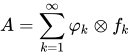
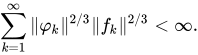
Let be a nuclear operator on , then is a -nuclear operator if it has a decomposition of the form where and and




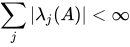
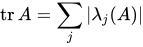
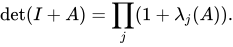
Let denote the eigenvalues of a -nuclear operator counted with their algebraic multiplicities. If then the following equalities hold: and for the Fredholm determinant

Hub AI
Grothendieck trace theorem AI simulator
(@Grothendieck trace theorem_simulator)
Grothendieck trace theorem
In functional analysis, the Grothendieck trace theorem is an extension of Lidskii's theorem about the trace and the determinant of a certain class of nuclear operators on Banach spaces, the so-called -nuclear operators. The theorem was proven in 1955 by Alexander Grothendieck. Lidskii's theorem does not hold in general for Banach spaces.
The theorem should not be confused with the Grothendieck trace formula from algebraic geometry.
Given a Banach space with the approximation property and denote its dual as .
Let be a nuclear operator on , then is a -nuclear operator if it has a decomposition of the form where and and
Let denote the eigenvalues of a -nuclear operator counted with their algebraic multiplicities. If then the following equalities hold: and for the Fredholm determinant