Hubbry Logo
Dual normDual normMain
Open search
Dual norm
Community hub
Dual norm
logo
7 pages, 0 posts
0 subscribers
Be the first to start a discussion here.
Contribute something
Dual norm
Dual norm
from Wikipedia

In functional analysis, the dual norm is a measure of size for a continuous linear function defined on a normed vector space.

Definition

[edit]

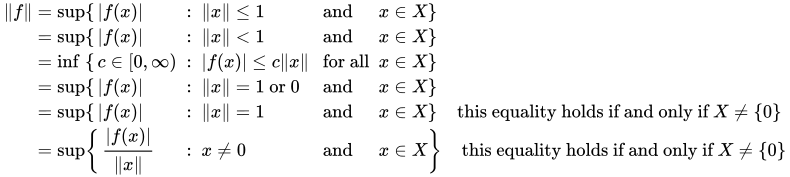
Let be a normed vector space with norm and let denote its continuous dual space. The dual norm of a continuous linear functional belonging to is the non-negative real number defined[1] by any of the following equivalent formulas: where and denote the supremum and infimum, respectively. The constant map is the origin of the vector space and it always has norm If then the only linear functional on is the constant map and moreover, the sets in the last two rows will both be empty and consequently, their supremums will equal instead of the correct value of

Importantly, a linear function is not, in general, guaranteed to achieve its norm on the closed unit ball meaning that there might not exist any vector of norm such that (if such a vector does exist and if then would necessarily have unit norm ). R.C. James proved James's theorem in 1964, which states that a Banach space is reflexive if and only if every bounded linear function achieves its norm on the closed unit ball.[2] It follows, in particular, that every non-reflexive Banach space has some bounded linear functional that does not achieve its norm on the closed unit ball. However, the Bishop–Phelps theorem guarantees that the set of bounded linear functionals that achieve their norm on the unit sphere of a Banach space is a norm-dense subset of the continuous dual space.[3][4]

The map defines a norm on (See Theorems 1 and 2 below.) The dual norm is a special case of the operator norm defined for each (bounded) linear map between normed vector spaces. Since the ground field of ( or ) is complete, is a Banach space. The topology on induced by turns out to be stronger than the weak-* topology on

The double dual of a normed linear space

[edit]

The double dual (or second dual) of is the dual of the normed vector space . There is a natural map . Indeed, for each in define

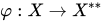
The map is linear, injective, and distance preserving.[5] In particular, if is complete (i.e. a Banach space), then is an isometry onto a closed subspace of .[6]

In general, the map is not surjective. For example, if is the Banach space consisting of bounded functions on the real line with the supremum norm, then the map is not surjective. (See space). If is surjective, then is said to be a reflexive Banach space. If then the space is a reflexive Banach space.

Examples

[edit]

Dual norm for matrices

[edit]

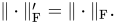
The Frobenius norm defined by is self-dual, i.e., its dual norm is

The spectral norm, a special case of the induced norm when , is defined by the maximum singular values of a matrix, that is, has the nuclear norm as its dual norm, which is defined by for any matrix where denote the singular values[citation needed].

If the Schatten -norm on matrices is dual to the Schatten -norm.

Finite-dimensional spaces

[edit]

Let be a norm on The associated dual norm, denoted is defined as

(This can be shown to be a norm.) The dual norm can be interpreted as the operator norm of interpreted as a matrix, with the norm on , and the absolute value on :

From the definition of dual norm we have the inequality which holds for all and [7][8] The dual of the dual norm is the original norm: we have for all (This need not hold in infinite-dimensional vector spaces.)

The dual of the Euclidean norm is the Euclidean norm, since

(This follows from the Cauchy–Schwarz inequality; for nonzero the value of that maximises over is )

The dual of the -norm is the -norm: and the dual of the -norm is the -norm.

More generally, Hölder's inequality shows that the dual of the -norm is the -norm, where satisfies that is,

As another example, consider the - or spectral norm on . The associated dual norm is which turns out to be the sum of the singular values, where This norm is sometimes called the nuclear norm.[9]

Lp and ℓp spaces

[edit]

For p-norm (also called -norm) of vector is

If satisfy then the and norms are dual to each other and the same is true of the and norms, where is some measure space. In particular the Euclidean norm is self-dual since For , the dual norm is with positive definite.

For the -norm is even induced by a canonical inner product meaning that for all vectors This inner product can expressed in terms of the norm by using the polarization identity. On this is the Euclidean inner product defined by while for the space associated with a measure space which consists of all square-integrable functions, this inner product is The norms of the continuous dual spaces of and satisfy the polarization identity, and so these dual norms can be used to define inner products. With this inner product, this dual space is also a Hilbert space.

Properties

[edit]

Given normed vector spaces and let [10] be the collection of all bounded linear mappings (or operators) of into Then can be given a canonical norm.

Theorem 1Let and be normed spaces. Assigning to each continuous linear operator the scalar defines a norm on that makes into a normed space. Moreover, if is a Banach space then so is [11]

When is a scalar field (i.e. or ) so that is the dual space of

Theorem 2Let be a normed space and for every let where by definition is a scalar. Then

  1. is a norm that makes a Banach space.[14]
  2. If is the closed unit ball of then for every Consequently, is a bounded linear functional on with norm
  3. is weak*-compact.

As usual, let denote the canonical metric induced by the norm on and denote the distance from a point to the subset by If is a bounded linear functional on a normed space then for every vector [18] where denotes the kernel of

See also

[edit]

Notes

[edit]

References

[edit]
[edit]
Revisions and contributorsEdit on WikipediaRead on Wikipedia
from Grokipedia
In , the dual norm of a given norm \|\cdot\| on a finite-dimensional is another norm defined on the via y=sup{yTx:x1}\|y\|_* = \sup \{ |y^T x| : \|x\| \leq 1 \}. This construction arises naturally in the study of normed s and captures the supremum of the of the inner product between yy and all unit-ball elements under the original norm, providing a measure of the "supporting" capacity of linear functionals relative to \|\cdot\|. The dual norm is always itself a norm and satisfies , yTxyx|y^T x| \leq \|y\|_* \|x\| for all x,yx, y, with equality achievable for appropriate choices. Key properties of dual norms include self-duality for certain norms and the biduality relation, where the dual of the dual norm recovers the original: x=x\|x\|_{**} = \|x\|. Common examples illustrate this complementarity: the dual of the 1\ell_1-norm x1=ixi\|x\|_1 = \sum_i |x_i| is the \ell_\infty-norm y=maxiyi\|y\|_\infty = \max_i |y_i|, while the dual of the \ell_\infty-norm is the 1\ell_1-norm; the Euclidean 2\ell_2-norm is self-dual, y2=y2\|y\|_2^* = \|y\|_2; and in matrix spaces, the dual of the norm (largest ) is the nuclear norm (sum of singular values). These pairings extend to infinite-dimensional spaces via the of bounded linear functionals, where the dual norm induces the on functionals. Dual norms are fundamental in , where they underpin Lagrange duality, conjugate functions, and conditions, enabling the transformation of primal problems into computationally tractable dual forms. For instance, the conjugate of a norm f(x)=xf(x) = \|x\| is the of the dual unit ball, f(y)=0f^*(y) = 0 if y1\|y\|_* \leq 1 and \infty otherwise, which facilitates regularization techniques like 1\ell_1-norm penalties in sparse modeling. In algorithms, dual norms guide steepest descent directions, such as in mirror descent or proximal methods, improving convergence for problems with structured norms like quadratic or 1\ell_1. Applications span (e.g., support vector machines via dual formulations), , and , where dual norms ensure sensitivity analysis and optimality certificates.

Fundamentals

Definition

In functional analysis, the dual space XX^* of a normed vector space (X,)(X, \|\cdot\|) consists of all continuous linear functionals on XX. The dual norm \|\cdot\|_* on XX^* is defined for each fXf \in X^* by f=sup{f(x):xX,x1}.\|f\|_* = \sup \left\{ |f(x)| : x \in X, \|x\| \leq 1 \right\}. This formulation arises as the operator norm of ff viewed as a bounded linear map from XX to the scalar field, capturing the supremum of the absolute values that ff attains on the closed unit ball of XX. An equivalent expression for the dual norm is the infimum over all positive constants that bound the growth of ff: f=inf{C>0:f(x)Cx for all xX}.\|f\|_* = \inf \left\{ C > 0 : |f(x)| \leq C \|x\| \text{ for all } x \in X \right\}. This infimum represents the smallest constant ensuring the continuity of ff with respect to the given norm on XX, directly tying the dual norm to the boundedness condition for linear functionals. The dual norm thus measures the "size" of linear functionals in a manner compatible with the original norm, providing a natural extension of the norm concept to the space of continuous linear maps while preserving key properties like homogeneity and the .

Dual space and double dual

In , given a XX, the XX^* is defined as the set of all continuous linear functionals from XX to the underlying (typically R\mathbb{R} or C\mathbb{C}), equipped with the dual norm f=sup{f(x):xX,x1}\|f\|_* = \sup \{ |f(x)| : x \in X, \|x\| \leq 1 \}. This norm makes XX^* itself a Banach space, regardless of whether XX is complete. The double dual, or bidual, XX^{**} is the dual space of XX^*, consisting of all continuous linear functionals on XX^* and equipped with the bidual norm g=sup{g(f):fX,f1}\|g\|_{**} = \sup \{ |g(f)| : f \in X^*, \|f\|_* \leq 1 \} for gXg \in X^{**}. There exists a canonical j:XXj: X \to X^{**} defined by j(x)(f)=f(x)j(x)(f) = f(x) for all xXx \in X and fXf \in X^*, which is linear and norm-preserving, satisfying j(x)=x\|j(x)\|_{**} = \|x\| for all xXx \in X. This embedding identifies XX isometrically with its j(X)j(X) in XX^{**}. The image j(X)j(X) is a closed subspace of XX^{**} XX is a (i.e., complete in its norm topology); in the case of an incomplete normed space, j(X)j(X) is dense but not closed in XX^{**}. It is important to distinguish the continuous dual XX^* from the algebraic dual of XX, which comprises all linear functionals on XX without the continuity requirement and is generally larger than XX^* unless XX is finite-dimensional.

Examples

p-norms and ℓ_p spaces

In the context of Lebesgue spaces, for a measure space (X,A,μ)(X, \mathcal{A}, \mu) and 1p<1 \leq p < \infty, the dual space of Lp(μ)L_p(\mu) is Lq(μ)L_q(\mu), where qq is the conjugate exponent satisfying 1p+1q=1\frac{1}{p} + \frac{1}{q} = 1. This identification is established via the Riesz representation theorem, which shows that every bounded linear functional on Lp(μ)L_p(\mu) can be represented as integration against an element of Lq(μ)L_q(\mu). Specifically, for fLq(μ)f \in L_q(\mu), the dual norm is given by fq=sup{Xfgdμ:gLp(μ),gp1},\|f\|_q = \sup \left\{ \int_X |f g| \, d\mu : g \in L_p(\mu), \, \|g\|_p \leq 1 \right\}, which aligns with the general definition of the dual norm as a supremum over the unit ball. For the sequence spaces p\ell_p (which correspond to LpL_p on the counting measure over the natural numbers), the duality holds analogously for 1<p<1 < p < \infty: the dual of p\ell_p is q\ell_q with 1p+1q=1\frac{1}{p} + \frac{1}{q} = 1, and the norms coincide under the pairing x,y=nxnyn\langle x, y \rangle = \sum_n x_n y_n..pdf) This isometric isomorphism is proven using Hölder's inequality, which bounds the pairing by nxnynxpyq\left| \sum_n x_n y_n \right| \leq \|x\|_p \|y\|_q and achieves equality for appropriate choices, ensuring the dual norm matches exactly..pdf) The extreme cases p=1p=1 and p=p=\infty exhibit distinct behaviors. For 1\ell_1, the dual is \ell_\infty, where for yy \in \ell_\infty, the dual norm is y=supny(en)\|y\|_\infty = \sup_n |y(e_n)| with {en}\{e_n\} the standard basis vectors, reflecting the supremum over unit vectors in the basis..pdf) In contrast, the dual of \ell_\infty is the larger space baba of bounded finitely additive measures on the power set of N\mathbb{N}, with the dual norm f=sup{nfnxn:x1}\|f\|_* = \sup \left\{ \left| \sum_n f_n x_n \right| : \|x\|_\infty \leq 1 \right\}, which extends beyond 1\ell_1 due to the non-reflexive nature of \ell_\infty. Hölder's inequality serves as the foundational tool for these dual pairings, stating that for fLq(μ)f \in L_q(\mu) and gLp(μ)g \in L_p(\mu), Xfgdμfqgp,\left| \int_X f g \, d\mu \right| \leq \|f\|_q \|g\|_p,
Add your contribution
Related Hubs
Contribute something
User Avatar
No comments yet.