Hubbry Logo
Reflexive spaceReflexive spaceMain
Open search
Reflexive space
Community hub
Reflexive space
logo
7 pages, 0 posts
0 subscribers
Be the first to start a discussion here.
Reflexive space
Reflexive space
from Wikipedia

In the area of mathematics known as functional analysis, a reflexive space is a locally convex topological vector space for which the canonical evaluation map from into its bidual (which is the strong dual of the strong dual of ) is a homeomorphism (or equivalently, a TVS isomorphism). A normed space is reflexive if and only if this canonical evaluation map is surjective, in which case this (always linear) evaluation map is an isometric isomorphism and the normed space is a Banach space. Those spaces for which the canonical evaluation map is surjective are called semi-reflexive spaces.

In 1951, R. C. James discovered a Banach space, now known as James' space, that is not reflexive (meaning that the canonical evaluation map is not an isomorphism) but is nevertheless isometrically isomorphic to its bidual (any such isometric isomorphism is necessarily not the canonical evaluation map). So importantly, for a Banach space to be reflexive, it is not enough for it to be isometrically isomorphic to its bidual; it is the canonical evaluation map in particular that has to be a homeomorphism.

Reflexive spaces play an important role in the general theory of locally convex TVSs and in the theory of Banach spaces in particular. Hilbert spaces are prominent examples of reflexive Banach spaces. Reflexive Banach spaces are often characterized by their geometric properties.

Definition

[edit]
Definition of the bidual

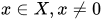
Suppose that is a topological vector space (TVS) over the field (which is either the real or complex numbers) whose continuous dual space, separates points on (that is, for any there exists some such that ). Let (some texts write ) denote the strong dual of which is the vector space of continuous linear functionals on endowed with the topology of uniform convergence on bounded subsets of ; this topology is also called the strong dual topology and it is the "default" topology placed on a continuous dual space (unless another topology is specified). If is a normed space, then the strong dual of is the continuous dual space with its usual norm topology. The bidual of denoted by is the strong dual of ; that is, it is the space [1] If is a normed space, then is the continuous dual space of the Banach space with its usual norm topology.

Definitions of the evaluation map and reflexive spaces

For any let be defined by where is a linear map called the evaluation map at ; since is necessarily continuous, it follows that Since separates points on the linear map defined by is injective where this map is called the evaluation map or the canonical map. Call semi-reflexive if is bijective (or equivalently, surjective) and we call reflexive if in addition is an isomorphism of TVSs.[1] A normable space is reflexive if and only if it is semi-reflexive or equivalently, if and only if the evaluation map is surjective.

Reflexive Banach spaces

[edit]

Suppose is a normed vector space over the number field or (the real numbers or the complex numbers), with a norm Consider its dual normed space that consists of all continuous linear functionals and is equipped with the dual norm defined by

The dual is a normed space (a Banach space to be precise), and its dual normed space is called bidual space for The bidual consists of all continuous linear functionals and is equipped with the norm dual to Each vector generates a scalar function by the formula: and is a continuous linear functional on that is, One obtains in this way a map called evaluation map, that is linear. It follows from the Hahn–Banach theorem that is injective and preserves norms: that is, maps isometrically onto its image in Furthermore, the image is closed in but it need not be equal to

A normed space is called reflexive if it satisfies the following equivalent conditions:

  1. the evaluation map is surjective,
  2. the evaluation map is an isometric isomorphism of normed spaces,
  3. the evaluation map is an isomorphism of normed spaces.

A reflexive space is a Banach space, since is then isometric to the Banach space

Remark

[edit]

A Banach space is reflexive if it is linearly isometric to its bidual under this canonical embedding James' space is an example of a non-reflexive space which is linearly isometric to its bidual. Furthermore, the image of James' space under the canonical embedding has codimension one in its bidual. [2] A Banach space is called quasi-reflexive (of order ) if the quotient has finite dimension

Examples

[edit]
  1. Every finite-dimensional normed space is reflexive, simply because in this case, the space, its dual and bidual all have the same linear dimension, hence the linear injection from the definition is bijective, by the rank–nullity theorem.
  2. The Banach space of scalar sequences tending to 0 at infinity, equipped with the supremum norm, is not reflexive. It follows from the general properties below that and are not reflexive, because is isomorphic to the dual of and is isomorphic to the dual of
  3. All Hilbert spaces are reflexive, as are the Lp spaces for More generally: all uniformly convex Banach spaces are reflexive according to the Milman–Pettis theorem. The and spaces are not reflexive (unless they are finite dimensional, which happens for example when is a measure on a finite set). Likewise, the Banach space of continuous functions on is not reflexive.
  4. The spaces of operators in the Schatten class on a Hilbert space are uniformly convex, hence reflexive, when When the dimension of is infinite, then (the trace class) is not reflexive, because it contains a subspace isomorphic to and (the bounded linear operators on ) is not reflexive, because it contains a subspace isomorphic to In both cases, the subspace can be chosen to be the operators diagonal with respect to a given orthonormal basis of

Properties

[edit]

Since every finite-dimensional normed space is a reflexive Banach space, only infinite-dimensional spaces can be non-reflexive.

If a Banach space is isomorphic to a reflexive Banach space then is reflexive.[3]

Every closed linear subspace of a reflexive space is reflexive. The continuous dual of a reflexive space is reflexive. Every quotient of a reflexive space by a closed subspace is reflexive.[4]

Let be a Banach space. The following are equivalent.

  1. The space is reflexive.
  2. The continuous dual of is reflexive.[5]
  3. The closed unit ball of is compact in the weak topology. (This is known as Kakutani's Theorem.)[6]
  4. Every bounded sequence in has a weakly convergent subsequence.[7]
  5. The statement of Riesz's lemma holds when the real number[note 1] is exactly [8] Explicitly, for every closed proper vector subspace of there exists some vector of unit norm such that for all
    • Using to denote the distance between the vector and the set this can be restated in simpler language as: is reflexive if and only if for every closed proper vector subspace there is some vector on the unit sphere of that is always at least a distance of away from the subspace.
    • For example, if the reflexive Banach space is endowed with the usual Euclidean norm and is the plane then the points satisfy the conclusion If is instead the -axis then every point belonging to the unit circle in the plane satisfies the conclusion.
  6. Every continuous linear functional on attains its supremum on the closed unit ball in [9] (James' theorem)

Since norm-closed convex subsets in a Banach space are weakly closed,[10] it follows from the third property that closed bounded convex subsets of a reflexive space are weakly compact. Thus, for every decreasing sequence of non-empty closed bounded convex subsets of the intersection is non-empty. As a consequence, every continuous convex function on a closed convex subset of such that the set is non-empty and bounded for some real number attains its minimum value on

The promised geometric property of reflexive Banach spaces is the following: if is a closed non-empty convex subset of the reflexive space then for every there exists a such that minimizes the distance between and points of This follows from the preceding result for convex functions, applied to Note that while the minimal distance between and is uniquely defined by the point is not. The closest point is unique when is uniformly convex.

A reflexive Banach space is separable if and only if its continuous dual is separable. This follows from the fact that for every normed space separability of the continuous dual implies separability of [11]

Super-reflexive space

[edit]

Informally, a super-reflexive Banach space has the following property: given an arbitrary Banach space if all finite-dimensional subspaces of have a very similar copy sitting somewhere in then must be reflexive. By this definition, the space itself must be reflexive. As an elementary example, every Banach space whose two dimensional subspaces are isometric to subspaces of satisfies the parallelogram law, hence[12] is a Hilbert space, therefore is reflexive. So is super-reflexive.

The formal definition does not use isometries, but almost isometries. A Banach space is finitely representable[13] in a Banach space if for every finite-dimensional subspace of and every there is a subspace of such that the multiplicative Banach–Mazur distance between and satisfies

A Banach space finitely representable in is a Hilbert space. Every Banach space is finitely representable in The Lp space is finitely representable in

A Banach space is super-reflexive if all Banach spaces finitely representable in are reflexive, or, in other words, if no non-reflexive space is finitely representable in The notion of ultraproduct of a family of Banach spaces[14] allows for a concise definition: the Banach space is super-reflexive when its ultrapowers are reflexive.

James proved that a space is super-reflexive if and only if its dual is super-reflexive.[13]

Finite trees in Banach spaces

[edit]

One of James' characterizations of super-reflexivity uses the growth of separated trees.[15] The description of a vectorial binary tree begins with a rooted binary tree labeled by vectors: a tree of height in a Banach space is a family of vectors of that can be organized in successive levels, starting with level 0 that consists of a single vector the root of the tree, followed, for by a family of 2 vectors forming level that are the children of vertices of level In addition to the tree structure, it is required here that each vector that is an internal vertex of the tree be the midpoint between its two children:

Given a positive real number the tree is said to be -separated if for every internal vertex, the two children are -separated in the given space norm:

Theorem.[15] The Banach space is super-reflexive if and only if for every there is a number such that every -separated tree contained in the unit ball of has height less than

Uniformly convex spaces are super-reflexive.[15] Let be uniformly convex, with modulus of convexity and let be a real number in By the properties of the modulus of convexity, a -separated tree of height contained in the unit ball, must have all points of level contained in the ball of radius By induction, it follows that all points of level are contained in the ball of radius

If the height was so large that then the two points of the first level could not be -separated, contrary to the assumption. This gives the required bound function of only.

Using the tree-characterization, Enflo proved[16] that super-reflexive Banach spaces admit an equivalent uniformly convex norm. Trees in a Banach space are a special instance of vector-valued martingales. Adding techniques from scalar martingale theory, Pisier improved Enflo's result by showing[17] that a super-reflexive space admits an equivalent uniformly convex norm for which the modulus of convexity satisfies, for some constant and some real number

Reflexive locally convex spaces

[edit]

The notion of reflexive Banach space can be generalized to topological vector spaces in the following way.

Let be a topological vector space over a number field (of real numbers or complex numbers ). Consider its strong dual space which consists of all continuous linear functionals and is equipped with the strong topology that is,, the topology of uniform convergence on bounded subsets in The space is a topological vector space (to be more precise, a locally convex space), so one can consider its strong dual space which is called the strong bidual space for It consists of all continuous linear functionals and is equipped with the strong topology Each vector generates a map by the following formula: This is a continuous linear functional on that is,, This induces a map called the evaluation map: This map is linear. If is locally convex, from the Hahn–Banach theorem it follows that is injective and open (that is, for each neighbourhood of zero in there is a neighbourhood of zero in such that ). But it can be non-surjective and/or discontinuous.

A locally convex space is called

  • semi-reflexive if the evaluation map is surjective (hence bijective),
  • reflexive if the evaluation map is surjective and continuous (in this case is an isomorphism of topological vector spaces[18]).

Theorem[19]A locally convex Hausdorff space is semi-reflexive if and only if with the -topology has the Heine–Borel property (i.e. weakly closed and bounded subsets of are weakly compact).

Theorem[20][21]A locally convex space is reflexive if and only if it is semi-reflexive and barreled.

Theorem[22]The strong dual of a semireflexive space is barrelled.

Theorem[23]If is a Hausdorff locally convex space then the canonical injection from into its bidual is a topological embedding if and only if is infrabarreled.

Semireflexive spaces

[edit]

Characterizations

[edit]

If is a Hausdorff locally convex space then the following are equivalent:

  1. is semireflexive;
  2. The weak topology on had the Heine-Borel property (that is, for the weak topology every closed and bounded subset of is weakly compact).[1]
  3. If linear form on that continuous when has the strong dual topology, then it is continuous when has the weak topology;[24]
  4. is barreled;[24]
  5. with the weak topology is quasi-complete.[24]

Characterizations of reflexive spaces

[edit]

If is a Hausdorff locally convex space then the following are equivalent:

  1. is reflexive;
  2. is semireflexive and infrabarreled;[23]
  3. is semireflexive and barreled;
  4. is barreled and the weak topology on had the Heine-Borel property (that is, for the weak topology every closed and bounded subset of is weakly compact).[1]
  5. is semireflexive and quasibarrelled.[25]

If is a normed space then the following are equivalent:

  1. is reflexive;
  2. The closed unit ball is compact when has the weak topology [26]
  3. is a Banach space and is reflexive.[27]
  4. Every sequence with for all of nonempty closed bounded convex subsets of has nonempty intersection.[28]

Theorem[29]A real Banach space is reflexive if and only if every pair of non-empty disjoint closed convex subsets, one of which is bounded, can be strictly separated by a hyperplane.

James' theoremA Banach space is reflexive if and only if every continuous linear functional on attains its supremum on the closed unit ball in

Sufficient conditions

[edit]
Normed spaces

A normed space that is semireflexive is a reflexive Banach space.[30] A closed vector subspace of a reflexive Banach space is reflexive.[23]

Let be a Banach space and a closed vector subspace of If two of and are reflexive then they all are.[23] This is why reflexivity is referred to as a three-space property.[23]

Topological vector spaces

If a barreled locally convex Hausdorff space is semireflexive then it is reflexive.[1]

The strong dual of a reflexive space is reflexive.[31]Every Montel space is reflexive.[26] And the strong dual of a Montel space is a Montel space (and thus is reflexive).[26]

Properties

[edit]

A locally convex Hausdorff reflexive space is barrelled. If is a normed space then is an isometry onto a closed subspace of [30] This isometry can be expressed by:

Suppose that is a normed space and is its bidual equipped with the bidual norm. Then the unit ball of is dense in the unit ball of for the weak topology [30]

Examples

[edit]
  1. Every finite-dimensional Hausdorff topological vector space is reflexive, because is bijective by linear algebra, and because there is a unique Hausdorff vector space topology on a finite dimensional vector space.
  2. A normed space is reflexive as a normed space if and only if it is reflexive as a locally convex space. This follows from the fact that for a normed space its dual normed space coincides as a topological vector space with the strong dual space As a corollary, the evaluation map coincides with the evaluation map and the following conditions become equivalent:
    1. is a reflexive normed space (that is, is an isomorphism of normed spaces),
    2. is a reflexive locally convex space (that is, is an isomorphism of topological vector spaces[18]),
    3. is a semi-reflexive locally convex space (that is, is surjective).
  3. A (somewhat artificial) example of a semi-reflexive space that is not reflexive is obtained as follows: let be an infinite dimensional reflexive Banach space, and let be the topological vector space that is, the vector space equipped with the weak topology. Then the continuous dual of and are the same set of functionals, and bounded subsets of (that is, weakly bounded subsets of ) are norm-bounded, hence the Banach space is the strong dual of Since is reflexive, the continuous dual of is equal to the image of under the canonical embedding but the topology on (the weak topology of ) is not the strong topology that is equal to the norm topology of
  4. Montel spaces are reflexive locally convex topological vector spaces. In particular, the following functional spaces frequently used in functional analysis are reflexive locally convex spaces:[32]
    • the space of smooth functions on arbitrary (real) smooth manifold and its strong dual space of distributions with compact support on
    • the space of smooth functions with compact support on arbitrary (real) smooth manifold and its strong dual space of distributions on
    • the space of holomorphic functions on arbitrary complex manifold and its strong dual space of analytic functionals on
    • the Schwartz space on and its strong dual space of tempered distributions on

Counter-examples

[edit]
  • There exists a non-reflexive locally convex TVS whose strong dual is reflexive.[33]

Other types of reflexivity

[edit]

A stereotype space, or polar reflexive space, is defined as a topological vector space (TVS) satisfying a similar condition of reflexivity, but with the topology of uniform convergence on totally bounded subsets (instead of bounded subsets) in the definition of dual space More precisely, a TVS is called polar reflexive[34] or stereotype if the evaluation map into the second dual space is an isomorphism of topological vector spaces.[18] Here the stereotype dual space is defined as the space of continuous linear functionals endowed with the topology of uniform convergence on totally bounded sets in (and the stereotype second dual space is the space dual to in the same sense).

In contrast to the classical reflexive spaces the class Ste of stereotype spaces is very wide (it contains, in particular, all Fréchet spaces and thus, all Banach spaces), it forms a closed monoidal category, and it admits standard operations (defined inside of Ste) of constructing new spaces, like taking closed subspaces, quotient spaces, projective and injective limits, the space of operators, tensor products, etc. The category Ste have applications in duality theory for non-commutative groups.

Similarly, one can replace the class of bounded (and totally bounded) subsets in in the definition of dual space by other classes of subsets, for example, by the class of compact subsets in – the spaces defined by the corresponding reflexivity condition are called reflective,[35][36] and they form an even wider class than Ste, but it is not clear (2012), whether this class forms a category with properties similar to those of Ste.

See also

[edit]

References

[edit]
Revisions and contributorsEdit on WikipediaRead on Wikipedia
from Grokipedia
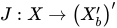
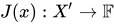
In functional analysis, a reflexive space is a Banach space XX for which the canonical evaluation map J:XXJ: X \to X^{**}, defined by J(x)(f)=f(x)J(x)(f) = f(x) for all xXx \in X and fXf \in X^* (where XX^* is the dual space and XX^{**} the bidual), is surjective, thereby establishing an isometric isomorphism between XX and its bidual. This property ensures that every continuous linear functional on the dual space XX^* arises from evaluation at some element of XX. The concept was first introduced by Hans Hahn in 1927 as part of early developments in the theory of normed linear spaces. Reflexive spaces exhibit several significant structural properties that distinguish them from general Banach spaces. Notably, the closed unit ball of a reflexive space is weakly compact, meaning every sequence in the unit ball has a weakly convergent subsequence, which aligns their behavior closely with that of finite-dimensional spaces. Additionally, reflexivity is preserved under taking closed subspaces and duals: if XX is reflexive, then so is its dual XX^*, and every closed subspace of XX is reflexive. All finite-dimensional normed spaces and Hilbert spaces are reflexive, providing foundational examples in the theory. Prominent examples of infinite-dimensional reflexive spaces include the Lebesgue spaces Lp(μ)L^p(\mu) for 1<p<1 < p < \infty, where reflexivity follows from the uniform convexity of these spaces under the pp-norm. In contrast, spaces such as 1\ell^1 (sequences absolutely summable) and c0c_0 (sequences converging to zero with the sup norm) are non-reflexive, illustrating that reflexivity is not a universal property of Banach spaces. These characteristics make reflexive spaces particularly useful in applications involving weak convergence, optimization, and operator theory, where the identification with the bidual simplifies many analytical arguments.

Core Concepts

Definition via dual spaces

In functional analysis, the dual space XX^* of a normed vector space XX over the scalar field K\mathbb{K} (typically R\mathbb{R} or C\mathbb{C}) is the vector space consisting of all continuous linear functionals on XX, that is, all bounded linear maps f:XKf: X \to \mathbb{K}. Equipped with the operator norm fX=supxX1f(x)\|f\|_{X^*} = \sup_{\|x\|_X \leq 1} |f(x)|, XX^* becomes a Banach space even if XX is merely normed. This construction captures the linear structure of XX through its "observations" via functionals, forming the foundation for duality theory. The bidual XX^{**} is defined as the dual space of XX^*, comprising all continuous linear functionals g:XKg: X^* \to \mathbb{K}. Thus, elements of XX^{**} act on functionals in XX^*, extending the duality one level further. For any normed space XX, there exists a canonical evaluation map J:XXJ: X \to X^{**}, known as the natural embedding, given by J(x)(f)=f(x)J(x)(f) = f(x) for all xXx \in X and fXf \in X^*. This map is always linear and norm-preserving (an isometry), embedding XX isometrically into XX^{**} as a subspace (closed if XX is complete). Algebraically, JJ identifies each point in XX with the functional on XX^* that evaluates it; topologically, since JJ is an isometry, it preserves the norm topology, ensuring that the image J(X)J(X) inherits the metric structure of XX. A normed space XX is reflexive if the canonical map J:XXJ: X \to X^{**} is surjective, meaning every continuous linear functional on XX^* arises as an evaluation from some element of XX. In this case, JJ is a linear isometry onto its image, and surjectivity implies that XX is isometrically isomorphic to XX^{**}, aligning the algebraic and topological structures perfectly. For incomplete normed spaces, reflexivity requires this surjectivity, but the property is most studied in complete (Banach) spaces, where XX^{**} is automatically Banach and surjectivity yields a Banach isomorphism. The canonical embedding JJ thus serves as the bridge between XX and its iterated duals. The concept of reflexivity originated in the work of Hans Hahn in 1927, who introduced the canonical map and identified spaces where it is surjective (initially termed "regular" spaces). The modern term "reflexive" was coined by Edgar R. Lorch in 1939 to describe this property precisely.

Canonical embedding and reflexivity

In the context of dual spaces, the canonical embedding provides a natural way to identify a normed vector space XX with a subspace of its bidual XX^{**}. This map, denoted J:XXJ: X \to X^{**}, is defined by J(x)(ϕ)=ϕ(x)J(x)(\phi) = \phi(x) for all xXx \in X and ϕX\phi \in X^*, where XX^* is the continuous dual of XX. Thus, J(x)J(x) acts as the evaluation functional on XX^* at the point xx, embedding XX linearly into the space of all continuous linear functionals on XX^*. A space XX is reflexive if and only if this canonical embedding JJ is surjective, meaning that every continuous linear functional on XX^* can be represented as an evaluation at some point in XX. In the case of Banach spaces, surjectivity of JJ implies bijectivity, yielding an isometric isomorphism between XX and XX^{**}. The map JJ is always linear and continuous, with J(x)=x\|J(x)\| = \|x\| for all xXx \in X, making it an isometry. To see the norm preservation, note that J(x)=supϕ1J(x)(ϕ)=supϕ1ϕ(x)=x,\|J(x)\| = \sup_{\|\phi\| \leq 1} |J(x)(\phi)| = \sup_{\|\phi\| \leq 1} |\phi(x)| = \|x\|, where the final equality follows from the dual norm definition. Continuity then holds since JJ is a linear isometry into the normed space XX^{**}. Moreover, JJ is injective: if J(x)=0J(x) = 0, then ϕ(x)=0\phi(x) = 0 for all ϕX\phi \in X^*, so x=0x = 0 by the Hahn-Banach separation theorem in normed spaces. Reflexivity also manifests in topological terms involving the weak* topology on XX^{**}, which is the weakest topology making all evaluations ψψ(ϕ)\psi \mapsto \psi(\phi) continuous for ϕX\phi \in X^*. Under this topology, the image J(BX)J(B_X) of the closed unit ball BX={xX:x1}B_X = \{x \in X : \|x\| \leq 1\} coincides with the closed unit ball BXB_{X^{**}} when XX is reflexive, ensuring that J(BX)J(B_X) is weak* closed and compact by the Banach-Alaoglu theorem. In non-reflexive spaces, J(BX)J(B_X) is proper and only weak* dense in BXB_{X^{**}}.

Banach Space Reflexivity

Fundamental properties

A fundamental property of reflexive Banach spaces is that their closed unit ball is weakly compact. This characterization, known as Kakutani's theorem, provides an equivalent condition for reflexivity in terms of topological compactness. James's theorem provides another fundamental characterization: a Banach space XX is reflexive if and only if every continuous linear functional on XX attains its norm on the closed unit ball of XX. This result was proved by Robert C. James in 1957 for separable Banach spaces and extended to general Banach spaces in 1964. The theorem connects reflexivity to the geometric property of norm attainment and is related to the weak compactness of the unit ball, as the existence of points where functionals achieve their supremum relies on the compactness in the weak topology. Reflexivity is preserved under isomorphisms: if two Banach spaces are linearly isomorphic, then one is reflexive if and only if the other is. Additionally, every closed subspace of a reflexive Banach space is itself reflexive, as the canonical embedding restricts appropriately to the subspace. James' distortion theorem asserts that if an infinite-dimensional Banach space contains a subspace isomorphic to 1\ell^1 (or c0c_0), then for any ε>0\varepsilon > 0, it contains a subspace that is (1+ε)(1 + \varepsilon)-isomorphic to 1\ell^1 (or c0c_0). This result highlights structural rigidity in non-reflexive spaces and limits how much can occur without these classical spaces almost isometrically. Reflexive Banach spaces possess the Radon-Nikodym property, which means that every closed bounded subset of the space is dentable and that vector measures taking values in the space admit densities under suitable scalar measures. This property follows from the reflexivity ensuring the existence of supporting hyperplanes in a controlled manner. In a reflexive , the closed unit ball is weakly compact, and by the Eberlein–Šmulian theorem, it is weakly sequentially compact, meaning every sequence in the unit ball has a weakly convergent . However, weak convergence does not generally imply strong convergence on the unit sphere.

Examples of reflexive Banach spaces

provide a fundamental class of reflexive Banach spaces. The establishes that every Hilbert space HH is isometrically isomorphic to its dual HH^*, via the that sends each xHx \in H to the functional ϕx(y)=x,y\phi_x(y) = \langle x, y \rangle for yHy \in H, implying that the canonical into the bidual HH^{**} is surjective, hence reflexive. The Lebesgue spaces Lp(μ)L^p(\mu) for 1<p<1 < p < \infty, where μ\mu is a σ\sigma-finite measure, are reflexive Banach spaces. Reflexivity follows from showing that the dual of LpL^p is LqL^q with 1/p+1/q=11/p + 1/q = 1, using Hölder's inequality to pair elements appropriately, and then verifying the bidual identification. Sobolev spaces Wk,p(Ω)W^{k,p}(\Omega) for integers k1k \geq 1, open sets ΩRn\Omega \subset \mathbb{R}^n, and 1<p<1 < p < \infty are reflexive as closed subspaces of the product space [Lp(Ω)](n+kk)[L^p(\Omega)]^{\binom{n+k}{k}}, which is reflexive. The closed embedding preserves reflexivity since closed subspaces of reflexive spaces are reflexive. All finite-dimensional Banach spaces are reflexive, including spaces like pn\ell_p^n for 1p1 \leq p \leq \infty and n<n < \infty. This holds because the algebraic dimension equals that of the dual and bidual, making the canonical embedding an isomorphism. Uniformly convex Banach spaces form another important class of reflexive spaces, as established by the Milman-Pettis theorem. For example, LpL^p spaces for 2<p<2 < p < \infty are uniformly convex (hence reflexive) via the Clarkson inequalities, while L2L^2 is both uniformly convex and a Hilbert space.

Non-reflexive Banach spaces

A prominent example of a non-reflexive Banach space is 1\ell^1, the space of absolutely summable real sequences equipped with the norm a1=an\|a\|_1 = \sum |a_n|. The dual of 1\ell^1 is isometrically isomorphic to \ell^\infty, the space of bounded sequences with the supremum norm, via the pairing a,y=anyn\langle a, y \rangle = \sum a_n y_n. The bidual (1)(\ell^1)^{**} is then ()(\ell^\infty)^*, and the canonical embedding J:1(1)J: \ell^1 \to (\ell^1)^{**} given by Jx(ϕ)=ϕ(x)Jx(\phi) = \phi(x) for ϕ(1)=\phi \in (\ell^1)^* = \ell^\infty is an isometric isomorphism onto its image but not surjective. To see the failure of surjectivity, note that there exist bounded linear functionals on \ell^\infty that do not arise from elements of 1\ell^1; for instance, a Banach limit is a norm-one linear functional Λ:R\Lambda: \ell^\infty \to \mathbb{R} that extends the ordinary limit on convergent sequences, satisfies Λ(y)=Λ(Sy)\Lambda(y) = \Lambda(Sy) for the shift operator SS, and agrees with limits where they exist, but no sequence in 1\ell^1 can represent it because such representations would vanish on certain ultrafilter-defined measures or fail translation invariance. Similarly, the space c0c_0 of real sequences converging to zero, normed by the supremum, is non-reflexive. Its dual is isometrically isomorphic to 1\ell^1 via the same pairing as above, restricted to sequences in c0c_0, and the bidual is (1)=(\ell^1)^* = \ell^\infty. The canonical embedding J:c0c0J: c_0 \to c_0^{**} \cong \ell^\infty maps a sequence xc0x \in c_0 to the functional Jy(x)=ynxnJy(x) = \sum y_n x_n for y1y \in \ell^1, but the image is precisely c0c_0 itself under the identification, which is a proper subspace of \ell^\infty (e.g., constant sequences like the all-ones sequence lie in \ell^\infty but not in c0c_0). Thus, JJ fails to be surjective. The space C[0,1]C[0,1] of continuous real-valued functions on the unit interval with the supremum norm provides another example, as it contains a subspace isomorphic to c0c_0. Since reflexivity is inherited by isomorphic subspaces (if XX is reflexive and YZXY \cong Z \subset X, then YY is reflexive), the presence of a non-reflexive subspace like c0c_0 implies C[0,1]C[0,1] cannot be reflexive. A concrete embedding arises from sequences of "tent" functions peaking at distinct dyadic rationals and narrowing to zero height, yielding an isomorphic copy of c0c_0. Finally, the Lebesgue space L1[0,1]L^1[0,1] of integrable functions on [0,1][0,1] with the L1L^1-norm is non-reflexive. Its dual is L[0,1]L^\infty[0,1], and the bidual is (L[0,1])(L^\infty[0,1])^*, with the canonical embedding J:L1[0,1](L1[0,1])J: L^1[0,1] \to (L^1[0,1])^{**} not surjective. Specifically, there exist elements in the bidual corresponding to finitely additive signed measures on [0,1][0,1] that extend the integral representation but are not absolutely continuous with respect to Lebesgue measure, hence not representable by integration against an L1L^1 function; this failure is tied to L1[0,1]L^1[0,1] lacking the Radon-Nikodym property.

Superreflexive Banach spaces

A superreflexive Banach space is defined as a Banach space XX such that every Banach space finitely representable in XX is reflexive. This notion was introduced by Robert C. James in the early 1970s as a refinement of reflexivity, capturing spaces with stronger geometric properties that prevent the finite representability of non-reflexive structures. An equivalent characterization is that XX is superreflexive if and only if there exists a constant K1K \geq 1 such that for all nNn \in \mathbb{N}, XX contains no KK-isomorphic copy of n1\ell_n^1 or n\ell_n^\infty. This condition ensures that as the dimension nn increases, subspaces mimicking the extreme cases of p\ell^p spaces (with p1p \to 1 or pp \to \infty) cannot embed with uniformly bounded distortion, highlighting the uniform control over non-reflexive embeddings in superreflexive spaces. Superreflexive spaces thus exhibit boundedly complete distortion properties, meaning any potential distortion of non-reflexive finite-dimensional models remains controlled and incompatible with reflexivity preservation. A key property is that every superreflexive Banach space admits an equivalent renorming that makes it uniformly convex. Conversely, any Banach space admitting an equivalent uniformly convex norm is superreflexive. This equivalence underscores the geometric stability of superreflexivity, as uniformly convex norms enforce strict separation of points, aligning with the absence of pathological finite representability. Superreflexivity implies reflexivity, since reflexive spaces form the base case of finite representability preservation, but the converse does not hold. The first counterexample to the converse was constructed by in 1973, yielding a separable reflexive lacking the approximation property; such a space cannot admit an equivalent uniformly convex norm and is thus non-superreflexive. This example demonstrates that reflexivity alone does not guarantee the stronger uniform convexity or finite representability control inherent to superreflexivity.

James' theorem on finite trees

James' theorem on finite trees provides a metric characterization of reflexivity in Banach spaces through the absence of certain finite-dimensional structures with controlled distortion. Specifically, a Banach space XX is reflexive if and only if for every ε>0\varepsilon > 0, XX does not contain a normalized finite ε\varepsilon- of arbitrary size with branching constant greater than 1+ε1 + \varepsilon. This result, established by R. C. James in 1964, links the canonical embedding into the bidual with geometric properties of finite metric embedded in the space. A normalized finite ε\varepsilon-tree in a is a finitely branching metric consisting of nodes indexed by finite sequences from a , equipped with vectors xσXx_\sigma \in X such that xσ=1\|x_\sigma\| = 1 for all nodes σ\sigma, the parent node satisfies xσ=1ki=1kxσix_\sigma = \frac{1}{k} \sum_{i=1}^k x_{\sigma^\smallfrown i} where kk is the branching degree and σi\sigma^\smallfrown i are the children, and siblings at each level are separated by xσixσjε\|x_{\sigma^\smallfrown i} - x_{\sigma^\smallfrown j}\| \ge \varepsilon for iji \ne j. The branching constant at a node is the supremum of the ratios xσi/kxσ\frac{\|\sum x_{\sigma^\smallfrown i}\| / k}{\|x_\sigma\|} over branches, measuring the distortion in norm preservation under averaging; a constant exceeding 1+ε1 + \varepsilon indicates significant subadditivity failure in the norm. These structures generalize finite-dimensional approximations of infinite-dimensional phenomena like unconditional convergence. The proof of James' theorem proceeds in two directions. If XX is non-reflexive, then by properties of the bidual , XX admits a subspace isomorphic to 1\ell_1, which embeds 1\ell_1-trees—finite where the norm is additive (branching constant close to 1)—but with extensions to higher distortion allowing branching constants >1 + \varepsilon for small ε>0\varepsilon > 0, violating reflexivity conditions derived from weak compactness. Conversely, if XX is reflexive, every is weakly relatively compact, preventing the construction of such distorting finite ε\varepsilon-trees of unbounded size, as they would imply a non-weakly compact via the tree branches. This relies on James' earlier characterizations linking reflexivity to norm attainment (see Fundamental properties) and weak sequential completeness. This theorem has significant applications in the study of spreading models, where finite tree embeddings help identify asymptotic p\ell_p-structures or mixed bases in reflexive spaces, and in unconditional bases, as the absence of high-distortion trees ensures that bases behave well under unconditional convergence without 1\ell_1-distortions. For example, in Hilbert spaces like 2\ell_2, no such ε\varepsilon-trees exist beyond trivial depth due to the parallelogram law enforcing branching constants bounded by 1. In the , Odell and Schlumprecht extended these ideas to infinite trees, showing that separable reflexive s avoid certain infinite weakly null trees with uniform branching control, providing a tree-metric analogue for reflexivity beyond finite approximations.

Locally Convex Space Reflexivity

Extension to locally convex spaces

A locally convex topological vector space XX is reflexive if the canonical evaluation map J:XXJ: X \to X'', where XX'' is the strong dual of the strong dual XX' of XX, is a surjective topological with XX''. This generalizes the Banach space case by replacing the norm topology on the bidual with the strong topology β(X,X)\beta(X', X), defined by on bounded subsets of XX. The strong dual XX' consists of all continuous linear functionals on XX, equipped with the topology of on the bounded sets of XX. In reflexive locally convex spaces, the original topology on XX coincides with the Mackey topology τ(X,X)\tau(X, X'), generated by the seminorms pϕ(x)=ϕ(x)p_{\phi}(x) = |\phi(x)| for ϕX\phi \in X'. This equivalence holds because reflexivity implies that XX is barrelled, meaning every closed convex balanced absorbing set (barrel) is a neighborhood of the origin, and all barrelled locally convex spaces are Mackey spaces. The concept of reflexivity was extended beyond normed spaces to general locally convex topological vector spaces by in his 1953 thesis "Sur les espaces (F) et (DF)", building on duality theory to handle non-normable settings. Unlike Banach spaces, where the dual and bidual are equipped with norm topologies, reflexivity in locally convex spaces involves continuous whose topologies may arise as inductive limits of finite-dimensional or simpler spaces, accommodating structures like Fréchet or LF-spaces without a global norm.

Characterizations of reflexivity

In locally convex spaces, reflexivity admits several equivalent characterizations in terms of topologies and geometric properties. A fundamental one involves the Mackey topology, defined as the finest locally convex topology compatible with the duality between a space XX and its dual XX'. Specifically, a locally convex space XX is reflexive if and only if the Mackey topology τ(X,X)\tau(X, X') on XX coincides with the Mackey topology τ(X,X)\tau(X'', X') on the bidual XX'', making the canonical embedding a topological isomorphism. Another key characterization draws from compactness in dual topologies. By the Alaoglu-Bourbaki , which generalizes the Banach-Alaoglu to locally convex spaces, the polar of any neighborhood of the origin in XX is weakly* compact in XX'. Extending this, XX is reflexive every closed convex balanced bounded subset of XX is weakly compact in the σ(X,X)\sigma(X, X'). This condition highlights the interplay between boundedness and in reflexive settings. Reflexivity also manifests in barrelled space properties. A barrel in a locally convex space is a closed, convex, balanced, and absorptive set. The space XX is barrelled if every barrel is a neighborhood of the origin. Reflexivity implies that XX is barrelled. For complete locally convex spaces, reflexivity equates to the alignment of certain dual topologies. In particular, a complete locally convex space XX is reflexive the strong topology β(X,X)\beta(X', X) on the dual XX'—generated by seminorms supxBf(x)\sup_{x \in B} |f(x)| for bounded BXB \subset X—coincides with the Mackey topology τ(X,X)\tau(X', X) on XX'. This equivalence underscores the completeness assumption in bridging strong and uniform convergence properties. In the context of bornological spaces, where the topology is generated by the uniform structure from bounded sets, reflexivity relates to the extension of linear forms. A bornological space XX is reflexive if the strong dual XX' is barrelled. Bornologicality ensures that the on XX is the finest locally convex topology compatible with the given dual pair, and the barrelledness of XX' implies that the strong and Mackey topologies on XX' coincide, leading to reflexivity. In sequentially complete locally convex spaces, reflexivity can be established using the applied to bounded families of continuous linear functionals. Specifically, if every bounded subset of the dual is equicontinuous, then the space satisfies the conditions for the Mackey to equal the strong , implying reflexivity. Recent results extend these conditions to LF-spaces, which are countable strict inductive limits of Fréchet spaces. For instance, a strict (LF)-space that is complete and Montel is reflexive.

Semireflexive spaces

A locally convex space XX is semireflexive if the canonical mapping J:XXJ: X \to X^{**} is surjective, establishing a as sets between XX and its bidual XX^{**}. This condition represents a weakening of full reflexivity, where the mapping is a topological , by requiring surjectivity without the continuous inverse. The concept was introduced by Grothendieck in his work on topological vector spaces. A characterization of semireflexive spaces is that XX is semireflexive the σ(X,X)\sigma(X, X') on XX has the Heine-Borel property, meaning every closed and bounded subset of XX is weakly compact. This property ensures that the weak compactness in the space corresponds to the surjectivity of the embedding. Semireflexive spaces relate to reflexivity in that if XX is semireflexive and its dual XX^* is also semireflexive, then XX is reflexive. This follows from the fact that the surjectivity for both XX and XX^* implies the bijectivity and topological required for reflexivity in the locally convex setting. Examples of semireflexive spaces include Montel spaces, where bounded sets are relatively compact, implying the necessary weak compactness conditions. On the other hand, non-semireflexive examples include certain inductive limits of non-barrelled spaces, where the canonical mapping fails to be surjective due to the lack of appropriate separation properties.

Sufficient conditions for reflexivity

A locally convex is reflexive if it is both barrelled and semireflexive. This condition arises from the fact that barrelledness ensures the coincidence of the Mackey topology with the strong topology on the dual under semireflexivity, thereby making the space the strong dual of its bidual. Fréchet spaces, being complete metrizable locally convex spaces, are always barrelled. Thus, a Fréchet space is reflexive it is semireflexive. Montel spaces provide another class of reflexive spaces. A Montel space is a complete locally convex space in which every equicontinuous subset is relatively compact. Such spaces are automatically barrelled and semireflexive, hence reflexive. A locally convex space XX is reflexive if it is bornological and its strong dual XX^* is barrelled. Bornologicality ensures that the topology on XX is the finest locally convex topology compatible with the given dual pair, and the barrelledness of XX^* implies that the strong and Mackey topologies on XX^* coincide, leading to reflexivity. In sequentially complete locally convex spaces, reflexivity can be established using the applied to bounded families of continuous linear functionals. Specifically, if every bounded subset of the dual is equicontinuous, then the space satisfies the conditions for the Mackey topology to equal the strong topology, implying reflexivity. Recent results extend these conditions to LF-spaces, which are countable strict inductive limits of Fréchet spaces. For instance, a strict (LF)-space that is complete and Montel is reflexive.

Properties of reflexive locally convex spaces

In reflexive locally convex spaces, the strong topology and the Mackey topology coincide both on the space itself and on its . This equivalence extends the corresponding property from Banach spaces to the broader setting of locally convex topologies, ensuring that the finest locally convex topology compatible with the duality pair aligns with the topology of on convex, balanced, and absorbing sets. Reflexive locally convex spaces are semi-Montel, meaning that every bounded subset is relatively compact in the . Equivalently, in the , every equicontinuous subset is relatively weakly compact, which follows from the surjectivity of the canonical embedding into the bidual and the Mackey-Arens theorem. This property distinguishes reflexive spaces by guaranteeing weak compactness for bounded sets without requiring the stronger sequential compactness of Montel spaces. Reflexivity is preserved under the formation of products, direct sums, and quotients, provided the original space is complete. For instance, the product of reflexive spaces inherits reflexivity through the identification of the bidual with the product of the biduals, while quotients by closed hyperplanes maintain the isomorphism with the bidual under completeness assumptions. A key theorem states that every reflexive locally convex space is fully complete, in the sense that every Cauchy net converges. This follows from the reflexivity ensuring that the space is barrelled and the on bounded sets is complete, aligning with the Banach-Dieudonné theorem generalized to locally convex settings. Unlike the Banach space case, where reflexivity of the dual follows directly from the norm structure, in general locally convex spaces, reflexivity implies that the strong dual is itself reflexive. This bidirectional reflexivity arises because the strong bidual coincides with the original space, making the strong dual's bidual isomorphic to the original space under the strong topology.

Examples and counterexamples

The S(Rn)\mathcal{S}(\mathbb{R}^n) of rapidly decreasing smooth functions on Rn\mathbb{R}^n is a prototypical example of a reflexive Fréchet space. Its reflexivity follows from the fact that it is a Fréchet-Schwartz space, where bounded sets are relatively compact, implying relative weak compactness and thus reflexivity via standard criteria for locally convex spaces. Another example is the space D(Ω)\mathcal{D}(\Omega) of smooth test functions with compact support on an open set ΩRn\Omega \subset \mathbb{R}^n, equipped with its standard inductive limit topology, forming a complete strict (LF)-space that is reflexive. The reflexivity of D(Ω)\mathcal{D}(\Omega) is established by showing that the canonical embedding into its bidual is an , with the on the bidual restricting to the on the image. Counterexamples to reflexivity in the category of locally convex spaces include inductive limits of non-reflexive spaces. For instance, if each space in the directed system is non-reflexive, the resulting inductive limit inherits this property and remains non-reflexive. Non-barrelled inductive limits provide further illustrations, as the failure of the barrelled property can prevent the canonical evaluation map from being surjective onto the bidual. Strict inductive limits of sequences of non-Montel Fréchet spaces often fail to be reflexive, particularly when the component spaces are themselves non-reflexive. Such constructions highlight how the inductive limit topology may not preserve reflexivity without additional assumptions like Montelness in the components. A non-semireflexive example arises in incomplete variants of distribution spaces, such as the space of distributions D(Ω)\mathcal{D}'(\Omega) endowed with a topology weaker than the standard strong dual topology, where the to the bidual is neither surjective nor a topological due to incompleteness. Modern counterexamples from the 2000s demonstrate non-reflexive bornological spaces, such as certain products of bornological spaces that fail to be bornological under set-theoretic assumptions, leading to structures where bounded sets do not align with reflexive properties. These examples underscore the role of incompleteness in bornological contexts, revealing pathologies absent in complete cases.

Broader Notions of Reflexivity

Reflexivity in Fréchet spaces

In Fréchet spaces, which are complete metrizable locally convex topological vector spaces, reflexivity admits a precise characterization: a Fréchet space is reflexive if and only if it is barrelled and semi-Montel. All Fréchet spaces are barrelled, where a barrelled space is one in which every barrel—an absorbing, balanced, convex, and closed set—is a neighborhood of the origin, ensuring the validity of the uniform boundedness principle in this context. Semi-Montel means that every bounded subset is relatively compact in the weak topology, a condition weaker than the full Montel property where bounded sets are relatively compact in the original topology but sufficient for reflexivity when combined with barrelledness in the metrizable complete setting. This equivalence highlights the interplay between topological completeness, metrizability, and bounded set behavior unique to Fréchet spaces. A notable property in this framework concerns nuclear Fréchet spaces, which admit an approximation by Hilbert spaces via tensor products. Among these, Schwartz spaces—nuclear Fréchet spaces defined by seminorms controlling derivatives and rapid decay at , such as the classical space of test functions on Rn\mathbb{R}^n—are reflexive. This reflexivity follows from the relative compactness of bounded sets in the , aligning with the semi-Montel condition, and underscores how decay properties enhance duality in nuclear settings. An illustrative example is the space of entire functions on C\mathbb{C}, denoted H(C)H(\mathbb{C}), endowed with the Fréchet topology of on compact subsets. This space is Montel—hence barrelled and semi-Montel—rendering it reflexive, as bounded sets (families of entire functions bounded on compacts) are equicontinuous and thus relatively compact by standard estimates from .

Reflexivity in other topological vector spaces

Reflexivity in the context of non-locally convex topological vector spaces (TVS) is inherently limited because such spaces lack a basis of convex neighborhoods of the origin. A fundamental result states that a TVS admits a non-trivial continuous dual if and only if it possesses a proper convex neighborhood of the origin. Consequently, in non-locally convex TVS, the continuous dual is trivial, rendering the canonical evaluation map into the bidual degenerate and preventing reflexivity. Moreover, even if one considers algebraic duals, the strong bidual topology on any TVS is always locally convex by construction, as it is generated by seminorms of on bounded sets. Thus, reflexivity—requiring a topological with the bidual—forces the original space to be locally convex, implying that no non-trivial non-locally convex TVS can be reflexive. In bornological spaces, reflexivity is often approached through variants like B-reflexivity, where the canonical map to the bidual equipped with the bornological topology (generated by absorbing balanced sets) is considered. A bornological TVS is B-reflexive if this map is a topological . For locally convex bornological spaces, reflexivity in the standard sense coincides with B-reflexivity. More generally, the reflexivity of a bornological space is equivalent to the reflexivity of its completion under the associated fine locally convex , as the bornology determines bounded sets, and completion preserves the duality in this setting. Other notions of reflexivity arise in specialized TVS frameworks. In ordered topological vector spaces, reflexivity can be defined via lattice duality, where the space is isomorphic to its order dual—the set of order-preserving linear functionals—equipped with an appropriate . For instance, an ordered linear space is reflexive if it coincides with its order bidual, ensuring the order structure is preserved under duality. Similarly, in inductive limits of TVS without assuming completeness, reflexivity holds if the limit is almost regular, meaning every bounded closed is contained in a of a compact set from one of the steps; this condition ensures the dual behaves well despite potential incompleteness. Recent extensions in the have explored reflexivity in quasi-complete TVS, leveraging automatic continuity theorems, which assert that bounded linear operators between certain quasi-complete spaces are continuous. In quasi-complete TVS—where every closed bounded is complete—reflexivity implies enhanced duality properties, such as the bidual map being open, facilitated by automatic continuity in non-metrizable settings. Every reflexive TVS is quasi-complete, providing a bridge to broader duality results without full completeness. A notable counterexample illustrating non-reflexivity occurs in non-Hausdorff TVS, such as the indiscrete on an infinite-dimensional , where the only continuous linear functionals are zero, yielding a trivial continuous dual and thus a degenerate bidual . In such cases, the space fails to separate points topologically, precluding any with its bidual.

References

Add your contribution
Related Hubs
User Avatar
No comments yet.