Hubbry Logo
HaydamakHaydamakMain
Open search
Haydamak
Community hub
Haydamak
logo
8 pages, 0 posts
0 subscribers
Be the first to start a discussion here.
Haydamak
Haydamak
from Wikipedia

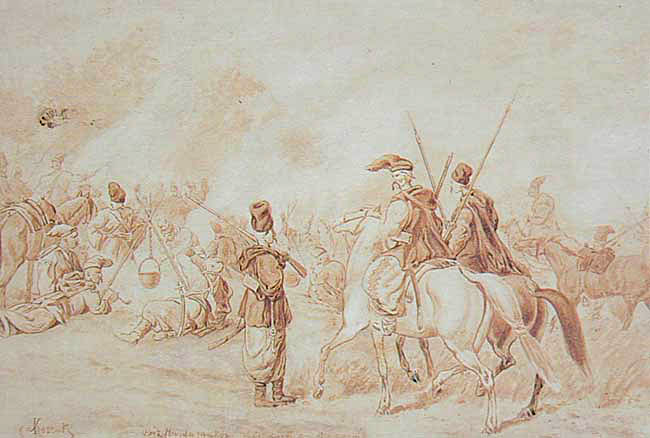
Camp of haidamakas (1899)

The haydamaks, also haidamakas or haidamaky or haidamaks (sg. haidamaka; pl. haidamaky, from Ukrainian: гайдамаки and Polish: hajdamacy) were soldiers of Ukrainian Cossack paramilitary outfits composed of commoners (peasants, craftsmen), and impoverished noblemen in the eastern part of the Polish–Lithuanian Commonwealth. They were formed in reaction to the Commonwealth's actions that were directed to reconstitute its orders[clarification needed] on territory of right-bank Ukraine,[1] which was secured following ratification of the Treaty of Perpetual Peace with the Tsardom of Russia in 1710.

Etymology and terminology

[edit]

Etymology

[edit]

The word haydamak has two related meanings: either 'Ukrainian insurgent against the Poles in the 18th century', or 'brigand'.[2] The role played by haydamaks in the anti-Polish Ukrainian revolts of the 18th-century led by Maksym Zalizniak and Ivan Honta led to the first meaning.[2]

The word has been adopted into Ukrainian from the Crimea and the neighbouring region, where it has been used in some Kipchak, Oghuz and Slavic languages.[2] The origin is the Turkic word 'haydamak', 'to drive, to drive away', the etymological vehicle being the Ottoman Turkish.[2] The verb (h)ayda was probably derived from the onomatopoeic stem used to spur someone on: 'hayda!'.[2] Depending on the local context, it was understood to mean 'driving someone or something away', and later 'to chase, to pursue'.[2] In the infinitive Turkish verbs have the ending -mak or -mek.[3] The ending -ak(a) however also exists in Ukrainian, in words with meanings somewhat related to each other, such as huljáka, 'crouser' (crouse = brisk, livelyl, confident), pyjak(a), 'drunkard', rozbyšaka, 'brigand', and that might have led to the initial meaning of 'to chase, to pursue' evolving to mean 'chaser, pursuer', and finally 'insurgent'.[2] In different other languages the meaning of 'brigand' given to hajdamak(a) took shape in accordance to the way their enemies saw the hajdamaks.[2]

In Ottoman Turkish, haydamak used to mean "a cattle-lifter, marauder",[2] and in modern Turkish it means "to attack, raid, drive cattle".[3]

Older Ukrainian terms

[edit]

Other more ancient exonyms of the same haidamaks include levenetz and deineka.[4] Equivalents of haidamaka include opryshok in Ukrainian Galicia.[clarification needed]

In other languages

[edit]

The Romanian word haidamac means 'strong, sometimes no-good man'.[5]

The words hajduk used in Central Europe and the Balkans has a similar meaning.[2]

Historical connotations

[edit]
Cossack Mamay and the Haidamaka hang a Jew by his heels. Ukrainian folk art, 19th century

Because of the massacres of Jews, Jesuits, Uniates, and Polish nobility, the Polish language term Hajdamactwo became a pejorative label for Ukrainians as a whole. However, Ukrainian folklore and literature generally (with some notable exceptions) treat the actions of the haidamaks positively. Haidamaky (1841), an epic poem by Taras Shevchenko, treats its subjects both sympathetically and critically.

History

[edit]

The term "haidamak" was used in Polish and Muscovite sources in relation to Cossacks starting from the time of Khmelnytsky Uprising in the mid-17th century. However, the emergence of haidamaks as a separate phenomenon is related to the consequences of the Treaty of Prut, which was signed in 1711 and led to a renewed partition of Ukraine between Muscovy and Poland. Starting from that time, Cossacks loyal to hetman Pylyp Orlyk and the Zaporozhian Sich engaged in raids on Right-bank Ukraine in order to expel the Polish administration from the area. Those "unruly Cossacks" became widely known as haidamaks.[6]

Haidamaks waged war mainly against the Polish nobility and collaborationists in right-bank Ukraine, though the movement was not limited to the right bank only, and they participated in Zaporozhian raids on the Cossack szlachta in left-bank Ukraine as well. The latter raids occasionally deteriorated to common robbery and murder, for example in the so-called Matsapura case in the Left Bank in 1734.[7][8]

The haidamak movement included representatives of various social strata: peasants, townspeople, impoverished nobles, Cossacks and even monks. They engaged in attacks against merchants, officials and small army units, robbed warehouses and destroyed estates. Haidamak outfits were usually led by Zaporozhian Cossacks not aligned with any neighbouring power. Living in the lands of Zaporozhian Sich, Cossack Hetmanate and Ottoman Ukraine, they remained outside of the reach of Polish authorities, and many even took official positions in government and military. From time to time, haidamaks would gather in military encampments (sich) to prepare for the next campaign. Local population in Ukraine widely supported the rebels, recognizing them as protectors of their civic, religious and economic rights, delivered them food, supplied with weapons, provided shelter and warned about enemy presence. Many joined the ranks of haidamaks themselves.

One of the main centres of haidamak activity was the Motronyn Monastery near Chyhyryn, then part of the Polish-Lithuanian Commonwealth. In 1717 the post of its hegumen was taken by a former Cossack sotnyk Ustym Sakhnenko (clerical name Ignatius), who headed the monastery for almost 40 years and turned it into a refuge for Zaporozhians. The first big wave of haidamak rebellions, which took place in 1729-1730, saw the emergence of rebel bands in nearby Chyhyryn and Medvedivka.[9]

Opposition to the szlachta and to Roman Catholics led to the haidamaka rebellions (haidamachchyna). Three major uprisings took place, in 1734, 1750, and the largest – usually referred to as Koliyivschyna in 1768.

The first uprising came during the war for control of the Polish Kingdom in 1734 after the death of Frederick Augustus II in 1733. Russian troops, brought in to remove King Stanisław I (Leszczyński), were initially seen[by whom?] as liberators from the Poles, and an insurrection developed in Kiev, spreading to Podolia and Volhynia. After Augustus III gained the throne of Poland-Lithuania in 1734, the Russian military suppressed the insurrection. Small raids by haidamakas against Polish nobility continued in the following years under the leadership of Hnat Holy.[10]

In 1750 another uprising occurred as the haidamakas continued to receive popular sympathy. Based in the lands of the Zaporozhian Cossacks, they moved into the south of the Kiev Palatinate, generating a near-complete rebellion by Right-Bank Ukraine. Although they captured a number of towns and areas, they were eventually crushed[by whom?] due to lack of organization.

In 1768, led by Zaporozhian Cossack Maksym Zalizniak and leader of the Uman Cossack paramilitary group Ivan Gonta, the peasants were initially successful in conquering much of the Kiev and Bracław Voivodeships, as well as large chunks of Volhynia and Podolia. In captured territories the nobility, Ukrainian Catholics, Jesuits and above all the Jews, were murdered en masse (see Massacre of Uman), which led to a quick response by the Polish army. By July of the same year the Poles – with Russian military assistance – had suppressed the revolt, though bloody repression against the Cossacks lasted for several years. See Koliyivschyna article for more details.

The last flare-up of the Haydamak violence occurred in 1830s, during the Ustym Karmaliuk rebellion. This final chapter of Haydamaka history was unique in large part due to the support the rebellion enjoyed not only among the peasantry, but also among the Poles and the Jews marginalized and rendered destitute by the Russian Empire.[citation needed]

Legacy

[edit]

Cultural depictions

[edit]

Ukrainian poet Taras Shevchenko presented a romanticized depiction of the haidamak movement in his poems Haidamaky (1841) and Cold Ravine (1845).

Haidamaks in Jewish and Polish Cultural Consciousness

[edit]

Prior to World War II in the cultural consciousness of Jews living on the former Polish-Lithuanian lands, as well as Poles, Haidamaks were seen in similiar way Nazis are seen today in their cultural consciousness. Calling someone a Haidamak, prior to World War II, in Jewish and Polish communities was equivalent to calling someone a Nazi today. In Jewish national memory Koliivshchyna, especially the Massacre of Uman, is often called the first Holocaust,[11] for Poles the Batoh massacre is often compared to Katyn massacre, and called "Sarmacki Katyń."[12] The massacres of unarmed civilians by Haidamaks, including Jews, Poles, Catholics of any ethnicity, and other minorities, are also sometimes compared to Volhynia and Eastern Galicia Massacres during World War II.[13] Haidamaks often boasted about the murders they committed, making songs about them: "From my childhood years I wandered the world, I murdered Poles, Jews, merchant masters — everyone I met. To tell the truth, I did not murder Uniate priests, but I flayed them while they were still alive."[14]

Commemoration

[edit]

In the 20th century the commemoration of haidamaks was promoted by Soviet Ukrainian authorities. In 1967 Cold Ravine, the historical base of haidamaks, was visited by Petro Shelest, First Secretary of the Communist Party of Ukraine, who was claimed to be a descendant of one of the haidamak leaders. Plans were made to turn the area into a memorial object, which would include a museum of Koliivshchyna, but those were never realized due to Shelest's removal from power in 1972.[15]

See also

[edit]

References

[edit]
[edit]
Revisions and contributorsEdit on WikipediaRead on Wikipedia
from Grokipedia
Haydamaks (Ukrainian: гайдамаки, haidamaky) were bands composed primarily of Ukrainian peasants, , and runaway serfs who operated as guerrillas in 18th-century under Polish-Lithuanian rule, conducting raids against Polish nobles, Catholic clergy, and Jewish leaseholders and tax farmers in response to economic exploitation, , and . The term derives from the Turkish word haydamak, signifying to chase or pursue, often connoting , though participants viewed their actions as justified resistance. These groups emerged amid intensifying social tensions, including heavy labor imposed by Polish magnates and intermediaries, which fueled sporadic uprisings such as those in 1734 and 1750, but reached their peak in the 1768 rebellion led by Maksym Zalizniak and Ivan Gonta, which escalated into widespread violence including massacres of thousands in and other areas. The , triggered by Orthodox grievances and hopes of Russian support, weakened Polish authority in the region and contributed to the broader destabilization leading to Poland's partitions, though it was brutally suppressed by combined Polish and Russian forces. While romanticized in later as defenders of national and religious liberty, the Haydamaks' campaigns were marked by indiscriminate brutality against non-combatants, particularly Jewish communities serving as economic agents of the Polish system, resulting in pogroms that highlight the causal interplay of class , ethnic , and confessional conflict in the era's causal dynamics.

Etymology and Terminology

Etymology

The term haydamak derives from the verb haydamak, signifying "to drive," "to herd," or "to chase away," often in the context of shouting imperatives like hayda to urge animals or people into motion. This root evolved semantically to denote brigands or marauders, reflecting the peripatetic and predatory of irregular fighters in Ottoman border regions. Linguistic scholarship traces the word's entry into Ukrainian as haydamak or hajdamak (гайдамака), likely through direct Ottoman-Polish-Ukrainian interactions amid 17th–18th-century raids, where such groups embodied the "driving" action against settled authorities. Scholars propose connections to Hungarian hajdú, originally meaning "herdsman" and later "" in the context of 16th–17th-century anti-Habsburg insurgents under figures like István Bocskai, suggesting a Turkic-to-Hungarian-to-Slavic borrowing chain facilitated by shared nomadic influences. This pathway aligns with broader patterns of Turkic lexical into Eastern European military terminology, where commands (hayda as "move on!") connoted both utility and defiance. Polish chronicles first applied haydamak to Cossack auxiliaries and rebels during the mid-17th-century , framing them as haydamacy—disorderly "freebooters" disrupting seigneurial order. Alternative derivations, such as direct Turkish haydut for "bandit," appear in some historical accounts but lack the verbal nuance of haydamak, which better captures the tactical mobility of these bands; primary Ottoman and Tatar attestations emphasize the "shouting to drive" sense over innate criminality. By the , the term carried overtones in Polish-Lithuanian sources, denoting social outcasts, while romanticized haydamaky as avengers against oppression.

Ukrainian and Regional Variants

In Ukrainian, the term is rendered as гайдамака (haydamaka, singular) or гайдамаки (haydamaky, plural), denoting an irregular fighter or brigand involved in 18th-century popular rebellions against Polish-Lithuanian rule, particularly in regions such as Podilia and palatinates. The word entered Ukrainian lexicon as a borrowing from via Polish mediation, initially connoting a mobile raider or pursuer (hajdemak in Turkish, meaning "to chase" or "pursue"), but evolved to specifically describe anti-feudal insurgents recruited from Cossack fringes, fugitive peasants, and Orthodox sympathizers. Regionally, in Western Ukrainian areas like Galicia under Habsburg rule, the equivalent designation for analogous bands—operating as social rebels or Robin Hood-like figures against local —was опришок (opryshok), a term derived from Romanian influences and applied to Carpathian highlanders engaging in guerrilla actions from the 17th to 19th centuries. This distinction reflects geographic and administrative divides: haydamaky dominated southern steppe-border zones with Ottoman and Cossack ties, while opryshky characterized forested, mountainous western peripheries, though both embodied resistance to and foreign domination without direct organizational links. Ukrainian historiography, drawing from 19th-century chroniclers like Danylo Shcherbatovyi, uses гайдамаччина (haidamachchyna) collectively for the series of uprisings, emphasizing their proto-national character amid religious and economic grievances, in contrast to Polish usages framing them as mere banditry. Dialectal variants in eastern Ukrainian speech occasionally appear as гайдабура (haydabura), a localism synonymous with haydamaka as a rowdy brigand or mischief-maker, preserved in 19th-century lexicographic records of Podilian and Volhynian vernaculars. These forms underscore the term's dual valence—heroic liberator in nationalist narratives versus lawless marauder in official chronicles—shaped by the socio-political contexts of usage, with no evidence of systematic phonetic divergence across core haydamak operational territories.

Connotations Across Languages and Eras

In Turkish, the root term haydamak originally connoted raiding or cattle-driving, evolving to denote marauders or freebooters by the , reflecting perceptions of irregular fighters as opportunistic bandits in Ottoman border contexts. This negative framing persisted in Polish sources from the mid-17th century onward, where haydamak described Cossack insurgents as disruptive rebels threatening the Commonwealth's authority in , often equated with criminal bands amid chronic instability. In Russian imperial accounts, the term similarly evoked , portraying haydamaks as anarchic outlaws preying on settled society during Poland's weakening, a view reinforced by their raids into the 1760s. By the , Ukrainian romantic nationalism reframed haydamaks positively in , as seen in Taras Shevchenko's 1841 epic poem Haidamaky, which depicted them as avengers against Polish noble oppression and symbols of ethnic resistance, influencing folkloric heroization despite their violent tactics. Soviet historiography from the mid-20th century further adapted this to class-warfare narratives, presenting haydamak uprisings like the 1768 as proto-revolutionary peasant struggles against feudal lords, downplaying ethnic or religious dimensions to fit Marxist frameworks. In Polish scholarship, conversely, they remained associated with barbarism and anti-Polish anarchy, with 20th-century analyses emphasizing their role in destabilizing the without romantic gloss. Jewish historical records consistently viewed haydamaks harshly as predatory paramilitaries whose raids, including the 1768 massacres, targeted Jewish leaseholders and communities, framing them as existential threats amid Ukraine's ethnic tensions rather than liberators. Across eras, these connotations highlight partisan lenses: adversarial in Polish-Russian-Jewish perspectives as societal scourges, rehabilitated in Ukrainian and Soviet ones as defiant underdogs, with modern Ukrainian nationalist discourse retaining Shevchenko's heroic archetype while acknowledging internal Cossack influences.

Preconditions and Social Context

Serfdom and Economic Exploitation in Right-Bank Ukraine

In , after the suppression of Cossack autonomy in the early , Polish authorities fully reinstated , binding the majority of Ukrainian peasants to the estates of Polish nobility and reducing them to near-total dependence. Landlords held absolute control, including the power to sell serfs individually or as families, prohibit marriages without consent, and impose arbitrary punishments, while serfs received only small subsistence plots in exchange for their obligations. This system contrasted sharply with , where Hetmanate regulations limited to 1–2 days per week and preserved a larger class of state peasants exempt from private bondage. Economic exploitation centered on the panshchyna, or labor, which initially required about two days per week in the early but escalated amid post-war population recovery and landlord demands, often consuming most of a serf's time on fields while yields from personal allotments barely sustained families. Additional burdens included fixed rents or cash, church tithes, and fees extracted by Jewish leaseholders (arendatory), who operated taverns, mills, and distilleries under noble concessions, amplifying grievances through and monopolistic practices. Large latifundia estates dominated the landscape, prioritizing export-oriented grain production for Polish magnates and leaving peasants vulnerable to and indebtedness, with conditions reaching a nadir by the . These practices fueled widespread destitution, prompting mass flight (bieh) to Zaporozhian frontiers or forests, where escaped serfs formed armed bands that preyed on symbols of . The haidamaks explicitly demanded serfdom's abolition alongside relief from noble and leaseholder exactions, reflecting how economic coercion eroded loyalty to the Polish regime and primed the region for recurrent uprisings.

Religious Persecution and Orthodox Resistance

The in 1596 formalized the subordination of much of the Ruthenian Orthodox Church to the Roman , creating the Uniate (Greek Catholic) hierarchy while those bishops and clergy remaining loyal to the faced immediate suppression, including the loss of legal recognition, seizure of ecclesiastical properties, and bans on ordaining new Orthodox priests. This schism deepened divisions in , where Orthodox believers, comprising the majority of the peasant population, encountered escalating restrictions on public worship, interconfessional marriages, and inheritance rights favoring Catholics and Uniates. Royal decrees, such as those issued under King , enforced the union through fines, excommunications, and military interventions against dissenting Orthodox communities, fostering a climate of coerced conversions and underground religious practice. By the , under renewed Polish noble dominance in following the diminished Cossack autonomy after the 1710s, Orthodox resistance manifested in clandestine brotherhoods (bratstva) that maintained secret schools, presses, and liturgical services despite periodic raids and closures ordered by Catholic bishops. These groups appealed to for protection, viewing Russian Orthodox intervention as a bulwark against and Latinization, which intensified after the 1717 suppression of the Kyiv-Mohyla Academy's influence and the 1720s bans on Orthodox publications. Economic exploitation intertwined with religious grievances, as Jewish arendators (leaseholders) acting on behalf of Catholic landlords were often targeted as symbols of confessional hierarchy, with Orthodox peasants perceiving their tax collection and estate management as extensions of anti-Orthodox policies. This backdrop of persecution galvanized irregular forces like the Haydamaks, who framed their raids as defenses of the "true faith" against "Latin heretics" and their agents, drawing on Cossack traditions of holy war (e.g., invoking the 1648 Khmelnytsky Uprising's religious rhetoric). Pamphlets and oral traditions circulated among rebels emphasized restoring Orthodox dominance, with leaders like Verlan in 1734 explicitly calling for the expulsion of Poles and Jews to enable free Orthodox worship, reflecting a causal link between suppressed religious identity and violent backlash amid serfdom's burdens. While some contemporary Polish accounts attributed uprisings solely to banditry, archival evidence from Orthodox chronicles underscores the motivational role of faith preservation, unmitigated by Commonwealth tolerance edicts that rarely extended to rural Orthodox enclaves.

Influence of Cossack Traditions and Border Instability

The Haydamak bands drew extensively from Zaporozhian traditions, incorporating their emphasis on mobile guerrilla tactics, communal organization, and a warrior ethos rooted in frontier autonomy. Former and individuals from the frequently joined or led Haydamak detachments, infusing them with practices such as elective atamans (leaders), oath-bound brotherhoods, and proficiency in raids suited to the terrain. This heritage positioned Haydamaks as inheritors of Cossack resistance against external domination, particularly Polish overlordship, while adapting it to peasant grievances over and religious suppression. The ideological core of Cossack traditions—defending Orthodox faith and communal liberty against perceived oppressors—resonated deeply with Haydamak participants, many of whom viewed their actions as a continuation of like those under in the . Haydamak and songs, preserved in Ukrainian oral traditions, often glorified Cossack-like figures as avengers, reinforcing a shared cultural of heroic . This influence extended to operational methods, including the use of hidden camps (similar to Cossack winter quarters) and alliances with nomadic elements for intelligence and mobility. Border instability in 18th-century Right-Bank Ukraine amplified these traditions by creating a vacuum of authority along the frontier, where Polish control waned amid recurrent Crimean Tatar raids—estimated at dozens annually in the 1730s–1760s—that devastated villages and displaced populations. The region's adjacency to the semi-autonomous and the lawless enabled Haydamaks to operate as cross-border raiders, retreating to Cossack-held territories after strikes on Polish estates, exploiting the Commonwealth's overstretched garrisons and internal divisions. This geopolitical flux, exacerbated by the 1667 Treaty of Andrusovo's division of , fostered a perpetual state of that Haydamaks navigated using Cossack-honed survival strategies. Such instability not only recruited fugitives into Haydamak ranks but also sustained their economic model of plunder and extraction, echoing Cossack practices of "wintering" campaigns against foes. By the 1768 uprising, this fusion had evolved Haydamak forces into a hybrid force capable of coordinated offensives, though ultimately vulnerable to concerted suppression by Polish and Russian troops.

Chronology of Uprisings

Early Actions and the 1734 Uprising

The earliest recorded Haydamak actions involved sporadic raids in during the late , targeting Polish estates and officials amid renewed enforcement of following the expiration of temporary exemptions granted after the . These raids, often conducted by fugitive from the and loyalists to the exiled , aimed to disrupt Polish control and included attacks on noble properties in regions like and palatinates. The 1734 uprising marked the first large-scale Haydamak insurrection, erupting in the context of the (1733–1738), where Russian intervention to support Augustus III created opportunities for rebellion as Polish authority weakened. Bands under leaders such as the Cossack Andrey Sulyak mobilized thousands of peasants and , rousing widespread participation across , including in Shargorod where the movement gained early momentum among burghers and landless peasants. The rebels conducted guerrilla operations, robbing and destroying villages, estates, and towns in , , and , with significant violence directed at Polish , Catholic , and Jewish leaseholders perceived as agents of exploitation. This uprising acquired elements of class struggle, driven by economic grievances and the reimposition of feudal obligations, leading to the devastation of multiple settlements and the deaths of numerous elites and intermediaries. Russian troops initially tolerated or indirectly supported the unrest during their occupation, but the rebellion subsided following their withdrawal and Polish reprisals, which restored order through military campaigns though failing to address underlying causes. The events foreshadowed recurrent Haydamak , highlighting the fragility of Polish rule in the region.

Mid-Century Raids and the 1750 Uprising

In the decades following the 1734 uprising, haydamak bands conducted sporadic raids across , targeting Polish estates and settlements amid ongoing and religious tensions. These mid-century actions, primarily in the 1740s, involved small groups operating from Zaporozhian refuges, employing guerrilla tactics to plunder villages and evade Polish forces disorganized by internal conflicts. The 1750 uprising erupted spontaneously in southern province, driven by accumulated peasant grievances without direct external incitement, rapidly spreading to Podilia and . Haydamak forces, bolstered by Cossack elements and popular sympathy, seized multiple towns, destroying estates and inflicting heavy losses on Polish landowners and Jewish communities through , , and killings estimated in the thousands. Under unnamed Cossack leaders, the rebels focused on Catholic and Uniate clergy alongside nobles, reflecting Orthodox resistance to perceived religious imposition, though their methods included indiscriminate violence against non-combatants. Polish suppression relied on ad hoc militias raised by local , which after prolonged engagements quelled the revolt, restoring order but highlighting the regime's vulnerability to such internal disruptions.

The Koliivshchyna Uprising of 1768

The Koliivshchyna Uprising erupted in in May 1768, driven by long-standing grievances over and imposed by Polish Catholic landowners and their agents. Maksym Zalizniak, a Zaporozhian Cossack from near , initiated the rebellion by assembling a band of several hundred haidamaks in the region around Subotiv and Zhabotyn, proclaiming a defense of Orthodox faith and imperial Russian protection against Polish oppression. Early actions included raids on estates, targeting Polish nobles, Uniate clergy, and Jewish estate managers (arendators) who collected rents and taxes from peasants, resulting in the deaths of dozens in initial skirmishes. By late May, Zalizniak's forces had grown to thousands, incorporating fugitive serfs, Cossacks, and Orthodox clergy, and captured the town of Zhabotyn, where they executed local Polish officials and burned manorial records to symbolize the abolition of feudal dues. A pivotal escalation occurred when Ivan Gonta, captain of the Polish-employed Cossack militia in Uman, defected to the rebels on June 20, 1768, bringing 500–1,000 armed men and enabling the joint assault on Uman. Over June 20–21, the haidamaks overran the fortress town, massacring an estimated 2,000–5,000 Polish nobles, soldiers, Uniate priests, and Jewish residents in a three-day orgy of violence that included torture and desecration of Catholic sites, while sparing some Orthodox inhabitants who joined the cause. The uprising rapidly expanded across , , and Podilia voivodeships, with subordinate leaders like Semen Nezhyvy and Mykyta Shvachka commanding detachments that sacked over 20 towns and villages, including Motryn and Korsun, killing hundreds more in reprisals against perceived oppressors and redistributing looted and to peasants. Haidamak tactics emphasized mobility and surprise, using Cossack-style guerrilla raids to avoid pitched battles with superior Polish forces engaged in the Bar Confederation's anti-Russian campaigns, while propaganda invoked a forged Russian imperial manifesto promising and religious freedom to rally support. Total rebel strength peaked at 10,000–20,000, but internal discipline frayed as atrocities alienated potential allies, including initially contacted for aid. Hopes for Russian backing collapsed in late June 1768 when imperial troops, prioritizing stability amid the brewing Russo-Turkish War, clashed with haidamak bands and disarmed stragglers near the Dnieper River. On July 7, Zalizniak, Gonta, and Nezhyvy were arrested during negotiations with Russian commanders near Ivanivka, effectively decapitating the movement; Gonta was extradited to Polish authorities for execution by impalement in Uman, while Zalizniak received a sentence of hard labor in Siberia. Scattered remnants continued minor raids into early 1769, but the core uprising lasted under two months, leaving an estimated 10,000–20,000 dead primarily among Polish elites and Jewish intermediaries, though figures vary due to incomplete records and biased contemporary accounts from noble chroniclers. The event intensified Polish-Russian tensions and foreshadowed the partitions of Poland, while embedding haidamak motifs in Ukrainian folklore as symbols of resistance against serfdom.

Organization and Operations

Social Composition of Haydamak Bands

The Haydamak bands were primarily composed of disaffected peasants, including many fugitive escaping the burdens of and labor under Polish landlords in . These rural laborers formed the numerical core of the detachments, driven by economic grievances and religious tensions, with their participation intensifying in mid-century uprisings where they constituted the majority of attackers. Impoverished or unattached Cossacks, often from the Zaporozhian Sich or borderlands, supplied leadership, tactical knowledge, and a martial ethos inherited from earlier Cossack traditions, though they were outnumbered by peasant recruits in larger actions. Smaller contingents included artisans, petty burghers, hired laborers, and occasionally townsfolk or even discontented clergy, reflecting a cross-section of Orthodox lower strata opposed to Catholic Polish dominance, but without significant involvement from the nobility or higher estates. In the 1768 Koliivshchyna uprising, contemporaneous estimates indicate roughly 500–600 alongside 4,000–5,000 peasants in pivotal engagements, underscoring the peasant-heavy base that amplified the movement's scale before its suppression. Bands operated fluidly, with members joining temporarily for raids before dispersing into forests or steppes, which facilitated from transient fugitives but hindered sustained .

Tactics and Methods of Guerrilla Warfare

The Haydamaks conducted operations through small, mobile bands typically comprising 50 to 500 fighters, drawing on Cossack traditions of to execute hit-and-run raids against Polish estates, administrative outposts, and settlements in . These groups, often led by elected atamans, prioritized surprise attacks launched from concealed bases in forests, riverine areas, or the Zaporozhian , using local knowledge of terrain to isolated targets before dispersing to avoid retaliation from regular troops. Their methods emphasized rapid mounted assaults, enabling quick and overwhelming of defenders in vulnerable locations such as manors or market towns, followed by plunder of grain, livestock, and weapons to sustain operations. In major uprisings like the of 1768, Haydamak tactics escalated to coordinated seizures of larger centers, such as the fortress town of on June 7, where rebels under Maksym Zalizniak exploited internal divisions and numerical superiority—gathering up to 6,000 fighters—to breach defenses through infiltration and combat, resulting in the slaughter of thousands of Polish soldiers, nobles, clergy, and civilians. Bands avoided pitched battles against disciplined Polish haiduk or Russian , instead employing feints, decoy maneuvers, and scorched-earth retreats to prolong engagements and wear down pursuers logistically. Cossack influence introduced scouting parties for intelligence and charges with sabers and lances, effective for routing disorganized garrisons but less so against fortified positions. Weapons were improvised and captured, including muskets, pistols, scythes converted to bardiches, and axes for close-quarters fighting, supplemented by to destroy and deny resources to authorities. This asymmetric approach, rooted in the fluid social composition of fugitives and disaffected peasants, sustained intermittent raids from the 1730s through the 1760s, with peaks in 1734 and 1750 seeing bands like those under or Hrab raid estates, killing dozens of officials per incursion before melting into the countryside. While effective for localized terror and resource extraction, these methods lacked strategic cohesion, contributing to fragmentation and ultimate suppression by joint Polish-Russian expeditions deploying cordons and mass hangings.

Leadership and Alliances

The leadership of Haydamak bands consisted primarily of atamans—charismatic chieftains elected or emerging through prowess—who were often providing tactical direction, drawing on traditions of and Orthodox resistance. These leaders coordinated loosely structured detachments rather than formal hierarchies, with authority rooted in personal loyalty and battlefield success rather than centralized command. In earlier uprisings, such as that of 1734, initial coordination efforts were led by Cossack centurions like , while raids in the 1750s involved unnamed Cossack atamans directing assaults on Polish estates in , , and . The 1768 Koliivshchyna uprising marked the movement's apex, under Maksym Zalizniak, a Zaporozhian Cossack from Medvedivka near who operated from the Kholodnyi Yar forest base and proclaimed himself , mobilizing thousands through appeals to Cossack revival and Orthodox grievances. Zalizniak's forces were bolstered by Ivan Gonta, captain of the Uman Cossack regiment in the service of Polish voivode Franciszek Salezy Potocki, who defected with his 500-man militia upon Zalizniak's approach to on June 8, 1768, assuming a colonelcy among the rebels. Alliances formed organically with the Zaporozhian Cossack Host, which supplied ideological impetus, refuge in the Sich after raids, and occasional detachments for joint operations, as Haydamaks frequently originated from or retreated to Cossack territories beyond Polish control. Tactical pacts emerged with local unregistered Cossacks and peasant militias, exemplified by Gonta's regiment integration, but bands remained autonomous, avoiding formal ties to imperial powers like Russia or the Ottoman Empire despite occasional opportunistic overtures—such as 1768 appeals to Russian commanders during the Russo-Turkish War, which yielded no sustained support and culminated in Russian arrests of leaders like Zalizniak in July 1768. This independence preserved operational flexibility but limited scalability against Polish-Lithuanian reprisals.

Suppression and Immediate Consequences

Russian and Polish Responses

Russian Empress Catherine II directed General Mikhail Nikitich Krechetnikov to deploy troops in support of Polish Crown forces against the Haydamak rebels during the 1768 uprising. Russian units advanced alongside Polish contingents starting in late June 1768, routing rebel detachments in and capturing key leaders including Maksym Zalizniak and Ivan Gonta during negotiations near a Russian camp. Zalizniak, the primary commander, was transported to for trial and subsequently exiled to , where he died in penal servitude around 1790. Polish forces, comprising noble militias and regular troops from the , Podilia, and voivodeships, collaborated in the suppression, focusing on punitive measures against captured insurgents. Gonta, a former Polish Cossack officer who defected to the rebels, was surrendered to Polish custody, subjected to prolonged including , and executed by dismemberment in in late September 1768. Polish units conducted brutal interrogations and summary executions, such as at Kodnia near , targeting not only active participants but also suspected sympathizers among the peasantry. In earlier uprisings, responses followed similar patterns of military intervention and reprisals. Following the 1734 , Russian armies suppressed the unrest after III's enthronement, while Polish authorities imposed additional repressions, torturing and executing captives to deter future actions. The 1750 uprising was quelled primarily by assembled Polish noble forces without direct Russian involvement, though it highlighted the Commonwealth's reliance on localized militias amid weakening central authority. By July 1768, the was fully subdued through these combined efforts, ending large-scale Haydamak activity and initiating broader liquidations like the Zaporozhian Sich's destruction in 1775.

Massacres and Reprisals

During the Koliivshchyna uprising of 1768, Haydamak forces under leaders Maksym Zalizniak and Ivan Gonta conducted widespread massacres targeting Polish nobles, Catholic clergy, Uniate priests, and Jewish leaseholders and townspeople, whom they associated with serfdom and religious oppression. The most notorious occurred at Uman in early June 1768, where rebels overran the town and killed an estimated 20,000 Poles and Jews over several days; resistance in a synagogue resulted in the slaughter of 3,000 Jews there alone, with bodies subsequently piled outside the gates. Similar attacks struck towns across Kyiv, Bratslav, Podilia, and Volhynia voivodeships, including Tetiub, Golta, Balta, Tulchin, and Fastov, claiming hundreds more victims through indiscriminate killings and arson. Polish and Russian authorities responded with coordinated military suppression starting in late June 1768, deploying troops to crush remaining Haydamak bands and prevent further spread of violence. Russian Ivan Krekchetnikov captured key leaders Zalizniak and Gonta, transferring them to Polish custody for ; Gonta, a former Uman Cossack captain who had defected, endured a particularly gruesome execution in , involving , , and a red-hot before quartering. Polish commander Franciszek Stempkowski led operations that dismantled dispersed rebel groups, resulting in mass executions of captured fighters and suspected sympathizers, with bloody reprisals extending into 1769. These reprisals effectively ended the immediate threat but fueled cycles of resentment, as authorities imposed collective punishments on villages harboring rebels, including confiscations and forced relocations. Earlier uprisings in 1734 and 1750 had seen analogous patterns, with Polish forces executing hundreds of Haydamaks post-suppression, though on a smaller scale than in 1768. The joint Russian-Polish effort underscored the geopolitical context, where suppression served both to restore order and to counter the Polish Bar Confederation's anti-Russian activities that had indirectly sparked the revolt.

Liquidation of the Zaporozhian Sich

In the aftermath of the Pugachev Rebellion (1773–1775), during which elements of the provided tacit support or refuge to rebels, Russian authorities under Catherine II viewed the autonomous as a persistent threat to imperial control, prompting its targeted elimination to prevent further insurgencies. , overseeing southern frontier affairs, instructed General Peter Tekeli in late May 1775 to advance on the Nova (Pidpilnenska) Sich with approximately 4,000–6,000 troops, including regular , , and loyal Cossack auxiliaries. The Zaporozhian Host, numbering around 5,000 registered Cossacks under Kosh Otaman Petro Kalnyshevsky, opted for surrender without armed resistance on June 5, 1775, after negotiations; Russian forces promptly demolished the Sich's fortifications, seized its treasury (valued at over 300,000 rubles in cash and goods), archives, and regalia, while dispersing the population. Kalnyshevsky and senior officers, including Writing Chancellery head Ivan Yablonsky, were arrested and exiled—Kalnyshevsky to lifelong imprisonment in the Solovetsky Monastery, where he died in 1803. Catherine II formalized the dissolution via a manifesto on August 3, 1775, declaring the Sich's lands annexed to the newly formed Novorossiya Governorate for systematic colonization and agricultural development, effectively ending the Cossacks' semi-independent political and military structure east of the Dnieper. This action curtailed the Sich's role as a sanctuary for dissidents, including fugitive haydamaks from Right-Bank uprisings like the Koliivshchyna, thereby neutralizing a cross-border haven that had occasionally sheltered anti-Polish and anti-Russian irregulars amid ongoing border instabilities. Immediate repercussions included the forced resettlement of surviving into Russian regular forces or scattered villages, with thousands fleeing southward to Ottoman territories along the , where they reestablished a Transdanubian in under former Otaman Sidor Bily. The facilitated Russian expansion into the , incorporating fertile black-earth lands into imperial estates and promoting settlement by state peasants and foreign colonists, but it also eroded traditional Cossack martial traditions, contributing to long-term demographic shifts in the region.

Historical Interpretations and Debates

Portrayals as Criminal Bandits

In Polish historiography, haidamaks were frequently characterized as opportunistic bandits and unruly whose actions prioritized plunder over legitimate political resistance against the Polish-Lithuanian Commonwealth. This perspective, rooted in 18th- and 19th-century accounts from Polish chroniclers and officials, highlighted their raids on estates, villages, and merchant convoys as manifestations of criminality rather than structured , often likening them to common thieves disrupting . For instance, Polish sources emphasized the haidamaks' targeting of wealthy landowners and Jewish leaseholders not solely for ideological reasons but as predatory enterprises that enriched band leaders through and , with little evidence of broader egalitarian aims. Russian imperial records similarly framed haidamak activities during the Uprising of 1768 as banditry warranting suppression, portraying the groups as lawless mobs that exploited Cossack traditions for personal gain amid the Right-bank Ukraine's instability. Official dispatches from the period documented haidamak detachments as comprising deserters, fugitive peasants, and habitual offenders who engaged in arbitrary violence, including the seizure of livestock, grain stores, and personal valuables, which aligned more closely with itinerant than coordinated . This influenced punitive measures, such as the joint Russo-Polish military campaigns that treated captured haidamaks as felons subject to or , underscoring a view of their operations as antithetical to state authority rather than proto-nationalist struggle. Critics of romanticized narratives, including some 20th-century scholars, have reinforced this portrayal by noting the haidamaks' lack of centralized command and reliance on ad hoc alliances, which facilitated episodes of unchecked predation on non-combatants and blurred distinctions between guerrilla tactics and outright criminality. Jewish contemporary memoirs, such as those from 18th-century Podolia, further corroborate this by recounting haidamak incursions as brutal heists motivated by greed, where bands coerced locals into revealing hidden treasures under threat of death, independent of anti-Polish sentiment. While acknowledging occasional anti-feudal rhetoric, these sources argue that empirical records of sporadic, self-serving violence—such as the 1768 sacking of Uman, where plunder preceded organized revolt—undermine claims of purely heroic intent, positioning haidamaks within a continuum of frontier banditry prevalent in the Polish-Turkish borderlands.

Romanticization as Defenders Against Oppression

In 19th-century , the Haydamaks were romanticized as valiant defenders of the oppressed peasantry against Polish noble domination and , particularly through Taras Shevchenko's epic poem Haidamaky (1841), which dramatizes the 1768 uprising led by Maksym Zalizniak and Ivan Gonta. Shevchenko, drawing from his grandfather's eyewitness accounts of the revolt, portrayed the rebels as symbols of national and social liberation, emphasizing their resistance to labor, land exploitation by Polish magnates, and religious pressures from Catholic and Uniate clergy. The poem frames Gonta, a of who defected to the rebels, as a torn by loyalty to his Orthodox faith and kin, culminating in his brutal execution by the Poles in October 1768, thereby evoking for the underclass's futile yet noble stand. This literary depiction infused the Haydamaks with Romantic ideals of folk heroism and anti-tyranny struggle, influencing Ukrainian populist of the era, which idealized them as precursors to Cossack-led independence efforts while downplaying against non-Orthodox groups. Folk songs and dumas preserved similar heroic motifs, recounting raids on Polish estates in —such as the 1734 and 1750 uprisings—as righteous assertions of Orthodox rights and from Jewish leaseholders allied with nobles, though these narratives often served to foster ethnic amid imperial partitions. By the late 19th and early 20th centuries, amid rising Ukrainian national consciousness under Russian and Austro-Hungarian rule, Shevchenko's work elevated the Haydamaks to emblematic status in the independence movement, symbolizing peasant agency against foreign oppression despite the uprisings' ultimate suppression by combined Polish and Russian forces. Such portrayals, while rooted in verifiable grievances like the heavy burdens—up to six days weekly—and documented in period petitions, reflect a selective nationalist lens that prioritizes anti-feudal causation over the revolts' chaotic escalation into mass killings exceeding 20,000 victims in alone. Ukrainian sources from Shevchenko onward, often produced in contexts of cultural revival, exhibit an inherent bias toward glorifying indigenous resistance, contrasting with Polish accounts that frame the bands as anarchic brigands; this divergence underscores the need to imperial records for causal balance, revealing the uprisings as driven by both systemic exploitation and opportunistic plunder.

Involvement in Anti-Jewish Violence and Its Context

The Haidamak bands, operating primarily in the Polish-Lithuanian Commonwealth's Ukrainian territories during the , routinely targeted communities amid their raids against Polish landowners and authorities, viewing Jews as economic intermediaries enforcing exploitative systems. arendators—leaseholders managing taverns, mills, and estates on behalf of absentee Polish nobles—collected rents, taxes, and fees from Orthodox peasant serfs, fostering deep resentment as Jews became proxies for noble oppression despite lacking political power themselves. This socio-economic friction, compounded by religious divides between Orthodox Haidamaks and communities, escalated into pogroms during major uprisings, where against Jews served both retaliatory and opportunistic purposes, including plunder of Jewish property. The Koliyivshchyna uprising of 1768–1769, the largest Haidamak revolt, exemplified this pattern, erupting in Right-Bank Ukraine under leaders Maksym Zalizniak and Ivan Gonta, who mobilized Cossacks and peasants against Polish rule amid the Bar Confederation's chaos. Beginning in June 1768, the rebels systematically attacked Polish nobles, Catholic clergy, Uniate believers, and Jewish settlers, with massacres documented in towns across Podolia and Kyiv regions; Jewish victims were often singled out for their perceived allegiance to Polish interests, leading to the destruction of synagogues and entire shtetls. Overall estimates for the uprising's death toll range from 100,000 to 200,000, including substantial Jewish losses that decimated communities, though precise figures for Jews alone vary due to incomplete contemporary records, with some accounts citing tens of thousands affected across episodes. A focal point was the Uman from June 27–29, 1768 (5–7 Tammuz), where Gonta's forces overran the town, compelling local Christians to join or face death while systematically slaughtering and Polish residents who sought refuge together; victims were tortured, impaled, or drowned, with Gonta reportedly issuing ultimatums to kill any sheltering . Estimates of fatalities in specifically range widely from 2,000 to 20,000 combined Polish and dead, reflecting the scale of brutality that left mass graves and prompted fasting observances in tradition; survivors buried victims in communal pits at the local . These acts, while embedded in an anti-feudal rebellion, deviated into ethnic-religious targeting, as Haidamaks spared fellow Orthodox peasants but pursued indiscriminately, underscoring how economic grievances fused with to produce targeted violence beyond the uprising's core political aims.

Long-Term Legacy

Influence on Ukrainian Nationalism

The Haydamak uprisings, particularly the of 1768, exerted influence on primarily through 19th-century literary and historiographical romanticization, framing them as emblematic of popular resistance against Polish-Lithuanian Commonwealth oppression. Taras Shevchenko's epic poem Haydamaky, completed in 1841 and first published in 1845, portrayed the rebels—led by Maksym Zalizniak and Ivan Gonta—as avengers of and Catholic domination, blending historical events with folk motifs to evoke a collective Ukrainian struggle for . This work, drawing on oral traditions and Cossack lore, elevated the Haydamaky from marginalized outlaws to symbols of proto-national defiance, resonating amid rising cultural awakening under Russian imperial rule. Shevchenko's narrative, which glossed over the uprisings' anti-Jewish violence to emphasize anti-feudal themes, aligned with Romantic ideals of folk heroism and helped forge a distinct Ukrainian ethnic consciousness separate from Russian or Polish identities. By invoking the Haydamaky's guerrilla tactics and egalitarian ideals—rooted in Zaporozhian Cossack traditions—the poem inspired subsequent generations of intellectuals, including members of the Ukrainian romantic school, to view these events as foundational to national self-assertion. Ukrainian populist historians of the mid-19th century, such as Mykhailo Maksymovych, further idealized the Haydamaky in scholarly works, interpreting their actions as early manifestations of agrarian revolt against foreign exploitation rather than mere banditry. This romanticized legacy persisted into 20th-century nationalist discourse, where Haydamak imagery symbolized unyielding opposition to imperial powers, influencing organizations like the Organization of Ukrainian Nationalists (OUN) in their emphasis on armed insurgency and historical continuity with Cossack forebears. However, Soviet historiography from the onward suppressed such portrayals, recasting the uprisings as class-based peasant revolts devoid of nationalistic import, which limited their direct mobilization until post-1991 revival in independent Ukraine's cultural narratives. Despite debates over the movements' chaotic nature and interethnic violence, their invocation in Shevchenko's oeuvre remains a cornerstone of Ukrainian identity formation, underscoring themes of resilience against assimilation.

Depictions in Literature, Art, and Folklore

Taras Shevchenko's epic poem Haidamaky, published in 1841, portrays the haidamaks as central figures in the Koliivshchyna uprising of 1768, led by Maksym Zalizniak and Ivan Gonta, framing their rebellion as a response to Polish oppression while depicting the ensuing violence, including massacres in Uman. The work draws on historical events and folklore, romanticizing the haidamaks as unruly avengers against serfdom and foreign rule, though it controversially includes graphic scenes of interethnic bloodshed that have sparked debate over its nationalist undertones. Shevchenko's narrative influenced subsequent Ukrainian literature by embedding the haidamaks as symbols of popular resistance, with their actions justified through first-person accounts of suffering under gentry exploitation. In , haidamaks appear in epic songs and ballads as heroic outlaws who raided Polish estates and liberated serfs, often celebrated for defying authorities in the steppe regions beyond the River. These oral traditions, collected in the , emphasize themes of and Cossack camaraderie, portraying haidamaks as "unruly ones" of Turkic who embodied peasant defiance, though some variants acknowledge their . The persistence of such lore contributed to the haidamaks' integration into narratives, merging historical rebellion with mythic elements of retribution against enslavers. Visual depictions in art romanticize the haidamaks' martial lifestyle, as seen in Mykola Samokish's 1899 watercolor Haidamak on a , which captures a mounted figure in Cossack attire, highlighting mobility and insurgency in the Ukrainian steppe. Such works, produced amid rising Ukrainian cultural revival, emphasize the haidamaks' role as equestrian warriors rather than mere bandits, aligning with literary heroic portrayals. Later artists like Stadnychuk continued this tradition in paintings evoking collective haidamak bands, reinforcing their image as folk defenders in visual media.

Modern Historiographical Perspectives

In the second half of the , Polish historiography, as represented by Władysław A. Serczyk, interpreted the Haydamak uprisings, particularly the Koliyivshchyna of 1768, as a convergence of social discontent over , religious antagonism toward Catholic and Uniate institutions, and nascent Ukrainian ethnic consciousness, with the Uman massacre resulting in approximately 12,000 deaths among Polish nobility, Jewish leaseholders, and Uniate . This multi-causal framework contrasted with earlier Polish views, such as those of Franciszek Rawita-Gawroński, which emphasized Haydamak fueled by Orthodox fanaticism and alleged Turanian ethnic predispositions, often attributing the unrest to Russian intrigue in . Ukrainian perspectives diverged sharply, with scholar Petro Mirchuk framing the Koliyivshchyna as a deliberate national-liberation campaign against Polish domination, led by figures like Maksym Zalizniak with the goal of reviving Cossack autonomy akin to the Hetmanate; he contested Polish estimates of 5,000–18,000 Uman victims as inflated propaganda, prioritizing rebel agency over indiscriminate violence. In Soviet Ukrainian historiography, Grigorij Hraban applied a Marxist , depicting Haydamak actions as proto-revolutionary class warfare by impoverished peasants and against feudal exploitation, while minimizing ethnic and religious targeting—such as the disproportionate killing of as economic intermediaries for Polish lords—and claiming fewer than 2,000 deaths at based on selective archival reinterpretation. These interpretations underscore persistent national biases: Polish accounts, rooted in partitions-era trauma, stress criminality and anti-Polish pogroms, while Ukrainian ones, shaped by independence aspirations or Soviet , elevate anti-colonial resistance, often contextualizing anti-Jewish violence as incidental to broader grievances rather than religiously incited . Post-Soviet has sought synthesis, acknowledging from 18th-century reports of widespread massacres—totaling tens of thousands across uprisings, per Russian and Polish dispatches—as outcomes of structural failures in the Polish-Lithuanian Commonwealth's borderlands, where Orthodox peasants faced burdens enforced by Jewish arendators and Catholic , yet without excusing the causal chain of clerical agitation leading to confessional targeting. Such views prioritize verifiable socio-economic pressures over romanticized heroism, critiquing earlier narratives for ideological distortion amid academia's left-leaning tendencies to frame revolts as progressive irrespective of collateral ethnic devastation.

References

Add your contribution
Related Hubs
User Avatar
No comments yet.