_Hydrangea_macrophylla,_Iwafune,_Isumi,_Chiba,_Japan_2.jpg/2000px-(Natural)_Hydrangea_macrophylla,_Iwafune,_Isumi,_Chiba,_Japan_2.jpg)

Hydrangea macrophylla
View on Wikipedia
| Hydrangea macrophylla | |
|---|---|
_Hydrangea_macrophylla,_Iwafune,_Isumi,_Chiba,_Japan_2.jpg)
| |
| Hydrangea macrophylla growing wild in Chiba Prefecture, Japan | |
Scientific classification 
| |
| Kingdom: | Plantae |
| Clade: | Embryophytes |
| Clade: | Tracheophytes |
| Clade: | Spermatophytes |
| Clade: | Angiosperms |
| Clade: | Eudicots |
| Clade: | Asterids |
| Order: | Cornales |
| Family: | Hydrangeaceae |
| Genus: | Hydrangea |
| Species: | H. macrophylla
|
| Binomial name | |
| Hydrangea macrophylla | |
| Synonyms[1] | |
|
List
| |
_Hydrangea_macrophylla,_Oshima,_Shizuoka,_Japan_07.jpg)
Hydrangea macrophylla is a species of flowering plant in the family Hydrangeaceae, native and endemic to Japan.[1] It is a deciduous shrub growing to 3 m (10 ft) tall by 2.5 m (8 ft) or more broad with large heads of pink or blue flowers in summer and autumn.[2][3][4] It is currently treated as monotypic, with no subspecies or varieties.[1] Common names include bigleaf hydrangea, and, for particular cultivar groups, the names lacecap hydrangea, mophead hydrangea, and hortensia.[2] It is widely cultivated in many parts of the world in many climates. It is not to be confused with H. aspera 'Macrophylla'.
Distribution and habitat
[edit]Hydrangea macrophylla is endemic to Japan,[1] where it occurs in coastal habitats from Honshu southwards.[5] Natural wild plants, formerly sometimes distinguished as H. macrophylla var. normalis E.H.Wilson,[5] have "lacecap" structure flowerheads, with a few large sterile showy bract-like flowers that act as targets for pollinators, surrounding a central cluster of small fertile flowers. A closely related hydrangea from the mountains of the interior of Japan, Hydrangea serrata, was treated as a variety of H. macrophylla by some authors in the past,[6] but is currently treated as a separate species.[7]
The species is naturalised in China, Korea, Siberia, New Zealand and the Americas,[8] and has become an invasive species in the Azores and Madeira archipelagos.[9]
Description
[edit]
The term macrophylla means 'large- or long-leaved'.[10] The opposite leaves can grow to 15 cm (6 in) in length. They are simple, membranous, orbicular to elliptic and acuminate. They are generally serrated.
The natural inflorescence of wild Hydrangea macrophylla is a corymb, with all flowers placed in a plane. Two distinct types of flowers are found; numerous central, small, fertile pentamerous ones, and a few peripheral, large, tetramerous ones; the latter are usually sterile, and whitish to pale blue or pinkish.[5][3] The small flowers have five small greenish sepals and five small petals. Flowering begins in early summer and lasts until early winter. The fruit is a subglobose capsule. In cultivation as an ornamental plant, numerous variants have been developed as cultivars; in most of these (over 500 cultivars), the small central flowers replaced by large, sterile or mostly sterile tetramerous flowers, the inflorescence forming a hemisphere or a whole sphere rather than in a flat plane. These cultivar groups are known as "mophead" or "hortensia" hydrangeas.[2] These large flowers have colours ranging from pale pink to red, fuchsia, purple, to blue. A much smaller cultivar group (over 20 cultivars), known as "lacecap" hydrangeas, retain the natural form of flat flowerheads with small flowers surrounded by a halo of large sterile flowers, but varying from the wild plants in more intense colours.[2] Some cultivars (possibly many, and particularly those selected for greater cold tolerance) derive from hybrids between Hydrangea macrophylla and Hydrangea serrata, the hill hydrangea of the mountains of Japan.[3]
Colour and soil acidity
[edit]The flowers of Hydrangea macrophylla cultivars can be blue, red, pink, light purple, or dark purple. The colour is affected by soil pH.[11][12] An acidic soil (pH below 7) will usually produce a flower colour closer to blue, whereas an alkaline soil (pH above 7) will produce flowers of a pink, or even a red colour.[13] This is caused by a colour change of the flower pigments in the presence of aluminium ions which can be taken up into hyperaccumulating plants. Scientists do not understand why this happens, whether it is due to predation or to attract pollinators.
Chemistry
[edit]Phyllodulcin, hydrangenol, and their 8-O-glucosides, and thunberginols A and F can be found in H. macrophylla.[14] Thunberginol B,[15] the dihydroisocoumarins thunberginol C, D and E, the dihydroisocoumarin glycosides thunberginol G 3'-O-glucoside and (−)-hydrangenol 4'-O-glucoside[16] and four kaempferol and quercetin oligoglycosides[17] can be found in Hydrangeae Dulcis Folium, the processed leaves of H. macrophylla var. thunbergii. The leaves also contain the stilbenoid hydrangeic acid.[18]
The various colours, such as red, mauve, purple, violet and blue, in H. macrophylla are developed from one simple anthocyanin, delphinidin 3-glucoside (myrtillin), which forms complexes with metal ions called metalloanthocyanins.[19][20]
Lunularic acid, lunularin, 3,4′-dihydroxystilbene and a glycoside of lunularic acid have been found in the roots of H. macrophylla.[21]
Hydrangine is another name for the coumarin umbelliferone, and may be responsible for the possible toxicity of the plant.
Uses
[edit]
Amacha is a Japanese beverage made from fermented leaves of Hydrangea macrophylla var. thunbergii.
Hydrangeae Dulcis Folium is a drug made from the fermented and dried leaves of H. macrophylla var. thunbergii with possible antiallergic and antimicrobial properties.[22] It also has a hepatoprotective activity by suppression of D-galactosamine-induced liver injury in vitro and in vivo.[23]
Hydrangea macrophylla is included in the Tasmanian Fire Service's list of low flammability plants, indicating that it is suitable for growing within a building protection zone.[24]
Leaf extracts of Hydrangea macrophylla are being investigated as a possible source of new chemical compounds with antimalarial activity.[25][26] Hydrangeic acid from the leaves is being investigated as a possible anti-diabetic drug as it significantly lowered blood glucose, triglyceride, and free fatty acid levels in laboratory animals.[18]
Cultivars
[edit]The two main groups of H. macrophylla cultivars are called "lacecap" and "mophead".[2][27]
Some popular hydrangea cultivars (those marked agm have gained the Royal Horticultural Society's Award of Garden Merit) include:[28]
- 'All Summer Beauty'; cold-hardy, floriferous mophead
- 'Alpengluhen'; deep-red coloured mophead
- 'Altona' agm;[29] compact plant with large rose-red florets
- 'Ami Pasquier' agm;[30] floriferous, wine pink to blue mophead
- 'Ayesha';[31] small, cupped, lilac-like flowers in clusters
- 'Bailmer' (marketed as Endless Summer) a perpetual-blooming, pink to blue mophead
- 'Beauté Vendômoise'; giant whitish-pink lacecap
- 'Blaumeise' agm;[32] Swiss-bred "Teller" blue lacecap
- 'Blue Bonnet'; hardy, blue mophead
- 'Blue Wave'; robust light pink to light blue lacecap
- 'Blushing Bride'; cold-hardy, ever-blooming white mophead
- 'Cocktail'; bushy shrub with ovate, serrated sepals
- 'Europa' agm;[33] compact, deep pink mophead
- 'Forever Pink'; a pink mophead
- 'Générale Vicomtesse de Vibraye' agm;[34] compact, cold-hardy, French-bred pink to blue mophead
- 'Hamburg'; deep-coloured pink to blue mophead
- 'Harlequin'; a picoteed pink to purple mophead
- 'Lady in Red';[35] large lacecap flowers of rose-red
- 'Lanarth White' agm;[36] white lacecap
- 'Lilacina'; cold-hardy, disease-resistant pink to blue lacecap
- 'Love You Kiss' agm;[37] red-margined white florets, lacecap
- 'Madame Emile Mouillère' agm;[38] small shrub to 1.8 m (5.9 ft), white flowers
- 'Marechal Foch'; old-fashioned pink to blue mophead
- 'Mariesii Grandiflora';[39] blue or pink and white lacecap
- 'Mariesii Lilacina' agm;[40] mauve pink or blue lacecap
- 'Mariesii Perfecta';[41] blue, or blue and pink, lacecap
- 'Masja';[42] bushy and compact, dark pink to pink mophead
- 'Möwe';[43] rose-red and cream lacecap
- 'Nigra';[44] pink or blue mophead, black stems
- 'Nikko Blue'; popular, cold-hardy pink to blue mophead
- 'Pia'; dwarf pink to purplish-blue mophead
- 'Penny Mac'; cold-hardy, pink to blue mophead
- 'Rotschwantz’ agm;[45] deep red and white lacecap
- 'Soeur Therese'; hardy, robust white mophead
- 'Taube'; Swiss-bred "Teller", pink to blue lacecap
- 'Tokyo Delight' agm;[46] mauve-pink and white lacecap
- 'Twist-N-Shout'; ever-blooming, hardy pink to blue lacecap
- 'Veitchii' agm;[47] blue and white lacecap
- 'Westfalen' agm;[48] compact, crimson-purple mophead
- 'Zorro’ agm;[49] agm bright blue lacecap
Gallery
[edit]- Lacecaps
-
 'Buntspecht'
 -
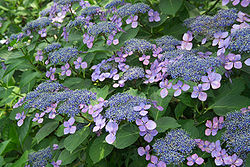 'Gakuajisai'
 -
 'Geoffrey Chadbund'
 -
 'Taube'
 -
 'Tokyo Delight'
 -
 'Zaunkoenig'


- Mopheads (also called hortensias)
-
 'Ayesha'
 -
 'Beauté Vendomoise'
 -
 'Harlequin'
 -
 'La Marne'
 -
 'Mariesii'
 -
 'Merveille'
 -
 'Nikko Blue'
 -
 'Pia'
'Pia' -
 'Red Ace'
 -
 'Satinette'


References
[edit]- ^ a b c d "Hydrangea macrophylla (Thunb.) Ser". Plants of the World Online. Royal Botanic Gardens, Kew. Retrieved 15 March 2025.
- ^ a b c d e Huxley, Antony; Levy, Margot (1992). The New Royal Horticultural Society Dictionary of Gardening. London & New York: MacMillan. p. 610. ISBN 0-333-47494-5.
- ^ a b c Bean, William Jackson; Clarke, D. L. (1981). Trees and Shrubs Hardy in the British Isles. Vol. 2. John Murray Pubs Limited. pp. 391–396. ISBN 0-7195-2256-0.
- ^ RHS A-Z encyclopedia of garden plants. United Kingdom: Dorling Kindersley. 2008. p. 1136. ISBN 978-1405332965.
- ^ a b c Wilson, Ernest Henry (1921). "The Hortensias Hydrangea macrophylla DC. and Hydrangea serrata DC". Journal of the Arnold Arboretum. 4: 238. ISSN 0004-2625. Retrieved 2025-04-25.
- ^ Ohwi, Jisaburo; Meyer, Frederick G.; Walker, Egbert H. (1965). Flora of Japan. Smithsonian Institution. pp. 511.
- ^ "Hydrangea serrata (Thunb.) Ser". Plants of the World Online. Retrieved 2025-04-25.
- ^ Wiersema, John H.; León, Blanca (2016). World Economic Plants: A Standard Reference, Second Edition. CRC Press. p. 357. ISBN 9781466576810.
- ^ "Hydrangea macrophylla". flora.on. Retrieved 1 November 2020.
- ^ Harrison, Lorraine (2012). RHS Latin for gardeners. United Kingdom: Mitchell Beazley. p. 224. ISBN 9781845337315.
- ^ Wade, Gary L. (August 2017) [September 2009]. Growing Bigleaf Hydrangea. University of Georgia.
- ^ "Hydrangea Questions and Answers". The United States National Arboretum. United States Department of Agriculture. 28 September 2005. Archived from the original on 16 May 2013.
- ^ "Tips for Using pH to Change Hydrangea Color". Earth Science. 2020-01-30. Retrieved 2024-07-21.
- ^ Matsuda, H.; Shimoda, H.; Yamahara, J.; Yoshikawa, M. (1999). "Effects of Phyllodulcin, Hydrangenol, and their 8-O-Glucosides, and Thunberginols A and F from Hydrangea macrophylla SERINGE var. thunbergii MAKINO on Passive Cutaneous Anaphylaxis Reaction in Rats" (pdf). Chemical and Pharmaceutical Bulletin. 22 (8): 870–872. doi:10.1248/bpb.22.870. PMID 10480329.
- ^ Matsuda, H; Wang, Q; Matsuhira, K; Nakamura, S; Yuan, D; Yoshikawa, M (2008). "Inhibitory effects of thunberginols A and B isolated from Hydrangeae Dulcis Folium on mRNA expression of cytokines and on activation of activator protein-1 in RBL-2H3 cells". Phytomedicine. 15 (3): 177–84. doi:10.1016/j.phymed.2007.09.010. PMID 17950587.
- ^ Yoshikawa, M; Uchida, E; Chatani, N; Kobayashi, H; Naitoh, Y; Okuno, Y; Matsuda, H; Yamahara, J; Murakami, N (1992). "Thunberginols C, D, and E, new antiallergic and antimicrobial dihydroisocoumarins, and thunberginol G 3'-O-glucoside and (−)-hydrangenol 4'-O-glucoside, new dihydroisocoumarin glycosides, from Hydrangeae Dulcis Folium". Chemical and Pharmaceutical Bulletin. 40 (12): 3352–4. doi:10.1248/cpb.40.3352. PMID 1363465.
- ^ Murakami, N; Mostaqul, HM; Tamura, S; Itagaki, S; Horii, T; Kobayashi, M (2001). "New anti-malarial flavonol glycoside from Hydrangeae Dulcis Folium" (PDF). Bioorganic & Medicinal Chemistry Letters. 11 (18): 2445–7. doi:10.1016/s0960-894x(01)00467-x. PMID 11549443.[permanent dead link]
- ^ a b Zhang, Hailong; Matsuda, Hisashi; Yamashita, Chihiro; Nakamura, Seikou; Yoshikawa, Masayuki (2009). "Hydrangeic acid from the processed leaves of Hydrangea macrophylla var. thunbergii as a new type of anti-diabetic compound". European Journal of Pharmacology. 606 (1–3): 255–61. doi:10.1016/j.ejphar.2009.01.005. PMID 19374876.
- ^ Hayashi, K.; Abe, Y. (1953). "Studien über Anthocyane. XXIII. Papierchromatographische Übersicht der Anthocyane im Pflanzenreich". Miscellaneous Reports of the Research Institute for Natural Resources. 29: 1–8.
- ^ Yoshida K, Mori M, Kondo T (2009). "Blue flower color development by anthocyanins: from chemical structure to cell physiology". Natural Product Reports. 26 (7): 884–915. doi:10.1039/b800165k. PMID 19554240.
- ^ Gorham, John (1977). "Lunularic acid and related compounds in liverworts, algae and Hydrangea". Phytochemistry. 16 (2): 249–253. Bibcode:1977PChem..16..249G. doi:10.1016/S0031-9422(00)86795-3.
- ^ Yoshikawa, M; Matsuda, H; Shimoda, H; Shimada, H; Harada, E; Naitoh, Y; Miki, A; Yamahara, J; Murakami, N (1996). "Development of bioactive functions in Hydrangeae Dulcis Folium. V. On the antiallergic and antimicrobial principles of Hydrangeae Dulcis Folium. (2). Thunberginols C, D, and E, thunberginol G 3'-O-glucoside, (−)-hydrangenol 4'-o-glucoside, and (+)-hydrangenol 4'-O-glucoside". Chemical and Pharmaceutical Bulletin. 44 (8): 1440–7. doi:10.1248/cpb.44.1440. PMID 8795265.
- ^ Nakagiri R, Hashizume E, Kayahashi S, Sakai Y, Kamiya T (December 2003). "Suppression by Hydrangeae Dulcis Folium of D-galactosamine-induced liver injury in vitro and in vivo". Bioscience, Biotechnology, and Biochemistry. 67 (12): 2641–3. doi:10.1271/bbb.67.2641. PMID 14730144. S2CID 29536120.
- ^ Chladil and Sheridan, Mark and Jennifer. "Fire retardant garden plants for the urban fringe and rural areas" (PDF). www.fire.tas.gov.au. Tasmanian Fire Research Fund.
- ^ Kamei K.; Matsuoka H.; Furuhata S.I.; Fujisaki R.I.; Kawakami T.; Mogi S.; Yoshihara H.; Aoki N.; Ishii A.; et al. (2000). "Anti-malarial activity of leaf-extract of Hydrangea macrophylla, a common Japanese plant". Acta Medica Okayama. 54 (5): 227–232. PMID 11061572.
- ^ Yarnell E, Abascal K (Oct 2004). "Botanical treatment and prevention of malaria: Part 2 - Selected botanicals". Alternative and Complementary Therapies. 10 (5): 277–84. doi:10.1089/act.2004.10.277.
- ^ Types of Hydrangeas at Plant Addicts. Accessed 7/3/2018
- ^ "AGM Plants - Ornamental" (PDF). Royal Horticultural Society. July 2017. p. 51. Retrieved 7 March 2018.
- ^ "RHS Plant Selector - Hydrangea macrophylla 'Altona'". Retrieved 1 August 2020.
- ^ "RHS Plant Selector - Hydrangea macrophylla 'Ami Pasquier'". Retrieved 1 August 2020.
- ^ "RHS Plants - Hydrangea macrophylla 'Ayesha'". Retrieved 1 September 2019.
- ^ "RHS Plantfinder - Hydrangea macrophylla 'Blaumeiser'". Retrieved 7 March 2018.
- ^ "RHS Plant Selector - Hydrangea macrophylla 'Europa'". Archived from the original on 4 March 2016. Retrieved 22 June 2013.
- ^ "RHS Plant Selector - Hydrangea macrophylla 'Générale Vicomtesse de Vibraye'". Retrieved 5 September 2020.
- ^ "RHS Plant - Hydrangea macrophylla 'Lady in Red'". Retrieved 1 September 2019.
- ^ "RHS Plant Selector - Hydrangea macrophylla 'Lanarth White'". Retrieved 5 September 2020.
- ^ "RHS Plantfinder - Hydrangea macrophylla 'Love You Kiss'". Retrieved 7 March 2018.
- ^ "RHS Plant Selector - Hydrangea macrophylla 'Madame Emile Mouillère'". Retrieved 5 September 2020.
- ^ "RHS Plant Selector - Hydrangea macrophylla 'Mariesii Grandiflora'". Retrieved 5 September 2020.
- ^ "RHS Plant Selector - Hydrangea macrophylla 'Mariesii Lilacina'". Retrieved 1 August 2020.
- ^ "RHS Plant Selector - Hydrangea macrophylla 'Mariesii Perfecta'". Retrieved 1 August 2020.
- ^ "RHS Plant - Hydrangea macrophylla 'Masja'". Retrieved 1 September 2019.
- ^ "RHS Plant Selector - Hydrangea macrophylla 'Möwe'". Retrieved 5 September 2020.
- ^ "RHS Plant Selector - Hydrangea macrophylla 'Nigra'". Retrieved 22 June 2013.
- ^ "RHS Plantfinder - Hydrangea macrophylla 'Rotschwantz'". Retrieved 7 March 2018.
- ^ "RHS Plant Selector - Hydrangea macrophylla 'Tokyo Delight'". Retrieved 1 August 2020.
- ^ "RHS Plant Selector - Hydrangea macrophylla 'Veitchii'". Retrieved 1 August 2020.
- ^ "RHS Plant Selector - Hydrangea macrophylla 'Westfalen'". Retrieved 1 August 2020.
- ^ "RHS Plantfinder - Hydrangea macrophylla 'Zorro'". Retrieved 7 March 2018.
Yuan, Qi, H., Yang, S., Chu, Z., Zhang, G., & Liu, C. (2023). Role of delphinidin-3-glucoside in the sepal blue color change among Hydrangea macrophylla cultivars. Scientia Horticulturae, 313, 111902–. https://doi.org/10.1016/j.scienta.2023.111902
External links
[edit]

- - Splendor In The Grass
- Hydrangeas- Their Pruning and Care(Heronswood Nursery)
- http://www.HydrangeasHydrangeas.com/mopheads.html - All About Hydrangeas: Information on Hydrangea macrophylla.
- http://www.floridata.com/ref/h/hydran_m.cfm
- http://www.clemson.edu/extension/hgic/plants/landscape/shrubs/hgic1067.html
- Hydrangea Thoughts I - Informative but non-scholarly essay on Hydrangea (Culture, History and Etymology).
| Authority control databases: National |
|---|

Hydrangea macrophylla
View on GrokipediaTaxonomy
Etymology and nomenclature
The genus name Hydrangea derives from the Ancient Greek words ὕδωρ (hydōr, meaning "water") and ἄγγος (angos or angeîon, meaning "vessel" or "capsule"), alluding to the cup-shaped seed capsules of the plants that can retain water.[5] This nomenclature was coined by Carl Linnaeus in 1753, drawing from earlier observations of the fruit structure.[14] The specific epithet macrophylla originates from the Greek μακρός (makros, "large") and φύλλον (phyllon, "leaf"), highlighting the species' characteristic large, broad leaves.[5][2] Common names for Hydrangea macrophylla include bigleaf hydrangea, French hydrangea, hortensia, and mophead hydrangea, the latter referring to cultivars with rounded flower heads.[2] The name "hortensia" emerged in 18th-century Europe following the plant's introduction from Japan around 1788, when it was initially classified under the genus Hortensia by Antoine Laurent de Jussieu in 1789, possibly honoring the French name Hortense or derived from Latin hortus (garden).[15] This term persists as an old-fashioned descriptor for mophead forms and remains the common name in French and Spanish.[16] The accepted binomial is Hydrangea macrophylla (Thunb.) Ser., with the authority attributed to Carl Peter Thunberg for the original description as Viburnum macrophyllum in 1784, and Nicolas Charles Seringe transferring it to Hydrangea in 1830 as part of Augustin Pyramus de Candolle's Prodromus Systematis Naturalis Regni Vegetabilis.[17] A notable synonym is Hydrangea hortensis Sm., proposed by James Edward Smith in 1792, which reflects early European naming conventions but is now considered obsolete.[18]Classification
Hydrangea macrophylla is classified within the kingdom Plantae, phylum Tracheophyta, class Magnoliopsida, order Cornales, family Hydrangeaceae, genus Hydrangea, and species H. macrophylla (Thunb.) Ser..[19][20] The species is recognized as a distinct entity in modern taxonomy, though debates persist regarding its infraspecific divisions, particularly between the mophead (var. macrophylla) and lacecap (var. normalis) forms based on inflorescence architecture.[15][21] Some classifications treat these as varieties, while others recognize them as forms (f. macrophylla and f. normalis), reflecting ongoing discussions on their genetic and morphological distinctiveness. Close relatives include H. serrata, often grouped with H. macrophylla in phylogenetic analyses due to shared East Asian origins and genetic similarities, and H. quercifolia, a North American species representing broader disjunct distributions in the genus.[22][23] Phylogenetic studies place H. macrophylla within Hydrangea section Macrophyllae, with the tribe Hydrangeeae showing an Asian origin and divergence around 30 million years ago, calibrated using fossil evidence from the Oligocene.[23][24]Description
Morphology
Hydrangea macrophylla is a deciduous shrub characterized by a rounded to spreading growth habit, typically reaching 1 to 3 meters (3 to 10 feet) in height and width, with multi-stemmed shoots emerging freely from the base.[5][15] The plant exhibits a coarse texture and fast growth rate, forming a bulky structure that can vary in overall size depending on the cultivar, though the species typically maintains this moderate stature under optimal conditions.[25][26] The leaves are opposite, simple, and ovate to obovate or elliptic in shape, measuring 10 to 20 centimeters (4 to 8 inches) in length and 5 to 13 centimeters (2 to 5 inches) in width, with serrated margins, a rounded base, and an acuminate tip.[5][15][27] They are glossy dark green on the upper surface, thick-textured, and essentially glabrous or slightly felted on the lower surface, supported by petioles 2.5 to 7.5 centimeters (1 to 3 inches) long; in autumn, the foliage often turns yellow before abscising.[15][2] Stems are woody and emerge directly from the ground with limited branching, featuring light brown to tan coloration, large leaf scars, and shreddy, peeling bark on older growth.[2][28] New shoots are pubescent, contributing to the plant's textured appearance during active growth.[15] The root system is fibrous and shallow, spreading widely to facilitate efficient uptake of moisture from the upper soil layers.[11][3] Inflorescences vary by form, with mophead types featuring rounded clusters dominated by showy sterile florets and lacecap types displaying flatter corymbs with central fertile flowers surrounded by sterile ones.[2][5]Flowering and fruit
Hydrangea macrophylla produces terminal inflorescences in the form of corymbs, typically measuring 10-20 cm across, with pubescent branches supporting both fertile and sterile flowers.[15] The species exhibits two primary inflorescence types: mophead, characterized by rounded clusters dominated by enlarged sterile florets that create a dome-shaped appearance, and lacecap, featuring a central cluster of small fertile florets surrounded by a ring of larger sterile florets along the margins.[29] Individual flowers are actinomorphic. Fertile flowers measure 4-6 mm in diameter, with deltate sepals 0.5-1 mm long, five ovate petals 1-2 mm long, eight to ten stamens, and an inferior, 2-5-locular ovary. Sterile florets lack true petals and instead possess four prominent, petaloid sepals that are ovate to orbicular in shape and can reach 2-5 cm across.[30][2] Following pollination, the plant develops dry, dehiscent capsules as fruit, which are small, narrow, and oval, approximately 6-8 mm long, containing numerous minute, dust-like seeds that are fusiform to ellipsoid and longitudinally striate.[28][31][32] These capsules turn brown and persist on the plant, with seed dispersal occurring in autumn as the capsules dehisce.[25] In temperate climates, blooming typically initiates in June and extends through September, with the duration influenced by cultivar and environmental conditions.[2] Certain reblooming cultivars, such as those in the Endless Summer series, exhibit additional flowering on new growth later in the summer, potentially extending the bloom period until the first frost.[2][5]Distribution and habitat
Native distribution
Hydrangea macrophylla is endemic to Japan and occurs naturally in the temperate regions of south-central Honshu, particularly coastal areas on the Pacific side such as the Miura and Boso peninsulas, as well as the Izu Islands and Ogasawara (Bonin) Islands.[17][15] The species inhabits coastal areas, including forests, forest margins, and grasslands near the sea, often in moist, shaded environments such as woodlands, forest edges, and stream banks at elevations from sea level up to approximately 1000 meters.[15][33] It prefers acidic to neutral soils rich in organic matter that retain moisture, thriving in well-drained conditions.[34][27] The native climate for H. macrophylla features cool, humid summers and mild winters, corresponding to USDA hardiness zones 6 to 9, with high annual rainfall that supports its growth in these humid, temperate settings.[34][25] Its historical range has shown stability, remaining confined to these Japanese locales without evidence of significant natural expansion beyond its endemic areas prior to human cultivation.[17]Introduced ranges
_Hydrangea macrophylla was first introduced to Europe in the late 18th century, with specimens arriving in Britain around 1788 via English surgeon Alexander Duncan, who collected plants during his time in China. Subsequent introductions from Japan in the 1820s and 1830s, facilitated by botanist Philipp Franz von Siebold, brought additional cultivars that popularized the species in European gardens. By the 19th century, the plant had spread to North America, likely through colonial trade routes in the early 1800s, and later to Australia and New Zealand during colonial expansion, where it became a staple ornamental shrub. Today, it is widely cultivated across these continents for its ornamental value in gardens and landscapes.[35][36][37] The species thrives in USDA hardiness zones 5 to 9, preferring temperate climates with consistent humidity and moderate temperatures. It performs best in regions such as the southeastern United States, where ample rainfall supports its moisture needs, and coastal areas of Europe, including the British Isles and Mediterranean fringes, benefiting from mild winters and foggy conditions. In Australia and New Zealand, cultivation is concentrated in cooler, wetter southern and coastal zones, mirroring its native Japanese habitat requirements for partial shade and well-drained, acidic to neutral soils.[38][34] Outside its native range, H. macrophylla has occasionally naturalized and exhibits potential invasiveness in suitable habitats, particularly moist, shaded woodlands and forest edges. In New Zealand, it is classified as an environmental weed, spreading via birds and water in high-rainfall areas like the North Island, where it competes with native understory plants for light and resources, though its impact remains localized. In the southeastern United States, spontaneous populations have been documented in states like Arkansas and Georgia, arising from discarded horticultural material, but it is not considered aggressively invasive, forming small thickets in disturbed, humid sites without widespread displacement of natives. Overall, its ecological footprint is limited compared to more aggressive ornamentals, due to reliance on human-assisted dispersal.[39][40][41] Adaptation to arid or extreme climates poses significant challenges for H. macrophylla, as it demands high soil moisture and is sensitive to drought stress, leading to wilting, reduced flowering, and dieback in dry regions without supplemental irrigation. In hot, arid areas like inland Australia or the southwestern United States, plants struggle with excessive evaporation and heat, often requiring shaded microclimates and mulching to survive, though long-term establishment is rare. Similarly, in colder extremes beyond zone 5, late frosts damage flower buds, limiting bloom reliability, while intense summer heat in continental climates exacerbates water loss from its large leaves. These limitations confine successful cultivation to humid, temperate zones globally.[42][43][44]Ecology
Pollination and reproduction
Hydrangea macrophylla exhibits primarily entomophilous pollination, facilitated by insects such as bees, butterflies, and hoverflies that visit the fertile florets within its inflorescences.[45] The species features two flower types: small, fertile florets that produce nectar and pollen, and larger, sterile florets that enhance visual attraction to pollinators without contributing to seed production.[46] This dimorphic structure ensures pollinator access to rewarding fertile flowers, though many cultivated varieties emphasize sterile florets, thereby reducing overall seed set while maintaining appeal to insects.[47] Reproduction in H. macrophylla occurs through both sexual and asexual means, with sexual reproduction being predominant in natural populations but limited in cultivation. The species is strongly self-incompatible, preventing successful self-pollination and promoting outcrossing via pollen transfer from compatible individuals, as evidenced by reduced pollen tube growth in self-pollinations compared to cross-pollinations.[48] Sexual reproduction yields seeds from fertilized ovules within dehiscent capsules, which open in late summer to release numerous small, dust-like seeds dispersed by wind; however, seed viability is generally low in wild settings due to factors like ploidy mismatches in interpopulation crosses and environmental constraints.[49] Asexual reproduction supplements seed-based propagation through natural processes like layering of low-lying stems that root upon contact with soil, allowing clonal spread in suitable habitats.[2] In ecosystems, particularly in introduced ranges, H. macrophylla supports native insect pollinators by providing seasonal nectar and pollen resources during its summer blooming period, contributing to biodiversity despite its non-native status in many regions. However, in some introduced regions like the Azores and Madeira, it has become invasive, potentially displacing native flora.[50] The inflorescence structure briefly influences pollinator access by positioning fertile flowers centrally or peripherally, optimizing visitation efficiency.[46]Pests and diseases
Hydrangea macrophylla faces several biotic threats from insect pests, fungal pathogens, bacteria, and occasionally viruses, which can lead to reduced vigor, aesthetic damage, and plant decline in both native Asian habitats and introduced regions worldwide. These issues are more pronounced in cultivated settings where environmental stress exacerbates susceptibility, such as drought or poor drainage that weakens plant defenses.[43] Management typically relies on cultural practices like proper spacing for air circulation and sanitation to remove infected debris, though chemical interventions may be necessary for severe infestations.[51] Among insect pests, aphids (family Aphididae) are common sap-feeders that cluster on new growth, causing leaf curling, distortion, and stunted shoots through injection of saliva that disrupts plant tissues. Their feeding also produces sticky honeydew, promoting sooty mold growth on leaf surfaces. Aphids reproduce asexually via parthenogenesis, with females giving birth to live nymphs that mature in 7-10 days under warm conditions, enabling rapid population explosions of up to 12 generations per year.[52] Spider mites, particularly the two-spotted spider mite (Tetranychus urticae), use piercing-sucking mouthparts to extract cell contents, resulting in stippled, bronzed, or yellowed leaves and fine webbing on undersides; severe infestations defoliate plants. Their life cycle—from egg to adult—spans 5-20 days depending on temperature and humidity, with multiple overlapping generations in hot, dry summers.[26] Scale insects, such as oystershell scale (Lepidosaphes ulmi), appear as small, immobile bumps on stems and leaves, sucking sap and causing yellowing, wilting, and sooty mold; armored scales protect themselves with waxy coverings, while their crawlers (mobile juveniles) spread via wind or tools, maturing in 1-3 months.[53] Rose chafers (Macrodactylus subspinosus), adult beetles, chew ragged holes in flowers and foliage during summer, preferring sunny exposures; their one-year life cycle involves larval root-feeding in soil followed by adult emergence in June-July for 2-4 weeks of feeding.[54] Fungal diseases pose significant risks, especially in humid environments. Powdery mildew (Erysiphe polygoni) manifests as a white, powdery coating on upper leaf surfaces, leading to chlorosis, premature leaf drop, and weakened growth; spores spread via wind, thriving in moderate temperatures (60-80°F) with high humidity but dry foliage.[3] Leaf spot diseases, caused by fungi like Cercospora hydrangeae, produce circular brown spots with yellow halos on leaves, often coalescing to cause defoliation; infections start in wet springs, with spores overwintering on debris.[3] Botrytis blight, or gray mold (Botrytis cinerea), affects flowers and buds, turning petals brown and developing fuzzy gray spores, particularly after prolonged wetness; the pathogen persists as sclerotia in soil or plant parts.[55] Root rot, commonly from Phytophthora species like P. cinnamomi, occurs in waterlogged soils, causing wilting, root decay, and sudden collapse; oospores survive in soil for years, infecting via wounded roots in cool, wet conditions.[51] Bacterial diseases include leaf spot and wilt from pathogens like Xanthomonas campestris pv. hydrangeae, which enter through wounds or stomata, producing water-soaked spots that turn necrotic and lead to vascular blockage and wilting; symptoms worsen with overhead watering that splashes bacteria.[26] Viral infections are rare but can include hydrangea ringspot virus, causing faint ring patterns and mottling on leaves without systemic spread; transmission occurs via contaminated tools or insects, with no cure and emphasis on rogueing affected plants.[56] In native Japanese forests, H. macrophylla encounters fewer novel pests due to co-evolved resistances, whereas in introduced ranges like North America, local insects and pathogens adapt more readily, increasing outbreak risks. Stressed plants, such as those in compacted or nutrient-poor soils, show heightened vulnerability to these threats, as reduced vigor impairs natural defenses like stomatal closure or chemical repellents.[53]Physiology and chemistry
Flower color variation
The flower color of Hydrangea macrophylla varies prominently based on soil pH, with blooms appearing pink or red in alkaline conditions (pH greater than 6.5) and blue in strongly acidic conditions (pH less than 5.5); purple or violet hues occur in intermediate pH ranges (5.5–6.5).[57][3] White or green hues occur in certain cultivars that remain unaffected by pH changes.[58] These variations stem from the underlying pigment delphinidin, which shifts appearance depending on environmental factors.[59] Color changes are observed primarily in mophead (hortensia) and select lacecap forms where the sepals produce anthocyanins, enabling the pH-responsive pigmentation; fertile flower colors in the center remain stable and unaffected.[60] Once established during sepal development, the color is generally stable for the bloom's duration, though gradual shifts can occur across seasons if soil conditions alter before flowering.[61] The pH-dependent color variation in H. macrophylla was first noted in Europe during the early 20th century. The role of soil pH as the primary driver through its influence on aluminum availability was elucidated in the 1930s–1940s.[57] Gardeners commonly manipulate these colors for aesthetic purposes by amending soil pH: adding lime raises alkalinity to promote pink tones, while incorporating sulfur or aluminum sulfate lowers acidity to achieve blue shades.[58] However, as the inflorescences age during the blooming period, the sepals of colored forms often fade to green or greenish tones. The sepals, being modified leaves, naturally contain chlorophyll and appear green in early bud stages; the vibrant anthocyanin pigments (such as delphinidin derivatives) that produce blue, pink, or purple hues dominate during peak bloom but degrade over time due to factors like prolonged exposure to heat, intense sunlight, or natural senescence. This results in the colorful blooms transitioning to green, sometimes progressing to brown or papery textures by the end of the season. This fading is particularly noticeable in hot, humid climates (e.g., the southeastern United States) and is a normal part of the plant's lifecycle rather than a sign of disease or poor health. Gardeners often appreciate the subtle color shifts for extended ornamental interest or use in dried arrangements.Biochemical mechanisms
The primary pigment responsible for sepal coloration in Hydrangea macrophylla is the anthocyanin delphinidin-3-glucoside, which exists in a blue form in aqueous solution but undergoes structural modifications that alter its visible hue depending on environmental and physiological factors.[57] This pigment accumulates in the vacuoles of epidermal sepal cells, where its color is influenced by interactions with metal ions and other molecules.[62] The formation of the blue hue involves complexation between delphinidin-3-glucoside and aluminum ions (Al³⁺), which occurs under acidic conditions. In soil with a pH of 5.2–5.5, Al³⁺ becomes solubilized and is taken up by the plant roots, subsequently transported to the sepals and binding to the anthocyanin within vacuoles to form a stable metalloanthocyanin complex.[63] In contrast, alkaline soil conditions (pH above 6.0) cause Al³⁺ to precipitate as insoluble hydroxides, preventing uptake and complex formation; here, the anthocyanin relies on co-pigmentation with flavones and other phenolic compounds, resulting in a pink coloration due to bathochromic shifts and stabilization of the flavylium cation form.[64] This Al³⁺-delphinidin complex can be simplified as:Cultivation
History of cultivation
_Hydrangea macrophylla has been cultivated in Japan for centuries prior to the 18th century, primarily for its ornamental value in gardens and its use in traditional practices such as brewing amacha, a sweet herbal tea derived from its leaves, which contain phyllodulcin, a natural non-caloric sweetener.[68] The plant's native habitats in Japan's mountainous regions facilitated early selection for desirable traits like flower color and form, with references to ajisai (the Japanese name for hydrangea) appearing in poetry and literature as early as the 8th century.[69] This long history of domestication in Asia laid the foundation for its global ornamental appeal. The species was first introduced to Europe in the late 18th century through Dutch traders and botanists associated with the Dutch East India Company, with Carl Peter Thunberg providing the initial scientific description in 1784 based on specimens from Japan.[70] Living plants arrived shortly thereafter, with the first viable specimens reaching England in 1788 via Sir Joseph Banks, who received them from China and Japan; these were initially known as Hortensia before being renamed Hydrangea macrophylla in 1830.[71] By the 1830s, the plant had gained popularity in Britain and France, where breeders began developing color-changing varieties influenced by soil pH, leading to the creation of mophead and lacecap forms that became staples in Victorian gardens.[69] Its arrival in the United States occurred around 1800, with early cultivation in Philadelphia-area gardens such as The Woodlands by William Hamilton, who imported European cultivars and adapted them to American landscapes.[72] In the 20th century, cultivation advanced significantly with focused breeding efforts for reblooming capabilities and disease resistance, exemplified by the introduction of the Endless Summer cultivar in 2004, the first bigleaf hydrangea to reliably flower on both old and new wood, extending its bloom period.[73] Post-World War II economic recovery spurred the growth of commercial cut-flower industries in Europe and North America, where H. macrophylla became a key crop for greenhouses due to its prolific blooms and vase life.[74] Culturally, H. macrophylla holds symbolic importance, representing apology and heartfelt emotion in Japan, stemming from legends where emperors gifted the flowers to express regret and sincerity.[75] In Victorian England, it symbolized gratitude and understanding, often given as a token of appreciation for empathy or support in social contexts.[75]Propagation methods
Hydrangea macrophylla is primarily propagated vegetatively to maintain cultivar characteristics, though sexual propagation via seed is possible but less common due to genetic variability. Vegetative methods such as cuttings, layering, and division ensure true-to-type plants, while tissue culture is used commercially for large-scale, disease-free production.[76] Cuttings are the most widely used propagation technique for H. macrophylla, with softwood, semi-hardwood, and hardwood types employed depending on the season. Softwood cuttings, taken from terminal shoots in early summer, are treated with 1,000 ppm indole-3-butyric acid (IBA) rooting hormone and root in 3-5 weeks under high humidity with near 100% success.[77] Semi-hardwood cuttings, collected in late summer, involve a basal dip in 500-1,500 ppm potassium salt of IBA (K-IBA) for 5 seconds, achieving reliable rooting under mist.[77] Hardwood cuttings, harvested in winter from dormant stems, root more slowly but are viable with similar hormone treatments.[77] Layering provides a simple, low-risk method for propagating H. macrophylla in the garden, particularly for low-branching plants. Simple or tip layering involves wounding a flexible stem, burying the tip in moist soil, and securing it with a peg or stone; roots typically form in 1-2 months in humid conditions.[11] This technique leverages natural rooting tendencies in moist soils and is effective for establishing new plants near the parent.[78] Division is suitable for mature H. macrophylla clumps, allowing separation of offsets or suckers to create new plants. Performed in spring or fall, the process entails digging up the clump, carefully dividing the root ball with a sharp tool, and replanting sections with intact roots immediately.[78] This method is straightforward for expanding colonies but is less common than cuttings for commercial production.[54] Seed propagation of H. macrophylla is rarely practiced because it results in high variability, failing to produce true-to-type offspring from cultivars, and requires specific conditions for germination. Seeds are small and sown on the surface of a moist, well-drained medium without covering, as they need light; cold stratification at 4-5°C for 30-60 days improves germination rates, which are generally low.[76] No stratification is required in some cases, but success remains inconsistent compared to vegetative methods.[79] Tissue culture, or micropropagation, is employed commercially to produce virus-free stock of H. macrophylla on a large scale. Explants from shoots are sterilized and cultured on media supplemented with cytokinins and auxins, such as benzyladenine and IBA, to induce multiple shoot formation and rooting.[76] This method ensures uniform, disease-free plants and is particularly useful for elite cultivars.[80]How to propagate Ajisai
Ajisai is the Japanese name for Hydrangea macrophylla. The following provides a practical, step-by-step guide for home gardeners to propagate this popular ornamental shrub, complementing the technical details above. Softwood Cuttings (most common and reliable for home use)- In late spring or early summer, select young, healthy, non-flowering shoots from the current season's growth.
- Cut 10–15 cm (4–6 inch) sections, making a clean cut just below a leaf node.
- Remove the lower leaves, leaving 2–4 leaves at the top to support photosynthesis.
- Dip the cut end in rooting hormone powder or gel (containing IBA) to encourage root development.
- Insert the cuttings into a well-draining medium such as a mix of equal parts peat moss (or coir) and perlite or sand.
- Water thoroughly and place in a shaded location with high humidity (cover with a plastic bag or use a propagation tray).
- Maintain moist but not waterlogged conditions; roots typically form in 3–8 weeks.
- Once rooted, gradually acclimate to normal conditions and transplant to individual pots or the garden.
- Select a low, flexible stem that can be bent to reach the ground.
- Wound the underside of the stem slightly (scrape or cut) where it will contact the soil, and optionally apply rooting hormone.
- Bury the wounded portion in a shallow trench, leaving the tip exposed above ground.
- Anchor it with a peg, stone, or wire and cover with soil.
- Keep the area consistently moist; roots usually develop in 1–3 months (sometimes longer).
- Once rooted, sever the new plant from the parent and transplant.