Hubbry Logo
HymnalHymnalMain
Open search
Hymnal
Community hub
Hymnal
logo
8 pages, 0 posts
0 subscribers
Be the first to start a discussion here.
Hymnal
Hymnal
from Wikipedia
A row of hymnals
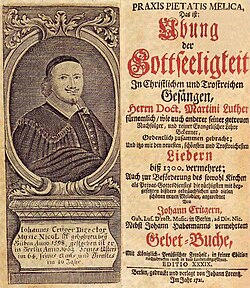
Praxis pietatis melica by Johann Crüger, an important German Lutheran hymnal from the 17th century

A hymnal or hymnary is a collection of hymns, usually in the form of a book, called a hymnbook (or hymn book). They are used in congregational singing. A hymnal may contain only hymn texts (normal for most hymnals for most centuries of Christian history); written melodies are extra, and more recently harmony parts have also been provided.

Hymnals are omnipresent in churches but are not often discussed; nevertheless, liturgical scholar Massey H. Shepherd once observed: "In all periods of the Church's history, the theology of the people has been chiefly molded by their hymns."[1]

Elements and format

[edit]

Since the twentieth century, singer-songwriter hymns have become common, but in previous centuries, generally poets wrote the words, and musicians wrote the tunes. The texts are known and indexed by their first lines ("incipits") and the hymn tunes are given names, sometimes geographical (the tune "New Britain" for the incipit "Amazing Grace, how sweet the sound"). The hymnal editors curate the texts and the tunes. They may take a well-known tune and associate it with new poetry, or edit the previous text; hymnal committees are typically staffed by both poets and musicians. Some hymnals are produced by church bodies and others by commercial publishers.

In large denominations, the hymnal may be part of a coordinated publication project that involves several books: the pew hymnal proper; an accompaniment version (e.g. using a ring binder so that individual hymns can be removed and sit nicely on a music stand); a leader's guide (e.g. matching hymns to lectionary readings); and a hymnal companion, providing descriptions about the context, origin and character of each hymn, with a focus on their poets and composers.

Service music

[edit]

In some hymnals, the front section is occupied by service music, such as doxologies, three-fold and seven-fold amens, or entire orders of worship (Gradual, Alleluia, etc.). A section of responsorial psalms may also be included.

Indexes

[edit]

Hymnals usually contain one or more indexes; some of the specialized indexes may be printed in the companion volumes rather than the hymnal itself. A first line index is almost universal. There may also be indexes for the first line of every stanza, the first lines of choruses, tune names, and a metrical index (tunes by common meter, short meter, etc.). Indexes for composers, poets, arrangers, translators, and song sources may be separate or combined. Lists of copyright acknowledgements are essential. Few other books are so well indexed; at the same time, few other books are so well memorized. Singers often have the song number of their favorite hymns memorized, as well as the words of other hymns. In this sense, a hymnal is the intersection of advanced literate culture with the persistent survival or oral traditions into the present day.

History

[edit]
Jistebnice hymn book, a Czech hand-written hymnbook from around 1430

Origins in Europe

[edit]

The earliest hand-written hymnals are from the Middle Ages in the context of European Christianity, although individual hymns such as the Te Deum go back much further. The Reformation in the 16th century, together with the growing popularity of moveable type, quickly made hymnals a standard feature of Christian worship in all major denominations of Western and Central Europe. The first known printed hymnal was issued in 1501 in Prague by Czech Brethren (a small radical religious group of the Bohemian Reformation) but it contains only texts of sacred songs.[2] The Ausbund, an Anabaptist hymnal published in 1564, is still used by the Amish, making it the oldest hymnal in continuous use. The first hymnal of the Lutheran Reformation was Achtliederbuch, followed by the Erfurt Enchiridion. An important hymnal of the 17th century was Praxis pietatis melica.

Hymnals in Early America

[edit]

Market forces rather than denominational control have characterized the history of hymnals in the thirteen colonies and the antebellum United States; even today, denominations must yield to popular tastes and include "beloved hymns" such as Amazing Grace[3] and Come Thou Fount of Every Blessing,[4] in their hymnals, regardless of whether the song texts conform to sectarian teaching.

The first hymnal, and also the first book, printed in British North America, is the Bay Psalm Book, printed in 1640 in Cambridge, Massachusetts,[5][6] a metrical Psalter that attempted to translate the psalms into English so close to the original Hebrew that it was unsingable. The market demand created by this failure, and the dismal nature of Calvinist "lining out the psalms" in general, was served by hymnals for West gallery singing imported from England.

William Billings of Boston took the first step beyond West Gallery music in publishing The New-England Psalm-Singer (1770), the first book in which tunes were entirely composed by an American.[7] The tune-books of Billings and other Yankee tunesmiths were widely sold by itinerant singing-school teachers. The song texts were predominantly drawn from English metrical psalms, particularly those of Isaac Watts. All of the publications of these tunesmiths (also called "First New England School") were essentially hymnals.

In 1801, the tunebook market was greatly expanded by the invention of shape notes, which made it easier to learn how to read music. John Wyeth, a Unitarian printer in Harrisburg, Pennsylvania, who had apprenticed in Boston during the emergence of the First New England School, began to publish tunebooks in 1810 in German and English for various sectarian groups (but not Unitarians). He saw a virgin market in the Methodist and Baptist revival movement. Singing in these camp meetings was chaotic because multiple tunes were sung simultaneously for any given hymn text. Since he lacked musical training, Wyeth employed Elkanah Kelsey Dare to collect tunes and edit them. Wyeth's Repository of Music, Part Second (1813) included 41 folk tunes, the first printed in America. This was also the birth of the "folk hymn": the use of a folk tune, collected and harmonized by a trained musician, printed with a hymn text.[8] "Nettleton," the tune used in North America to sing "Come Thou Fount" (words written in 1758), first appeared here.

Southern Shape Note Hymnals (Tunebooks)

[edit]
Original long hymnal with shape note music notation of a tune titled "New Britain" set to Newton's first verse, with four subsequent verses printed below. Underneath is another hymn titled "Cookham".
An 1847 publication of Southern Harmony, showing the title "New Britain" ("Amazing Grace") and shape note music.

Southerners identified with folk hymns of Wyeth's 1813 Part Second and collected more: the titles of Kentucky Harmony (1816) of Ananias Davisson, the Tennessee Harmony (1818) of Alexander Johnson, the Missouri Harmony (1820) of Allen D. Carden. and the Southern Harmony (1835) of William Walker drew attention to the fact that they contained regional folk songs for singing in two, three, or four parts. A new direction was taken by B. F. White with the publication of the Sacred Harp (1844): whereas others had gone on to produce a series of tunebooks, White stopped at one, then spent the rest of his life building an organization, modeled on church conventions, to organize singing events, with the result that the Sacred Harp continues as a living tradition to the present. The other tunebooks eventually yielded to denominational hymnals that became pervasive with the development of railroad networks, with the exception of the Southern Harmony, for which there is an annual singing in Benton, Kentucky to the present day, and Walker's Christian Harmony, published in 1866, with the first convention organized in 1875 (43 all-day singings in 2010); the Kentucky Harmony was republished in altered form as the Shenandoah Harmony in 2010, reviving the world of predominantly minor key melodies and unusual tonalities of Davisson's work.

The Better Music Movement in the Industrialized North

[edit]

In the North, the "Better Music Boys," cultivated musicians such as Lowell Mason and Thomas Hastings who turned to Europe for musical inspiration, introduced musical education into the school system, and emphasized the use of organs, choirs, and "special music." In the long term this resulted in a decline of congregational singing. On the other hand, they also composed hymns that could be sung by everybody. Mason's The Handel and Haydn Society Collection of Church Music (1822) was published by the Handel and Haydn Society of Boston while Mason was still living in Savannah; nobody else would publish it. This never became a denominational hymnal but was well-received by choirs. Mason's famous hymns, which were also included in Southern tunebooks, appeared later editions or publications: Laban ("My soul, be on thy guard;" 1830), Hebron ("Thus far the Lord hath led me on," 1830), Boylston ("My God, my life, my love," 1832), Shawmut ("Oh that I could repent! 1835") Bethany ("Nearer, My God, to Thee", as sung in the United States) (1856).

Hymns Ancient and Modern appears in England

[edit]

In England, the growing popularity of hymns inspired the publication of more than 100 hymnals during the period 1810–1850.[9] The sheer number of these collections prevented any one of them from being successful.[10] In 1861, members of the Oxford Movement published Hymns Ancient and Modern under the musical supervision of William Henry Monk,[11] with 273 hymns. For the first time, translations from languages other than Hebrew appeared, the "Ancient" in the title referring to the appearance of Phos Hilaron, translated from Greek by John Keble, and many hymns translated from Latin. This was a game-changer. The Hymns Ancient and Modern experienced immediate and overwhelming success.[10] Total sales in 150 years were over 170 million copies.[11] As such, it set the standard for many later hymnals on both sides of the Atlantic.[10] English-speaking Lutherans in America began singing the metrical translations of German chorales by Catherine Winkworth and Jane Laurie Borthwick, and rediscovered their heritage. Although closely associated with the Church of England, Hymns Ancient and Modern was a private venture by a committee, called the Proprietors, chaired by Sir Henry Baker.[11]

See also

[edit]

References

[edit]
[edit]
Revisions and contributorsEdit on WikipediaRead on Wikipedia
from Grokipedia
A is a containing a collection of hymns, tunes, and sometimes service music, primarily used for congregational singing during services. Hymnals have evolved over centuries, originating from early Christian practices influenced by Greek "hymnos" meaning a song of praise, and drawing from the singing of in the Hebrew Temple as well as references to hymns by the Apostle Paul. In the , hymns were often performed as Gregorian chants in Latin by monastic choirs, but the 16th-century invention of the and the Protestant , led by figures like , enabled widespread congregational participation through vernacular hymnals. The 17th and 18th centuries marked a golden age for English hymnody, with (1674–1748) revolutionizing the form by writing heartfelt, scripture-based hymns that shifted away from strict psalmody, earning him the title "liberator of English hymnody," followed by the Wesley brothers' contributions to through thousands of simple, doctrinal hymns. By the , gospel hymns with robust harmonies emerged, and the first American hymnal pairing texts with tunes appeared in 1831, moving beyond the practice of "lining out" where leaders recited lines for the congregation to repeat. Theologically and culturally, hymnals serve as synthetic manuals of , immersing users in biblical language and the church's historical voice while fostering unity across denominations and generations. They function as educational tools, often forming the basis of early in the 18th and 19th centuries when they were among the first books owned by children, and continue to provide ethical and prophetic perspectives on societal issues through their selected texts and tunes. In modern contexts, hymnals adapt to by incorporating diverse styles, from traditional anthems to global and ecumenical songs, reflecting the evolving expression of faith while preserving a repository of sacred music.

Definition and Purpose

Overview of Hymnals

A hymnal is a bound collection of hymns, which are religious poems or to set to music for during , primarily in Christian traditions. These collections are arranged to facilitate congregational participation in services, distinguishing them from individual or unbound compilations. Core components of a hymnal include the of each hymn, paired with for the and , typically in four-part arrangements suitable for group . Attributions to the text authors (often poets or theologians) and tune composers are standard, providing historical and creative context for the pieces. Hymnals differ from psalters, which contain only metrical paraphrases of the biblical for , and from anthem collections, which feature more complex choral works intended for performance by trained choirs rather than entire congregations. Instead, hymnals prioritize accessible, metrical hymns that enable broad participation. The content of hymnals has evolved to incorporate doctrinal hymns that articulate core theological teachings, seasonal pieces tied to church calendars such as Advent or , and responsive chants for call-and-response elements in , establishing these as standard features across denominations.

Role in Religious Worship

Hymnals play a central role in the liturgical integration of across Protestant, Catholic, and Orthodox traditions, serving as repositories for used in key moments such as opening praises, responsive readings, and closing benedictions. In Protestant services, particularly in Lutheran Holy Communion liturgies, hymnals provide the hymn of the day to summarize scriptural themes and respond to the proclamation of the word, integrating seamlessly with the fourfold structure of gathering, word, meal, and sending. Catholic Masses employ hymnals to facilitate ecstatic encounters with the divine, where like St. Thomas Aquinas's "Pange Lingua" draw participants out of themselves through beauty and theological depth, aligning with the U.S. Conference of Catholic Bishops' emphasis on music as a gift that unites body, mind, and spirit in . In Orthodox divine liturgies, hymnals support the choral by providing texts that enhance the mystical flow of services, often led by choirs to elevate communal toward . The communal aspect of hymnals fosters among worshippers by enabling shared singing of texts and tunes, often accompanied by organs or choirs, which creates a expression of . This shared vocalization enacts the church's harmony, as described in Ephesians 5:18–21, where singing , hymns, and spiritual songs fills believers with the Spirit and manifests differentiated unity amid diversity, bridging social and cultural divides in the congregation. Hymnals facilitate this by offering linear texts suited for group harmony, promoting a sense of belonging and mutual submission, as seen in practices where committees or assemblies sing together to build camaraderie and model . In various denominations, this extends to ecumenical settings, where common hymns reinforce the bond of the across traditions. Hymnals serve an educational function by embedding theological truths in memorable lyrics, teaching doctrines through repetition in worship and personal devotion. Christians often absorb more working theology from sung hymns than from formal catechisms, as the music aids retention of concepts like the incarnation or atonement. For instance, Charles Wesley's "Hark! The Herald Angels Sing" reinforces the doctrine of the incarnation with lines like "Veiled in flesh the Godhead see," echoing Nicene Creed affirmations of Christ's divinity. Similarly, Ambrose's hymns countered Arian heresy by emphasizing Trinitarian truths, while modern examples like "In Christ Alone" by Keith Getty instruct on Christ's resurrection and assurance of salvation, paralleling creedal statements on eternal life. These lyrics not only convey moral lessons, such as repentance in "And Can It Be," but also shape believers' understanding of God's nature across generations. Beyond the sanctuary, hymnals exert a cultural impact by shaping worship experiences in revivals, daily devotions, and missionary outreach, adapting to diverse contexts while preserving core theological messages. In revival settings, hymns like those from the Great Awakenings inspire collective fervor and spiritual renewal, serving as markers of encounters with God that influence ongoing congregational life. For daily devotions, hymnals provide accessible resources for personal reflection, fostering habits of praise and moral instruction outside formal services. In missions and adaptations, bilingual hymns such as "Gusten y Vean / Taste and See" bridge cultural gaps, enabling inclusive participation in Spanish-English congregations and engaging younger generations through simple, versatile melodies suitable for global outreach. This adaptability underscores hymnals' role in forming worship that resonates across cultures, from urban groups to international missions.

Structural Elements

Format and Layout

Hymnals are typically bound in durable or materials to withstand frequent use during church services and communal . Traditional editions often feature reinforced bindings, such as sewn signatures, to ensure longevity in high-traffic settings like pews or pulpits. Premium versions may include ribbon markers for quick navigation between hymns and gilt edges on the pages to prevent wear and add a decorative element suitable for liturgical contexts. The page layout of hymnals is designed for ease of reading and singing in group settings, often employing a structured that separates from textual content. Music appears at the top of the page in a single or double-column format, with aligned directly beneath the notes for the line, while additional are presented in parallel columns below to accommodate multiple verses without excessive page turns. Stanza numbers are bolded for visibility, and leader cues—such as the first line of each verse in italics or larger font—guide congregational participation by signaling transitions during performance. Musical in hymnals adheres to standard Western staff notation, utilizing four-part (soprano, , , bass) to support choral and organ . Chord symbols are commonly included above the staff to facilitate guitar or keyboard , enhancing versatility for varied ensembles. This prioritizes clarity, with consistent staff heights (typically 16-20 points) and key signatures to aid singers of all skill levels. Hymnals vary in size to suit different uses, with editions measuring around 3.5 by 5 inches for personal devotion or portability, featuring smaller fonts (7-9 points) and compact bindings. In contrast, standard editions are approximately 6 by 9 inches for optimal visibility in congregational settings, while larger or books, often 9.8 by 6.7 inches or bigger, provide amplified text and music for leaders directing from a distance. These size variations ensure accessibility across contexts, from individual study to large-scale .

Indexes and Organizational Features

Hymnals employ various alphabetical indexes to facilitate rapid location of hymns during services. These commonly include indexes by first line of the hymn text, which serves as the primary entry point since many hymns lack formal titles, and by tune name to identify melodies associated with specific hymns. Additional alphabetical listings cover authors and composers of texts and music, as well as scriptural references, allowing users to connect hymns directly to biblical passages for thematic alignment in services. Thematic organization within hymnals structures content into sections that reflect the liturgical or doctrinal topics, enhancing their utility in planned . Hymns are often grouped by seasons such as Advent, , , and , enabling and musicians to select pieces that correspond to the church year's progression and its associated rituals. Topical categories further aid navigation, with groupings for themes like , , mission, or the sacraments, promoting cohesive service planning around spiritual emphases. Metrical indexes provide a systematic listing of tunes based on their count and rhythmic structure, denoted in notations like Common Meter (8.6.8.6) or Long Meter (8.8.8.8), to assist in pairing new or alternative texts with compatible melodies. This feature is particularly valuable for hymn leaders seeking substitutions when a preferred tune is unavailable or to adapt for varied congregational needs, ensuring rhythmic compatibility without altering musical settings. Cross-references in hymnals link entries for hymns that share common themes, scriptural bases, or tunes, supporting substitutions and enriching service variety. For instance, notations may direct users to alternative hymns on that use the same , or to thematically related pieces for Advent , thereby streamlining decisions under time constraints in settings.

Inclusion of Service Music

Service music in hymnals encompasses a variety of short, formulaic musical pieces designed to complement and frame the singing of hymns during services. Common types include , such as the well-known " from whom all blessings flow," the Gloria Patri (a lesser doxology affirming Trinitarian praise), responsive Amens concluding prayers or hymns, and chants used for liturgical responses or antiphons, particularly in psalmody or call-and-response elements. These pieces originated in early , where they served to punctuate scriptural readings and prayers with brief affirmations of faith. The primary purpose of service music is to provide concise, participatory elements that enhance the liturgical flow, often bookending hymns or other congregational singing to emphasize theological themes like and closure. Typically composed or arranged in four-part harmony—soprano, , , and bass—these selections encourage unified congregational response while allowing for organ or choral . Unlike extended hymns, service music prioritizes brevity and repetition, fostering a sense of communal affirmation without overshadowing the main body of worship. For example, the is traditionally sung after psalms to "Christianize" texts by directing glory to the , while Amens offer a resolute "so be it" to petitions. In terms of notation, service music appears in hymnals with simplified scores that emphasize , featuring clear lines, basic chord symbols for keyboard instruments, and optional harmony parts separate from the fuller, verse-based arrangements of core . This format supports quick learning and execution in diverse congregational settings, often without verse structures or elaborate ornamentation. Chants, for instance, may use modal scales or plainchant styles for antiphonal use, while doxologies and Amens provide straightforward tonal settings in major keys. The inclusion of service music in hymnals has evolved significantly over time, transitioning from peripheral or optional appendices in early Protestant compilations to prominent, integrated sections in modern editions. In 17th- and 18th-century hymnals, such as those influenced by Anglican or Lutheran traditions, these elements were sometimes appended as supplementary aids rather than core content, reflecting a focus on primary hymnody. By the , however, denominational hymnals began embedding service music within dedicated portions; for instance, The Lutheran Hymnal (1941) innovated by adding printed "Amen" responses at the end of hymns, previously left to . Contemporary examples, like The United Methodist Hymnal (1989), consolidate doxologies and under a service music index on page 951, while The Hymnal 1982 (Episcopal) devotes sections S1–S66 to such pieces, underscoring their essential role in unified .

Historical Development

Origins in Medieval and Early Modern Europe

The origins of hymnals in trace back to medieval liturgical books that compiled chants and hymns for worship. In the 9th to 12th centuries, Latin graduals and antiphonaries served as precursors, systematically organizing plainchant melodies and texts for the and Divine . Graduals contained responsorial and alleluias, while antiphonaries gathered antiphons—short scriptural verses framing psalms—for monastic and cathedral use, reflecting standardized Carolingian reforms that promoted uniformity across Western churches. These volumes often included early hymns attributed to St. Ambrose of Milan (c. 340–397), such as "Aeterne rerum conditor" and "Deus creator omnium," composed in iambic dimeter for morning and evening services during the Arian controversies; Ambrose's introduction of metrical hymns into public worship in 386 marked their integration into Western liturgy, influencing subsequent compilations despite initial resistance in Rome until the 12th century. By the 9th century, monastic hymnaries like those from St. Gall preserved and expanded these Ambrosian hymns alongside sequences—poetic elaborations on alleluias—developed by figures such as Notker Balbulus (c. 840–912), who authored around 47 sequences for feasts, further enriching the repertoire in French and German centers. The Protestant Reformation in the 16th century transformed these traditions by emphasizing vernacular hymnals for congregational singing, beginning with Martin Luther's initiatives. In 1524, Luther collaborated with Paul Speratus to produce the Achtliederbuch, the first Lutheran hymnal, containing eight hymns—four by Luther, including "Dear Christians, One and All, Rejoice"—translated into German to make scripture accessible beyond . This small booklet prioritized doctrinal teaching through music, aiming to restore active participation in worship, as Luther believed songs should ensure "the Word of God... may dwell among the people" via communal rendition rather than choral performance alone. Luther's approach drew from medieval models but shifted focus to lay involvement, influencing later compilations across Protestant regions. Early printed hymnals in the mid-16th century advanced standardization, notably through Reformed and Anglican efforts led by and . The of 1562, completed under Calvin's supervision in , provided the first full metrical translation of the 150 into French, set to original tunes composed between 1539 and 1562 by Louis Bourgeois and others, for exclusive use in Reformed worship to avoid "superstitious" songs. Calvin, emphasizing scriptural purity, collaborated with poets Clément Marot and Théodore de Bèze to ensure rhythmic, singable verses that promoted moral edification among congregations. Similarly, the Anglican Whole Book of Psalms (1562), published by John Day and edited likely by William Whittingham, compiled metrical English versions by Thomas Sternhold (44 psalms), John Hopkins (61 psalms), and others like Thomas Norton—whose familial ties to Cranmer's circle linked it to earlier reforms. Cranmer, as , had laid groundwork through the 1549 and 1552 Books of Common Prayer, which incorporated a Psalter for potential singing and mandated English , fostering metrical adaptations to encourage psalmody in Edwardian churches. These compilers standardized collections by integrating Genevan influences with native tunes in common meter, ensuring accessibility for broad use until the late 17th century.

Hymnals in Colonial and Early America

In colonial America, early settlers relied heavily on imported English psalters for congregational singing, particularly in where religious worship centered on psalmody. The Sternhold and Hopkins Psalter, first published in 1562 as the "Old Version," was among the most common imports, used by Pilgrims in Plymouth and initially by colonists despite its associations with the . Puritans criticized its poetic liberties but employed it until local alternatives emerged, reflecting a broader English adapted to the context. The first significant American publication was The Whole Booke of Psalmes Faithfully Translated into English Metre, known as the , printed in , in 1640 by Stephen Daye—the earliest book produced in the British North American colonies. Crafted by Puritan leaders like to provide a more literal translation of the , it became the standard in nearly all churches, emphasizing scriptural fidelity over rhyme and meter. Later, Isaac Watts's Psalms of David Imitated in the Language of the New Testament marked a shift; while first published in in 1719, its inaugural American edition appeared in 1729, printed by in , introducing psalm paraphrases that blended Old Testament themes with New Testament theology and gaining traction through endorsements like that of . Regional variations emerged due to diverse religious landscapes. In the North, particularly Congregationalist , hymnals focused on strict psalmody for orderly worship, with the dominating until Watts's works supplemented it. In the mid-Atlantic colonies, such as and New York, a mix of Anglican, Quaker, and Presbyterian influences allowed for broader hymn use, including emerging revivalist applications during the (starting around 1730s), where Watts's hymns supported emotional preaching by figures like . These developments faced significant challenges, including scarce presses—only a handful operated in the colonies before —and widespread illiteracy, which limited access to tunebooks. As a result, "lining out" became prevalent: a precentor would each line of a psalm for the congregation to repeat, accommodating those without books or skills, though this practice often led to discordant singing and prompted reform movements like singing schools in the .

Shape-Note Tunebooks in the American South

Shape-note tunebooks emerged as a distinctive innovation in the American South during the early , building on earlier colonial practices to facilitate music-making among rural communities with limited formal musical training. The fasola system, a four-syllable method using fa, sol, la, and mi, was introduced in the tunebook The Easy Instructor by William Little and William Smith, first published in 1801 in . This system assigned unique shapes to each syllable's note head to simplify : a for fa, an oval for sol, a rectangle for la, and a diamond for mi. By adapting these shapes to standard five-line staff notation, the method enabled singers to associate visual forms with solfege sounds, promoting rapid learning in group settings without reliance on complex round-note systems. Two seminal publications solidified the shape-note tradition in the South: William Walker's , released in 1835 in , and B. F. White and E. J. King's The Sacred Harp, published in 1844 in Hamilton, Georgia. Walker's , printed in the four-shape fasola notation, compiled over 200 tunes, including psalm settings, fuging tunes, and anthems, and emphasized performance in community gatherings. Similarly, The Sacred Harp featured around 250 pieces in fasola notation, prioritizing unaccompanied choral singing arranged for multiple voice parts, with the melody typically in the tenor line to support robust, participatory ensembles. These tunebooks shifted the focus from singing-school formalities to a more democratic Southern style, where participants rotated as leaders in a "hollow square" formation to foster egalitarian involvement. In the cultural landscape of the , shape-note tunebooks played a vital role in religious and social life, particularly during camp meetings and dedicated shape-note conventions that blended folk and sacred musical elements. Camp meetings, large-scale outdoor revivals prevalent in the early 1800s, incorporated shape-note to accompany fervent , drawing on folk-derived melodies adapted with sacred lyrics to evoke emotional and communal responses. Conventions, such as the Southern Musical Convention established in , organized regular all-day singings from these tunebooks, serving as hubs for musical exchange and social bonding in rural areas across states like Georgia, , and . This integration of vernacular folk rhythms with Protestant hymnody created a hybrid tradition that emphasized , , and collective participation, sustaining shape-note practices through the and into the 20th in isolated Southern communities.

19th-Century Reforms in England and the Industrial North

In the mid-19th century, the underwent significant reforms in hymnal production and content, driven by the Oxford Movement's emphasis on liturgical revival and the need for standardized resources amid rapid . A pivotal publication was Hymns Ancient and Modern (1861), edited principally by Henry Williams Baker with musical contributions from and translations by , which compiled 273 hymns drawing from ancient Latin and Greek sources alongside contemporary English compositions. This hymnal introduced high-quality, harmonized tunes inspired by European classical traditions, aiming to elevate congregational singing from fragmented local practices to a unified, aesthetically refined form suitable for Anglican services. Its success, with over 60 editions by the century's end, reflected a broader push for quality control in hymnody, contrasting with the more rustic, participatory styles prevalent in southern American contexts like shape-note singing. The profoundly influenced these reforms by facilitating mass production of hymnals through steam-powered presses, which dramatically reduced costs and enabled widespread distribution to burgeoning urban congregations in England's industrial heartlands, such as and . By the , innovations like Friedrich Koenig's steam press allowed printers to produce thousands of copies hourly, making illustrated, durable editions affordable for working-class churchgoers and Sunday schools in factory towns. This technological shift supported the growth of nonconformist chapels and Anglican parishes serving migrant laborers, where hymnals became essential tools for communal worship and moral instruction amid social upheaval. In parallel, across the Atlantic in the industrializing North of the , similar advancements in printing presses democratized access to refined resources, aligning with efforts to professionalize for urban audiences. In America, the Better Music Movement, spearheaded by , sought to supplant "crude" folk tunes with sophisticated European influences, particularly in northern industrial cities like and New York. Mason's Cantica Laudis (1850), co-edited with George James Webb, featured 350 selections of chaste melodies from classical composers, arranged in four-part to promote disciplined choral singing in Protestant churches. This initiative, part of a broader wave, emphasized musical literacy through conventions and publications, influencing urban congregations by integrating Gregorian chants and Handel-inspired anthems while deliberately excluding shape-note notations favored in rural southern tunebooks. By prioritizing harmonized settings and excluding simplified aids like shape notes, northern publications fostered a more formal, elite aesthetic that mirrored the era's industrial emphasis on standardization and efficiency.

20th-Century Ecumenical and Global Expansions

The marked a significant shift toward ecumenical collaboration in hymnal production, as Protestant denominations sought to bridge doctrinal divides through shared worship resources. One early example of this trend was the joint efforts among Presbyterian bodies, culminating in publications that drew from multiple traditions to foster unity. By the mid-century, the Hymn Society of America, founded in , played a pivotal role in these initiatives, sponsoring consultations and recommending hymns suitable for interdenominational use. A landmark ecumenical hymnal was The Worshipbook: Services and Hymns (1972), compiled by a joint committee representing the United Presbyterian Church in the U.S.A., the Presbyterian Church in the U.S., and the . This volume blended hymns, services, and liturgical elements from various Protestant streams, emphasizing and diverse theological perspectives to support unified practices across denominations. It included 597 hymns alongside prayers and orders of service, reflecting a deliberate effort to incorporate the "best that fellow Christians in other Churches and traditions offer." The hymnal's ecumenical approach extended to its musical arrangements, adapting folk melodies and global tunes to appeal to a broad audience. Parallel to these developments, hymnals began incorporating global influences, particularly through the inclusion of African-American spirituals and missionary hymns from and , reflecting the expanding reach of Christian missions. African-American spirituals, rooted in the experiences of enslaved communities, gained prominence in mainstream Protestant hymnals as symbols of resilience and faith. For instance, the hymn "," with lyrics by and music by (copyrighted in 1921), became a staple in 20th-century collections, symbolizing hope and liberation; it appeared in Episcopal and Methodist hymnals, bridging Black and white worship traditions. Other spirituals, such as adaptations of "," were integrated into denominational resources to acknowledge African-American contributions to sacred music. Missionary hymns from non-Western contexts further globalized hymnal content, drawing from and sources to emphasize and cultural exchange. In , tunes like the Philippine folk melody for "Father in Heaven" (translated and included in North American hymnals by the 1960s) highlighted local adaptations of Christian themes. From , Ghanaian folk songs inspired hymns such as "Jesu, Jesu, Fill Us with Your Love" (1969), composed by Tom Colvin during his service and later adopted in Presbyterian and Methodist books for its call to servanthood. These inclusions, supported by the Hymn Society's endorsements of regional compilations like the East Asian Christian Conference Hymnal (1963), promoted a vision of worldwide Christian unity. The World Wars profoundly influenced hymnal revisions, prompting additions of patriotic and peace-oriented themes amid global conflict and reconstruction. The Methodist Hymnal (1935), official hymnal of the , responded to the interwar period's social upheavals by emphasizing themes of brotherhood, service, and the Kingdom of God, with new sections on "Kingdom of God" and "Brotherhood" that included hymns advocating and . Hymns like "God of Grace and God of Glory" (1930), written by during the , called for national renewal and anti-war sentiments, gaining traction in wartime contexts. While overt patriotic anthems like "" were absent from Methodist collections, the hymnal's focus on ideals—such as unity against "war's bloody way"—aligned with broader Protestant efforts to promote amid the era's turmoil. Standardization efforts accelerated through organizations like the Hymn Society of America, which compiled inclusive texts and fostered research to unify hymnal practices. By 1977, its Consultation on Ecumenical Hymnody had recommended 227 hymns for broad Protestant use, influencing subsequent editions and ensuring theological consistency across traditions. The society's publications, including a 1983 index of American hymnody, facilitated the integration of diverse global and ecumenical elements, solidifying hymnals as tools for 20th-century Christian solidarity.

Modern Variations and Influences

Denominational and Contemporary Hymnals

Denominational hymnals are tailored to reflect the specific doctrines and liturgical practices of their traditions, ensuring alignment with theological emphases. The Baptist Hymnal (2008), published by , organizes its 674 hymns and worship songs around key Baptist beliefs, including sections on , the Son, the , the , the Word of God, and the Church, featuring classics like "A Mighty Fortress Is Our God" alongside responsive readings and baptismal hymns. The Hymnal 1982, authorized by the General Convention of the and published by Church Publishing, contains 720 hymns and extensive service music, with selections emphasizing Anglican theology, such as eucharistic hymns and canticles drawn from Scripture, while incorporating ecumenical sources for broader appeal. Similarly, Worship, Fourth Edition (2011) from GIA Publications serves as a comprehensive Catholic resource with 613 songs and hymns, along with psalms, Mass settings, and other service music totaling over 1200 musical pieces, aligned to Roman Catholic doctrine, including bilingual English-Spanish texts and liturgical indices to support the revised . Contemporary hymnals frequently blend longstanding traditional hymns with modern praise choruses and worship songs to bridge generational divides and adapt to diverse musical preferences in worship. The Faith We Sing (2000), a supplement to The United Methodist Hymnal issued by Abingdon Press, compiles 284 items that mix classic texts with contemporary compositions, including and songs like "" and global tunes to foster energetic congregational participation. Gather, Third Edition (2011), also published by GIA Publications, exemplifies this approach in Catholic contexts by integrating 594 songs and hymns, along with service music and shorter contemporary songs, with guitar-friendly arrangements, such as Taizé-style refrains and multicultural settings, to enhance full liturgical engagement. Inclusivity has become a prominent trend in recent hymnals, promoting broader through linguistic, cultural, and thematic updates. Many editions revise texts to incorporate , replacing male-specific pronouns for God and humanity with inclusive alternatives, as recommended in guidelines for hymns to reflect egalitarian . Multicultural tunes from African, Asian, Latin American, and Indigenous traditions are increasingly featured to honor global Christian diversity, with examples like pentatonic melodies and rhythmic patterns from non-Western sources enriching congregational repertoires. Environmental themes also gain emphasis, with hymns addressing creation care, , and ecological justice, such as those lamenting climate impacts or calling for planetary renewal, to align with contemporary ethical concerns. Major publishing houses drive these developments by commissioning and distributing updated editions that respond to evolving liturgical needs. Abingdon Press, affiliated with The , specializes in Protestant and ecumenical resources, producing supplements like The Faith We Sing to incorporate fresh compositions while preserving doctrinal integrity. GIA Publications, a leader in Catholic music since , focuses on comprehensive hymnals such as and Gather, emphasizing psalmody, bilingual content, and inclusive innovations through collaborations with composers worldwide.

Digital and Multimedia Adaptations

In the , digital hymnals have transformed access to sacred music through searchable online platforms and mobile applications, enabling users to explore vast collections without physical volumes. Hymnary.org, launched in 2008 by Calvin University's Christian Classics Ethereal Library, serves as a premier digital resource, indexing over one million hymns, tunes, and texts from thousands of historical and contemporary sources, with features for searching by topic, scripture, or . Its mobile apps, released in 2020 for and Android, incorporate audio playback and customizable playlists, allowing worship leaders and congregations to access recordings alongside lyrics during services or personal devotion. Similarly, apps like Hymns Mobile offer searchable databases of over 700 hymns with integrated audio tracks and multilingual support, facilitating on-the-go use for diverse users. Multimedia integrations have further reduced reliance on printed hymnals by enabling real-time projection and enhanced presentation in settings. Software such as EasyWorship, designed specifically for churches, allows users to import lyrics, scriptures, and videos into seamless service schedules, projecting them onto screens for communal singing and eliminating the need for distributed books. This tool supports media-rich experiences, including background videos synchronized with hymns, which has become standard in many contemporary congregations seeking to engage visual learners and streamline logistics. Online virtual hymnals extend these capabilities with interactive elements like video performances and emerging AI-assisted features. The Cyber Hymnal, maintained since the early 2000s and updated through the 2020s, provides free access to over 16,600 hymns with , , audio files, and playback, serving as a foundational digital for global users. Recent innovations include platforms like Sing Out Love, a virtual hymnal launched in September 2025 by the , which offers video previews of hymns and downloadable arrangements to support remote and hybrid . In parallel, AI tools tailored for , such as the AI Worship Music Assistant (as of 2024), generate harmonies and arrangements from user-input , enabling customized simulations for small or remote groups without live musicians. These adaptations bring significant benefits, particularly in providing global access to diverse congregations, including those in remote areas or during pandemics, where digital platforms enable participation via smartphones or streaming without geographical barriers. However, challenges persist, notably around management; while public-domain hymns are freely digitized, contemporary works require licensing to prevent unauthorized distribution, complicating global and for creators in an era of easy online replication. Balancing these issues, digital hymnals promote inclusivity for non-traditional settings, such as virtual services, while necessitating robust legal frameworks to sustain innovation.

References

Add your contribution
Related Hubs
User Avatar
No comments yet.