
Hubbry Logo
Mixolydian modeMixolydian modeMain
Open search
Mixolydian mode
Community hub
Mixolydian mode
logo
7 pages, 0 posts
0 subscribers
Be the first to start a discussion here.
Mixolydian mode
Mixolydian mode
from Wikipedia

Mixolydian mode may refer to one of three things: the name applied to one of the ancient Greek harmoniai or tonoi, based on a particular octave species or scale; one of the medieval church modes; or a modern musical mode or diatonic scale, related to the medieval mode. (The Hypomixolydian mode of medieval music, by contrast, has no modern counterpart.)

 {
\key c \mixolydian
\override Score.TimeSignature #'stencil = ##f
\relative c' { 
  \clef treble \time 7/4
  c4^\markup { Modern C Mixolydian scale } d e f g a bes c2
} }

The modern diatonic mode is the scale forming the basis of both the rising and falling forms of Harikambhoji in Carnatic music, the classical music form of southern India, or Khamaj in Hindustani music, the classical music form of northern India.

Greek Mixolydian

[edit]

The idea of a Mixolydian mode comes from the music theory of ancient Greece. The invention of the ancient Greek Mixolydian mode was attributed to Sappho, the 7th-century-B.C. poet and musician.[1] However, what the ancient Greeks thought of as Mixolydian is very different from the modern interpretation of the mode. The prefix mixo- (μιξο-) means "mixed", referring to its resemblance to the Lydian mode.

In Greek theory, the Mixolydian tonos (the term "mode" is a later Latin term) employs a scale (or "octave species") corresponding to the Greek Hypolydian mode inverted. In its diatonic genus, this is a scale descending from paramese to hypate hypaton: in the diatonic genus, a whole tone (paramese to mese) followed by two conjunct inverted Lydian tetrachords (each being two whole tones followed by a semitone descending). This diatonic genus of the scale is roughly the equivalent of playing all the white notes of a piano from B to B, which is also known as modern Locrian mode.

 {
\key e \locrian
\override Score.TimeSignature #'stencil = ##f
\relative c' { 
  \clef treble \time 7/4
  e4^\markup { Greek Mixolydian tonos (diatonic genus) on E } f g a bes c d e2
} }

In the chromatic and enharmonic genera, each tetrachord consists of a minor third plus two semitones, and a major third plus two quarter tones, respectively.[2]

 {
\key e \locrian
\override Score.TimeSignature #'stencil = ##f
\relative c' { 
  \clef treble \time 7/4
  e4^\markup { Greek Mixolydian tonos (chromatic genus) on E } f fis a bes ces d e2
} }
 {
\key e \locrian
\override Score.TimeSignature #'stencil = ##f
\relative c' { 
  \clef treble \time 7/4
  e4^\markup { Greek Mixolydian tonos (enharmonic genus) on E } eih f a aih bes d e2
} }

Medieval Mixolydian and Hypomixolydian

[edit]

The term Mixolydian was originally used to designate one of the traditional harmoniai of Greek theory. It was appropriated later (along with six other names) by 2nd-century theorist Ptolemy to designate his seven tonoi or transposition keys. Four centuries later, Boethius interpreted Ptolemy in Latin, still with the meaning of transposition keys, not scales.

When chant theory was first being formulated in the 9th century, these seven names plus an eighth, Hypermixolydian (later changed to Hypomixolydian), were again re-appropriated in the anonymous treatise Alia Musica. A commentary on that treatise, called the Nova expositio, first gave it a new sense as one of a set of eight diatonic species of the octave, or scales.[3] The name Mixolydian came to be applied to one of the eight modes of medieval church music: the seventh mode. This mode does not run from B to B on white notes, as the Greek mode, but was defined in two ways: as the diatonic octave species from G up one octave to the G above, or as a mode whose final was G and whose ambitus runs from the F below the final to the G above, with possible extensions "by licence" up to A above and even down to E below, and in which the note D (the tenor of the corresponding seventh psalm tone) had an important melodic function.[4] This medieval theoretical construction led to the modern use of the term for the natural scale from G to G.

The seventh mode of western church music is an authentic mode based on and encompassing the natural scale from G to G, with the perfect fifth (the D in a G to G scale) as the dominant, reciting note or tenor.

The plagal eighth mode was termed Hypomixolydian (or "lower Mixolydian") and, like the Mixolydian, was defined in two ways: as the diatonic octave species from D to the D an octave higher, divided at the mode final, G (thus D–E–F–G + G–A–B–C–D); or as a mode with a final of G and an ambitus from C below the final to E above it, in which the note C (the tenor of the corresponding eighth psalm tone) had an important melodic function.[5]

In the Common practice period, the Hypomixolydian is notably used in the sacred section (marked with Andante maestoso) of Beethoven's renowned Ninth symphony finale, through male chorus' plainchant intonation of the "Seid Umschlungen, Millionen" and "Brüder, Uber'm Sternerzelt" verses.[6] The mode is featured again in the following double fugue, when the plainchant "Seid Umschlungen, Millionen" theme gets combined with the Ode to Joy melody.[7]

Modern Mixolydian

[edit]

The modern Mixolydian scale is the fifth mode of the major scale (Ionian mode). That is, it can be constructed by starting on the fifth scale degree (the dominant) of the major scale. Because of this, the Mixolydian mode is sometimes called the dominant scale.[8]
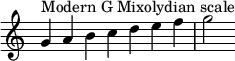
 {
\override Score.TimeSignature #'stencil = ##f
\relative c'' { 
  \clef treble \time 7/4
  g4^\markup { Modern G Mixolydian scale } a b c d e f g2
} }

The Mixolydian scale has the formula

1, 2, 3, 4, 5, 6, 7, 8

That is, the scale has the same series of tones and semitones as the major scale, but with a minor seventh. As a result, the seventh scale degree is a subtonic, rather than a leading-tone.[9] The flattened seventh of the scale is a tritone away from the mediant (major-third degree) of the key. The order of whole tones and semitones in a Mixolydian scale is

whole, whole, half, whole, whole, half, whole

In the Mixolydian mode, the tonic, subdominant, and subtonic triads are all major, the mediant is diminished, and the remaining triads are minor. A classic Mixolydian chord progression is I-VII-IV-V.[10]

The Mixolydian mode is common in non-classical harmony, such as folk, jazz, funk, blues, and rock music. It is often prominently heard in music played on the Great Highland bagpipes.

[In the blues progression, for] example [often] uses D Mixolydian triads ... over the D7 [tonic] chord, then uses G Mixolydian triads ... over the G7 [subdominant] chord, and so on.[11]

As with natural and harmonic minor, Mixolydian is often used with a major seventh degree as a part of the dominant and perfect cadences. "Wild Thing" by The Troggs is a, "perfect example," while others include "Tangled Up in Blue" by Bob Dylan, "Shooting Star" by Bad Company, and "Bold as Love" by Jimi Hendrix.[10]

Klezmer musicians refer to the Mixolydian scale as the Adonai malakh mode. In Klezmer, it is usually transposed to C, where the main chords used are C, F, and G7 (sometimes Gm).[12]

To hear a modern Mixolydian scale, one can play a G-major scale on the piano, but change the F to F.

List of Modern Mixolydian scales

[edit]
Major Key Minor Key Key Signatures Tonic Component pitches
C♯ major A♯ minor 7♯ G♯ G♯ A♯ B♯ C♯ D♯ E♯ F♯
F♯ major D♯ minor 6♯ C♯ C♯ D♯ E♯ F♯ G♯ A♯ B
B major G♯ minor 5♯ F♯ F♯ G♯ A♯ B C♯ D♯ E
E major C♯ minor 4♯ B B C♯ D♯ E F♯ G♯ A
A major F♯ minor 3♯ E E F♯ G♯ A B C♯ D
D major B minor 2♯ A A B C♯ D E F♯ G
G major E minor 1♯ D D E F♯ G A B C
C major A minor - G G A B C D E F
F major D minor 1♭ C C D E F G A B♭
B♭ major G minor 2♭ F F G A B♭ C D E♭
E♭ major C minor 3♭ B♭ B♭ C D E♭ F G A♭
A♭ major F minor 4♭ E♭ E♭ F G A♭ B♭ C D♭
D♭ major B♭ minor 5♭ A♭ A♭ B♭ C D♭ E♭ F G♭
G♭ major E♭ minor 6♭ D♭ D♭ E♭ F G♭ A♭ B♭ C♭
C♭ major A♭ minor 7♭ G♭ G♭ A♭ B♭ C♭ D♭ E♭ F♭

Notable music in Mixolydian mode

[edit]

Hit songs in Mixolydian include "Paperback Writer"..., "Manic Depression"..., "Fire"..., "Reelin' in the Years"..., "Only You Know and I Know"..., "The Tears of a Clown"..., "Don't Stop 'til You Get Enough"..., "Norwegian Wood"..., "Saturday Night's Alright..., "My Generation"..., "Centerfold"..., "Boogie Fever"..., "Hollywood Nights"..., and many others.[13]

Some song examples that are either entirely based in Mixolydian mode or at least have a Mixolydian section include the following: "But Anyway"..., "Cinnamon Girl"..., "Cult of Personality"..., "Fire on the Mountain"..., "Franklin's Tower"..., "Get Down Tonight".[14]

Traditional

[edit]

Classical

[edit]
[edit]

See also

[edit]

References

[edit]

Further reading

[edit]
[edit]
Revisions and contributorsEdit on WikipediaRead on Wikipedia
from Grokipedia
The Mixolydian mode is a diatonic musical scale in Western music theory, defined by the ascending interval pattern of whole step, whole step, half step, whole step, whole step, half step, whole step (W-W-H-W-W-H-W), which produces a bright yet dominant character due to its major third and minor seventh. It corresponds to the fifth mode of the major scale, using the same set of pitches but beginning on the dominant (fifth degree), such as G Mixolydian deriving from C major with notes G, A, B, C, D, E, and F. The mode's name and conceptual framework trace back to ancient Greek music theory, where it was one of the harmoniai or tonoi—scale systems theorized by philosophers like around the BCE—derived as a mixture with the and named after the ancient kingdom of , linked to emotional effects such as or melancholy. During the medieval period, theorists adapted Greek ideas into the eight church modes, positioning authentic Mixolydian (mode VII) with final G, alongside its plagal counterpart Hypomixolydian, influencing sacred and secular compositions until the rise of the tonal major-minor system in the . In , the Mixolydian mode is prominent in genres including folk, , and , where its flattened seventh creates a resolved yet tense "bluesy" quality, often aligning with dominant seventh chords for and melodic phrasing. Notable examples include the guitar in Nirvana's "" (1993), which emphasizes the lowered seventh for a resigned tone, showcasing its applications in rock.

Historical Origins

Ancient Greek Mixolydian

In ancient Greek , the Mixolydian was recognized as one of the seven principal nomoi or harmoniai, representing a distinct scalar framework within the broader system of tonoi and octave species. This mode was integral to the theoretical tradition, particularly as articulated by key figures such as and , who positioned it relative to other harmoniai like the Dorian and Lydian. The Mixolydian was not merely a sequence of pitches but embodied a specific musical character, derived from the conjunct and disjunctive arrangements of tetrachords in the Greater Perfect System—a two-octave structure spanning from the hypate hypaton to the nete hyperbolaeon. Aristoxenus, in his Harmonics, described the Mixolydian as occupying a variable position among the tonoi, with pre-Aristoxenian traditions debating its exact placement—either a semitone above the Lydian or a quarter-tone below the Dorian—reflecting the evolving seven- and fifteen-tonoi systems. He emphasized its structural irregularity, noting that it featured two pykna (close-packed intervals, often quarter-tones in the enharmonic genus or s in diatonic), which distinguished it from more stable modes. , in his Harmonics (Book 2), systematized the Mixolydian within a reduced set of seven tonoi, aligning its high variant a fifth above the Hypolydian and its low variant a fourth above the Dorian; he integrated it into the thetic note-naming of the Greater Perfect System, where it spanned the from paramese (the note above mese) to hypate hypaton, facilitating modulation in practical music-making. The interval structure of the Mixolydian was fundamentally based on the —a descending divided into unequal intervals—arranged as two tetrachords (sharing a common note) with a disjunctive whole tone at the upper end. In the diatonic genus, it consisted of two tetrachords (each divided descending as whole tone, whole tone, ) plus a disjunctive whole tone at the upper end, spanning the from paramese to hypate hypaton and yielding an ascending pattern of , whole tone, whole tone, , whole tone, whole tone, whole tone (e.g., approximating B-C-D-E-F-G-A-B in ). This configuration, often enharmonic in early forms with quarter-tones in the pyknon, created a tense, asymmetrical ascent and descent, contrasting the balanced Dorian's semitone at the bottom. Emotionally, the Mixolydian was associated with , tension, and lamentation, evoking , , and a depressive temper suitable for tragic expression—qualities that set it apart from the stable, manly ethos of the Dorian or the ecstatic, Bacchic fervor of the Phrygian. Aristoxenus linked it to sorrowful moods in his analysis of musical ethics (Harmonics 2.37), while Ptolemy noted its capacity for intense emotional modulation, often tied to aulos performances in dithyrambs or laments. This aligned it with Dionysian themes of ecstasy through sorrow, as reflected in its use by poets like Sappho and in tragic contexts, where it heightened dramatic tension without the grandeur of Dorian mixtures.

Transition to Medieval Modes

The transition from the ancient Greek Mixolydian harmonia to its medieval counterpart began in the early Christian era, particularly through the scholarly efforts of in his De institutione musica (c. 510 CE), which synthesized Greek musical theory for a Latin audience. adapted the Greek harmoniai—including the Mixolydian, described as the highest mode with an species a tone above the Lydian's mese—into Latin terms such as modus and tropus, while introducing related concepts like Hypolydian as a lower species tied to the hyperboleon . Although primarily used terms like Hypolydian rather than directly emphasizing Mixolydian, his systematic arrangement of modes within and their ethical implications laid the groundwork for later medieval theorists to incorporate and refine the Mixolydian as one of the eight church modes. This translation preserved the Greek emphasis on modes' emotional character while beginning to shift toward a more structured, speculative framework influential in the . Byzantine chant played a crucial role in preserving and adapting these Greek modes during the intervening centuries, bridging ancient theory with emerging through the development of the oktoechos system. In the 8th century, codified this eight-mode framework, selecting diatonic scales for their spiritual resonance and assigning them to liturgical weeks, thereby adapting Greek harmoniai like the Mixolydian into tones such as the Fourth Tone (with a D base note) to enhance hymnody without theatrical excess. This system, which categorized modes into authentic and plagal pairs, influenced Western traditions by maintaining the qualitative essence of Greek modes while integrating them into monophonic chant practices. The Byzantine approach ensured the survival of modal structures amid the empire's cultural synthesis of Greek, Syrian, and Hebrew elements. A fundamental shift occurred as medieval theorists moved from the ethos-based Greek harmoniai—which prioritized emotional and ethical effects over fixed pitches—to the pitch-based toni of ecclesiastical music, involving significant renaming and reordering of modes for liturgical utility. Greek modes like the Mixolydian, originally the highest in the series with separations by half-tones or tones, were reordered into an ascending sequence of eight toni (protus, deuterus, tritus, tetrardus, with plagal counterparts), where Mixolydian aligned with (authentic, G final) or Mode 8 (plagal, D–d ambitus). This evolution, evident in 9th-century texts like Musica enchiriadis, emphasized finals (D, E, F, G) and octave species rather than descending Greek tonoi, reflecting a practical for chant classification. Transitional figures such as Hucbald and further refined this by integrating empirical melodic recognition with theoretical scales, solidifying the pitch-oriented system. Early medieval mode identification revealed discrepancies, particularly during the Carolingian reforms of the , where vague terminology and empirical practices led to confusions between modes like Lydian and Mixolydian. For instance, the Alia musica treatise addressed misalignments in Mode 8 (initially termed Hypermixolydian with an a–aa range), reassigning it to a G final and D–d to resolve overlaps with Lydian structures, which were similarly adjusted from Greek effeminate connotations to avoid the in F-based finals. These reforms, part of the broader standardization of under , relied on tonaries for modal assignment but often conflated tonus meanings (interval, note, or mode), highlighting the tension between inherited Greek theory and emerging Latin practice until clarified in later treatises.

Theoretical Foundations

Scale Structure and Intervals

The Mixolydian mode follows the pattern with successive intervals of whole step, whole step, half step, whole step, whole step, half step, and whole step (W-W-H-W-W-H-W). This structure derives directly from the , specifically as its fifth mode, where the scale begins on the dominant (fifth degree) rather than the tonic. By rotating the 's notes to start on the fifth, the seventh degree becomes flattened relative to the 's leading tone, preserving the overall diatonic collection while altering the tonal center. A representative example is the G Mixolydian mode, which uses the notes G-A-B-C-D-E-F-G and corresponds to the white keys of starting from G, drawn from the scale. In this configuration, the perfect fourth (C) and perfect fifth (D) from the tonic G maintain the bright, major-like quality of the first five notes, while the flattened seventh (F) introduces a subtle instability. Similarly, constructing the mode on C yields C-D-E-F-G-A-B♭-C, where the B♭ serves as the defining lowered seventh degree, emphasizing the mode's resemblance to a scale but with a conclusive rather than leading seventh. This flattened seventh imparts a dominant-like character, as it forms the root of a minor seventh chord on the tonic (e.g., G-B-D-F in G Mixolydian), evoking tension suitable for harmonic progression. Tuning systems influence the mode's intervallic purity, particularly the tritone formed between the and flattened seventh degrees (e.g., B to F in G Mixolydian), which spans six semitones and contributes to the dominant quality. In , this tritone measures precisely 600 cents, providing consistent dissonance across keys but approximating just ratios unevenly. In , using 5-limit ratios from the diatonic collection, the tritone adopts a 64/45 ratio (approximately 610 cents), derived from the (5/4) and (16/9 or adjusted to fit the mode), resulting in a slightly wider yet tense interval that enhances resolution to the tonic when the mode functions dominantly. This difference highlights how preserves harmonic purity in static contexts, while facilitates modulation and fixed-pitch instruments.

Comparison to Other Modes

The Mixolydian mode differs from the (the ) solely in its seventh scale degree, which is flattened by a half step, resulting in a minor seventh interval instead of a major seventh. This alteration imparts a quality to the tonic in Mixolydian, creating a sense of tension that often resolves to the tonic of a related major key, evoking a bluesy or unresolved feel compared to the stable, conclusive nature of Ionian progressions. In comparison to the , Mixolydian features a and , lending it a brighter, more major-like , whereas Dorian has a and , positioning it as a minor mode with a somewhat elevated character. Both modes share the flattened seventh, which contributes to their similar dominant tendencies, but Mixolydian's provides greater harmonic brightness and a less melancholic resolution than Dorian's . Relative to the , Mixolydian maintains a but flattens the seventh, producing a grounded, dominant sound, while Lydian raises the fourth to an augmented fourth, yielding a floating, ethereal quality. This structural distinction—the in Mixolydian versus the raised fourth in Lydian—has led to occasional historical in modal , though their characteristic intervals clearly differentiate their harmonic profiles. Within the diatonic modal system derived from the , Mixolydian occupies the fifth position (mode V), obtained by rotating the Ionian scale to begin on its dominant (fifth degree), which underscores its natural association with dominant function in tonal .

Medieval and Renaissance Usage

Mixolydian in

In , the authentic Mixolydian mode is designated as mode VII, with its final on G and a full range spanning an octave from G to the higher G, allowing melodies to explore the upper register while centering on the dominant D, which serves as the . This structure facilitates monophonic lines that emphasize modal gravity through stepwise motion and occasional leaps, particularly the rising fifth from G to D at the outset of many pieces. Representative examples illustrate the mode's application in liturgical texts, such as the Christmas Day introit Puer natus est nobis, which opens with a bold ascent to the dominant and employs the reciting tone D for the psalm verse, culminating in cadences that resolve gently to the final G. Similarly, the gradual Audi filia from the Mass for the Octave of the Nativity of the Blessed Virgin Mary features melismatic flourishes on the dominant and subdominant, highlighting the mode's capacity for expressive recitation in responsorial forms. These chants underscore the reciting tone's role in sustaining textual delivery and the cadential formulas that prioritize modal consonance over tension. The mode's interval pattern—whole, whole, half, whole, whole, half, whole—results in a flattened seventh degree (F natural), eschewing a leading tone and thereby producing cadences with an open, unresolved quality that suits the meditative or celebratory ethos of chant phrases. This avoidance of diatonic tension fosters phrases that feel suspended or angelic, often interacting with the plagal Hypomixolydian mode (VIII) in paired psalmody where lower-range verses complement the authentic's . In the 11th century, advanced the standardization of such modal identifications in his treatise Micrologus, enabling clearer classification and pedagogical transmission of chants by integrating them with his system.

Hypomixolydian Mode

The Hypomixolydian mode, designated as mode 8 in the medieval of eight church modes, functions as the plagal counterpart to the authentic Mixolydian (mode 7). It features a final on G and a range, or ambitus, extending from D below the final to the D an higher, thereby encompassing an octave species from D to D with the primary centered on the final G. This structure maintains the characteristic flattened seventh degree relative to G (F natural, often notated with B-flat to avoid the in practice), aligning with the diatonic intervals of the authentic Mixolydian but confined to a lower . In contrast to the authentic Mixolydian, which emphasizes a higher ambitus from G to the G above for more emphatic expressions, the Hypomixolydian employs its lower range to convey a sense of and subdued devotion, making it particularly suited to less vigorous Gregorian chants such as certain tracts, , and communions. Cadential formulas in this mode typically resolve to the final G via the dominant (the fourth degree above the final), differing from mode 7's formulas that often highlight the higher dominant and extend into the upper for greater intensity. Representative examples include the Tract De profundis clamavi from the Mass, which utilizes the mode's contemplative range for its psalmic recitation, and the Domine Deus in simplicitate cordis mei for the Dedication of a Church, featuring melismatic phrases that on G within the D-to-D ambitus. The theoretical delineation of plagal modes like the Hypomixolydian emerged in the ninth century through Frankish scholars adapting earlier Byzantine and Roman traditions. Hucbald of Saint-Amand, in his treatise De harmonica institutione (c. 880), provided the earliest systematic description of the eight modes, defining plagal ranges as spanning a fourth below the final to a fifth above it—thus specifying the Hypomixolydian from D to D—while integrating Greek tonal concepts with practical classification. Notker Balbulus (c. 840–912), a monk at the , advanced modal through his compilation of tonaries and sequences, which aided in assigning chants to specific modes, including plagal ones, and emphasized their liturgical and mnemonic roles in monastic practice. These contributions solidified the Hypomixolydian's place within the system, facilitating the organization of the vast Gregorian repertoire.

Renaissance Usage

During the , the Mixolydian mode persisted in polyphonic sacred music, where composers such as composed works like the Missa O admirabile commercium in the Mixolydian mode on G, employing modal cadences and avoiding the leading tone to preserve the characteristic sound, even as harmonic practices began evolving toward . This usage allowed for expressive while adhering to the church modal system, influencing the transition to the major-minor tonal framework in later centuries.

Modern Interpretations

Construction in Contemporary Theory

In theory, the Mixolydian mode is constructed as the fifth mode of the , derived by starting on the fifth scale degree of a given and employing the same set of pitches, resulting in a scale of whole-whole-half-whole-whole-half-whole steps. For instance, G Mixolydian emerges from the scale (with no sharps or flats in its ), yielding the pitches G-A-B-C-D-E-F. This modal construction is fully transposable to any root note, adjusting the parent accordingly; for example, C Mixolydian derives from the scale (which has one flat, B♭), producing C-D-E-F-G-A-B♭. The mode's defining characteristic is this flattened seventh relative to the , which imparts a bluesy or unresolved quality while maintaining major-third stability on the tonic. Harmonically, Mixolydian functions primarily as a dominant mode, underpinning dominant seventh (V7) chords without the typical resolution to the tonic, as the absent leading tone (raised seventh) reduces pull toward the or tonic, allowing sustained tension in progressions like those in or rock. In notation practices, the typically mirrors that of the parent to minimize accidentals, with any deviations—such as the natural seventh in keys requiring a sharp—indicated by explicit accidentals in the score rather than altering the signature itself. Modal signatures are occasionally employed in specialized contexts like charts to denote the mode explicitly, but standard practice favors the parent for readability in contemporary .

Variations and Altered Forms

The Mixolydian b6 scale, also known as the Aeolian dominant or , is a variation of the standard Mixolydian mode featuring a flattened sixth degree, resulting in the interval pattern 1-2-3-4-5-b6-b7. This alteration creates a darker, more tense sound suitable for improvising over dominant seventh chords with a flat thirteenth (7b13), such as in contexts where it emphasizes the Phrygian flavor within a major framework. For example, the G Mixolydian b6 scale consists of the notes G-A-B-C-D-Eb-F. As the fifth mode of the , it integrates seamlessly into extended tonality, providing a bridge between harmonic structures. Another prominent altered form is the Mixolydian b9 b13 scale, which modifies the Mixolydian mode by flattening both and sixth degrees (1-b2-3-4-5-b6-b7), introducing heightened dissonance for tension in improvisation. This variant, derived as the fifth mode of the , is particularly effective over dominant chords implying b9 and b13 tensions, enhancing the exotic or ethnic quality in compositions. It appears in theory resources as a tool for creating instability that resolves to more stable tonalities, often in progressions involving altered dominants. The Lydian dominant scale represents a brighter alteration of the Mixolydian mode, incorporating a raised fourth degree (1-2-3-#4-5-6-b7), which combines the Lydian mode's augmented fourth with the Mixolydian flat seventh for a shimmering, unresolved quality. Also referred to as Mixolydian #4 or #11, it is the fourth mode of the melodic and is widely used in over dominant seventh chords with a sharp eleventh (#11), such as in ii-V-I progressions where it adds a sense of lift and forward momentum. For instance, the C Lydian dominant scale includes the notes C-D-E-F#-G-A-Bb, facilitating chromatic approaches in . Other modern extensions include the Mixolydian ♭2 (equivalent to Mixolydian b9), which further alters the second degree for increased in . These forms expand the Mixolydian palette beyond diatonic boundaries, drawing from melodic and harmonic minor derivatives to support extended dominant functions in and fusion genres.

Musical Applications

In Classical Music

In the Baroque era, the Mixolydian mode appeared in settings, where it facilitated modal cadences that evoked solemnity. This approach highlighted the mode's role in blending diatonic stability with subtle modal color, a technique adapted from earlier German organ traditions. During the Classical period, composers incorporated Mixolydian inflections into string quartets to impart folk-like rusticness to themes, often as part of modal mixture to heighten expressive contrast. These elements reflected interest in vernacular styles, using the mode sparingly to add timbral variety without disrupting . In the Romantic era, integrated Mixolydian elements into symphonic writing, particularly in the finale of Symphony No. 9 in ("From the New World," Op. 95), where modal four-note collections blend with pentatonic scales to fuse American spirituals and Bohemian folk idioms into a triumphant coda. This mixture created a hybrid that underscored the symphony's cross-cultural , with the mode's characteristic flattened seventh enhancing the movement's energetic, hymn-like drive. By the early , treated the Mixolydian mode as a coloristic device in impressionistic piano works, employing it for atmospheric depth. In "La cathédrale engloutie" from Préludes, Book 1 (L. 117/10), the upper melody unfolds in C Mixolydian, with parallel harmonies and the B-flat altering the diatonic framework to evoke the submerged cathedral's resonant bells, shifting fluidly between modal layers for a sense of ancient mystery.

In Folk and Traditional Music

The Mixolydian mode plays a prominent role in Celtic and folk traditions, where it imparts a rustic, earthy quality to tunes like jigs and reels. In Irish music, many jigs employ the mode's characteristic flattened seventh degree, creating a sense of modal ambiguity that suits drone-based accompaniments on instruments such as the or . This modal approach distinguishes traditional Irish sessions from tonal major-key structures, emphasizing communal and regional variants. In , particularly Appalachian traditions, the Mixolydian mode contributes to the genre's raw, narrative-driven sound, often facilitating open-string harmonies on and . Tunes like "Soldier's Joy," a staple of old-time repertoire, feature occasional flattened seventh inflections (C natural) against the D tonic, producing a buoyant yet slightly melancholic drive suited to square dances and storytelling. This enables harmonic simplicity, with modal cadences resolving on the tonic rather than a leading tone, mirroring the mode's use in British source material while adapting to isolated mountain acoustics. The mode's prevalence here underscores Appalachian music's retention of European modal roots amid cultural isolation. Eastern European folk traditions, as documented in Béla Bartók's ethnomusicological collections, incorporate modal elements in rural melodies from the , where scalar segments form the basis of repetitive, hypnotic lines accompanied by asymmetric rhythms on gaida bagpipes or tambura. Such elements appear in his transcribed volumes, highlighting the mode's role in evoking communal rituals and seasonal cycles across the region. Non-Western parallels to the Mixolydian mode appear in various global traditions. These usages underscore the mode's cross-cultural utility in fostering authentic, non-hierarchical tonal landscapes.

In Jazz and Blues

In and , the Mixolydian mode serves primarily as the foundational scale for improvising over dominant seventh chords, providing the essential b7 that defines the chord's tension and resolution. In the blues tradition, particularly within the standard 12-bar form, musicians apply the Mixolydian mode to each dominant chord to outline harmonic changes while incorporating blues inflections like the b3 and b5 for color. For instance, in a 12-bar blues in B, the I chord (B7) uses B Mixolydian, the IV (E7) uses E Mixolydian, and the V (F#7) uses F# Mixolydian, creating a cohesive yet varied solo framework that emphasizes the mode's major triad with a flattened seventh. This approach is exemplified in Robert Johnson's "," a classic in B that follows the 12-bar structure, where the F#7 turnaround invites F# Mixolydian phrasing to heighten the song's dramatic resolve. In jazz improvisation, the chord-scale theory popularized by theorists like Mark Levine reinforces the Mixolydian mode's role over dominant 7ths, matching the scale directly to the chord for targeted substitution and extension. Levine outlines how G Mixolydian (G-A-B-C-D-E-F) aligns perfectly with a G7 chord, allowing players to emphasize chord tones while adding 9ths, 11ths, and 13ths for richer lines. A seminal example appears in Miles Davis's "All Blues" from the 1959 album Kind of Blue, where the head and solos revolve around G Mixolydian over a modal G7 vamp, blending blues bends with the mode's bright yet tense quality to evoke a swinging, extended blues feel. This modal application reduces chord changes, freeing improvisers to explore the scale's inherent groove and color. Bebop pioneers like extended the Mixolydian framework with chromatic approaches and alterations, often incorporating a b6 (as in Mixolydian b6) to create altered dominant sounds over V7 chords leading to minor resolutions. Parker's lines frequently target the b13 (equivalent to b6 from the root) alongside b9 and #9 tensions, drawing from the mode's structure but infusing 's rhythmic density and enclosure techniques for heightened expressivity. In post-2000 fusion contexts, guitarist integrates Mixolydian into tracks on albums like Überjam (2002), employing the mode over funky dominant vamps and merging bebop extensions with groove-oriented phrasing and effects for a contemporary hybrid sound. Altered variations of Mixolydian, such as the b6 form, appear in Scofield's solos to add dissonance without abandoning the mode's core dominant function.

In Rock and Pop

The Mixolydian mode gained prominence in and starting in the , valued for its bright major tonality combined with a flattened seventh degree, which imparts an anthemic yet unresolved tension ideal for riff-driven structures and extended grooves. This modal approach, drawing briefly from influences in early , allowed composers to evoke a sense of drive and ambiguity without full resolution to the tonic, distinguishing it from standard major-key progressions. In 1960s rock, the mode featured prominently in psychedelic and experimental tracks, where its riff-based application created hypnotic, drone-like effects. The Beatles' "Tomorrow Never Knows" (1966) exemplifies this with its central riff and vocal melody centered in C Mixolydian, built around oscillating chords of C and B-flat that emphasize the mode's characteristic bVII-I movement for a swirling, Eastern-inspired ambiance. By the 1970s, embraced Mixolydian for aggressive, riff-heavy harmony that amplified the mode's bold, dominant quality. Led Zeppelin's "Black Dog" (1971) deploys a syncopated in A Mixolydian, anchored by A and G chords to propel the track's irregular phrasing and raw energy, showcasing how the mode supports blues-derived rock without traditional resolution. In pop, the mode appeared in socially conscious songs to underscore narrative tension through verse structures. Stevie Wonder's "" (1973) employs F♯ Mixolydian in its verses, with a repeating F♯ pedal and outlining the scale's and flattened seventh, enhancing the track's gritty urban portrayal amid shifting time signatures. Modern extensions in the 2000s and beyond adapted Mixolydian for electronic and indie contexts, often in looped riffs that sustain modal ambiguity. For example, in rock, the mode continues to appear in riff-based songs emphasizing flattened sevenths for tension. In indie rock, bands like The Strokes have used major-key structures with bluesy elements in tracks like "Last Nite" (2001), contributing to garage-rock's raw edge.

References

Add your contribution
Related Hubs
User Avatar
No comments yet.