


Community hub
Recent from talks
Contribute something
Nothing was collected or created yet.
Indra Jatra
View on Wikipedia| Indra Jātra | |
|---|---|
 Mask of Sweta Bhairava at Durbar Square | |
| Also called | Yenya in Nepali |
| Observed by | Nepalese Hindus and Buddhists |
| Type | Religious |
| Significance | Unity of Local People of Kathmandu |
| Celebrations | Chariot processions on
6th of September 2025 (Kwaneyā) 7th of September 2025 (Thaneyā) 11th Of September 2025 (Nānichāyā) |
| Observances | Processions, masked dances, tableau |
| Begins | Yanlāthwā Dwadashi (ञलाथ्व द्वादशी) |
| Ends | Yanlāgā Chaturthi (ञलागा: चतुर्थी) |
| Started by | King Gunakāmadeva |
Indra Jātrā, also known as Yenyā Punhi is the biggest religious street festival in Kathmandu, Nepal. "Ye" means the old Newari name for "Kathmandu", "Ya" means “Celebration”, and "Puhni" means full moon so together means the birthday of the old city of Kathmandu.[1] The celebrations consist of two events, Indra Jātrā and Kumāri Jātrā. Indra Jātrā is marked by masked dances of deities and demons, displays of sacred images, and tableaus in honor of the deity Indra, the king of heaven. Kumāri Jātrā is the chariot procession of the living goddess Kumari.
Family members deceased in the past year are also remembered during the festival. The main venue of the festival is Kathmandu Durbar Square. The celebrations last for eight days from the 12th day of the bright fortnight to the 4th day of the dark fortnight of Yanlā (ञला), the eleventh month in the lunar Nepal Era calendar.[2][3]
Indra Jatra was started by King Gunakamadeva- (गुणकामदेव) to commemorate the founding of the Kathmandu city in the 10th century.[4] Kumari Jatra began in the mid-18th century. The celebrations are held according to the lunar calendar, so the dates are changeable.
Opening ceremony
[edit]
The festival starts with Yosin Thanegu (योसिं थनेगु), the erection of Yosin, a pole from which the banner of Indra is unfurled, at Kathmandu Durbar Square. The pole, a tree shorn of its branches and stripped of its bark, is obtained from a forest near Nālā, a small town 29 km to the east of Kathmandu. It is dragged in stages to Durbar Square by men pulling on ropes.
Another event on the first day is Upāku Wanegu (उपाकु वनेगु) when participants visit shrines holding lighted incense to honor deceased family members. They also place small butter lamps on the way. Some sing hymns as they make the tour. The circuitous route winds along the periphery of the historic part of the city. The procession starts at around 4 pm.[5]
Processions
[edit]Kumari Jatra
[edit]_-_BL_WD_3279.jpg)

Kumari Jatra, which means the chariot festival of Kumari, coincides with Indra Jatra. It was started in 1756 AD during the reign of Jaya Prakash Malla.[6][7]
During this festival, three chariots carrying human representations of the deities Ganesh, Bhairava and Kumari accompanied by musical bands are pulled along the festival route through Kathmandu on three days. The procession starts at around 3 pm.
On the first day of Kumari Jatra known as Kwaneyā (क्वनेया:), the chariots are pulled through the southern part of town. The second day is the full moon day known as Yenya Punhi (येँयाः पुन्हि). During the procession known as Thaneyā (थनेया:), the chariots are drawn through the northern part till Asan. And on the third day Nānichāyā (नानिचाया:), the procession passes through the central section at Kilāgal. Since 2012, the chariot of Kumari has been pulled by an all women's team on the third day of the chariot festival.
- Route on first day of chariot festival, Kwaneyā (downtown procession): Basantapur, Maru, Chikanmugal, Jaisidewal, Lagan, Brahma Marga, Wonde, Hyumata, Kohity, Bhimsensthan, Maru, Basantapur.
- Route on second day of chariot festival, Thaneyā (uptown procession): Basantapur, Pyaphal, Yatkha, Nyata, Tengal, Nhyokha, Nhaikan Tol, Asan, Kel Tol, Indra Chowk, Makhan, Basantapur.
- Route on third day of chariot festival, Nānichāyā (midtown procession): Basantapur, Pyaphal, Yatkha, Nyata, Kilagal, Bhedasing, Indra Chowk, Makhan, Basantapur.
Mata Biye
[edit]Mata Biye (मत बिये) means to offer butter lamps. On the day of Kwaneyā, the first day of the chariot festival, Newars honor family members deceased during the past year by offering small butter lamps along the processional route. They also present butter lamps to relatives and friends on the way as a mark of respect. The procession starts at around 6 pm.
- Route: Maru, Pyaphal, Yatkha, Nyata, Tengal, Nhyokha, Nhaikan Tol, Asan, Kel Tol, Indra Chok, Makhan, Hanuman Dhoka, Maru, Chikanmugal, Jaisidewal, Lagan, Hyumata, Bhimsensthan, Maru.
- Day: On the day of Kwaneyā.

Dagin
[edit]The procession of the goddess Dāgin (दागिं) (alternative name: Dāgim) re-enacts Indra mother's going around town in search of her son. The procession consists of a man wearing a mask accompanied by a musical band. It starts at after the chariot of Kumari returns to Basantapur after journeying around the southern part of town. Dagin is followed by many people who has lost their family member in that specific year.
The procession begins from an alley at the south-western corner of Maru square and passes by the western side of Kasthamandap. The participants follow the festival route north to Asan and then back to Durbar Square. The procession continues to the southern end of town before returning to Maru.[8]
- Route: Maru, Pyaphal, Yatkha, Nyata, Tengal, Nhyokha, Nhaikan Tol, Asan, Kel Tol, Indra Chok, Makhan, Hanuman Dhoka, Maru, Chikanmugal, Jaisidewal, Lagan, Hyumata, Bhimsensthan, Maru.
- Day: On the day of Kwaneyā.
Bau Mata
[edit]Bau Mata (बौँ मत) consists of a long representation of a holy snake made of reeds on which a row of oil lamps are placed. The effigy is suspended from poles carried on the shoulders and taken along the festival route. The procession starts from the southern side of Kasthamandap at Maru. When the Dagin procession returns from the upper part of town and reaches Maru, that is the cue for the Bau Mata procession to set off. It starts after Dagin has returned to Maru and is organized by the Manandhar caste group.
- Route: Maru, Pyaphal, Yatkha, Nyata, Tengal, Nhyokha, Nhaikan Tol, Asan, Kel Tol, Indra Chok, Makhan, Hanuman Dhoka, Maru, Chikanmugal, Jaisidewal, Lagan, Hyumata, Bhimsensthan, Maru.
- Day: On the day of Kwaneyā.
Exhibitions
[edit]
Bhairava
[edit]Masks of Bhairava are displayed at various places in Kathmandu throughout the eight days of the festival. Bhairava is the terrifying aspect of Shiva. The largest ones are of Sweta Bhairava at Durbar Square, and of Akash Bhairava at Indra Chok. A pipe sticking out of the mouth of Sweta Bhairava dispenses alcohol and rice beer on different days. An image of Bākā Bhairava is exhibited at Wotu, next to Indra Chok.
The mask of Aakash Bhairava is related to the Mahabharata. Some believe it to be the head of the first Kirat King Yalambar. Every night, different groups gather and sing hymns at Indra Chowk.
Indraraj Dyah
[edit]Images of Indraraj Dyah with his outstretched hands bound with rope are exhibited on a tall platform at Maru near Durbar Square and at Indra Chok, Kathmandu.
Dasavatar
[edit]A tableau is known as Dasavatar or the 10 incarnations of Vishnu is shown on the temple steps in front of Kumari House every night.
Masked dances
[edit]
Pulu Kisi (पुलु किसि)
[edit]This is performed by the residents of Kilagal tole. Pulu Kisi is believed to be the carrier of Indra himself. Pulu Kisi goes through the streets of the ancient city Kathmandu in search for his imprisoned master. People view the masked creature with the roar of excitement and laughter. From time to time It does naughty and mischievous things by running through the street knocking anyone that comes in its path and swinging its tail in an amazing manner. Like other dancers, he also has a team of a musical band and a torch carrier in front.
Majipā Lākhey
[edit]The demon dance of Majipā Lākhey is performed on the streets and market squares. The Majipa Lakhey dancer and his retinue of musicians move with much agility .He alongside Pulukisi helps in crowd control before chariot procession through the streets and crowds spreading the festive mood. It is the only time when people can see Majipa Lakhey on entire year.
Sawa Bhakku
[edit]The Sawa Bhakku dance group from Halchok, at the western edge of the Kathmandu Valley, makes its rounds along the festival route, stopping at major street squares to perform and receive offerings from devotees. The dancers consist of Bhairava (in blue) holding a sword and his two attendants (in red). The ensemble is also known informally as Dhin Nāli Sintān after the sound of their music.
Devi Pyakhan
[edit]Devi Pyakhan from Kilagal, Kathmandu is performed at Kilagal, Hanuman Dhoka, Jaisidewal, Bangemuda, Indrachowk, Kilagal . Dancers wearing masks of various gods & goddesses and the name of them Bhairav, Kumari, Chandi, Daitya, Kawan, Beta, & Khya. As per historical themes The Devi Pyakhan (Devi nach was born the time of Gunakar raj.
Māhākāli Pyakhan
[edit]Māhākāli Pyakhan from Bhaktapur performs at Durbar Square and major street squares around Kathmandu. Khyāh Pyākhan (ख्याः प्याखं) features dancers dressed in a costume representing the Khyah, a fat, hairy ape-like creature. Their dance is marked by antics and a lot of tumbling.
In Basantapur
[edit]Indra Jatra is celebrated in Basantapur by erecting poles representing Indra at various localities around the city. The poles are known as Yambodyah. Masked dances and Pulu Kisi dance are also performed.[9][10]
In Terai
[edit]Indra Jatra is also observed in some districts of Terai (Nepal and Indian Northern Bihar) as Indra Puja according to the local traditions. Rituals are different than in the Kathmandu Valley but the festival is observed around the same time indicating a common origin of the festival, probably during the Lichhavi period.
Mythology
[edit]Indra Jatra is celebrated in honor of Lord Indra, the Hindu king of the heavens. Indra is renowned for his role in ensuring the welfare and prosperity of humanity by regulating rainfall and fostering abundant harvests. Indra Jatra is always celebrated at the time of the retreat of the summer monsoon, and the time when rice paddies are blooming and heavy rainfall could damage the crops.[1] According to legend, Indra (Hindu god-king of heaven), disguised as a farmer, descended to earth in search of parijat swã (Night jasmine), a white flower his mother Basundhara needed to perform a ritual. As he was plucking the flowers at Maruhiti, a sunken water spout at Maru, the people caught and bound him like a common thief. He was then put on display in the town square of Maru in Kathmandu. (In a reenactment of this event, an image of Indra with his hands bound is put on display at Maru and other places during the festival.)
His mother, worried about his extended absence, came to Kathmandu and wandered around looking for him. (This event is commemorated by the procession of Dagin (दागिं) through the city. Pulu Kisi (alternate name Tānā Kisi), a wicker representation of an elephant, also runs around town reenacting Indra's elephant searching frantically for its master.)[11]
When the city folk realized they had captured Indra himself, they were appalled and immediately released him. Out of appreciation for his release, his mother promised to provide enough dew throughout the winter to ensure a rich crop. It is said that Kathmandu starts to experience foggy mornings from this festival onwards because of this boon.[12][13]
Closing ceremony
[edit]On the last day, the yosin pole erected at Durbar Square is taken down in a ceremony known as Yosin Kwathalegu (योसिं क्वथलेगु). It marks the end of the festivities.
Open air theater
[edit]Yenya is also the season of open air theatre productions. Performances depicting social themes, satire and comedy are held on dance platforms or makeshift stages at market squares all over the Kathmandu Valley on the sidelines of the sacred festival. The plays, known as Dabu Pyākhan (दबू प्याखं), have a history going back centuries.
Gallery
[edit]-
 Statue of Indra with his hands bound at Maru
 -
 Mask of Akash Bhairava at Indra Chok
 -
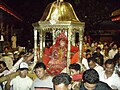 Living goddess Kumari
 -
 Child representing Bhairava (Bhelu)
 -
 Chariot of Kumari
 -
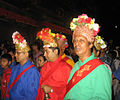 Buddhist priests during chariot procession
 -
 Majipa Lakhe dancer
 -
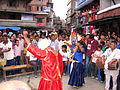 Sawa Bhakku
 -
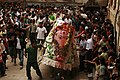 Pulu Kisi dance
 -
 Bau Mata
 -
 1960s pamphlet advertising street play
 -
 Haatha Daya: Swetha Bhairav


.jpg)
See also
[edit]| Music | |
|---|---|
| Cuisine | |
| Festival | |
| Rituals | |
| Architecture | |
| Language | |
| Deities | |
| Castes | |
| Misc | |
| Religion | |

References
[edit]- ^ a b Bhandari, S.; Paudayal, K. N. (2007-12-31). "Palynostratigraphy and palaeoclimatic interpretation of the Plio- Pleistocene Lukundol Formation from the Kathmandu valley, Nepal". Journal of Nepal Geological Society. 35: 1–10. doi:10.3126/jngs.v35i0.23629. ISSN 0259-1316.
- ^ Toffin, Gérard (January 1992). "The Indra Jātrā of Kathmandu as a Royal Festival Past and Present". Contributions to Nepalese Studies. Center for Nepal and Asian Studies, Tribbuvan University. Retrieved 24 July 2012. Page 73.
- ^ Lewis, Todd Thornton (1984). The Tuladhars of Kathmandu: A Study of Buddhist Tradition in a Newar Merchant Community. Columbia University. p. 377. Retrieved 30 July 2012.
- ^ "Indra Jatra, Munindra Ratna Bajracharya". Gorkhapatra. Archived from the original on 2012-03-25. Retrieved 2011-09-17.
- ^ "Kathmandu's Indra Jatra Festival". Lonely Planet. 2012. Retrieved 1 August 2012.
- ^ Manandhar, Tirtha Narayan (27 September 2012). "Indra, Kumari Jatras two different events". The Kathmandu Post. Retrieved 1 October 2012.
- ^ Oldfield, Henry Ambrose (2005). Sketches from Nipal. Asian Educational Services. p. 315. ISBN 9788120619586. Retrieved 2 August 2012.
- ^ van den Hoek, A. W. (2004) Caturmāsa: Celebrations of death in Kathmandu, Nepal. CNWS Publications. ISBN 9789057890987. Page 53. Retrieved 31 July 2012.
- ^ RSS (20 September 2010). "Indra jatra begins in Bhaktapur". The Himalayan Times. Archived from the original on 14 November 2022. Retrieved 30 September 2012.
- ^ "Khwapay Yambodyah thana ("Yambodyah erected in Bhaktapur")". Sandhya Times. 28 September 2012. Page 11.
- ^ van den Hoek, A. W. (2004) Caturmāsa: Celebrations of death in Kathmandu, Nepal. CNWS Publications. ISBN 9789057890987. Page 53. Retrieved 4 April 2012.
- ^ Burbank, Jon (2002). Cultures of the World: Nepal. Marshall Cavendish. ISBN 9780761414766. Page 115.
- ^ "Indrajatra". guru.com.np. Archived from the original on 2015-03-31. Retrieved 2011-09-17.
Indra Jatra
View on GrokipediaHistorical and Cultural Context
Origins and History
Indra Jatra traces its roots to the ancient Lichchhavi period (circa 400–750 CE), when it emerged as part of Newar traditions involving rituals to honor deities and ensure agricultural prosperity through rainfall. During this era, the festival included offerings to the Living Goddess Kumari, processions of a life-size Indra figure, and elements like the search by Dakine Devi for Indra, reflecting early communal reverence for nature and divine intervention in human affairs. These practices laid the foundation for the festival's evolution, integrating tantric and indigenous Newar customs that emphasized collective participation and cultural continuity.[4][5] The festival was formally established in the 10th century by King Gunakamadeva, the founder of Kathmandu, who initiated Indra Jatra to commemorate the city's creation and foster unity among the diverse communities of the Kathmandu Valley. Gunakamadeva's reign marked a pivotal development, as he incorporated traditions such as receiving a tika (forehead mark) from Kumari to symbolize legitimate rule, blending political consolidation with religious observance inspired by the mythological legend of Indra's visit to earth. This founding not only unified the valley's inhabitants but also preserved Newar identity through shared rituals, evolving from rudimentary Lichchhavi observances into a structured annual event that reinforced social bonds and cultural heritage.[3][5][4] A significant milestone occurred in 1756 during the Malla period, when King Jaya Prakash Malla introduced the Kumari Jatra procession, expanding the festival by building a residence for the Living Goddess and integrating her chariot parade into the celebrations. This addition, motivated by a vision from Goddess Taleju, elevated the festival's scale and deepened its role in state welfare and community cohesion among Newars. Further enhancements in the Malla era included the establishment of masked dances, such as the Lakhe dance, which depicted mythical narratives and were performed during the festival to entertain and educate participants, solidifying Indra Jatra's function as a vital mechanism for cultural preservation and social unity across centuries.[6][5][4]Mythological Foundations
The mythological foundations of Indra Jatra are rooted in ancient Newar legends that intertwine Hindu deities with local folklore, centering on Indra, the king of gods and deity of rain and thunder. According to the primary myth, Indra descended from heaven to the Kathmandu Valley disguised as a humble gardener to steal parijat flowers (night-flowering jasmine), which his mother, Dagin or Devasri, needed for a celestial ritual. Unable to find the flowers in heaven, Indra ventured to earth, where the blooms grew abundantly, but his suspicious behavior led to his capture by valley residents who bound him as a thief, unaware of his divine identity.[7][8][9] In response to Indra's disappearance, his mother Dagin, veiled in white, and his loyal elephant mount Airavata—known locally as Pulu Kisi—searched frantically through the streets of Kathmandu. Dagin, also captured briefly by the locals, revealed their divine natures to secure Indra's release, leading to his liberation on the festival's eighth day. As boons for the valley's inhabitants, Indra and Dagin granted protective morning fog to shield the land from invaders and promised to escort the souls of the deceased to heaven, symbolized by a chain of spirits that broke and formed a sacred lake. These elements underscore Indra's role as a benevolent rain god, ensuring agricultural prosperity through monsoon blessings during the festival.[7][8][4] The legends prominently feature related deities that highlight the syncretic Hindu-Buddhist fabric of Newar mythology. Kumari, revered as the living incarnation of the goddess Taleju (a form of Durga), embodies divine feminine power and emerges during the festival to bless participants, reflecting Buddhist influences through her selection from the Shakya clan. Bhairava, the fierce protector aspect of Shiva, stands as a guardian of the festivities, with his masks displayed to ward off evil and ensure communal harmony. This blending of Hindu figures like Indra and Bhairava with Buddhist elements, such as Vajracharya priestly roles, illustrates the inclusive spiritual worldview of the Newars, where celestial myths foster unity and reverence for nature's cycles.[7][8][4]Significance and Observance
Cultural and Religious Importance
Indra Jatra serves as a pivotal celebration in Nepalese society, marking the conclusion of the monsoon season and the onset of the harvest period, while invoking the deity Indra to ensure agricultural prosperity and bountiful yields.[1] This festival, observed annually in September, underscores the deep interconnection between divine benevolence and human sustenance, particularly in the agrarian context of the Kathmandu Valley.[10] The festival exemplifies syncretic traditions unique to the Newar community, seamlessly blending Hindu and Buddhist practices to foster communal harmony across religious lines.[7] In Kathmandu, it unites participants from diverse castes and ethnic groups in shared rituals, promoting social cohesion and reinforcing collective identity among the Newars, who view it as a cornerstone of their cultural heritage.[11] Through elements like masked dances and processions, it honors ancestors via commemorative rites, such as the Upaku procession with butter lamps, guiding souls and preserving oral histories of the ancient city.[12] As an element of Nepal's intangible cultural heritage, Indra Jatra plays a vital role in safeguarding traditional knowledge and community bonds, contributing to the nation's cultural landscape recognized by international bodies like UNESCO's Asia-Pacific Centre.[10] It bolsters Newar ethnic identity by enacting divine-human interactions, symbolized in the veneration of living deities like Kumari, and enhances tourism by drawing global visitors to witness its vibrant displays of renewal and protection against calamities.[1] These aspects highlight the festival's enduring function in invoking protection from natural adversities and celebrating cyclical renewal tied to Indra's role as guardian of fertility and land.[7]Dates, Locations, and Participants
Indra Jatra is observed annually from the 12th day of the bright fortnight (Shukla Paksha) to the 4th day of the dark fortnight (Krishna Paksha) in the Nepali month of Bhadra, known as Yanlā in the Newari calendar, which generally falls in August or September according to the Gregorian calendar.[13] The festival spans eight days, marking the end of the monsoon season and the onset of autumn harvest celebrations within Newari communities.[14] In 2025, the event occurred from September 6 to September 13, aligning with the 21st to 28th days of Bhadra 2082 in the Nepali calendar.[15] The primary venue for Indra Jatra is Kathmandu Durbar Square, a UNESCO World Heritage site in the heart of Kathmandu, where key rituals such as the erection and lowering of the sacred pole (Linga or Indradhwaja) take place amid historic temples and palaces.[16] Festivities extend to surrounding areas within the Kathmandu Valley, including processions through narrow streets lined with traditional Newari architecture, and branch out to nearby cities like Bhaktapur and Patan (Lalitpur), where localized versions feature unique chariot pulls and dances adapted to regional traditions.[14] These locations serve as focal points for communal gatherings, emphasizing the festival's role in uniting diverse neighborhoods across the valley.[17] Key participants include Newar priests from the Shakya and Vajracharya castes, who conduct essential rituals as Buddhist officiants, ensuring the spiritual integrity of ceremonies like the pole consecration.[18] Central to the event is the Kumari, a pre-pubescent girl from the Shakya caste selected as the living embodiment of the goddess Taleju through a rigorous process evaluating her physical purity, horoscope, and 32 specific attributes of perfection; she remains in this role until puberty or minor injury, after which a successor is chosen.[18] Masked dancers, representing deities and demons, perform traditional Lakhe and other pyakhan dances; these performers hail from hereditary guthi guilds, community-based organizations that preserve and execute the intricate choreography passed down through generations.[19] The festival's organizational structure relies on hereditary guthi trusts, ancient Newari institutions that manage logistics, fund activities through endowed lands, and coordinate participant roles to sustain cultural practices.[20] The guthi system, which oversees over 12,000 significant religious structures across Nepal, manages temple maintenance and ritual execution for events like Indra Jatra, ensuring community involvement and tradition fidelity.[20] Government oversight, provided by the Guthi Sansthan (a federal body under the Ministry of Land Management, Cooperatives and Poverty Alleviation), handles safety, crowd control, and financial support during the large-scale gatherings, preventing disruptions while respecting guthi autonomy.[21]Festival Ceremonies
Opening Ceremony
The opening ceremony of Indra Jatra commences with the erection of the Yosin, also known as the Lingo, a sacred wooden pole central to the festival's rituals. This approximately 50-foot-tall sal tree is selected from a forest near Nālā, located about 29 km east of Kathmandu, where community members identify a suitable straight trunk shorn of branches and stripped of bark to symbolize purity.[11][7] The selection process involves traditional consultations with priests to ensure auspiciousness, followed by initial rituals including offerings and purification to invoke divine blessings.[22] The transportation of the Yosin pole engages broad community involvement, as teams of men from Kathmandu's Newar guilds drag it in stages over several days using ropes, accompanied by chants, music, and periodic stops for rituals at shrines along the route to honor local deities and prevent mishaps.[23][22] Upon arrival at Kathmandu Durbar Square, the pole is erected in front of Hanuman Dhoka palace at an astrologically determined auspicious time, typically in the morning, with priests performing invocations and the crowd participating in synchronized pulling to raise it upright. This act marks the official launch of the festival, symbolizing Indra's descent to earth and serving as the axis mundi connecting heaven and earth, thereby establishing the divine presence that permeates the ensuing celebrations.[2][7] In the evening of the same day, the Upāku Wanegu procession unfolds as a solemn evening parade to honor deceased ancestors, beginning around 4 pm and involving families carrying lighted incense, oil lamps, and sometimes musical bands through the historic streets of Kathmandu.[24][14] Participants visit household shrines and key sites within the old city, offering prayers and lights to guide the spirits of the departed, reinforcing communal bonds and the festival's theme of remembrance amid celebration. This rite draws from Newar traditions of ancestral veneration, integrating seamlessly with the pole's erection to invoke both living and ancestral participation in welcoming Indra.[25]Closing Ceremony
The closing ceremony of Indra Jatra, known as Yosin Kwathalegu, takes place on the eighth and final day of the festival in Kathmandu's Hanuman Dhoka Durbar Square, marking the resolution of the event with the ritualistic lowering of the towering Yosin pole.[14][26] This pole, erected at the festival's outset as a symbol of Indra's presence, is carefully dismantled amid chants and prayers by priests and community members, serving as a thanksgiving to the deity for blessings of rain and prosperity while ensuring the structure's respectful handling to prevent any misfortune.[27][28] The ceremony counterpoints the opening pole-raising, completing the symbolic cycle of Indra's visit to earth.[29] Following the pole's lowering, final offerings are presented to the deities, including the pouring of thow (rice beer) from Swet Bhairav's mouth as prasad to devotees, alongside samay baji—a traditional Newari platter of beaten rice, spiced meat, and eggs—shared among priests, dancers, and participants as a communal feast to honor their contributions and express collective gratitude.[26][14] These rituals emphasize closure through shared sustenance, reinforcing social bonds within the Newar community. In 2025, due to national political turmoil and curfews, some associated processions were halted, leading to a modified conclusion focused on core rituals.[30][31] The symbolic dispersal occurs as the dismantled Yosin pole is paraded to the Bishnumati or Bagmati River, where it is submerged and broken into pieces; these fragments are then used to fuel a perpetual light at a local Bhairab temple, signifying the scattering of sacred elements back into nature and the divine realm while ensuring the festival's spiritual essence endures.[14][26] Community gatherings accompany this procession, with families and onlookers assembling to witness the rite, fostering a sense of reflection and unity at the festival's end. Post-festival customs involve thorough cleaning of the Durbar Square and surrounding sites by festival organizers and volunteers to restore order, alongside preliminary preparations for the next year's observance, such as inspecting ritual materials and coordinating with guilds for pole sourcing.[14] These activities underscore the festival's cyclical nature, transitioning from exuberance to renewal within Kathmandu's cultural calendar.[27]Processions
Kumari Jatra
The Kumari Jatra is the central chariot procession of the Indra Jatra festival, featuring the living goddess Kumari as the embodiment of the Hindu deity Taleju Bhawani, a manifestation revered in both Hindu and Buddhist traditions. This procession, which spans three days, symbolizes divine blessings and communal harmony, with the Kumari offering tika (vermilion marks) to devotees along the routes, invoking protection and prosperity. Rooted in the mythological narrative of Indra's release from captivity through divine intervention, the event underscores the festival's themes of redemption and seasonal renewal.[18] The selection of the Kumari is a rigorous process confined to prepubescent girls from the Newar Shakya or Vajracharya clans, ensuring continuity of the tradition established in the 17th century by Malla kings. Candidates, typically aged 3 to 10, must exhibit 32 specific physical attributes—such as a body like a banyan tree, cow-like eyelashes, and a voice soft as a duck's—along with flawless skin free of blemishes, cuts, or birthmarks. The process involves astrological compatibility checks, family lineage verification (no inter-caste marriages for three generations), and a Tantric ritual where the girl is tested for fearlessness and spiritual signs like body temperature rise or eye-rolling to confirm possession by Taleju. Once selected, the Kumari adheres to strict purity rules, including virginity and seclusion from public life except during festivals, with her divinity ending upon reaching puberty (first menstruation), suffering an injury that causes bleeding, or displaying human frailties such as fear or anger, prompting a new selection.[32][18] The procession unfolds over three consecutive days, each with a distinct route through Kathmandu's historic core, starting from the Kumari Ghar in Basantapur (Kathmandu Durbar Square). On the first day, known as Kwaneyā, the chariots traverse the southern route, passing through areas like Lagan, Maru, and Basantapur, where crowds gather to receive the Kumari's tika blessings. The second day, Thaneyā, shifts to the northern path, winding through key squares such as Asan and Indra Chok, allowing devotees from outlying neighborhoods to participate in the rituals. The third day, Nānichāyā, follows the central route via Makhan and returns to Basantapur, emphasizing the festival's culmination in the heart of the city.[14][33] Three towering chariots, adorned with intricate carvings and fabrics, are central to the event: one for Ganesh (the elephant-headed deity), another for Bhairava (a fierce form of Shiva), and the tallest for the Kumari, who is carried in a gilded throne atop it. Traditionally pulled by young men using ropes amid rhythmic chants and music from accompanying bands, the chariots symbolize the deities' journey to bless the populace. Since 2012, to promote gender inclusivity, an all-women team has pulled the Kumari's chariot exclusively on the third day (Nānichāyā), marking a significant shift after over two centuries of male-only participation and drawing large crowds to witness this empowering tradition.[6][14]Dagin Procession
The Dagin Procession, a poignant reenactment during Indra Jatra, symbolizes the desperate search by Indra's mother, known as Dagini or Devasri, for her captured son. Performed by a man wearing a distinctive white mask to represent the goddess, the procession is accompanied by musicians playing melancholic tunes on traditional instruments like the ponga and damaru, evoking themes of sorrow and hope as the performer weaves through crowds, calling out inquiries about Indra's whereabouts.[34][35] This event occurs on the festival's first day, Kwaneyā, commencing around 8 p.m. immediately after the Kumari Jatra chariot returns to Maru Square, ensuring a seamless continuation of the divine narrative. The route mirrors the southern path of the earlier Kumari procession, starting from a narrow alley at the southwestern corner of Maru Square, passing west of the historic Kasthamandap temple, and proceeding through Pyaphal, Yatkha, Nyata, Tengal, Nhyokha, Nhaikan Tol, Asan, Kel Tol, Indra Chowk, Makhan, and Hanuman Dhoka before looping back via Chikanmugal, Jaisidewal, Lagan, Hyumata, and Bhimsensthan to Maru. Along the way, the masked figure interacts symbolically with onlookers, heightening the dramatic portrayal of the maternal quest.[15][36][13] At its core, the procession embodies maternal devotion, highlighting Dagini's tireless efforts to locate and liberate Indra from earthly captivity. Upon his release, she grants the people of Kathmandu a boon of enveloping fog, interpreted as the seasonal mist that descends on the valley to nourish crops and ensure agricultural prosperity, a tradition still invoked in the festival's rituals. This element underscores the procession's role in blending mythology with communal gratitude for nature's bounty.[37][38]Mata Biye
Mata Biye, meaning "offering butter lamps" in the Newari language, is a poignant evening ritual during Indra Jatra dedicated to honoring deceased family members and ancestors.[17] It occurs on the first day of the festival, known as Kwaneyā, which marks the start of the chariot processions, and begins around 6 p.m. on the first day, as part of the opening ceremonies, prior to the Dagin Procession.[15][39] In this ritual, members of the Newar community, particularly families, gather to light small oil lamps fueled by butter, referred to as mata, and place them in rows along streets, rooftops, and processional paths.[15][14] These lamps symbolize light guiding the souls of the departed, and participants often carry them in informal processions to express gratitude toward living relatives and acquaintances as well.[15] The processions typically follow historic routes through Kathmandu's old city, starting from areas like Maru and passing through neighborhoods such as Pyaphal, Yatkha, Nyata, Tengal, Nhyokha, Nhaikan Tol, Asan, Kel Tol, and Indra Chok, before looping back via Makha, Hanuman Dhoka, Chikanmugal, Jaisidewal, Lagan, Hyumata, and Bhimsensthan.[15] Key destinations include sites like Bangemukha and Kathmandu Durbar Square, where the lamps are offered at homes, temples, or public spaces to invoke remembrance.[39][14] The primary purpose of Mata Biye is the commemoration of those who passed away in the preceding year, fostering a sense of communal mourning and gratitude that aligns with Indra Jatra's overarching themes of spiritual renewal and blessings for prosperity in the afterlife.[15][14] This ritual underscores the festival's blend of reverence for the dead with celebrations of life's cycles, ensuring the departed are included in the communal invocation of Indra's benevolence.[39]Bau Mata
The Bau Mata procession occurs on the first evening of Indra Jatra, commencing around 9 PM immediately after the Dagin procession returns to Maru and in coordination with other initial rituals.[15][40] This ritual centers on a large effigy known as Bau, constructed from bamboo or reeds to represent a holy snake, with a row of flickering oil lamps placed along its length to illuminate the figure at night.[15][33] The effigy is suspended from long poles and carried on the shoulders of participants, creating a serpentine, glowing form that winds through the streets.[26][28] The procession is organized and led by members of the Manandhar caste community within the Newar tradition, emphasizing communal participation in the festival's sacred observances.[15][26] The route begins at Maru on the southern side of Kasthamandap and proceeds along a designated path through the lower city areas, including Pyaphal, Yatkha, Nyata, Tengal, Nhyokha, Nhaikan Tol, Asan, Kel Tol, Indra Chok, Makhan, Hanuman Dhoka, and back to Maru, before extending to Chikanmugal, Jaisidewal, Lagan, Hyumata, and Bhimsensthan.[15][33] Participants perform ritual movements that evoke a sense of evasion and guidance, with the lamp-lit snake effigy symbolically leading the way through the darkened paths.[40] In the context of Indra Jatra's mythology, the Bau Mata effigy embodies a sacred serpent tied to the narrative of Indra's earthly adventure, his capture, and subsequent release, enhancing the overarching theme of divine search and restoration within the festival's rituals.[26][40]Exhibitions and Displays
Deity Exhibitions
During the Indra Jatra festival, sacred masks and images of deities are stationed at key locations in Kathmandu for public veneration, enabling devotees to offer homage through nightly rituals performed by priests. These static exhibitions, held over the eight-day period, emphasize reverence for protective and divine figures associated with the festival's mythology, drawing crowds to historic squares until the closing ceremonies.[1][7] The most prominent display is the massive gilded mask of Sweta Bhairava, a fierce form of Shiva standing approximately 10 feet tall, unveiled at the Hanuman Dhoka corner near the palace wall in Kathmandu Durbar Square. Hidden behind a latticed screen for the rest of the year, this mask is exposed exclusively during the festival's eight days, allowing public viewing and ritual interactions. Priests conduct offerings, including a continuous flow of rice liquor (raksi) from a pipe attached to the mask's mouth, which devotees collect and consume as a blessing for health and prosperity.[41][7][42] Images of Indraraj Dyah, representing Indra in his captured form with outstretched hands bound by a rope, are exhibited on elevated wooden platforms at Maru Tole near Durbar Square and at Indra Chowk. These depictions, often crafted in copper and gold or as painted icons, symbolize Indra's mythological arrest by locals and are adorned with garlands for nightly worship by Brahmin and Newar priests, who perform oil lamp rituals twice daily.[7] Other Bhairava forms, such as Akash Bhairava, contribute to the exhibitions with a small silver mask displayed openly at Indra Chowk facing its temple, decorated with flowers and garlands. An additional image of Akash Bhairava appears at Basantpur Square on a raised platform, incorporating historical artifacts from royal palaces to underscore the deity's role as a guardian. These displays, accompanied briefly by procession arrivals, facilitate communal homage until the festival's conclusion.[1]Dasavatar Tableau
The Dasavatar Tableau is a prominent nightly exhibition during Indra Jatra, held every evening over the eight-day festival at the Kumari House in Basantapur, Kathmandu, where performers enact the ten incarnations of Vishnu on the stone steps in front of the temple.[14][44] This dramatic presentation features a sequence of ten scenes depicting the avatars from Matsya (the fish) to Kalki (the future warrior), utilizing elaborate masks, traditional costumes, and minimal dialogue to convey the narrative through visual and symbolic means.[45][44] Rooted in the Newar community's longstanding cultural and religious traditions, the tableau originated as a means to educate audiences on Hindu cosmology, illustrating Vishnu's role in preserving cosmic order through successive divine interventions across yugas, or cosmic ages.[14] Performed by trained actors from Newar guilds specializing in ritual arts, it blends devotional offering with theatrical storytelling, distinct from mobile processions by its fixed, staged format.[44][46] Public viewing draws large crowds of devotees and visitors, who gather at the site to witness the enactments, often accompanied by ritual chants that reinforce themes of cyclical time and the recurring need for divine incarnations to restore dharma.[14][45] Positioned alongside deity exhibitions in the festival's exhibition area, it provides thematic continuity by linking individual divine forms to the broader epic of preservation and renewal.[44]Masked Dances and Performances
Pulu Kisi
Pulu Kisi is a traditional masked dance performed during Indra Jatra, depicting the mythical white elephant Airavata, the vehicle of the god Indra, as it searches for its missing master after his capture by locals for stealing a sacred flower.[7][47] The performance is carried out by members of the Kilagha Twaa-Khala Guthi, a community guild from Kilagal Tole in Kathmandu, who construct and animate the elephant using a large mask crafted from a bamboo frame covered in white cloth, painted with floral motifs, bells, and a kalash, along with elements like mud, egg yolk, and Nepali paper for detailing.[47][11] The dance routine involves two performers inside the structure maneuvering the elephant's body to execute stomping steps, fluid trunk swings, and playful interactions with the crowd, such as charging forward and weaving through spectators to symbolize the frantic search across fields and settlements.[7][47] Accompanied by live drumming on instruments like the dhime—a large drum featuring elephant carvings—along with bhusya flutes and bells, the performance creates a lively, rhythmic atmosphere that engages participants and onlookers alike.[47] As one of the oldest elements of Indra Jatra, Pulu Kisi is deeply tied to post-monsoon agricultural themes, celebrating the end of the rainy season brought by Indra and invoking blessings for bountiful harvests in the Kathmandu Valley's rice fields.[47][11] It takes place on the first evening of the festival at Basantapur Durbar Square, lasting approximately two hours and drawing crowds to witness this communal reenactment of divine benevolence and seasonal renewal.[7][47]Majipā Lākhey
Majipā Lākhey is a distinctive masked dance featuring a single dancer adorned with a large, intricately carved Lakhe mask originating from Kathmandu's Majipa area, performed annually during the Indra Jatra festival in September.[48][49] This performance embodies a "peaceful demon" figure, symbolizing protection and crowd control, and is executed by members of the Newar community's Ranjitkar clan, who maintain the tradition through hereditary guthi organizations.[50][49] The routine involves dynamic and aggressive movements, including forceful marches through the streets, elaborate sword dances, and feigned attacks on onlookers to clear pathways and engage the audience, often accompanied by traditional instruments like the dhime drum and bhushya cymbals.[49][51] A young boy known as Jhyalincha typically teases the dancer to provoke these interactions, heightening the dramatic entertainment while ensuring orderly flow during the festivities.[50][52] These elements not only entertain but also invoke a sense of security, representing the Lakhe demon as a subdued guardian force allied with the gods.[49][51] Historically introduced to enhance festival security and manage large crowds, the dance traces its roots to a protective pact ensuring the demon's benevolent role in subduing threats during events like Indra Jatra.[49][51] It commences at Nhyokha Bahal in Kathmandu, where the performer dons the mask, before parading to Kathmandu Durbar Square, integrating into the broader processions as a symbolic escort.[51][50] This annual ritual underscores the Newar cultural heritage, blending performance with communal safeguarding.[49]Sawa Bhakku
The Sawa Bhakku is a masked dance procession performed by a group of Newar dancers originating from Halchok, on the western edge of the Kathmandu Valley, during the Indra Jatra festival. The performance centers on the figure of Bhairava, also called Sawa Bhakku or Akash Bhairab, depicted in a striking blue mask and costume while wielding a sword, accompanied by two attendants in red masks representing Kumari and Chandi.[14][33] The procession starts from Halchok and proceeds along the festival route through central Kathmandu, reaching key areas such as Asan Tole, where the dancers execute synchronized, rhythmic steps punctuated by the resounding beats of large cymbals known as dhin nal. The group halts at major street intersections to enact their routine, blending seamlessly with the evening performances that animate the streets over the festival's primary days.[33][13] In the festival's symbolic framework, Sawa Bhakku embodies Bhairava's fierce yet protective role as an ally to Indra, ensuring the safeguarding of the Kathmandu Valley and its inhabitants from malevolent forces, while the attendants highlight complementary divine attributes of the deity. This dynamic procession complements the static exhibitions of Bhairava images elsewhere in the celebrations.[35][53]Devi Pyakhan
Devi Pyakhan is a sacred group dance performed exclusively during the Indra Jatra festival by male dancers from the Newar community in Kathmandu's Kilagal neighborhood, embodying the divine feminine through intricately carved wooden masks depicting goddesses. Rooted in ancient Newar ritual traditions, the dance traces its origins to the historical periods of the Kathmandu Valley, with performances tied to Buddhist and Hindu cosmological narratives that invoke protective deities.[54] These masked performances form part of the broader heritage of itinerant Newar dances, blending devotion and artistry to honor celestial figures.[55] The routine commences with rehearsals in late Shrawan, involving the worship of ritual items like the ghagalasi, and unfolds over the festival's initial days with seven specialized dance crews representing figures such as Bhairav, Kumari (the living goddess), Chandi, Daitya (a demon), Kankal (skeleton), Vetal, and Kayak. Dancers execute graceful, synchronized movements including fluid spins, elegant gestures, and invocatory poses that symbolize the triumph of divine benevolence over chaos, starting at Kilagal Bahal and processing through key sites like Hanuman Dhoka Durbar Square, Jaisidewal, Bangemuda, and Indrachowk. Accompanied by traditional Newar percussion ensembles featuring seven distinct instruments and rhythms—such as drums and cymbals—the performance creates a rhythmic, immersive soundscape that guides the dancers' steps and engages spectators in communal devotion.[56][55] Through these enactments, Devi Pyakhan portrays aspects of multiple goddesses, including protective forms like Chandi and the youthful Kumari, alongside symbolic contrasts with demonic elements to affirm themes of peace, health, and cosmic harmony. The tradition notably highlights gender fluidity within Newar cultural practices, as male performers don elaborate female deity masks and attire, channeling the sacred feminine in a manner that transcends binary roles and reinforces ritual potency. This embodiment serves not only aesthetic purposes but also spiritual ones, invoking blessings for the community's well-being during the festival.[56][55]Māhākāli Pyakhan
The Māhākāli Pyakhan is an energetic masked dance performance brought to Indra Jatra by artists from Bhaktapur, where dancers don elaborate Māhākāli masks depicting the fierce goddess in her protective form, often incorporating Khyāh costumes that portray a massive, hairy ape-like creature. The performance is renowned for its acrobatic displays, including flips, somersaults, and tumbling maneuvers that showcase the dancers' agility and strength, interspersed with humorous skits that engage the crowd through playful antics and light-hearted interactions.[15][35] Originating from Bhaktapur's longstanding Khyah tradition—a Newari cultural practice with medieval origins—this dance was adapted for Kathmandu's Indra Jatra to enrich the festival's repertoire of performances. It incorporates elements of social commentary through satirical elements embedded in the skits, allowing performers to subtly critique societal norms while maintaining a festive atmosphere. The tradition preserves Newar mythological narratives, emphasizing communal storytelling and cultural continuity.[15] Typically staged in the evenings at Kathmandu's Durbar Square and surrounding street squares during the eight-day festival, the performance lasts approximately one hour and fosters direct audience engagement, with dancers often improvising responses to onlookers' reactions to heighten the entertainment. This interactive format draws both locals and visitors, creating a lively communal experience.[15][35] Symbolically, the dance embodies Māhākāli as a fierce protector against evil forces, merging devotional reverence for the goddess—manifested through rhythmic movements and traditional Newari instrumentation—with entertaining spectacles that balance spiritual significance and popular appeal. By portraying her dynamic energy, the Pyakhan reinforces themes of divine intervention and cultural resilience within the broader Indra Jatra celebrations.[35]Regional Variations
In Kathmandu Valley
The Indra Jatra festival in the Kathmandu Valley centers on Basantapur Durbar Square, where the primary rituals and performances unfold as the epicenter of celebrations. The festival commences with the erection of a towering pine wooden pole, known as the lingo or Yambodyah, in front of the Hanuman Dhoka Palace, symbolizing Indra's descent and marking the integration of core mythological processions with local dances and events.[1][57] Masked performances, including Lakhey dances, occur nightly around the pole, blending reverence for Indra with community gatherings that feature oil lamps illuminating historic shrines and the display of sacred images like Akash Bhairab.[1] In Patan and Bhaktapur, variations of the festival incorporate local traditions managed by guthi organizations, which are traditional Newar social and religious groups responsible for sustaining rituals and performances.[58] These guthi-led events highlight regional distinctions within the Valley, with Patan and Bhaktapur each featuring unique processions and dances. Bhaktapur features multiple pole installations across sites like Shiddhapokhari, alongside unique processions like Indrayani Jatra and Yama deity dances.[59] Community involvement is profound, with neighborhood toles—local wards—hosting sub-events that extend the festival's reach beyond central squares. Residents organize processions, traditional music sessions, and distributions of Newari foods like baji (beaten rice sets) with meats, beans, and pickles, fostering social bonds and nutritional sharing during the eight-day period.[60] Artisan displays of handcrafted masks, costumes, and percussion instruments by local craftsmen are showcased in toles, underscoring the festival's role in preserving Newar craftsmanship.[61] Following the 2015 Gorkha earthquake, which severely damaged Durbar Squares, the festivals resumed with enhanced safety measures at heritage sites, including restricted access to damaged areas.[62] Women's participation has also increased, with more women joining guthi activities, dance troupes, and preservation efforts, including roles in music and sub-event organization, reflecting broader community empowerment in cultural continuity.[63][4] In 2025, the celebrations in Kathmandu were impacted by political unrest and protests, leading to curfews, army deployment, and the shortening or cancellation of some events, such as parts of the chariot processions, amid reports of violence that resulted in at least 30 deaths.[64][65][66]References
- https://www.[researchgate](/page/ResearchGate).net/publication/231858556_Decoding_Myths_in_the_Nepalese_Festival_of_Indra_Jatra