Hubbry Logo
ChandiChandiMain
Open search
Chandi
Community hub
Chandi
logo
8 pages, 0 posts
0 subscribers
Be the first to start a discussion here.
Chandi
Chandi
from Wikipedia

Chandi
The fiery destructive power of Shakti
Member of The Eight Matrika
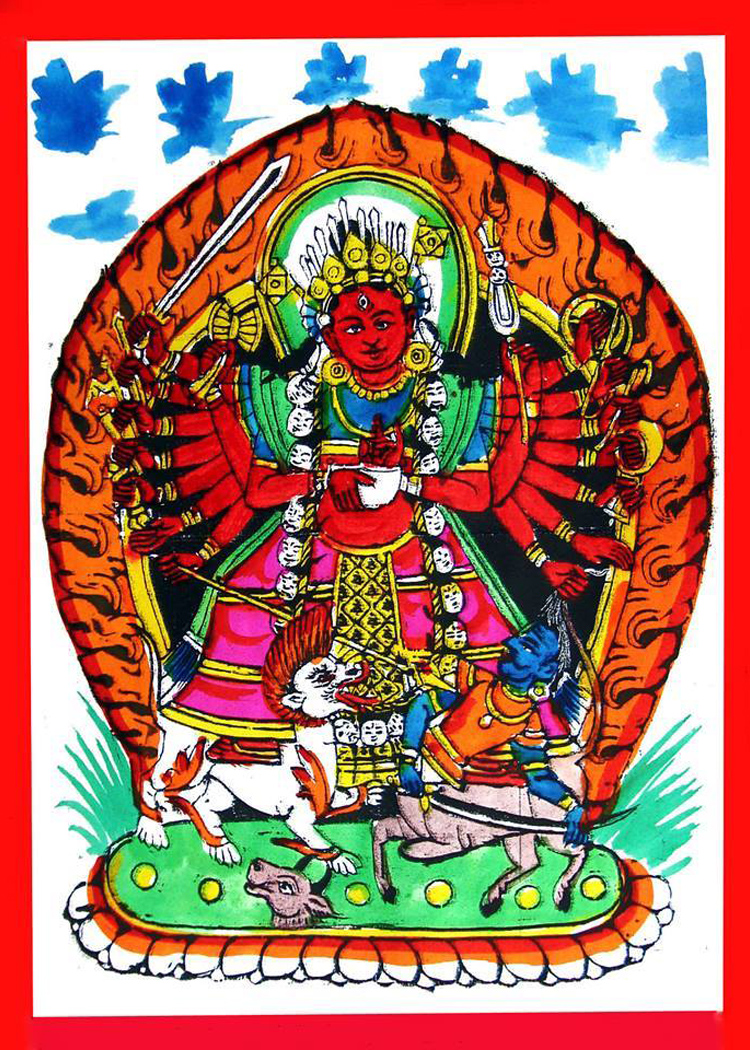
Newari portrayal of Chandi
Devanagariचण्डी
Sanskrit transliterationCaṇḍī
Affiliation
Mantra
  • Oṁ Namaś Caṇḍikāyai
  • Om Aim Hrīm Klīm Cāmuṇḍāyai Vicce
MountLion

Chandi (Sanskrit: चण्डी, IAST: Caṇḍī) or Chandika (IAST: Caṇḍika) is a Hindu deity. Chandika is a form of goddess Durga.[1] She shares similarities with the Goddess Chamunda, not only in name but also in attributes and iconography. Due to these similarities, some consider them to be the same deity, while others view them as different manifestations of Mahadevi. Both are often associated with other powerful goddesses like Durga, Katyayani, Kali and Kalaratri. The Goddess is particularly revered in Gujarat.

History

[edit]

In the Devī Māhātmya. Chandi represents the killer of Chanda. the Supreme Divine is often referred to as Caṇḍī or Caṇḍikā. This name is derived from the Sanskrit root caṇḍa, meaning “fierce” or “terrible.” Chandi is celebrated as the vanquisher of the demonic generals Chanda and Munda.[2] According to Bhaskararaya, a prominent authority on Devi worship, Chandi embodies divine wrath and passion.[3]

The epithet of Chandi or Chandika appears in the Devi Mahatmya, a text deeply rooted in the Shakta tradition of Bengal. This region has long been a significant center for Goddess worship and tantric practices. Since ancient times, it is the most common epithet used for the Goddess. Within the Devi Mahatmya, Chandi, Chandika, Ambika, and Durga are often used interchangeably to refer to the Supreme Goddess in the sect. [4][page needed]

Alongside the Sri Vidhya mantras, it is one of the principal mantras in Shakti worship. It is customary to chant this mantra when chanting the Devi Mahatmya. It is one of the primary mantras in the worship of Shakti. Traditionally, this mantra is chanted during recitations of the Devi Mahatmya. According to belief, the goddess resides in Mahakal, Kailasa.[5] The city of Chandigarh, the joint capital of Punjab and Haryana, is named after the Goddess.

Legends

[edit]

She is known as the supreme goddess Mahishasuramardini or Katyayini Durga (6th Navadurga) who slayed the demon Mahishasura. She has been affiliated with and also considered as Vindhyavasini or Kaushiki or Yogmaya or Ambika who killed Shumbha, Nishumbha and their fellow demons.[6] "The great Goddess was born from the energies of the male divinities when the devas became impotent in the long-drawn-out battle with the asuras. All the energies of the Gods became united and became supernova, throwing out flames in all directions. Then that unique light, pervading the Three Worlds with its lustre, combined into one, and became a female form."[7][page needed]

"Devi projected overwhelming omnipotence. The three-eyed goddess was adorned with the crescent moon. Her multiple arms held auspicious weapons and emblems, jewels and ornaments, garments and utensils, garlands and rosaries of beads, all offered by the gods. With her golden body blazing with the splendour of a thousand suns, seated on her lion vehicle, Chandi is one of the most spectacular of all personifications of Cosmic energy."[8]

In other scriptures, Chandi is portrayed as "assisting" Kali in her battle with the demon Raktabīja. Chandi wounded him, but a new demon sprang up from every drop of his blood that fell on the ground. By drinking Raktabīja's blood before it could reach the ground, Kali enabled Chandi to first destroy the armies of demons and finally kill Raktabīja himself.[9] In Skanda Purana, this story is retold and another story of Mahakali killing demons Chanda and Munda is added.[10] Authors Chitralekha Singh and Prem Nath says, "Narada Purana describes the powerful forms of Lakshmi as Durga, Kali, Bhadrakali, Chandi, Maheshwari, Lakshmi, Vaishnavi and Andreye". Also, she is the one who purified Halahal (during Samudra Manthan) into Amrit (Ambrosio).[11]

Chandi Homa (Havan)

[edit]

Chandi Homa is one of the most popular Homas in Hindu religion. It is performed across India during various festivals, especially during the Navaratri. Chandi Homa is performed by reciting verses from the Durga Sapthasathi and offering oblations into the sacrificial fire. It could also be accompanied by the Navakshari Mantra. Kumari Puja & Suvasini Puja also form a part of the ritual.[12][page needed]

Iconography

[edit]
A Burmese portrayal of Chandi (Sandi Dewi).

The dhyana sloka preceding the Middle episode of Devi Mahatmya the iconographic details are given. The Goddess is described as having vermilion complexion, eighteen arms bearing string of beads, battle axe, mace, arrow, thunderbolt, lotus, bow, water-pot, cudgel, lance, sword, shield, conch, bell, wine-cup, trident, noose and the discus (sudarsana). She has a complexion of coral and is seated on a lotus.[13] In some temples the images of Maha Kali, Maha Lakshmi, and Maha Saraswati are kept separately. The Goddess is also portrayed as four armed in many temples.

In folklore of Bengal

[edit]

Chandi is one of the most popular goddess in Bengal, and a number of poems and literary compositions in Bengali called Chandi Mangala Kavyas were written from 13th century to early 19th century.[14] These merged the local folk and tribal goddesses with mainstream Hinduism. The Mangal kavyas often associate Chandi with goddess Kali or Kalika[15] and recognise her as a consort of Shiva and mother of Ganesha and Kartikeya, which are characteristics of goddesses like Parvati and Durga.[16] The concept of Chandi as the supreme Goddess also underwent a change. The worship of the goddess became heterogeneous in nature.

Chandi is associated with good fortune. Her auspicious forms like Mangal Chandi, Sankat Mangal Chandi, Rana Chandi bestow joy, riches, children, good hunting and victory in battles while other forms like Olai Chandi cure diseases like cholera, plague and cattle diseases.[17]

These are almost all village and tribal Goddesses with the name of the village or tribe being added onto the name Chandi. The most important of these Goddesses is Mongol Chandi who is worshipped in the entire state and also in Assam. Here the word "Mongol" means auspicious or benign.[18]

See also

[edit]

References

[edit]
[edit]
Revisions and contributorsEdit on WikipediaRead on Wikipedia
from Grokipedia
Chandi is a fierce in , revered as a manifestation of the supreme Divine Mother () and an epithet of , embodying the destructive power of to vanquish evil and restore cosmic order. She is central to , the tradition that worships the feminine divine energy as the ultimate reality, and is depicted as a protector who aids devotees in overcoming obstacles and enemies. The primary scriptural source for Chandi is the (also known as Chandi Path or Saptashati), a section of the comprising chapters 81–93, composed between the 5th and 6th centuries CE. In this text, Chandi, referred to as Candika (meaning "the fierce one"), arises from the collective radiance of the gods when oppressed by the demon ; she is armed with weapons like a , spear, discus, bow, and arrows, and rides a as her mount. The narrative unfolds in three episodes: her slaying of Madhu and Kaitabha, the buffalo demon , and the demons along with their armies, highlighting her role as the supreme illusion (Mahamaya) who creates, sustains, and destroys the universe. In the third episode, during the battle against Shumbha's forces, Candika emanates the terrifying goddess from her forehead to combat the demons Chanda and Munda; upon their defeat, Kali is acclaimed as for subduing these fierce adversaries. Chandi is also associated with other forms of the goddess, including , , and the ten Mahavidyas, forming part of the trinity with Mahalakshmi and as aspects of . Worship of Chandi involves recitation of the Chandi Path, a ritual hymn praising her glories, often performed for protection, prosperity, and victory over negativity; it is especially prominent during the Navratri festival, which celebrates the goddess's triumph over evil, and in . Devotees invoke her through homas (fire rituals) and , seeking her grace for success in endeavors. Iconographically, she is portrayed with up to ten arms wielding divine weapons, her form combining beauty and terror to symbolize the integration of nurturing and destructive energies. Notable temples include the Chandi Devi Temple on Neel Parvat in , constructed in by King Suchat Singh, where she is venerated as a wish-fulfilling deity accessible by cable car or trek.

Etymology and Origins

Name and Epithets

Chandi, also spelled Caṇḍī or rendered as Candika, is the primary name by which the supreme goddess is invoked in the , a foundational Shakta text within the Mārkaṇḍeya Purāṇa. The term derives from the root caṇḍ, connoting fierceness, violence, or wrathful intensity, symbolizing the goddess's embodiment of unyielding divine power directed against cosmic evil. This underscores her role as the "violent and impetuous one," a manifestation of that integrates destructive and protective energies to uphold . In the Devi Mahatmya, Chandi is not a singular but part of a rich nomenclature reflecting her multifaceted nature, with epithets often used synonymously to evoke her as the (parabrahman). These names appear across the text's hymns and narratives, emphasizing her supremacy as the source of creation, preservation, and annihilation. Scholarly analysis, such as in Devadatta Kali's commentary, highlights how these epithets blend Vedic sovereignty with Tantric , portraying Chandi as the projector of all cosmic forces. Key epithets include Ambika, denoting the maternal aspect that nurtures and incinerates foes ( 4.3, 4.24); , signifying an impregnable fortress against adversity and the slayer of the demon Mahiṣāsura ( 4.11, 11.50); and Kālī, the dark, time-devouring form emerging in battle with emaciated features and bloodied fangs ( 7.6–15). Other prominent ones are Mahāmāyā, the great illusion-weaver who deludes enemies ( 1.55); Nārāyaṇī, evoking universal consciousness and protection in the Nārāyaṇī Stuti ( 11.3–35); and Cāmuṇḍā, a for Kālī post-victory over the demons Caṇḍa and Muṇḍa ( 7.27). These terms collectively affirm Chandi's identity as the singular principle, beyond duality, as articulated in Tantric interpretations where she is the supreme consciousness (citśakti). The following table summarizes select epithets from the Devi Mahatmya, their meanings, and contextual significance:
EpithetMeaning and DerivationSignificance in Devi MahatmyaKey References
CaṇḍikāFierce or wrathful (from caṇḍ)Supreme power annihilating demons; highest 3.28, 7.26, 11.50
AmbikāMother or primal oneMaternal protector reducing enemies to ashes4.3, 6.66–67
DurgāImpenetrable or difficult of accessInvincible warrior against chaos4.11, 11.20–23
KālīDark or time (from )Destructive force in battles, embodying eternal cycle7.9–15, 7.58
MahāmāyāGreat deluderCosmic illusion controlling minds and 1.55, 11.31
NārāyaṇīBelonging to the universal lordOmniscient guardian of and liberation11.8, 11.98
This nomenclature evolved from earlier Vedic hymns like the Devī Sūkta (Ṛgveda 10.125), where the goddess claims sole sovereignty, crystallizing in the as Chandi's integrated persona. Thomas B. Coburn's study further elucidates how these epithets trace to pre-Purāṇic sources, unifying disparate goddess traditions into a cohesive .

Scriptural Foundations

The scriptural foundations of Chandi, a fierce manifestation of the Divine Mother in , are rooted in ancient texts that portray her as the supreme power embodying destruction of evil and cosmic order. The most central and comprehensive source is the , also known as the Chandi Path or Durga Saptashati, which forms chapters 81–93 of the , one of the eighteen major composed around the 5th–6th century CE. This text, comprising 700 verses divided into thirteen chapters across three charitas (episodes), narrates the goddess's victories over demons such as and Kaitabha, , and Shumbha-Nishumbha, establishing her as Chandika, the embodiment of adya shakti (primordial energy). The elevates Chandi as the ultimate reality, integrating philosophical elements from and traditions to symbolize the triumph of divine grace over ego and ignorance. Earlier Vedic roots provide conceptual groundwork for Chandi's fierce aspect, particularly through the Devi Sukta (Rig Veda 10.125), a circa 1200 BCE hymn attributed to the seer Vak Ambhrini, which invokes the goddess as the all-encompassing cosmic force manifesting in various forms, including speech, creation, and sustenance. This sukta, one of the earliest references to a supreme feminine divinity in Vedic literature, influences later Shakta worship by portraying the as the source of all powers, a theme echoed in Chandi's portrayal as the unifier of divine energies. Additionally, the (circa 400–200 BCE) alludes to the primeval, unchanging feminine principle akin to Chandika's role in cosmic balance, bridging Vedic and Puranic traditions. Beyond the Devi Mahatmya, Chandi or Chandika appears in other Puranas, reinforcing her as an epithet of Parvati or Durga. In the Bhagavata Purana (circa 9th–10th century CE), she is invoked as Yogamaya, the illusory power aiding divine interventions (e.g., Book X, 2.12), and a shrine dedicated to her is mentioned (Book V, 9.14). The Brahmanda Purana describes her as a servant-maid of Parvati and a mother-goddess enshrined in sacred sites (e.g., IV.7.72), while the Matsya Purana and Shiva Purana use Chandika as an epithet for Uma/Parvati, highlighting her protective ferocity (e.g., Matsya Purana 13.43; Shiva Purana 2.1.16). In Tantric texts like the Manthana-Bhairava Tantra, Chandika is one of the Bhairavis, associated with esoteric rituals and the southern guardian of sacred realms, extending her scriptural role into Shakta-Tantric practices. These references collectively affirm Chandi's evolution from Vedic abstractions to a fully realized Puranic deity central to Shaktism.

Iconography

Depictions and Attributes

Chandi, revered as Chandika in the Devi Mahatmya, is iconographically portrayed as a formidable warrior goddess embodying divine wrath and cosmic power. She manifests from the collective radiance of the gods, filling the with her effulgence and assuming a form that combines beauty with terror to inspire awe and dread among demons. Her primary depiction features her seated or standing in a dynamic battle pose, often with a radiant or flushed complexion reflecting her intense energy, as seen when her face turns black as ink in moments of supreme anger during combat. This form underscores her role as the annihilator of evil forces, with her eyes reddened and echoing thunderously across the skies. In her most elaborate representations, Chandi possesses eighteen arms, each wielding a unique weapon or emblem gifted by the deities to empower her against asuras, symbolizing the unified strength of the divine pantheon. These include the from for piercing ignorance, the discus from for severing attachments, the from for purifying sound, the from for consuming impurities, the bow and arrows from the for directional strikes, the thunderbolt and bell from for authoritative command, the staff from for enforcing justice, the noose from for binding enemies, the rosary and water pot from for knowledge and sustenance, the sword and shield from Kala for timeless protection, the axe and armor from for , and the lotus from the ocean for spiritual purity. Such multi-armed highlights her omnipotence, allowing her to engage multiple foes simultaneously while maintaining serene composure amid chaos. Chandi's attributes further emphasize her multifaceted nature, blending ferocity with benevolence. She is frequently shown adorned with celestial ornaments, including a crest jewel, earrings, bracelets, anklets, necklaces, and rings, often complemented by garlands of lotuses or to signify over ego and . Her vehicle, the lion, gifted by the , roars ferociously in battle, tearing apart demons and representing the triumph of righteousness () over ; this mount underscores her protective ferocity and regal authority. In tantric meditations, she appears as with ten faces, ten arms, and a sapphire-blue hue, holding weapons like the , discus, mace, bow, , and human head, evoking her all-pervading presence. Variations include her red-hued incarnation as Raktadantika, entirely crimson from head to weapon, devouring foes with blood-stained teeth, or the blue-complexioned , nurturing with a of vegetation to alleviate worldly suffering. These depictions, drawn from the 's meditative verses (dhyana shlokas) and narrative episodes, illustrate Chandi's attributes as both destroyer and sustainer, adapting to the spiritual needs of devotees.

Symbolism and Interpretations

Chandi, as a manifestation of the , symbolizes the fierce and protective dimension of the divine feminine energy in , embodying the power to eradicate evil and restore cosmic balance. Her depiction as a highlights the triumph of over , where her battles against demons represent the internal and external struggle against , ego, and negative forces. In philosophical interpretations, Chandi illustrates the dynamic nature of () as both creator and destroyer, emphasizing the unity of all existence and the necessity of surrender to divine will for spiritual liberation. The goddess's iconographic attributes further deepen her symbolic significance; for instance, her multiple arms wielding weapons such as the , , and discus signify her boundless power and multifaceted abilities to combat various forms of adversity. The , in particular, pierces the buffalo demon , symbolizing the penetration and dissolution of tamasic (inert or destructive) qualities, thereby awakening inner resilience and clarity. These elements underscore Chandi's role as , the supreme feminine principle that balances creation with dissolution, complementing masculine aspects of the divine while asserting Shakti's primacy in sustaining the universe. Interpretations of Chandi extend to empowerment themes, where her victories in the Devi Mahatmya inspire devotees to harness latent strength against personal and societal challenges, promoting and ethical fortitude. Scholarly views position her as a of cyclical renewal, akin to natural forces like seasonal changes, reflecting Hinduism's integration of feminine divinity into broader cosmological narratives. This portrayal not only reinforces gender complementarity in but also serves as a meditative tool for transcending dualities of and protection.

Worship and Rituals

Chandi Homa and Recitations

Chandi Homa is a sacred Vedic ritual performed to invoke the blessings of Chandi, the fierce form of the Divine Mother, for protection, prosperity, and the removal of obstacles. This elaborate ceremony, rooted in Shakta traditions, centers on offerings into a consecrated (homa kunda) while reciting the , a key scripture extolling Chandi's triumphs over demonic forces. Typically conducted by trained priests, the ritual begins with sankalpa (vow declaration), Ganapati puja to remove impediments, and the invocation of (fire deity) into the altar, followed by the main homa where substances like ghee, grains, and herbs are offered amid mantra chants. It culminates in purnahuti, the final oblation of a and cloth, symbolizing complete surrender to the . The ritual integrates three kalasams (brass pots) representing Maha Kali, Maha Lakshmi, and Maha Saraswati—aspects unified in Chandi—connected by a sacred thread to the fire pit, emphasizing her multifaceted power. Performed during auspicious periods like or to avert crises, Chandi Homa is believed to purify the environment, neutralize negative energies, and foster spiritual and material well-being, drawing from ancient texts like the where the goddess defeats . In practice, it lasts several hours, with the fire serving as a medium to carry invocations to the divine, amplifying the potency of the accompanying recitations. Chandi Path, or the devotional recitation of the (also known as Saptashati), forms the core of this worship, comprising 700 verses divided into 13 chapters that narrate Chandi's cosmic battles against evil. Embedded in the , this text is chanted in to invoke the goddess's protective energy, often in one continuous session or over multiple days for intensified sadhana (). The recitation procedure includes preparatory mantras like the Navakshari (nine-syllable mantra), followed by chapter-wise chanting with pauses for reflection, and concluding stotrams (hymns) praising her glory; it may incorporate (seed syllables) to enhance vibrational effects on the . In Chandi Homa, the Path is recited verse by verse, with each offering into the fire synchronizing the spoken word and sacrificial act, thereby magnifying the ritual's transformative power. This integration symbolizes the destruction of inner demons like ego and , mirroring the scripture's themes of divine . Devotees undertake the Path individually for personal empowerment or collectively during festivals, reporting heightened devotion, clarity, and obstacle removal as outcomes. Traditionally, it is accessible to all sincere practitioners, though some lineages emphasize guidance from a for esoteric depths.

Temples, Festivals, and Regional Practices

Several prominent temples dedicated to Goddess Chandi are located across , serving as key centers for her worship. The Chandi Devi Temple in , , perched atop Neel Parvat in the Shivalik Hills, is a revered Siddha Peetha believed to fulfill devotees' wishes. Constructed in 1929 by King Suchat Singh of , it houses an ancient idol said to have been installed in the 8th century by Adi , depicting Chandi as a demon-slaying form of who vanquished . In , the Cuttack Chandi Temple near the River stands as the presiding deity of the city, with its origins tied to a divine dream experienced by Hansa Panda, who discovered the idol covered in red . This ancient shrine features intricate carvings of mythological scenes and attracts over two million devotees annually. In , Chandi worship manifests in several historic sites, including the Melai Chandi Temple in Amta, , recognized as one of the 51 Shakti Peethas where a part of Sati's body ( Chaki) is believed to have fallen. The Mangal Chandika Temple in Ujani, Bardhaman district, is similarly venerated as the 51st Shakti Peeth, emphasizing Chandi's role in auspiciousness and protection. These temples highlight Chandi's integration into regional traditions, often blending tantric elements with mainstream worship. Festivals centered on Chandi are prominently observed during Navratri, a nine-night celebration honoring Durga's forms, including Chandi as the fierce warrior aspect invoked on the seventh or eighth day. In , the Chandi Devi Temple sees heightened pilgrimages during both Navratri (March-April) and Sharadiya Navratri (September-October), with devotees ascending via trek or ropeway for darshan and rituals seeking valor and obstacle removal. The Chandi Homa, a fire ritual involving recitations from the , peaks on Ashtami, symbolizing the goddess's triumph over evil and performed for protection against adversities. In eastern , Durga Puja extends Chandi's reverence over 16 days from Ashwina Krishna Ashtami to , particularly at the Chandi Temple, where elaborate processions, cultural performances, and animal sacrifices (in traditional forms) draw millions, underscoring her role as the city's guardian deity. In , Mahalaya marks the prelude to with widespread Chandi Path recitations—collective chanting of the Devi Mahatmya's 700 verses—conducted in homes and temples to invoke the goddess's arrival and dispel negativity. This practice, rooted in tantric traditions, emphasizes communal devotion and is often led by priests in Bengali households during the festival season. Regional practices vary, reflecting local cultural integrations. In , Chandi Padvo dedicates a day to her worship, involving home altars and recitations during Navratri, focusing on prosperity and family well-being. In and southern regions, Chandi is honored within broader temples through Homa rituals, though less distinctly separated from forms. In Bengal's folk traditions, she appears as Olai Chandi or Kului Chandi in rural shrines, with offerings of rice and sweets for harvest blessings, blending agrarian rites with scriptural worship. These variations underscore Chandi's adaptability, from tantric invocations in the east to wish-fulfilling pilgrimages in the north, always centered on her protective and victorious essence.

Mythology

Battles in Devi Mahatmya

The , a key text within the , narrates the exploits of the in her fierce form as Chandi, emphasizing her role as the supreme power () who restores cosmic order through victorious battles against demonic forces. Structured into three charitas (episodes), the narrative unfolds as a of escalating conflicts, where Chandi manifests in various forms to asuras (demons) symbolizing chaos and ego. These battles highlight her omnipotence, as she emerges from divine energies and employs weapons, mounts, and emanations to triumph. In the first charita, the focus is on the slaying of and Kaitabha, two asuras born from 's earwax while he slumbers on the cosmic serpent Ananta. These demons attempt to drown the and destroy , who is emerging from 's navel lotus to initiate creation. invokes the as Mahamaya (or Yoganidra), who manifests from 's body to delude the asuras with illusions of pride and false boons. After a 5,000-year battle, , empowered by her grace, tricks the demons— who demand to be slain where the earth is not covered by water—into lying on his thighs amid the ocean, then beheads them with his . This victory underscores Chandi's subtle power of maya (illusion) in upholding without direct combat. The second charita centers on the destruction of , a shape-shifting buffalo who, granted a boon of invulnerability to male deities, conquers the heavens and expels the gods. Oppressed, the devas pool their tejas (radiant energy), from which Chandi emerges as , armed with divine weapons: Shiva's , Vishnu's discus, Indra's , and others. Mounted on a , she single-handedly annihilates Mahishasura's vast , including generals like Chikshura, Chamara, and Bashkala, whose forces number in the millions with chariots, elephants, and . Mahishasura himself metamorphoses through forms—a , man, elephant, and buffalo—before Chandi pins him with her lion's claws, pierces his chest with a , and severs his head with her sword. The gods then offer the Shakradistuti in praise, restoring their sovereignty and affirming Chandi's role as Mahishasuramardini, the slayer of the buffalo . The third and most elaborate charita depicts the downfall of brothers , who usurp the three worlds after defeating the gods and claim all wealth, including the herself. From Parvati's body emerges Ambika (Chandi's form as ), who, through her messenger Shivaduti, rejects Shumbha's advances, provoking war. Ambika first dispatches Dhumralochana and his 60,000-strong army, then emanates (or ) to behead Chanda and Munda. To counter Raktabija, whose blood spawns clones upon touching the ground, laps up the drops while Chandi slays him. Joined by the (seven mother-goddesses like Brahmani and Vaishnavi, born from the gods), Chandi battles the clans, including Udayudhas and Kalakas. She then kills Nishumbha with her and, in the climax, absorbs her emanations to confront Shumbha directly, hurling him to the and decapitating him with her . This restores universal harmony, with the granting boons to devotees like King Suratha and merchant , emphasizing her compassionate ferocity.

Other Legends and Associations

In medieval , the Chandi Mangal Kavya, composed by poets like Mukundaram Chakraborty in the , presents Chandi as a pre-Aryan hunter who seeks integration into pantheon as Shiva's consort, emphasizing her humanized traits and desire for worship across social strata. In one prominent episode, the low-born hunter Kalketu, cursed as Indra's son Nilambar, receives divine empowerment from Chandi to amass wealth, clear a forest, and establish a kingdom dedicated to her , after which he ascends to heaven, illustrating her role in promoting egalitarian devotion beyond barriers. The second key narrative involves the wealthy merchant Dhanapati Saudagar, a devout Shaivite who initially rejects Chandi's worship; his ships sink due to her wrath, but his wife Khullana and son Shripati endure trials that culminate in Dhanapati's conversion following a vision of an androgynous Shiva-Parvati form, underscoring Chandi's strategy of using adversity to foster universal reverence. In epic mythology, Chandi is invoked by in the Bengali Krittivasi Ramayana (15th century), where he performs the Chandi Path recitation, advised by , to secure victory over , blending her fierce energy with themes of and devotion during the autumnal season. Chandi's broader associations extend to her identification with various forms of . She is also tied to the Matrika group as a fierce mother-goddess akin to , representing destructive renewal in Shakta traditions, though her primary role remains as an independent embodying inner wisdom and power. These legends collectively portray Chandi not only as a but as a solicitous who navigates patriarchal structures to affirm her among diverse devotees.

Cultural Significance

In Bengali Folklore and Literature

In Bengali literature, Chandi holds a central place through the genre of Mangalkavyas, epic poems composed between the 13th and 18th centuries to glorify local deities and legitimize their worship. The most renowned is the Chandimangal by Kavikankan Mukundaram Chakrabarti, written in the late , which narrates Chandi's efforts to establish her cult among humans across three books: the Book of the Gods, depicting divine origins and conflicts; the Book of the Hunter, focusing on a royal hunter's devotion; and the Book of the Merchant, illustrating a trader's trials and ultimate piety. This work blends mythological grandeur with social critique, portraying Chandi in her multifaceted forms—from benevolent protector to fierce warrior—and highlighting 16th-century Bengali society's hierarchies, roles, and economic life. Other Mangalkavyas, such as those by poets like Dvija Madhab, further embed Chandi in medieval Bengali narratives, often depicting her as a symbol of regional resistance against external powers, including the Mughal conquest. In these texts, Chandi vanquishes monstrous representations of Mughal forces, evolving from a conqueror to a figure of negotiated devotion as Mughal rule stabilized in the 17th and 18th centuries, reflecting cultural adaptation and the goddess's enduring spiritual authority in . In Bengali , Chandi permeates oral traditions and performative arts, notably through patachitra, a scroll-painting practice by itinerant artists (Patuas) in , where episodes from are visually rendered and sung in vernacular songs during performances. These dynamic recitations, passed down orally without reliance on written texts, preserve Chandi's stories of divine intervention and human devotion, fostering communal that bridges rural audiences with epic lore. Folk tales also invoke Chandi as a restorer of life, as in the 16th-century Sakhi-sona narrative by Rama Kavibhusana, where she revives a devotee's , underscoring her role in themes of sacrifice and protection among lower castes and syncretic Hindu-Muslim communities. Additionally, the Chandi Path—a Bengali recitation of the from the —integrates into folk rituals and literature, reinforcing Chandi's (or Durga's) battles against demons as metaphors for cosmic and social order.

Broader Impact in Art and Society

Chandi's iconography has profoundly shaped visual arts across South and Southeast Asia, manifesting in sculptures and paintings that emphasize her multifaceted role as a warrior-protector and divine feminine force. In Bengal and eastern India, depictions of Chandi appear in terracotta plaques and stone sculptures from the medieval period, often integrated into temple architecture and illustrating scenes from the Devi Mahatmya. For instance, 19th-century Nepalese illuminated manuscripts of the Devi Mahatmya, such as the 1863 "Chitramayachandi," blend Rajput, Newar, and European styles to portray Chandi's battles, with folios showing her multi-armed form amid Himalayan landscapes and ritual elements like flame halos, commissioned by rulers to legitimize their authority and fuse traditional devotion with modern aesthetics. These artworks not only served devotional purposes but also documented socio-political shifts, highlighting Chandi's role in reinforcing elite power structures during transitions like the Rana dynasty in Nepal. In folk traditions, particularly Bengali patachitra scroll paintings, Chandi's narratives from the Chandimangal Kavya—a 16th-17th century epic by Mukundaram Chakrabarty—have inspired performative art forms where itinerant patuas (scroll painters) unroll illustrated cloths while reciting songs, transforming her myths into communal storytelling that preserves oral histories and local folklore. These vibrant, natural-pigment works, depicting Chandi's establishment of her worship among humans, underscore her integration into everyday rural life, fostering cultural continuity and artistic innovation among artisan communities in West Bengal. Scholarly analyses trace such representations back to ancient Austric roots, where Chandi evolved from tribal mother figures into a syncretic deity blending indigenous and Brahmanical elements, influencing regional aesthetics in Bihar and Bangladesh through museum-held specimens. The goddess's influence extended to via Indian , adapting in Javanese and art to reflect localized spiritual and societal dynamics. In , Chandi (as or Candi) features in 9th-14th century temple sculptures, such as those at Candi Prambanan and Candi Rimbi, portraying her with serene, multi-armed forms adorned in heavy jewelry and high headdresses, symbolizing protection rather than overt conflict. Royal patronage, like King Erlangga's 11th-century worship for military success, embedded her in political narratives, with no dedicated temples but widespread integration into Hindu-Buddhist complexes. In , her journey from an Indian warrior archetype to a more fearsome, demonic figure in reliefs and statues during the 10th-15th centuries mirrors patriarchal societal shifts, influencing ceremonies like Jatra for protection and prosperity while evoking fears of curses if rituals falter. This adaptation highlights Chandi's broader societal role in negotiating gender power, from in Indian folklore to cautionary symbols in Indonesian traditions, impacting folk life through tantric rituals and communal healing practices.

References

Add your contribution
Related Hubs
User Avatar
No comments yet.