


Community hub
Recent from talks
Contribute something
Nothing was collected or created yet.
Baby transport
View on Wikipedia
Various methods of transporting children have been used in different cultures and times. These methods include baby carriages (prams in British English), infant car seats, portable bassinets (carrycots), strollers (pushchairs), slings, backpacks, baskets and bicycle carriers.
The large, heavy prams (short for perambulator), which had become popular during the Victorian era, were replaced by lighter designs during the latter half of the 1900s.
Baskets, slings and backpacks
[edit]
Infant carrying likely emerged early in human evolution as the emergence of bipedalism would have necessitated some means of carrying babies who could no longer cling to their mothers and/or simply sit on top of their mother's back.[1] On-the-body carriers are designed in various forms such as baby slings, backpack carriers, and soft front or hip carriers, with varying materials and degrees of rigidity, decoration, support and confinement of the child. Slings, soft front carriers, and "baby carriages" are typically used for infants who lack the ability to sit or to hold their head up. Frame backpack carriers (a modification of the frame backpack), hip carriers, slings, mei tais and a variety of other soft carriers are used for older children.


Images of children being carried in slings can be seen in Egyptian artwork dating back to the time of the Pharaohs,[2] and have been used in many indigenous cultures. One of the earliest European artworks showing baby wearing is a fresco by Giotto painted in around 1306 AD, which depicts Mary carrying Jesus in a sling.[3] Baby wearing in a sling was well known in Europe in medieval times, but was mainly seen as a practice of marginalised groups such as beggars and Romani people.[4] A cradleboard is a Native American baby carrier used to keep babies secure and comfortable and at the same time allowing the mothers freedom to work and travel.[5] The cradleboards were attached to the mother's back straps from the shoulder or the head. For travel, cradleboards could be hung on a saddle or travois. Ethnographic tradition indicates that it was common practice to cradleboard newborn children until they were able to walk,[6] although many mothers continued to swaddle their children well past the first birthday. Bound and wrapped on a cradleboard, a baby can feel safe and secure. Soft materials such as lichens, moss and shredded bark were used for cushioning and diapers. Cradleboards were either cut from flat pieces of wood or woven from flexible twigs like willow and hazel, and cushioned with soft, absorbent materials. The design of most cradleboards is a flat surface with the child wrapped tightly to it. It is usually only able to move its head.
On-the-body baby carrying started being known in western countries in the 1960s, with the advent of the structured soft pack in the mid-1960s. Around the same time, the frame backpack quickly became a popular way to carry older babies and toddlers. In the early 1970s, the wrap was reintroduced in Germany. The two ringed sling was invented by Rayner and Fonda Garner in 1981 and popularized by Dr William Sears starting in around 1985.[7] In the early 1990s, the modern pouch carrier was created in Hawaii. While the Chinese mei tai has been around in one form or another for centuries, it did not become popular in the west until it was modernized with padding and other adjustments. It first became popular and well known in mid-2003.
Portable cradles, including cradleboards, baskets, and bassinets, have been used by many cultures to carry young infants.
Wheeled transport methods
[edit] | This section needs additional citations for verification. (September 2023) |
Wheeled devices are generally divided into prams, used for newborn babies in which the infant normally lies down facing the pusher, and the strollers, which are used for the small child up to about three years old in a sitting position facing forward.
History
[edit]William Kent developed an early stroller in 1733.[8] In 1733, the Duke of Devonshire asked Kent to build a means of transport that would carry his children. Kent obliged by constructing a shell shaped basket on wheels that the children could sit in. This was richly decorated and meant to be pulled by a goat or small pony. Benjamin Potter Crandall sold baby carriages in the US in the 1830s which have been described as the "first baby carriages manufactured in the US".[9] Another early development was F.A. Whitney Carriage Company. His son, Jesse Armour Crandall was issued a number of patents for improvements and additions to the standard models. These included adding a brake to carriages, a model which folded, designs for parasols and an umbrella hanger. By 1840, the baby carriage became extremely popular. Queen Victoria bought three carriages from Hitchings Baby Store.
The carriages of those days were built of wood or wicker and held together by expensive brass joints. These sometimes became heavily ornamented works of art. Models were also named after royalty: Princess and Duchess being popular names, as well as Balmoral and Windsor.
In June 1889, an African American man named William H. Richardson patented his idea of the first reversible stroller. The bassinet was designed so it could face out or in towards the parent. He also made structural changes to the carriage. Until then the axle did not allow each wheel to move separately. Richardson's design allowed this, which increased maneuverability of the carriages. As the 1920s began, prams were now available to all families and were becoming safer, with larger wheels, brakes, deeper prams, and lower, sturdier frames.
In 1965, Owen Maclaren, an aeronautical engineer, worked on complaints his daughter made about travelling from England to America with her heavy pram. Using his knowledge of aeroplanes, Maclaren designed a stroller with an aluminium frame and created the first true umbrella stroller. He then went on to found Maclaren, which manufactured and sold his new design. The design took off and soon "strollers" were easier to transport and used everywhere.
In the 1970s, however, the trend was more towards a more basic version, not fully sprung, and with a detachable body known as a "carrycot".[notes 1] Now, prams are very rarely used, being large and expensive when compared with "buggies" (see below). One of the longer lived and better known brands in the UK is Silver Cross, first manufactured in Hunslet, Leeds, in 1877, and later Guiseley from 1936 until 2002 when the factory closed. Silver Cross was then bought by the toy company David Halsall and Sons who relocated the head office to Skipton and expanded into a range of new, modern baby products including pushchairs and "travel systems". They continue to sell the traditional Silver Cross coach prams which are manufactured at a factory in Bingley in Yorkshire.
Since the 1980s, the stroller industry has developed with new features, safer construction and more accessories.
Prams
[edit]
Larger and heavier prams, or perambulators, had been used since their introduction in the Victorian era; prams were also used for infants, often sitting up. The term carrycot became more common in the UK after the introduction of lighter units with detachable baby carriers in the 1970s.
As they developed through the years suspension was added, making the ride smoother for both the baby and the person pushing it.
The word pram is etymologically a shortening of its now less common synonym perambulator.[10][11]
Strollers
[edit]
"Strollers" or "pushchairs/buggies" (British English) are used for small children up to about three years old in a sitting position facing forward.
"Pushchair" was the popularly used term in the UK between its invention and the early 1980s,[citation needed] when a more compact design known as a "buggy" became the trend, popularised by the conveniently collapsible aluminium-framed Maclaren buggy designed and patented by the British aeronautical designer Owen Maclaren in 1965. "Buggy" is the usual term in the UK (sometimes "pushchair"); in American English, buggy usually refers to a four-wheeled vehicle known as a quad or quad bike in the UK. "Stroller" is the usual term in the USA. Newer versions can be configured to carry a baby lying down like a low pram and then be reconfigured to carry the child in the forward-facing position.
A variety of twin pushchairs are manufactured, some designed for babies of a similar age (such as twins) and some for those with a small age gap. Triple pushchairs are a fairly recent addition, due to the number of multiple births being on the increase. Safety guidelines for standard pushchairs apply. Most triple buggies have a weight limit of 50 kg and recommended use for children up to the age of four years.
A travel system is typically a set consisting of a chassis with a detachable baby seat and/or carrycot. Thus a travel system can be switched between a pushchair and a pram. Another benefit of a travel system is that the detached chassis (generally an umbrella closing chassis) when folded will usually be smaller than other types, to transport it in a car trunk or boot. Also, the baby seat will snap into a base meant to stay in an automobile, becoming a car seat. This allows undisturbed movement of the baby into or out of a car and a reduced chance of waking a sleeping baby.
Another modern design showcases a stroller that includes the possibility for the lower body to be elongated, thereby transforming the stroller into a kick scooter. Steering occurs by leaning towards either side. Depending on the model, it can be equipped with a foot- and/or handbrake. Speeds up to 15 km/h (10 mph) can be reached. The first stroller of this kind was the so-called "Roller Buggy", developed by industrial designer Valentin Vodev in 2005. In 2012 the manufacturer Quinny became interested in the concept and teamed up with a Belgian studio to design another model.
The modern infant car seat is a relative latecomer. It is used to carry a child within a car. Such car seats are required by law in many countries to safely transport young children.
In contemporary culture, with four-figure systems or sleek jogging strollers common in some circles, strollers often serve as not only an infant transport device but also a highly visible symbol of everything from class to parenting philosophy.[12]
Others
[edit].jpg)

Bicycles can be fitted with a bicycle trailer or a children's bicycle seat to carry small children. An older child can ride his own bike, or ride a one-wheel trailer bike with an integrated seat and handle bars.
A "travel system" includes a car seat base, an infant car seat, and a baby stroller. The car seat base is installed in a car. The infant car seat snaps into the car seat base when traveling with a baby. From the car, the infant car seat can be hand carried and snapped onto the stroller.
Gallery
[edit]-
 An 1847 stroller from the John Leech Archives
 -
 An advertisement for an early perambulator in the 1868 Boston Directory
 -
 Baby carriages for sale in Stockholm, Sweden in 1931
 -
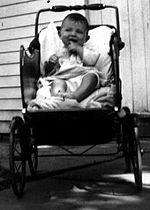 A baby in a buggy, United States, 1935
 -
 A pram in the 'Odessa Steps scene' from the 1926 film Battleship Potemkin
 -
 A child in a bicycle carrier
 -
 A car seat for infants
 -
 A shopping cart with space for a small child
 -
 A 3-in-1 travel system
 -
 A baby sitting in a stroller with a doll above her head
 -
 A baby in a stroller with belts holding her in place
 -
 A jogging stroller on Park Avenue, New York City
 -
 A roller buggy
 -
 East Berlin child minders, with multiple-seat prams in 1984
 -
 A perambulator
 -
 Baby tricycle
 -
 Wicker baby buggy from 1908
 -
 Portrait of child in wicker stroller, 1894
 -
 Reserved parking space for persons with stroller (road sign in the Czech Republic)


_008.JPG)
.jpg)


See also
[edit]Notes
[edit]- ^ The modern equivalent—for babies that cannot walk—is a pram with a body that can be detached for carrying or for attaching to a frame to become a car seat (a "travel system").
References
[edit]- ^ Wall-Scheffler, C.M.; Geiger, K.; Steudel-Numbers, K. (2007). "Infant carrying: The role of increased locomotory costs in early development". American Journal of Physical Anthropology. 133 (2): 841–846. doi:10.1002/ajpa.20603. PMID 17427923.
- ^ I.C. van Hout. Beloved Burden - Baby wearing around the world. pp 6-7. Royal Tropical Institute, Amsterdam. 2011. ISBN 9789068321746
- ^ Rosie Knowles. Why Babywearing Matters. p 19. Pinter & Martin, 2016. ISBN 9781780665351
- ^ I.C. van Hout. Beloved Burden - Baby wearing around the world. pp 58-63. Royal Tropical Institute, Amsterdam. 2011. ISBN 9789068321746
- ^ Cradleboard Encarta. Retrieved 27 March 2009. Archived 2009-10-31.
- ^ [1], Native American Cradles exhibited at Pequot Museum, The Day - October 6, 2001, Retrieved 4 May 2015.
- ^ Maria Blois MD. Babywearing - The Benefits and Beauty of This Ancient Tradition. pp 32-35. Hale Publishing, 2005. ISBN 0972958339
- ^ Amato, Joseph (November 2004). On foot: a history of walking - Google Book Search. NYU Press. ISBN 9780814705025. Retrieved 2009-03-24.
- ^ Museum of American Heritage, retrieved 6 Sep 2010
- ^ "perambulator". The Chambers Dictionary (9th ed.). Chambers. 2003. ISBN 0-550-10105-5.
- ^ "pram". The Chambers Dictionary (9th ed.). Chambers. 2003. ISBN 0-550-10105-5.
- ^ Parrish Morgan, Amanda (2022). Stroller. New York: Bloomsbury Academic. ISBN 978-1-5013-8669-5. OCLC 1293234547.
Bibliography
[edit]- Fontanel, Beatrice (October 1, 1998). Babies Celebrated. Harry N. Abrams. ISBN 0-8109-4012-4.
- van Hout, I. C. (1993). Beloved Burdens. Koninklijk Instituut voor de Tropen.
External links
[edit]


- Bushwalkers' pram (1930s) Archived 2014-07-03 at the Wayback Machine at the National Museum of Australia.
Baby transport
View on GrokipediaHistory
Early Methods
In hunter-gatherer societies, parents utilized simple, hands-free methods to transport infants during foraging and daily activities, primarily employing animal skins, rudimentary cloth wraps, and basic wooden frames to secure babies against the body. These carriers allowed caregivers, often mothers, to maintain mobility while keeping infants close for protection, feeding, and bonding, as evidenced by ethnographic studies of contemporary hunter-gatherer groups that inform reconstructions of prehistoric practices.[8][9] Archaeological evidence supports the antiquity of these practices, with a notable 10,000-year-old infant burial from the Arma Veirana cave in Liguria, Italy, revealing ochre-stained shell beads arranged in patterns suggestive of a sling or wrap carrier, likely made from perishable leather or plant fibers. This Epipaleolithic find, analyzed through 3D photogrammetry and micro-CT scans, indicates the infant was adorned and carried in a manner akin to modern hunter-gatherer traditions, where such items served both practical and symbolic roles. Further back, depictions in ancient Egyptian tombs, dating to around 4,000 years ago, illustrate linen-backed slings used for carrying babies, as seen in hieroglyphic reliefs from tombs in the Theban necropolis, such as the Tomb of Ann'a.[10][11] In North America, Native American cradleboards—rigid wooden frames with hide or cloth coverings—provide evidence of structured carrying, with origins tracing to migrations across the Bering land bridge over 15,000 years ago, though direct organic remains are rare due to preservation challenges.[12] Regional variations highlight adaptive materials and designs shaped by local environments. In African cultures, traditional slings often consisted of woven cloth or bark strips tied in loops around the shoulder and torso, facilitating back or hip carrying during communal labor; these used natural fibers like cotton or plant materials for breathability in tropical climates. Asian papoose-style carriers, such as those among the Miao people of China, featured embroidered cotton panels with straps for secure front or back positioning, incorporating silk threads and geometric motifs for cultural significance, dating back centuries in agrarian communities. Native American cradleboards varied by tribe, with Plains groups like the Sioux employing willow wood frames laced with buckskin and adorned with quills or beads, while Eastern Woodlands versions used softer birchbark hoods for protection against elements. These materials—leather from hunted animals, bark from trees, and plant fibers—ensured durability and portability across diverse ecosystems.[13][14][15] The shift from nomadic to settled societies around 10,000–12,000 years ago, coinciding with the Neolithic Revolution and the advent of agriculture, influenced carrier designs toward greater stability for infants left briefly unattended during fieldwork. In transitioning communities, soft wraps evolved into more rigid frames like cradleboards, which could be propped upright or hung, allowing caregivers to multitask in fixed settlements while still promoting close physical contact. This adaptation is reflected in ethnographic parallels, where settled groups prioritized carriers that balanced mobility with secure positioning.[16][17]Evolution of Wheeled Devices
The evolution of wheeled baby transport devices marked a significant shift from manual carrying methods, introducing mechanical aids that enhanced parental mobility while prioritizing infant comfort and safety. In 1733, English architect William Kent invented the first perambulator, a wheeled baby carriage commissioned for the children of the Third Duke of Devonshire. This device featured a shell-shaped wicker basket mounted on four wheels, designed initially to be pulled by a goat or pony rather than pushed by hand, resembling a miniature adult carriage.[18] By the early 19th century, perambulators had transitioned to push designs, with American toymaker Benjamin Potter Crandall producing the first manufactured baby carriages in the United States during the 1830s. Marketed initially as doll carriages but adapted for infants, these wooden models with iron wheels sold for about $1.50 and represented an early commercialization of the concept.[19] The 1840s saw widespread popularization in Britain when Queen Victoria purchased three elaborate prams from Hitchings Baby Store in London for her children, elevating the device from aristocratic novelty to a status symbol among the upper and emerging middle classes. Further innovation arrived in 1889 with William H. Richardson's patent for the first reversible perambulator, which allowed the seat to pivot so the child could face either forward or toward the caregiver, improving interaction and supervision.[18] The early 20th century brought broader accessibility following World War I, as the postwar baby boom and advances in mass manufacturing introduced lighter steel frames, rubber tires for smoother rides, and foot brakes, standardizing prams for urban family use in the 1920s and 1930s. A pivotal advancement occurred in 1965 when aeronautical engineer Owen Maclaren patented a lightweight aluminum-frame stroller that folded compactly like an umbrella, drawing on his aircraft design expertise to create a portable model weighing under 12 pounds and collapsing to 26 inches for easy storage and travel.[18]Portable Carriers
Slings and Wraps
Slings and wraps are flexible, fabric-based carriers that secure an infant or toddler against a caregiver's body, promoting close physical contact while allowing hands-free mobility. These carriers typically consist of a single piece or adjustable length of cloth draped over the shoulder or torso, adjustable to fit various body sizes and baby positions. Unlike more rigid options, they rely on the fabric's tension and tying techniques for support, making them versatile for use from birth onward.[20] Common types include ring slings, pouch slings, and woven wraps. A ring sling features a long strip of fabric, usually about 2 meters in length, threaded through two aluminum rings for quick adjustment and tightening. This construction allows for one-shouldered carrying and easy on-off use. Pouch slings, by contrast, form a fixed, curved loop of fabric without rings or ties, sized specifically to the wearer's body measurements for a seamless fit, though they offer less adjustability for sharing. Woven wraps are the longest variety, typically measuring 4 to 7 meters, and are tied into intricate configurations using the entire length of the cloth for multi-layer support.[21][22][23] These carriers are commonly made from breathable natural fibers such as cotton, linen, or blends like cotton-linen or modal, which provide softness, durability, and airflow to prevent overheating during extended wear. Linen, in particular, offers superior moisture-wicking properties, making it suitable for warmer climates. For safety, especially with sensitive infant skin, fabrics should be organic and free from synthetic treatments. Dyeing techniques prioritize non-toxic methods, such as fiber-reactive dyes that permanently bond to the fibers or natural plant-based extracts from fruits, vegetables, and roots, avoiding harmful chemicals like azo compounds or formaldehyde that could leach during use.[24][25][26][27] Usage spans from newborns weighing around 3.5 kg to toddlers up to 15 kg, with most models rated for 3.5 to 15.9 kg to accommodate growth. Positions include front carries for infants (cradle or upright), hip carries for interactive play, and back carries for older toddlers, all emphasizing an ergonomic "M" shape for the baby's legs—knees higher than bottom, hips spread, and thighs supported—to promote healthy development. Caregivers must follow safety protocols like the T.I.C.K.S. rule: ensure the carrier is tight and snug, the baby in view at all times, close enough to kiss, with chin off the chest and back supported, to minimize risks such as suffocation or falls. These practices also support proper hip positioning, reducing developmental dysplasia risks. Compliance with updated federal standards, such as the 2024 revision to 16 C.F.R. part 1236 effective February 22, 2025, ensures protection against hazards like falls and suffocation.[28][2] Slings and wraps hold deep cultural significance worldwide, often rooted in traditional practices that emphasize bonding and practicality. In Mayan communities of Latin America, the rebozo—a long, woven shawl of cotton or wool—is tied around the body to carry babies securely, facilitating maternal tasks like farming while maintaining skin-to-skin contact. Similarly, in India, saris or sarongs are adapted as improvised carriers by mothers and laborers, wrapping infants against the back or front for all-day mobility, a tradition tied to economic necessities and familial closeness. These ancestral methods have inspired contemporary designs, blending heritage with modern safety standards.[20][29]Structured Carriers
Structured carriers are semi-rigid baby transport devices equipped with frames or harness systems that facilitate hands-free carrying of infants and toddlers, distributing weight effectively across the wearer's body while promoting ergonomic positioning. These carriers typically feature padded shoulder straps, adjustable hip belts, and supportive panels or seats to maintain the child's hips in an "M" position—thighs spread apart and knees higher than the bottom—for healthy hip development and to reduce the risk of dysplasia.[4] This design contrasts with flexible fabric options by providing more rigid support suitable for active movement. Front packs, exemplified by Ergobaby models, incorporate a structured back panel made from breathable mesh or padded fabric, along with wide hip belts that evenly distribute the child's weight between the hips and shoulders, minimizing back strain during daily activities. These carriers support children from approximately 3.2 kg (7 lbs) to 20 kg (45 lbs) and often include adjustable lumbar support and side pockets for essentials. Many Ergobaby designs have been certified as "hip-healthy" by the International Hip Dysplasia Institute (IHDI) since 2015, ensuring compliance with guidelines for natural leg positioning and spinal alignment.[31] Ventilation panels and removable hoods for sun or rain protection further enhance usability in varied environments.[32] Hiking backpacks, such as the Deuter Kid Comfort series or Osprey Poco models, employ lightweight aluminum frames—often weighing around 3-4 kg empty—to create a stable platform for toddlers during outdoor excursions, suitable for children who can sit unaided (typically 6+ months) and supporting child weights up to around 40-50 lbs (18-23 kg), with total load capacities up to 22 kg (48 lbs) including gear.[33][34] These feature variably adjustable waistbands and padded, ergonomic shoulder harnesses tailored for different torso lengths, including women's-specific fits with narrower shoulders. Integrated storage includes large compartments for diapers and snacks, mesh side pockets, and kickstands for easy loading, while mesh back panels and spring-loaded suspensions promote airflow to prevent overheating on trails. Sun hoods and rain covers are standard, making them ideal for extended hikes where the child faces outward for better visibility.[34] The design of structured carriers has evolved from mid-20th-century backpack-inspired systems, with buckle carriers emerging in the 1960s and framed hiking carriers in the 1980s, laying groundwork for weight distribution via hip belts, progressing to IHDI-certified versions in the 2000s that prioritize ventilation, adjustability, and multi-position carrying for activities like urban errands or nature walks.[35] This progression reflects a shift toward child-centered ergonomics, supported by pediatric research on posture and joint health.[4]Traditional Baskets
Traditional baskets represent rigid, non-fabric carriers designed for cradling and transporting infants, primarily in historical and cultural contexts where hands-free mobility was essential. Among Native American communities, cradleboards served as a prominent example, featuring a flat wooden frame that supported the baby's back while allowing secure attachment to the caregiver's body. These were often constructed with a backboard made from wood such as pine or cedar, lined with soft padding like sphagnum moss or cattail down to provide comfort and absorb moisture. In Athabascan groups, birch bark was commonly used for the structure, sewn with spruce roots for durability and waterproofing.[15][36][37] Construction of these baskets relied on locally sourced natural materials, including willow or reed for woven elements in some designs, and birch bark for flexible yet sturdy enclosures. Decorations were integral, often incorporating beads, quillwork, or carvings that held cultural and ritual significance, such as protective symbols or family motifs passed down through generations. For instance, Nez Perce cradleboards included buckskin coverings over wooden boards, adorned with beadwork and sometimes a hood for shade, reflecting both functionality and artistic tradition. These embellishments not only beautified the carrier but also invoked spiritual protection during transport.[37] In agrarian societies, traditional baskets facilitated infant transport during daily labor, such as field work, where mothers strapped the cradleboard to their backs or fronts using leather thongs or ties to keep the baby secure while tending crops. This method restricted the infant's movement to promote straight posture and safety, mimicking the sensation of being held. Examples from 18th-century colonial America highlight their prevalence among indigenous groups, where cradleboards were valued heirlooms, often gifted at birth and reused across families due to their labor-intensive creation. European counterparts, like hand-carried wicker bassinets in rural settings, similarly employed yokes or straps for short hauls in farming communities, though less rigidly framed than Native designs.[15][36][38] Contemporary revivals of these baskets emphasize eco-friendly practices, utilizing sustainable natural materials for short-distance carrying in cultural or outdoor settings, preserving traditions amid modern lifestyles. Organizations and artisans continue crafting cradleboards to reconnect with ancestral methods, promoting both cultural heritage and environmental consciousness without relying on synthetic alternatives.[39][40]Wheeled Transport
Prams
Prams, also known as perambulators, are full-sized, bassinet-style wheeled devices specifically designed for newborns, allowing infants to lie flat in a reclined position to support healthy spine development and safe sleep during outings.[41] These prams typically feature large hoods for sun and weather protection, spacious storage baskets for essentials, and four-wheel suspension systems that provide a smooth ride over urban surfaces like sidewalks and pavements.[42] Empty, they generally weigh between 10 and 15 kg, reflecting their robust construction for stability and durability.[43] In the 19th century, prams evolved from ornate, coach-like designs crafted with luxurious materials such as polished wood and velvet upholstery, symbolizing status among affluent families and often featuring intricate detailing inspired by horse-drawn carriages.[44] By the post-1950s era, designs shifted toward safety-focused models, incorporating essential features like reliable brakes to prevent unintended rolling.[45] This transition emphasized functionality over aesthetics, aligning with growing awareness of child safety standards. Historical patents, such as those for early wheeled mechanisms, laid the groundwork for these advancements, though detailed evolution is covered elsewhere.[19] Modern convertible prams, popularized in the 2000s, offer versatility by transforming from a bassinet for newborns to a seated position for older infants, often with reversible handles that allow parents to face the child and all-terrain tires for enhanced maneuverability on varied surfaces.[46] Market examples like Silver Cross prams exemplify luxury and durability, originally invented in 1877 by William Wilson as the world's first patented baby carriage and continuing to prioritize high-quality craftsmanship suitable for infants aged 0-6 months.[47] These models remain a preferred choice for their robust build and focus on newborn comfort, supporting flat-lying positions until the baby develops sufficient head control.[48]Strollers
Strollers are lightweight, collapsible wheeled devices designed primarily for transporting sitting infants and toddlers, emphasizing portability and ease of use in urban environments. Unlike earlier prams, which focused on bassinet-style carrying for newborns, strollers evolved to support older babies in an upright or reclined position, with features optimized for quick folding and storage.[19] The foundational design of modern strollers traces back to the 1960s umbrella-style model invented by British engineer Owen Maclaren, featuring a lightweight aluminum frame that folds compactly like an umbrella, typically on a three- or four-wheel base for maneuverability. This innovation, patented in 1965 and first mass-produced in 1967, allowed for one-handed operation, enabling parents to fold the stroller while holding a child, and weighed under 10 kg for easy carrying. Further refinements in the 1990s, including enhanced one-hand fold mechanisms, were pioneered by brands like Bugaboo, which introduced modular systems in 1994 for seamless adaptability.[49][50][51] Key features include adjustable seats that recline up to 180 degrees to accommodate babies from around 6 months, providing near-flat positions for napping, and extending usability up to 4 years or about 22 kg. Frames are commonly constructed from durable aluminum, paired with breathable polyester fabrics for seats and canopies that offer weather protection, such as UPF 50+ sun shields and rain covers. Many models incorporate travel system compatibility, using adapters to attach infant car seats directly, facilitating smooth transitions from vehicle to stroller without disturbing the child.[52][53][54] Popular brands like Maclaren and Bugaboo exemplify these advancements, with Maclaren's classic umbrella strollers prioritizing simplicity and lightness for on-the-go urban travel, while Bugaboo's designs focus on agile handling with puncture-proof wheels and one-second folds for city navigation. These strollers typically weigh 6-8 kg, fold to dimensions fitting airline overhead bins, and include storage baskets for essentials, making them ideal for parents in dense urban settings.[55][56][57]Specialized Variants
Specialized variants of wheeled baby transport extend the functionality of standard strollers to accommodate specific activities, terrains, or family needs, such as running, handling multiple children, or navigating challenging environments. These adaptations prioritize enhanced durability, safety features, and convenience over everyday urban use. Jogging strollers are designed for active parents, featuring fixed front wheels to maintain stability at higher speeds, shock-absorbing suspension systems to cushion impacts during runs, and hand-operated brakes for controlled stopping on declines.[58][59][60] These models typically support running on paved paths, with large air-filled tires providing traction and a smooth ride for the child.[61] Double and triple strollers cater to families with siblings, available in side-by-side configurations for equal access and visibility or tandem setups for narrower profiles in tight spaces.[62] Many include independent reclining seats that adjust up to 140 degrees for individual comfort, along with adjustable leg rests, and per-seat weight capacities reaching up to 22.7 kg to accommodate growing children.[63][64] Triple variants follow similar designs but are less common, often extending tandem frames to support three children with shared or modular seating. All-terrain strollers incorporate pneumatic, air-filled tires—typically 12 inches or larger—for superior performance on uneven surfaces like beaches, snow, or trails, where they provide better flotation and shock absorption compared to standard wheels.[65][66][67] These models often feature all-wheel suspension and robust frames to handle rugged conditions while maintaining maneuverability. In contrast, travel strollers emphasize portability for air travel, weighing under 6 kg and complying with airline overhead bin dimensions for gate-checking or cabin storage.[68][69] Niche adaptations include attachments that convert standard strollers into golf push carts, such as the Kid Caddie, which secures clubs to the handlebar and undercarriage for parents playing on courses.[70] Luxury off-road prams, like those from Thule, combine premium materials, ergonomic handles, and advanced suspension for high-end all-terrain use, blending style with performance for outdoor enthusiasts.[66]Integrated Transport Methods
Automotive Seats
Automotive seats, also known as child safety seats or child restraint systems, are engineered devices installed in vehicles to protect infants and young children from injury during crashes by securely positioning and restraining them. These seats distribute crash forces away from the child's vulnerable areas, such as the head and abdomen, and are legally required for children under a certain age or weight in most countries. Development of these seats accelerated in the mid-20th century, with early innovations in the 1960s leading to federal standards in the United States by 1971 that mandated secure attachment to the vehicle.[71][72] Rear-facing infant seats are the primary type for newborns and young infants, accommodating children from birth up to 13.6-15.9 kg (30-35 lbs) or the manufacturer's height limit, typically around 76-81 cm (30-32 inches). These seats feature a five-point harness system that secures the child at the shoulders and hips, distributing forces across the torso and pelvis rather than the neck, and incorporate impact-absorbing foam like expanded polystyrene (EPS) in the shell to cushion the head and reduce injury risk in frontal collisions. Rear-facing orientation is mandatory for newborns and recommended by safety experts until the child outgrows the seat's limits, as it better supports the head, neck, and spine during sudden deceleration. Under FMVSS 213a effective December 5, 2026, infant seats will be limited to 13.6 kg (30 lbs).[73][74][75] Convertible seats offer versatility by transitioning from rear-facing (typically up to 18-22 kg or 40 lbs) to forward-facing harness mode for children weighing 9-18 kg (20-40 lbs), and eventually to booster mode for 15-36 kg (33-80 lbs) or higher, depending on the model. These seats often integrate LATCH (Lower Anchors and Tethers for Children) or the European ISOFIX anchorage systems, which use rigid lower anchors and a top tether to minimize installation errors and enhance stability compared to seat belt-only methods. The forward-facing phase uses a five-point harness until the child reaches the seat's limits, after which the booster elevates the child for proper seat belt fit across the shoulder and lap.[73][76][77] Proper installation is critical for effectiveness, with rear-facing seats positioned at a recline angle of 30-45 degrees to maintain the child's head position and prevent slumping. To check if a rear-facing child car seat is properly reclined, look on the side of the seat for a built-in recline indicator, such as a ball in a tube or a colored line; for rear-facing infants, it needs to be in the "infant" or blue/reclined zone.[78][79] This is achieved using built-in levels or foam inserts under the base. Side-impact protection, a key feature in modern seats, includes reinforced side wings and energy-absorbing materials to shield against lateral forces in T-bone crashes; this was advanced through updated Federal Motor Vehicle Safety Standard (FMVSS) 213a, with mandatory compliance for seats manufactured on or after December 5, 2026, requiring dynamic side-impact testing at speeds up to 30 mph. The 2024 FMVSS 213a update also caps infant seat weight limits at 13.6 kg (30 lbs) and introduces standardized side-impact testing using a 50th percentile 12-month-old child dummy for restraints accommodating 12.7-36.3 kg (28-80 lbs), effective December 5, 2026. These standards trace back to 1960s research on child crash injuries, culminating in NHTSA's 1971 mandate for child restraint systems, with dynamic crash testing requirements added in subsequent updates.[80][72][81][82][83] Many infant and convertible seats are certified for airline use by the Federal Aviation Administration (FAA), labeled as such on the side, allowing them to serve as onboard restraints for children under 2 years when installed in a forward-facing aircraft seat with a separate ticket. These approved models must meet both automotive and aviation criteria, ensuring compatibility with narrow airplane seats. For hygiene, cleaning protocols emphasize spot-cleaning harnesses and fabrics with mild soap and lukewarm water using a soft cloth, avoiding bleach, solvents, or machine washing to prevent fabric degradation or harness weakening; seats should air dry fully in a well-ventilated area before reinstallation, with regular vacuuming to remove debris.[84][85]Bicycle and Public Transit Adaptations
Bicycle adaptations for baby transport primarily involve secure seating options designed to balance safety, comfort, and ease of use during rides. Rear-mounted child bike seats, positioned behind the rider, are a common choice for children aged approximately 9 months to 5 years, accommodating weights from 9 to 22 kg as specified in the European standard EN 14344, which ensures structural integrity, harness systems, and impact resistance.[86] These seats often feature quick-release clamps for rapid attachment and detachment from the bicycle frame, allowing parents to switch bikes or store the seat conveniently without tools.[87] Adjustable footrests are standard to support growing legs and prevent dangling feet, promoting stability and reducing fatigue for the child during longer trips.[88] Front handlebar-mounted carriers provide an alternative for closer parent-child interaction, suitable for toddlers aged 2 to 5 years, though they require bicycles with compatible handlebar designs to avoid steering interference.[89] For cargo bikes, which offer expanded load capacity for family use, trailers serve as versatile attachments towed behind the bike, often equipped with high-visibility flags—typically orange and mounted 3.5 to 7 feet high—to alert other road users and enhance safety in traffic.[90] These trailers support child weights up to 22 kg per seat in compliance with EN 14344 guidelines, though total capacities can reach 45 kg including multiple children and gear, emphasizing the need for balanced loading to maintain bike handling.[86] Public transit adaptations focus on integrating baby transport devices into bus and train systems while prioritizing space efficiency and accessibility. Foldable stroller hooks, often attached to seats or walls, allow parents to secure lightweight, collapsed strollers during bus rides, preventing them from blocking aisles or becoming hazards in crowded conditions.[91] Many transit agencies, such as the MTA in New York, have implemented open stroller policies in designated front areas of buses, where unfolded strollers up to certain dimensions can be accommodated without folding if space permits, as part of pilots expanding since 2023 to support family mobility.[92] On trains, bassinet areas—priority zones near doors or in family carriages—provide space for upright strollers or bassinets, enabling safe storage during journeys without obstructing passenger flow. These features align with Americans with Disabilities Act (ADA) guidelines under 49 CFR Part 37, which mandate accessible vehicle designs like low-floor boarding and securement areas that indirectly benefit stroller users by ensuring equitable space for mobility aids and family equipment.[93] Hybrid urban solutions have gained prominence since the 2010s, particularly with electric cargo bike integrations that combine pedal-assist technology for effortless hauling in city environments. Electric bikes equipped with rear seats or integrated cargo boxes allow parents to transport infants securely over longer distances, reducing physical strain while navigating urban traffic and hills.[94] Studies highlight how these e-cargo bikes enable families to replace car trips for school runs and errands, with models like the Urban Arrow featuring Bosch motors to handle up to 250 kg total vehicle weight (bike + rider + load), including children, fostering sustainable commuting in dense areas.[95][96] Such adaptations often incorporate foldable elements for seamless transitions to public transit, briefly referencing the portability of wheeled strollers for multimodal trips.[92]Safety and Standards
Ergonomic and Health Guidelines
Babywearing offers significant benefits for both infant and caregiver, particularly through enhanced bonding facilitated by skin-to-skin contact, which supports emotional attachment and physiological regulation such as heart rate synchronization.[97] A landmark randomized controlled trial demonstrated that carrying infants for at least three hours daily reduced overall crying by 43% and evening fussiness by 51%, attributing this to the security and responsiveness provided by close proximity. Proper positioning in carriers is essential to support healthy development and mitigate risks like hip dysplasia, a condition affecting joint formation in infancy. The recommended M-position—characterized by flexed hips and knees with thighs spread and supported—allows natural hip abduction and helps maintain the femoral head within the acetabulum, promoting optimal joint stability as endorsed by the International Hip Dysplasia Institute.[98] In back carriers, even weight distribution across the caregiver's hips, shoulders, and core is critical to prevent spinal strain; structured carriers with waistbands transfer load to the pelvis, reducing lumbar pressure compared to shoulder-only designs.[99] Caregivers can enhance ergonomics by engaging core muscles during use, maintaining an upright posture with shoulders relaxed to distribute weight evenly and avoid compensatory strain on the lower back.[100] For newborns, usage should begin with short sessions of 30 minutes to one hour, gradually increasing to 2-4 hours daily as tolerance builds, allowing for monitoring of comfort and preventing fatigue or pressure points.[101] Health risks associated with baby transport methods include overheating in carriers made from non-breathable fabrics, which can impair thermoregulation in infants; selecting natural materials like cotton or linen facilitates air circulation and reduces sweat accumulation, especially in warm environments.[102] In prams, maintaining a flat, supine sleeping position on the back minimizes SIDS risk by ensuring an open airway and preventing head flexion that could obstruct breathing, as inclined positions have been linked to positional asphyxia.[103]Regulations and Testing
In the United States, the Consumer Product Safety Commission (CPSC) enforces safety standards for strollers through 16 CFR Part 1227, which incorporates ASTM F833-21, establishing performance requirements including brake efficiency and stability tests to prevent unintended movement.[104] These tests evaluate parking brakes by applying force to simulate a child's interaction and ensure the stroller remains stationary on inclines, addressing hazards like runaway incidents.[105] In Europe, EN 1888 specifies safety requirements for pushchairs and prams, mandating brake tests for efficacy and stability on a 12-degree slope to verify resistance to rolling when unoccupied or loaded up to 15 kg.[106][105] Child car seats must comply with international regulations such as UN ECE R44/04, which requires dynamic frontal impact testing at 50 km/h using anthropomorphic test devices to measure head injury criterion and chest acceleration limits, ensuring restraint integrity during crashes.[107][108] Additionally, manufacturers recommend expiration dates of 6-10 years from the date of manufacture due to potential material degradation from UV exposure, heat, and wear, though no universal legal mandate exists; users must check labels for compliance.[109][110] International variations include Australia's mandatory AS/NZS 1754 standard for child restraint systems, which outlines design, performance, and labeling requirements for carriers used in vehicles, including dynamic testing to simulate collisions and ensure secure fitment.[111][112] Regulatory bodies enforce mandatory recalls for defects, as seen in the 2019 CPSC recall of 4.7 million Fisher-Price Rock 'n Play sleepers following reports of infant fatalities linked to inclined positioning, highlighting the need for ongoing post-market surveillance.[113] Testing methods for baby transport encompass dynamic crash simulations using sled tests to replicate vehicle impacts, measuring forces on child dummies to validate restraint performance beyond minimum standards.[114] Chemical safety assessments for fabrics and components include certifications ensuring lead content below 100 ppm under the U.S. CPSIA, with additional scrutiny for phthalates and heavy metals to prevent exposure risks.[115][116]References
- https://www.[researchgate](/page/ResearchGate).net/publication/299985039_Baby_carriers_a_comparison_of_traditional_sling_and_front-worn_rear-facing_harness_carriers