


Community hub
Recent from talks
Contribute something
Nothing was collected or created yet.
6 Hebe
View on Wikipedia
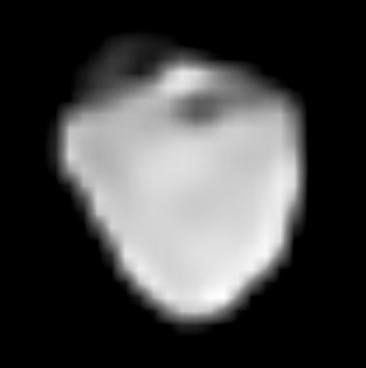
 Hebe imaged by the European Southern Observatory's Very Large Telescope | |
| Discovery[1] | |
|---|---|
| Discovered by | Karl Ludwig Hencke |
| Discovery site | Driesen, Prussia |
| Discovery date | 1 July 1847 |
| Designations | |
| (6) Hebe | |
| Pronunciation | /ˈhiːbiː/[2] |
Named after | Hēbē |
| A847 NA; 1847 JB | |
| Main belt | |
| Adjectives | Hebean /hiːˈbiːən/ (trad.)[3] |
| Symbol | .svg) (historical) (historical) |
| Orbital characteristics[1] | |
| Epoch 13 September 2023 (JD 2453300.5) | |
| Uncertainty parameter 0 | |
| Aphelion | 2.92 AU (437 million km) |
| Perihelion | 1.93 AU (289 million km) |
| 2.43 AU (364 million km) | |
| Eccentricity | 0.2027 |
| 3.78 yr (1379.85 d) | |
Average orbital speed | 18.93 km/s |
| 144.0° | |
| Inclination | 14.736° |
| 138.63° | |
| 10 March 2022 | |
| 239.59° | |
| Earth MOID | 0.97 AU (145 million km) |
| Proper orbital elements[4] | |
Proper semi-major axis | 2.4252710 AU |
Proper eccentricity | 0.1584864 |
Proper inclination | 14.3511092° |
Proper mean motion | 95.303184 deg / yr |
Proper orbital period | 3.77742 yr (1379.702 d) |
Precession of perihelion | 31.568209 arcsec / yr |
Precession of the ascending node | −41.829042 arcsec / yr |
| Physical characteristics | |
| Dimensions | 205 km × 185 km × 170 km[5][6] |
| 195±3 km[7] | |
| Flattening | 0.25[a] |
| Mass | (1.24±0.24)×1019 kg[7][b] (1.27±0.13)×1019 kg[c][8] |
Mean density | 3.18±0.64 g/cm3[7] |
Equatorial surface gravity | ~0.079–0.099 m/s2 |
Equatorial escape velocity | ~0.127–0.135 km/s (457–486 km/h) |
| 7.274 h[6]: 349 | |
Pole ecliptic longitude | 339° |
Pole ecliptic latitude | 45° |
| 0.268[7][5] | |
| Temperature | ~170 K max: ~269 K (−4°C) |
| S | |
| 7.5[9] to 11.50 | |
| 5.61[1] | |
| 0.26" to 0.065" | |
6 Hebe (/ˈhiːbiː/) is a large main-belt asteroid, containing around 0.5% of the mass of the belt. However, due to its apparently high bulk density (greater than that of the Moon), Hebe does not rank among the top twenty asteroids by volume. This high bulk density suggests an extremely solid body that has not been impacted by collisions, which is not typical of asteroids of its size – they tend to be loosely-bound rubble piles.
In brightness, Hebe is the fifth-brightest object in the asteroid belt after Vesta, Ceres, Iris, and Pallas. It has a mean opposition magnitude of +8.3, about equal to the mean brightness of Saturn's moon Titan,[10] and can reach +7.5 at an opposition near perihelion.
Hebe may be the parent body of the H chondrite meteorites, which account for about 40% of all meteorites striking Earth.
History
[edit]Hebe was discovered on 1 July 1847 by German astronomer Karl Ludwig Hencke in the town of Driesen, Brandenburg, Prussia (now Drezdenko, Poland).[1] It is the sixth asteroid discovered. It was the second and final asteroid discovery by Hencke, after 5 Astraea. The name Hebe, after the Greek goddess of youth, was proposed by Carl Friedrich Gauss at Hencke's request.[11] The first asteroids discovered had widely been considered planets by astronomers, but the rapid discoveries of several new asteroids in the late 1840s complicated the classification of asteroids.[12] In the years following its discovery, Hebe was variously labelled as a planet,[11] small planet, or asteroid.[13] Eventually, throughout the latter half of the 19th century, the terms "asteroid" and "minor planet" became favored,[12] although some astronomers continued referring to Hebe as a planet in this period.[14]
Gauss chose a wineglass as Hebe's astronomical symbol.[11][15] It was encoded in Unicode 17.0 as U+1CEC0 (.svg) ).[16][17] As asteroids and their symbols grew in number, the practicality of assigning unique astronomical symbols to each asteroid was questioned. In 1851, astronomer Johann Franz Encke proposed a simpler system of a number—denoting the order of discovery—inscribed in a circle. For Hebe, this would be ⑥.[12][18]: 80 This system was widely adopted by astronomers, though astronomers eventually switched to using parentheses enclosing the number—thus (6) Hebe[19] or 6 Hebe[1] in modern notation.[12]
).[16][17] As asteroids and their symbols grew in number, the practicality of assigning unique astronomical symbols to each asteroid was questioned. In 1851, astronomer Johann Franz Encke proposed a simpler system of a number—denoting the order of discovery—inscribed in a circle. For Hebe, this would be ⑥.[12][18]: 80 This system was widely adopted by astronomers, though astronomers eventually switched to using parentheses enclosing the number—thus (6) Hebe[19] or 6 Hebe[1] in modern notation.[12]
On 5 March 1977, Hebe occulted the star γ Ceti A (Kaffaljidhma).[20]
Orbit
[edit]
Hebe orbits the Sun with an average distance (or semi-major axis) of 2.426 astronomical units (AU),[1] placing it in the inner section of the main asteroid belt.[21]: 1282 Its distance to the Sun varies from 1.935 AU at perihelion to 2.917 AU at aphelion due to its moderately elliptical orbit, indicated by its orbital eccentricity of 0.202. It has an orbital period of 3.778 Earth years, following an orbit inclined by 14.74° with respect to the ecliptic plane.[1]
Hebe resides near but does not participate in several orbital resonances. It orbits close to the 3:1 mean-motion resonance (MMR) with Jupiter at approximately 2.50 AU.[21]: 1282 Asteroids caught in the 3:1 Jovian MMR have orbital periods one-third that of Jupiter's; their orbits are destabilized and they are eventually removed by encounters with the planets, creating the 3:1 Kirkwood gap.[22]: 101 Hebe is also located near the destabilizing () secular resonance with Saturn, which at Hebe's average distance of 2.426 AU is located at 15–16° inclination.[21]: 1282


Possible Hebe family
[edit]In the 1990s, Hebe was identified as a possible source for H chondrites and IIE iron meteorites.[21]: 1293 [23]: 3 Its location near the 3:1 Jovian MMR and the Saturnian secular resonance means that fragments created by impact events are easily destabilized into Earth-crossing orbits, where they could eventually impact Earth as meteorites.[24]: 288, 300 Indeed, the H chondritic surface compositions of two near-Earth objects—(4953) 1990 MU and 2007 LE—point towards Hebe as their parent body.[25]: 65 [26]: 436 Spectral observations of asteroids near the 3:1 Kirkwood gap in the early 2010s identified 695 Bella, 1166 Sakuntala, and 1607 Mavis as potential relatives of Hebe.[27]: 531–532 [28] However, they are located on the opposite side of the 3:1 Kirkwood gap, indicating that they jumped across the gap.[23]: 3–4 In 2020, a study led by Sherry K. Fieber-Beyer identified nine additional candidate members of the tentative Hebe family, with some located on Hebe's side of the 3:1 Kirkwood gap.[23]: 1
Physical characteristics
[edit]

Hebe is a large asteroid, with a volume-equivalent spheroidal diameter of 193 ± 6 kilometres (119.9 ± 3.7 mi). Though Hebe's shape approximates an oblate spheroid, it hosts numerous extreme topographical features. Five large depressions have been identified on its surface, possibly representing deep impact craters.[30]: 4–6 The depressions range from around 50 km (31 mi) to over 100 km (62 mi) in size, with depths between 7 and 18 kilometres (4.3 and 11.2 mi).[30]: 6 Hebe additionally has a large, flattened face, giving it the appearance of a "lopped-off tooth". This large facet may represent a section of the asteroid that was blasted away into space by an ancient impact event.[23]: 9
Based on Hebe's lightcurve, or variations in its observed brightness, it rotates in a prograde (counterclockwise) direction with a rotation period of 7.27 hours. Its north pole pointing towards ecliptic coordinates (β, λ) = (45°, 339°) with a 10° uncertainty.[6]: 349
Spectrum and composition
[edit]Hebe is classified as an S-type asteroid[31]: 104 under the Tholen classification scheme.[32] Planetary scientist Michael James Gaffey further subdivided S-type asteroids into seven mineralogical subclasses,[33] categorizing Hebe as an S(IV)-type asteroid. Hebe's S(IV) classification indicates its surface is silicate (or stony) in composition and undifferentiated or partially differentiated.[21]: 1282
See also
[edit]Notes
[edit]
References
[edit]- ^ a b c d e f g "JPL Small-Body Database: 6 Hebe". Jet Propulsion Laboratory. Retrieved 20 September 2023.
- ^ Noah Webster (1884) A Practical Dictionary of the English Language
- ^ Gabriel Nisbet (1733) Caledon's Tears
- ^ "AstDyS-2 Hebe Synthetic Proper Orbital Elements". Department of Mathematics, University of Pisa, Italy. Retrieved 1 October 2011.
- ^ a b Supplemental IRAS Minor Planet Survey Archived 23 June 2006 at archive.today
- ^ a b c Torppa, Johanna; Kaasalainen, Mikko; Michałowski, Tadeusz; Kwiatkowski, Tomasz; Kryszczyńska, Agnieszka; Denchev, Peter; Kowalski, Richard (August 2003). "Shapes and rotational properties of thirty asteroids from photometric data". Icarus. 164 (2): 346–383. Bibcode:2003Icar..164..346T. doi:10.1016/S0019-1035(03)00146-5.
- ^ a b c d e Vernazza, P.; et al. (October 2021). "VLT/SPHERE imaging survey of the largest main-belt asteroids: Final results and synthesis". Astronomy & Astrophysics. 654: A56. Bibcode:2021A&A...654A..56V. doi:10.1051/0004-6361/202141781. hdl:10261/263281. A56.
- ^ Baer, James; Chesley, Steven R.; Matson, Robert D. (May 2011). "Astrometric masses of 26 asteroids and observations on asteroid porosity". The Astronomical Journal. 141 (5): 143. Bibcode:2011AJ....141..143B. doi:10.1088/0004-6256/141/5/143.
- ^ Donald H. Menzel & Jay M. Pasachoff (1983). A Field Guide to the Stars and Planets (2nd ed.). Boston, MA: Houghton Mifflin. pp. 391. ISBN 0-395-34835-8.
- ^ The Brightest Asteroids Archived 2008-05-11 at the Wayback Machine
- ^ a b c Wöchentliche Unterhaltungen für Dilettanten und Freunde der Astronomie, Geographie und Witterungskunde [Weekly entertainments for Enthusiasts and Friends of Astronomy, Geography, and Meteorology]. 1847. p. 315.
- ^ a b c d Hilton, J. L. (16 November 2007). "When did asteroids become minor planets?". U.S. Naval Observatory. Archived from the original on 21 September 2007. Retrieved 27 March 2025.
- ^ Gould, B. A., Jr. (July 1848). "On the Orbits of the Asteroids". American Journal of Science and Arts. 6 (16).
{{cite journal}}: CS1 maint: multiple names: authors list (link) - ^ Luther, R. (1889). "Berechnung der Planeten (II) Parthenope und (6) Hebe". Astronomische Nachrichten (in German). 122 (6): 107–114. Bibcode:1889AN....122..107L. doi:10.1002/asna.18891220603.
- ^ Steger, Franz (1847). Ergänzungs-conversationslexikon [Supplementary Conversational Lexicon] (in German). Vol. 3. p. 442.
Hofrath Gauß gab auf Hencke's Ansuchen diesem neuen Planetoiden den Namen Hebe mit dem Zeichen (ein Weinglas).
- ^ Bala, Gavin Jared; Miller, Kirk (18 September 2023). "Unicode request for historical asteroid symbols" (PDF). unicode.org. Unicode. Retrieved 26 September 2023.
- ^ "Miscellaneous Symbols Supplement" (PDF). unicode.org. The Unicode Consortium. 2025. Retrieved 9 September 2025.
- ^ Gould, B. A. (January 1852). "On the symbolic notation of the asteroids". The Astronomical Journal. 2: 80. Bibcode:1852AJ......2...80G. doi:10.1086/100212.
- ^ "(6) Hebe = 1847 NA = 1947 JB". Minor Planet Center. Retrieved 26 April 2025.
- ^ Dunham, David W.; Maley, Paul D. (December 1977). "Possible Observation of a Satellite of a Minor Planet". The Minor Planet Bulletin. 5: 16–17. Bibcode:1977MPBu....5...16D.
- ^ a b c d e Gaffey, Michael J.; Gilbert, Sarah L. (November 1998). "Asteroid 6 Hebe: The probable parent body of the H-type ordinary chondrites and the IIE iron meteorites". Meteoritics & Planetary Science. 33 (6): 1281–1295. Bibcode:1998M&PS...33.1281G. doi:10.1111/j.1945-5100.1998.tb01312.x.
- ^ Yoshikawa, Makoto (September 1990). "Motions of Asteroids at the Kirkwood Gaps". Icarus. 87 (1): 78–102. Bibcode:1990Icar...87...78Y. doi:10.1016/0019-1035(90)90022-2.
- ^ a b c d Fieber-Beyer, Sherry K.; Gaffey, Michael J. (December 2020). "The Family of (6) Hebe". The Planetary Science Journal. 1 (3): 68. Bibcode:2020PSJ.....1...68F. doi:10.3847/PSJ/abc17a. 58.
- ^ Farinella, Paolo; Froeschle, Christiane; Gonczi, Robert (March 1993). "Meteorites from the Asteroid 6 Hebe". Celestial Mechanics and Dynamical Astronomy. 56 (1–2): 287–305. Bibcode:1993CeMDA..56..287F. doi:10.1007/BF00699740.
- ^ Kelley, Michael S.; Gaffey, Michael J.; Reddy, Vishnu; Sanchez, Juan A. (May 2014). "Surface composition of near-Earth Asteroid (4953) 1990 MU: Possible fragment of (6) Hebe". Icarus. 233: 61–65. Bibcode:2014Icar..233...61K. doi:10.1016/j.icarus.2014.01.015.
- ^ Fieber-Beyer, Sherry K.; Gaffey, Michael J.; Bottke, William F.; Hardersen, Paul S. (April 2015). "Potentially hazardous Asteroid 2007 LE: Compositional link to the black chondrite Rose City and Asteroid (6) Hebe". Icarus. 250: 430–437. Bibcode:2015Icar..250..430F. doi:10.1016/j.icarus.2014.12.021.
- ^ Fieber-Beyer, Sherry K.; Gaffey, Michael J.; Kelley, Michael S.; Reddy, Vishnu; Reynolds, Chalbeth M.; Hicks, Tony (June 2011). "The Maria asteroid family: Genetic relationships and a plausible source of mesosiderites near the 3:1 Kirkwood Gap". Icarus. 213 (2): 524–537. Bibcode:2011Icar..213..524F. doi:10.1016/j.icarus.2011.03.009.
- ^ Gaffey, M. J.; Fieber-Beyer, S. K. (September 2013). Identification of a Possible H-Chondrite Asteroid Family. 76th Annual Meeting of the Meteoritical Society. Edmonton, Alberta, Canada. Bibcode:2013M&PSA..76.5124G.
- ^ "Not the mother of meteorites". eso.org. Retrieved 19 June 2017.
- ^ a b Marsset, M.; Carry, B.; Dumas, C.; Hanuš, J.; Viikinkoski, M.; Vernazza, P.; Müller, T. G.; Delbo, M.; Jehin, E.; Gillom, M.; Grice, J.; Yang, B.; Fusco, T.; Berthier, J.; Sonnett, S.; Kugel, F.; Caron, J.; Behrend, R. (August 2017). "3D shape of asteroid (6) Hebe from VLT/SPHERE imaging: Implications for the origin of ordinary H chondrites". Astronomy & Astrophysics. 604: A64. arXiv:1705.10515. Bibcode:2017A&A...604A..64M. doi:10.1051/0004-6361/201731021. A64.
- ^ Migliorini, F.; Manara, A.; Scaltriti, F.; Farinella, P.; Cellino, A.; Di Martino, M. (July 1997). "Surface Properties of (6) Hebe: A Possible Parent Body of Ordinary Chondrites". Icarus. 128 (1): 104–113. Bibcode:1997Icar..128..104M. doi:10.1006/icar.1997.5679.
- ^ DeMeo, F. E.; Alexander, C. M. O'D.; Walsh, K. J.; Chapman, C. R.; Binzel, R. P. (2015). "The Compositional Structure of the Asteroid Belt" (PDF). In Michel, Patrick; DeMeo, Francesca E.; Bottke, William F. (eds.). Asteroids IV. University of Arizona Press, Tucson. pp. 13–41. arXiv:1506.04805. Bibcode:2015aste.book...13D. doi:10.2458/azu_uapress_9780816532131-ch002. ISBN 978-0-816-53213-1.
- ^ Gaffey, Michael J.; Bell, Jeffrey F.; Brown, R. Hamilton; Burbine, Thomas H.; Piatek, Jennifer L.; Reed, Kevin L.; Chaky, Damon A. (December 1993). "Mineralogic variations within the S-type asteroid class". Icarus. 106 (2): 573–602. Bibcode:1993Icar..106..573G. doi:10.1006/icar.1993.1194.
External links
[edit]- shape model deduced from lightcurve
- MNRAS 7 (1847) 283 (discovery announcement)
- MNRAS 8 (1848) 103
- JPL Ephemeris
- 6 Hebe at AstDyS-2, Asteroids—Dynamic Site
- 6 Hebe at the JPL Small-Body Database

| International | |
|---|---|
| Other | |
6 Hebe
View on GrokipediaDiscovery and History
Discovery
6 Hebe was discovered on 1 July 1847 by Karl Ludwig Hencke, a German amateur astronomer and retired postmaster, using a refractor telescope from his home observatory in Driesen, Prussia (now Drezdenko, Poland). Hencke's observation came during his systematic and prolonged search for additional minor planets, undertaken in the belief that more objects beyond the first four asteroids—Ceres (discovered 1801), Pallas (1802), Juno (1804), and Vesta (1807)—remained undiscovered in the region between Mars and Jupiter.[4] Having already succeeded with 5 Astraea in 1845 after 15 years of diligent effort, Hencke continued his methodical comparisons of star charts against the night sky, a pursuit that exemplified the perseverance required in early asteroid hunting despite widespread skepticism about further finds.[4] The object was faint enough to demand repeated observations over several nights to establish its motion relative to background stars and confirm it as a new solar system body rather than a misidentified star. Hencke promptly reported his positional measurements to the Berlin Observatory, where the discovery was verified through independent observations, providing the crucial validation needed to announce 6 Hebe as the sixth known asteroid. This rapid confirmation highlighted the collaborative network among European observatories that accelerated the recognition of new discoveries in the mid-19th century.[4]Naming and Early Observations
Upon its discovery, 6 Hebe was assigned the provisional designation reflecting its status as the sixth such object identified in the main asteroid belt. It was subsequently named after Hebe, the Greek goddess of youth and the cupbearer to the Olympian gods, who was the daughter of Zeus and Hera and personified eternal vitality.[5] This mythological naming convention followed the tradition established for earlier asteroids, emphasizing classical figures to denote their celestial significance. In the mid-19th century, 6 Hebe was initially classified as the sixth planet in the solar system, aligning with the era's understanding of small bodies between Mars and Jupiter as planetary additions to the known system. However, the rapid discovery of additional objects with similar orbital characteristics—reaching 15 by the end of 1851—prompted astronomers to reclassify these bodies collectively as asteroids, distinguishing them from the major planets due to their shared zone and minor sizes.[6] This shift marked a pivotal evolution in solar system nomenclature, reducing the planetary count and formalizing the asteroid belt concept. Early telescopic observations of 6 Hebe highlighted its visibility and provided foundational data on its properties. It ranks as the fifth-brightest asteroid overall, exhibiting a mean opposition magnitude of +8.3, which renders it observable with moderate amateur equipment under dark skies. A key event was its first recorded stellar occultation on 5 March 1977, when it passed in front of the 3.6-magnitude star γ Ceti, allowing observers in Mexico to time the ingress and egress for an estimated equatorial diameter of approximately 195 km based on the event's duration.[7][8] The identification of 6 Hebe on 1 July 1847 by Karl Ludwig Hencke signified a resurgence in asteroid hunting after a 40-year lull since the discovery of 4 Vesta in 1807, invigorating systematic searches that yielded 7 Iris just one month later on 13 August and 8 Flora on 18 October of the same year. This cluster of findings in 1847 accelerated the recognition of the asteroid belt's population density, transitioning asteroid studies from sporadic detections to a structured field of astronomical inquiry.[9]Orbital Characteristics
Orbital Elements
The orbital elements of 6 Hebe describe its elliptical path around the Sun within the inner main asteroid belt, with parameters determined from extensive astrometric observations and dynamical modeling. These elements are typically expressed in the Keplerian form relative to the ecliptic plane and the equinox of J2000.0, though they are computed for a specific epoch to account for perturbations from planets and other bodies.[2] As of the epoch JD 2460000.5 (February 24, 2023 00:00 UTC), the key orbital parameters are as follows, sourced from the JPL Small-Body Database solution with orbit ID 13 (based on 47,160 observations spanning 1891 to 2023).[10]| Parameter | Symbol | Value | Unit |
|---|---|---|---|
| Semi-major axis | a | 2.42524054 | AU |
| Eccentricity | e | 0.20275238 | - |
| Inclination | i | 14.73756424 | ° |
| Longitude of ascending node | Ω | 138.63826477 | ° |
| Argument of perihelion | ω | 239.54004370 | ° |
| Mean anomaly | M | 91.86528298 | ° |