


Community hub
Recent from talks
Contribute something
Nothing was collected or created yet.
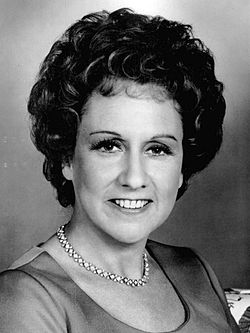
Jean Stapleton
View on Wikipedia
 | This article needs additional citations for verification. (October 2020) |
Jean Stapleton (born Jeanne Murray; January 19, 1923 – May 31, 2013) was an American character actress of stage, television and film. Stapleton is best known for her portrayal of Edith Bunker, the perpetually optimistic and devoted wife of Archie Bunker, on the 1970s sitcom All in the Family.[1] The role earned her three Emmys and two Golden Globes for Best Actress in a comedy series.
Key Information


Early life
[edit]Stapleton was born on January 19, 1923[2] in Manhattan. She was the daughter of Marie A. Stapleton, an opera singer, and Joseph E. Murray, a billboard advertising salesman.[3] She had an elder brother, Jack.[2] Her uncle was a vaudevillian performer, and her brother was a stage actor who inspired her to pursue acting.[4]
Career
[edit]Stapleton began her career in 1942 aged 18 in summer stock theatre and made her New York debut in the Off-Broadway play American Gothic. She was featured on Broadway in several hit musicals, such as Funny Girl, Juno, Damn Yankees and Bells Are Ringing, recreating her parts from the latter two musicals in the film versions of Damn Yankees (1958) (her film debut) and Bells Are Ringing (1960).[5]
Stapleton's early television roles included parts in Starlight Theatre, Robert Montgomery Presents, Lux Video Theater, Woman with a Past, The Philco-Goodyear Television Playhouse, The Patty Duke Show, Dr. Kildare,[3] My Three Sons,[3] Dennis the Menace, Naked City, and as Rosa Criley in a 1963 episode of NBC's medical drama about psychiatry, The Eleventh Hour, entitled "The Bride Wore Pink". In 1962, Stapleton guest-starred as Mrs. Larsen in "The Hidden Jungle", an episode of the TV series The Defenders (broadcast on December 1 that year), alongside her future All in the Family co-star Carroll O'Connor.[3]
Stapleton also appeared in the feature films Something Wild (1961), Up the Down Staircase (1967), Klute (1971) and the Norman Lear comedy Cold Turkey (also 1971).
Stapleton bested both Mary Tyler Moore and Marlo Thomas for the "Best Actress in a Comedy" Primetime Emmy award on May 9, 1971. She was offered the role of Mrs. Teevee in the feature film Willy Wonka & the Chocolate Factory (1971), but declined because it coincided with the production of the All in the Family pilot (the role ultimately went to Nora Denney).[6]
All in the Family
[edit]
Stapleton played the role of Edith in All in the Family, which premiered in 1971.[5] The show was originally broadcast on the CBS network for nine seasons from January 12, 1971, to April 8, 1979, for a total of 205 episodes. The role earned her three Emmys[7] and two Golden Globes.[8]
Feeling her character had run its course, Stapleton continued the role of Edith for only five more episodes in the follow-up series Archie Bunker's Place to help the transition, and then Edith was written out via stroke, offscreen, in the first episode of season two.[5]
Other works
[edit]Stapleton appeared in the Emmy Award–winning TV movie Tail Gunner Joe (1977), dramatizing the life of U.S. Senator Joseph R. McCarthy, and later guest-starred in the sixth episode of the third season of The Muppet Show (broadcast on September 30, 1978).
In 1979, she featured in the original Canadian production of the musical Something's Afoot, which was later broadcast on Showtime. She played the title role in the Hallmark Hall of Fame TV movie, Aunt Mary (also 1979), which detailed the true story of Baltimore children's advocate Mary Dobkin.[9] In 1982, Stapleton portrayed Eleanor Roosevelt in the TV movie Eleanor, First Lady of the World,[10] focusing on the subject's later life. The role earned her Emmy and Golden Globe nominations for Best Actress.
She continued to guest-star in a number of television series during the 1980s including two episodes of Faerie Tale Theatre — in 1983 and 1985 editions entitled "Jack and the Beanstalk" as the Giant's Wife and "Cinderella" as the Fairy Godmother — Scarecrow and Mrs. King and The Love Boat. Stapleton also co-starred in the film The Buddy System (1984), alongside Susan Sarandon and Richard Dreyfuss, and played Ariadne Oliver in the 1986 television adaptation of Dead Man's Folly, opposite Peter Ustinov as Hercule Poirot. She declined the role of Jessica Fletcher in the TV series Murder, She Wrote, which went to Angela Lansbury.[11]
From 1990 to 1991, Stapleton co-starred with Whoopi Goldberg in 15 episodes of Bagdad Cafe,[5] the television series based on the movie of the same name.
In 1994, Stapleton played the role of Mrs. Piggle-Wiggle in a children's series of the same name based on the books by Betty MacDonald.[12]
In 1996, Stapleton appeared in the educational series Beakman's World as Beakman's mother, Beakmom,[13] and also appeared on Everybody Loves Raymond playing Ray's imperious aunt.[14] The same year, she appeared in the Murphy Brown episode "All in the Family" playing Miles's grandmother, Nana Silverberg,[15] and also played opposite John Travolta in Nora Ephron's hit film Michael as the eccentric rooming house owner, Pansy Milbank.[5]
Making a debut in the world of video games, Stapleton was the voice of Grandma Ollie on KinderActive, Turner Pictures, and New Line Cinema's venture Grandma Ollie's Morphabet Soup. The game won a Teacher's Choice Award from Learning Magazine.
On January 26, 1998, Stapleton guest-starred on the Jean Smart sitcom Style & Substance in the episode "A Recipe for Disaster", playing a former television chef who has an alcohol problem.[16] She voiced John Rolfe's maid, Mrs. Jenkins, in Disney's 1998 direct-to-video animated film Pocahontas II: Journey to a New World,[17] and appeared in the film You've Got Mail as a close co-worker in whom Meg Ryan's character confides. From 1998, Stapleton took her "Eleanor" characterization to live theaters, now adapted as a one-woman show.[18]
In May 2000, Stapleton appeared in "Mother's Day", an episode of the TV series Touched by an Angel, portraying an angel named Emma who came to help Celine who was taking care of her late best friend's mother.
Stapleton's final film role was as Irene Silverman in the 2001 fact-based TV movie, Like Mother, Like Son: The Strange Story of Sante and Kenny Kimes, starring Mary Tyler Moore as convicted criminal Sante Kimes.[19] while her final acting role was in Horton Foote's The Carpetbaggers Children at Lincoln Center in NY., March 7th 2002.).[20]
Stapleton was inducted into the American Theatre Hall of Fame in 2002.[21] She was also inducted into the Television Hall of Fame that same year.[22]
Personal life
[edit]Stapleton was married to William Putch from 1957 until his death in 1983. The couple had two children: actor/writer/director John Putch and television producer Pamela Putch.[23] For 30 years, William Putch directed a summer stock theater, Totem Pole Playhouse, at Caledonia State Park in Fayetteville, Pennsylvania. Stapleton performed regularly at the theatre with the resident company. When William Putch died of a heart attack during the run of a production Stapleton had been appearing in at the playhouse, Stapleton insisted on performing that night.[24]
Stapleton's brother, Jack Stapleton, was a stage actor. Her cousin was actress Betty Jane Watson.[25] Stapleton was active in the Christian Science church.[26] She was unrelated to actress Maureen Stapleton, contrary to a common misconception.[3]
Stapleton supported Walter Mondale's campaign in the 1984 presidential election,[27] was a vocal supporter of the Equal Rights Amendment, and took an active role in the 1977 National Women's Conference.[28]
Stapleton rarely appeared on talk shows, but reunited on-camera with Carroll O'Connor on Donny and Marie Osmond's show on April 24, 2000, a little over a year before O'Connor's death. When the Osmonds asked her to perform in Edith Bunker's voice, she declined to do so, and jokingly told them that she only does so "for pay".[29] Stapleton admitted that she seldom watched All in the Family, but by 2000 she reconsidered,[30] she told the Archive of American Television.[11]
Death and reaction
[edit]Stapleton died at her apartment in Manhattan, on May 31, 2013, at age 90.[3]
Norman Lear said, "No one gave more profound 'how to be a human being' lessons than Jean Stapleton."[31] Co-star Rob Reiner said, "Working with her was one of the greatest experiences of my life."[31] Sally Struthers said, "Jean lived so in the present. She was a Christian Scientist who didn't say or think a negative thing ... She was just a walking, living angel".[32]
The marquee lights on Broadway were dimmed for two minutes on June 5, 2013, at 8 p.m. EDT, to honor the memory of Stapleton.[33] She was cremated by Neptune Society in Paramus, New Jersey. Her cenotaph lies at Lincoln Cemetery in Chambersburg, Pennsylvania.[34]
Filmography
[edit]Films
[edit]| Year | Title | Role | Notes |
|---|---|---|---|
| 1958 | Damn Yankees | Sister Miller | Film debut; recreating Broadway role |
| 1960 | Bells Are Ringing | Sue | |
| 1961 | Something Wild | Shirley Johnson | |
| 1967 | Up the Down Staircase | Sadie Finch | |
| 1971 | Cold Turkey | Mrs. Wappler | |
| Klute | Goldfarb's Secretary | 1979 Aunt Mary | |
| 1984 | The Buddy System | Mrs. Price | |
| 1993 | The Trial | Landlady | Uncredited |
| 1996 | Michael | Pansy Milbank | |
| 1998 | Pocahontas II: Journey to a New World | Mrs. Jenkins (voice) | Direct-to-video |
| 1998 | You've Got Mail | Birdie Conrad | |
| 2001 | Pursuit of Happiness | Lorraine | Final film role |
Television
[edit]| Year | Title | Role | Notes |
|---|---|---|---|
| 1951 | Starlight Theatre | Woman | Episode: "The Come-Back" |
| 1952 | Robert Montgomery Presents | Episode: "Storm" | |
| 1953 | Lux Video Theatre | Teacher | Episode: "A Time for Heroes" |
| 1954–1956 | Omnibus | 2 episodes | |
| 1954 | Woman with a Past | Gwen | TV series |
| 1955 | Repertory Theatre | Bus Girl | Episode: "A Business Proposition" |
| 1960 | The Robert Herridge Theater | Episode: "The End of the Beginning" | |
| 1961–1963 | Naked City | Various | 3 episodes |
| 1961 | Dr. Kildare | Nurse Whitney | Episode: "The Patient" |
| 1962 | Dennis the Menace | Mrs. Flora Davis | Episode: "Mr. Wilson's Housekeeper" |
| The Nurses | Mrs. Montgomery | Episode: "The Barbara Bowers Story" | |
| Jackie Gleason: American Scene Magazine | Nagging Wife | Episode: #1.5 | |
| The Defenders | Mrs. Larsen | Episode: "The Hidden Jungle" | |
| Car 54, Where Are You? | Mrs. Duggan (uncredited) | Episode: "Je T'Adore Muldoon" | |
| 1963 | The Eleventh Hour | Rosa Criley | Episode: "The Bride Wore Pink" |
| Route 66 | Mrs. Snyder | Episode: "93 Percent in Smiling" | |
| 1964 | My Three Sons | Molly Dunbar | Episode: "The People's House" |
| 1965 | The Patty Duke Show | Mrs. Pollack | Episode: "The Raffle" |
| 1971–1979 | All in the Family | Edith Bunker | 205 episodes Primetime Emmy Award for Outstanding Lead Actress in a Comedy Series (1971–1972, 1978) Golden Globe Award for Best Actress – Television Series Musical or Comedy (1973–1974) Nominated — Primetime Emmy Award for Outstanding Lead Actress in a Comedy Series (1973–1975, 1977, 1979) Nominated — Golden Globe Award for Best Actress – Television Series Musical or Comedy (1972, 1975, 1978–1980) |
| 1973 | Acts of Love and Other Comedies | Gina's Mother | TV movie |
| 1976 | American Documents, Vol. 5: How We Got the Vote | Host/Narrator | TV documentary |
| 1977 | Tail Gunner Joe | Mrs. DeCamp | TV movie |
| 1978 | The Muppet Show | Herself | 1 episode |
| 1979 | You Can't Take it With You | Penny Sycamore | TV movie |
| Aunt Mary | Mary Dobkin | TV movie | |
| Archie Bunker's Place | Edith Bunker | 5 episodes | |
| 1981 | Angel Dusted | Betty Eaton | TV movie |
| Captain Kangaroo | Freddie's Mom | Episode: "The Captain Kangaroo's 25th Anniversary Special" | |
| Isabel's Choice | Isabel Cooper | TV movie | |
| 1982 | Eleanor, First Lady of the World | Eleanor Roosevelt | TV movie Nominated — Primetime Emmy Award for Outstanding Lead Actress in a Limited Series or Movie Nominated — Golden Globe Award for Best Actress – Miniseries or Television Film |
| Something's Afoot | Miss Tweed | TV movie | |
| 1983–1985 | Faerie Tale Theatre | Various | 2 episodes |
| 1984 | A Matter of Sex | Irene | TV movie |
| Scarecrow and Mrs. King | Lady Emily Farnsworth | 2 episodes | |
| 1985 | Great Performances | Helen | Episode: "Grown-Ups" |
| 1986 | Dead Man's Folly | Ariadne Oliver | TV movie |
| The Love Boat | Helen Branigan | 2 episodes | |
| 1987 | Tender Places | Sam | TV movie |
| 1989 | Trying Times | Edna | Episode: "The Boss" |
| 1990 | The American Playwrights Theater: The One Acts | Helen | Episode: "Let Me Hear You Whisper" |
| Mother Goose Rock 'n' Rhyme | Mother Goose | TV movie | |
| 1990–1991 | Bagdad Cafe | Jasmine Zweibel | 15 episodes |
| 1991 | Fire in the Dark | Henny | TV movie Nominated — Golden Globe Award for Best Supporting Actress – Series, Miniseries or Television Film |
| 1992 | Shelley Duvall's Bedtime Stories | Narrator (voice) | Episode: "Elizabeth and Larry/Bill and Pete" |
| The Habitation of Dragons | Lenora Tolliver | TV movie | |
| The Ray Bradbury Theater | Grandma | Episode: "Fee Fie Foe Fum" | |
| 1993 | General Motors Playwrights Theater | Emilie | Episode: "The Parallax Garden" |
| Ghost Mom | Mildred | TV movie | |
| 1994 | Mrs. Piggle-Wiggle | Mrs. Piggle-Wiggle | 13 episodes |
| Grace Under Fire | Aunt Vivian | Episode: "The Road to Paris, Texas" Nominated — Primetime Emmy Award for Outstanding Guest Actress in a Comedy Series | |
| 1995 | Caroline in the City | Aunt Mary Kosky | Episode: "Caroline and the Opera" |
| 1996 | Murphy Brown | Nana Silverberg | Episode: "All in the Family" |
| Lily Dale | Mrs. Coons | TV movie | |
| Everybody Loves Raymond | Aunt Alda | Episode: "I Wish I Were Gus" | |
| Beakman's World | Beakman's Mom | Episode: "Elephants, Beakmania and X-Rays" | |
| 1914–1918 | Edith Wilson (voice) | TV miniseries documentary: "War Without End" | |
| 1998 | Style & Substance | Gloria | Episode: "A Recipe for Disaster" |
| Chance of a Lifetime | Mrs. Dunbar | TV movie | |
| 2000 | Touched by an Angel | Emma | Episode: "Mother's Day" |
| Baby | Byrd | TV movie | |
| 2001 | Like Mother Like Son: The Strange Story of Sante and Kenny Kimes | Irene Silverman | TV movie Final film role |
References
[edit]- ^ "Biography for Jean Stapleton". Turner Classic Movies. Retrieved June 2, 2013.[dead link]
- ^ a b Weber, Bruce (June 1, 2013). "Jean Stapleton, Who Played Archie Bunker's Better Angel, Dies at 90". The New York Times. ISSN 0362-4331. Retrieved February 12, 2022.
- ^ a b c d e f Weber, Bruce (June 1, 2013). "Jean Stapleton, Who Played Archie Bunker's Better Angel, Dies at 90". The New York Times. Retrieved June 2, 2013.
- ^ "Women of History: Jean Stapleton". MBE Library. November 3, 2019. Retrieved September 6, 2020.
- ^ a b c d e "Jean Stapleton". The Official Masterworks Broadway Site. Retrieved October 16, 2020.
- ^ Karol, Michael. Funny Ladies. p. 46.
- ^ "'All In The Family' Star Jean Stapleton Dies At 90". CBS News New York. June 2013. Retrieved June 2, 2013.
- ^ Eby, Margaret (June 1, 2013). "Jean Stapleton, Edith Bunker of 'All in the Family', dies at 90". Daily News. New York. Retrieved June 2, 2013.
- ^ Machuca, Irene (December 2, 1979). "A Tribute to 'Aunt Mary,'". Victoria Advocate. p. 13.
- ^ Eleanor, First Lady of the World at IMDb
- ^ a b "All in the Family actress Jean Stapleton dies". BBC News. June 3, 2013.
- ^ Braxton, Greg (June 1, 2013). "Jean Stapleton: Actress who played Edith Bunker was no 'dingbat'". Los Angeles Times.
- ^ Cohen, Aryeh Dean (October 3, 2003). "The Logi-cal choice for concerned parents". The Jerusalem Post. p. 18.
- ^ Silverton, Stephen M. (June 1, 2013). "Jean Stapleton Dies at 90". People. Archived from the original on June 8, 2013. Retrieved June 2, 2013.
- ^ Byrge, Duane; Barnes, Mike (June 1, 2013). "'All in the Family' Star Jean Stapleton Dies at 90". The Hollywood Reporter.
- ^ Johnson, Steve (January 26, 1998). ""Style & Substance": Some shows earn a raspberry. This new..." Chicago Tribune. Retrieved June 2, 2013.
- ^ King, Susan (August 20, 1998). "Pocahontas, Re-Revisited: A direct-to-video sequel from Disney continues the story of the Native American heroine". Los Angeles Times. Retrieved June 2, 2013.
- ^ Faires, Robert (November 10, 2000). "Image of a First Lady". Austin Chronicle. Retrieved March 7, 2010.
- ^ Fries, Laura (May 16, 2001). "Like Mother, Like Son: The Strange Story of Sante and Kenny Kimes". Variety. Retrieved December 4, 2017.
- ^ "Jean Stapleton Career Timeline". Retrieved July 5, 2024.
- ^ "32nd Annual Theatre Hall of Fame Inductees Announced; Mamet, Channing, Grimes Among Names - Playbill.com". Archived from the original on February 26, 2014. Retrieved August 8, 2019.
- ^ "Hall of Fame Honorees: Complete List". Television Academy. Academy of Television Arts & Sciences. Retrieved December 4, 2017.
- ^ "William H. Putch". The New York Times. November 25, 1983. Retrieved June 2, 2013.
- ^ "Actor-director William Putch died of a heart attack Wednesday... - UPI Archives". Correction: Production was at Syracuse Stage in Syracuse, NY. It was not at Totem Pole. They were touring in a production of the Show-Off by George Kelly. Putch passed on opening night of the production. nytimes.com upi.com
- ^ "Jean Stapleton – Forever Grateful, and Back on Stage". totaltheater.com. Retrieved June 2, 2013.
- ^ Anderson, Nancy (September 10, 1974). "Jean Stapleton Talks Religion". The Desert Sun. Copley News Service. Retrieved February 26, 2022 – via California Digital Newspaper Collection.
- ^ "Mixing politics with show business makes for star wars in Hollywood". UPI.
- ^ "New York State Women's Meeting and the First National Women's Conference". Retrieved September 6, 2020.
- ^ Perigard, Mark. "Jean Stapleton, actress, Archie Bunker's Edith, 90". Boston Herald. Retrieved June 2, 2013.
- ^ "Jean Stapleton Interview". Academy of Television Arts & Sciences Foundation. October 22, 2017. Retrieved December 4, 2017.
- ^ a b Botelho, Greg (June 1, 2013). "Actress Jean Stapleton, from 'All in the Family,' dies". CNN. Retrieved June 2, 2013.
- ^ starpulse.com Archived July 7, 2013, at the Wayback Machine
- ^ "Broadway To Dim Its Lights In Honor Of Jean Stapleton". NY1. Archived from the original on June 11, 2013. Retrieved June 4, 2013.
- ^ Stapleton, Jean. "artist". masterworksbroadway. Lucy E Cross. Retrieved December 7, 2024.
External links
[edit]
- Jean Stapleton at IMDb
- Jean Stapleton at the Internet Broadway Database
- Jean Stapleton at the Internet Off-Broadway Database (archived)
- Jean Stapleton at the TCM Movie Database
- Jean Stapleton at the American Film Institute Catalog
- Jean Stapleton at Playbill Vault
- Jean Stapleton at The Interviews: An Oral History of Television
- Obituary on BroadwayWorld

Jean Stapleton
View on GrokipediaEarly life and education
Family background and childhood
Jean Stapleton was born Jeanne Murray on January 19, 1923, in Manhattan, New York City, the daughter of Joseph Edward Murray, a billboard advertising salesman, and Marie A. Stapleton Murray, a classical and opera singer.[7][8][9] Her parents' marriage connected her to the performing arts through her mother's vocal career, though her father's occupation centered on advertising rather than entertainment.[8] The family, including Stapleton and her brother Jack, lived in Manhattan during the 1920s and 1930s, with records placing them at 509 West 142nd Street by 1930.[10] Stapleton's childhood unfolded amid the economic hardships of the Great Depression, in a household shaped by her mother's artistic pursuits and her father's steady but modest employment in sales.[7] As a young girl, she frequently accompanied her mother to rehearsals and live performances, gaining early exposure to the world of music and theater that would influence her later path.[8] She later adopted her mother's maiden name, Stapleton, as her professional surname, reflecting a personal and artistic alignment with her maternal heritage.[9]Initial career steps and training
Following her graduation from Wadleigh High School in New York City in 1939, Stapleton briefly attended Hunter College before leaving to support herself financially through secretarial work, initially as a typist in an insurance company and later advancing to a secretary position in a railroad's shipping department.[11][12] These daytime jobs enabled her to fund evening acting classes, where she honed foundational performance skills under instructors affiliated with organizations such as the American Theatre Wing.[12][8] Around this period, she adopted the professional stage name Jean Stapleton, drawing from her mother's maiden name to enhance its theatrical resonance, while retaining her birth name Jeanne Murray for personal use.[13] She supplemented formal training by participating in local amateur and apprentice theater collectives, including early involvement with the American Actors Company—founded by playwright Horton Foote—which provided practical exposure to ensemble performances and character work prior to any paid engagements.[8][14] This preparatory phase emphasized self-directed skill-building through repetitive scene study and improvisation, laying the groundwork for her subsequent professional pursuits without immediate reliance on formal conservatory programs.Pre-breakthrough career
Broadway and stage debut
Stapleton began her professional stage career in summer stock theater at age 18, debuting in 1941 at the Greenwood Playhouse on Peaks Island, Maine.[8] She adopted her mother's maiden name as her professional moniker to distinguish her performing identity.[8] Her New York stage debut occurred Off-Broadway in the 1953 production of American Gothic by Victor Wolfson at the Circle in the Square, where she performed alongside actors including Jason Robards Jr. Less than two months later, she made her Broadway debut in Jane Bowles's drama In the Summer House at the Playhouse Theatre, portraying the role of Inez from December 29, 1953, to February 13, 1954.[8][15] Stapleton continued building her stage presence with supporting roles in musicals, including Sister in the long-running hit Damn Yankees, which opened May 5, 1955, at the 46th Street Theatre and ran until October 12, 1957. Her early theater work encompassed both dramatic and comedic parts, establishing her as a reliable character actress with a knack for timing in ensemble casts.[8] In 1952, prior to these Broadway appearances, she encountered director William Putch while visiting the Olney Theatre in Maryland, where he served as stage manager; the two later married in 1956 during her run in Bells Are Ringing.[16][8]Early television and film roles
Stapleton began transitioning to television in the early 1950s with appearances in live anthology series, including episodes of Robert Montgomery Presents and Lux Video Theatre, where she portrayed supporting characters in dramatic sketches.[17] She also secured a recurring role in the daytime soap opera Woman with a Past, which aired from 1954 to 1955 and focused on a woman's search for her missing husband, allowing her to develop ensemble playing skills in serialized format.[18] Her film debut came in 1958 with the musical comedy Damn Yankees, directed by George Abbott and Stanley Donen, in which she played Sister Miller, a devoted fan of the Washington Senators baseball team.[19] Stapleton reprised her Broadway character from the original stage production, marking her entry into feature films amid the era's adaptation trend for popular musicals.[20] She followed with a supporting role as Dr. Kit Ramsey in the 1960 musical Bells Are Ringing, again adapting her stage performance opposite Judy Holliday, and appeared as the neighbor Mrs. Aurelius in the 1961 drama Something Wild, portraying a concerned figure aiding a rape victim.[21] Throughout the 1960s, Stapleton honed her screen presence through guest spots on established sitcoms and dramas, including an episode of Dennis the Menace in 1962 titled "Mr. Wilson's Housekeeper," where she depicted a domineering domestic aide to the character's neighbor.[22] Additional appearances encompassed medical drama Dr. Kildare and urban crime series Naked City, alongside variety shows like The Jackie Gleason Show, contributing to her versatility in comedic and character-driven parts prior to network primetime leads.[8]Role in All in the Family
Casting as Edith Bunker
Jean Stapleton was selected for the role of Edith Bunker by producer Norman Lear, who had directed her in the 1971 film Cold Turkey and admired her earlier stage performances, such as Sister Miller in the road company of the Broadway musical Damn Yankees.[23][24] All in the Family, an American adaptation of the British sitcom Till Death Us Do Part, premiered on CBS on January 12, 1971, with Stapleton co-starring opposite Carroll O'Connor as the Bunkers.[25][26] The series began with modest viewership, placing 55th in the Nielsen ratings during its debut week, but experienced a rapid ascent, reaching the top spot by late in its first season and maintaining dominance through 1976, which solidified Stapleton's position as a central figure alongside O'Connor.[27]Character development and performance
Jean Stapleton portrayed Edith Bunker as a figure of moral steadfastness, employing a seemingly naive "dingbat" demeanor that concealed profound forgiveness, adherence to traditional homemaker principles, and quiet opposition to rapid societal shifts.[28] This layered approach highlighted Edith's role as the family's ethical core, where her simplicity masked deeper wisdom and resilience amid Archie's prejudices.[29] Stapleton's performance evolved across the series, with Edith displaying increasing emotional depth in later seasons, responding to challenges with innate decency rather than overt confrontation.[30] Stapleton's acting techniques included distinctive vocal inflections, such as the high-pitched exclamation "Oh, Arch-ie!", which she developed independently to embody Edith's earnest optimism.[24] She incorporated physical comedy through subtle tics and mannerisms, delivered with precise theatrical timing drawn from her stage background, transforming potentially caricatured traits into authentic character nuances.[31] These elements allowed Stapleton to blend humor with vulnerability, making Edith's responses feel grounded in realism despite the character's exaggerated quirks.[32] For her work as Edith, Stapleton received three Primetime Emmy Awards for Outstanding Lead Actress in a Comedy Series in 1971, 1972, and 1978.[2] Her portrayal spanned over 200 episodes of All in the Family from 1971 to 1979, after which she departed the role to prevent typecasting.[8] In the spin-off Archie Bunker's Place, Edith's character was killed off-screen via a stroke in the first season, a narrative choice Stapleton supported to conclusively end the association.[33][34]Reception and cultural impact
Stapleton's portrayal of Edith Bunker garnered critical praise for humanizing the traditional working-class housewife, infusing the character with optimism, empathy, and quiet resilience that contrasted sharply with the era's evolving social norms. Reviewers highlighted how her performance elevated Edith from a potential caricature to a relatable symbol of enduring familial devotion, making the character accessible and endearing to diverse audiences.[35][36] This reception propelled All in the Family to the top of Nielsen ratings from 1971 to 1976, the first series to hold the number-one spot for five consecutive seasons and reflecting its role in pioneering taboo-breaking discussions on race, politics, and gender through comedic realism.[37][38] The show's peak viewership exceeded 50 million weekly viewers, underscoring Stapleton's contribution to its cultural dominance and influence on subsequent programming that tackled societal issues.[39] Edith Bunker's depiction of steadfast loyalty and homemaking sparked debates on the viability of traditional roles amid 1970s feminism, with many perceiving her as a resilient counterexample to narratives emphasizing radical independence, thereby affirming the appeal of familial stability in times of change.[40] Stapleton's nuanced interpretation facilitated the series' genre-shifting impact, inspiring spin-offs like Maude and normalizing candid explorations of cultural tensions in American television.[41][42]Controversies and criticisms
Conservative viewers and organizations in the 1970s criticized All in the Family for portraying Archie and Edith Bunker as exaggerated caricatures that mocked working-class prejudices and traditional family dynamics, arguing it fostered elite condescension toward ordinary Americans' values.[43] The show's use of ethnic slurs and depictions of bigotry, even in satirical context, prompted thousands of viewer complaints to CBS about vulgarity and perceived anti-conservative bias, contributing to regulatory pressures like the imposition of a "family viewing hour" that forced scheduling changes.[44] Some conservatives defended Archie as a relatable truth-teller voicing frustrations with cultural upheavals, but others protested that the program's structure—positioning him as the perpetual fool—normalized disdain for blue-collar conservatism rather than genuinely critiquing it.[43] Jean Stapleton herself voiced ambivalence about embodying Edith Bunker, stating in a May 17, 1972, New York Times interview her hope that "most wives aren't like Edith," reflecting discomfort with the character's passive subservience and limited agency.[45] Stapleton collaborated on developing Edith's mannerisms but later emphasized her own independence contrasted sharply with the role, suggesting unease with how it might perpetuate outdated housewife stereotypes amid rising feminist awareness.[29] Liberal and feminist critics contended the series reinforced harmful stereotypes by humanizing bigoted viewpoints through Archie's rants, potentially emboldening real-world prejudices under the cover of humor rather than fully discrediting them.[46] While intended to expose racism and sexism, the show's format—allowing Archie to often "win" arguments through sheer persistence—unwittingly validated audience identification with his resistance to 1960s-1970s social transformations, including civil rights advances and gender role shifts, thus complicating its satirical aims.[43] This duality fueled debates over whether All in the Family advanced progressive dialogue or merely amplified divisions without resolution.[35]Later career and other works
Television appearances after All in the Family
Following the conclusion of All in the Family in 1979, Stapleton appeared as Edith Bunker in four episodes of the spin-off series Archie Bunker's Place during its inaugural 1979–1980 season, marking her final performances in the role before fully departing to pursue varied characterizations.[47] Stapleton sought to evade typecasting through eclectic guest roles across sitcoms and dramas, including a 1979 appearance on The Love Boat as a contest judge and single-episode spots on series such as Glitter (1985) and Murphy Brown (1996), where she portrayed news producer Miles Silverberg's mother.[48][49] In a more prominent return to series television, she co-starred as Jasmine, an eccentric German immigrant befriending a struggling diner owner, in the CBS sitcom Bagdad Cafe (1990), which adapted the 1987 film and featured Whoopi Goldberg; the program aired 15 episodes over one season before its cancellation amid mixed reviews critiquing mismatched comedic tones.[50][51] Stapleton delivered a notable guest performance as Aunt Vivian, a meddlesome relative aiding family reconciliation, in the Grace Under Fire episode "The Road to Paris, Texas" (aired October 26, 1994), earning her a 1995 Primetime Emmy nomination for Outstanding Guest Actress in a Comedy Series.[52][53] Later television work included voice and live-action guests on animated and family-oriented programs, such as the Touched by an Angel episode "Mother's Day" (2000) and Everybody Loves Raymond's "I Wish I Were Gus" (1996), alongside a supporting role as Mrs. Stockum in the Lifetime TV movie Baby (2000), which addressed adoption challenges.[54][55]Film roles
Stapleton's entry into feature films occurred in the late 1950s with supporting roles in musical comedies, beginning with Damn Yankees (1958), in which she played Sister Miller, a member of a women's baseball fan club.[56] She followed this with the role of Sue, a switchboard operator, in Bells Are Ringing (1960), a romantic comedy musical starring Judy Holliday.[56] These early appearances showcased her versatility in light ensemble parts derived from her stage background.[55] By the 1960s, Stapleton took on more dramatic supporting characters, such as Shirley Johnson in the thriller Something Wild (1961), which depicted a young woman's abduction and trauma, and Sadie Finch, a school secretary, in the teacher-focused drama Up the Down Staircase (1967).[56] In 1971, she appeared in two contrasting films: as Goldfarb's secretary in the neo-noir mystery Klute, supporting leads Jane Fonda and Donald Sutherland in a story of investigation and prostitution, and as Mrs. Wappler in Norman Lear's satirical black comedy Cold Turkey, where a town competes to quit smoking amid absurd corporate interference.[56][57] These roles, though minor, highlighted her ability to blend into ensemble dynamics across genres.[58] Post-All in the Family fame, Stapleton's film work remained limited to character parts, often comedic and supportive, with approximately 15 feature credits spanning her career.[59] Notable later examples include her portrayal of a feisty nursing home resident in Michael (1996), a fantasy comedy involving an angel played by John Travolta, and Birdie Conrad, the wise-cracking bookstore proprietor, in the romantic comedy You've Got Mail (1998) opposite Tom Hanks and Meg Ryan.[58] Critics observed that while these roles capitalized on her established quirky persona, cinema opportunities rarely explored her fuller dramatic depth evident in stage performances, confining her to typecast supports rather than leads or complex antagonists.[60][61]Return to stage and voice work
Following the conclusion of All in the Family in 1979, Stapleton returned to the stage, focusing on regional and Off-Broadway productions that allowed for live audience interaction distinct from scripted television constraints.[62] In 1982, she portrayed Philaminte in Molière's The Learned Ladies at the American Conservatory Theater in San Francisco, marking an early post-television revival of her classical theater interests.[63] Stapleton's stage resurgence included the role of Abby Brewster in the 1986 Broadway revival of Arsenic and Old Lace at the 46th Street Theatre (now Richard Rodgers Theatre), a production that toured nationally and earned her an Outer Critics Circle Award for her performance as one of the elderly aunts poisoning lonely men.[64] [62] She reprised similar comedic character work in 1991 as Philamente, a pretentious matriarch, in an Off-Broadway mounting of The Learned Ladies at the Classic Stage Company's East 13th Street Theatre, directed by Christopher Martin.[65] [8] Her regional theater engagements often connected to the legacy of her husband, William Putch, who produced and directed over 300 shows at Totem Pole Playhouse in Fayetteville, Pennsylvania, from 1953 until his death in 1983; Stapleton appeared there more than 20 times across decades, including post-1979 productions that sustained her live performance practice.[66] [67] Additional late-career stage credits encompassed venues like Hartford Stage and South Coast Repertory, reinforcing her commitment to ensemble-driven theater over solo screen roles.[8] In voice work, Stapleton lent her distinctive timbre to Mrs. Jenkins, the well-meaning housekeeper to John Rolfe, in the 1998 direct-to-video Disney animated sequel Pocahontas II: Journey to a New World, a minor but fitting extension of her character-acting versatility into non-visual media.[68]Personal life
Marriage and family
Jean Stapleton married theater director and producer William Putch on December 28, 1957, after meeting through their shared work in regional theater productions.[69][7] The marriage lasted until Putch's death from a heart attack on November 23, 1983, at age 59.[70][71] The couple had two children: a son, John Putch (born July 28, 1959), who pursued a career as an actor, writer, and director, and a daughter, Pamela Putch (born January 13, 1961), who became a television producer.[72][73] Both children entered the entertainment industry, with John directing episodes of series such as The New Adventures of Old Christine and Pamela producing shows including The O.C..[74] Stapleton and her family divided their time between urban residences in New York and Los Angeles and rural Pennsylvania, where Putch managed the Totem Pole Playhouse, a summer stock theater in Fayetteville near Harrisburg, for over 30 years starting in the 1950s.[12][75] The family maintained a degree of seclusion during these seasonal retreats, with Stapleton occasionally performing at the venue to support her husband's operations while prioritizing home life amid her rising television commitments.[76] She never remarried following Putch's passing, focusing instead on her children and grandchildren in her later years.[77]Political views and public stances
Jean Stapleton described herself as leaning liberal in a 1972 interview, though she expressed uncertainty about specific political candidates or affiliations.[78] This self-assessment aligned with her broader avoidance of partisan activism; she stated during the 1977 National Women's Conference that she was "not a political person really," viewing certain issues like women's rights as transcending party politics.[79] Her portrayal of Edith Bunker prompted personal reflection on traditional values, influencing her advocacy for women's rights. Stapleton credited the role with awakening her to gender inequities, leading her to support the Equal Rights Amendment (ERA) as "a simple matter of justice" in a 1978 public service announcement.[80] She emphasized that Edith, despite her submissive demeanor, embodied principles of fairness that resonated with real-world causes, though Stapleton critiqued the character as unrepresentative of most American housewives to avoid reinforcing stereotypes of everyday women as naive or passive.[81] Stapleton defended All in the Family against accusations of indecency or moral corruption, responding to critics who questioned her involvement as a Christian Scientist by highlighting the show's role in exposing societal hypocrisies through unvarnished dialogue rather than endorsing vice.[42] She maintained that the series aimed to illuminate human flaws for self-examination, not to demean ordinary Americans, prioritizing artistic truth over didactic messaging.[78]Death and legacy
Final years and passing
Jean Stapleton resided in New York City during her final years, maintaining a low public profile after scaling back her acting commitments in the late 1990s and 2000s.[21] She passed away on May 31, 2013, at the age of 90, from natural causes at her Manhattan apartment.[6] [82] Her son, director John Putch, announced the death, noting that Stapleton was surrounded by family and friends at the time and that no prolonged public battle with illness had been disclosed.[83] [84] In pre-death reflections, such as a Television Academy interview, she addressed the typecasting associated with her iconic role as Edith Bunker, viewing it as a challenge she navigated through diverse stage and voice pursuits rather than with resentment.[41]Awards, honors, and tributes
Stapleton earned three Primetime Emmy Awards for Outstanding Lead Actress in a Comedy Series for her role as Edith Bunker in All in the Family, receiving the honors in 1971, 1972, and 1978.[5][72] She also secured two Golden Globe Awards for Best Actress in a Television Series – Musical or Comedy for the same performance.[2] In 2002, she was inducted into the Television Academy Hall of Fame, recognizing her contributions to the medium.[85] Upon her death on May 31, 2013, at age 90, industry peers issued immediate tributes emphasizing her impact on the role. Norman Lear, the series creator, stated that "no one gave more profound 'how to be a human being' lessons than Jean Stapleton" and praised her as "brilliant, generous, and loving."[86] Rob Reiner, her on-screen son-in-law, honored her memory during the 65th Primetime Emmy Awards broadcast later that year, recalling her decision to depart the show after its transition to Archie Bunker's Place.[87] These remembrances underscored her professional discipline and the authenticity she brought to the character.[88]Enduring influence on television and culture
Stapleton's embodiment of Edith Bunker introduced a nuanced archetype of the traditional housewife—outwardly naive yet inwardly resilient, defined by unwavering forgiveness and empathy that tempered familial bigotry and challenged the era's pervasive cynicism. This portrayal humanized conservative-leaning domestic figures, enabling audiences to engage with their moral complexities rather than dismiss them as relics, as reflected in the character's peacemaking role that balanced Archie's prejudices with quiet insight. Such depth paved the way for later working-class matriarchs, setting a precedent for authentic family tensions in sitcoms like Roseanne, where resilient, flawed women navigated economic hardship and relational strife with similar realism.[35][89] Edith's arc debunked simplistic narratives of passive homemakers by showcasing incremental agency, including her 1974 employment at a Sunshine Home and instances of direct confrontation, such as slapping Archie amid his gambling relapse, which empirically correlated with broader cultural shifts like reduced acceptance of spousal verbal abuse. Her "Jesus-like" compassion, per creator Norman Lear, modeled redemptive kindness amid polarization, fostering empathy for archetypes rooted in faith and forgiveness that contrasted with more adversarial modern depictions. This causal influence on viewer perceptions is evidenced by the character's use in Equal Rights Amendment campaigns as a "second-class citizen," highlighting how Stapleton's performance bridged traditional values with emerging demands for equity.[90][91] Retrospectives during the show's 50th anniversary in 2021, including the publication of All in the Family: The Show that Changed Television, underscored Stapleton's lasting ripple effects by crediting Edith's archetype with advancing television's pivot to unvarnished social realism over idealized portrayals, a foundation that sustained explorations of class and gender in subsequent decades. With All in the Family drawing over 20% household viewership by 1975, Edith's model empirically validated the viability of empathetic, archetype-defying characters in driving cultural discourse on family dynamics and prejudice.[90][89]Filmography
Feature films
Stapleton's feature film credits were limited, totaling around a dozen roles across six decades, primarily in supporting capacities that extended her stage-honed dramatic and comedic skills into cinema. These appearances spanned musicals, dramas, thrillers, and fantasies, often portraying maternal or eccentric figures, demonstrating versatility outside her iconic television persona.[55] Her early films drew from Broadway successes, while later ones included collaborations with directors like Alan J. Pakula and Nora Ephron, underscoring her selective involvement in theatrical releases amid a TV-dominant career.[55]| Year | Title | Role | Notes |
|---|---|---|---|
| 1958 | Damn Yankees | Sister Miller | Reprised her Tony-nominated Broadway role in the musical adaptation about a middle-aged baseball fan's pact with the devil; film directed by George Abbott and Stanley Donen. |
| 1960 | Bells Are Ringing | Sue | Supporting part in the Vincente Minnelli-directed musical comedy, again adapting her stage performance as a switchboard operator entangled in clients' lives.[92] |
| 1961 | Something Wild | Mrs. Mortie | Brief dramatic role as a mother in Jack Garfein's film exploring trauma and rebellion, starring Carroll Baker. |
| 1967 | Up the Down Staircase | Sadie Finch | Portrayed a dedicated school secretary in Robert Mulligan's adaptation of Bel Kaufman's novel on urban education challenges. |
| 1971 | Klute | Goldfarb's Secretary | Minor role in Alan J. Pakula's thriller starring Jane Fonda as a call girl; highlighted Stapleton's ability in tense, non-comic settings. |
| 1971 | Cold Turkey | Mrs. Wappler | Played a Quaker wife in Norman Lear's satirical comedy on a town's mass smoking cessation for a cash prize. |
| 1996 | Michael | Pansy Milbank | Notable supporting turn as a tabloid editor in Nora Ephron's fantasy-comedy with John Travolta as an angel; earned praise for blending whimsy and wit.[93] |
| 1998 | You've Got Mail | Birdie | Wise, nurturing bookstore employee in Ephron's romantic comedy remake of The Shop Around the Corner, offering sage advice amid digital-age romance. |