Hubbry Logo
logo
Jeremy Griffith
Community hub

Jeremy Griffith

logo
0 subscribers
Read side by side
from Wikipedia

Jeremy Griffith (born 1945) is an Australian biologist and author.[1][2] He first came to public attention for his attempts to find the Tasmanian tiger. He later became noted for his writings on the human condition and theories about human progress,[3] which seek to give a biological, rational explanation of human behaviour.[4] He founded the World Transformation Movement in 1983.

Key Information

Early life and career

[edit]

Griffith was raised on a sheep property in central New South Wales.[4] He was educated at Tudor House School, New South Wales, and the Geelong Grammar School, Victoria, in 1965 completing the NSW Higher School Leaving Certificate with first class honours in biology.[5] He began a science degree at the University of New England, in northern New South Wales, and completed his Bachelor of Science degree in zoology at the University of Sydney in 1971.[6]: 528 [7]

Search for the Tasmanian Tiger

[edit]

Griffith first became known for his search for surviving Tasmanian tigers, or thylacines,[8] the last known specimen of which had died in captivity in 1936. The search was conducted from 1967 to 1973.[9] It is considered the most intensive search to that point,[8] and included exhaustive surveys along Tasmania's west coast,[9] installation of automatic camera stations, prompt investigations of claimed sightings,[10] and in 1972 the creation of the Thylacine Expeditionary Research Team with Bob Brown. It concluded without finding any evidence of the animal's continuing existence, despite numerous claimed ongoing sightings.[8] Griffith's search was the subject of an episode of ABC TV's A Big Country;[11] and his report of the search was published in Natural History.[9][12]

The thylacine was declared extinct by the International Union for Conservation of Nature in 1982[13] and by the Tasmanian government in 1986.[10]

On human nature, the human condition, and progress

[edit]

Griffith began writing on the human condition in 1975. His books seek to give a biological and rational explanation of human behaviour[4] and include references to philosophical and religious sources.[3]

His first book on the subject, Free: The End of the Human Condition, was published in 1988,[14] and Griffith was interviewed by Caroline Jones on her Radio National program, The Search for Meaning.[15][16] A Species In Denial (2003) became a bestseller in Australia and New Zealand.[17] 'Freedom': The End of the Human Condition (2016) has been described as the definitive presentation of his treatise.[18][19]

Griffith presents a wide-ranging induction-derived synthesis.[18] In support of his theory, he cites from a broad selection of sources, including many thinkers he regards as "unevasive" or "contemporary prophets", including James Darling, Charles Darwin, Sigmund Freud, Carl Jung, Thomas Huxley, Stephen Hawking and Laurens van der Post.[4][6]

Griffith explains human nature (what he terms the human condition) by proposing that as consciousness emerged in our hominid ancestors, the intellect's experiments in self-management were in effect criticised by our pre-established instincts, the result of which was that humans unavoidably became increasingly "angry, egocentric and alienated".[20][21] An article by Griffith published in The Irish Times summarised the thesis presented in Freedom: The End of The Human Condition (2016) as "Adam & Eve without the guilt: explaining our battle between instinct and intellect."[22] Kirkus Reviews wrote, "Griffith offers a treatise about the true nature of humanity and about overcoming anxieties about the world".[23]

According to psychologist Ronald Conway, Griffith holds that we are at war with our own selves, causing humanity to become, as Plato proposed in his allegory of the cave, alienated from its original peaceful state of innocence. Griffith says that this war within is the cause of ongoing actual wars and the general lack of cooperation in the world.[24] Griffith analyses the scientific literature in human evolution; rejects claims that human ancestors were brutal and aggressive; and instead points to fossil evidence such as that of Ardipithecus ramidus in support of his thesis that ancient humans were a gentle, loving and co-operative species.[2]

Griffith's ideas have been criticised based on perceived problems with the empirical veracity of his anthropological writings, an objection that highlights his reliance on the writings of the South African novelist Sir Laurens van der Post and the work of the anthropologist Elizabeth Marshall Thomas.[2] While readers may agree with the broad thrust of Griffith's thesis, some may also disagree with his evaluation of certain people and events, for example his "high opinion" of the Scottish psychiatrist R. D. Laing.[25]

A reviewer of Griffith's 2003 book A Species in Denial described the book's thesis as "humanity is in denial about the loss of its innocence in a corrupt and broken world", and believed it would have benefited from including discussion of the works of Martin Buber, H. Richard Niebuhr, Lawrence Kohlberg and James W. Fowler, who also examine the moral stages of human growth.[26]

Some reviewers described A Species in Denial as challenging[27] or difficult to read, however "through the repetition of his concepts the reader finally grasps Griffith's meaning and, surprisingly, when this happens all kinds of questions arise, which is refreshing."[28] Ronald Conway wrote "A Species In Denial needs repeated reading, not because it is particularly difficult but because it goes against so much of the resigned don't-rock-the-boat attitude of the Western mind in particular."[24]

The Templeton Prize winner and biologist Charles Birch, the New Zealand zoologist John Morton, the former president of the Canadian Psychiatric Association Harry Prosen, and Australian Everest mountaineer Tim Macartney-Snape[29][21][20] have been long-standing proponents of Griffith's ideas. Birch wrote the Foreword to Griffith's 2004 book A Species In Denial.[6] Morton commended several of Griffith's books.[30][31] In 2021 Prosen wrote, "Griffith puts forward a wide-ranging induction-derived synthesis. As Professor Scott Churchill, former Chair of Psychology at the University of Dallas, said in his review of Freedom, 'Griffith's perspective comes to us not as a simple opinion of one man, but rather as an inductive conclusion drawn from sifting through volumes of data representing what scientists have discovered.' ... I have no doubt Griffith's explanation of the human condition is the holy grail of insight we have sought for the psychological rehabilitation of the human race".[18]

In a 2020 article "The fury of the left, explained", published in The Spectator Australia, Griffith argues that the ideology of the Left is dangerous to humanity's progress. He describes left-wing views as regressive and likely to lead to extinction:[32]

So that is the first left-wing-culture-destroying clarification that understanding the human condition enables – that while the right-wing has continued humanity's heroic quest for understanding, the Left has given in to the temptation of relief-hunting[a] and abandoned that all-important search [for understanding of the human condition].

 ... the Left have not only given up the search for understanding, they are actively working against the finding of it. This is because their favoured feel-good cause of dogmatically insisting that everyone comply with PC, Marxist cooperative and selfless principles oppresses the freedom of expression needed to find knowledge, ultimately the understanding of ourselves that alone can end our insecure condition and actually bring about a cooperative and loving world.

— Jeremy Griffith (2020), The Spectator Australia

When interviewed by Alan Jones and Graham Richardson on their Richo & Jones Sky News Australia television programme, Griffith said that "my article in The Spectator last week was all about how we can bring rationale, understanding to the danger of the Left, reason versus dogma".[33]

Dutch actor Pierre Bokma discussed Griffith's work on the Zomergasten television programme for VPRO in 2024, saying Griffith's explanation allowed him to understand why humans are ultimately good despite being angry, guilty, alienated, selfish, egotistic and power hungry.[34]

In 2025 Macartney-Snape wrote that Griffith had answered what John Kenneth Galbraith referred to as "the search for a truly superior moral justification for selfishness".[21]

World Transformation Movement

[edit]

The World Transformation Movement was founded by Griffith in 1983 as the Centre for Humanity's Adulthood, an organisation dedicated to developing and promoting understanding of the human condition. It was incorporated in 1990 with Griffith and his colleague, mountaineer Tim Macartney-Snape, among its founding directors and became a registered charity in New South Wales in 1990, known as the Foundation for Humanity's Adulthood. In 2009, its name changed to the World Transformation Movement.[35]

[edit]

In 1995, Griffith, Macartney-Snape and the Foundation for Humanity's Adulthood (the World Transformation Movement's name at the time) were the subject of an Australian Broadcasting Corporation (ABC) Four Corners programme[19] and an article in the Sydney Morning Herald (SMH) newspaper[36] in which it was alleged that Macartney-Snape used speaking appearances at schools to promote the foundation, and that Griffith "publishes work of such a poor standard that it has no support at all from the scientific community". In defamation actions against the ABC and the SMH, the allegations were ruled to be false and the pieces defamatory.[37]

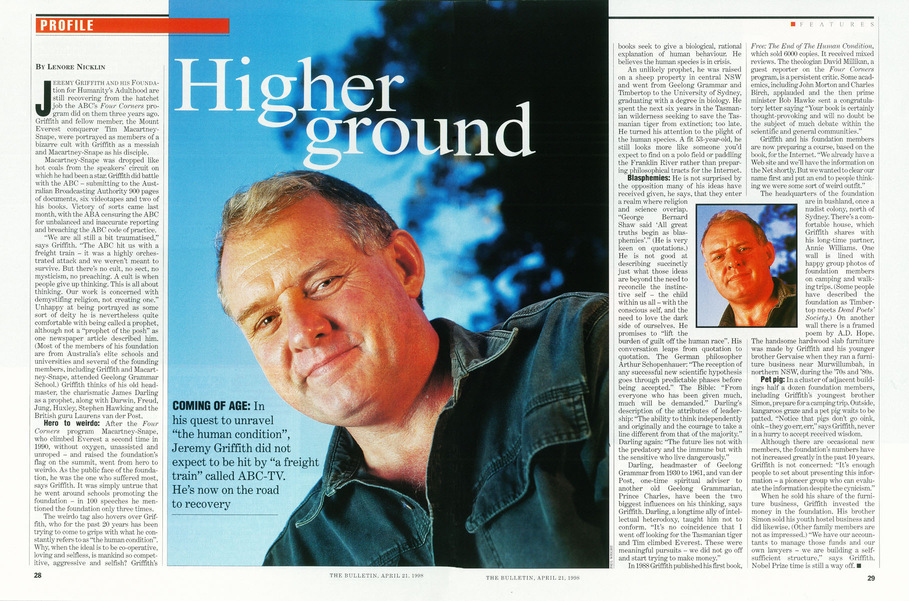
In 1998, following a complaint by Griffith and Macartney-Snape, the Australian Broadcasting Authority censured the ABC for unbalanced and inaccurate reporting and breaching the ABC code of practice, with The Bulletin describing the Four Corners programme as a "hatchet job" (another term for a "hit piece").[4]

Griffith, Macartney-Snape and the World Transformation Movement sued the ABC and the Sydney Morning Herald in the NSW Supreme Court and both publications were found to be defamatory.[36][38] In 2008, the ABC was ordered to pay Macartney-Snape almost $500,000 in damages, and with costs, the payout was expected to exceed $1 million.[38] While the jury found that what the ABC said about Griffith was defamatory, the judge dismissed the case after the defences of truth, qualified privilege and comment were considered.[37][38] Griffith appealed that decision to the New South Wales Court of Appeal, which dismissed the appeal[39] on the basis of qualified privilege and comment being upheld, but found that the defamatory allegation about Griffith was not justified.[19][37][40] The court case against the Sydney Morning Herald was resolved in 2009 when it published an apology to the World Transformation Movement for the harm caused by the publication.[41]

Bushfire analysis

[edit]

In 2020, an article by Griffith published in The Spectator Australia under the heading "The science of bushfires is settled"[42] about his biological analysis of the dangers of eucalypts in light of the 2019–20 Australian bushfire season resulted in him appearing on Alan Jones's 2GB radio programme,[43] and on the Richo & Jones Sky News Australia television programme.[44] Griffith's analysis also generated interest in the United Kingdom.[42] In a follow-up Spectator Australia article, Griffith makes a link between what – in his view – is poor forest management and left-wing influence – their outlook on such issues arising, as he sees it, from the human condition:[32]

So the management of our forests comes down to how to combat the irrational "religious" fanaticism of tree-hugging Lefties. Indeed, everywhere we look in the world we are faced with this problem of "how to combat the irrationality of the increasingly rabid Marxist, politically correct culture?"

Well, if honest biological thinking was able to get to the bottom of the problem of eucalypts ... might such thinking also be able to finally solve the problem of the madness of the Left? I believe it can.

 ... when we humans take up a cause that makes us feel good it can bring such astronomical relief to the extreme insecurity caused by our species' tortured, 'good and evil' – stricken so-called human condition that our attachment to that cause becomes more precious to us than any rational argument Plato, Darwin and Einstein combined could put to us! ...

 ... So it's relief from the human condition at all costs that is really going on. The human condition is the real issue ...

— Jeremy Griffith (2020), The Spectator Australia

Selected works

[edit]

Books

[edit]
  • Death by Dogma: The Biological Reason Why the Left Is Leading Us to Extinction, and the Solution. WTM Publishing & Communications Pty Ltd. 2021. ISBN 978-1-74129-066-0.
  • Freedom: The End of The Human Condition. WTM Publishing & Communications Pty Ltd. 2016. ISBN 978-1-74129-028-8.
  • The Book of Real Answers to Everything!. WTM Publishing & Communications Pty Ltd. 2011. ISBN 978-1-74129-007-3.
  • A Species in Denial. WTM Publishing & Communications Pty Ltd. 2003. ISBN 978-1-74129-001-1.
  • Beyond the Human Condition. WTM Publishing & Communications Pty Ltd. 1991. ISBN 978-0-646-03994-7.
  • Free: The End of the Human Condition. WTM Publishing & Communications Pty Ltd. 1988. ISBN 0-7316-0495-4.

Monographs

[edit]

Notes

[edit]

References

[edit]
Revisions and contributorsEdit on WikipediaRead on Wikipedia
from Grokipedia
Jeremy Griffith (born 1 December 1945) is an Australian biologist and author who has dedicated his professional life to providing a fully accountable biological explanation of the human condition.[1] Griffith holds a Bachelor of Science degree in Zoology and early in his career sought to apply biological principles to fundamental questions about human behavior, founding the World Transformation Movement in 1983 as a non-profit organization to advance research and understanding of humanity's psychological dilemmas.[1][2] His seminal work, FREEDOM: The End of the Human Condition (2016), synthesizes decades of inquiry into a comprehensive thesis that biologically reconciles the apparent paradox of humans' capacity for both profound cooperation and destructive competition, positing this insight as the key to transcending denial and enabling psychological transformation.[3][4] Prior publications, including the Australasian bestseller A Species in Denial (2003), laid the groundwork by critiquing prevailing evasions of human nature's instinctive heritage, while FREEDOM delivers what Griffith describes as the definitive resolution to the underlying psychosis afflicting the species.[4]

Early Life and Education

Childhood and Family Background

Jeremy Griffith was born on December 1, 1945, in rural New South Wales, Australia. He grew up on the family's sheep station near Mumbil in central-western New South Wales, an environment that immersed him in the Australian countryside and cultivated a deep early connection to nature.[1][5] Griffith's upbringing on the sheep station emphasized practical rural life, including hands-on involvement with livestock and land management, which exposed him to unfiltered animal behaviors and the rhythms of the natural world. His parents provided a nurturing family dynamic marked by unconditional love, supporting his formative years amid this isolated, self-reliant setting.[6][7] His mother, Jill Griffith (née Pountney; 1922–2008), shared a particular passion for botany, planting numerous trees and fostering an appreciation for plant life within the family. Griffith's father met an untimely death in a tractor accident on the property, underscoring the hazards inherent in such rural operations. This family background, rooted in traditional agrarian values, contrasted sharply with urban detachment and laid the groundwork for Griffith's lifelong observation of instinctual patterns in wildlife.[7][7]

Formal Education and Initial Interests

Jeremy Griffith attended Geelong Grammar School in Victoria, Australia, one of the country's most prestigious institutions, known for integrating classical academic rigor with extensive outdoor and experiential learning, particularly through its Timbertop campus in the Victorian Alps.[1][8] There, he spent a year engaging in physically demanding activities amid natural surroundings, which complemented the school's emphasis on developing self-reliance and intellectual discipline. Griffith excelled academically, earning first-class honors in biology during his state matriculation examinations and receiving the Natural History Prize at Timbertop in 1961.[1] His early fascination with biology manifested in activities such as leading a birdwatching club at age 11 in 1957, reflecting an budding empirical interest in animal observation and natural history.[1] In 1965, Griffith commenced a science degree at the University of New England in northern New South Wales, later transferring and completing a Bachelor of Science in Zoology at the University of Sydney in 1971.[1][9][10] His coursework emphasized zoological principles, including evolutionary biology and animal behavior, providing a foundation in mechanistic and genetic processes observed in non-human species.[2] These studies honed his commitment to evidence-based analysis derived from first-hand biological data, rather than abstract theorizing.[1] While still grounded in formal biological training, Griffith's university pursuits began to reveal limitations in prevailing explanations of behavior, particularly those reducing complex adaptations to purely mechanistic or environmental determinism without accounting for integrative causal dynamics.[11] This nascent skepticism with nurture-only or gene-centric models of conduct—prevalent in mid-20th-century biology—prompted an orientation toward independent, principle-based inquiry that extended beyond standard curricula, foreshadowing his divergence from institutional paradigms.[1][12]

Early Career in Conservation

Search for the Tasmanian Tiger

In December 1967, Jeremy Griffith initiated a systematic expedition to determine whether the thylacine (Thylacinus cynocephalus), officially declared extinct in 1936 following human-driven hunting and habitat pressures, persisted in remote Tasmanian wilderness.[13] Joined by dairy farmer James Malley in March 1968, the effort formed the Thylacine Expeditionary Research Team, later expanded to include botanist Robert Brown in 1972; this two-to-three-person operation conducted the most extensive field investigation for the species to date, spanning approximately five years until December 1972.[14] [13] The search employed empirical methods tailored to the thylacine's elusive, nocturnal habits, including thylacine-specific snares deployed from November 1968, 1080 poison baits, and tracking via scent trails and plaster casts of potential prints.[13] [14] Griffith pioneered rudimentary trail cameras, deploying 25 monitors in late 1972, supplemented by six radio-signaled tracking pads; earlier attempts with automatic cameras and caged fowl decoys proved impractical due to false triggers and weather exposure.[13] [14] Indigenous knowledge informed site selection, with consultations at Tasmanian Aboriginal locations guided by Peter Simms to identify historical prey habitats.[13] Teams covered over 3,360 kilometers in the initial 19 days of 1968, averaging 800 kilometers per week by mid-1972, traversing northwest regions like Arthur River and Pieman River, southwest areas from Macquarie Harbour to Port Davey, and northeast zones including Fingal and Surrey Hills.[14] [13] Logistical hardships plagued the endeavor, including persistent wet weather delaying operations in 1968, frequent Land Rover breakdowns on rugged tracks, and chronic funding shortages necessitating self-financing amid limited institutional support.[13] Skepticism from Tasmanian authorities hindered cooperation, while scientific and public dismissal of 82 northwest sighting reports and 40 Fingal-area claims—gathered via a June 1972 Tiger Centre exhibition—fueled perceptions of improbability, though the team rigorously vetted each for tracks or scat without confirmation.[14] [13] Despite exhaustive coverage yielding indistinct footprint photos (e.g., 20 from Beulah in May 1971) and no verifiable signs of live animals, Griffith concluded the thylacine was extinct, attributing absence to irreversible human impacts like bounties that killed over 2,000 individuals by 1909.[13] [14] Malley dissented, maintaining possible survival in untraversed pockets, but the expedition's documentation—archived at the Queen Victoria Museum in Launceston—underscored a methodical absence of evidence, reinforcing empirical closure on the species' fate.[14]

Broader Wildlife Conservation Efforts

Following the conclusion of his thylacine search in 1973, Griffith established a research center equipped with field units to support ongoing monitoring of threatened species, innovating the use of trail cameras—a technique he deployed extensively during the expedition and which has since become standard for verifiable ecological data collection in wildlife surveys.[1] This approach prioritized empirical observation over speculative or anthropomorphic interpretations, reflecting Griffith's commitment to biological rigor in assessing habitat viability and population dynamics across Australian ecosystems.[15] Griffith critiqued mainstream environmentalism for its sentimental framing, which he argued evades the underlying causes of degradation by externalizing blame onto the environment rather than confronting human psychological drivers. He contended that such movements adopt a "pseudo-moralistic stance" that fosters superficial moral superiority while ignoring the need for truthful acknowledgment of human flaws, as echoed in observations that environmentalism diverts scrutiny from "the human state’s massively upset, angry, egocentric and alienated state."[16] In contrast, Griffith advocated for conservation grounded in causal analysis of species interactions and habitat pressures, dismissing policy-driven initiatives that overlook verifiable data on predator-prey balances or land-use impacts in favor of ideologically driven prohibitions.[16] This phase marked Griffith's shift from direct field interventions to viewing environmental decline—such as habitat loss and species extinctions in Australia—as manifestations of broader human behavioral dysfunctions, prompting him to investigate those roots rather than pursue isolated preservation tactics. By the early 1980s, he had redirected efforts toward synthesizing biological principles to explain such patterns, recognizing that without addressing human-induced disruptions, empirical conservation measures alone could not reverse systemic degradation.[1]

Formulation of the Human Condition Theory

Origins of the Inquiry into Human Behavior

In the mid-1970s, following his exhaustive but ultimately unsuccessful search for the Tasmanian tiger, which he concluded was extinct by 1973, Australian biologist Jeremy Griffith shifted his focus from wildlife conservation to investigating the underlying causes of human behavior. This transition was prompted by his growing recognition that humanity's destructive tendencies, including environmental degradation and social conflict, originated not from external pressures but from an inherent psychological tension within human nature itself. Griffith, who had earned a BSc in Zoology from the University of Sydney in 1971, began dedicating the early morning hours each day to contemplating this "wrongness" in human conduct, a practice he initiated around 1975 while managing a furniture manufacturing business he had started in 1972.[17][18] Griffith's inquiry rejected dominant psychological and philosophical dogmas of the era, such as the blank-slate environmentalism that attributed all behavior to nurture while denying innate genetic influences, and explanations positing humans as inherently evil or aggressive without biological justification. Instead, he pursued a first-principles biological approach, positing that humans possess a fundamentally cooperative, genetically inherited orientation—evident in primate social structures and fossil evidence of group-living hominids dating back millions of years—that became corrupted by the emergence of fully conscious, abstract thought. This perspective challenged mechanistic reductions in mainstream biology and psychology, which Griffith argued evaded the issue of human defensiveness by avoiding scrutiny of our species' idealistic instincts.[17][19] To ground his analysis empirically, Griffith drew on evolutionary biology, including studies of cooperative behaviors in non-human primates and the archaeological record showing early hominid reliance on social hunting and sharing, which contrasted sharply with the self-corrosive effects of developing intellect capable of questioning instinctual directives. His initial writings in the 1970s laid the foundation for this investigation, emphasizing causal mechanisms rooted in genetic adaptation rather than speculative or ideologically driven interpretations. This period marked the genesis of a decades-long effort to biologically reconcile humanity's evident capacity for both altruism and destructiveness.[17][11]

Core Biological Principles

Griffith posits that human moral instincts—cooperative, selfless orientations—were genetically acquired through natural selection over millions of years of group living among proto-human ancestors, particularly via maternal nurturing enabled by the adoption of a semi-upright posture in primates.[20] These instincts represent species-specific behavioral templates hardwired in genes, analogous to migratory patterns in birds refined across generations, and are evidenced by the cooperative, non-aggressive traits observed in bonobos, humans' closest living relatives sharing 98.7% DNA.[20] Underlying this cooperative adaptation lies genetic opportunism, where survival favored both selfless group behavior and inherent self-interest, rendering instincts imperfectly moral.[11] Approximately 2 million years ago, the emergence of a fully conscious, nerve-based intellect—capable of understanding cause and effect—initiated an unavoidable conflict with these pre-established gene-based instincts.[11] The intellect's capacity for honest, critical evaluation defied the instincts' authority, recognizing their compromised nature due to genetic self-interest, which generated self-awareness but also profound psychological insecurity from the "double whammy" of defying and critiquing non-defendable orientations.[20] This insecurity arose as the price of the intellect's search for knowledge, as instincts, lacking understanding, could not counter the critique.[11] From a causal biological standpoint, human psychological traits such as anger, egocentricity, and alienation function as defense mechanisms against this endemic insecurity, rather than manifestations of innate flaws or savage instincts.[11] Anger serves to block the flow of upsetting knowledge, egocentricity counters underlying guilt, and alienation withdraws from confrontation with the conflict; these responses emerged as adaptive evasions to the instinct-intellect tension, preserving the capacity for understanding amid the upset.[20][11]

Key Elements of Griffith's Explanation of the Human Condition

The Instinct-Intellect Conflict

Griffith identifies the human condition as arising from a biological conflict between humanity's gene-based instincts and nerve-based intellect. These instincts, developed through millions of years of natural selection in group-living primates such as bonobos (sharing 98.7% DNA with humans), oriented early hominids toward cooperative, selfless, and loving behaviors essential for social survival.[11][20] Approximately 2 million years ago, the emergence of a conscious, thinking mind enabled humans to understand cause-and-effect truths and self-adjust behavior accordingly, marking a departure from instinctual autopilot. This intellect, however, inevitably recognized the arbitrary, non-truth-based nature of instincts—hardwired responses not derived from mechanistic understanding—leading to deviations from instinctual orientations that instincts interpret as selfish or immoral.[11][21] The resulting clash generates an undeserved guilt and insecurity in the intellect, as instincts condemn its exploratory deviations, prompting defensive reactions of anger, alienation, and egocentricity—what Griffith terms psychological "upset." This manifests as a "virtual insanity" wherein the intellect becomes corrupted, prioritizing evasion of criticism over truth-seeking.[11] Empirical support draws from developmental biology, where unconditional parental love exemplifies instinctive goodness: infants initially receive selfless care without question, but emerging intellect introduces doubt and criticism, mirroring the broader conflict. Primate analogs, like bonobo nurturing, further validate instincts as originally integrative and moral, not savage.[11][20] Griffith differentiates this from Freudian models, which attribute conflict to unconscious drives repressing instincts via ego/superego dynamics without addressing evolutionary biology's gene-nerve dichotomy, and from nurture-centric views that sidestep innate biological imperatives by blaming environment alone, evading accountability for instinct-intellect tension.[11]

Implications for Human Behavior and Society

Griffith's theory posits that the instinct-intellect conflict generates a profound psychological insecurity, manifesting in humans as defensive, alienated behaviors that prioritize self-justification over innate cooperative instincts. This upset state explains the prevalence of aggression, egocentricity, and division in human interactions, where individuals and groups exhibit "volcanic anger" and estrangement from their moral conscience as a reaction to the instincts' implicit criticism of the intellect's necessary but initially insensitive inquiries.[11][20] Such dynamics underlie observable phenomena like interpersonal alienation and collective selfishness, not as inherent savagery but as corrupted expressions of an otherwise heroic adaptation in life's story.[11] In societal terms, this framework interprets pseudo-idealism in religions and philosophies as an evasion tactic, where the intellect is condemned as sinful or instincts idealized to avoid confronting the conflict's guilt-inducing reality, while materialism represents a resigned acceptance of upset through superficial pursuits that deny deeper psychological truths.[20][22] Wars, inequality, and environmental degradation emerge as outgrowths of these alienated defenses—symptoms of accumulated insecurity driving power struggles and exploitation—rather than primary causes rooted in systemic oppression or innate evil.[11][20] Griffith argues these ills reflect humanity's corrupted state, suppressed through denial, perpetuating cycles of cruelty and superficiality without addressing the causal insecurity.[20] The theory highlights progress as the intellect's capacity, once armed with understanding of the conflict, to validate and defend the instincts' moral authority, potentially countering degenerative trends toward further alienation.[11] This causal realism reframes human advancement not as moral evolution or material accumulation, but as reconciliation enabling genuine cooperation, with historical scientific inquiry serving as a tentative defense against instinctual condemnation.[20] By privileging empirical origins of behavior over blame, the explanation offers a foundation for interpreting societal patterns as resolvable outcomes of an ancient psychological tension, rather than irredeemable flaws.[11]

Path to Resolution via Understanding

Griffith maintains that biological insight into the instinct-intellect conflict resolves the human condition by affirming the intellect's two-million-year struggle to understand existence as a heroic endeavor, rather than a flawed or evil one, thereby converting underlying insecurity and guilt into validation and security.[11] This understanding, as presented in his writings, reframes human "upset" behaviors—such as aggression and selfishness—as temporary, understandable defenses against the psychological tension of the conflict, excusing them without implying inherent badness.[11] The resolution hinges on enabling an "honest conversation" about human actions, unburdened by condemnation or evasion, which allows the alienated conscious mind to reconcile with the instincts it once defied in pursuit of knowledge.[23] Griffith anticipates that this comprehension yields empirically testable psychological relief, manifesting as lifted guilt and emotional transformation, a effect reported by those who engage with the explanation, including sensations of profound optimism and wholeness.[11][24][25] Unlike behavioral therapies that target surface symptoms through adjustment or ideological remedies that impose superficial equity without probing causes, Griffith's causal explanation directly neutralizes the origin of division, fostering genuine cooperation and progress unmarred by denial or suppression.[11][24]

World Transformation Movement

Founding and Organizational Evolution

The World Transformation Movement (WTM) traces its origins to 1983, when Australian biologist Jeremy Griffith established the Centre for Humanity's Adulthood in Sydney as an independent institution dedicated to investigating the human condition through biological inquiry.[26] Incorporated as the Foundation for Humanity's Adulthood (FHA) in 1990 as a company limited by guarantee, the organization focused on synthesizing and disseminating Griffith's biological explanation of human behavior, positioning itself as a forum for evidence-based dialogue rather than prescriptive ideology.[26] In 2011, the FHA rebranded to the World Transformation Movement to underscore its aim of fostering global reconciliation through compassionate understanding of humanity's psychological origins, reflecting a maturation from localized research efforts to an international not-for-profit entity committed to non-dogmatic exploration.[26] This evolution emphasized structural openness, with governance designed to prioritize truth-seeking over hierarchical authority, explicitly rejecting cult-like dynamics in favor of voluntary engagement with Griffith's propositions.[27] The WTM expanded by establishing international outreach while maintaining its Sydney headquarters, developing a network of supporters and discussion groups across continents to facilitate education on the human condition without militant activism.[27] This growth prioritized accessible resources like publications and seminars to encourage independent verification, aligning with Griffith's insistence on empirical defensibility over unquestioned adherence.[26]

Core Activities and Global Reach

The World Transformation Movement (WTM) centers its operations on producing and distributing materials by biologist Jeremy Griffith that offer a biologically grounded explanation of human behavior, distinguishing itself from advocacy-oriented groups by emphasizing dissemination of this understanding as the basis for societal amelioration. Key outputs include Griffith's book FREEDOM: The End of the Human Condition, first published in 2016, a collection of over 50 Freedom Essays addressing topics from biology to psychology, and video series such as "The Explanation of the Human Condition" and "The Great Transformation," which collectively exceed dozens of hours of content.[28][29] These resources are made freely available via the WTM's website, prioritizing broad accessibility to enable direct engagement with the explanatory framework without subscription or purchase requirements.[30] In addition to material production, WTM facilitates community-building through structured discussions and supporter networks that apply Griffith's insights to personal and interpersonal dynamics, with accounts from participants describing subsequent improvements in cooperation and conflict resolution as understanding alleviates underlying psychological tension. These efforts occur via online platforms, including dedicated Facebook communities and Reddit subgroups, where members exchange experiences and explore implications of the human condition resolution.[31][32] The organization's global reach is evidenced by its establishment as an international not-for-profit charity with affiliates and centers in countries including Australia, the United States, Ethiopia, and India, supporting localized promotion of Griffith's work. Endorsements from a diverse array of professionals—such as geneticists, psychiatrists, and educators across continents—underscore expanding engagement, with commendations highlighting the framework's potential to foster unity amid reported prior isolation in addressing human behavioral issues.[33]

Media Engagement and Public Outreach

The World Transformation Movement (WTM) organized the launch of Jeremy Griffith's FREEDOM: The End of the Human Condition on June 2, 2016, at the Royal Geographical Society in London, featuring a keynote address by Sir Bob Geldof to an invitation-only audience that included reporters.[34][35] This event aimed to introduce Griffith's biological explanation of human behavior to media professionals, yet it received scant mainstream coverage, which WTM members interpret as indicative of broader institutional reluctance to engage with material that defends human goodness against dominant mechanistic and victimhood-oriented paradigms.[35] WTM has sustained public outreach through interviews, videos, and podcasts, including the "World Transformation Movement: The Human Condition Solved!" series on Spotify, where Griffith addresses the instinct-vs-intellect conflict underlying human behavior.[36] Additional engagements feature discussions with figures like British actor Craig Conway, emphasizing the theory's potential to resolve societal divisions without delving into pseudoscientific or ideological evasions.[37] In 2025, amid escalating reports of social fragmentation and institutional distrust, WTM participated in podcasts such as "Reading Ourselves" on August 28, where Griffith reiterated the urgency of understanding innate human cooperativeness to counter declining civilizational trends.[38] Complementary articles, including one in CityWatchLA on September 9, framed the movement's insights as a biological antidote to prevailing confusion over human motivations, attributing renewed interest to observable failures of non-causal, empirically deficient approaches in policy and culture.[39] Proponents of Griffith's work describe a consistent pattern of media resistance, characterized by what they term the "deaf effect"—a subconscious aversion rooted in unprocessed guilt over humanity's historic departure from genetic expectations of innocence—leading to underrepresentation despite persistent efforts via alternative platforms.[40] This dynamic, they argue, privileges narratives of perpetual oppression over evidence-based affirmations of species-wide potential for reconciliation, prompting WTM's strategy of dogged, evidence-anchored dissemination through accessible digital media rather than capitulating to gatekept channels.

Defamation Proceedings and Responses

In 1995, the Australian Broadcasting Corporation (ABC) aired a Four Corners program produced by Reverend David Millikan that portrayed biologist Jeremy Griffith and mountaineer Tim Macartney-Snape, co-directors of the Foundation for the Human Adulthood (predecessor to the World Transformation Movement), as leaders of a cult-like organization lacking scientific credibility, implying Griffith's work was deluded and that Macartney-Snape deceived schools by promoting it under the guise of lectures on his Everest ascent.[41] A contemporaneous Sydney Morning Herald article by Millikan echoed these imputations, suggesting the group tore families apart and operated antisocially.[42] Following Griffith's complaint, the Australian Broadcasting Authority investigated the ABC program in 1998 and deemed it "inaccurate, unbalanced, and partial," recommending an apology that the ABC declined to issue, prompting defamation proceedings against both the ABC and the Sydney Morning Herald.[42] In 2003, a New South Wales Supreme Court jury ruled that the ABC broadcast conveyed defamatory imputations against Griffith and Macartney-Snape, including that Griffith's biological theories were unworthy of consideration and that their organization was a destructive sect.[41] A similar jury verdict followed in 2005 regarding the Sydney Morning Herald article.[42] Damages hearings ensued, with the ABC ordered in 2008 to pay approximately $500,000 in costs related to the findings, amid broader claims exceeding $1.5 million including additional damages and legal fees.[43][42] The Sydney Morning Herald resolved its case in 2009 by publishing an apology acknowledging the defamatory nature of the article and retracting the imputations.[42] In the ABC matter, a 2010 New South Wales Court of Appeal decision in Griffith v Australian Broadcasting Corporation [2010] NSWCA 257 rejected certain defenses of qualified privilege and fair comment, upholding aspects of the defamation ruling by determining the broadcasts lacked good faith and fairness, thereby affirming the imputations as unjustified and vindicating Griffith's presentation of his work as a legitimate scientific endeavor rather than pseudoscience.[42][44] These proceedings highlighted institutional resistance to Griffith's theories on the human condition, with juries rejecting media characterizations that dismissed his evidence-based explanations without substantive engagement, resulting in financial penalties and retractions that exposed flaws in journalistic scrutiny of unconventional biological hypotheses.[41][43] Griffith and associates framed the actions as necessary defenses against character assassination aimed at suppressing a potential resolution to human psychological distress, a view supported by the courts' invalidation of truth and privilege defenses due to the programs' partiality.[42]

Institutional Rejections and Defenses

In the mid-1990s, Scientific American rejected an article outline by Jeremy Griffith presenting his biological explanation of the human condition, deeming it "not in the realm of science."[45] This assessment dismissed the work's premises without engaging its teleological framework, which posits purposeful development in biology as an alternative to strictly mechanistic interpretations prevalent in institutional science.[46] Similarly, in 2014, Scientific American's Executive Editor declined a pitch for a feature story on Griffith's book FREEDOM: The End of the Human Condition, along with an excerpt for publication, reflecting ongoing reluctance to address explanations that implicate psychological defenses in scientific evasion.[47] Australian media institutions exhibited parallel rejections, exemplified by a 1995 Australian Broadcasting Corporation (ABC) Four Corners program and accompanying Sydney Morning Herald coverage that characterized the World Transformation Movement (WTM)—the organization promoting Griffith's theory—as a "mindless anti-social organisation."[48] These portrayals prompted defamation lawsuits, with courts in 2003 and 2005 ruling the claims untrue and unbalanced, and a 2010 New South Wales Court of Appeal decision overturning a lower court's skepticism by recognizing Griffith's treatise as legitimate teleological science worthy of scientific defense.[48] The ABC ultimately paid approximately $1.5 million in damages in 2008, underscoring the institutional resistance to paradigms that directly confront the human condition's underlying causes.[49] Griffith has countered these dismissals in dedicated essays, documenting patterns of evasion—such as ad hominem attacks and refusal to evaluate substantive biological arguments—as manifestations of the very psychological denial his theory elucidates, where exposure to the human condition's resolution provokes defensive retaliation rooted in historic insecurity.[46] He traces this to broader institutional adherence to non-teleological models, which avoid causal analysis of human behavior's origins to evade indictment of mechanistic science's limitations.[48] Proponents defend the theory's validity through reports of observable behavioral shifts among adherents, including diminished alienation, egocentricity, and aggression, alongside enhanced cooperativeness and clarity—changes framed as empirical, falsifiable outcomes testable against null hypotheses of no transformative effect from understanding the human condition.[50] These accounts, drawn from individuals across professions, provide prima facie evidence of psychological resolution, contrasting with institutional critiques that sidestep such real-world validations in favor of paradigmatic conformity.[51]

Additional Analyses and Contributions

Bushfire Dynamics and Environmental Critiques

Griffith contends that Australian bushfires are primarily driven by the inherent fire-promoting biology of eucalypt-dominated ecosystems, which accumulate highly flammable litter and debris as part of their competitive strategy to eliminate rival vegetation.[52] He describes eucalypts as "incinerators from hell," noting their oily, waxy leaves and peeling bark facilitate rapid fire spread, particularly crown fires, with epicormic resprouting enabling survival of intense blazes.[52] Fossil records indicate eucalypts proliferated across Australia only after the arrival of Aboriginal fire practices around 40,000–60,000 years ago, which involved frequent low-intensity burns that prevented fuel buildup while favoring eucalypt dominance over rainforests.[52] Modern fire suppression policies, Griffith argues, exacerbate these dynamics by allowing unnatural fuel load accumulation, transforming periodic natural fires into catastrophic events.[52] Empirical studies confirm that cessation of regular indigenous-style burning has led to higher fuel loads in southeast Australia, correlating with increased fire severity and extent.[53] For instance, multi-decadal analyses show burned area trends linked to reduced disturbance frequency, amplifying risks beyond weather alone.[54] Griffith attributes this mismanagement to ideologically driven decisions that prioritize short-term environmental preservation—such as opposition to prescribed burns over concerns for emissions or habitat disruption—over long-term ecological harmony with fire-adapted systems.[52] In critiquing prevailing green ideologies, Griffith highlights their failure to acknowledge eucalypts' hazardous nature, akin to ignoring dangers like crocodiles, which has blocked effective hazard reduction and contributed to outcomes like the 2019–2020 fires that killed over one billion animals.[52] He advocates restricting eucalypt growth near human settlements through legislation, arguing that their global spread—facilitated by human introduction—poses similar risks elsewhere.[52] This analysis challenges alarmist climate narratives by emphasizing verifiable mismanagement factors, such as suppressed burns, as primary intensifiers of fire cycles rather than solely attributing severity to rising temperatures.[52] Research supports that fuel reduction burning mitigates extreme fire impacts locally, validating predictions that resuming regular, low-intensity burns would reduce overall bushfire destructiveness.[55]

Critiques of Prevailing Ideologies

Griffith critiques materialism as a form of resignation that reduces human behavior to mechanistic, gene-based determinism, evading the deeper psychological conflict arising from the development of consciousness in defiance of gene-based learning.[11] This view, prevalent in reductionist biology since the mid-20th century, accepts selfishness as an inevitable outcome of natural selection without addressing the potential for cooperative ideals, thereby surrendering the search for understanding without resolution.[56] Similarly, Griffith identifies fundamentalism, particularly in religious contexts such as the "Bible Belt" in the southern United States, as a denial that suppresses empirical inquiry into human origins and behavior through dogmatic adherence to scripture, avoiding confrontation with the insecurities of self-knowledge.[57] In his 2016 book FREEDOM: The End of the Human Condition, paragraph 1094 describes this as an escapist retreat that, while less aggressively oppositional than other evasions, still halts progress toward integrative explanation by prioritizing unexamined faith over evidence-based reasoning.[57] Griffith exposes leftist ideologies as pseudo-idealistic, characterized by an abandonment of the pursuit of knowledge about human flaws in favor of enforced cooperative behaviors, such as equity-focused policies that prioritize outcomes over accountability for underlying causes.[58] This approach, termed "pseudo-idealism" by Griffith, deludes adherents into believing that politically correct denial—exemplified by Marxist blank-slate denial of inherent instincts or environmentalist dogmas like extreme climatism—constitutes moral progress, yet it actively campaigns against understanding, risking humanity's extinction by terminal alienation.[59] He argues this dishonesty stems from an inability to tolerate the psychological upset of confronting the human condition, leading to oppressive suppression of dissent, as seen in critiques of figures like Jordan Peterson for defending free inquiry.[57] In contrast, Griffith aligns certain right-leaning perspectives with biological realism for their commitment to facing uncomfortable truths about human competitiveness, though he frames this not as political endorsement but as heroic persistence in the search for knowledge that mechanistic or dogmatic evasions abandon.[59] This realism supports evidence from evolutionary biology, such as the 2-million-year transition from instinct to intellect, without resorting to resignation or denial, ultimately advocating for a synthesized understanding that reconciles apparent brutality with underlying cooperative potential.[11] By resolving the human condition through such integration, Griffith posits that polarized ideologies become obsolete, transforming societal division into unified redemption.[59]

Reception, Achievements, and Criticisms

Endorsements and Transformative Impacts

Griffith's biological explanation of the human condition has garnered endorsements from prominent scientists, including physicist Stephen Hawking, who described himself as "most impressed" by its potential to illuminate humanity's psychological dilemmas, and Nobel Laureate in Physics Charles H. Townes, who praised its capacity to foster a compassionate understanding of human behavior.[1] Additional support has come from biologist Harry Messel, a Templeton Prize recipient, who commended the work for confronting the core paradox of human goodness amid apparent destructiveness.[60] These endorsements emphasize the theory's role in resolving longstanding philosophical and scientific questions about the origins of human irrationality and morality through a mechanistic, gene-based analysis. In 2025, media outlets highlighted the theory's contributions to emotional healing, framing Griffith's synthesis as a biological resolution to mental turmoil rooted in evolutionary adaptation rather than inherent pathology. For instance, a June 2025 Medical Daily article detailed how the explanation equips individuals to confront and transcend emotional upset by understanding its genetic basis, potentially alleviating alienation without reliance on escapist mechanisms.[61] Similarly, an August 2025 Science Times piece noted endorsements from experts in psychology and biology for the hypothesis's originality in providing self-understanding that counters pseudoscientific approaches to human suffering.[50] A October 2025 River Journal article echoed this, citing praise from academics for the World Transformation Movement's promotion of the ideas as a pathway to psychological reconciliation.[62] Supporters affiliated with the World Transformation Movement have reported transformative personal outcomes, including diminished feelings of alienation, enhanced emotional resilience, and a shift toward judgment-free compassion following deep engagement with Griffith's writings.[63] These accounts describe a transition from human-condition-induced insecurity to genuine optimism, with individuals citing the theory's truthful exposition as enabling immediate psychological relief and prosocial motivation.[64] The dissemination of these insights via the World Transformation Movement is advanced as a mechanism for broader societal impacts, positing that empirical validation of human defensiveness' biological origins could counteract cultural decline by restoring cooperative potential among 8 billion people worldwide as of 2025.[65] Proponents argue this truth-based approach, unencumbered by ideological evasion, holds potential for collective healing and renewed purpose, as reflected in organizational outreach efforts reaching diverse global audiences.[66]

Scientific and Ideological Objections

Critics have labeled Griffith's biological thesis on the human condition—an explanation positing that humanity's cooperative genetic instincts became insecure through conflict with the developing intellect—as pseudoscientific, citing its alleged unfalsifiability and reliance on untestable assertions about innate morality.[67] For example, Scientific American rejected an early outline of the theory in the 1980s as lying "not in the realm of science."[68] Such dismissals frequently arise from mechanistic paradigms in biology and psychology that prioritize environmental or reductive models, decrying Griffith's holistic integration of evolutionary evidence as speculative overreach into unverified causal mechanisms.[46] Ideological objections portray the work as ideologically subversive, particularly from nurture-oriented academic and media sources that view its validation of inherent human goodness as undermining guilt-driven frameworks for social critique and reform.[46] These critiques often highlight inconsistencies, such as selective use of primate behavior (e.g., bonobo cooperation) while ignoring counterexamples of aggression, and accuse the theory of echoing religious redemption narratives without empirical grounding.[67] Detractors from left-leaning institutions, prone to systemic biases favoring constructed over biological explanations, tend to frame the synthesis as a threat to prevailing dogmas that attribute dysfunction solely to external oppression rather than internal genetic tension.[46] Griffith counters these charges by underscoring the theory's foundation in observable evolutionary principles, such as the transition from gene-based to nerve-based learning, and repeatedly inviting substantive empirical scrutiny of its predictions on behavior.[46] He maintains that critics' avoidance of direct causal rebuttal—opting instead for ad hominem dismissal or misrepresentation—reflects their own psychological resistance to confronting the human condition's implications, a dynamic corroborated by commendations from biologists like Harry Prosen, former President of the Canadian Psychiatric Association, who endorsed the explanation as biologically compelling.[46] A 2010 New South Wales Court of Appeal decision in a defamation suit further upheld the work's legitimacy as "a serious attempt to advance a particular hypothesis," rejecting claims of pseudoscience.[46]

Broader Cultural Resistance

Griffith's explanation of the human condition has encountered systemic opposition, interpreted by proponents as confirmation of its validity, since confronting the underlying psychological insecurity—arising from the conflict between developing consciousness and pre-established instincts—disrupts entrenched mechanisms of denial and resignation.[11] This resistance manifests in media blackouts and ad hominem attacks, described as "ferocious" due to the theory's challenge to comforting evasions that allow individuals and institutions to avoid accountability for alienated behaviors.[46] For instance, the World Transformation Movement (WTM), founded to promote Griffith's work, faced a coordinated campaign of defamation in 1995, culminating in Australia's largest defamation trial, which spanned 15 years and was resolved in 2010 with a court affirmation of the theory's constructive intent despite its discomforting implications.[48] Culturally, the theory opposes the normalization of human flaws through frameworks like therapy culture, which Griffith argues fosters resignation by treating symptoms of insecurity—such as egocentricity and aggression—as inherent or manageable traits rather than resolvable outcomes of an unaddressed genetic conflict.[69] This "resigned" state, solidified during adolescence, sustains a societal preference for pseudoscientific or mechanistic explanations that evade the core dilemma, privileging adaptation over transformative understanding and thereby perpetuating cycles of division.[70] Proponents contend that such resistance, including rejections by outlets like Nature and New Scientist in 1983 for Griffith's teleological arguments, underscores the theory's causal accuracy, as unthreatening ideas would not provoke equivalent hostility.[1] The persistence of this opposition amid 2020s crises—such as escalating cultural polarization and mental health epidemics—further validates the framework's relevance, as unhealed insecurity exacerbates global dysfunction without addressing root causes.[71] Griffith's analysis posits that only a biological reconciliation can end these patterns, rendering the cultural aversion not merely ideological but instinctively driven to protect the status quo of evasion.[72]

Major Works

Key Books

Beyond the Human Condition (1991) represents an early milestone in Griffith's articulation of a biological explanation for the human condition, focusing on the psychological resistance to confronting humanity's departure from instinctive behavior.[73] A Species in Denial (2003), a bestseller in Australasia, builds foundational arguments by positing that humans evade acknowledgment of their psychologically upset state, thereby denying evidence of corruption in behavior.[74] FREEDOM: The End of the Human Condition (May 2016) serves as the comprehensive synthesis of Griffith's theory, providing a detailed biological resolution to the underlying insecurity driving human defensiveness and aggression.[75] Subsequent publications, including THE Interview (2020), reinforce these core insights through accessible summaries without introducing revisions to the established framework.[76]

Essays, Monographs, and Other Publications

Griffith has produced a series of 64 Freedom Essays, primarily authored by himself, which dissect specific facets of his thesis on the human condition, such as the instinct-versus-intellect conflict underlying human behavior.[28] These essays, hosted on the World Transformation Movement website, extend core arguments from his books into focused, illustrated analyses, addressing targeted critiques like the psychological process of "resignation" to alienated adulthood and applications to contemporary issues without restating full book-length treatments.[28] Prefaced by four introductory video presentations—"THE Interview," "The Great Guilt," "The Great Transformation," and related overviews—they emphasize practical reconciliation of humanity's psychological tensions through biological reasoning.[28] Among these, essays explore evolutionary origins of moral instincts, including maternal protectiveness, portraying it as a genetically selected trait that prioritizes offspring survival amid broader competitive dynamics, which Griffith contrasts with emerging conscious understanding to resolve instinct-intellect alienation.[77] Others examine stalled societal advancement, attributing it to unresolved human-condition insecurity that blocks genuine progress, while proposing his explanatory framework as enabling transformative cooperation.[28] These pieces function as standalone monographs on niche topics, such as biological defenses against prevailing mechanistic views of life, delivered in concise digital formats for broader accessibility.[28] Complementing the textual essays, Griffith's output includes video elucidations and printable booklet compilations, facilitating dissemination of these analyses via online platforms since their compilation around 2016, with ongoing updates tied to his central treatise.[28] This format prioritizes empirical dissection of causal mechanisms in human psychology over narrative synthesis, serving as supplementary resources for readers seeking targeted engagements with his ideas.[28]

References

User Avatar
No comments yet.