Hubbry Logo
Jerome AdamsJerome AdamsMain
Open search
Jerome Adams
Community hub
Jerome Adams
logo
8 pages, 0 posts
0 subscribers
Be the first to start a discussion here.
Jerome Adams
Jerome Adams
from Wikipedia

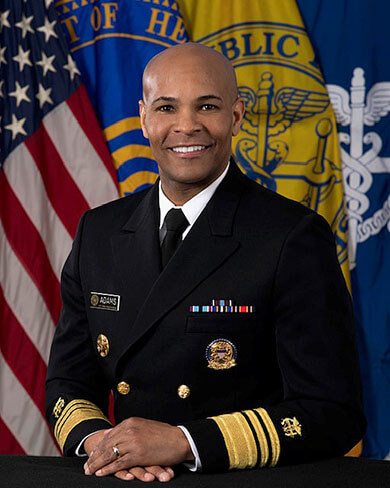
Jerome Michael Adams[3] (born September 22, 1974) is an American anesthesiologist and a former vice admiral in the U.S. Public Health Service Commissioned Corps who served as the 20th surgeon general of the United States from September 5, 2017, until January 20, 2021. Prior to becoming Surgeon General, he served as the Indiana state health commissioner, from 2014 to 2017.

Key Information

On June 29, 2017, President Donald Trump nominated Adams to become Surgeon General of the United States.[4][5] Adams was confirmed by the United States Senate on August 3, 2017.[6] Adams' tenure as Surgeon General coincided with the onset of the COVID-19 pandemic.[7]

Early life and education

[edit]

Adams is the son of Richard and Edrena Adams of Mechanicsville, Maryland, and grew up on the family farm. He attended Chopticon High School, graduating in 1992, in the top 5% of his class.[8] He then attended the University of Maryland Baltimore County through a full-tuition Meyerhoff Scholarship, a grant dedicated to minority students interested in the sciences.[9] Adams received his Bachelor of Science in biochemistry and his Bachelor of Arts in biopsychology. Additionally, Adams studied abroad in the Netherlands and Zimbabwe.[10]

Adams attended medical school at Indiana University School of Medicine as an Eli Lilly and Company Scholar.[9] He also received a Master of Public Health degree from the University of California, Berkeley, in 2000, with a focus on chronic disease prevention.[11] Adams completed his internship in internal medicine (2002–2003) at St. Vincent Indianapolis Hospital and his residency in anesthesiology (2003–2006) at Indiana University. He is board certified in anesthesiology.[12]

Career

[edit]

Private practice and academia

[edit]

After two years in private practice at Ball Memorial Hospital,[13][14] Adams was named assistant professor of anesthesiology at Indiana University.[15][16] He has written several academic papers and book chapters, including chapters in Anesthesia Student Survival Guide: A Case-based Approach,[17] and an editorial in the American Journal of Public Health, "Are Pain Management Questions in Patient Satisfaction Surveys Driving the Opioid Epidemic?"[18]

Indiana state health commissioner

[edit]

In October 2014, Adams was appointed Indiana state health commissioner. He was originally appointed by Governor Mike Pence and re-appointed by newly elected governor Eric Holcomb in 2017.[19] In this role, he oversaw the Public Health Protection and Laboratory Services, Health and Human Services, Health Care Quality and Regulatory, and Tobacco Prevention and Cessation Commissions. He also served as Secretary of Indiana State Department of Health's executive board, as Chairman of the Indiana State Trauma Care Committee, as President of the Healthy Hoosier Foundation, and as co-chairman of the Indiana Perinatal Quality Improvement Collaborative Governing Council.[15] During an HIV epidemic in 2015, Adams initially opposed needle-exchange programs on "moral" grounds, but he later changed his position as cases continued to mount.[20]

Surgeon General of the United States

[edit]
U.S. vice president Mike Pence swearing in Adams as U.S. Surgeon General on September 5, 2017.

On June 29, 2017, President Donald Trump nominated Adams as surgeon general of the United States.[4] He was confirmed to the position by the Senate on August 3, 2017.[21] Upon his confirmation, Adams said that addressing the opioid epidemic along with untreated mental illness would be two of his major priorities.[6] Adams was sworn in as surgeon general on September 5, 2017,[22] and received his commission shortly after.

In April 2018, Adams urged Americans who are at risk of overdosing on opioids, as well as their family and friends, to carry an over-the-counter antidote to help combat rising fatalities.[23][24] In May 2018, Adams responded to an in-flight medical emergency on a flight to Jackson, Mississippi.[25]

In September 2018, Adams began a campaign along with other public health officials to promote seasonal flu vaccinations. The 2017 flu epidemic had resulted in the deaths of an estimated 80,000 Americans, the highest number of deaths in at least four decades, according to CDC director Robert Redfield. Of the 180 children who died, 80 percent were unvaccinated.[26] [6]

COVID-19 pandemic

[edit]
Adams speaking to the White House press corps on COVID-19 in March 2020.

In February 2020, Adams was appointed to the task force for dealing with the COVID-19 pandemic.[27] Adams initially downplayed the risk from COVID-19 by comparing it to the flu, which was criticized by experts.[28][29] He also strongly implored people not to buy or use face masks because he said they were “NOT effective” in preventing the general public from catching COVID-19,[30][31] and that wearing a mask could actually increase the risk of catching the virus.[32] This was in line with other United States Public Health officials, including Anthony Fauci, who later admitted his recommendation was not based on science but rather to prevent shortages for doctors and other health professionals.[33]

Adams later retracted this recommendation because he said there was new information about the asymptomatic spread of the virus.[34][35] Politico reported in April 2020 that Adams had been largely sidelined by the administration.[7]

When asked about African-Americans’ increased risks from COVID, Adams replied that “African-Americans and Latinos should avoid alcohol, drugs and tobacco. Do it for your abuela, do it for your granddaddy, do it for your big momma, do it for your pop-pop.” Public health experts criticized his assertions as misleading and lacking adequate context.[36]

Adams expressed concern that the George Floyd protests could lead to a spike in COVID-19 cases. According to Adams, "Based on the way the disease spreads, there is every reason to expect that we will see new clusters and potentially new outbreaks moving forward."[37]

Adams confirmed that he was asked to step down as Surgeon General by the incoming Biden administration. Former surgeon general Vivek Murthy took his place.[38] He officially resigned on January 20, 2021, at the request of President Joe Biden.[39]

Subsequent career

[edit]

Following his service as surgeon general, Adams joined Purdue University in October 2021 as a Presidential Fellow and its first executive director of health equity initiatives, professor of practice in the departments of Pharmacy Practice and Public Health, and a faculty member of the Regenstrief Center for Healthcare Engineering.[40] Having been part of the Trump administration, he described how this made it difficult to obtain a position in academia or the corporate world.[41]

Personal life

[edit]

Adams is Catholic, and he and his wife Lacey have three children.[42][43]

Awards and decorations

[edit]

References

[edit]
[edit]
Revisions and contributorsEdit on WikipediaRead on Wikipedia
from Grokipedia
Jerome Michael Adams (born September 22, 1974) is an American anesthesiologist and administrator who served as the 20th of the from September 2017 to January 2021. Adams earned a B.S. in biochemistry and B.A. in biopsychology from the in 1997, an M.P.H. from the in 2000, and an M.D. from in 2002. Prior to entering leadership, he worked as an of clinical anesthesia at Indiana University and as a staff anesthesiologist at Eskenazi Health in . Appointed Indiana State Health Commissioner in 2014, Adams managed responses to public health crises, including a 2015 HIV outbreak in Scott County linked to intravenous use; he authorized syringe service programs to curb transmission, a policy that proved effective in limiting cases despite political resistance from conservative lawmakers and initial gubernatorial reluctance. He also advanced efforts against the by promoting physician involvement in prescribing reforms and access. As and operational head of the 6,000-member U.S. Service Commissioned , Adams prioritized recovery, tobacco cessation, and emergency responses to threats like , Zika, and multiple hurricanes. During the , he co-led the , emphasizing evidence-based preventive actions such as mask-wearing and vaccination while navigating tensions between scientific recommendations and administration policies. Since leaving office, Adams has served as a Presidential and Executive Director of Purdue University's Center for Community Health Enhancement and Learning, focusing on , , and chronic disease prevention, alongside ongoing academic and clinical roles at and Eskenazi Health.

Early Life and Education

Childhood and Academic Background

Jerome Adams was born on September 22, 1974, in , the second oldest of four children to Richard and Edrena Adams, both educators. His family relocated to , where he was raised on a in Mechanicsville amid a rural environment of tobacco fields and fishing communities. As a child, Adams suffered from severe , which required long drives—up to two hours—to reach the nearest , highlighting the challenges of rural healthcare access. Adams attended Chopticon High School in Morganza, , graduating in 1992. He then pursued higher education at the (UMBC), earning dual bachelor's degrees in biochemistry and psychology in 1997. Following undergraduate studies, Adams enrolled at , where he obtained his (M.D.) degree. He subsequently completed a Master of Public Health (MPH) at the , in 2000, with a focus on chronic disease prevention.

Professional Career

Clinical Practice and Academia

Adams earned his degree from in 2002. He completed an internship in at St. Vincent Hospital in and a residency in at from 2003 to 2006. Adams is board-certified in by the American Board of Anesthesiology. Following residency, Adams engaged in private clinical practice as a general anesthesiologist for two years at Ball Memorial Hospital in , where he provided anesthesia care for general procedures, , , and trauma cases. He later served as a staff anesthesiologist at Eskenazi Health in , focusing on regional anesthesia alongside his broader interests. In academia, Adams held the position of of clinical anesthesia at , where he instructed residents, medical students, paramedics, and dentists in anesthesia techniques and patient management. His academic contributions included recognition with the of Early Career Achievement Award. This dual role in clinical practice and teaching bridged hands-on patient care with educational efforts in anesthesiology until his appointment as Indiana State Health Commissioner in 2014.

Indiana State Health Commissioner

Jerome Adams was appointed Indiana State Health Commissioner by Governor on October 22, 2014, at age 40, overseeing the Indiana State Department of Health with responsibilities for protection, , and emergency responses. In this role, he managed a staff handling vital statistics, , and chronic disease prevention, emphasizing data-driven interventions amid rising concerns over infectious diseases and . A defining challenge during Adams's tenure was the 2015 HIV outbreak in Scott County, particularly , which became the largest U.S. outbreak linked to injection drug use, with over 180 confirmed cases by mid-2015 tied to opioid-fueled intravenous consumption and high C co-infection rates. Adams advocated for and secured legislative approval for syringe exchange programs in affected counties, overcoming initial resistance from Pence, who had previously opposed such measures on moral grounds; from the program's implementation showed it curbed new HIV transmissions by providing clean needles and connecting users to treatment, with cases declining after peaking. This response integrated with addiction services, addressing intertwined epidemics of HIV, C, and opioid dependency, though some experts criticized delays in broader needle access statewide. Adams also prioritized the opioid crisis, which underpinned the HIV surge, by promoting expanded distribution, prescriber education on controlled substances, and monitoring overdose deaths, which rose significantly in during his term. He led preparations for other threats, including screening protocols in 2014 and Zika monitoring in 2016, while tackling high rates through targeted campaigns focusing on social determinants like and access to . His tenure ended in June 2017 upon nomination as U.S. , during which he testified before on opioid-HIV linkages, stressing local partnerships over federal mandates for sustainable outcomes.

U.S. Surgeon General

Jerome Adams was nominated by President Donald Trump to serve as the 20th U.S. Surgeon General on June 29, 2017, confirmed by the Senate on August 3, 2017, and sworn into office on September 5, 2017, by Vice President Mike Pence. In his swearing-in remarks, Adams outlined his motto of "better health through better partnerships," emphasizing collaboration across sectors to address public health challenges. His role as the "Nation's Doctor" involved issuing advisories, promoting evidence-based practices, and leading the U.S. Public Health Service Commissioned Corps. A primary focus of Adams' tenure was combating the , which claimed over 42,000 lives in 2016 alone. In April 2018, he issued the first Surgeon General's Advisory since 2005, urging widespread access to , a that reverses overdoses, and calling for its distribution to laypersons including family members and community members. Adams also advanced the Turn the Tide initiative, launched under his predecessor but expanded during his term, to reduce stigma around , increase treatment access, and integrate services. During the onset of the in early 2020, Adams joined the and initially described the virus as a "bad flu" in 2020 interviews, aligning with early federal messaging that downplayed severity. He later advocated for , hand hygiene, and mask usage as evidence evolved, while highlighting disparities in infection and mortality rates among Black and minority communities, urging targeted outreach to achieve 80% compliance in these groups. These comments drew criticism from some experts who viewed them as implying behavioral deficits in affected communities rather than systemic factors. Adams' visibility diminished in mid-2020 amid reported tensions within the administration over messaging. Adams' tenure concluded on , 2021, when he resigned at the request of the incoming Biden administration, eight months before his four-year term was set to expire. During his service, he received commendations including the Service Distinguished Service Medal for leadership in crisis response.

Key Public Health Initiatives

As U.S. Surgeon General, Jerome Adams prioritized combating the opioid epidemic through the "Turn the Tide" campaign, launched in January 2018, which called on healthcare professionals to pledge actions such as screening for opioid use disorder, prescribing naloxone, and promoting evidence-based prescribing practices to reduce overdose deaths. On April 5, 2018, Adams issued the U.S. Surgeon General's Advisory on Naloxone and Opioid Overdose, recommending that more individuals—including family members, first responders, and the public—carry naloxone, an opioid overdose reversal agent, to address the crisis that claimed over 115 lives daily in 2016. This advisory emphasized expanding naloxone access via community distribution programs and standing orders, building on federal efforts to distribute 6 million doses by 2018. Adams also advanced the Community Health and Economic Prosperity (CHEP) initiative, which underscored the interdependence of and economic vitality, urging businesses to invest in employee wellness, , and community partnerships to foster resilient local economies. In December 2020, he released the first CHEP report, "Engaging Businesses as Stewards and Stakeholders," highlighting how corporate actions—like and workplace health screenings—could mitigate health disparities and boost productivity, with data showing that poor costs the U.S. economy up to $150 billion annually in lost output. Additionally, Adams commissioned the 2021 Surgeon General's Report on Oral Health in America, the first update since 2000, which integrated oral health into broader systemic health strategies, addressing disparities where 30% of U.S. adults reported unmet dental needs due to cost and access barriers. This effort, led by the National Institute of Dental and Craniofacial Research, advocated for interprofessional care models and policy reforms to treat oral disease as a preventable contributor to chronic conditions like and .

Response to the COVID-19 Pandemic

Jerome Adams served as a member of the established in late January 2020 to coordinate the federal response to the emerging . In this role, he advocated for measures grounded in available evidence at the time, including hand hygiene, , and avoiding large gatherings. Adams emphasized personal responsibility, urging Americans to "act like you have the virus" by adopting behaviors such as frequent handwashing and staying home when ill, regardless of symptoms, to mitigate transmission risks. Early in the , on February 29, 2020, Adams tweeted that the public should "STOP BUYING MASKS," stating they were not effective for healthy individuals in preventing infection and that hoarding depleted supplies critical for healthcare workers treating patients. This guidance aligned with initial recommendations from the CDC and WHO, prioritizing personal protective equipment preservation amid shortages, though it drew criticism as evidence of asymptomatic spread emerged later. By March 2020, Adams appeared in media briefings defending administration efforts and projecting high weekly death tolls, estimating up to 10,000 to 240,000 U.S. fatalities based on modeling if failed. As the progressed, Adams supported shifts in guidance, including eventual recommendations for the public once supply chains stabilized and data indicated potential benefits in reducing droplet transmission. He participated in task force discussions on testing expansion, , and therapeutic development, while publicly praising President Trump's leadership in mobilizing resources like the Defense Production Act for ventilators and PPE. Adams also highlighted disproportionate impacts on minority communities, framing as a potential "disparity disaster" and calling for targeted outreach to address underlying health inequities exacerbating outcomes. In the latter phase of his tenure through January 2021, Adams contributed to promoting vaccine development under , stressing the importance of equitable distribution and countering misinformation to build public trust in efforts. Reflecting post-tenure, he acknowledged administrative missteps, such as delayed testing rollout and inconsistent messaging, while defending the overall scientific foundation of the response amid unprecedented .

Controversies and Criticisms During Tenure

During a White House briefing on April 10, 2020, Adams urged African Americans to take COVID-19 seriously, stating that the virus was killing "black Americans at an alarming rate" and imploring figures like "big mama and auntie Jemima" in communities to encourage masking and social distancing. These remarks drew immediate backlash from critics, including Rep. Maxine Waters, who condemned them as "highly offensive" and stereotypical, arguing they demeaned black women and distracted from systemic inequities exacerbating disparities in COVID-19 mortality. Black health experts echoed this, with some describing the language as "irresponsible" and indicative of a failure to address structural racism's role in health outcomes, rather than relying on colloquial appeals. The controversy led to Adams being sidelined by the Trump administration, with his television appearances curtailed shortly after the briefing as officials questioned his messaging amid broader tensions in the coronavirus . Critics from circles and media outlets portrayed the incident as emblematic of Adams' challenges in balancing scientific communication with political pressures, particularly in an administration skeptical of alarmist rhetoric. Adams defended the intent behind his words as culturally attuned outreach to high-risk groups, where data showed disproportionate impacts— comprised 13% of the U.S. population but 38% of hospitalizations by early April 2020—but the phrasing fueled perceptions of insensitivity. Adams also encountered scrutiny for the administration's early pandemic guidance, including initial reluctance to recommend widespread masking, which aligned with CDC recommendations at the time but later evolved amid emerging evidence of asymptomatic transmission. While Adams personally advocated for evidence-based shifts, such as promoting masks by mid-2020, detractors argued his role in the task force contributed to mixed messaging that eroded public trust, with over 20,000 U.S. deaths reported by late March 2020 when federal responses intensified. These criticisms, often amplified in left-leaning media, highlighted systemic biases in coverage favoring narratives of administrative incompetence over contextual constraints like supply shortages for PPE.

Post-Surgeon General Roles

Following the end of his tenure as U.S. Surgeon General on January 20, 2021, Adams transitioned to academia and advisory positions. In October 2021, he joined as a Presidential Fellow and the inaugural Executive Director of the Center for Community Health Enhancement and Learning (HEAL), focusing on initiatives and partnerships. He also holds a position as Distinguished Professor in the College of Health and Human Sciences at Purdue, where he contributes to education and research on topics including and pandemic preparedness. In August 2025, Adams was appointed as a medical adviser to Eko Health, a health technology company specializing in AI-enabled cardiac devices, leveraging his expertise in public health and clinical practice to guide product development and policy outreach. He maintains his license as an anesthesiologist and has continued limited clinical involvement, though his primary activities post-2021 emphasize leadership in health equity, policy critique, and speaking engagements on public health challenges. Adams has publicly noted difficulties securing employment immediately after leaving the Trump administration, attributing it to political affiliations amid a polarized job market for former officials.

Public Health Views and Advocacy

Health Equity and Social Factors

Jerome Adams has advocated that —factors including socioeconomic status, education, housing, transportation, and geographic location—profoundly influence outcomes, often more than genetic predispositions or access to clinical care. He has repeatedly asserted that an individual's serves as a stronger predictor of and longevity than their , emphasizing that disparities arise from environmental and community conditions rather than solely biological or behavioral factors. Adams estimates these non-medical determinants account for approximately 80% of results, underscoring the need to address upstream causes like and limited resources to achieve equitable outcomes. As U.S. from 2017 to 2021, Adams promoted awareness of health disparities rooted in social factors, including during the when he attributed elevated impacts on minority communities partly to structural racism manifesting through these determinants, such as denser housing and occupational exposures. Post-tenure, in his role as Executive Director of Health Equity Initiatives at since October 1, 2021, he has focused on rural and underserved areas, integrating business, policy, and community resources to mitigate influences like family background and cultural barriers on health. His initiatives aim to leverage data-driven strategies and partnerships to reduce urban-rural divides in life expectancy and disease prevalence. Adams recommends practical interventions for clinicians and policymakers, prioritizing as foundational—"people need to know that you care before they care what you know"—to build trust and encourage behavior change. He urges routine screening for social needs using validated tools, collaboration with local entities like faith-based organizations and departments, and workforce diversification to mirror patient demographics, alongside bias training via implicit association assessments and techniques. In discussions of (DEI) efforts, Adams supports their application to when evidence-based and targeted, arguing they enhance outcomes by addressing specific disparities—such as in or access—without supplanting merit. He critiques polarized that conflates DEI with unrelated failures or dismisses merit concerns, calling instead for measurable goals, regular evaluations, and empathetic dialogue to avoid counterproductive while fostering inclusive informed by varied perspectives.

Vaccine and Infectious Disease Policies

During his tenure as U.S. from 2017 to 2021, Jerome Adams prioritized vaccination campaigns to combat seasonal , launching a national effort in September 2018 to promote flu shots following the 2017-2018 season's estimated 80,000 deaths. He publicly received his own flu to model behavior, stating that "flu vaccinations save lives" and urging widespread uptake to reduce hospitalization and mortality from this preventable infectious disease. Adams emphasized targeting vulnerable populations, including children and workers, through accessible delivery in doctors' offices, schools, and workplaces, while highlighting vaccines' empirical efficacy in mitigating flu's annual burden. In response to the , Adams advocated for rapid vaccine development and deployment under , publicly receiving the Pfizer-BioNTech vaccine on December 18, 2020, at a White House event alongside Vice President . He underscored the vaccine's safety based on data and rigorous regulatory review, particularly addressing historical mistrust among Black Americans by referencing events like the and affirming his personal prioritization due to comorbidities such as and . Adams promoted as a core strategy for achieving , recommending "micro-herds" in families and communities with 70%+ uptake to curb transmission, alongside measures to improve access like mobile clinics and paid time off. Adams testified before on July 1, 2021, framing —not limited to but evident in routine immunizations—as a long-standing barrier to controlling infectious diseases, advocating compassionate, targeted over stigmatizing labels like "anti-vaxxer." He supported pursuing full FDA approval to alleviate concerns over emergency use authorizations and endorsed research into hesitancy drivers, while citing data that vaccines reduce severe outcomes, such as 95% of 2023-2024 COVID hospitalizations occurring among the unvaccinated. Post-tenure, Adams has sustained advocacy for annual flu and updated boosters, particularly among health care providers, recommending employer-led clinics, incentives, and peer influence to boost uptake rates, which lagged below 20% for COVID boosters in some settings during 2023-2024. He has criticized policies undermining confidence, such as funding cuts for mRNA research or dissemination of on childhood vaccines like HPV, arguing that supports their role in preventing diseases like and measles outbreaks. In a 2024 , Adams detailed his decision to receive an updated COVID shot, citing ongoing risks—nearly 45,000 U.S. deaths in 2024—and vaccines' proven reduction in and hospitalizations, while rejecting politicization in favor of data-driven .

Critiques of Policy and Administration

During his tenure as U.S. , Jerome Adams faced criticism for remarks made on April 10, 2020, during a briefing on disparities among racial minorities. Adams advised to combat higher infection and mortality rates by adhering to medications for conditions like and , while avoiding alcohol, , and illicit drugs, framing it as personal responsibility to "step up" alongside . Critics, including Rep. (D-CA), described the comments as offensive and stereotypical, accusing Adams of victim-blaming and perpetuating racial tropes by emphasizing individual behaviors over systemic factors such as , inadequate healthcare access, and environmental inequities. Black health experts and progressive commentators further contended that Adams' language, including references to "big mama and big daddy" in familial appeals, reflected a lack of sensitivity to structural and failed to address root causes like the 30% of households lacking running water, which hindered hygiene measures. These remarks drew backlash from figures like Rep. (D-NY), who labeled them as amplifying "racist dog whistles," and prompted accusations that Adams overlooked broader social determinants despite his prior emphasis on . The controversy contributed to Adams being sidelined by the Trump administration, with his television appearances dropping from over 10 per week to one by mid-April 2020, and no further White House briefings after April 10. Observers interpreted this as an internal rebuke for deviating from administration messaging or insufficient loyalty, limiting his administrative influence during a critical phase of the pandemic response. As Indiana State Health Commissioner prior to his federal role, Adams advocated for syringe exchange programs to curb an HIV outbreak in Scott County in 2015, which successfully reduced new cases from 181 in early 2015 to near zero by mid-2016. However, some advocates later criticized him for not exerting stronger pressure on then-Gov. to implement the policy more swiftly, arguing that delays exacerbated the outbreak amid initial resistance to approaches perceived as enabling drug use.

Personal Life

Family and Personal Interests

Adams has been married to Lacey Adams since before his tenure as Surgeon General began in 2017. The couple has three children: Caden, Eli, and Millie. Lacey Adams was diagnosed with in 2011 after a mole removal from her revealed the cancer. The disease recurred metastatically in 2018, prompting public disclosure by her husband during his service to raise awareness. A third recurrence was announced in summer 2022, with the family sharing updates via to highlight challenges in cancer care access and stigma. Adams has one brother who developed opioid following untreated issues, culminating in a sentence for stealing $200 to fund the habit; this experience has informed Adams' on and . Adams maintains a Christian , referencing a Catholic upbringing in statements and drawing on religious themes, such as sacrifice during amid the , to frame messaging.

Recognition and Publications

Awards and Honors

Jerome Adams received the Sagamore of the Wabash Award, the highest civilian honor bestowed by the , in August 2017 for his leadership as Indiana State Health Commissioner. He was also awarded the Indiana Center for Achievement Award in 2017. In 2016, prior to his nomination as Surgeon General, Adams earned the Indiana University School of Medicine Early Career Achievement Award, recognizing his rapid contributions to medicine as an alumnus, and the Indiana Public Health Foundation's Distinguished Service Award. As a commissioned officer in the U.S. Public Health Service Commissioned Corps, Adams accumulated several personal decorations, including the from the Department of Defense, the Surgeon General's Exemplary Service Medal, and the Public Health Service Outstanding Service Medal with one bronze star device. His unit honors encompass the Public Health Service Outstanding Unit Citation and the Public Health Service Unit Commendation. Adams additionally qualified for service ribbons such as the Public Health Service Regular Corps Ribbon and the Commissioned Corps Training Ribbon, reflecting his active-duty tenure. During his tenure as Surgeon General, Adams accepted the Daniel Perry Founder's Award in October 2019 from the Congressional Award Foundation, honoring his public health advocacy.

Books and Key Writings

Adams authored Crisis and Chaos: Lessons from the Front Lines of the War Against COVID-19, published on October 24, 2023, by Post Hill Press, in which he draws on his experiences as Surgeon General to critique aspects of the U.S. pandemic response, including communication failures, policy missteps, and the need for better preparedness. The book emphasizes empirical lessons from the crisis, such as the importance of data-driven decision-making and addressing social determinants of health disparities exacerbated by the virus. During his tenure as Surgeon General, Adams led the production of key official reports, including the 2020 Smoking Cessation: Progress, Barriers, and New Opportunities, the 34th Surgeon General's report on , which analyzed barriers to quitting and proposed evidence-based interventions to reduce the 480,000 annual U.S. attributable to . He also oversaw the 2018 Surgeon General's Spotlight on Opioids, a 40-page document spotlighting the epidemic's scope—over 42,000 overdose deaths that year—and urging community-level responses beyond prescription limits. In academic contributions, Adams co-authored chapters on topics in Anesthesia Student Survival Guide: A Case-Based Approach. His peer-reviewed papers include "Are Pain Management Questions in Patient Satisfaction Surveys Driving the ?" published in the in 2016, which examined how survey incentives might incentivize overprescribing. Additionally, in 2019, he published "The Business Case for Reducing Tobacco Use" in Public Health Reports, arguing that yields economic benefits exceeding $300 billion annually in healthcare savings and productivity gains.

References

Add your contribution
Related Hubs
User Avatar
No comments yet.