


Community hub
Recent from talks
Contribute something
Nothing was collected or created yet.
Joe Baca
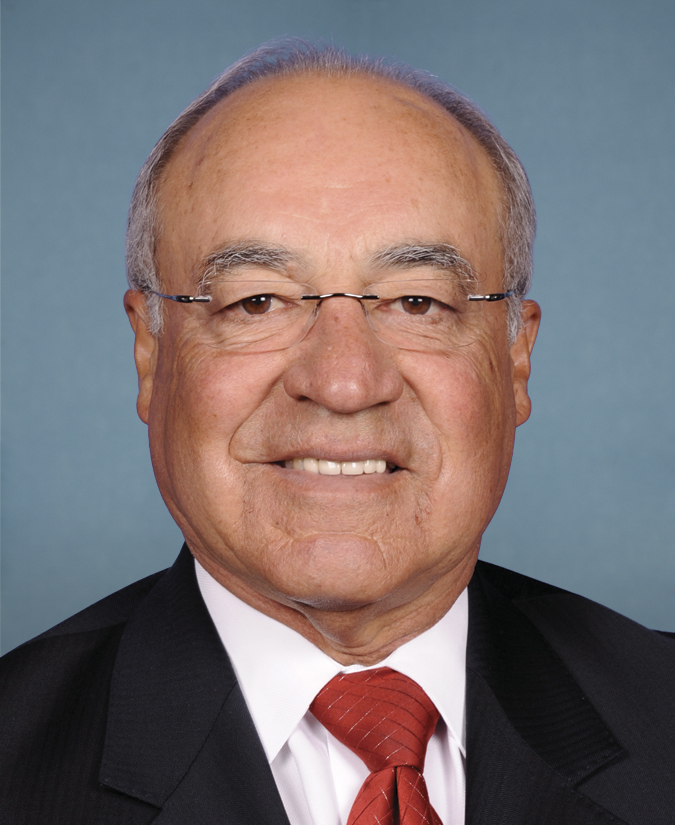
View on WikipediaJoseph Natalio Baca Sr. (born January 23, 1947) is an American Democratic politician who served as the U.S. representative for southwestern San Bernardino County (including Fontana, Rialto, Ontario and parts of the city of San Bernardino) from 1999 to 2013.
Key Information


In June 2015, Baca switched his affiliation to the Republican Party, citing his "core Christian" and pro-business beliefs.[2] In January 2018, Baca switched his affiliation back to the Democratic Party, saying that "in my heart, I've always been a Democrat with a 100 percent voting record for labor."[3]
Prior to his time in the House of Representatives, Baca served in the California Senate from 1998 to 1999, and the California State Assembly from 1992 to 1998.
In 2022, Baca returned to politics at the local level and was elected to the Rialto City Council.[4] Baca currently serves as the mayor of the city of Rialto after being elected to a four-year term in 2024.[5]
Early life, education and career
[edit]Baca was born in Belen, New Mexico in 1947, the youngest of 15 children in a primarily Spanish-speaking household.[6] His father was a railroad laborer.[6] The family moved to Barstow, California when Joe was young, where he shined shoes at age 10, delivered newspapers, and later worked as a laborer for the Santa Fe Railroad, until he was drafted in 1966, serving in the United States Army until 1968. He did not serve in Vietnam.[7][8]
Following military service, Baca attended Barstow Community College and went on to receive his bachelor's degree in sociology from California State University, Los Angeles.[9] He worked for 15 years in community relations with General Telephone and Electric. In 1979, he was the first Latino elected to the board of trustees for the San Bernardino Valley College District.[9] He was elected to the State Assembly in 1992,[6] and to the State Senate in 1998.[6]
U.S. House of Representatives
[edit]Committee assignments
[edit]Caucus memberships
[edit]- Congressional Hispanic Caucus (Former Chairman)
- Corporate America, Technology, Communications and the Arts Task Force (Chairman)
- Blue Dog Coalition[10]
He served on the House Financial Services Committee, where he was a member of the Subcommittee on Capital Markets, Insurance, and Government Sponsored Enterprises, and the Subcommittee on Financial Institutions and Consumer Credit. Rep. Baca also served on the House Agriculture Committee, where he was the ranking member of the Subcommittee on Departmental Operations, Oversight, Nutrition and Forestry.
Rep. Baca was the Chair of the CHC Corporate America Task Force, which aims to increase Hispanic representation in corporate America.[citation needed] He created and co-chaired the Congressional Sex and Violence in the Media Caucus. Other caucus memberships included the Congressional Diabetes Caucus, the Military/ Veterans Caucus, the Native American Caucus and the U.S.-Mexico Caucus.
In 2011, Rep. Baca became a co-sponsor of Bill H.R.3261 otherwise known as the Stop Online Piracy Act.[11] The same year, he voted for the National Defense Authorization Act for Fiscal Year 2012 as part of a controversial provision that allows the government and the military to indefinitely detain American citizens and others without trial.[12]
In March 2012, Baca and Rep. Frank Wolf (R-VA) introduced a bill that would force video game companies to put warning labels on their products. H.R. 4204, the Violence in Video Games Labeling Act, would compel game companies to label their products with "WARNING: Exposure to violent video games has been linked to aggressive behavior". [citation needed]
Political campaigns
[edit]1999 special election
[edit]A few months after Baca was elected to the State Senate, Congressman George Brown, Jr. died after a long illness. Baca finished first in a seven-way primary, but fell far short of a majority due to the presence of two minor Democratic candidates. In the special general election, Baca defeated Republican Elia Pirozzi with 50.4%.
Baca won a full term in 2000 with 59% of the vote. After the 2000 census, the district was renumbered as the 43rd and reconfigured as a majority-Hispanic district. Baca was handily reelected from this redrawn district in 2002, and did not face another close contest until 2012.
2012 campaign
[edit]After the 2010 United States census, the Citizens Redistricting Commission significantly redrew California's congressional map. The bulk of Baca's former territory became the 35th District, though his home in Rialto was placed in the 31st District. Baca opted to run in the 35th, and finished first in the new all-party primary with 46.7 percent of the vote. His nearest opponent, State Senator Gloria Negrete McLeod, took 34 percent; under the new "top two" primary rules, both advanced to the general election.
A few weeks before the general election, Negrete McLeod's campaign benefited from $3.2 million in independent expenditures from the Federal Super PAC of billionaire Michael Bloomberg, who was Mayor of New York City at that time. The Super PAC ran negative advertisements in newspapers, radio, and television accusing Baca of being soft on crime and causing perchlorate water contamination in drinking water. Bloomberg had become unhappy with Baca because he had not been supportive of Bloomberg's efforts for stronger federal laws for gun control and the enactment of federal registration.[citation needed] Negrete McLeod defeated Baca, taking 56 percent to Baca's 44 percent.
Baca ran for Congress again, changing to the 31st District in 2014, but finished fifth in the primary with 11.2%.
In 2014, Baca also ran for Mayor of Fontana.[13][14][15] He lost in a landslide and subsequently announced his retirement from politics. but made a comeback to the Rialto City Council in 2022.[16][4]
2022 campaign
[edit]In 2022, Baca made a political comeback after an eight-year retirement, as he was elected to a seat on the Rialto City Council. [17]
2024 campaign
[edit]Baca won the 2024 Rialto mayoral election, defeating incumbent Deborah Robertson and two other candidates. Baca secured 6,226 votes (40.76%) to Robertson's 4,668 votes (30.56%). The other candidates, Rafael Trujillo and Ché Rose Wright, finished with 22.55% and 6.13%, respectively.[18]
Controversies
[edit]According to the Los Angeles Times, Baca, chairman of the Congressional Hispanic Caucus, directed Caucus funds from its PAC[19] BOLDPAC (Building Our Leadership Diversity)[20] to the unsuccessful California campaigns of his sons, Joe Baca, Jr. and Jeremy Baca. At the time, Rep. Loretta Sanchez and five other members dropped out of the PAC in protest of these actions.[19] They alleged that the funds, meant to elect Hispanic candidates, should not have been used to help Baca's sons run against Hispanic candidates and that in a previous race funded by the PAC, Joe Jr. had run against Hispanic candidates.[20]
Citizens for Responsibility and Ethics in Washington (CREW) released a report stating that Rep. Baca had paid his daughter $27,000 from campaign funds and donated more than $20,000 to his sons' political campaigns from his own campaign funds.[21] They reported accusations that were made in 2006 by former members of Baca's Washington staff that they were sent to California in 2004 for a staff retreat and pressured to work on Joe Baca, Jr.'s campaign for the state Assembly on their paid time for the senior Baca.[6]
2007 House Hispanic Caucus election
[edit]In January 2007, fellow Hispanic Caucus members including Loretta Sanchez, Nydia Velázquez, Hilda Solis, and Linda Sánchez wrote a letter to Baca asking for a new election with a secret ballot. They claimed that Baca was elected chair of the Caucus in a public ballot, despite Caucus rules for electing a chair that require a secret-ballot election.
On January 31, Politico reported that Rep. Baca had called Loretta Sanchez a "whore". Baca denied making the insult.[22] Loretta Sanchez and Solis alleged that Baca made the remark in the summer of 2006.
Citing Baca's alleged insult and the perceived impropriety in Baca's election to chairman of the CHC, as well as Baca's treatment of Latina members in the CHC, Loretta Sanchez resigned from the Caucus along with her sister, three other female California members and one female member from Arizona. The two congresswomen state that they heard the remark from unnamed sources, although Politico identified California State Assemblyman Fabian Núñez as one of those who heard the insult firsthand and told Loretta Sanchez.[23] She said that Baca confirmed the comments to her sister Linda Sánchez the day before Loretta Sanchez confronted him over the accusation.[19]
In a February, 2014 interview in The Hill, Baca described Representative Gloria Negrete McLeod, who had defeated him in the 2012 elections after receiving $3.2 million in help from then New York Mayor Michael Bloomberg's Super PAC in the final weeks leading up to the election, as "some bimbo." Minutes later he apologized, saying he was upset because he felt it was a disservice to the voters that she had announced the day before that she would not seek re-election to the congressional seat after holding it for only two years.[24]
Personal life
[edit]Baca and his wife, Barbara, began their own business, Interstate World Travel, in San Bernardino in 1989. They have four children: Joe Jr., Jeremy, Natalie and Jennifer. Son Joe Baca, Jr. served one term as state assemblyman for California's 62nd district.
See also
[edit]References
[edit]- ^ "Once a Soldier... Always a Soldier" (PDF). Legislative Agenda. Association of the United States Army. 2011. Archived from the original (PDF) on 21 October 2013. Retrieved 27 January 2013.
- ^ Nelson, Joe (June 12, 2015). "Former 'Blue Dog' Rep. Joe Baca goes Republican". The San Bernardino Sun. Retrieved June 14, 2015.
- ^ Horseman, Jeff (February 27, 2018). "Switching parties again, Joe Baca wants back in Congress". The Press-Enterprise. Retrieved May 21, 2018.
- ^ a b "Joe Baca Sr. Takes seat on Rialto City Council a decade after he left Congress". 14 December 2022.
- ^ "Updates on the Results of Rialto and Moreno Valley Races for Mayor, City Council". 12 November 2024.
- ^ a b c d e "Former staff accuse Baca of 'forced volunteering' (Culture of Corruption Alert)". The Hill. 2006-05-18.
- ^ "Joe Baca (D)". The Wall Street Journal. 2012. Retrieved 27 January 2013.
Baca worked as a laborer for the Santa Fe Railroad before getting drafted into the U.S. Army in 1966. He served as a paratrooper during the Vietnam War, but did not see combat. He was discharged in 1968.
- ^ a b "Congressman Joe Baca: Biography". US House of Representatives. Retrieved 5 April 2010.
- ^ "Blue Dog Coalition". Archived from the original on June 15, 2010. Retrieved July 12, 2010.
- ^ Bill H.R.3261; GovTrack.us;
- ^ "NDAA Bill: How Did Your Congress Member Vote?". International Business Times. 16 December 2011.
- ^ "Former Rep. Joe Baca takes steps to run for Fontana mayor this fall". Los Angeles Times. 28 July 2014.
- ^ "Latino". Fox News. 16 March 2022.
- ^ "FONTANA: Joe Baca's comeback bid in politics continues". Press Enterprise. 16 August 2014.
- ^ "Inland Empire politician Joe Baca calls it a career with latest loss". 9 November 2014.
- ^ "Joe Baca Sr. takes seat on Rialto City Council a decade after he left Congress". The San Bernardino Sun. 14 December 2022.
- ^ "2024 Election Results Joe Baca leads in race for Rialto mayor". Inland Valley Daily Bulletin. 5 November 2024.
- ^ a b c Bunis, Dena (2007-02-01). "Sanchez quits caucus". The Orange County Register. Archived from the original on 2007-09-30. Retrieved 2007-06-20.
- ^ a b Aleman, Adam (2006-11-29). "Baca to Chair Congressional Hispanic Caucus Despite Female Members' Misgivings". Flash Report. Archived from the original on 2007-09-28. Retrieved 2007-06-20.
- ^ "Watchdog lists 64 in the House paying kin out of campaign funds". Citizens for Ethics. 2007-06-19. Archived from the original on 2007-09-28. Retrieved 2007-06-20.
- ^ Hearn, Josephine (2007-02-02). "Sanchez Accuses Democrat of Calling Her a 'Whore', Resigns from Hispanic Group". Politico. Retrieved 2007-02-08.
- ^ Werner, Erica (2007-02-01). "Hispanic Caucus Members Toil Over Insult". The Washington Post. Retrieved 2007-02-08.
- ^ Ex-Rep. Joe Baca Calls Congresswoman Who Beat Him "Some Bimbo" by Laura Bassett, 18 February 2014, Huffington Post
External links
[edit]- U.S. Congressman Joe Baca official U.S. House website
- Joe Baca for Congress
- Biography at the Biographical Directory of the United States Congress
- Financial information (federal office) at the Federal Election Commission
- Legislation sponsored at the Library of Congress
- Profile at Vote Smart
- Profile at SourceWatch
- Explaining his agenda of increasing La Raza on YouTube
- Join California Joe Baca
- Joe Baca at Ballotpedia
- Appearances on C-SPAN
Chairs of the Congressional Hispanic Caucus | ||
|---|---|---|
 | ||
| International | |
|---|---|
| National | |
| People | |
| Other | |

Joe Baca
View on GrokipediaEarly life and education
Childhood and family origins
Joseph Natalio Baca Sr. was born on January 23, 1947, in Belen, Valencia County, New Mexico, as the youngest of 15 children in a large family of Mexican descent.[2][1] The household was primarily Spanish-speaking, with limited English usage, reflecting the family's cultural roots and the economic constraints of a working-class environment.[1] At age four, Baca's family relocated to Barstow, California, in San Bernardino County, where his father worked as a laborer for the Santa Fe Railroad, supporting the household through manual employment amid post-World War II migration patterns common among Mexican-American families seeking stability.[1] Growing up in this setting exposed Baca to labor-intensive conditions early on; by age 10, he contributed by shining shoes, instilling a firsthand understanding of self-reliance and the demands of low-wage work in a community reliant on railroad and related industries.[5] These formative experiences in the San Bernardino area, characterized by familial interdependence and economic pragmatism, shaped his early worldview prior to formal schooling.[6]Academic background and early professional experience
Baca attended Barstow Community College following his U.S. Army service, earning an associate's degree there in 1970. He subsequently transferred to California State University, Los Angeles, where he received a Bachelor of Arts degree in sociology in 1971.[1][7] After completing his undergraduate education, Baca entered professional roles that leveraged his sociological training in community-oriented work. He served as a counselor for SER Jobs for Progress, a nonprofit focused on employment services for Hispanic individuals, providing direct support in job placement and vocational guidance. He later joined General Telephone and Electric (GTE) in community relations, a position he maintained for 15 years until 1989, handling public outreach and service coordination in the San Bernardino region during an era of expanding telecommunications infrastructure amid local economic pressures from manufacturing declines.[5][8]Pre-congressional political career
Local government roles
Joe Baca was first elected to public office in 1979 as a trustee on the San Bernardino Community College District Board of Trustees, becoming the first Hispanic American to serve in that role. The district governed San Bernardino Valley College and Crafton Hills College, institutions serving Inland Empire communities with vocational and transfer education programs.[9] Baca held the trustee position continuously for 14 years, through 1993, during a period when California community colleges faced recurrent state funding shortfalls and enrollment pressures from demographic shifts in the region.[9] His service provided foundational experience in local fiscal oversight and educational policy administration, though detailed records of individual board votes or specific initiatives led by Baca during this tenure remain limited in public archives. No notable controversies or criticisms tied directly to his college board performance have been documented in contemporaneous reporting.California State Assembly service
Joe Baca was elected to the California State Assembly in the November 3, 1992, general election to represent the 62nd Assembly District, which included portions of San Bernardino County in the Inland Empire region, securing 51,372 votes against Republican challenger Gary G. Miller.[10] He was reelected in 1994 with 36,127 votes and in 1996 with 47,064 votes, serving from December 7, 1992, until his resignation in 1999 to pursue a seat in the California State Senate.[11] [2] As a Democrat in a district with a growing Latino population and economic challenges tied to manufacturing and agriculture, Baca emphasized local priorities including economic development to address unemployment in the Inland Empire, where industrial decline had persisted since the 1980s recession.[12] Baca's legislative record centered on district-specific issues such as water resource management, critical for the arid Inland Empire's reliance on imported supplies from the Colorado River and State Water Project, though specific sponsored bills on water rights yielded limited passage data amid competing regional demands.[11] He advocated for veterans' affairs, reflecting his district's military ties via nearby bases like Fort Irwin, and supported initiatives for trade education to bolster workforce training in export-oriented sectors. Efforts on gang prevention aligned with rising youth violence in urbanizing San Bernardino areas during the 1990s crack epidemic aftermath, but implementation effectiveness was constrained by state budget shortfalls and local enforcement variations, with no comprehensive evaluation metrics available from enacted measures.[11] In a Democrat-majority Assembly, Baca demonstrated early pragmatic tendencies by serving as Assistant Speaker pro Tempore in 1992 and from 1995 to 1996—the first Latino in that role—facilitating bipartisan procedural cooperation on appropriations and rules amid fiscal conservatism debates post-Proposition 13 property tax limits.[11] This positioning foreshadowed his later moderate stance, prioritizing incremental economic bills over expansive progressive spending, though conflicts arose with party leadership on term-limit compliance and redistricting fights favoring GOP incumbents in 1992. His tenure contributed to Latino caucus growth, influencing education and public safety policies, but passage rates for authored bills averaged below statewide Democratic norms due to veto threats from Governor Pete Wilson on welfare and infrastructure proposals.[13]Congressional service
1999 special election and entry to Congress
The vacancy in California's 42nd congressional district occurred after the death of longtime Democratic Representative George E. Brown Jr. on July 15, 1999, prompting Governor Gray Davis to call a special election.[14] The district, encompassing parts of San Bernardino and Riverside counties in the Inland Empire, featured a diverse electorate with a significant and growing Hispanic population that favored candidates addressing local economic concerns over partisan ideology.[15] In the Democratic primary on September 21, 1999, Joe Baca, then a California State Assembly member, emerged victorious from a field of ten candidates, narrowly defeating Marta Macias Brown, the widow of the deceased representative, in a contest marked by intense competition for the party's nomination.[16] Baca's campaign emphasized revitalizing the local economy through job creation and infrastructure investment, alongside advocating for greater representation of the district's Hispanic community, which appealed to voters prioritizing pragmatic governance amid the region's industrial and agricultural base.[17] Baca advanced to the special general election on November 16, 1999, where he defeated Republican businessman Elia Pirozzi, securing the seat with a Democratic hold in a low-turnout contest estimated at 12 percent of registered voters.[18] The victory reflected the district's Democratic leanings and Baca's established local profile, though the abbreviated campaign timeline posed initial challenges in mobilizing broader support.[19] He was sworn into the 106th Congress on November 18, 1999, marking his immediate entry into federal service and necessitating a swift transition to Washington, D.C., including assembling a congressional staff and navigating the complexities of national legislation.[20]Committee assignments and legislative roles
Baca served on the House Committee on Agriculture throughout his congressional tenure, from the 106th to the 112th Congresses (January 3, 1999–January 3, 2013).[1] This assignment positioned him to influence federal policies on farming, nutrition programs, and rural economic initiatives, including oversight of the U.S. Department of Agriculture's operations and funding allocations exceeding $100 billion annually during that period.[21] Within the Agriculture Committee, Baca held leadership roles on key subcommittees, chairing the Subcommittee on Department Operations, Oversight, Nutrition, and Forestry starting in 2007 after Democrats assumed House control.[1] In this capacity, he directed hearings on USDA administrative reforms, civil rights compliance in farm lending—where discriminatory practices had led to over $1 billion in settlements—and nutrition program efficacy, such as the Supplemental Nutrition Assistance Program's (SNAP) administration amid rising caseloads from 17 million participants in 1999 to 46 million by 2012.[22] He also served as ranking member on the Subcommittee on Nutrition and Horticulture, advocating for targeted subsidies in specialty crops and livestock sectors, which supported California's agricultural output valued at $45 billion yearly.[23] Additionally, Baca participated in the Subcommittee on General Farm Commodities, Risk Management, and Credit, contributing to deliberations on crop insurance expansions that reduced farmer bankruptcies by 20% post-2008 financial crisis through enhanced federal reinsurance.[24] Baca joined the House Committee on Financial Services from the 108th to 112th Congresses (2003–2013), focusing on banking regulations and housing finance amid events like the 2008 subprime mortgage collapse.[1] He sat on subcommittees including Financial Institutions and Consumer Credit, and Oversight and Investigations, where he probed executive compensation practices and mortgage fraud, leading to legislative pushes for stricter lending standards that influenced the Dodd-Frank Act's credit card reforms capping fees at 25% of balances.[23] These roles enabled scrutiny of fiscal policies, with Baca co-sponsoring measures for budgetary offsets in agricultural spending, such as H.R. 1148 provisions tying farm aid to performance metrics, though enactment rates remained below 30% for similar reform bills due to entrenched commodity interests.[25] His committee work emphasized oversight amid Democratic majorities (2007–2011), where Baca supported restrained appropriations, voting against unfunded expansions in farm bills—e.g., opposing $16.5 billion SNAP restorations without offsets in 2012 amendments—and favoring means-tested subsidies that trimmed $5 billion in projected costs over five years for direct payments to large agribusinesses.[26] This approach aligned with efforts to curb deficits, as federal farm spending rose 50% to $20 billion annually by 2010, yet Baca's inputs prioritized rural development credits, facilitating $2 billion in low-interest loans for infrastructure in underserved districts.[27]Caucus involvement and leadership positions
During his tenure in the U.S. House of Representatives, Joe Baca held the position of chair of the Congressional Hispanic Caucus (CHC) in the 110th Congress (2007–2008), succeeding Grace Napolitano and preceding Nydia Velázquez.[1] In this role, Baca prioritized advocacy for comprehensive immigration reform, including pathways to citizenship for undocumented immigrants, while pushing back against restrictive amendments on immigration and language policies.[28] The caucus under his leadership also emphasized economic issues affecting Hispanic communities, such as trade policies aimed at expanding opportunities for small businesses and veterans' benefits inclusive of Hispanic and Native American groups.[5] These efforts contributed to perceptions of Baca as an influential Hispanic legislator, with the CHC gaining visibility in bipartisan negotiations on border security and economic development.[1] Baca's chairmanship, however, faced internal frictions within the CHC, including criticisms that his priorities favored business-oriented agendas—such as support for free trade expansions and alliances with chambers of commerce—over more progressive causes like aggressive anti-poverty initiatives or labor protections favored by some caucus members.[29] These tensions highlighted divisions between moderate Democrats aligned with fiscal conservatism and those advocating for bolder social reforms, though Baca maintained that his approach strengthened the caucus's leverage in trade and immigration policy discussions.[30] Concurrently, Baca was a member of the Blue Dog Coalition, a group of moderate Democrats focused on fiscal discipline, deficit reduction through spending controls, and support for free trade agreements to promote economic growth.[31] His involvement aligned with the coalition's emphasis on bipartisan solutions to budgetary issues, often positioning him as a bridge between Democratic leadership and conservative-leaning districts, though this centrist stance drew occasional rebukes from progressive factions for prioritizing market-friendly policies over expansive government programs.[31]Key legislative achievements and votes
Baca voted in favor of the No Child Left Behind Act (H.R. 1) on May 23, 2001, supporting its passage by a 384-45 margin in the House, which reauthorized the Elementary and Secondary Education Act to impose standardized testing and accountability measures on public schools aimed at closing achievement gaps.[32] This bipartisan measure, signed into law by President George W. Bush on January 8, 2002, allocated $26.5 billion in additional federal education funding for fiscal year 2002 while tying aid to performance metrics, reflecting Baca's emphasis on empirical standards over unfettered spending increases.[32] In line with his district's veteran population, Baca sponsored H.R. 3905, the Veterans Gardens Employment and Opportunity Act, introduced on February 2, 2012, to establish horticulture-based job training programs for veterans through partnerships with the Department of Veterans Affairs and community gardens, addressing unemployment rates among post-9/11 service members that exceeded 12% nationally at the time.[33] He also co-sponsored H.R. 1471 in 2011 to authorize Medicare reimbursement for certain healthcare services provided at VA facilities, expanding access without broad entitlement overhauls and contributing to incremental VA budget growth from $90 billion in FY2009 to $123 billion by FY2012.[34] Baca's votes drew criticism from progressive organizations for diverging from party orthodoxy on fiscal matters, including his yea vote on the fiscal cliff compromise (H.R. 8) on January 1, 2013, which extended 80% of the 2001 and 2003 Bush tax cuts for 98% of taxpayers while raising top marginal rates to 39.6% and averting $500 billion in immediate defense and non-defense cuts.[8] Such positions, aligned with Blue Dog Coalition priorities for deficit reduction, contrasted with left-wing demands for broader entitlement expansions, yet correlated with stabilized district employment in sectors like logistics and manufacturing, where San Bernardino County jobs grew 1.2% annually from 2005 to 2010 amid national recession.[8] These outcomes underscored a focus on verifiable economic metrics over ideological purity, though sources like labor unions scored his record low for insufficient support of unchecked welfare growth.[35]Electoral history and defeats
2000–2010 re-elections
Baca won re-election to the full term in California's 42nd congressional district on November 7, 2000, defeating Republican Elia Pirozzi with 59.4% of the vote to Pirozzi's 36.6%.[36] Following the 2000 census and subsequent redistricting by the California State Legislature, which reapportioned districts to reflect population growth in the Inland Empire, Baca transitioned to the newly drawn 43rd district for the 2002 cycle; the reconfiguration incorporated more suburban and exurban areas in San Bernardino and Riverside counties, maintaining a majority-Hispanic electorate that aligned with Baca's established local networks from prior state assembly service.[37] In the November 5, 2002, general election for the 43rd district, Baca received 45,374 votes (66.4%) against Republican Wendy Neighbor's 20,821 votes (30.5%) and Libertarian Ethel Mohler's 2,145 votes (3.1%).[38] He secured subsequent victories with comparable margins, defeating Republican Ed Laning in 2004, Ray Yu in 2006 (68.3% to 31.7%), Tim Prince in 2008 (65.6% to 34.4%), and Scott Folkens in 2010 (65.5% to 34.5%).[39][40][41][7] These results demonstrated sustained district loyalty, particularly among Hispanic voters who comprised over 60% of the electorate, bolstered by Baca's incumbency advantages such as targeted constituent services addressing local infrastructure and employment needs in manufacturing and logistics sectors.[1]| Election Year | District | Baca Vote % | Opponent Vote % | Margin |
|---|---|---|---|---|
| 2000 | CA-42 | 59.4 | 36.6 (R) | 22.8 |
| 2002 | CA-43 | 66.4 | 30.5 (R) | 35.9 |
| 2004 | CA-43 | ~64 | ~36 (R) | ~28 |
| 2006 | CA-43 | 68.3 | 31.7 (R) | 36.6 |
| 2008 | CA-43 | 65.6 | 34.4 (R) | 31.2 |
| 2010 | CA-43 | 65.5 | 34.5 (R) | 31.0 |