


Community hub
Recent from talks
Contribute something
Nothing was collected or created yet.
KvLQT3
View on Wikipedia
| KCNQ3 | |||||||||||||||||||||||||||||||||||||||||||||||||||
|---|---|---|---|---|---|---|---|---|---|---|---|---|---|---|---|---|---|---|---|---|---|---|---|---|---|---|---|---|---|---|---|---|---|---|---|---|---|---|---|---|---|---|---|---|---|---|---|---|---|---|---|
| Identifiers | |||||||||||||||||||||||||||||||||||||||||||||||||||
| Aliases | KCNQ3, BFNC2, EBN2, KV7.3, potassium voltage-gated channel subfamily Q member 3 | ||||||||||||||||||||||||||||||||||||||||||||||||||
| External IDs | OMIM: 602232; MGI: 1336181; HomoloGene: 20949; GeneCards: KCNQ3; OMA:KCNQ3 - orthologs | ||||||||||||||||||||||||||||||||||||||||||||||||||
| |||||||||||||||||||||||||||||||||||||||||||||||||||
| |||||||||||||||||||||||||||||||||||||||||||||||||||
| |||||||||||||||||||||||||||||||||||||||||||||||||||
| |||||||||||||||||||||||||||||||||||||||||||||||||||
| |||||||||||||||||||||||||||||||||||||||||||||||||||
| Wikidata | |||||||||||||||||||||||||||||||||||||||||||||||||||
| |||||||||||||||||||||||||||||||||||||||||||||||||||


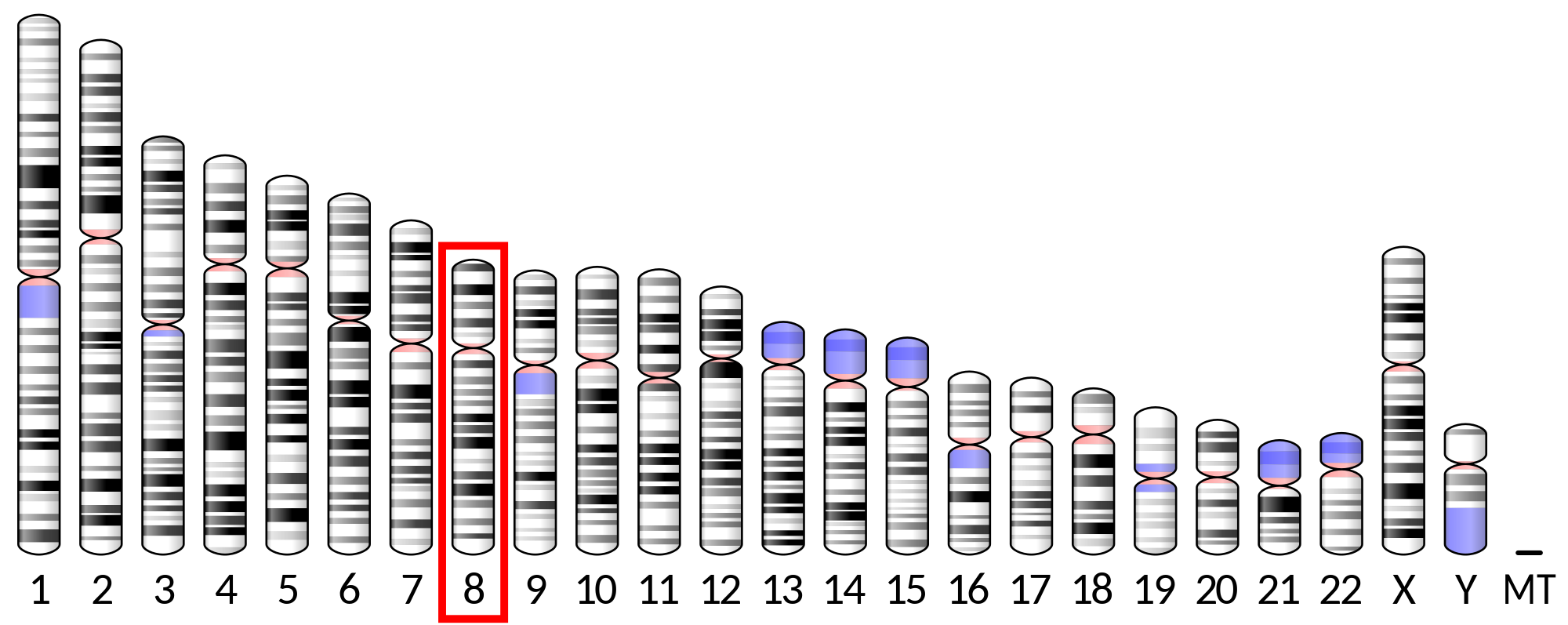
Kv7.3 (KvLQT3) is a potassium channel protein coded for by the gene KCNQ3.[5]
It is associated with benign familial neonatal epilepsy[6] and autism.[7][8]
The M channel is a slowly activating and deactivating potassium channel that plays a critical role in the regulation of neuronal excitability. The M channel is formed by the association of the protein encoded by this gene and one of two related proteins encoded by the KCNQ2 and KCNQ5 genes, both integral membrane proteins. M channel currents are inhibited by M1 muscarinic acetylcholine receptors and activated by retigabine, a novel anti-convulsant drug. Defects in this gene are a cause of benign familial neonatal convulsions type 2 (BFNC2), also known as epilepsy, benign neonatal type 2 (EBN2).[5]
Interactions
[edit]References
[edit]- ^ a b c GRCh38: Ensembl release 89: ENSG00000184156 – Ensembl, May 2017
- ^ a b c GRCm38: Ensembl release 89: ENSMUSG00000056258 – Ensembl, May 2017
- ^ "Human PubMed Reference:". National Center for Biotechnology Information, U.S. National Library of Medicine.
- ^ "Mouse PubMed Reference:". National Center for Biotechnology Information, U.S. National Library of Medicine.
- ^ a b "Entrez Gene: KCNQ3 potassium voltage-gated channel, KQT-like subfamily, member 3".
- ^ Nardello R, Mangano GD, Miceli F, Fontana A, Piro E, Salpietro V (December 2020). "Benign familial infantile epilepsy associated with KCNQ3 mutation: a rare occurrence or an underestimated event?". Epileptic Disorders. 22 (6): 807–810. doi:10.1684/epd.2020.1221. PMID 33337327.
- ^ Sands TT, Miceli F, Lesca G, Beck AE, Sadleir LG, Arrington DK, et al. (August 2019). "Autism and developmental disability caused by KCNQ3 gain-of-function variants". Annals of Neurology. 86 (2): 181–192. doi:10.1002/ana.25522. hdl:2078.1/224457. PMID 31177578.
- ^ Arredondo K, Myers C, Hansen-Kiss E, Mathew MT, Jayaraman V, Siemon A, et al. (May 2022). "Phenotypic Spectrum in a Family Sharing a Heterozygous KCNQ3 Variant". Journal of Child Neurology. 37 (6): 517–523. doi:10.1177/08830738221089741. PMID 35384780.
- ^ Yus-Nájera E, Muñoz A, Salvador N, Jensen BS, Rasmussen HB, Defelipe J, et al. (2003). "Localization of KCNQ5 in the normal and epileptic human temporal neocortex and hippocampal formation". Neuroscience. 120 (2): 353–364. doi:10.1016/S0306-4522(03)00321-X. PMID 12890507. S2CID 38381189.
Further reading
[edit]- Gutman GA, Chandy KG, Grissmer S, Lazdunski M, McKinnon D, Pardo LA, et al. (December 2005). "International Union of Pharmacology. LIII. Nomenclature and molecular relationships of voltage-gated potassium channels". Pharmacological Reviews. 57 (4): 473–508. doi:10.1124/pr.57.4.10. PMID 16382104. S2CID 219195192.
- Ryan SG, Wiznitzer M, Hollman C, Torres MC, Szekeresova M, Schneider S (May 1991). "Benign familial neonatal convulsions: evidence for clinical and genetic heterogeneity". Annals of Neurology. 29 (5): 469–473. doi:10.1002/ana.410290504. PMID 1859177. S2CID 25424485.
- Lewis TB, Leach RJ, Ward K, O'Connell P, Ryan SG (September 1993). "Genetic heterogeneity in benign familial neonatal convulsions: identification of a new locus on chromosome 8q". American Journal of Human Genetics. 53 (3): 670–675. PMC 1682419. PMID 8102508.
- Charlier C, Singh NA, Ryan SG, Lewis TB, Reus BE, Leach RJ, et al. (January 1998). "A pore mutation in a novel KQT-like potassium channel gene in an idiopathic epilepsy family". Nature Genetics. 18 (1): 53–55. doi:10.1038/ng0198-53. PMID 9425900. S2CID 10437379.
- Yang WP, Levesque PC, Little WA, Conder ML, Ramakrishnan P, Neubauer MG, et al. (July 1998). "Functional expression of two KvLQT1-related potassium channels responsible for an inherited idiopathic epilepsy". The Journal of Biological Chemistry. 273 (31): 19419–19423. doi:10.1074/jbc.273.31.19419. PMID 9677360.
- Wang HS, Pan Z, Shi W, Brown BS, Wymore RS, Cohen IS, et al. (December 1998). "KCNQ2 and KCNQ3 potassium channel subunits: molecular correlates of the M-channel". Science. 282 (5395): 1890–1893. Bibcode:1998Sci...282.1890W. doi:10.1126/science.282.5395.1890. PMID 9836639.
- Schroeder BC, Kubisch C, Stein V, Jentsch TJ (December 1998). "Moderate loss of function of cyclic-AMP-modulated KCNQ2/KCNQ3 K+ channels causes epilepsy". Nature. 396 (6712): 687–690. Bibcode:1998Natur.396..687S. doi:10.1038/25367. PMID 9872318. S2CID 4417442.
- Kubisch C, Schroeder BC, Friedrich T, Lütjohann B, El-Amraoui A, Marlin S, et al. (February 1999). "KCNQ4, a novel potassium channel expressed in sensory outer hair cells, is mutated in dominant deafness". Cell. 96 (3): 437–446. doi:10.1016/S0092-8674(00)80556-5. PMID 10025409.
- Selyanko AA, Hadley JK, Wood IC, Abogadie FC, Delmas P, Buckley NJ, et al. (September 1999). "Two types of K(+) channel subunit, Erg1 and KCNQ2/3, contribute to the M-like current in a mammalian neuronal cell". The Journal of Neuroscience. 19 (18): 7742–7756. doi:10.1523/JNEUROSCI.19-18-07742.1999. PMC 6782456. PMID 10479678.
- Shapiro MS, Roche JP, Kaftan EJ, Cruzblanca H, Mackie K, Hille B (March 2000). "Reconstitution of muscarinic modulation of the KCNQ2/KCNQ3 K(+) channels that underlie the neuronal M current". The Journal of Neuroscience. 20 (5): 1710–1721. doi:10.1523/JNEUROSCI.20-05-01710.2000. PMC 6772928. PMID 10684873.
- Rundfeldt C, Netzer R (March 2000). "The novel anticonvulsant retigabine activates M-currents in Chinese hamster ovary-cells tranfected with human KCNQ2/3 subunits". Neuroscience Letters. 282 (1–2): 73–76. doi:10.1016/S0304-3940(00)00866-1. PMID 10713399. S2CID 28431577.
- Selyanko AA, Hadley JK, Wood IC, Abogadie FC, Jentsch TJ, Brown DA (February 2000). "Inhibition of KCNQ1-4 potassium channels expressed in mammalian cells via M1 muscarinic acetylcholine receptors". The Journal of Physiology. 522 Pt 3 (Pt 3): 349–355. doi:10.1111/j.1469-7793.2000.t01-2-00349.x. PMC 2269765. PMID 10713961.
- Cooper EC, Aldape KD, Abosch A, Barbaro NM, Berger MS, Peacock WS, et al. (April 2000). "Colocalization and coassembly of two human brain M-type potassium channel subunits that are mutated in epilepsy". Proceedings of the National Academy of Sciences of the United States of America. 97 (9): 4914–4919. Bibcode:2000PNAS...97.4914C. doi:10.1073/pnas.090092797. PMC 18332. PMID 10781098.
- Schwake M, Pusch M, Kharkovets T, Jentsch TJ (May 2000). "Surface expression and single channel properties of KCNQ2/KCNQ3, M-type K+ channels involved in epilepsy". The Journal of Biological Chemistry. 275 (18): 13343–13348. doi:10.1074/jbc.275.18.13343. PMID 10788442.
- Hirose S, Zenri F, Akiyoshi H, Fukuma G, Iwata H, Inoue T, et al. (June 2000). "A novel mutation of KCNQ3 (c.925T→C) in a Japanese family with benign familial neonatal convulsions". Annals of Neurology. 47 (6): 822–826. doi:10.1002/1531-8249(200006)47:6<822::AID-ANA19>3.0.CO;2-X. PMID 10852552. S2CID 11096248.
- Main MJ, Cryan JE, Dupere JR, Cox B, Clare JJ, Burbidge SA (August 2000). "Modulation of KCNQ2/3 potassium channels by the novel anticonvulsant retigabine". Molecular Pharmacology. 58 (2): 253–262. doi:10.1124/mol.58.2.253. PMID 10908292. S2CID 11112809.
- Wickenden AD, Yu W, Zou A, Jegla T, Wagoner PK (September 2000). "Retigabine, a novel anti-convulsant, enhances activation of KCNQ2/Q3 potassium channels". Molecular Pharmacology. 58 (3): 591–600. doi:10.1124/mol.58.3.591. PMID 10953053.
- Tinel N, Diochot S, Lauritzen I, Barhanin J, Lazdunski M, Borsotto M (September 2000). "M-type KCNQ2-KCNQ3 potassium channels are modulated by the KCNE2 subunit". FEBS Letters. 480 (2–3): 137–141. Bibcode:2000FEBSL.480..137T. doi:10.1016/S0014-5793(00)01918-9. PMID 11034315. S2CID 8386123.
- Wickenden AD, Zou A, Wagoner PK, Jegla T (January 2001). "Characterization of KCNQ5/Q3 potassium channels expressed in mammalian cells". British Journal of Pharmacology. 132 (2): 381–384. doi:10.1038/sj.bjp.0703861. PMC 1572592. PMID 11159685.
- Yus-Najera E, Santana-Castro I, Villarroel A (August 2002). "The identification and characterization of a noncontinuous calmodulin-binding site in noninactivating voltage-dependent KCNQ potassium channels". The Journal of Biological Chemistry. 277 (32): 28545–28553. doi:10.1074/jbc.M204130200. PMID 12032157.
External links
[edit]- KCNQ3+Potassium+Channel at the U.S. National Library of Medicine Medical Subject Headings (MeSH)
This article incorporates text from the United States National Library of Medicine, which is in the public domain.
 | This membrane protein–related article is a stub. You can help Wikipedia by adding missing information. |