Hubbry Logo
KenyapithecusKenyapithecusMain
Open search
Kenyapithecus
Community hub
Kenyapithecus
logo
8 pages, 0 posts
0 subscribers
Be the first to start a discussion here.
Kenyapithecus
Kenyapithecus
from Wikipedia

Kenyapithecus
Temporal range:
14 Million years ago
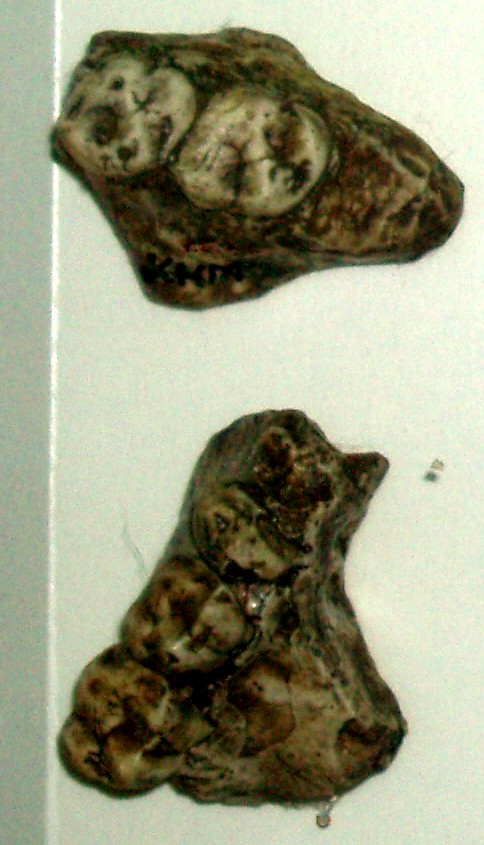
"Kenyapithecus wickeri" teeth
Kenyapithecus wickeri teeth
Scientific classification Edit this classification
Kingdom: Animalia
Phylum: Chordata
Class: Mammalia
Order: Primates
Family: Hominidae
Genus: Kenyapithecus
Leakey, 1961[1]
Species:
K. wickeri
Binomial name
Kenyapithecus wickeri
Leakey, 1961

Kenyapithecus wickeri is a fossil ape discovered by Louis Leakey in 1961 at a site called Fort Ternan in Kenya. The upper jaw and teeth were dated to 14 million years ago.[2] One theory states that Kenyapithecus may be the common ancestor of all the great apes. More recent investigations suggest Kenyapithecus is more primitive than that and is only slightly more modern than Proconsul, which is considered to be an ape.

Evidence suggests that Kenyapithecus wickeri was one of the species that started a radiation of apes out of Africa.

Morphology

[edit]

Impressed by Kenyapithecus's modern-looking teeth, Leakey declared Kenyapithecus to be "a very early ancestor of man himself."[3]

Kenyapithecus possessed craniodental adaptations for hard object feeding including thicker molar enamel, and a large mandible, large premolars and upper incisors that are similar to those seen in living pitheciine monkeys.[4] Kenyapithecus also possessed macaque-like limbs adapted for a knuckle-walking mode of semi-terrestrial locomotion.[5] This could show that as hominins evolved, they passed through a knuckle-walking phase.

Kenyapithecus wickeri has very distinct features, especially details in the canine teeth and is similar to modern apes.

See also

[edit]

References

[edit]
Revisions and contributorsEdit on WikipediaRead on Wikipedia
from Grokipedia
Kenyapithecus is an extinct of large-bodied hominoid that inhabited eastern during the Middle , approximately 14–16 million years ago. The currently includes a single recognized , K. wickeri, known primarily from fossil sites in , including Fort Ternan; material from Maboko Island, formerly classified as K. africanus, is now assigned to Equatorius africanus. It is represented by dental, cranial, and limited postcranial remains that reveal a adapted to arboreal life in woodland environments. Key physical features of Kenyapithecus include thick-enameled molars suited for grinding hard or tough plant materials, small and procumbent lower incisors, an arcuate dental arcade, and a short rostrum, indicating a diet emphasizing incisal preparation and molar processing. Limited postcranial remains suggest a body size comparable to modern large apes and locomotor behaviors dominated by pronograde quadrupedalism combined with orthograde climbing and clambering, without evidence of suspensory adaptations. These traits position Kenyapithecus as a predominantly arboreal species, more derived than earlier Miocene stem hominoids like Ekembo but retaining primitive features relative to later great apes. Phylogenetically, Kenyapithecus is regarded as an early member of the great ape and human clade (Homininae), having diverged after basal catarrhines like Proconsul but prior to the last common ancestor of extant great apes and humans. Its hominid-like dental and symphyseal features, such as a robust mandible with a massive inferior transverse torus in juveniles, have sparked debate on its affinities to Eurasian Miocene apes and its role in the radiation of early hominines. The genus provides critical evidence for the African origins of great ape evolution, highlighting adaptations that may have facilitated dispersal and diversification across continents during the Miocene.

Discovery and Naming

Initial Discovery

The initial discovery of Kenyapithecus took place in 1961 at the Fort Ternan locality in western , under the direction of paleoanthropologist Louis S. B. Leakey. During excavations on a farm owned by Fred Wicker, Leakey's team recovered the first fossils of the genus: fragments of a left upper jaw () preserving molars and premolars, along with isolated teeth. These remains, cataloged as KNM-FT 55 and associated specimens, represented the earliest known evidence of a large-bodied hominoid in the region at the time. The Fort Ternan site, situated in the region near the Kipsigis Escarpment, yielded these fossils from tuffaceous sandstones interbedded with volcanic layers, part of the broader sequence in the Western Rift Valley. Initial age estimates placed the deposits at approximately 14 million years ago, determined through potassium-argon (K-Ar) radiometric dating of sanidine crystals from overlying and underlying phonolitic tuffs, combined with biostratigraphic analysis of associated mammalian fauna such as Nyanzachoerus and proboscideans indicative of a middle age. In 1962, Leakey published a formal description of the material in the Annals and Magazine of Natural History, establishing the new genus and species Kenyapithecus wickeri. The generic name derives from "" and the Greek pithecus (), reflecting the discovery location, while the specific epithet honors Fred Wicker for alerting Leakey to the eroding fossils on his property. Leakey initially interpreted K. wickeri as a primitive hominid and potential early human ancestor, emphasizing resemblances in the robust dental structure—particularly the low-crowned molars with thick enamel and reduced canines—to those of later , positioning it as a key link in .

Subsequent Fossils

Following the initial discovery in 1961, excavations at Fort Ternan continued through the 1960s and into the 1970s, yielding additional teeth and fragments attributed to Kenyapithecus wickeri. These materials enhanced the hypodigms for the and supported ongoing taxonomic evaluations of Miocene catarrhines at the site. In 1982 and 1983, fieldwork on Maboko Island in , , recovered a substantial collection of higher teeth, increasing the total known Kenyapithecus fossils from the locality to 72 specimens. This expanded sample prompted a re-assessment of the genus's status, with morphological comparisons indicating closer affinities to Asian hominoids such as Sivapithecus and Ramapithecus rather than early hominids, and suggesting that K. wickeri and K. africanus may reflect within a single rather than distinct taxa. A juvenile mandible of K. africanus (specimen KNM-MB 20573), including a left lateral , , molars, and an unerupted second molar, was recovered from middle deposits (14–16 million years old) on Maboko Island and reported in 1993. This find provided novel cranial evidence, revealing features like a proclined symphyseal axis and thick-enameled molars adapted for incisal biting of tough foods. Collectively, these post-1961 recoveries from Fort Ternan and Maboko Island affirmed Kenyapithecus's distribution across multiple Kenyan sites during the middle , underscoring its role in early hominoid diversification in eastern .

Taxonomy and Classification

Recognized Species

The genus Kenyapithecus is generally recognized to include two species from middle deposits in , though the status of one remains debated. The , K. wickeri, is based on fossils recovered from the Fort Ternan locality, including an upper jaw fragment preserving molars and premolars, as well as isolated teeth. These specimens are characterized by large molars with thick enamel, indicative of adaptations for processing tough or hard foods, and relatively small incisors. The second species, K. africanus, was established from dental remains collected at multiple sites on Maboko Island in , with the hypodigm including a type and numerous isolated teeth. However, a 1999 proposed reclassifying material attributed to K. africanus (including from Maboko Island) into a new , Equatorius africanus, based on postcranial and dental differences suggesting a more primitive form; this reclassification is not universally accepted, and some recent studies (as of 2025) continue to recognize K. africanus as valid. Key additions to this species include a juvenile discovered in 1993, which exhibits mixed and permanent and confirms mandibular morphology. K. africanus is distinguished from K. wickeri by more robust chewing adaptations, such as broader premolars and slightly larger overall tooth size, suggesting a marginally bigger body size and potentially different dietary emphases. Early taxonomic debates considered synonymy between Kenyapithecus and the smaller ape genus Simiolus from the same Maboko assemblages, but distinctions have been upheld based on dental metrics, including smaller overall dimensions and less robust molar structure in Simiolus. The of K. wickeri, consisting of the Fort Ternan upper , is housed in the .

Phylogenetic Placement

Kenyapithecus is classified within the family , encompassing great apes and humans, primarily due to shared dental features such as thick enamel and robust molars indicative of adaptations for processing tough or hard foods, as well as cranial characteristics like a relatively large face and low forehead. Its subfamily placement remains debated, with some analyses assigning it to (the clade) based on similarities in jaw robusticity and cheek tooth morphology to Asian forms, while others position it in Dryopithecinae (a European ape group) due to primitive postcranial traits suggesting generalized . Upon its initial description in the early 1960s, proposed Kenyapithecus as a direct ancestor to hominins, interpreting its Fort Ternan fossils (dated to around 14 million years ago) as evidence of an early link between apes and humans based on the perceived hominid-like robusticity of the jaws and teeth. This view was later revised in the and , as additional fossils revealed it to be a primitive hominoid more closely aligned with the basal stock of great apes rather than a specialized hominin precursor, emphasizing its retention of Miocene ape-like features such as a sectorial canine and lack of advanced bipedal indicators. In comparisons to contemporaneous genera, Kenyapithecus differs from the more arboreal and generalized , which exhibits thinner enamel and smaller body size suited to suspensory locomotion in forested environments, whereas Kenyapithecus shows evidence of terrestrial adaptations through heavier build and specialized mastication for abrasive foods. It shares some dental resemblances with the Asian , an relative, particularly in molar structure, but lacks the latter's pronounced and is distinguished by a more primitive cranial profile, supporting its role as an African endemic rather than a direct migrant to . Post-1990s cladistic analyses, incorporating expanded fossil datasets and , have reinforced Kenyapithecus's position as a stem hominid, often clustering it with other early Miocene African apes like Griphopithecus to suggest an African origin for the broader hominoid radiation around 20-14 million years ago, prior to dispersals into . These studies highlight its basal placement outside crown subclades, with shared derived traits like enhanced occlusal relief linking it to the divergence of pongines and hominines.

Physical Characteristics

Cranial and Dental Features

Kenyapithecus exhibits a robust mandible characterized by a massive inferior transverse torus and a proclined symphyseal axis, features that support powerful chewing musculature adapted for processing resistant foods. The dental arcade is arcuate with a short rostrum, and the corpus displays significant buttressing for occlusal loading. The dentition features small incisors relative to the cheek teeth, with the lateral incisor being narrow (mesiodistal diameter ~5.6 mm), high-crowned (~13.4 mm), and strongly procumbent, indicating a reduced role in food preparation compared to grinding. Canines are prominent and sexually dimorphic, with males exhibiting tall, gracile crowns similar to those in extant apes, suggesting functions in display and social interactions. Premolars are large and robust, while molars are buccolingually expanded with thick enamel and crenulated occlusal surfaces suited for grinding hard objects like fruits and fibrous vegetation.

Postcranial Anatomy

Postcranial remains of Kenyapithecus are scarce, with the type species K. wickeri known primarily from a single distal (KNM-FT 2751) recovered from the Fort Ternan locality in , dated to approximately 14 million years ago. This fragment provides limited insights into the skeleton beyond the cranium and . The exhibits a combination of primitive and derived features, including a relatively monkey-like humeral head and a distal articular surface with a deep fossa and retroflexed medial , suggesting adaptations for pronograde . Body size estimates for K. wickeri are approximately 36 kg, derived from mandibular dimensions, positioning it as larger than early Miocene apes like Proconsul heseloni (approximately 11 kg) but smaller than extant great apes, which typically exceed 40 kg. These estimates indicate a medium-to-large bodied hominoid capable of supporting substantial weight during locomotion. The forelimbs show robust joint morphology, facilitating both arboreal climbing and terrestrial progression in a mixed environment. The absence of tail vertebrae in the known postcranial sample, consistent with broader hominoid morphology, reinforces Kenyapithecus' placement within the tailless , distinguishing it from cercopithecoid monkeys. Overall, these elements point to a locomotor blending arboreal and terrestrial elements, with robust joints enabling versatile movement across forested and open habitats.

Distribution and Paleoecology

Geological and Temporal Context

Kenyapithecus fossils are known exclusively from sites in , restricting their distribution to the eastern African rift system during the Middle Miocene. These occurrences date to the Langhian stage of the Middle Miocene, approximately 14 to 16 million years ago, as established by potassium-argon (K-Ar) and argon-argon (⁴⁰Ar/³⁹Ar) dating of volcanic tuffs and associated lavas at the primary localities of Fort Ternan, Maboko Island, and Nachola. The Fort Ternan site in southwestern lies within the Valley, where fossiliferous sedimentary deposits are interbedded between the Lower and Upper Phonolites. These sediments, dated to approximately 13.7 ± 0.3 Ma via ⁴⁰Ar/³⁹Ar analysis of and from bounding lavas, preserve Kenyapithecus wickeri alongside a diverse fauna that includes equids such as Anchitherium and proboscideans like , reflecting early depositional environments. At Maboko Island in the Nyanza Rift near , the fossils occur in the Maboko Formation, comprising lacustrine and fluvial sediments laid down in wet conditions. The site's age of approximately 15 Ma (with upper limits around 14.7 Ma) is supported by initial K-Ar of correlative mainland volcanics, recent radiometric refinement, and biostratigraphic alignment with other East African Miocene assemblages, such as those from Fort Ternan. Postcranial remains attributed to Kenyapithecus sp. have also been recovered from Nachola in northern , dated to approximately 15 Ma via and associated volcanics.

Habitat and Inferred Behavior

Kenyapithecus inhabited a mosaic environment at the Fort Ternan site in during the middle Miocene, characterized as a wooded or based on associated and faunal assemblages. from the site indicates significant grassy cover, with grass comprising over 50% of the assemblage, suggesting open areas interspersed with woodlands. The faunal community included equids such as Anchitherium and diverse bovids like Tragoportax sp., whose locomotor adaptations—intermediate between forest and open-country forms—support an ecotonal with wooded patches near water sources. This setting likely provided access to riparian forests amid expanding grasslands following volcanic activity around 15 Ma. Dietary inferences for Kenyapithecus derive primarily from dental morphology and enamel structure, indicating a mixed folivorous-frugivorous regime suited to the seasonal, relatively dry environment. Thick molar enamel, comparable to that in modern hard-object feeders, suggests consumption of tough fruits, seeds, and possibly mature leaves, with reduced reliance on incisors for food preparation. Although direct microwear analyses are limited, cusp morphology and enamel microstructure align with diets incorporating fibrous vegetation and seasonal fruits, distinguishing it from more specialized folivores. Claims of tool use remain unconfirmed due to lack of associated artifacts or unambiguous tool marks on fossils. Social behavior in Kenyapithecus is inferred from pronounced sexual dimorphism in canine size and body mass, resembling patterns in modern polygynous apes and suggesting group-living with intra-male competition for mates. Canine dimorphism exhibits a bimodal distribution, with males possessing larger, more robust canines likely used in agonistic displays or combat, indicative of multimale-multifemale social units. This structure parallels baboon-like groups, adapted to defend resources in a patchy woodland-savanna mosaic. During middle to late Miocene climate shifts toward drier conditions and grassland expansion in , Kenyapithecus may have exhibited local migration patterns, dispersing between sites like Fort Ternan, Maboko Island, and Nachola in response to . These movements likely tracked gallery forests along rift valleys amid and tectonic uplift, facilitating adaptation to variable resource availability. Such patterns align with broader hominoid dispersals influenced by ecological changes around 14 Ma.

Evolutionary Role

Relation to Early Hominoids

Kenyapithecus shares a basal dental plan with earlier hominoids like , including the Y-5 molar cusp pattern and bunodont occlusal morphology indicative of a frugivorous diet, but exhibits more derived features such as thicker molar enamel and a robust adapted for processing harder foods. The of Kenyapithecus is markedly robust, with a massive inferior transverse and proclined axis, contrasting with the relatively gracile structure in , while enamel thickness in Kenyapithecus incisors and molars exceeds that of , suggesting enhanced resistance to wear from abrasive items. These traits position Kenyapithecus as diverging after around 16-14 million years ago, representing an intermediate stage in early hominoid dental . In contrast to the Asian , which displays derived pongine cranial traits such as a short face, thick enamel, and large canines akin to orangutans, Kenyapithecus lacks these specialized features and instead shows a more generalized postcranial suited to arboreal without the suspensory emphases seen in some Sivapithecus elements. Postcranial differences include a Kenyapithecus with moderate humeral head globosity and trochlear morphology indicating pronograde locomotion, differing from Sivapithecus's more variable adaptations that blend climbing and potential . This underscores Kenyapithecus as an African stem hominoid, predating the pongine-hominine divergence and contributing to the Eurasian radiation of apes without direct pongine ancestry. Kenyapithecus played a pivotal role in post-African hominoid diversification during the Middle Miocene, with fossils indicating dispersal from Africa around 16-14 million years ago, seeding lineages leading to European dryopithecins and Asian pongines, though it has no known direct descendants. As a basal member of the great ape clade, dated to approximately 14–16 million years ago, it is contemporaneous with or slightly before the last common ancestor of Sivapithecus, extant great apes, and humans, featuring a mosaic of primitive and derived traits that highlight the early stages of great ape orthogrady and dietary shifts. Key differences from earlier Oligocene catarrhines like include substantially larger body size—Kenyapithecus estimated at around 30 kg compared to 's 5-7 kg—and locomotor adaptations shifting toward mixed arboreal with climbing elements, evidenced by a longer relative to and retroflexed process, versus 's more strictly pronograde, monkey-like .

Implications for Ape Evolution

Kenyapithecus provides compelling evidence for an origin of the , the clade encompassing great and humans, dating to the middle around 14–16 million years ago. Fossils from sites like Maboko Island in represent the earliest known members of this group, predating Eurasian hominoids such as Griphopithecus and challenging models that posited a primary radiation of great apes in around 14 Ma. Instead, these findings suggest that early hominids dispersed from to , giving rise to lineages like the dryopithecins in and pongines in , while maintaining diversity on the continent. Initial interpretations by in the 1960s positioned Kenyapithecus africanus as a direct to hominins, based on fragmentary remains from Fort Ternan suggesting affinities to both apes and early humans. However, subsequent discoveries, including a well-preserved juvenile from Maboko, have shifted the consensus toward viewing it as a primitive great ape precursor, diverging after earlier forms like but before the last common of extant great apes and humans. This reevaluation has influenced studies on origins by highlighting that early hominids lacked specialized locomotor traits, implying bipedality evolved later in amid environmental pressures rather than from a direct Kenyapithecus-like form. Kenyapithecus contributes to understanding climate-driven adaptations in early hominids, particularly the shift toward more terrestrial behaviors in response to expanding woodlands and seasonal around 16–14 Ma. Features like robust anterior for incisal biting, combined with thick enamel, indicate dietary flexibility suited to harder, less folivorous foods, paralleling broader hominoid responses to and . This context supports models of early great ape divergence, including the pongine () lineage, which likely arose from African emigrants adapting to Asian forests following initial terrestrial shifts in . Significant gaps remain in Kenyapithecus knowledge, particularly the scarcity of postcranial remains, which limits clarification of whether represents a shared derived trait among great apes or an independent adaptation. Recent studies (as of 2025) continue to debate its exact phylogenetic placement relative to contemporaneous genera like Nacholapithecus, emphasizing the need for more complete skeletons to resolve locomotor inferences and their implications for the last common ancestor of African apes and humans. Additional fossils are needed to resolve these questions.

References

Add your contribution
Related Hubs
User Avatar
No comments yet.