


Community hub
Recent from talks
Contribute something
Nothing was collected or created yet.
Tarsier
View on Wikipedia | This article may need to be rewritten to comply with Wikipedia's quality standards. (November 2024) |
| Tarsiers[1][2] Temporal range: Middle Eocene to recent
| |
|---|---|

| |
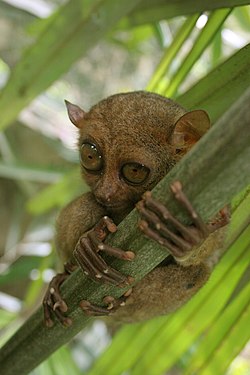
| Philippine tarsier (Carlito syrichta) | |
Scientific classification 
| |
| Kingdom: | Animalia |
| Phylum: | Chordata |
| Class: | Mammalia |
| Order: | Primates |
| Infraorder: | Tarsiiformes |
| Family: | Tarsiidae Gray, 1825 |
| Type genus | |
| Tarsius Storr, 1780
| |
| Genera | |

| |
| Range of all tarsier species | |
Tarsiers (/ˈtɑːrsiərz/ TAR-see-ərz) are haplorhine primates of the family Tarsiidae, which is the lone extant family within the infraorder Tarsiiformes. Although the group was prehistorically more globally widespread, all of the existing species are restricted to Maritime Southeast Asia, predominantly in Brunei, Indonesia, Malaysia and the Philippines.[3]
.jpg)
They are found primarily in forested habitats, especially forests that have liana, since the vine gives tarsiers vertical support when climbing trees.[4]
Evolutionary history
[edit]Fossil record
[edit]Fossils of tarsiiform primates have been found in Asia, Europe, and North America (with disputed fossils from Northern Africa), but extant tarsiers are restricted to several Southeast Asian islands. The fossil record indicates that their dentition has not changed much, except in size, over the past 45 million years.
Within the family Tarsiidae, there are two extinct genera—Xanthorhysis and Afrotarsius; however, the placement of Afrotarsius is not certain,[5] and it is sometimes listed in its own family, Afrotarsiidae, within the infraorder Tarsiiformes,[6] or considered a simian (anthropoid) primate.[7]
So far, four fossil species of tarsiers are known from the fossil record:
- Tarsius eocaenus is known from the Middle Eocene in China.[5][8]
- Hesperotarsius thailandicus lived during the Early Miocene in northwestern Thailand.[5][9]
- Hesperotarsius sindhensis lived during the Miocene in Pakistan.[10]
- Tarsius sirindhornae lived during the Middle Miocene in northern Thailand.[7]
The genus Tarsius has a longer fossil record than any other primate genus, but the assignment of the Eocene and Miocene fossils to the genus is dubious.[11]
Classification
[edit]The phylogenetic position of extant tarsiers within the order Primates has been debated for much of the 20th century, and tarsiers have alternately been classified with strepsirrhine primates in the suborder Prosimii, or as the sister group to the simians (Anthropoidea) in the infraorder Haplorhini. Analysis of SINE insertions, a type of macromutation to the DNA, is argued to offer very persuasive evidence for the monophyly of Haplorhini, where other lines of evidence, such as DNA sequence data, remain ambiguous. Thus, some systematists argue the debate is conclusively settled in favor of a monophyletic Haplorrhini. In common with simians, tarsiers have a mutation in the L-gulonolactone oxidase (GULO) gene, which prevents their bodies from synthesizing vitamin C so they must find it in the diet. Since the strepsirrhines do not have this mutation and have retained the ability to make vitamin C, the genetic trait that confers the need for it in the diet would tend to place tarsiers with haplorhines.[12]

At a lower phylogenetic level, the tarsiers have, until recently, all been placed in the genus Tarsius,[1] while it was debated whether the species should be placed in two (a Sulawesi and a Philippine-western group) or three separate genera (Sulawesi, Philippine and western groups).[13] Species level taxonomy is complex, with morphology often being of limited use compared to vocalizations.[citation needed] Further confusion existed over the validity of certain names. Among others, the widely used T. dianae has been shown to be a junior synonym of T. dentatus, and comparably, T. spectrum is now considered a junior synonym of T. tarsier.[1]
In 2010, Colin Groves and Myron Shekelle suggested splitting the genus Tarsius into three genera, the Philippine tarsiers (genus Carlito), the western tarsiers (genus Cephalopachus), and the eastern tarsiers (genus Tarsius). This was based on differences in dentition, eye size, limb and hand length, tail tufts, tail sitting pads, the number of mammae, chromosome count, socioecology, vocalizations, and distribution. The senior taxon of the species, T. tarsier was restricted to the population of a Selayar island, which then required the resurrection of the defunct taxon T. fuscus.[2]
In 2014, scientists published the results of a genetic study from across the range of the Philippine tarsier, revealing previously unrecognised genetic diversity. Three subspecies are recognised in the established taxonomy: Carlito syrichta syrichta from Leyte and Samar, C. syrichta fraterculus from Bohol, and C. syrichta carbonarius from Mindanao. Their analysis of mitochondrial and nuclear DNA sequences suggested that ssp. syrichta and fraterculus may represent a single lineage, whereas ssp. carbonarius may represent two lineages – one occupies the majority of Mindanao while the other is in northeastern Mindanao and the nearby Dinagat Island, which the authors termed the 'Dinagat-Caraga tarsier'. More detailed studies that integrate morphological data will be needed to review the taxonomy of tarsiers in the Philippines.[14]
- Infraorder Tarsiiformes
- Family Tarsiidae: tarsiers
- Genus Carlito
- Philippine tarsier, Carlito syrichta
- C. s. syrichta
- C. s. fraterculus (to be combined into C. s. syrichta?)
- C. s. carbonarius
- Philippine tarsier, Carlito syrichta
- Genus Cephalopachus
- Horsfield's tarsier, Cephalopachus bancanus
- C. b. bancanus
- C. b. natunensis
- C. b. boreanus
- C. b. saltator
- Horsfield's tarsier, Cephalopachus bancanus
- Genus Tarsius
- Dian's tarsier, T. dentatus
- Makassar tarsier T. fuscus
- Lariang tarsier, T. lariang
- Niemitz's tarsier, T. niemitzi
- Peleng tarsier, T. pelengensis
- Sangihe tarsier, T. sangirensis
- Gursky's spectral tarsier, T. spectrumgurskyae[15]
- Jatna's tarsier, T. supriatnai[15]
- Spectral tarsier, T. tarsier
- Siau Island tarsier, T. tumpara
- Pygmy tarsier, T. pumilus
- Wallace's tarsier, T. wallacei
- Genus Carlito
- Family Tarsiidae: tarsiers
Anatomy and physiology
[edit]
Tarsiers are small animals with enormous eyes; each eyeball is approximately 16 millimetres (0.63 in) in diameter and is as large as, or in some cases larger than, its entire brain.[16][17] The unique cranial anatomy of the tarsier results from the need to balance their large eyes and heavy head so they are able to wait silently for nutritious prey.[18] Tarsiers have a strong auditory sense, and their auditory cortex is distinct.[18] Tarsiers also have long hind limbs, owing mostly to the elongated tarsus bones of the feet, from which the animals get their name.[page needed] The combination of their elongated tarsi and fused tibiofibulae makes them morphologically specialized for vertical clinging and leaping.[19] The head and body range from 10 to 15 cm in length, but the hind limbs are about twice this long (including the feet), and they also have a slender tail from 20 to 25 cm long. Their fingers are also elongated, with the third finger being about the same length as the upper arm. Most of the digits have nails, but the second and third toes of the hind feet bear claws instead, which are used for grooming. Tarsiers have soft, velvety fur, which is generally buff, beige, or ochre in color.[20]
Tarsier morphology allows for them to move their heads 180 degrees in either direction, allowing for them to see 360 degrees around them.[21] Their dental formula is also unique: 2.1.3.31.1.3.3[22] Unlike many nocturnal vertebrates, tarsiers lack a light-reflecting layer (tapetum lucidum) of the retina and have a fovea.
The tarsier's brain is different from that of other primates in terms of the arrangement of the connections between the two eyes and the lateral geniculate nucleus, which is the main region of the thalamus that receives visual information. The sequence of cellular layers receiving information from the ipsilateral (same side of the head) and contralateral (opposite side of the head) eyes in the lateral geniculate nucleus distinguishes tarsiers from lemurs, lorises, and monkeys, which are all similar in this respect.[23] Some neuroscientists suggested that "this apparent difference distinguishes tarsiers from all other primates, reinforcing the view that they arose in an early, independent line of primate evolution."[24]
Philippine tarsiers are capable of hearing frequencies as high as 91 kHz. They are also capable of vocalizations with a dominant frequency of 70 kHz.[25]
Behavior
[edit]Pygmy tarsiers differ from other species in terms of their morphology, communication, and behavior.[27] The differences in morphology that distinguish pygmy tarsiers from other species are likely based on their high altitude environment.[28]
All tarsier species are nocturnal in their habits, but like many nocturnal organisms, some individuals may show more or less activity during the daytime. Based on the anatomy of all tarsiers, they are all adapted for leaping even though they all vary based on their species.[29][30][31][32]
Ecological variation is responsible for differences in morphology and behavior in tarsiers because different species become adapted to local conditions based on the level of altitude.[33] For example, the colder climate at higher elevations can influence cranial morphology.[34]
Tarsiers tend to be extremely shy animals and are sensitive to bright lights, loud noises, and physical contact. They have been reported to behave suicidally when stressed or kept in captivity.[35][36]
Predators
[edit]Due to their small size, tarsiers are prey to various other animals. Tarsiers primarily inhabit the lower vegetation layers as they face threats from both terrestrial predators such as cats, lizards, and snakes, and aerial predators such as owls and birds. By residing in these lower layers, they can minimize their chances of being preyed upon by staying off the ground and yet still low enough to avoid birds of prey.
Tarsiers, though known as being shy and reclusive, are known to mob predators. In nature, mobbing is the act of harassing predators to reduce the chance of being attacked. When predators are near, tarsiers will make a warning vocalization. Other tarsiers will respond to the call, and within a short period of time, 2-10 tarsiers will show up to mob the predator. The majority of the group consists of adult males, but there will occasionally be a female or two. While tarsier groups only contain one adult male, males from other territories will join in the mob event, meaning there are multiple alpha male tarsiers attacking the predator.[37][21][38]
Diet
[edit]Tarsiers are the only entirely carnivorous extant primates, albeit mainly insectivorous, catching invertebrates by jumping at them. The tarsiers also opportunistically prey on a variety of arboreal and small forest animals, including orthopterans, scarab beetles, small flying frogs, lizards and, occasionally, amphibious crabs that climb into the lower sections of trees.[39][40][41] However, it has been found that their favorite prey are arthropods, beetles, arachnids, cockroaches, grasshoppers, katydids, cicadas, and walking sticks.[21] Tarsiers are, rarely, also known to prey on baby birds, small tree snakes and even baby bats.[20]
Reproduction
[edit]Gestation takes about six months,[42] and tarsiers give birth to single offspring. Young tarsiers are born furred, and with open eyes, and are able to climb within a day of birth. They reach sexual maturity by the end of their second year. Sociality and mating system varies, with tarsiers from Sulawesi living in small family groups, while Philippine and western tarsiers are reported to sleep and forage alone.
Conservation
[edit]Tarsiers have never formed successful breeding colonies in captivity; this may be due in part to their special feeding requirements.[43][44][45][46][47]
A sanctuary near the town of Corella, on the Philippine island of Bohol, has had some success restoring tarsier populations.[48] The Philippines Tarsier Foundation has developed a large, semi-wild enclosure known as the Tarsier Research and Development Center. Carlito Pizarras, also known as the "Tarsier man", founded the sanctuary, where visitors can observe tarsiers in the wild. The trees in the sanctuary are populated with nocturnal insects that make up the tarsier's diet.[49]
The first quantitative study on the activity patterns of captive Philippine tarsiers (Tarsius syrichta) was conducted at the Subayon Conservation Centre for the Philippine Tarsier in Bilar, Bohol. From December 2014 to January 2016, female and male T. syrichta were observed based on their time apportioned to normal activities during non-mating versus mating seasons. During the non-mating season, a significant amount of their waking hours were spent scanning prior to resting, foraging, and traveling. Feeding, scent-marking, self-grooming, social activities, and other activities were minimal. Scanning was still a common activity among the paired sexes during mating season. However, resting markedly decreased, while increases in travel and foraging were evident.[50]
The 2008-described Siau Island tarsier in Indonesia is regarded as critically endangered and was listed among The World's 25 Most Endangered Primates by Conservation International and the IUCN/SCC Primate Specialist Group in 2008.[51] The Malaysian government protects tarsiers by listing them in the Totally Protected Animals of Sarawak, on the island of Borneo, where they are commonly found.[52]
References
[edit]- ^ a b c Groves, C. P. (2005). Wilson, D. E.; Reeder, D. M. (eds.). Mammal Species of the World: A Taxonomic and Geographic Reference (3rd ed.). Baltimore: Johns Hopkins University Press. pp. 127–128. ISBN 0-801-88221-4. OCLC 62265494.
- ^ a b Groves, C.; Shekelle, M. (2010). "The Genera and Species of Tarsiidae". International Journal of Primatology. 31 (6): 1071–1082. doi:10.1007/s10764-010-9443-1. S2CID 21220811.
- ^ The Editors of Encyclopædia Britannica. "Tarsier." Encyclopædia Britannica, Encyclopædia Britannica, Inc., 14 April 2019, http://www.britannica.com/animal/tarsier.
- ^ Simeon, S.G.F.; Duya, M.R.M; Duya, M.V.; Galindon, J.M.M.; Pasion, B.O.; Ong, P.S. (2020). "Living in small spaces: Forest fragment characterization and its use by Philippine tarsiers (Tarsius syrichta Linnaeus, 1758) in Mindanao Island, Philippines". Primates. 61 (3): 529–542. doi:10.1007/s10329-020-00798-2. PMID 32043166. S2CID 211075031.
- ^ a b c Gunnell, G.; Rose, K. (2002). "Tarsiiformes: Evolutionary History and Adaptation". In Hartwig, W.C. (ed.). The Primate Fossil Record. Cambridge University Press. ISBN 978-0-521-66315-1.
- ^ McKenna, M.C., and Bell, S.K. 1997. Classification of Mammals Above the Species Level. Columbia University Press, New York, 337–340 pp. ISBN 0-231-11013-8
- ^ a b Chiamanee, Y., Lebrun, R., Yamee, C., and Jaeger, J.-J. (2010). "A new Middle Miocene tarsier from Thailand and the reconstruction of its orbital morphology using a geometric–morphometric method". Proceedings of the Royal Society B: Biological Sciences. 278 (1714): 1956–1963. doi:10.1098/rspb.2010.2062. PMC 3107645. PMID 21123264.
{{cite journal}}: CS1 maint: multiple names: authors list (link) - ^ Rossie, J.B.; Ni, X.; Beard, K.C. (2006). "Cranial remains of an Eocene tarsier" (PDF). PNAS. 103 (12): 4381–4385. doi:10.1073/pnas.0509424103. PMC 1450180. PMID 16537385.
- ^ Nowak, R.M. (1999). Walker's Mammals of the World (6th ed.). Johns Hopkins University Press. pp. 94–97. ISBN 978-0-8018-5789-8.
- ^ Zijlstra, Jelle S.; Flynn, Lawrence J.; Wessels, Wilma (2013). "The westernmost tarsier: A new genus and species from the Miocene of Pakistan". Journal of Human Evolution. 65 (5): 544–550. Bibcode:2013JHumE..65..544Z. doi:10.1016/j.jhevol.2013.06.015. PMID 23928350.
- ^ Simons, E.L. (2003). "The Fossil Record of Tarsier Evolution". In Wright, P.C.; Simons, E.L.; Gursky, S. (eds.). Tarsiers: past, present, and future. Rutgers University Press. ISBN 978-0-8135-3236-3.
- ^ Pollock, J. I. & Mullin, R. J. (1986). "Vitamin C biosynthesis in prosimians: Evidence for the anthropoid affinity of Tarsius". American Journal of Physical Anthropology. 73 (1): 65–70. doi:10.1002/ajpa.1330730106. PMID 3113259. Archived from the original on 28 June 2012. Retrieved 16 March 2010.
- ^ Brandon-Jones, D.; et al. (2004). "Asian primate classification". International Journal of Primatology. 25 (1): 97–164. doi:10.1023/B:IJOP.0000014647.18720.32. S2CID 29045930.
- ^ Brown, Rafe M.; Weghorst, Jennifer A.; Olson, Karen V.; Duya, Mariano R. M.; Barley, Anthony J.; Duya, Melizar V.; Shekelle, Myron; Neri-Arboleda, Irene; Esselstyn, Jacob A.; Dominy, Nathaniel J.; Ong, Perry S.; Moritz, Gillian L.; Luczon, Adrian; Diesmos, Mae Lowe L.; Diesmos, Arvin C. (19 August 2014). "Conservation Genetics of the Philippine Tarsier: Cryptic Genetic Variation Restructures Conservation Priorities for an Island Archipelago Primate". PLOS ONE. 9 (8) e104340. Bibcode:2014PLoSO...9j4340B. doi:10.1371/journal.pone.0104340. ISSN 1932-6203. PMC 4138104. PMID 25136854.
- ^ a b Shekelle, Myron; Groves, Colin P; Maryanto, Ibnu; Mittermeier, Russell A (May 2017). "Two New Tarsier Species (Tarsiidae, Primates) and the Biogeography of Sulawesi, Indonesia". Primate Conservation. 31 (1): 1–9.
- ^ Soluri, K. Elizabeth; Sabrina C. Agarwal (2016). The Laboratory Manual and Workbook for Biological Anthropology. W.W. Norton. ISBN 978-0-393-91291-3.
- ^ Shumaker, Robert W.; Benjamin B. Beck (2003). Primates in Question. Smithsonian Books. ISBN 978-1-58834-151-8.
- ^ a b Shekelle, Myron; Gursky (2010). "Why tarsiers? Why now? An introduction to the special edition on tarsiers". International Journal of Primatology. 31 (6): 937–940. doi:10.1007/s10764-010-9459-6. S2CID 326565.
- ^ Rasmussen, D. T.; Conroy, G. C.; Simons, E. L. (1998). "Tarsier-like locomotor specializations in the Oligocene primate Afrotarsius". Proceedings of the National Academy of Sciences of the United States of America. 95 (25): 14848–14850. Bibcode:1998PNAS...9514848T. doi:10.1073/pnas.95.25.14848. PMC 24538. PMID 9843978.
- ^ a b Niemitz, Carsten (1984). Macdonald, D. (ed.). The Encyclopedia of Mammals. New York: Facts on File. pp. 338–339. ISBN 978-0-87196-871-5.
- ^ a b c Gron KJ. 2010 December 1. Primate Factsheets: Tarsier (Tarsius) Taxonomy, Morphology, & Ecology . http://pin.primate.wisc.edu/factsheets/entry/tarsier . Retrieved 12 November 2019.
- ^ Simons, Elwyn L.; Wright, Patricia C.; Gursky, Sharon (2003). Tarsiers: Past, Present, and Future. Rutgers University Press. p. 65. ISBN 0-8135-3236-1.
- ^ Rosa, M. G.; Pettigrew J. D.; Cooper H. M. (1996). "Unusual pattern of retinogeniculate projections in the controversial primate Tarsius". Brain, Behavior and Evolution. 48 (3): 121–129. doi:10.1159/000113191. PMID 8872317.
- ^ Collins, C. E.; Hendrickson, A.; Kaas, J. H. (2005). "Overview of the visual system of tarsius". The Anatomical Record Part A: Discoveries in Molecular, Cellular, and Evolutionary Biology. 287 (1): 1013–1025. doi:10.1002/ar.a.20263. PMID 16200648. S2CID 21448186.
- ^ Ramsier, Marissa A.; Cunningham A.J.; Moritz G.L.; Finneran J.J.; Williams C.V.; Ong P.S.; Gursky-Doyen S.L.; Dominy N.J. (2012). "Primate communication in the pure ultrasound". Biology Letters. 8 (4): 508–11. doi:10.1098/rsbl.2011.1149. PMC 3391437. PMID 22319094.
- ^ Friderun Ankel-Simons (27 July 2010). Primate Anatomy: An Introduction. Academic Press. pp. 442, 521. ISBN 978-0-08-046911-9.
- ^ Grow, Nanda; Gursky-Doyen, Sharon (2010). "Preliminary Data On The Behavior, Ecology, And Morphology Of Pygmy Tarsiers ( Tarsius Pumilus)". International Journal of Primatology. 31 (6): 1174–1191. doi:10.1007/s10764-010-9456-9. S2CID 23939646.
- ^ Musser, G. G.; Dagosto, M. (1987). "The identity of Tarsius pumilus, a pygmy species endemic to the montane mossy forests of Central Sulawesi". American Museum Novitates (2867): 1–53.
- ^ Dagosto, M.; Gebo, D. L.; Dolino, C. (2001). "Positional behavior and social organization of the Philippine tarsier (Tarsius syrichta)". Primates. 42 (3): 233–243. doi:10.1007/bf02629639. S2CID 41499839.
- ^ Niemitz, C (1977). "Zur funktionsmorphologie und biometrie der gattung Tarsius, Storr, 1780". Courier Forschungsinstitut Senckenberg. 25: 1–161.
- ^ Niemitz, C. (1979). Relationships among anatomy, ecology, and behavior: A model developed in the genus Tarsius, with thoughts about phylogenetic mechanisms and adaptive interactions. In S. 1190 N. Grow, S. Gursky-DoyenMorbeck, H. Preuschoft, & N. Gomberg (Eds.), Environment, behavior, and morphology: Dynamic interactions (pp. 119–138). New York: Gustav Fischer.
- ^ Niemitz, C. (1984). An investigation and review of the territorial behaviour and social organization of the genus Tarsius. In C. Niemitz (Ed.), Biology of tarsiers (pp. 117–128). New York: Gustav Fischer
- ^ Körner, C (2007). "The use of 'altitude' in ecological research". Trends in Ecology and Evolution. 22 (11): 569–574. Bibcode:2007TEcoE..22..569K. doi:10.1016/j.tree.2007.09.006. PMID 17988759.
- ^ Rae, T. C.; Hill, R. I.; Hamada, Y.; Koppe, T. (2003). "Clinal variation of maxillary sinus volume in Japanese macaques (Macaca fuscata)". American Journal of Primatology. 59 (4): 153–158. doi:10.1002/ajp.10072. PMID 12682923. S2CID 12290499.
- ^ Jarosz, Andy (20 May 2019). "The Philippines: The Tarsier Man". National Geographic. Archived from the original on 21 May 2019. Retrieved 28 September 2019.
- ^ Sinclair, Joe (12 December 2011). "Tourism threatens tiny Philippine primate". My SinChew. AFP. Archived from the original on 28 September 2019. Retrieved 28 September 2019.
- ^ Řeháková-Petrů, M.; Peške, L. (2012). "Predation on a wild Philippine tarsier (Tarsius syrichta)". Acta Ethologica. 15 (2): 217–220. doi:10.1007/s10211-011-0096-7. S2CID 254163428.
- ^ Gursky, Sharon (February 2005). ""Predator Mobbing in Tarsius Spectrum"". International Journal of Primatology. 26 (1): 207–221. doi:10.1007/s10764-005-0731-0. S2CID 21188050.
- ^ Crompton, Robin Huw; Blanchard, Mary L.; Coward, Sam; Alexander, R. McNeill; Thorpe, Susannah K. (1 December 2010). "Vertical Clinging and Leaping Revisited: Locomotion and Habitat Use in the Western Tarsier, Tarsius bancanus Explored Via Loglinear Modeling". International Journal of Primatology. 31 (6): 958–979. doi:10.1007/s10764-010-9420-8. ISSN 1573-8604. S2CID 45884124.
- ^ Crompton, Robin Huw; Savage, Russell; Spears, Iain R. (14 February 1998). "The Mechanics of Food Reduction in Tarsius bancanus". Folia Primatologica. 69 (7): 41–59. doi:10.1159/000052698. ISSN 1421-9980. PMID 9595687. S2CID 24464173.
- ^ Syahrullah, Fakhri Naufal; Maddus, Un; Mustari, Abdul Haris; Gursky, Sharon; Indrawan, Mochamad (15 July 2023). "Distribution and abundance of Peleng Tarsier (Tarsius pelengensis) in Banggai Island group, Indonesia". Scientific Reports. 13 (1): 11445. Bibcode:2023NatSR..1311445S. doi:10.1038/s41598-023-30049-5. ISSN 2045-2322. PMC 10349819. PMID 37454197.
- ^ Izard, Kay M.; Wright, Simons (1985). "Gestation length in Tarsius bancanus". Am J Primatol. 9 (4): 327–331. doi:10.1002/ajp.1350090408. PMID 31979510. S2CID 83711759.
- ^ Roberts, M.; Kohn, F. (1993). "Habitat Use, Foraging Behavior, and Activity Patterns in Reproducing Western Tarsiers, Tarsius bancanus, in Captivity: A Management Synthesis" (PDF). Zoo Biology. 12 (2): 217–232. doi:10.1002/zoo.1430120207. Archived from the original (PDF) on 12 March 2012. Retrieved 19 November 2010.
- ^ Shekelle, M.; Nietsch, A. (2008). Shekelle, M.; Maryano, T.; Groves, C.; Schulze, H.; Fitch-Snyder, H. (eds.). Tarsier Longevity: Data from a Recapture in the Wild and from Captive Animals (PDF). LIPI Press. pp. 85–89. ISBN 978-979-799-263-7. Archived from the original (PDF) on 28 July 2011.
- ^ Severn, K.; Dahang, D.; Shekelle, M. (2008). Shekelle, M.; Maryano, T.; Groves, C.; Schulze, H.; Fitch-Snyder, H. (eds.). Eastern Tarsiers in Captivity, Part I: Enclosure and Enrichment (PDF). LIPI Press. pp. 91–96. ISBN 978-979-799-263-7. Archived from the original (PDF) on 24 July 2011.
- ^ Severn, K.; Dahang, D.; Shekelle, M. (2008). Shekelle, M.; Maryano, T.; Groves, C.; Schulze, H.; Fitch-Snyder, H. (eds.). Eastern Tarsiers in Captivity, Part II: A Preliminary Assessment of Diet (PDF). LIPI Press. pp. 97–103. ISBN 978-979-799-263-7. Archived from the original (PDF) on 28 July 2011.
- ^ Fitch-Snyder, H. (2003). "History of Captive Conservation of Tarsiers". In Wright, P.C.; Simons, E.L.; Gursky, S. (eds.). Tarsiers: Past, Present, and Future. Rutgers University Press. pp. 227–295. ISBN 978-0-8135-3236-3.
- ^ "StephenMBland". Retrieved 18 October 2016.
- ^ Jachowski, David S.; Pizzaras, Carlito (2005). "Introducing an innovative semi-captive environment for the Philippine tarsier (Tarsius syrichta)". Zoo Biology. 24 (1): 101–109. doi:10.1002/zoo.20023.
- ^ Wojciechowski, Filip J.; Kaszycka, K.A.; Wielbass, A.M.; Řeháková, M. (2019). "Activity Patterns of Captive Philippine Tarsiers (Tarsius Syrichta): Differences Related to Sex and Social Context". Folia Primatologica. 90 (2): 109–23. doi:10.1159/000495612. PMID 30826810. S2CID 73491766.
- ^ Shekelle, Myron; Salim, Agus. "Siau Island Tarsier". IUCN/SSC Primate Specialist Group. Archived from the original on 6 September 2010. Retrieved 1 January 2010.
- ^ "Totally Protected Animals of Sarawak". Forestry Department of Sarawak. Retrieved 1 January 2010.[permanent dead link]
External links
[edit]


- Tarsier.org Archived 16 January 2022 at the Wayback Machine, an international research and conservation project
- Tarsiers (Tarsiidae) at the Wayback Machine (archived 15 October 2004), Singapore Zoological Gardens Docents, 2000
- Gron, Kurt J. (July 2008). "Primate Factsheets: Tarsier (Tarsius) Taxonomy, Morphology, & Ecology". National Primate Research Center, University of Wisconsin–Madison.
- Tarsiers – Visiting the two Tarsier sanctuaries in Bohol, Philippines
- Tarsier skeleton Archived 18 August 2017 at the Wayback Machine – Skeleton from the University of Texas at Austin


| International | |
|---|---|
| National | |
| Other | |
