Hubbry Logo
BurnousBurnousMain
Open search
Burnous
Community hub
Burnous
logo
8 pages, 0 posts
0 subscribers
Be the first to start a discussion here.
Burnous
Burnous
from Wikipedia
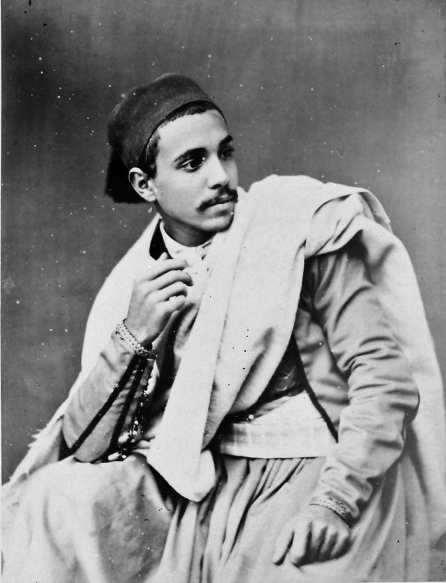
Urban Algerian man wearing a white/beige burnous, 19th century

A burnous (Arabic: برنوس, romanizedburnūs), also burnoose, burnouse, bournous or barnous, is a long cloak of coarse woollen fabric with a pointed hood, often white, traditionally worn by Arab and Berber men in North Africa.[1] Historically, the white burnous was worn during important events by men of high positions. Today, men of different social standing may wear it for ceremonial occasions, such as weddings or on religious and national holidays.[2][3][4]

Origin

[edit]

The word burnous (Arabic: برنوس) is an Arabic word for a "long, loose hooded cloak worn by Arabs", which itself is derived from the Greek word "birros".[5] The word is found in a hadith by Muhammad that prohibited the burnous and various other clothing during Hajj. In Mashriqi sources, it denotes a long hood or body garment.[6] The burnous was also present in the early Muslim Arabian Peninsula.[7] Various nineteenth century sources have referred to the burnous as an Arab cloak.[8][9][10]

In antiquity this garment was referred to as byruss Numidicus meaning "Numidian hooded cloak" and was mentioned as such in the Expositio totius mundi et gentium.[11] In the Maghreb, the colour of the burnous may be white, beige, or dark brown. There are rock engravings near Sigus that attest the existence of the burnous in the ancient times and that it was worn by the Numidians and inhabitants of the Arabian Desert.[12][13]

Cultural significance

[edit]

In Algeria

[edit]
Arab man wearing a burnous and an Arab woman in indoor clothes, in the Regency of Algiers.
Algerian military leader Abd el-Kader wearing a burnous in 1853
Algerian Spahis of the French army wearing the burnous as part of their uniform, 1886

During the French colonial period in Algeria (1830–1962), the burnous became a symbol of identity for Algerians. Many Algerians, including those who were not nomadic, began wearing the burnous as a way to assert their cultural heritage and resist French influence.

The burnous was also worn during the Algerian War of Independence (1954–1962), both as a symbol of resistance and as a practical garment for guerrilla fighters operating in the mountains and deserts.[14]

Today, the burnous remains an important symbol of Algerian culture and identity. It is often worn on special occasions, such as weddings and religious festivals, and is sometimes used as a costume in traditional dance performances.[15][16] It also forms part of the ceremonial uniform worn by the mounted cavalry detachment of the Algerian Republican Guard.

Burnous in other cultures

[edit]

The burnous became a distinctive part of the uniform of the French Army of Africa's spahi cavalry, recruited in Algeria, Morocco, and Tunisia.[17] It was also sometimes worn unofficially by officers or soldiers of other units in North Africa. The white burnous remains part of the parade uniform of the one remaining spahi regiment of the French Army: the 1st Spahi Regiment.[18]

Other names for a burnous include albornoz, sbernia, sberna, and bernusso.

See also

[edit]

References

[edit]
[edit]
Revisions and contributorsEdit on WikipediaRead on Wikipedia
from Grokipedia
The burnous, also spelled burnoose, bournous, or barnous, is a traditional hooded worn by men in , particularly in , , and . Crafted from coarse woollen fabric, it typically features a pointed hood and is often white, providing insulation against desert cold and sun protection during the day. Originating among Berber populations, the garment reflects practical adaptations to the Maghreb's harsh climate and has been adopted across Arab cultures in the region. Historically, the burnous served both utilitarian and symbolic roles, with plain white versions for and decorated variants denoting status or ceremonial occasions. Its design, including embroidery and tassels in finer examples, underscores enduring Berber and artisanal traditions amid nomadic and sedentary lifestyles in . While modernization has reduced its daily prevalence, the burnous remains a cultural emblem in , festivals, and as a marker of regional identity.

Etymology and Terminology

Linguistic Origins

The term burnous entered European languages in the late , with its earliest recorded English use in 1695 in a by Peter Anthony Motteux describing a hooded . It derives directly from French burnous, which was borrowed from burnus (بُرْنُس), the standard term in North African dialects for a long, hooded woolen mantle worn by and . The burnus itself traces to earlier Mediterranean linguistic layers, likely via intermediaries such as bōrs or Classical Syriac burnōnā, before reaching Byzantine Greek bírrhos (βίρρος), denoting a coarse hooded . This Greek form stems from birrus, referring to a thick, hooded garment possibly of Celtic or Germanic origin, worn by shepherds and travelers in ancient and for protection against rain. The path reflects historical trade and cultural exchanges across the , Byzantine East, and Islamic , where the term adapted to describe a similar functional garment. No evidence links the word to indigenous , despite the garment's deep roots in Berber attire; the designation predominates in regional nomenclature.

Regional Variations in Naming

The term burnous, derived from burnūs (برنوس), is widely used across the for the hooded woolen , but regional linguistic preferences introduce variations, particularly influenced by Berber (Amazigh) languages and local dialects. In , Berber communities in regions like the Sirwa often designate the garment as akhnif, an early form of hooded semicircular cloak woven by women for protection against harsh climates, while selham serves as another common Moroccan designation for the full-length version, occasionally overlapping with burnus in Arabic-influenced or urban settings. In , the name burnous predominates, especially among Arab and Berber populations, reflecting its Berber origins adapted through , though similar hooded garments may be called qashabiya in some contexts to denote winter variants with distinct woolen construction. In , burnus remains standard, but northern regions employ kachabiya for white-and-brown hooded cloaks akin to the burnous, highlighting subtle material or color-based distinctions in local nomenclature. These naming differences underscore the garment's pre-Islamic Berber roots, with burnūs overlaying indigenous terms like akhnif without fully supplanting them in rural or Berber-dominant areas, as evidenced by historical analyses. European adaptations, such as Spanish albornoz (from al-burnus), emerged during medieval interactions but do not reflect indigenous North African usage.

Physical Description

Materials and Construction

The burnous is primarily constructed from coarse en fabric, handwoven using fibers from sheep, goats, or camels to provide warmth and durability in the variable climates of the region. Sheep forms the base material for most traditional examples, while adds resilience and a natural insulation against cold nights and winds. This is tightly woven to create a heavy, protective layer, often undyed or in natural brown, black, or white hues derived from the raw fibers. In terms of construction, the burnous takes the form of a sleeveless, hooded cape or mantle, typically measuring around 2 to 3 meters in length to allow full-body coverage when draped. The body is fashioned from a large rectangular or semi-elliptical panel of fabric, folded over the shoulders and secured at the neck with a clasp, brooch, or simply by the weight of the material, enabling the arms to move freely through side openings or slits. A pointed hood, sewn or integrated at the nape, extends to shield the head and face from sun and sand. Artisanal weaving techniques, often performed on vertical looms by Berber women, ensure the fabric's uniformity and strength, with occasional decorative fringes or embroidery along the edges for regional distinction. Variations in construction reflect local adaptations; rural versions emphasize thicker, coarser weaves for nomads, while urban or ceremonial burnous may incorporate finer blends or linings for comfort. The garment's simplicity facilitates home production, with raw cleaned, carded, spun into , and loomed without complex tailoring, prioritizing functionality over ornamentation in its traditional form.

Design Features and Variations

The burnous consists of a long, sleeveless constructed from a single rectangular piece of coarse fabric, featuring a distinctive pointed hood that provides protection from sun and . It is typically draped over one or both and secured with a clasp or belt, allowing for versatile wear including over other garments. Materials vary by purpose and region, with everyday versions often in undyed gray or brown for durability and warmth in arid climates, while ceremonial ones favor white or cream hues for symbolic purity and status display. Festive burnous incorporate decorations such as , tassels, and woven patterns, enhancing aesthetic appeal during cultural events. Regional variations reflect local adaptations across the : in and , the burnous emphasizes the hooded, sleeveless form as a staple for men, distinguishing it from the sleeved jellaba prevalent in . Moroccan examples may feature finer wool or integrated with urban attire, while Libyan and Tunisian styles align closely with Algerian designs in hood shape and draping. No pronounced design differences exist between Berber and iterations, as both groups adopted the garment for its practical utility in nomadic and sedentary lifestyles. Thickness and fabric coarseness adjust to environmental needs, with heavier weaves for colder highlands and lighter for coastal areas.

Historical Development

Pre-Islamic and Berber Origins

The burnous originated among the indigenous Berber (Amazigh) peoples of , who have occupied the region since at least the period, with evidence of settled communities dating back over 10,000 years BCE. As nomadic pastoralists adapted to arid and semi-arid environments, they developed practical outer garments from locally available and to protect against extreme temperatures, sandstorms, and radiation; the burnous's loose, draped form with an attached hood exemplifies this environmental adaptation, predating external influences. Archaeological sources, including from the Capsian culture (circa 8000–6000 BCE) and later sites (3rd–2nd centuries BCE), depict Berber figures in mantles and hooded cloaks resembling the burnous, often worn over tunics for mobility during herding or warfare. Funerary monuments and stelae from ancient , such as those at Chemtou and Dougga, illustrate draped overgarments on elites and commoners, confirming the garment's widespread use among proto-Berber groups like the and tribes prior to Roman conquest in 46 BCE. These representations highlight the burnous's evolution from simple animal hides to woven wool variants, prioritizing durability over ornamentation in pre-urban societies. Pre-Islamic Berber society, characterized by tribal confederations and resistance to Phoenician and Roman incursions, integrated the burnous into daily and ceremonial life, with variations in color and weave denoting clan affiliations or regional resources—white for highland sheep , darker tones from Saharan hair. Unlike later Islamic-era elaborations, early forms lacked extensive embroidery, emphasizing utility; Greek and Roman chroniclers, such as (circa 64 BCE–24 CE), noted similar "Libyan" cloaks among Berber horsemen, underscoring continuity from Punic-era contacts (circa 800 BCE) without fundamental design shifts. This indigenous foundation persisted despite partial , as Berber highland communities retained until the Vandal invasions of the CE.

Arab and Islamic Influences

The Arab conquests of the Maghreb, initiated in 647 CE under the Rashidun Caliphate and consolidated by Umayyad forces by 709 CE, marked a pivotal phase in the burnous's historical trajectory. Arab military expeditions into Ifriqiya and beyond exposed conquerors to the indigenous Berber hooded cloak, which they adopted for its practicality in desert warfare and nomadic mobility. This integration is reflected in the Arabic term "burnūs," derived from the Latin "birrus" denoting a hooded garment, entering Islamic lexicon during early expansions. By the Abbasid era (750–1258 CE), historical accounts document the burnous as a widespread outer garment in urban centers like , worn by both men and women, indicating its dissemination from North African peripheries to the Islamic heartlands. In the , Arab settlers and Islamized refined the burnous using local , aligning it with Islamic prescriptions for modest, loose-fitting attire that facilitated ritual prayer and shielded against environmental harshness. Unlike the open-fronted 'abā' of Arabian origins, the burnous's enclosed hood and mantle emphasized regional adaptation under Islamic rule. Islamic cultural synthesis further elevated the burnous's status, as it conformed to sharīʿa guidelines on aurah coverage for men, promoting its use among Muslim elites and commoners alike. Medieval texts, such as those by al-Asfahani, describe variants like the burnus cap among Abbasid women, underscoring the garment's versatility and enduring appeal in pious, everyday contexts across Arab-influenced domains.

Ottoman and Pre-Colonial Era

During the Ottoman era in , from the establishment of the in 1516 to its conquest by in 1830, the burnous remained a core element of male attire among Arab and Berber populations in the , particularly in and . While Ottoman governors and Turkish-origin elites adopted imperial garments such as kaftans and entaris, indigenous communities favored the burnous for its practicality in the region's arid climate, serving as a hooded cloak that provided protection against sun, wind, and cold. Local deys and beys, though nominally loyal to the , often integrated the burnous into their wardrobes, reflecting a synthesis of provincial autonomy and Ottoman oversight where Turkish dress held prestige but did not supplant longstanding Berber-Arab customs. In urban centers like ' Casbah, the burnous was ubiquitous among merchants, artisans, and tribesmen, typically crafted from white or brown and sometimes adorned with for higher-status individuals, symbolizing maturity and authority rather than strictly Ottoman hierarchy. Ottoman military units, including recruited from local and , incorporated the burnous over tunics during campaigns or ceremonial displays, blending it with Turkish-influenced saddlery and weaponry. European consular reports from the 17th and 18th centuries, such as those by English and Dutch envoys, frequently described Algerian corsairs and provincial leaders draped in burnouses, underscoring its role in both daily life and maritime raiding economies under Ottoman . Pre-colonial variations emphasized regional adaptations: in Tunisia's Regency, established around 1574, finer silks from Ottoman trade occasionally lined burnouses for urban elites, while inland Berber groups preferred coarser, undyed variants for pastoral mobility. This period saw minimal disruption to the garment's form, as Ottoman administration focused on tribute and naval power rather than uniform cultural imposition, preserving the burnous as a marker of identity amid broader Islamic influences. By the late , as European pressures mounted, the burnous also connoted resistance to infidel incursions, worn by tribal confederations in skirmishes against Spanish and French outposts.

Colonial Period and Nationalist Symbolism

During the beginning in 1830, the burnous served as attire for key resistance figures, including , who led organized opposition from 1832 until his surrender in 1847 after unifying tribes against colonial expansion. Abdelkader's use of the garment underscored its role as a marker of authority and martial tradition among Algerian leaders confronting French forces. French colonial authorities incorporated the into the uniforms of native , such as the Spahis regiments recruited from , , and starting in the , blending it with European military elements to foster among indigenous troops. This adaptation highlighted the garment's versatility but also contrasted with its emerging symbolism in anti-colonial sentiment, where persistence in traditional dress resisted assimilation policies promoting Western attire as a civilizing tool. In the , amid rising , the burnous symbolized cultural identity and defiance against French rule, particularly during the War of Independence from 1954 to 1962, when fighters employed it for practical concealment in rugged terrain and as an emblem of national heritage. Tattoos depicting the burnous among Algerian women further embedded it in of resistance, representing the cloaks worn by soldiers in the liberation struggle. Similar dynamics appeared in and under French protectorates established in 1912 and 1881, respectively, where the burnous retained prestige as a sign of dignity and was invoked in movements to assert pre-colonial Berber and traditions against colonial modernization efforts.

Cultural and Social Role

Symbolism in Berber and Arab Societies

In Berber societies, particularly among the Kabyle of , the burnous functions as a potent emblem of traditional village life and cultural continuity, often worn during communal events to invoke ancestral heritage and resist modernization's erosion of rural customs. This symbolism underscores its role in identity movements, where donning the garment asserts Berber distinctiveness amid pressures prevalent since the post-independence era. Within Arab societies of the , the burnous conveys dignity, , and national pride, evolving from a practical to a marker of heritage preserved through ceremonial wear at weddings, religious festivals, and rites of passage. In regions like , , it specifically represents masculine cultural identity, with variations in fabric and embellishment signaling tribal or regional affiliations. Its white woolen form, dominant in Arab contexts, evokes purity and resilience, qualities tied to Islamic-influenced values of in arid environments. Across both Berber and groups, the burnous transcends utility to symbolize resistance to external cultural impositions, as seen in its adoption during anti-colonial struggles, thereby linking personal attire to collective narratives of and . Designs and colors can denote status hierarchies, with finer wools and denoting wealth or authority, reflecting socioeconomic structures inherent to these societies.

Usage in Algerian Context

In Algerian culture, the burnous serves as a staple garment for men, particularly in rural and mountainous regions, providing protection from harsh weather conditions such as cold winters and rain. Constructed primarily from , it is draped over the shoulders and back, often over a gandoura or other inner , allowing for mobility during daily activities like herding or farming. The garment's usage extends to social and ceremonial contexts, where it denotes dignity and prestige among both Berber and communities. White or brown variants are common, with finer, embroidered versions reserved for weddings, religious festivals, and community gatherings, reflecting regional styles such as those in the or Kabylie. Historically prevalent across social classes, the burnous adapted in quality—from coarse wool for laborers to luxurious for elites—underscoring its versatility in everyday and . Contemporary usage persists in traditionalist areas, where it symbolizes cultural continuity amid modernization, though urban adoption has declined in favor of Western attire. In events like Eid celebrations or local fairs, men don the burnous to affirm heritage, with artisanal production centered in regions like and Constantine maintaining its craftsmanship.

Adoption in Morocco, Tunisia, and Broader Maghreb

The burnous, a hooded , achieved widespread adoption in the due to its adaptability to the region's arid and temperate climates, providing insulation against cold desert nights and shielding from daytime heat and dust. Prevalent among Berber populations since pre-Islamic times, it was incorporated into societal norms following the Islamic conquests of the 7th and 8th centuries, evolving into a standard outer garment across , , and adjacent areas by the medieval era under dynasties like the Fatimids. In , the garment gained elite connotations around the 13th or , when the white burnous became reserved for men of influence and authority, worn in governance, religious, and ceremonial settings to denote status. It complemented inner garments like the , with variants favored for winter protection in mountainous and rural zones, maintaining ceremonial relevance into modern times among traditionalist communities. Tunisia saw the burnous integrated as an overgarment atop the jebba, particularly in northern and inland regions prone to cooler weather, where its hooded structure offered practical utility for shepherds and farmers. Crafted from local , often in neutral tones like brown or black, it formed part of formal male attire for events such as weddings, with decorative elements enhancing its role in cultural continuity despite urban shifts toward Western clothing. Across the broader , including parts of and , the burnous persisted among nomadic and semi-nomadic groups for its portability and multifunctionality, such as serving as a or cover when not worn. Its adoption transcended ethnic lines, blending Berber practicality with aesthetics, though rural usage declined post-colonial , preserving it chiefly in heritage and festive contexts.

Gender and Social Status Associations

The burnous is traditionally a male garment in Berber and societies of the , particularly in and , where it serves as outerwear for men during ceremonial, religious, or harsh weather conditions. Women in these regions typically wear alternative coverings such as the haik or , which provide similar and protection but differ in form and cultural designation. This gender association stems from historical Berber pastoralist practices, where the hooded cloak facilitated mobility for male herders and warriors, while women's attire emphasized indoor and familial roles. Social status is conveyed through the burnous's material quality, coloration, and embellishments; finer , , or dyeing—often reserved for elites—signal and , as coarser variants were practical for laborers. In , a embroidered burnous historically denoted high-ranking men during significant events, symbolizing maturity, honor, and , though post-colonial shifts have broadened access across classes while retaining prestige for ornate versions. Among , the garment embodies dignity and tribal heritage, with elaborate designs reinforcing elder or chieftain status in communal settings. These markers persist in modern ceremonial contexts, where the burnous underscores social hierarchy amid .

Global Adoption and Influence

European Encounters and Military Contexts

European encounters with the burnous intensified during Napoleon's Egyptian campaign of 1798–1801, where the garment's design influenced military attire, as evidenced by Napoleon's adoption of a red wool burnous-style cloak for its protective qualities in desert conditions. This early exposure highlighted the burnous's utility in arid environments, blending functionality with exotic appeal for European observers. Following the French invasion of in 1830, troops frequently encountered the burnous among Berber and Arab resistance fighters, including those under , prompting its integration into colonial military practices. To leverage local cavalry expertise, established Spahi regiments in the 1830s, recruiting from Algerian, Moroccan, and Tunisian populations and incorporating the white or colored burnous as a standard uniform element for its role in shielding against sun, sandstorms, and temperature extremes. The garment's loose, hooded form proved advantageous for mounted operations, enhancing mobility and endurance in North African terrain. Spahi units, clad in burnous over red jackets and sashes, participated in the pacification of , the conquests of (1907–1912) and , and extended service in on European fronts, where the billowing burnous during charges symbolized French colonial prowess. This adoption extended to other formations like Saharan motorized companies of the , which utilized specialized burnous variants for desert patrols into the mid-20th century. The burnous's persistence in parade uniforms, as retained by the modern , underscores its enduring military legacy.

Integration into Western Fashion and Collectibles

The burnous entered Western fashion primarily through European encounters with North African colonial contexts in the , where French military units such as the Spahis adopted the garment, influencing its adaptation as an exotic outerwear style. By the 1850s, it gained popularity among upper-class Victorian women in Europe as a hooded worn over large-skirted dresses, valued for its loose drape accommodating hoopskirts and its hood echoing contemporary bonnets, often rendered in luxurious materials like silk velvet, cashmere, or to evoke . This trend peaked through the 1870s, with decorative fringes and tassels enhancing its appeal as a fashionable mantle inspired by Algerian and Moroccan originals. In the early , British retailer Liberty & Co. further integrated stylized burnous designs into Edwardian wardrobes, producing cloaks such as a mid-blue example with machine-embroidered trim dated 1905–1916, and variants around , aligning with the firm's emphasis on Eastern imports and aesthetic movement influences. These pieces, including satin evening burnous attributed to circa 1920, blended traditional hooded silhouettes with Western tailoring for evening or outerwear use, sustaining the garment's niche in cosmopolitan fashion circles. As collectibles, antique burnous and their Western adaptations have been preserved in museum collections, such as a red-and-white striped lace example at the Shetland Museum & Archives potentially linked to the 1851 Great Exhibition, reflecting their status as artifacts of 19th-century exoticism. Vintage specimens, including Liberty-era cloaks, appear in high-end markets like 1stDibs, where they command value for their historical craftsmanship and cultural fusion, though authenticity varies due to adaptations from original North African woolens. These items attract enthusiasts of Victorian and Edwardian attire, underscoring the burnous's enduring appeal as a bridge between colonial appropriation and decorative heritage.

Contemporary Relevance

Modern Cultural and Ceremonial Use

In contemporary , the burnous remains a garment of choice for men during significant ceremonial events, including weddings and religious festivals such as and , where it symbolizes cultural continuity and social prestige. Artisans and cultural preservation efforts, often tied to and heritage initiatives, promote its use in festivals like those in the , reinforcing its role as a marker of Berber and Arab identity amid modernization. In , grooms frequently incorporate the burnous into wedding attire, layering it over formal clothing to evoke traditional dignity and status, particularly in urban and rural celebrations blending Islamic customs with local Berber influences. National holidays, such as Day on July 5, see its donning by participants in public processions and official events, underscoring its nationalist connotations post-colonial era. Usage in mirrors this, though less documented, with ceremonial appearances in family rituals and cultural reenactments. Across the , the burnous features in heritage festivals and diplomatic cultural exchanges, such as UNESCO-recognized events, where it represents regional authenticity against global fashion trends, though daily wear has largely shifted to Western suits. Its woolen construction, often in white or earth tones, adapts minimally for these occasions, prioritizing symbolic over practical evolution.

Revivals in Fashion and Heritage Preservation

In the , the burnous has seen revivals in contemporary , where designers adapt its hooded and woolen fabric into modern garments, blending traditional North African craftsmanship with global trends. Moroccan houses have incorporated burnous-inspired elements into winter collections since the early , emphasizing sustainable wool sourcing and updated fits for urban wear. Similarly, Algerian and broader designers have reimagined the burnous alongside garments like the haïk, creating timeless pieces for international runways that highlight regional heritage while appealing to eco-conscious consumers. These fashion adaptations often draw from historical forms, such as the camel-hair burnous, but incorporate contemporary motifs and lighter fabrics to suit modern lifestyles, as seen in collections that fuse Berber weaving techniques with minimalist aesthetics. This revival not only sustains artisanal skills but also positions the burnous as a symbol of cultural resilience amid , with appearances in cultural festivals and designer collaborations that promote North African identity. Heritage preservation efforts focus on safeguarding burnous production techniques, particularly handweaving and natural dyeing, through non-profit initiatives and community workshops in and . Organizations like Le Fennec et son Burnous in actively document and teach traditional vestimentary practices, including burnous tailoring, to younger generations, countering urbanization's erosion of these crafts. In , cultural programs integrate burnous preservation into tourism and education, ensuring the garment's role in ceremonial contexts endures while supporting local economies via authentic artisan markets. These initiatives emphasize empirical transmission of skills over commercialization, prioritizing fidelity to pre-colonial forms derived from Berber and traditions.

References

Add your contribution
Related Hubs
User Avatar
No comments yet.