Hubbry Logo
KomitadjiKomitadjiMain
Open search
Komitadji
Community hub
Komitadji
logo
8 pages, 0 posts
0 subscribers
Be the first to start a discussion here.
Komitadji
Komitadji
from Wikipedia
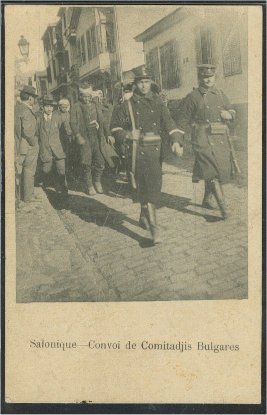
A column of Bulgarian Comitadjis captured during WWI in Thessaloniki.
Bulgarian comitadjis arrested by the Allies during WWI in Thessaloniki.

Komitadji, Comitadji, or Komita (plural: Komitadjis, Comitadjis, or Komitas) (Bulgarian, Macedonian and Serbian: Комити, Komiti, Romanian: Comitagiu, Greek: Κομιτατζής, plural: Κομιτατζήδες, romanizedKomitatzḗs, pl. Komitatzḗdes, Turkish: Komitacı, Albanian: Komit) was a collective name for members of various rebel bands (chetas) operating in the Balkans during the final period of the Ottoman Empire. The name itself originates from Turkish and translates as "committee members". Komitadjis fought against the Turkish authorities and were supported by the governments of the neighbouring states, especially Bulgaria.[1]

Komitadji was used to describe the members of the Bulgarian Revolutionary Central Committee during the April Uprising of 1876,[2][3][4] and Bulgarian bands during the following Russo-Turkish War.[5] The term is often employed to refer later to groups of rebels associated with the Bulgarian Macedonian-Adrianople Revolutionary Committees and the Supreme Macedonian-Adrianople Committee called by the Turks simply the Bulgarian Committees.[6]

In interwar Greece and Yugoslavia, the term was used to refer to bands organized by the pro-Bulgarian Internal Macedonian Revolutionary Organisation and Internal Thracian Revolutionary Organisation, which operated in Vardar and Aegean Macedonia and Western Thrace.[7] In interwar Romania, the term was used to refer to bands organized by the pro-Bulgarian Internal Dobrujan Revolutionary Organisation, which attacked the Romanian outposts and the Aromanian colonists in Southern Dobruja. During the Second World War this name was used to designate the members of the pro-Bulgarian Ohrana active in Northern Greece.[8]

Other uses

[edit]

See also

[edit]

References

[edit]
Revisions and contributorsEdit on WikipediaRead on Wikipedia
from Grokipedia
Komitadji (Bulgarian: комитади), also spelled comitadjis, were guerrilla fighters and armed members of revolutionary committees operating in Ottoman Macedonia and Thrace, primarily affiliated with the Internal Macedonian Revolutionary Organization (IMARO), founded in 1893 to secure autonomy for the region from Ottoman rule. These insurgents, organized in mobile bands known as chetas led by voivodes, employed tactics including raids, assassinations of officials, infrastructure sabotage, and enforcement of internal discipline to challenge Ottoman authority and protect local populations from reprisals. The Komitadji gained prominence through coordinated uprisings, most notably the of 1903, which involved thousands of rebels seizing towns, establishing temporary republics like in , and engaging Ottoman forces in over 200 skirmishes, though ultimately suppressed with heavy casualties on both sides. Their actions highlighted Ottoman administrative failures and atrocities, prompting international diplomatic interventions such as the Mürzsteg Agreement of 1903, which aimed to reform governance in Macedonia but fell short of granting autonomy. Post-1908 , IMARO splintered into factions, with Komitadji bands continuing guerrilla operations during the (1912–1913) and , often aligning with Bulgarian interests for territorial gains, while later interwar activities targeted Yugoslav and Greek control through cross-border raids and political assassinations, reflecting persistent irredentist goals amid ethnic and national rivalries. These efforts, while romanticized in Bulgarian as heroic resistance, involved internal purges, feuds with rival groups, and civilian hardships, underscoring the causal role of Ottoman decline and great-power rivalries in fueling Balkan insurgencies.

Etymology and Definition

Origin and Linguistic Roots

The term komitadji originates from komitacı, formed by combining komita—itself borrowed from French comité, denoting a —with the agentive -cı, indicating membership or affiliation. This linguistic construction entered Balkan vernaculars during the late Ottoman period, reflecting the influence of European revolutionary organizational models on clandestine groups challenging imperial authority. The term first gained prominence in the amid the formation of secret in the , initially referring neutrally to committee participants but rapidly acquiring connotations of armed insurgency as these groups mobilized against Ottoman governance. In revolutionary contexts, komitacı denoted operatives of underground networks, evolving from administrative descriptors to labels for irregular fighters by the late . Adaptations in Balkan languages highlight its regional diffusion: Bulgarian rendered it as komitadji or komiti, Greek as komitatzídes or comitadji, and Romanian as comitagiu or komitas, consistently applied to members of guerrilla detachments known as chetas. These variants preserved the core Turkish structure while integrating into local phonologies, underscoring the term's role in denoting both organized revolutionaries and, at times, bands operating across ethnic lines in the Ottoman periphery.

Scope and Historical Application

The term komitadji (from komitacı, denoting members of a ) served as a collective designation for irregular guerrilla fighters organized in small armed bands known as chetas, primarily active in Ottoman provinces including Macedonia, , and adjacent regions of from the 1870s onward. These fighters targeted Ottoman authorities through sabotage, assassinations, and uprisings, with activities intensifying during the empire's decline and culminating in the (1912–1913) and , after which Ottoman control effectively ended in the by 1918. The designation encapsulated both insurgents seeking territorial and, in some Ottoman and contemporary accounts, counterrevolutionary or bandit elements exploiting the chaos. While predominantly linked to Bulgarian-oriented committees advocating independence or incorporation into the —such as those involved in the and subsequent operations—the term occasionally extended to analogous irregular bands of other ethnic groups resisting Ottoman rule, including Albanian, Greek, and Serbian fighters, reflecting its broader connotation for partisan or operatives in the multi-ethnic Ottoman periphery. This application underscored the shared tactical model of decentralized, committee-directed insurgency across Balkan national movements, though Bulgarian groups dominated numerical and organizational prominence in core areas like Macedonia and . Following the Ottoman Empire's partition after , komitadji persisted as a label for surviving insurgent networks, now often viewed as destabilizing forces by emergent nation-states; in Vardar Macedonia under Yugoslav administration, remnants conducted cross-border raids and internal into the mid-1920s, prompting repressive measures including military operations and agrarian reforms to undermine their support bases. This shift marked an evolution from anti-Ottoman liberators to perceived internal threats, as successor regimes like prioritized consolidation over revolutionary legacies, with komitadji activities fueling ethnic tensions until broader pacification efforts in the late .

Historical Context

Ottoman Administration in the Balkans

The reforms, proclaimed from 1839 to 1876, represented Ottoman efforts to centralize administration, introduce legal equality across religious lines, and reorganize the military along European models to stem territorial losses. In the , however, implementation proved uneven, with local Muslim landowners and officials often retaining privileges that undermined promises of equitable taxation and , thereby alienating Christian subjects who perceived the changes as superficial or biased toward Islamic elites. This inconsistency fueled resentment, as reforms disrupted traditional land grants without fully replacing them with efficient state mechanisms, exacerbating fiscal pressures on rural Christian communities. Christian rayahs in the Balkans endured burdensome taxation, including the öşür tithe nominally set at one-tenth of agricultural produce but frequently escalating to 15 percent or more through tax farming malpractices, alongside irregular corvée labor demands for infrastructure and military support. These impositions contrasted sharply with exemptions for Muslim landowners and the pervasive corruption within Ottoman military units, such as lingering influences from the pre-1826 Janissary corps, which engaged in extortion and resisted modernization. By the late 19th century, under Sultan Abdul Hamid II, repressive policies culminated in the Hamidian massacres of 1894–1896, which targeted Armenian Christians but signaled broader intolerance toward non-Muslim unrest, resulting in an estimated 100,000 to 300,000 deaths and displacing communities across eastern provinces adjacent to Balkan territories. The Ottoman millet system granted religious communities semi-autonomous governance, preserving Christian institutions like the established in 1870, which enabled demographic cohesion amid a growing non-Muslim population in the —reaching over 40 percent in key provinces by the . This structure, while stabilizing multiconfessional rule initially, inadvertently nurtured ethnic self-awareness as Christian numbers expanded through natural growth and reduced conversions, clashing with centralizing edicts that curtailed millet privileges. interventions, notably the 1878 , which curtailed Bulgarian from the San Stefano and retained Ottoman control over Macedonia and , intensified irredentist pressures by highlighting national aspirations without resolving underlying administrative inequities.

Emergence of Revolutionary Nationalism

The began with Paisius Hilendarski's 1762 manuscript Istoriya Slavyanobolgarskaya, which asserted Bulgaria's distinct historical identity and Slavic heritage, countering Ottoman-era cultural suppression and Phanariot Greek dominance in Orthodox church affairs. Circulated clandestinely among monks and lay intellectuals, it fused medieval chronicles with contemporary observations of ethnic persistence, igniting a shift from religious to proto-nationalist self-assertion amid asymmetric imperial control, where direct confrontation was infeasible. The Greek War of Independence (1821–1830) provided an empirical model of successful Balkan , with Bulgarian towns supplying funds and several hundred volunteers joining Greek forces, exposing Ottoman vulnerabilities in peripheral provinces. This participation not only imported tactical insights into but also validated the causal logic of exploiting imperial overextension: Ottoman garrisons, strained by multi-front commitments, proved unable to suppress dispersed rural unrest, encouraging to prioritize ideological mobilization over immediate military parity. Educational proliferation underpinned this transition, as community-funded schools expanded from nascent church-based institutions to a network covering 1,504 towns and villages by 1877, elevating and enabling printed manifestos to bridge urban revivalist circles in with agrarian . Facing Ottoman reprisals—such as arbitrary taxation, forced conversions, and suppression of Slavic liturgy—secret committees coalesced in the to orchestrate komitadji operations, rationally adapting haiduk traditions into structured guerrilla asymmetry: small, mobile chetas evaded centralized Ottoman legions, sustaining resistance where conventional armies would collapse under logistical disparities.

Principal Organizations

Bulgarian Revolutionary Central Committee

The Bulgarian Revolutionary Central Committee (BRCC), established in in 1870 by Lyuben Karavelov, served as the primary external coordinating body for Bulgarian revolutionary efforts against Ottoman rule, building on earlier networks initiated by . Its core objective was to orchestrate a coordinated mass uprising across Bulgarian-inhabited territories to expel Ottoman forces and secure autonomous principalities under Bulgarian ethnic administration, prioritizing national unification over broader Balkan federalist schemes advocated by some contemporaries. The committee rejected multi-ethnic alliances that diluted Bulgarian claims, focusing instead on mobilizing ethnic Bulgarians through , agent networks, and preparations for armed resistance. Organizationally, the BRCC operated from exile in , relying on centralized funding raised from the via subscriptions and donations, alongside clandestine arms procurement and smuggling routes across the . It appointed voivodas to lead proto-cheta formations—small, mobile bands trained for guerrilla actions—and linked these to internal committees established by Levski's earlier efforts, which spanned hundreds of villages. This structure enabled the committee to synchronize operations, distributing manifestos and weapons to foster widespread readiness for revolt, though Levski's execution in 1873 disrupted direct ties. In preparation for the 1876 April Uprising, the BRCC resolved in late 1875 to launch simultaneous rebellions, capitalizing on distractions from the revolt; the ensuing insurrection mobilized thousands of participants across key centers in Sredna Gora and adjacent regions, including Panagyurishte, , and Klisura, before Ottoman suppression. Though the uprising failed militarily, it exposed Ottoman reprisals internationally, paving the way for the 1877–1878 Russo-Turkish War. The BRCC dissolved following Bulgaria's partial under the 1878 Treaty of Berlin, but its emphasis on centralized command, diaspora support, and ethnic-focused insurgency modeled subsequent komitadji frameworks.

Internal Macedonian Revolutionary Organization

The (IMRO), established on 23 October 1893 in Resen by , Damyan Gruev, and associates including Hristo Batandzhiev and Petar Poparsov, initially pursued autonomy for Ottoman Macedonia through revolutionary means, adopting the "Macedonia for the Macedonians" to broaden appeal and evade reprisals while organizing primarily among the Bulgarian-speaking Exarchist population. Its first statute emphasized political autonomy as a transitional step, with membership restricted to residents of Macedonia and Adrianople , rejecting external control from Sofia-based groups like the Supreme Macedonian-Adrianople Committee. This federalist stance masked underlying ethnic Bulgarian orientations, as founders and early statutes referenced Bulgarian Exarchist networks and drew inspiration from the 1885 unification of with , though publicly framed to include multi-ethnic elements under Ottoman reforms per the . By the early 1900s, IMRO's structure evolved into a decentralized network of chetas (armed bands) funded partly through branches in and other Bulgarian centers, amassing 20,000–30,000 active members by amid intensifying Ottoman repression. The 1903 Smilev Congress shifted priorities toward outright unification with for many leaders, abandoning pure in favor of irredentist aims, as evidenced by preparations for widespread that mobilized approximately 26,000 fighters. This marked IMRO as the archetypal komitadji apparatus, coordinating guerrilla and across vilayets while prioritizing Bulgarian ethnic consolidation over broader autonomy. Post-1903 failures precipitated factional splits between supremist (centralist, pro-Bulgarian unification) and (autonomist, multi-ethnic ) wings, exacerbating ideological rifts that weakened cohesion. By the , under Mihailov's leadership, the dominant right-wing faction consolidated power in exile, adopting terrorist tactics against Yugoslav authorities in Vardar Macedonia and explicitly opposing communist influences seeking to promote separate Macedonian , aligning instead with to counter Serb assimilation policies. This turn reinforced IMRO's role as a komitadji , sustaining operations through cross-border networks despite .

Other Regional Committees

In , regional committees affiliated with Bulgarian revolutionary networks operated in the , coordinating guerrilla actions parallel to those in Macedonia during the Preobrazhenie Uprising of August 19, 1903. These groups, drawing from parishes, mobilized chetas in the Mountains to challenge Ottoman control, employing , arms , and village networks akin to IMRO methods, which resulted in temporary liberation of over 200 villages and the establishment of a short-lived communal administration influenced by anarchist elements under figures like Mihail Gerdzhikov. The uprising, suppressed by Ottoman forces by early , highlighted the committees' focus on ethnic Bulgarian enclaves amid broader Ottoman reprisals that killed thousands. In , encompassing northern Bulgarian territories under Ottoman rule, local revolutionary cells functioned as extensions of central committees, organizing sporadic resistance in the region during the 1870s, though documentation remains sparse compared to southern counterparts; these efforts emphasized clandestine recruitment and arms caches to support broader uprisings like April 1876, without forming distinct large-scale structures. Parallel guerrilla organizations among neighboring ethnic groups illustrated rival nationalisms, often pitting them against Bulgarian komitadji in contested Ottoman territories. Greek andartes, irregular bands formed during the Macedonian Struggle (1904–1908), numbered in the hundreds and targeted Bulgarian committees to safeguard Hellenic populations and church interests, resulting in mutual assassinations and village raids that claimed hundreds of lives on both sides. Serbian chetniks, similarly structured paramilitary units, operated in Kosovo and western Macedonia, clashing with Bulgarian bands over borderlands; these conflicts intensified post-1913 Treaty of Bucharest, as chetnik detachments enforced Serbian claims amid irregular warfare that exacerbated ethnic tensions. Albanian revolts, such as the 1910 uprising in Kosovo against Young Turk centralization, involved tribal besa bands of up to 10,000 fighters resisting Ottoman garrisons at passes like Kaçanik, but diverged in prioritizing Albanian self-rule over anti-Ottoman Christian solidarity, occasionally intersecting with Bulgarian actions yet driven by distinct autonomy demands. These analogs underscored causal competition for Ottoman spoils, where tactical similarities masked irreconcilable territorial ambitions.

Major Uprisings and Campaigns

The began on April 20, 1876 (Old Style), in the Sredna Gora region, with initial outbreaks in villages such as and Panagyurishte, where local revolutionary committees proclaimed the revolt against Ottoman rule. Organized by the Bulgarian Revolutionary Central Committee (BRCC), which had established a network of agents inside to prepare for a coordinated national insurrection, the uprising aimed to liberate Bulgarian-populated territories through widespread armed resistance. The BRCC's preparations included smuggling arms and establishing depots, with communication maintained via couriers to synchronize actions across districts, though premature revelations of plans in some areas led to early suppressions. The rapidly spread to over a dozen districts in , mobilizing an estimated 8,000 to 10,000 armed rebels who seized administrative centers and disrupted Ottoman garrisons, though poor overall coordination limited sustained military gains. Ottoman forces, supplemented by irregular militias, responded with brutal , employing mass executions and village burnings to crush the rebellion within weeks; by mid-May, most rebel bands were dispersed or annihilated. The Ottoman suppression triggered widespread atrocities against Bulgarian civilians, with units responsible for documented massacres, including the slaughter of thousands in and an estimated 15,000 deaths near alone, contributing to a total civilian toll of 12,000 to 15,000. These events, reported by European observers and diplomats, generated international outrage—termed the "Bulgarian Horrors"—and shifted European sympathies toward Bulgarian autonomy, directly influencing Russian policy. Russia, citing pan-Slavic solidarity and the atrocities as , declared war on the in April 1877, leading to the Russo-Turkish War of 1877–1878. The uprising's strategic impact extended beyond the battlefield, as its suppression accelerated diplomatic pressure on the Ottomans. The resulting on March 3, 1878, established a large autonomous Bulgarian principality encompassing much of Macedonia and , reflecting Russia's wartime gains. However, the in July 1878, convened by European powers wary of Russian expansion, revised the treaty to create a smaller Bulgarian principality under nominal Ottoman suzerainty, while granting autonomy to and international oversight in Macedonia. This partial success marked the April Uprising as a catalyst in the Ottoman Empire's Balkan decline, demonstrating how localized revolts could leverage atrocities to provoke great-power intervention and territorial reconfiguration.

Ilinden–Preobrazhenie Uprising of 1903

The Ilinden–Preobrazhenie Uprising was launched on 2 August 1903 (St. Elijah's Day in the Orthodox calendar) across Ottoman Macedonia, coordinated by the Internal Macedonian Revolutionary Organization (IMRO) following its Smilevo Congress from 2 to 7 May 1903, where delegates resolved to initiate a general revolt despite incomplete preparations. The insurrection rapidly spread eastward, with the Preobrazhenie phase erupting on 19 August in the Strandzha Mountains of the Adrianople Vilayet, involving coordinated cheta detachments that temporarily liberated rural areas. IMRO's logistical network enabled the mobilization of over 200 cheta units, drawing in an estimated 20,000 to 30,000 insurgents from rural populations, showcasing the organization's capacity for decentralized command and supply chains forged through years of clandestine operations. Insurgents seized on 2 August, proclaiming a provisional "republic" that endured until 12 August, nominally structured as a multi-ethnic entity with an Aromanian figurehead president to appeal to local , , and others, though control rested firmly with IMRO's Bulgarian-oriented leadership pursuing autonomy under Bulgarian cultural influence. In the Adrianople sector, chetas clashed with Ottoman garrisons in skirmishes around Melnik, , , and Gorno Dzhumaya, where rebels briefly disrupted communications and supply lines before facing counteroffensives. The Strandzha actions established a commune-like zone held by about 2,000 fighters against a larger Ottoman force, emphasizing guerrilla disruption over sustained positional defense. The uprising collapsed within weeks as Ottoman authorities deployed reinforcements numbering in the hundreds of thousands, leveraging telegraphic coordination and to isolate chetas and regain control, underscoring the insurgents' empirical limitations in and open-field maneuverability against regular troops and irregular auxiliaries. Suppression involved systematic reprisals, including the burning of over 200 villages and mass killings targeting rebel sympathizers, with relief assessments documenting thousands of civilian deaths amid widespread displacement. In the Bitola District alone, Ottoman forces engaged in 150 documented battles, resulting in 746 confirmed insurgent fatalities, while similar intensities occurred in other sectors. The scale of Ottoman atrocities and the uprising's brief territorial gains prompted European powers to intervene diplomatically, culminating in the Mürzsteg Agreement of 2 October 1903, which imposed mixed commissions for atrocity investigations, administrative reforms, and an international in Macedonia to curb violence. These measures, enforced by Austrian and Russian oversight, eroded Sultan Abdul Hamid II's direct authority, fostering administrative fragmentation that weakened Ottoman cohesion and indirectly accelerated revolutionary pressures leading to the Young Turk coup in 1908.

Involvement in the Balkan Wars (1912–1913)

The remnants of IMRO chetas transitioned from autonomous insurgency to auxiliaries within the Bulgarian Army during the , which commenced on , , leveraging their familiarity with terrain and Ottoman defenses to support conventional offensives in and Macedonia. These units, numbering in the thousands, integrated as irregular forces to conduct , harass supply lines, and clear residual Ottoman pockets, thereby augmenting the Bulgarian mobilization of over 350,000 troops. A dedicated Macedonian militia contingent of approximately 14,000 volunteers, directed by IMRO veterans, operated under Bulgarian command in eastern sectors, including a volunteer comprising around 1,000 Macedonians, , and focused on localized combat support. This incorporation marked a strategic shift, with former komitadji providing expertise in guerrilla operations to complement the army's rapid advances, such as the Bulgarian thrust toward that captured key positions by late October 1912. Cheta veterans, hardened by prior uprisings, proved effective in fluid engagements against disorganized Ottoman rearguards, though their role remained subordinate to regular formations amid the war's emphasis on mass infantry assaults. In the ensuing , ignited on June 29, 1913, by Bulgarian-Serbian-Greek disputes over Macedonia's partition, IMRO-affiliated bands reverted to , mounting raids behind and lines to disrupt advances into Bulgarian-held territories. However, these efforts faltered against coordinated counteroffensives, resulting in the rout and expulsion of komitadji units from contested regions by early August 1913. The Bulgarian military's defeats, sealed by the Treaty of Bucharest on August 10, 1913—which ceded the bulk of Macedonia to (Vardar region) and (Aegean region)—exacerbated territorial grievances, galvanizing komitadji resolve for future irredentist actions without immediate recourse.

Operational Tactics

Structure of Chetas

Chetas formed the core operational units of the komitadji, consisting of small, decentralized guerrilla bands typically numbering 10 to 50 fighters, designed for mobility and resilience against Ottoman forces. Each cheta operated under the command of a voivoda, a local leader responsible for tactical decisions, , and enforcement of , often drawn from experienced revolutionaries or former Ottoman subjects with regional knowledge. Subdivisions within chetas included desetari-led cells of approximately 10 members to compartmentalize information and limit damage from captures or betrayals. The organizational hierarchy connected these units to broader IMARO networks through local committees, which handled recruitment from rural populations, including Exarchist-affiliated communities and schools that served as ideological and logistical hubs. Couriers, often utilizing churches, monasteries, or migrant networks, relayed orders and intelligence between district leaders and the central committee, ensuring coordinated actions despite geographic fragmentation. Specialized roles supported operations, such as blagajniks for financial management and jataks for supply coordination, comprising small percentages of cheta personnel to maintain efficiency. Funding sustained chetas via revolutionary taxes levied on local supporters, emigrant remittances from communities, and revenues from smuggling operations, including and . Arms procurement relied on smuggling routes from and , with caches accumulating hundreds to thousands of rifles, such as 600 Carnica-system weapons in 1902 and up to 5,000 from specific ransoms repurposed for revolutionary use. Sustainability emphasized seasonal activity, with peak operations in late summer when mountain cover and villager support were optimal, followed by winter retreats to remote highland hideouts or border areas to evade patrols. Local agriculture, requisitions, and self-funding mechanisms allowed chetas to persist independently, though reliance on state-backed supplies from neighbors like grew post-1903 amid intensified Ottoman suppression.

Guerrilla Strategies and Logistics

The komitadji of the Internal Macedonian Revolutionary Organization (IMARO) primarily employed hit-and-run ambushes against Ottoman garrisons and officials, targeting small detachments to disrupt control while evading larger forces. These operations leveraged the rugged terrain of regions such as the Rhodope Mountains and Šar Planina for concealment and rapid withdrawal, as seen in ambushes like Spiro Crne's 1880 attack on Turkish official Kuchuk Seleyman near Trojaci, informed by local peasant intelligence. Similarly, in 1895, Hristo Sarafov's band near Melnik killed or captured 50 of 100 Ottoman soldiers before fleeing after burning government buildings. Pitched battles were systematically avoided when outnumbered, such as the 1903 cancellation of plans to seize Kostur due to insufficient forces, prioritizing survival and sustained harassment over decisive engagements. Logistics relied on hidden supply caches of weapons, , and funds, often buried or stored in sympathetic villages via jataks (safe houses), with smuggling routes like to Capari facilitating arms inflows. For instance, in April 1901, Ottoman forces uncovered dynamite and rifles concealed near , while IMARO bands seized 2,500 pounds sterling and in Voden and Visheni during 1903 operations. Funding supplemented local support through ransoms, such as the 1901 kidnapping of American missionary Ellen Stone, yielding 14,500 liras, and revolutionary taxes on communities. Challenges included high desertion rates and betrayals, exacerbated by Ottoman informant networks during the 1903 Ilinden Uprising; examples encompass a pre-1900s Christian convert in Kostur exposing 600 members and Mihajlov's revelations under in 1900. These were mitigated through solemn oaths—sworn on the , , and —enforcing loyalty under penalty of , reinforced by kin-based recruitment drawing on familial vengeance and village ties. Propaganda efforts countered Ottoman divide-and-rule tactics by fostering ethnic solidarity among Orthodox populations, utilizing leaflets, revolutionary songs, and pamphlets distributed via teachers and priests in church networks for recruitment. A notable instance occurred on July 28, 1903, when couriers like Lazar Svetiev disseminated letters urging the Ilinden Uprising to commence on August 2, mobilizing hundreds in regions like Lerin with 500 participants, including 100 from Ekshisu. Such networks, often embedded in schools and parishes, emphasized shared grievances against Turkish oppression, drawing recruits from peasants motivated by personal losses despite risks of Ottoman reprisals.

Notable Individuals

Key Leaders and Their Contributions

Gotse Delchev, a co-founder of the Internal Macedonian Revolutionary Organization (IMRO) in 1893, served as a key ideologue who emphasized organizational development and gradual preparation for autonomy rather than immediate armed uprising, influencing the group's shift toward internal committees and educational outreach among Bulgarian populations in Ottoman Macedonia. He organized teacher networks and district assemblies to build clandestine support, critiquing premature revolts as likely to provoke Ottoman reprisals without sufficient backing. Delchev perished on May 4, 1903, during a skirmish with Ottoman forces near the village of Banica (Banitsa), just prior to the Ilinden–Preobrazhenie Uprising he had opposed in its timing. Yane Sandanski emerged as a prominent voivoda (guerrilla ) in the Pirin and Thracian regions, leading chetas (armed bands) against Ottoman authorities while advocating a vision for Balkan ethnic coexistence, which positioned him in opposition to IMRO's centralist factions favoring . His forces conducted raids and protected local Bulgarian communities during the 1903 uprising's aftermath, and he briefly allied with Young Turk reformers post-1908 before resuming amid unfulfilled promises. Sandanski's independent operations, including control over routes for arms, sustained komitadji resistance until his on April 22, 1915, near Rozhen Monastery by members of the rival right-wing IMRO faction amid ideological clashes. Vasil Levski, active in the precursor Bulgarian Revolutionary (BRCC) formed in , pioneered urban revolutionary networks by establishing secret committees in key towns like , , and , focusing on internal agitation and arms procurement to erode Ottoman control without reliance on external intervention. His strategy emphasized self-reliant popular mobilization through apostolic tours, laying groundwork for later komitadji decentralized structures by integrating clergy, merchants, and artisans into conspiratorial cells. Levski was captured near in December 1872 and executed by hanging in on February 18, 1873 (Julian February 6), an event that galvanized subsequent revolutionary efforts despite disrupting BRCC operations.

Controversies and Criticisms

Accusations of Banditry and Civilian Atrocities

Komitadji units, operating as chetas, faced accusations of through coercive methods, notably the levy of a "revolutionary tax" on rural households to sustain guerrilla and arms procurement. By 1903, this tax had escalated to one denar per household, enforced via or reprisals against non-payers, with the issuing receipts to legitimize collections but often blurring into from dissenting villages. Such practices mirrored Ottoman fiscal exactions but eroded local support, as villagers unaffiliated with IMARO viewed them as predatory rather than patriotic contributions. Targeted violence against civilians perceived as Ottoman collaborators or ethnic rivals further fueled banditry claims. IMARO revolutionary committees imposed summary executions on suspected spies and informers, incentivized by Ottoman rewards for betrayals, yet these tribunals frequently ensnared non-combatants without , contributing to an atmosphere of terror to enforce internal and loyalty. In inter-communal strife, komitadji clashed with Greek Patriarchist and Serbian-oriented groups, assassinating and villagers resistant to Exarchist influence; pre-1903 pressures on Patriarchist communities involved killings and coerced church shifts, escalating into broader reprisals during the Ilinden Uprising. European consular observations, including British reports, attributed several hundred civilian deaths to komitadji actions from 1898 to 1903, often framed as countermeasures to Ottoman divide-and-rule tactics but critiqued for proportionality failures that alienated neutral populations and invited retaliatory Ottoman reprisals. Historians note these reprisals responded to systemic Ottoman incentives for collaboration, yet indiscriminate enforcement—such as village-wide punishments—compromised IMARO's autonomy narrative, portraying fighters as akin to brigands in rival accounts. While defenders argued such measures prevented infiltration, the resultant civilian toll substantiated charges of atrocities, paralleling but distinct from Ottoman state violence.

Internal Divisions and Ideological Splits

The failure of the in late 1903 triggered a major ideological rift within the Internal Macedonian-Adrianople Revolutionary Organization (IMARO), pitting its left-wing federalist faction—advocating Macedonian autonomy, potentially through a Balkan-wide —against the right-wing centralist faction, which prioritized unification with as the path to national liberation. This division reflected deeper tensions over the organization's original statutes, which emphasized regional autonomy under Ottoman reform but increasingly clashed with post-uprising pressures for decisive action amid Ottoman reprisals that killed over 10,000 civilians and revolutionaries. Yane Sandanski, a key federalist leader, consolidated control over eastern Macedonian districts from 1903 onward, rejecting centralist dominance from -based exiles and promoting a vision of self-governance independent of Bulgarian state absorption. Fratricidal violence ensued, exemplified by Sandanski's group's 1907 assassinations of right-wing figures Boris Sarafov and Ivan Garvanov in , acts framed by federalists as necessary to purge "annexationist" elements but which deepened organizational fragmentation. Such internal purges, including suspicions around Gyorche Petrov's circle, eroded IMARO's cohesion without resolving the supremacist-federalist impasse rooted in competing interpretations of versus . By the 1920s, amid refugee influxes from partitioned Macedonia, IMRO's remnants shifted decisively rightward, expelling leftist sympathizers and combating communist infiltration that sought to co-opt the movement for Soviet-aligned . Leaders prioritized anti-communist vigilance, viewing Marxist universalism as antithetical to ethnic , though this hardened stance invited further schisms. These ideological fractures demonstrably undermined operational unity, facilitating Yugoslav state campaigns in Vardar Macedonia—such as 1920s military expeditions and gendarme raids—that eliminated komitadji bands through targeted killings and captures, with individual clashes claiming dozens per engagement and contributing to the exile or death of hundreds by decade's end.

Inter-ethnic Conflicts and Rival Nationalisms

The , spanning approximately to 1908, pitted Greek andartes against Bulgarian komitadji in direct competition for control over mixed-population regions in Ottoman Macedonia, with clashes escalating after the Ilinden Uprising's failure in 1903. Greek irregulars, responding to komitadji attacks on Hellenic communities, engaged in retaliatory actions, including the killing of Bulgarian revolutionaries in areas like Melnik, where riots and assassinations targeted perceived Bulgarian nationalists amid broader ethnic violence. Greek sources from the era consistently portrayed komitadji as "Bulgar bandits" responsible for atrocities against Greek-speaking villagers, framing their activities as aggressive expansionism rather than local autonomy efforts. Post-1913, following Bulgaria's territorial losses in the Second Balkan War, conflicts intensified with Serbian in the newly annexed Vardar Macedonia, where Serbian paramilitaries suppressed lingering Bulgarian komitadji networks through raids and expulsions. Serbian forces, viewing komitadji as irredentist threats, attributed systematic to Bulgarian groups attempting to retain influence, including forced displacements of pro-Bulgarian elements during consolidation of Serbian administration from 1913 onward. Bulgarian perspectives, conversely, hailed komitadji resistance as defensive unification struggles against rival nationalisms imposed by and , emphasizing the organizations' role in preserving Bulgarian-majority Slavic communities. IMARO's rank-and-file drew predominantly from Bulgarian-identifying recruits, with historical estimates indicating over 80% of active members in Macedonian districts self-identifying as Bulgarian prior to , based on Ottoman censuses and revolutionary records that aligned Slavic populations linguistically and culturally with . This composition counters post-communist narratives asserting exclusive "Macedonian" agency in revolts, as key leaders like and explicitly affirmed Bulgarian ethnic ties in their writings and manifestos, rejecting separate Macedonian nationhood. Rival nationalisms thus manifested not only in armed skirmishes but in competing claims over the same Slavic base, with komitadji dominance in early 20th-century insurgencies rooted in this demographic reality despite Greek and Serbian counter-efforts.

Legacy and Historiography

Role in Bulgarian National Liberation

The komitadji insurgents of the Bulgarian Revolutionary Central Committee initiated the April Uprising on April 20, 1876 (May 2 New Style), aiming to overthrow Ottoman rule and provoke external intervention, which, despite brutal suppression involving massacres of up to 15,000 civilians, generated European outrage and directly precipitated Russia's declaration of war on the in April 1877. This conflict culminated in the on March 3, 1878, granting to a Greater Bulgaria encompassing over 170,000 square kilometers of territory from the to the Aegean and Black Seas. Although the in July 1878 curtailed this to the (63,752 sq km) and the autonomous (36,000 sq km), totaling approximately 100,000 sq km of liberated lands, the uprising's causal chain—exposing Ottoman administrative failures—enabled arbitration that prioritized Christian over imperial integrity. Subsequent komitadji operations under the Internal Macedonian-Adrianople Revolutionary Organization (IMARO), founded in 1893, sustained pressure through guerrilla chetas targeting Ottoman forces and infrastructure in Macedonia and Thrace, forcing partial decentralization via international oversight like the 1903 Mürzsteg Agreement, which deployed Austro-Russian gendarmes to curb abuses and highlighted the empire's incapacity to govern multi-ethnic provinces. These activities eroded Ottoman cohesion amid the 1908 Young Turk Revolution, emboldening Prince Ferdinand to declare Bulgaria's full independence on October 5, 1908, without immediate reprisal, as the sultan's suzerainty claims rang hollow against decades of revolutionary attrition. In the (October 1912–May 1913), IMARO komitadji veterans integrated into Bulgarian regular forces as irregular chetas, providing local intelligence, sabotage, and combat expertise that facilitated rapid advances, yielding territorial acquisitions including Eastern Thrace (up to the Enos-Midia line) and Vardar Macedonia portions, expanding Bulgaria's area from 96,300 sq km to over 122,000 sq km temporarily. Their role underscored a metric of success in wresting control of ethnically Bulgarian-populated Ottoman holdings, though the failure to secure a unified "Greater Macedonia" amid the Second Balkan War's reversals critiqued the limits of cheta-centric strategies reliant on fleeting alliances rather than consolidated defense. Overall, komitadji efforts shifted Ottoman priorities toward repression over reform, catalyzing arbitration that incrementally favored through verifiable gains in sovereignty and land.

Debates in Modern Balkan Narratives

In Bulgarian national historiography, Komitadji affiliated with the Internal Macedonian-Adrianople Revolutionary Organization (IMARO) are framed as principled fighters for ethnic self-determination against Ottoman oppression, with primary sources like the organization's 1893 founding statute and 1903 Ilinden-Preobrazhenie Uprising manifestos explicitly invoking Bulgarian identity and Exarchate ties to substantiate claims of cultural and linguistic continuity. This perspective prioritizes archival evidence over later reinterpretations, viewing the revolutionaries' actions as a logical extension of 19th-century Bulgarian revivalism amid imperial decline. North Macedonian narratives, influenced by Yugoslav-era after 1944, retroactively appropriate Komitadji as proto-Macedonian figures fostering a separate ethnic consciousness, despite inconsistencies with contemporaneous self-identifications in Bulgarian-language documents from that affirm the fighters' Bulgarian rather than a distinct Macedonian one. This historiographical shift, often critiqued for prioritizing political consolidation over empirical records, has been challenged by post-communist analyses highlighting the absence of pre-1940s for a non-Bulgarian Macedonian framing among IMARO ranks. Serbian and Greek accounts portray Komitadji as expansionist aggressors whose insurgencies in Macedonia and Thrace necessitated defensive partitions during the Balkan Wars of 1912–1913, with Greek andart bands and Serbian forces actively countering them as threats to Orthodox co-religionist claims and territorial aspirations. Ottoman and Turkish perspectives, conversely, classify them as terrorists and bandits who accelerated imperial disintegration by targeting officials and infrastructure, a view rooted in administrative records depicting their guerrilla tactics as disruptive to multi-ethnic governance. Following the opening of Bulgarian and select Ottoman archives, scholarly reassessments have converged on interpreting Komitadji as strategic actors navigating the Ottoman Empire's structural collapse—marked by fiscal and ethnic —rather than apolitical criminals, emphasizing their role in a broader pattern of late-imperial insurgencies across . This consensus, drawn from declassified diplomatic correspondences and memoirs, counters earlier partisan dismissals by underscoring causal links between administrative failures and armed , though it acknowledges inter-ethnic rivalries that amplified .

Contemporary Commemorations and Scholarly Reassessments

In , the Ilinden Uprising is commemorated annually on as , with central events held in to honor the 1903 proclamation of the short-lived by IMARO revolutionaries. Similar observances occur in , where the uprising is framed as a key episode in the national liberation struggle against Ottoman rule. These events persist amid ongoing bilateral disputes, including vandalism of monuments dedicated to figures like , whose statues in and symbolize competing national claims despite shared veneration as an anti-Ottoman leader. Monuments to Delchev and other komitadji leaders, such as those erected in Bulgarian border regions and Macedonian towns, continue to serve as focal points for public memory, even as 2023 commemorations of his birth exacerbated tensions, with Bulgaria protesting North Macedonia's portrayal of him as exclusively Macedonian. These sites draw visitors and official delegations, underscoring the enduring symbolic role of komitadji in regional identity formation, though cross-border incidents, including detentions at shared frontiers during memorial travels, highlight persistent frictions. Post-communist scholarship since the has reassessed the komitadji through declassified archives and comparative Balkan studies, shifting from state-sponsored to analyses of their operational tactics and societal impacts. Bulgarian historians, often aligned with nationalist viewpoints, emphasize the komitadji's heroism in disrupting Ottoman control and fostering proto-national consciousness, while Macedonian narratives integrate them into a distinct ethnic framework, sometimes minimizing Bulgarian affiliations evident in primary documents. Western and regional reassessments, drawing on Ottoman records, counter idealizations by documenting guerrilla bands' involvement in violence against civilians, with estimates of mutual atrocities exceeding 10,000 deaths in alone, challenging left-leaning academic tendencies to frame such actions as mere resistance collateral. These debates inform conferences on Balkan revolutionary networks, prioritizing empirical over mythic national exclusivity.

References

Add your contribution
Related Hubs
User Avatar
No comments yet.