Hubbry Logo
Pinus koraiensisPinus koraiensisMain
Open search
Pinus koraiensis
Community hub
Pinus koraiensis
logo
8 pages, 0 posts
0 subscribers
Be the first to start a discussion here.
Pinus koraiensis
Pinus koraiensis
from Wikipedia

Pinus koraiensis
Trees at Cheremshany, Sikhote Alin, Russia
CITES Appendix III[2]
Scientific classification Edit this classification
Kingdom: Plantae
Clade: Tracheophytes
Clade: Gymnospermae
Division: Pinophyta
Class: Pinopsida
Order: Pinales
Family: Pinaceae
Genus: Pinus
Subgenus: P. subg. Strobus
Section: P. sect. Quinquefoliae
Subsection: P. subsect. Strobus
Species:
P. koraiensis
Binomial name
Pinus koraiensis

Pinus koraiensis is a species of pine known commonly as the Korean pine. It is a relic species of the Tertiary, identified as a rare tree species by United Nations.[3] It is native to eastern Asia, in Korea, northeastern China, the temperate rainforests of the Russian Far East, and central Japan.[4] In the north of its range, it grows at moderate elevations, typically 600 to 900 metres (2,000 to 3,000 feet), whereas further south, it is a mountain tree, growing at 2,000 to 2,600 m (6,600 to 8,500 ft) elevation in Japan.[1] Other common names include "Chinese pinenut".[5] The ancient woodland of P. koraiensis on the earth is about 50 million hectares, and China has about 30 million hectares, accounting for 60%.[6] It is a second-class national key protected plant in China.[6] P. koraiensis is a tree species with high economic and ecological value. The official name in Chinese is "红松 hóng sōng/red pine", because almost every part of it is related to red.[7]

According to some research, P. koraiensis can be divided into two natural types according to the thickness of the bark, namely Pinus koraiensis Sieb. et Zucc. f. pachidermis Wang et Chi and Pinus koraiensis Sieb. et Zucc. f. leptodermis Wang et Chi,[7] though these are not accepted as distinct by the Plants of the World Online database.[4]

Description

[edit]

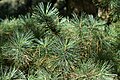
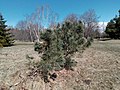
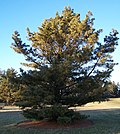
P. koraiensis is a member of the white pine group, Pinus, section Quinquefoliae. In their native habitat and growing conditions it grows to 20–35 m (66–115 ft) tall, rarely to 50 m (160 ft) in height.[8][9][10][7] Cultivated specimens are usually smaller, to around 20 m (66 ft) tall.[9] The tree is broad conical when young, becoming columnar with a conic apex with age; younger specimens having ascending branches and older trees having more horizontal branches. The grey or brownish bark flakes off to reveal reddish inner bark. The sapwood is yellowish white, while the heartwood is light yellowish-brown or light reddish-brown.[7] The branchlets and winter buds are also reddish-brown.[7] The branches are lined with blue-green needles in bundles of five, each up to 6–13 cm (2.4–5.1 in) long, with dark glossy green outer faces and glaucous white stomatal bands on the inner faces. P. koraiensis is monoecious with separate male and female cones. The male (pollen) cones are reddish-yellow, mostly clustered in the lower part of new branches to form spikes; pollination is in spring. The seed cones are 9–14 cm (3.5–5.5 in) long, rarely 20 cm (7.9 in) long, and 6–8 cm (2.4–3.1 in) diameter, rarely 10 cm (3.9 in) diameter; they are solitary or in groups near the top of new branches, green or purple when immature, ripening grey-brown in early autumn.[8][9][10] The seeds take about 18 months from pollination to maturity; the mature seeds do not fall out of the cones, but are dispersed by birds, primarily the northern nutcracker (Nucifraga caryocatactes), which collects the seeds in autumn and disperses them.[11][7] The nutshells are reddish brown.[7] P. koraiensis can live up to 700 years; after 100–200 years of growth, it enters the fruitful youth stage, and after 300–400 years, it enters the fruitful adult stage.[6] In the wild, P. koraiensis grows slowly, taking fifty or even eighty years to bear cones, and cultivated P. koraiensis usually takes more than twenty years to bear cones, but grafted seedlings can bear cones within a few years.[6]

Conservation

[edit]

The value of P. koraiensis has led to overexploitation of wild populations of the tree, and destruction of the forest ecosystems in which it grows. The Siberian tiger is resident in these pine forests, and preservation of this tree species is one step in the conservation of the tiger.[1]

Other associates of the tree in nature include the northern nutcracker, which collects the seeds and plays an important role in their dispersal.[11][12]

In China, the ancient P. koraiensis forests are concentrated in the Paektu Mountain and Lesser Khingan areas, and are the building species of the natural forests in the northeast. Except for the pure P. koraiensis forests in some areas, most of them are mixed with other coniferous and broad-leaved tree species.[7] The broad-leaved-P. koraiensis forest preserves the ancient structural characteristics of the Tertiary plant community. It is a climax community in northeastern China, and its ecological value is extremely precious. It maintains ecological balance and ecological security in northeastern China.[6] Yichun located in Lesser Khingan has the most typical and best-preserved P. koraiensis virgin forest community in Asia.[13] Yichun has two national nature reserves, 丰林/Fenglin and 涼水/Liangshui, which specialize in the protection of P. koraiensis. Among them, Fenglin Nature Reserve has been included in the World Network of Biosphere Reserves" by UNESCO. The P. koraiensis virgin forest community in Yichun is an important gene pool of China's biodiversity. "There are more than 110 kinds of precious coniferous and broad-leaved trees, more than 60 kinds of large mammalian wild animals, and more than 270 kinds of birds, including 64 kinds of national first-class and second-class protected animals; there are 1390 kinds of plants, including more than 700 kinds of wild medicinal materials".[13] Since 2004, the logging of wild P. koraiensis trees has been completely prohibited in Yichun, and the existing P. koraiensis trees have been registered one by one for protection.[3]

Uses

[edit]

P. koraiensis is a precious tree species with both economic and ecological value. Ecologically, it has the functions of water and soil conservation – its root having a large water storage capacity, which is a "small reservoir" in the eyes of ecologists – and the function of maintaining biodiversity. Economically, every part of the plant can be used. In China, it has a long history of being used in food, beverage, health preservation and medical treatment. The ancients called its fruit "長壽果/longevity fruit".[7] The traditional Chinese medicine "海松子/sea-pine nut" refers to the seeds of P. koraiensis, which is a nourishing and strengthening agent.[7] At present, the high-tech industry of P. koraiensis has outstanding achievements in the fields of food, health products, medicine, cosmetics and fine chemicals.

The nuts of this tree are edible and sold commercially.[14] It is the most common taxon sold as pine nuts in markets throughout Europe and the United States.[1] The nut oil contains 11.5% of the unusual fatty acid pinolenic acid (cis–5–cis–9–cis–12 octadecatrienoic acid).[15] It "has a variety of physiological effects such as weight loss, lipid lowering, immune enhancement, anti-inflammation, anti-oxidation, enhancement of insulin sensitivity, and anti-tumor metastasis."[16] Pine nut oil extracted from P. koraiensis nuts has high nutritional value. The oil is also used to make lubricants and soap.[17] The tree is a source of turpentine resin and tannin.[1][18] The pine needles can be used to extract pine needle oil.

Pine pollen (松花粉) is the dried pollen produced by the pollen cones. It is a traditional Chinese medicine and a traditional Chinese cooking ingredient. It is even used as the name of cakes or drinks, such as "松花糕/pine flower cake", "松花酒/pine flower wine" etc. ""中国预防医学科学院营养与食品卫生研究所/The Institute of Nutrition and Food Hygiene of the Chinese Academy of Preventive Medicine" has confirmed that pine pollen contains more than 200 nutritional components and bioactive substances, with anti-fatigue, anti-aging, regulating blood lipids, enhancing immunity, and beautifying five major health care functions".[19] ""国家体育总局运动医学研究所兴奋剂检测中心/The Doping Testing Center of the Institute of Sports Medicine of China" indicated that no ingredients banned by the Olympic Games were found in pine pollen".[19]

The Korean pine is used as an ornamental tree. It is tolerant of several soil types and thrives in urban settings. It is adapted to climates with very cold winters.[14] There are several cultivars, including the blue-tinged 'Glauca' and 'Silveray' and the wide-bodied 'Winton'.[20] The Korean pine is also a good tree species for afforestation in northeastern China.[6]

The wood is versatile and very useful for construction.[14] It is light, with straight grains, and easy to work. It is used for a great variety of products, including telephone poles, railroad ties, bridges, boats, plywood and flooring, furniture, sports equipment, and musical instruments. It is easy to break down into chips, particle board, or pulp for paper.[1] The fatwood used to be the best kindling in the forest area of northeast China, and now it is a rare objet. The carvings or prayer beads made of it are collected or used like precious ancient objects.[6]

[edit]

References

[edit]
[edit]
Revisions and contributorsEdit on WikipediaRead on Wikipedia
from Grokipedia
Pinus koraiensis, commonly known as the Korean pine, is a monoecious in the Pinus and , native to . It typically grows as a up to 30 meters tall with a of 150 cm, featuring a pyramidal form when young that becomes more irregular with age. The bark is gray-brown and smooth on young trees, becoming gray-black, scaly, and peeling on mature specimens. Needles occur in fascicles of five, measuring 6-13 cm long and 1 mm wide, with dark green outer faces and whitish inner faces bearing stomata lines. Male cones are ovoid and clustered at the base of new shoots, while female cones are ovoid to cylindric-ovoid, 9-11 cm long and 5-6 cm wide, with woody scales and wingless seeds about 15 mm long that are notably edible and nutritious. This species is distributed across northeastern China (primarily Heilongjiang Province), the (Ussuri River basin), , , and (central and ). It inhabits subalpine mixed s on mountainous slopes at elevations of 1,300-2,500 meters, often in association with broadleaf trees like oaks and birches, and is adapted to cold temperate climates with hardiness to USDA Zone 3 (tolerating temperatures down to -40°C). Ecologically, P. koraiensis plays a key role in ecosystems as a , providing and food for , particularly through its seeds which are a vital food source for birds and mammals. Economically, Pinus koraiensis is highly valued for its edible pine nuts, which are harvested for human consumption and contribute significantly to local economies in its native range, as well as for its high-quality timber used in and furniture. The nuts are rich in oils, proteins, and nutrients, making them a in , while the tree's essential oils and byproducts, such as leaf extracts, show potential medicinal applications for conditions like . In plantation forestry, particularly in , it supports multifunctional landscapes for timber, nut production, and . Conservation-wise, P. koraiensis is classified as Least Concern on the (2013), though its population is decreasing due to , , habitat degradation, and threats in its native temperate forests. Despite its wide distribution, ongoing threats necessitate to preserve this culturally and economically important . The tallest known specimen reaches 42 meters in Russia's Ussuri Nature Reserve, and the oldest dated individual is approximately 330 years old in .

Taxonomy

Nomenclature

Pinus koraiensis is the accepted binomial name for this species, authored by and Joseph Gerhard Zuccarini and first published in Flora Japonica volume 2, page 28, in 1842. The name Pinus originates from the Latin term for pine, referring to various species of this widespread . The specific epithet koraiensis is derived from "Korea" (historically transliterated as Corea), denoting the species' primary native range in the Korean Peninsula and adjacent regions. Notable synonyms include Pinus mandschurica Rupr. (1857) and Strobus koraiensis (Siebold & Zucc.) Moldenke (1939), reflecting historical taxonomic placements within the white . Common names for P. koraiensis vary by region and language, emphasizing its cultural and economic significance. In English, it is commonly known as Korean pine, Korean white pine, or Korean nut pine, highlighting its seeds. Regionally, it is called jatnamu (잣나무) in Korean, hongsong (红松) in Chinese, chosen-matsu (チョウセン松) in Japanese, and kedr koreyskiy (Кедр корейский) in Russian.

Phylogenetic position

Pinus koraiensis is classified within the Strobus of the Pinus, commonly known as the white pines, based on its haploxylon leaf anatomy and fascicles of five . This placement is further refined to the section Quinquefoliae, a group defined by the five-needled arrangement, unarmed branches, and typically cones, distinguishing it from the three-needled sections like Trifoliae. Morphological characteristics, such as the position in needles and cone structure, support this taxonomic assignment, which has been corroborated by extensive molecular data. The species shares close evolutionary ties with other white pines in section Quinquefoliae, including the North American Pinus strobus (eastern white pine) and the Asian Pinus armandii (Armand's pine). Genetic analyses reveal that these lineages diverged during the Tertiary period (approximately 66–2.6 million years ago), positioning P. koraiensis as a relict species adapted to temperate forests of East Asia. This ancient divergence is evidenced by fossil records and molecular clock estimates, highlighting the long-term stability of white pine diversification amid climatic shifts. Phylogenetic studies employing chloroplast DNA (cpDNA) restriction sites and nuclear (ITS) sequences have firmly situated P. koraiensis within the Asian white pine of subsection Strobus. Early 2000s molecular investigations, including those analyzing multiple low-copy nuclear loci, demonstrated the of section Quinquefoliae, with P. koraiensis clustering alongside East Asian congeners like P. armandii and P. sibirica. More recent chloroplast genome comparisons across 33 Pinus species have reinforced this topology, resolving previously ambiguous relationships and underscoring the 's distinct evolutionary trajectory from North American white pines. P. koraiensis exhibits limited natural hybridization with closely related taxa, including rare occurrences with Pinus sibirica (Siberian pine) in overlapping ranges of the Russian Far East, where ecological and phenological barriers generally prevent frequent gene flow. Such hybrids, though documented infrequently in natural settings, underscore the genetic compatibility within the Asian white pine group, as further evidenced by successful artificial crosses.

Description

Physical characteristics

Pinus koraiensis is an and monoecious tree that typically reaches heights of 30 to 50 meters in its native habitat, with trunk diameters up to 1.5 meters. Young trees exhibit a pyramidal crown shape with dense branching, which becomes more rounded and open as the tree matures, often with horizontally spreading branches. The bark is gray-brown and initially smooth on young trees, becoming scaly and flaking in irregular plates on older trunks, revealing a reddish-brown inner layer. The foliage consists of arranged in bundles of five, measuring 6 to 13 centimeters in length, with a dark green outer surface and whitish inner faces featuring stomatal lines; these persist for 2 to 3 years. Male cones, or microstrobili, are and clustered at the base of new shoots, typically 1 to 2 centimeters long. Female cones, or macrostrobili, are ovoid to cylindric-ovoid, 9 to 11 centimeters long and 5 to 6 centimeters wide, initially green and maturing to brown; they are non-serotinous and remain on the tree for several years after maturity. The species exhibits a slow to medium growth rate, with initial annual height increments of 30 to 60 centimeters in young trees, and individuals potentially living several hundred years, with the oldest dated specimen approximately 330 years old. Phenologically, burst occurs in spring, with flowering in May and cone maturation requiring 18 to 20 months, typically completing in October of the following year.

Reproduction

Pinus koraiensis is a monoecious species, bearing separate and cones on the same , with primarily facilitated by . cones produce copious amounts of equipped with air bladders that aid in airborne dispersal, while cones are receptive during the period. typically occurs in to early summer, from mid-June to late June in its native range, when is shed and captured by the ovules of cones. viability remains relatively high for up to one week following peak dispersal, allowing for effective fertilization even over moderate distances. Following successful , seed development proceeds over 14-15 months, including a winter phase, resulting in wingless seeds measuring approximately 15 mm in length. Each mature cone contains an average of 140-150 seeds, which are notably rich in , with content ranging from 58% to over 60%, contributing to their edibility and nutritional value. Seed dispersal is primarily achieved through gravity and animals such as rodents that cache seeds for later consumption, due to the large seed size. Regeneration begins with seed germination, which requires a period of cold stratification to break dormancy, typically lasting 3-6 months at low temperatures to achieve optimal rates. In natural settings, germination success varies between 20% and 50%, influenced by soil conditions, moisture, and microsite quality following dispersal. Trees reach sexual maturity and begin producing cones between 20 and 30 years of age, marking the onset of reproductive output in mature individuals.

Distribution and habitat

Geographic range

Pinus koraiensis is native to eastern Asia, with its primary distribution spanning the Russian Far East, including Primorsky Krai, Khabarovsk Krai, Amur Region, and Sakhalin Island. In China, it occurs in northeastern provinces such as Heilongjiang, Jilin, Liaoning, and northeastern Inner Mongolia, particularly in the Lesser Khingan and Changbai Mountains. The species is also found across the Korean Peninsula in both North and South Korea, often in mountainous regions like the Changbai Mountains. Additionally, disjunct populations exist in Japan, primarily in central Honshu (from Tochigi Prefecture southward to Gifu Prefecture northward) and Shikoku. Historically, P. koraiensis was more widespread in mixed forests across its native range, but intensive has led to significant fragmentation and reduction in its extent. For instance, in the Lesser Khingan Mountains of , natural forests have declined from approximately 1.2 million hectares in to less than 50,000 hectares due to over 50 years of exploitation, leaving only about 3 million mature trees. This fragmentation has resulted in isolated populations, particularly at the junctions between major mountain ranges. Within its native habitats, the occupies elevations that vary by : 200–600 m in the , 500–1,300 m in , and up to 2,500 m in . The tree inhabits boreal to zones, with disjunct distributions reflecting both natural historical patterns and anthropogenic influences. Outside its native range, P. koraiensis has been introduced and cultivated for and ornamental purposes in , including the and (such as and ), as well as in within USDA hardiness zones 3 to 7. These introductions support cold-temperate trials, though widespread remains limited.

Environmental requirements

Pinus koraiensis thrives in a characterized by winters and warm summers, with an annual mean around 3°C and monthly extremes ranging from -20°C in January to 22°C in . It exhibits strong hardiness, tolerating winter temperatures down to -40°C, making it suitable for USDA hardiness zones 3 to 7. Annual precipitation requirements typically fall between 600 and 800 mm, with about 80% occurring during the growing season from May to , supporting its preference for moist but not waterlogged conditions. The species prefers well-drained soils, such as loamy or sandy loams, with a ranging from acidic (around 4.5) to neutral (up to 7.0). It performs poorly on heavy clay or waterlogged sites, where can occur, but tolerates rocky slopes effectively. Pinus koraiensis requires full sun exposure for optimal growth, particularly after the sapling stage, as mature trees are shade-intolerant and compete poorly in conditions. Seedlings show some , but higher light levels (60-100% transmittance) are essential for early development and establishment. Once established, the tree demonstrates moderate to high drought resistance, maintaining growth under water-limited conditions through efficient water use strategies. However, it is sensitive to , which can impair and growth in industrial areas, and to late spring frosts, which pose risks to young shoots and regeneration. In its native habitat, Pinus koraiensis is commonly found on north-facing mountain slopes within mixed coniferous and broadleaf forests, where cooler, moister microclimates enhance its persistence at elevations from 200 to 600 meters.

Ecology

Forest associations

Pinus koraiensis plays a central role in broad-leaved Korean pine mixed forests (BKMFs), where it co-dominates the upper canopy alongside broad-leaved species such as Quercus mongolica, Tilia amurensis, Acer mono, and Betula platyphylla, as well as conifers like Abies nephrolepis and Picea jezoensis . These mixed stands, prevalent in northeastern China, the Russian Far East, and Korea, feature P. koraiensis forming a tall overstory that influences light penetration and understory development . The species contributes to structural complexity, with mature trees exhibiting aggregated spatial patterns that facilitate regeneration in shaded conditions . In forest succession, P. koraiensis functions as both a pioneer on disturbed sites and a climax dominant in old-growth BKMFs, regenerating effectively after or through wind-dispersed seeds . Simulations indicate that without ongoing disturbance, P. koraiensis increases in dominance over centuries, transitioning secondary forests toward climax mixed stands . The regenerates post- through and ectomycorrhizal associations that aid establishment in nutrient-poor soils . Symbiotic relationships enhance P. koraiensis fitness, particularly ectomycorrhizal associations with fungi in the genus (e.g., S. sibiricus, S. subluteus), which dominate root colonization in seedlings and improve nutrient uptake of and phosphorus in nutrient-poor soils . vegetation in these forests includes shrubs such as Rhododendron mucronulatum and Acanthopanax senticosus, which thrive in the moderated beneath the pine canopy . P. koraiensis also contributes to on mountainous slopes, reducing in its subalpine habitats. BKMFs harboring P. koraiensis support elevated plant diversity, with over 100 vascular plant species per hectare in old-growth stands, owing to the species' facilitation of stratified habitats . In the Changbai Mountain region, altitudinal zonation patterns show P. koraiensis dominating mixed forests from 700–1100 m elevation, transitioning to pure conifer stands higher up, though the species occurs up to 2,500 m across its range . Climate change projections indicate potential shifts in suitable habitats, with fragmentation in key regions like the Changbai Mountains. However, selective logging disrupts these associations by removing mature pines, often leading to monodominant P. koraiensis recovery in gaps due to its shade intolerance and competitive seeding, while reducing broadleaf diversity .

Wildlife interactions

Pinus koraiensis, as an monoecious , produces unisexual cones that are primarily pollinated by wind, with male cones releasing dispersed to female cones during specific phenological stages. There are no specialized pollinators for this species. The large seeds of Pinus koraiensis play a central role in trophic interactions, serving as a key food source for various vertebrates that act as both predators and dispersers. , including the Eurasian red squirrel (Sciurus vulgaris), (Tamias sibiricus), Korean field mouse (Apodemus peninsulae), and red-backed voles (Clethrionomys spp.), are primary consumers, often caching seeds in soil or litter, which facilitates post-dispersal survival and aids forest regeneration by leaving some caches uneaten. These transport seeds up to 22 m from sources, with caching behavior enhanced in microhabitats featuring moderate canopy cover (0.2–0.3). Birds such as the Eurasian nutcracker (Nucifraga caryocatactes) are effective long-distance dispersers, carrying up to 62 seeds per trip over distances of at least 4 km and burying them 2.5–3 cm deep, significantly contributing to establishment in second-growth forests. Other avian species, including Eurasian jays (Garrulus glandarius) and Eurasian nuthatches (Sitta europaea), also consume and occasionally cache seeds but over shorter distances (<50 m). While these interactions promote dispersal, substantial seed predation by and birds reduces availability, with consuming more in mixed broad-leaved forests and birds dominating in stands. Eurasian red squirrels specifically harvest entire cones, scatter-hoarding 2–4 seeds per cache, which supports regeneration in disturbed areas like post-cutting sites. Herbivory on Pinus koraiensis primarily targets cones and by squirrels, which can consume up to 22% of annual production in mixed forests, influencing cone toward larger sizes to deter predation. Insect pests affect Pinus koraiensis mainly under stress conditions, potentially leading to defoliation or bark damage in weakened trees. Pinus koraiensis provides essential services, with its dense foliage and branches offering year-round shelter and nesting sites for birds, including cavity-nesters in mature stands. Fallen needles contribute to soil litter, supporting communities that enhance nutrient cycling.

Conservation status

Threats

Pinus koraiensis faces several threats that impact its populations, primarily from anthropogenic activities and environmental changes, though it is assessed as Least Concern in by the IUCN due to its wide distribution and some protected areas. Habitat loss through and has significantly reduced old-growth stands, with primary Korean pine forests in regions like the Lesser Khingan Mountains declining from approximately 1.2 million hectares to less than 50,000 hectares over 56 years of intensive exploitation. This degradation is exacerbated by conversion to agriculture and urban expansion in parts of its native range in . Overharvesting for pine nuts has depleted seed sources, hindering natural regeneration and interacting with other factors to reduce establishment by up to 54.7% in affected areas. Intensive collection disrupts and limits population recovery in logged or disturbed forests. Pests and diseases pose substantial risks, particularly pine wilt disease caused by the Bursaphelenchus xylophilus, which has been reported on P. koraiensis in Korea and leads to rapid tree mortality. Other fungal pathogens, such as those causing bark rot and needle-shedding, further contribute to decline in vulnerable stands. Climate change is driving range shifts northward due to warming temperatures, while increased stress at southern limits heightens susceptibility to pests and reduces overall suitability. Projections indicate potential redistribution, with combined effects of warming and harvesting limiting migration at leading edges.

Protection efforts

Pinus koraiensis is protected in several key reserves and national parks across its range. In , the Changbai Mountain Reserve safeguards extensive stands of the species within its mixed forests, promoting biodiversity conservation through UNESCO's . Similarly, the Fenglin National , also a UNESCO Reserve, preserves virgin Korean pine forests covering 18,400 hectares, focusing on intact natural ecosystems. In , the Reserve protects large tracts of Korean pine-dominated forests, where the species is a dominant component of the temperate mixed woodlands. In , national parks such as those in Gangwon Province, including habitats in Hongcheon-gun, provide protection for remnant populations. The holds significant to regulate exploitation and trade. It is listed under Appendix III at the request of the Russian Federation since 2010, requiring export permits to monitor international trade in logs, , and veneer. In , P. koraiensis is classified as a second-class protected precious timber species, restricting harvesting and promoting sustainable management. In , notable specimens, such as the Jeongipumsong tree, are designated as Natural Monuments under the Cultural Heritage Protection Act, ensuring their preservation as cultural and ecological assets. Reforestation initiatives have been implemented to restore degraded habitats. In and , programs since the 2000s have involved planting Korean pine seedlings in secondary forests, with studies recommending the use of 3-year-old seedlings in large gaps to enhance regeneration success. South Korea's national reforestation efforts, launched in the 1970s and continuing today, have included Korean pine in broader campaigns, transforming barren lands into productive forests. Seed banks and orchards support these efforts by maintaining ; for instance, ex situ collections in preserve provenance-specific , showing that seed orchards can retain high while homogenizing population structure for breeding. Ongoing research focuses on genetic conservation and monitoring. Studies using EST-SSR markers have assessed across populations, revealing moderate differentiation and informing strategies to protect natural variability. Although specific monitoring for broad-leaved Korean pine mixed forests (BKMFs) is emerging, ground-based and molecular approaches currently dominate, with recommendations for ex situ protection in non-native areas to complement efforts. International cooperation enhances these protections through transboundary initiatives. The species benefits from UNESCO's , which integrates conservation in reserves like Changbai and . Bilateral and multilateral agreements among , , and the Koreas address shared ecosystems, including models for conserving broad-leaved forests in the Manchurian natural area, emphasizing joint management to counter cross-border threats.

Human uses

Culinary applications

The seeds of Pinus koraiensis, commonly known as Korean pine nuts, are the primary product derived from the 's cones and have been harvested for culinary purposes for centuries. These nuts are obtained through manual collection of mature cones in the fall, typically from to , when the seeds are fully developed but before natural dispersal. Processing involves drying the cones to release the seeds. In productive years, a mature can yield 10-15 kg of nuts after shelling, though this varies with environmental conditions and tree age. Nutritionally, Korean pine nuts are rich in lipids at about 65% of their composition, primarily unsaturated fatty acids, alongside 18% protein, making them a high-energy food source with approximately 673 kcal per 100 g. They contain significant levels of pinolenic acid, a unique omega-6 polyunsaturated fatty acid comprising 15-20% of total fatty acids, which contributes to their anti-inflammatory properties. Additionally, the nuts are abundant in antioxidants, including total phenolics (152.9 mg/100 g), flavonoids (45.0 mg/100 g), and tocochromanols (18.5 mg/100 g in the oil), supporting oxidative stress reduction. In traditional medicine, pine nut preparations have been used for respiratory issues due to their expectorant effects, aiding in the treatment of coughs and mucous membrane conditions. In , pine nuts feature prominently in dishes like jatjuk, a creamy made by blending soaked with toasted nuts and simmering to emulsify the nut fats for a nutty texture, often served for its nourishing qualities during illness or recovery. oil, extracted from , is used as a flavorful drizzle in salads or as a base for dressings, valued for its mild, buttery taste. In Japanese cooking, the nuts are incorporated into batters or as toppings for dishes, adding crunch and subtle richness. Russian cuisine employs them in salads such as layered or preparations, where their mild flavor complements creamy dressings. Globally, Korean pine nuts serve as an affordable substitute for Italian pine nuts in sauces, blended with , , and cheese for or spreads. Economically, Pinus koraiensis nuts are a major export commodity from and , with contributing around 30,000 metric tons annually and approximately 25,000 metric tons of in-shell nuts in recent seasons. The global trade in pine nuts, largely sourced from these regions, totals about 126,000 metric tons of in-shell product per year, supporting a premium market valued for its nutritional density.

Industrial and ornamental uses

The wood of Pinus koraiensis, known as Korean pine, is straight-grained and resinous, making it suitable for various industrial applications including , furniture, , and wood pulp production. With a wood of approximately 0.38 g/cm³, it is classified as low specific material, offering moderate strength but requiring treatment for enhanced durability against fungi and rot. The tree is tapped for , which yields and used in varnishes, adhesives, and other chemical products; these derivatives support industries such as pharmaceuticals, , and naval stores historically. As an ornamental species, P. koraiensis is planted in parks and gardens, particularly in cold climates like and the , due to its elegant pyramidal form and tolerance of urban conditions. Cultivars such as 'Morris Blue' are selected for their distinctive blue-tinged needles, enhancing aesthetic appeal in landscaping. Needles of P. koraiensis are distilled to produce essential oils with a fresh, resinous scent, valued for antibacterial properties and use in . The bark serves as , aiding retention and structure improvement in gardens. In East Asian culture, the tree symbolizes longevity and endurance, frequently depicted in and literature to represent national spirit. Historically, the wood was used in Korean and bridge for its decay resistance in structural roles. In modern sustainable , P. koraiensis plantations promote and resource conservation through integration.

Cultivation

Propagation

Pinus koraiensis is primarily propagated through , as vegetative methods yield limited success. Seed propagation begins with breaking the physiological inherent in fresh , which requires cold stratification to achieve viable . Traditional methods involve storing in moist sand at 0–5°C for 9–12 months, though optimized protocols recommend 6.5 months at 0°C to maximize the range for subsequent (up to 64% at 10/5°C alternating regimes). An alternative approach shortens this to 3 months at 3°C following a 6-day pre-soak starting at 70°C and continuing at , yielding rates of 49–63%. Without such treatments, seed viability remains low due to persistent . After stratification, seeds are sown in spring in well-drained substrates like a 50:50 mix of and sharp , ideally in nurseries for controlled conditions. typically occurs within weeks under alternating temperatures of 20/10°C, with rates enhanced by ectomycorrhizal , which promotes root development and overall vigor—studies show significant increases in shoot growth and phosphorus uptake post-. with like Pisolithus tinctorius can boost dry mass and stem diameter by up to 50% after 180 days compared to non-inoculated controls. Vegetative propagation is rarely employed due to poor rooting success but can be attempted via semi-hardwood cuttings or grafting. Brachyblast cuttings (4–5 cm long, treated with 1% ) from 9–12-year-old trees, maintained under mist in sand beds, achieve 40–60% rooting in related Korean pines, though rates for P. koraiensis remain experimentally lower. Grafting onto rootstocks like uses techniques such as lateral plating or cleft methods, with survival rates improved when scions are from compatible varieties; this approach supports and ornamental breeding but requires precise timing in early spring. Seeds for propagation are sourced from regulated wild collections or nursery production to support , as unrestricted harvesting in protected areas like Changbai Mountain Nature Reserve has depleted juvenile stands since the early —policies enacted in 2006 limit extraction to sustainable levels. Korean nurseries produce millions of seedlings annually, emphasizing improved seed orchards from selected plus trees. Seedlings face challenges including low viability absent stratification and heightened pest susceptibility, particularly to tip blight (Cenangium ferruginosum under drought stress), pine needle scale, sawflies, and rusts, necessitating protective measures in early stages. Under optimal nursery conditions, P. koraiensis seedlings exhibit slow initial growth, typically reaching 1 m in height within 3–5 years before accelerating, with annual increments of 20–30 cm post-establishment.

Growing conditions

Pinus koraiensis thrives in full sun exposure, receiving at least six hours of direct sunlight daily, though it can tolerate partial shade in cooler climates. For optimal growth, select sites with well-drained soils, including loams, sands, or even clay if drainage is adequate, preferring slightly acidic to neutral pH levels between 5.5 and 7.0. In forestry applications, space trees 4-6 meters apart to allow for canopy development and timber yield, while ornamental plantings benefit from 5-10 meters of separation to accommodate mature heights up to 20 meters. Avoid low-lying or waterlogged areas, as poor drainage can lead to root rot. During the establishment phase, provide moderate watering to keep consistently moist but not saturated, typically every 1-2 weeks depending on rainfall, transitioning to once are developed. Fertilizer requirements are low; apply a balanced, slow-release in spring only if tests indicate deficiencies, avoiding high-nitrogen inputs that promote weak, susceptible growth. is minimal, limited to removing dead or damaged branches in late winter or early spring to maintain shape and improve air circulation, with no more than one-third of the canopy removed in a single season. Common challenges include monitoring for pests such as and pine webworms, which can defoliate young trees, and fungal issues like needle cast, treatable with targeted fungicides during wet periods. This species demonstrates strong hardiness in USDA zones 3-7, making it suitable for urban plantings in cold-temperate regions with winter lows to -40°C. Nut production typically begins 10-15 years after planting, with reliable yields around 20 years for seed-grown trees, while timber harvest is viable after 40-60 years in managed stands.

References

Add your contribution
Related Hubs
User Avatar
No comments yet.