Recent from talks
Nothing was collected or created yet.
Kremlin drone attack
View on Wikipedia
| Kremlin drone attack | |
|---|---|
| Part of the Attacks in Russia of the Russo-Ukrainian war | |
Footage of the incident | |
| Location | Senate Palace, Kremlin, Moscow, Russia |
| Date | 3 May 2023 02:27 and 02:43[1] (UTC+03:00) |
| Target | Kremlin |
Attack type | Drone attack |
| Deaths | None |
| Injured | None |
| Perpetrators | Disputed |
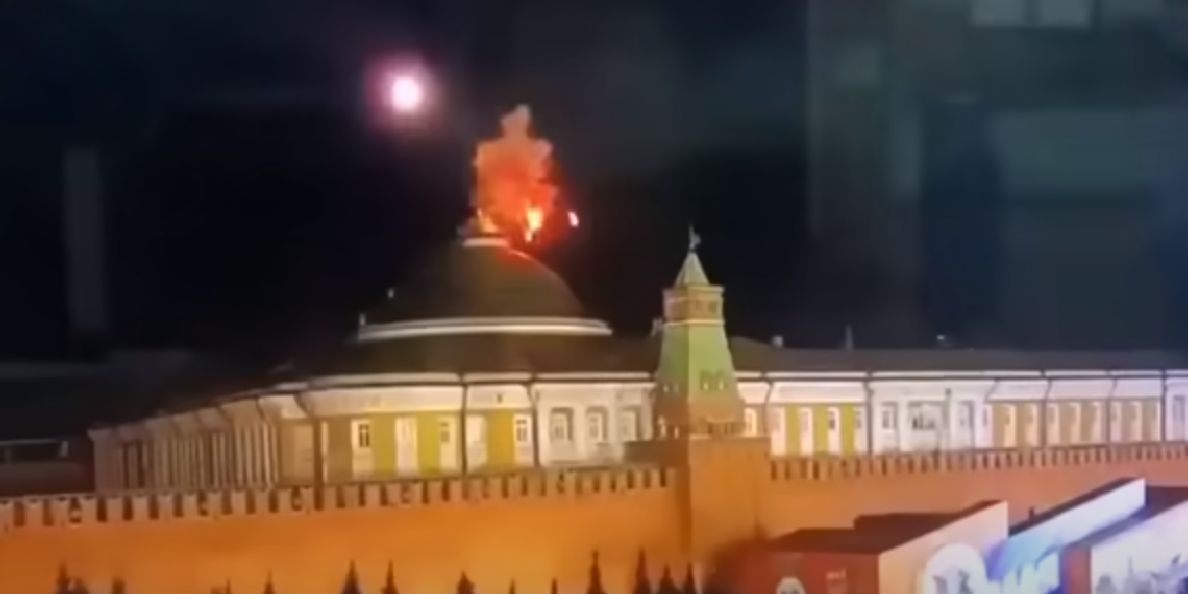
On 3 May 2023, amidst the ongoing Russo-Ukrainian war, two explosive drones allegedly targeted the Kremlin in Moscow and were shot down. President Vladimir Putin was not present in the building at the time and no one was injured in the incident.[2][3][4]
The Kremlin accused Ukraine of perpetrating the incident and called it an "act of terrorism" and an assassination attempt.[2] Ukrainian officials denied involvement, while U.S. officials said it was likely that a Ukrainian intelligence or special military unit was behind the attack.[5]
Incident
[edit]An unverified video posted on social media showed an object flying towards the Kremlin before a small explosion occurred near a flagpole on top of the Kremlin Senate dome. In the footage, two unidentified people were seen climbing the dome.[6] Another video showed smoke rising near the building.[2]
Russian officials claimed that the two drones were disabled with electronic radar assets.[2]
Reactions
[edit]Russia
[edit]On 3 May, Moscow's mayor Sergey Sobyanin announced a no drone zone over the city.[7]
Vyacheslav Volodin, the speaker of Russia's State Duma and ally of Putin, called the alleged drone attack a "terrorist attack" on Russia and compared the Ukrainian government to terrorist organizations such as al-Qaeda and the Islamic State, saying that "The Nazi Kyiv regime must be recognised as a terrorist organisation."[8] Volodin demanded the use of "weapons capable of stopping and destroying the Kyiv terrorist regime".[9] Loyalist and Duma deputy Mikhail Sheremet called for a retaliatory strike against Ukrainian President Zelensky.[8]
Yevgeny Prigozhin, the head of the Wagner military group, cautioned against the use of nuclear weapons, saying that "We look like clowns threatening to use nuclear weapons in response to a child's drone."[10]
Kremlin spokesman Dmitry Peskov claimed that the United States was behind an alleged drone attack on the Kremlin aiming to kill Putin, saying that "We know very well that decisions about such actions, about such terrorist attacks, are made not in Kyiv but in Washington."[11] Leading Kremlin propagandist Vladimir Solovyov compared the incident to the September 11 attacks.[12]
Former president and the current head of Russia's Security Council, Dmitry Medvedev, threatened that "After today's terrorist attack, there are no options left aside the physical elimination of Zelensky and his cabal."[13] State Duma member Andrey Gurulyov said that "We should officially declare that all of the leadership of this terrorist nation is subject to being physically eliminated."[12]
Moscow vowed to retaliate whenever and wherever it deems fit.[14]
Russian dissidents
[edit]Former Russian politician Ilya Ponomarev claimed in a CNN interview that prior to the attack he had spoken with Russian resistance "anti-fascists" who carried it out. According to Ponomarev, the group originally planned the attack to occur on Victory Day, but in April there were discussions where he advised that the attack instead occur prior to the festivities, due the danger to parade crowds, and that because to the sacredness of the day, it might achieve the opposite result due to a rally 'round the flag effect . On his account, the goal of the 3 May drone attack was to force cancellation of the parade so that Russians would understand that the war was lost.[15]
Ukraine
[edit]Ukrainian presidential adviser Mykhailo Podolyak commented that Kyiv had nothing to do with the alleged attack on the Kremlin, that such actions achieved nothing for Kyiv on the battlefield, and would only provoke Russia to take more radical action. Podolyak said that the allegations that Kyiv was behind the incident, and Russia's arrest of alleged Ukrainian saboteurs in Crimea, could indicate that Moscow was preparing for a large-scale "terrorist" attack against Ukraine in the coming days.[16] Ukrainian President Volodymyr Zelensky, while on a visit to Finland stated that, "We don't attack Putin or Moscow. We fight on our territory. We are defending our villages and cities."[2][17] On 3 May 2023, Russian strikes on Ukraine's Kherson Oblast killed 21 people.[18]
Other countries
[edit]U.S. Secretary of State Antony Blinken stated at a global press conference, "I would take anything coming out of the Kremlin with a very large shaker of salt." US officials were skeptical that any drone sent to Ukraine could have been used in the attack, as it would have to travel a long distance to reach Moscow.[19] White House press secretary Karine Jean-Pierre said the US was "not encouraging or enabling Ukraine to strike beyond its border."[17]
Phillips O'Brien, professor of strategic studies at the University of St Andrews, said, "It certainly wasn't an attempt to assassinate Putin, because he doesn't sleep in the roof and he probably never sleeps in the Kremlin." James Nixey, director of the Russia and Eurasia Program at the Chatham House think-tank, said "the two most likely possibilities are a 'warning shot across the bows' by Kyiv or a false flag operation by Moscow designed to justify more intense attacks in Ukraine or more conscription."[17]
U.S. officials said it was likely that a Ukrainian intelligence or special military unit was behind the attack, though they had "low confidence" that the Ukrainian government directly authorized the attack due to U.S. intelligence agencies having not yet identified specific units or officials involved in the attack.[5][20]
See also
[edit]- Drone warfare
- 2022–2023 Western Russia attacks
- 1999 Russian apartment bombings
- 2018 Caracas drone attack, a similar incident with a drone targeting Venezuelan President Nicolás Maduro
- Mathias Rust, who landed a light aircraft near the Kremlin
- 2024 drone attack on Benjamin Netanyahu's residence
References
[edit]- ^ "Атака беспилотников на Кремль. Главное" [Drone attack on the Kremlin. Main]. Kommersant (in Russian). 3 May 2023. Archived from the original on 3 May 2023.
- ^ a b c d e "Kremlin accuses Ukraine of trying to assassinate Putin". BBC News. 3 May 2023. Archived from the original on 3 May 2023. Retrieved 3 May 2023.
- ^ "Russia says Ukraine tried to kill Putin with drone attack on Kremlin". Reuters. 3 May 2023. Archived from the original on 3 May 2023. Retrieved 3 May 2023.
- ^ "Russia Claims It Foiled a Ukrainian Drone Attack on the Kremlin". The New York Times. 3 May 2023. Archived from the original on 3 May 2023. Retrieved 3 May 2023.
- ^ a b Barnes, Julian E.; Entous, Adam; Schmitt, Eric; Troianovski, Anton (24 May 2023). "Ukrainians Were Likely Behind Kremlin Drone Attack, U.S. Officials Say". The New York Times.
- ^ Altman, Howard (3 May 2023). "Drone Attack On The Kremlin In Moscow". The Drive. Archived from the original on 3 May 2023. Retrieved 3 May 2023.
- ^ "Kremlin drone: Zelensky denies Ukraine attacked Putin or Moscow". BBC News. 3 May 2023. Archived from the original on 3 May 2023. Retrieved 3 May 2023.
- ^ a b "Russian lawmakers call for Zelenskyy's residence to be bombed". Ukrainska Pravda. 3 May 2023.
- ^ "'Destroy Kyiv': Russian parliament speaker's call for action over Putin attack". Hindustan Times. 3 May 2023.
- ^ "Russia Accuses U.S. of Helping Kyiv to Plan Kremlin Attack". The Wall Street Journal. 4 May 2023.
- ^ "Kremlin 'lying' about U.S. involvement in Moscow drone strikes, officials say". Politico. 4 May 2023.
- ^ a b "Kremlin Cronies Compare Alleged Drone Attack to 9/11". The Daily Beast. 3 May 2023.
- ^ "Russian hawks demand brutal revenge for Kremlin drone strike 'terrorist attack'". The Telegraph. 3 May 2023.
- ^ "Russia claims Ukraine tried to assassinate Putin in Kremlin drone attack". NBC News. 3 May 2023. Archived from the original on 3 May 2023. Retrieved 3 May 2023.
- ^ Ponomarev, Ilya (9 May 2023). Hear why ex-Russian politician said Putin was afraid on Victory Day (Television production). Amanpour & Company. CNN interviewer Christian Amanpour. Main claims occur at time (mm:ss)- 3:24. Retrieved 24 May 2023.
- ^ "Ukraine says it has nothing to do with Kremlin drone attack". Reuters. 3 May 2023. Archived from the original on 3 May 2023. Retrieved 3 May 2023.
- ^ a b c "Ukraine denies Russian claim Kyiv sent drones to hit Kremlin". ABC News. 3 May 2023.
- ^ "Kremlin drone: Zelensky denies Ukraine attacked Putin or Moscow". BBC News. 3 May 2023. Archived from the original on 3 May 2023. Retrieved 3 May 2023.
- ^ "Russia claims Ukraine tried to assassinate Putin in Kremlin drone attack". NBC News. 3 May 2023. Archived from the original on 3 May 2023. Retrieved 3 May 2023.
- ^ Cohen, Zachary; Bertrand, Natasha (24 May 2023). "US intelligence indicates Ukrainians may have launched drone attack on Kremlin". CNN.
External links
[edit]
Kremlin drone attack
View on GrokipediaBackground
Context in the Russo-Ukrainian War
The full-scale Russian invasion of Ukraine commenced on 24 February 2022, intensifying a conflict rooted in Russia's 2014 annexation of Crimea and backing of separatist forces in the Donbas region. Russian objectives, as articulated by President Vladimir Putin, encompassed the demilitarization and denazification of Ukraine, alongside securing recognition for the independence of the self-proclaimed Donetsk and Luhansk People's Republics. Initial Russian advances captured substantial southern and eastern territories, including Kherson and parts of Kharkiv oblast, but met determined Ukrainian resistance bolstered by Western arms, leading to a Russian withdrawal from Kyiv and northern areas by April 2022. By late 2022, Russian forces had consolidated gains in Donbas, controlling roughly 18% of Ukraine's territory through attritional offensives like the battle for Bakhmut.[10][11][12] These territorial advances strained Ukraine's conventional defenses, prompting a pivot to asymmetric tactics emphasizing long-range precision strikes to target Russian logistics and command infrastructure beyond the front lines. Ukraine integrated Western-provided systems, such as Turkish Bayraktar TB2 drones for reconnaissance and strikes, with indigenous adaptations of commercial quadcopters and fixed-wing UAVs for extended reach, often exceeding 500 kilometers. This doctrinal shift compensated for artillery and manpower disparities, aiming to erode Russian sustainment capabilities amid Moscow's focus on grinding eastern gains following Ukraine's successful Kharkiv counteroffensive in September 2022.[13][14][12] Empirical patterns of Ukrainian drone incursions into Russian airspace escalated in late 2022, with operations targeting airfields hosting bombers conducting strikes on Ukraine. On 5 December 2022, drones hit the Engels-2 air base near Saratov—over 600 km from the border—killing three Russian personnel and damaging aircraft used for missile launches against Ukrainian cities. Concurrently, attacks struck the Dyagilevo airfield in Ryazan oblast, further inland, exposing vulnerabilities in Russian air defenses and foreshadowing strikes on high-value symbolic sites. These pre-2023 incidents, totaling several documented deep penetrations, underscored Ukraine's growing capacity to impose asymmetric costs, correlating with intensified Russian missile campaigns and frontline stalemates.[15][16][17][18]Prior Ukrainian drone operations against Russian territory
On December 5, 2022, Ukrainian drones targeted two Russian airbases deep inside the country: Engels-2 in Saratov Oblast, which houses Tu-95MS strategic bombers responsible for missile launches against Ukraine, and Dyagilevo in Ryazan Oblast. Russian defense officials confirmed the use of several aircraft-type drones launched from Ukraine, reporting that most were intercepted but explosions occurred, including a fire at Dyagilevo that damaged a hangar and potentially affected aircraft. Independent analysis indicated the strikes marked one of the earliest confirmed instances of Ukrainian drones reaching targets approximately 600 kilometers from the Ukrainian border.[19][20] A follow-up strike occurred on December 26, 2022, at Engels airbase, where Ukrainian drones evaded defenses to hit the facility, killing three Russian servicemen and injuring four others, according to the Russian Defense Ministry. The ministry described the attack as involving a small number of drones that caused an explosion and fire, damaging aviation equipment. Satellite imagery subsequently showed scorch marks on the tarmac near Tu-95 bombers and confirmed the destruction of at least one turboprop strategic bomber.[15][21] These late-2022 operations reflected an evolution in Ukrainian drone capabilities, shifting from short-range reconnaissance and tactical uses near the front lines to long-range, fixed-wing one-way attack drones engineered for precision strikes over extended distances. Russian interceptions admitted the employment of such systems, underscoring Ukraine's adaptation of commercial and custom designs to bypass air defenses and target strategic assets like bomber fleets used in the air campaign against Ukrainian cities. Earlier in 2022, Ukrainian drone activity against Russian territory was more limited to border-adjacent areas, such as reported incursions into Belgorod and Kursk oblasts, but lacked the depth and impact of the December airbase assaults.[22]The Incident
Timeline and sequence of events
Russian authorities reported that two Ukrainian drones were detected approaching the Kremlin in the early morning hours of May 3, 2023, Moscow time.[23] The first drone was intercepted and exploded above the Kremlin Senate Palace around 2:15 a.m., followed approximately 15 minutes later by a second drone interception shortly before 2:30 a.m., producing a visible fireball near the dome.[24][25] Russian air defense systems activated to neutralize the incoming threats, downing both drones over the Kremlin grounds without any reported casualties or immediate structural damage to the complex.[26][27] By midday on May 3, Russian state media outlets released surveillance videos capturing the interceptions and explosions, prompting an official Kremlin statement later that day accusing Ukraine of orchestrating the attack as an assassination attempt on President Vladimir Putin.[23] The statement emphasized that the drones were repelled before reaching their target, with no injuries or harm to Kremlin structures.[26]Description of the attack and visual evidence
On the early morning of May 3, 2023, two unmanned aerial vehicles targeted the Kremlin complex in Moscow, specifically approaching the Senate Palace dome. Russian authorities reported that air defense systems intercepted the drones, causing them to explode in mid-air.[28][29] Verified video footage captured the incidents approximately 15 minutes apart, with the first drone approaching from the south and the second from the east, resulting in bursts of light, smoke, and a brief fire above the dome.[29][30] One clip shows individuals on the dome roof ducking just before an explosion, while another depicts a small blast and rising smoke near the structure.[30] The observable physical effects included minor scorching and debris on the Senate Palace dome, with no reported injuries to personnel or significant structural damage.[29][28] Social media videos, timestamped around 2:30 a.m. local time and geolocated to the Kremlin perimeter via surrounding landmarks and metadata, provide the primary visual evidence, corroborated by outlets like Russian state media TV Centre.[29][28]Technical Aspects
Drone characteristics and capabilities
The drones reportedly used in the incident were small fixed-wing unmanned aerial vehicles (UAVs), characterized by low-altitude flight profiles designed to minimize radar detection.[31] These UAVs featured basic propulsion systems, enabling speeds sufficient for urban penetration while maintaining stealth through terrain-hugging navigation. Russian accounts described the devices as compact, with one neutralized via electronic warfare redirection leading to an airburst detonation, indicating limited structural robustness and reliance on simple guidance rather than advanced countermeasures resistance.[30] Payload capacities were modest, estimated at under 10 kg of explosives based on the observed air explosion and minor roof fire on the Senate Palace, which produced a localized blast without significant structural damage.[31] This aligns with warheads in commercially adapted strike drones, often improvised from available munitions like grenades or small charges, prioritizing volume over destructive power for symbolic or precision effects. Guidance systems likely incorporated GPS or satellite-aided inertial navigation for long-range transit, as evidenced by the drones' ability to approach from divergent directions despite reported jamming attempts.[32] Operational range supported flights of 500–1,000 km, feasible from border regions such as Ukraine's Sumy oblast to Moscow, using fuel-efficient fixed-wing designs with endurance of several hours.[32] Comparative analysis with captured Ukrainian one-way attack UAVs reveals similarities in construction, including lightweight composites and modular payloads, matching mass-produced models like those employed in prior deep strikes.[32] These features—autonomous waypoint following and basic warhead integration—mirror adaptations from civilian fixed-wing platforms, enabling evasion of initial detection layers through low observability and pre-programmed routes.[33]Feasibility of the attack from Ukrainian-controlled areas
The straight-line distance from the nearest Ukrainian-controlled territories, such as areas in Sumy or Kharkiv oblasts adjacent to the Russian border, to central Moscow is approximately 450-523 kilometers.[34] [35] This falls within the operational range demonstrated by Ukrainian drone strikes on Russian targets in 2023, including attacks on energy infrastructure like the Ryazan oil refinery, roughly 400 kilometers from the border, and airbases such as Engels, over 600 kilometers away.[28] Such precedents indicate that Ukrainian forces possessed the technical capacity for one-way drone missions covering similar or greater distances using commercially adapted or purpose-built unmanned aerial vehicles with extended loiter times and basic navigation systems. Logistically, executing a launch from Ukrainian-controlled areas would entail covert transportation of drones—likely disassembled for concealment—via ground routes or prepositioning in forward positions near the border, followed by on-site assembly and remote piloting or autonomous guidance. Ukrainian operations in Belgorod Oblast in 2023, involving multiple drone incursions despite proximity to Russian defenses, serve as empirical evidence of successful cross-border deployment tactics, including low-altitude flights to minimize detectability.[36] These strikes, which penetrated Russian airspace repeatedly, highlight the feasibility of infiltrating contested zones through coordinated decoy or swarm tactics, though risks of interception during transit remain high due to Russian border surveillance and electronic warfare (EW) jamming. Russian air defenses around Moscow, anchored by S-400 systems with detection ranges up to 400 kilometers, provide robust protection against high-altitude or ballistic threats but exhibit vulnerabilities to small, low-flying drones exploiting terrain masking, urban clutter, and approach corridors not fully saturated by radar coverage.[37] Analysts have observed that Pantsir and S-400 batteries cannot seal every potential ingress path into the capital, enabling penetration via evasive maneuvers at altitudes below 100 meters, as corroborated by patterns in intercepted Ukrainian drones during prior Moscow-region incursions.[38] While EW systems disrupt GPS and communications, Ukrainian adaptations—such as inertial navigation or visual waypoint guidance—have proven effective in sustaining strikes deep into Russian territory, underscoring the operational plausibility despite layered countermeasures.Attribution and Claims
Russian government's accusations
On May 3, 2023, the Kremlin press service announced that Ukrainian forces had launched two drones at the Kremlin complex in an attempted assassination of President Vladimir Putin, labeling the incident a "planned terrorist attack" orchestrated by Kyiv's special services.[23] The statement specified that one drone approached the Senate Palace and the other the dome of the Government Tower, but both were disabled by Russian air defenses before impact, with no harm to Putin or damage to Kremlin structures.[23] Russian authorities framed the strike as evidence of Ukraine's intent to target symbolic and civilian-adjacent sites in Moscow, escalating the conflict beyond the frontline.[2] In response, the Kremlin declared that Russia "reserves all the right to take retaliatory measures where and when it sees fit," positioning the attack as justification for intensified countermeasures against perceived Ukrainian aggression.[23] Kremlin spokesman Dmitry Peskov elaborated that the operation demonstrated Kyiv's reliance on Western-supplied technology, initially attributing ultimate decision-making to the United States by stating that "such decisions are not made in Kyiv, but in Washington."[39] This narrative tied the incident to broader accusations of NATO orchestration, though Russian officials subsequently emphasized Ukrainian culpability without repeating the U.S. direct involvement claim in public statements.[40]Ukrainian government's denial and counter-narratives
President Volodymyr Zelenskyy denied Ukrainian involvement in the May 3, 2023, incident, stating that Ukraine did not target Putin or Moscow and that its forces were focused on frontline defense against Russian military advances.[41] [26] The Ukrainian government rejected Moscow's accusations outright, describing them as unsubstantiated and intended to divert attention from Russia's ongoing aggression.[26] Ukrainian presidential adviser Mykhailo Podolyak advanced counter-narratives portraying the event as a likely Russian-staged provocation, arguing that the visuals and timing—occurring days before Russia's Victory Day parade on May 9—served propagandistic aims by fabricating a narrative of existential threat to justify domestic crackdowns and escalation.[42] Podolyak characterized the released footage as contrived, suggesting it highlighted Russian vulnerabilities rather than demonstrating Ukrainian aggression, and implied poor strategic optics for the Kremlin amid stalled advances in Ukraine.[42] Officials from Ukraine's Security Service (SBU) alluded to broader patterns of internal Russian sabotage networks potentially enabling such operations, aligning with reports of pro-Ukrainian partisans conducting strikes within Russia, though the SBU did not explicitly claim responsibility or attribute the Kremlin incident to domestic actors.[43] These narratives framed the denial as part of Kyiv's emphasis on Russia's history of information manipulation to sustain war momentum.[41]Claims by Russian anti-war groups
Russian anti-war activist and former State Duma deputy Ilya Ponomarev attributed the May 3, 2023, drone attack on the Kremlin to partisan groups consisting of Russian nationals operating clandestinely within Russia. In an interview with CNN on the day of the incident, Ponomarev stated that the operation was conducted by "one of the Russian partisan groups" to expose the regime's vulnerabilities and bolster domestic opposition to the war in Ukraine, rather than as a state-sponsored Ukrainian action.[44] He noted that these groups had not yet publicly claimed responsibility, distinguishing their insider tactics—such as smuggling compact drones into Moscow for short-range launches—from long-distance strikes originating from Ukrainian-controlled territory.[42] Ponomarev, who coordinates with various dissident networks from exile in Ukraine, framed the attack as part of a broader pattern of sabotage aimed at eroding President Vladimir Putin's authority ahead of the 2024 Russian presidential election. These partisans, he argued, seek to accelerate anti-war sentiment by highlighting security lapses in the heart of Russian power, drawing parallels to earlier unclaimed disruptions attributed to similar factions.[30] Unlike cross-border incursions by exile-based units such as the Freedom of Russia Legion or Russian Volunteer Corps—which publicly claimed raids into Belgorod and Bryansk regions later in May 2023—the Kremlin operation allegedly relied on operatives embedded in Russia to evade detection and minimize logistical footprints.[45] No verifiable evidence of direct involvement by named groups emerged, and Ponomarev's assertion remained unconfirmed by independent sources at the time.[41]Evidence and Analysis
Forensic and video evidence examination
Russian authorities stated that fragments recovered from the incident resembled components used in Ukrainian unmanned aerial vehicles, including foam wings and off-the-shelf commercial parts such as GPS modules and electric motors, which are characteristic of improvised long-range drones employed by Ukraine in prior strikes deep into Russian territory. However, no physical debris from the Kremlin site was made publicly available for independent verification, and forensic access by third parties remains unconfirmed, limiting assessments to official Russian descriptions.[28] Open-source video analysis geolocated multiple recordings to the Kremlin complex walls, specifically near the Senate Palace, using visual matches to architectural features and timestamp correlations from May 3, 2023, around 02:00-03:00 local time.[29] Frame-by-frame examination of the footage reveals an initial object trajectory followed by an explosion at an estimated altitude of 100 meters above ground level, producing a fireball and smoke plume consistent with a small drone's warhead detonation or structural failure under electronic jamming.[41] The videos, circulated on Russian Telegram channels and verified by outlets including The New York Times, show no evidence of ground impact prior to the burst, aligning with air interception scenarios.[29] Notable evidentiary gaps include the absence of released radar tracks or telemetry data from Russian air defenses, which could corroborate interception claims or reveal approach vectors.[46] Speculation regarding digital manipulation of videos has circulated in online discussions, citing inconsistencies in lighting and shadows, but no forensic authentication tools have confirmed alterations, and multiple angles from independent sources reduce the likelihood of wholesale fabrication.[41] These limitations underscore reliance on unverified official narratives for physical remnants while video evidence provides the primary visual record.[42]Independent expert assessments and intelligence reports
U.S. intelligence agencies concluded that Ukrainian operatives likely conducted the drone attack on the Kremlin on May 3, 2023, based on operational patterns matching prior Ukrainian strikes deep into Russian territory, including the use of small, low-payload drones that bypassed Russian air defenses without triggering alerts.[8] Officials emphasized that the operation was probably not authorized at the highest levels of the Ukrainian government, such as by President Zelenskyy, pointing to rogue elements or mid-level actors within Ukraine's security apparatus.[47] This assessment contrasted with skepticism from some analysts regarding Russian false flag theories, as the demonstrated Ukrainian technical feasibility—evidenced by contemporaneous strikes on Russian oil facilities—aligned more closely with Kyiv's asymmetric warfare doctrine than with Moscow's incentives for self-inflicted damage ahead of Victory Day celebrations.[42] Think tank evaluations, such as those weighing strategic intent, viewed the incident as a potential Ukrainian demonstration of reach to deter Russian complacency, despite the political costs of inviting escalation rhetoric from Moscow; false flag scenarios were dismissed as improbable given Russia's robust internal security and the causal mismatch of staging an "attack" that caused negligible damage yet amplified narratives of existential threat.[38] Open-source intelligence efforts identified drone characteristics consistent with Ukrainian-modified commercial models exported or adapted for long-range use, though no definitive forensic linkage to a specific perpetrator emerged, underscoring the limitations of visual and telemetry data in attributing covert operations amid information asymmetries.[48] Overall, empirical indicators favored Ukrainian involvement over alternative theories, prioritizing observed capabilities and historical precedents over speculative motives lacking corroboration.[49]Reactions
Russian official responses
Russian officials described the May 3, 2023, drone incident over the Kremlin as a premeditated terrorist attack by Ukraine intended to assassinate President Vladimir Putin. Kremlin spokesman Dmitry Peskov announced that two unmanned aerial vehicles were aimed at the Kremlin complex in the early hours, where Putin was working elsewhere, and asserted that Russian air defenses neutralized the drones mid-air before they could cause significant harm. Peskov labeled the operation a "planned terrorist attack" prepared abroad, warning that Russia would determine the timing, location, and nature of its countermeasures independently.[23][2] Russia's Investigative Committee promptly opened a criminal case classifying the event as an act of terrorism and attempted murder of a state official, citing evidence of coordinated drone deployment from Ukrainian-controlled territory. This legal action underscored Moscow's portrayal of the incident as a direct threat to national leadership, prompting internal security enhancements around key government sites and amplifying rhetoric equating Ukrainian leadership with international terrorism.[50][51] President Putin, briefed on the matter, integrated the attack into narratives of existential aggression by the "Kyiv regime," minimizing structural damage—limited to shattered windows and debris—but emphasizing its symbolic intent to destabilize Russia ahead of Victory Day celebrations. In public addresses throughout May 2023, Putin invoked the episode to justify escalated defensive postures and military resolve, framing it as evidence of Ukraine's shift toward asymmetric terror tactics that crossed previous thresholds, thereby bolstering domestic calls for sustained mobilization and retaliatory precision strikes on Ukrainian command infrastructure.[52][53]Ukrainian official responses
President Volodymyr Zelenskyy denied Ukrainian involvement in the May 3, 2023, drone incident over the Kremlin, stating that Ukraine does not attack Putin or Moscow and focuses its military efforts on defending its own territory.[54] [7] The presidential office similarly asserted that it was unaware of any such operation and had not authorized drone strikes on the Russian capital, emphasizing that Ukraine's actions are limited to countering Russian aggression on Ukrainian soil.[55] This response was issued promptly on the day of the incident, as part of a broader media strategy to refute Russian accusations of an assassination attempt while redirecting attention to ongoing Russian missile strikes against Ukrainian cities.[56] Kyiv's communications framed the event as a potential Russian provocation designed to escalate the conflict and justify intensified attacks on Ukraine, without conceding any Ukrainian strike capability that could invite international sanctions or heightened Russian retaliation.[57] Zelenskyy reiterated Ukraine's policy of selective targeting, publicly acknowledging strikes on Russian military infrastructure but excluding direct threats to Putin or symbolic sites in Moscow to maintain alignment with Western partners' preferences for de-escalatory rhetoric.[7] Domestically, officials portrayed the Kremlin's claims as psychological operations to demoralize Ukrainians and garner domestic Russian support for the war, coupling denials with renewed appeals for accelerated Western military aid to bolster air defenses against verified Russian bombardments.[42] These responses maintained consistency with prior Ukrainian admissions of long-range drone operations against Russian logistics but drew a firm line against operations in the Russian capital, preserving a narrative of restraint that supports ongoing diplomatic efforts for arms supplies and sanctions on Russia.[54] By pivoting to defensive imperatives and Russian aggression, Kyiv sought to reinforce the legitimacy of its cause amid the incident's timing before Russia's Victory Day celebrations on May 9, 2023.[28]International reactions and statements
The United States rejected Russian allegations of American involvement in the May 3, 2023, drone incident over the Kremlin, with National Security Council spokesperson John Kirby describing the claims as a "blatant, bold lie" and emphasizing that Washington had no prior knowledge of any such operation.[58] [59] U.S. officials urged restraint amid heightened tensions, while privately assessing that Ukrainian personnel likely conducted the attack without authorization from Kyiv's senior leadership, based on intercepted communications and forensic indicators pointing to non-state or rogue elements within Ukraine.[8] This evaluation underscored Washington's caution against escalation, prioritizing de-escalation to prevent broader NATO-Russia confrontation despite ongoing support for Ukraine's defense.[60] NATO issued no formal collective statement attributing blame or endorsing Russian narratives, reflecting alliance-wide restraint to avoid validating unverified claims that could provoke Russian retaliation against member states.[28] European Union officials similarly focused on calls for dialogue and risk reduction, with spokespersons highlighting the need to protect civilian infrastructure amid mutual drone and missile exchanges, without confirming the Kremlin's terrorism designation.[42] China's Foreign Ministry advocated restraint from all parties involved, stating on May 4, 2023, that escalation should be avoided and expressing hope that the incident would not hinder diplomatic efforts toward peace in Ukraine.[61] Beijing characterized the event as potentially linked to "extremist" actions rather than state-directed policy, aligning with its broader neutral stance that refrains from endorsing either side's military assertions.[62] India maintained silence on direct attribution, consistent with its policy of non-alignment, issuing no official condemnation or support for Moscow's version while emphasizing de-escalation in regional forums to safeguard multilateral stability.[63] United Nations officials did not issue a targeted response to the Kremlin incident, though subsequent Security Council briefings in May 2023 reiterated concerns over escalating drone usage risking civilian casualties and infrastructure damage across conflict zones, without specifying responsibility.[64] Western media analyses, drawing from open-source video and expert forensics, frequently questioned the Kremlin's account by noting inconsistencies such as minimal damage and potential for internal staging to justify reprisals, while Russian-aligned outlets amplified the terrorism framing to bolster domestic narratives.[42] [57] [65]Implications and Aftermath
Russian military and rhetorical escalations
In the days following the May 3, 2023, drone attack on the Kremlin, Russian forces intensified aerial operations against Ukraine, launching a massive barrage of missiles and drones on Kyiv on May 4 that Ukrainian military officials described as the most severe assault on the capital since the invasion's outset, involving over 30 projectiles and resulting in civilian casualties and infrastructure damage.[66] This uptick aligned with a broader pattern, as United Nations data indicated Russian missile and drone strikes across Ukraine nearly tripled in volume during May 2023 relative to prior months, targeting energy facilities and urban areas with hypersonic Kinzhal missiles and Shahed-type drones in coordinated waves.[64] Russian military spokespersons presented these actions as measured countermeasures to Ukrainian incursions on sovereign territory, though independent analyses noted the strikes' disproportionate impact on non-military sites without direct attribution to the Kremlin event in official briefings.[67] Rhetorically, the incident prompted heightened warnings from Russian leadership about breached thresholds for response. President Vladimir Putin characterized the drone strike as a deliberate terrorist operation targeting him personally, stating it necessitated retaliatory measures to deter further aggression, while Foreign Minister Sergey Lavrov invoked "red lines" on attacks against core Russian institutions, paralleling earlier doctrinal statements on escalation without specifying nuclear options or deployments.[30] Pro-Kremlin figures amplified calls for severe reprisals, with some advocating strikes on Ukrainian leadership, though Moscow's official posture emphasized restraint to avoid uncontrolled broadening of the conflict.[68] Operationally, the event exposed gaps in Moscow's defenses, leading to reallocations of air defense assets; reports indicated the transfer of additional S-400 and Pantsir systems to the capital's periphery in subsequent weeks to counter low-altitude drone threats, alongside temporary airspace closures and increased electronic warfare deployments.[69] These adjustments reflected a doctrinal pivot toward prioritizing homeland protection amid persistent Ukrainian drone penetrations, without altering frontline commitments in Ukraine.[70]Broader impact on information warfare and deterrence
The Kremlin drone incident of May 3, 2023, amplified Russia's portrayal of Ukraine as a terrorist actor striking at the symbolic core of the state, enabling Kremlin-controlled media to reinforce narratives of national peril and NATO orchestration, which polls indicated boosted domestic approval for the war effort by framing the event as an existential assault requiring unified resolve.[71] Ukrainian denials positioned the attack as a potential Russian self-inflicted provocation to justify escalation, a line echoed in some Western commentary that proliferated false flag theories—such as claims of staged pyrotechnics—despite video evidence of aerial objects and explosions over the Kremlin Senate, with analyses from outlets like Business Insider deeming it "likely" self-staged based on Russia's history of such operations but without forensic corroboration.[72] This narrative contestation, where mainstream Western sources often defaulted to skepticism of Moscow's account amid institutional biases favoring Kyiv's perspective, diluted scrutiny of empirical indicators like the drones' trajectory and interception, thereby complicating attribution and allowing propaganda on both sides to exploit ambiguity for perceptual advantage. From a deterrence standpoint, the event empirically challenged Russia's doctrine of territorial sanctuary, as verified footage and subsequent admissions revealed Ukrainian drones penetrating Moscow's airspace undetected initially, eroding the regime's aura of impregnability and prompting public statements from officials like Vladimir Putin that such strikes aimed to terrorize civilians.[73] Post-incident data shows a marked uptick in deep strikes, with drone incursions on Moscow intensifying: for instance, a May 30, 2023, swarm involved at least eight drones targeting residential areas, causing minor damage and injuries, while broader patterns through 2023 saw attacks on oil infrastructure and airfields escalate, correlating with Ukraine's adaptation of commercial drone tech for asymmetric reach.[74] This compelled Russian countermeasures, including expanded electronic warfare deployments that neutralized three drones in the May 30 episode via jamming, alongside accelerated procurement of anti-drone systems, reflecting a causal shift toward hardening urban defenses against low-cost, high-impact threats.[73] Yet, the unchecked spread of unproven false flag hypotheses in Western media—often amplified without balancing evidence of Ukrainian operational patterns—risked undermining deterrence signaling by normalizing doubt over verified capabilities, potentially emboldening adversaries through perceived narrative impunity. Longitudinally, the lack of conclusive attribution has entrenched information silos, fostering a hybrid stalemate where unresolved claims perpetuate distrust and hinder strategic learning, as neither empirical video analysis nor intelligence leaks have yielded a consensus beyond partisan interpretations.[42] Strike frequency metrics proxy this inertia: Ukrainian drone operations deep into Russia surged post-May 2023, with 2023-2024 records of refinery hits and airfield raids indicating sustained pressure rather than deterrence collapse, yet Russian adaptations like layered air defenses have contained urban impacts, prolonging attritional dynamics without decisive shifts.[75] This interplay underscores how biased sourcing—evident in Western outlets' predisposition to Kyiv-favorable framing over causal dissection of drone proliferation—obscures lessons on technological parity, where information warfare sustains perceptual equilibria at the expense of verifiable escalation drivers.References
- https://www.[snopes](/page/Snopes).com/fact-check/ukraine-attack-kremlin-in-russia-with-drone/
- https://www.[cnbc](/page/CNBC).com/2023/05/04/did-russia-stage-the-kremlin-drone-attack-it-blamed-on-ukraine-.html
