Hubbry Logo
Yevgeny PrigozhinYevgeny PrigozhinMain
Open search
Yevgeny Prigozhin
Community hub
Yevgeny Prigozhin
logo
35 pages, 0 posts
0 subscribers
Be the first to start a discussion here.
Yevgeny Prigozhin
Yevgeny Prigozhin
from Wikipedia

Yevgeny Viktorovich Prigozhin[a][b] (1 June 1961 – 23 August 2023) was a Russian mercenary leader, rebel commander, and oligarch.[5] He led the Wagner Group, a private military company, and was a close confidant of Russian president Vladimir Putin until launching a rebellion in June 2023.[6] Prigozhin was sometimes referred to as "Putin's chef" because he owned restaurants and catering businesses that provided services to the Kremlin.[7] Once a convict in the Soviet Union,[8] Prigozhin controlled a network of influential companies whose operations, according to a 2020 investigation, were "tightly integrated with Russia's Defence Ministry and its intelligence arm, the GRU".[9]

Key Information

In 2014, Prigozhin reportedly founded the Wagner Group[10][11][12] to support Russian separatist forces in Ukraine. Funded by the Russian state, it played a significant role in Russia's invasion of Ukraine and supported Russian interests in Syria and in Africa. In November 2022, Prigozhin acknowledged his companies' interference in United States elections.[13] In February 2023, he confirmed that he was the founder and long-time manager of the Internet Research Agency, a Russian company running online propaganda and disinformation campaigns.

Prigozhin's companies and associates, and formerly Prigozhin himself, are subject to economic sanctions and criminal charges in the United States[14] and the United Kingdom.[15] In October 2020, the European Union (EU) imposed sanctions against Prigozhin for his financing of the Wagner Group's activities in Libya. In April 2022, the EU imposed further sanctions on him for his role in the Russian invasion of Ukraine.[16] The FBI offered a reward of up to $250,000 for information leading to Prigozhin's arrest.[17][18]

Prigozhin openly criticized the Russian Defense Ministry for corruption and mishandling the war against Ukraine. Eventually, he said the reasons they gave for invading were lies.[19] On 23 June 2023, he launched a rebellion against the Russian military leadership. Wagner forces captured Rostov-on-Don and advanced toward Moscow.[20] The rebellion was called off the following day, and the criminal charges against Prigozhin were dropped after he agreed to relocate his forces to Belarus.[21] On 23 August 2023, exactly two months after the rebellion,[22] Prigozhin was killed along with nine other people when a business jet crashed in Tver Oblast, north of Moscow.[23] The Wall Street Journal cited sources within the US government as saying that the crash was likely caused by a bomb on board or "some other form of sabotage".[24][25] Since then, researchers and other analysts have reached the conclusion that an on-board bomb or explosive likely downed the plane.[26][27][28][29]

Early life and education

[edit]

Yevgeny Viktorovich Prigozhin was born an only child on 1 June 1961 in Leningrad, Soviet Union (now Saint Petersburg, Russia).[30][31][32] His mother, Violetta Kirovna Prigozhina, was a hospital nurse.[30][33] His father, Viktor Yevgenyevich Prigozhin, was a mining engineer who died when Yevgeny was nine.[33][34] His grandfather, Yevgeny Ilyich Prigozhin, was a captain in the Red Army during World War II, who fought in the Battles of Rzhev and received a medal "For Courage".[35][36] Prigozhin sponsored the 2020 war film Rzhev [ru], based on a 1991 novel by Vyacheslav Kondratyev [ru] that mentions his grandfather.[37]

His father and stepfather are believed to be of Jewish descent.[38] Prigozhin's great-uncle was Soviet scientist Yefim Ilyich Prigozhin [ru].[39] He settled with Yefim for several years during his childhood in the Ukrainian city of Zhovti Vody, where he worked in an open-pit uranium mine.[40][39]

His stepfather, Samuil Fridmanovich Zharkoi, was a ski instructor and introduced Prigozhin to cross-country skiing.[41][42] Aspiring to be a professional skier, he graduated from Leningrad Sports Boarding School No. 62 [ru] in 1977.[43][30] However, he abandoned his sports career after an injury.[33][44] He later worked as a fitness trainer at a children's sports school.[33]

Criminal history and imprisonment

[edit]

In 1979, 18-year-old Prigozhin was caught stealing and was given a suspended sentence of two years and six months in prison. He served his sentence working at a chemical plant in Veliky Novgorod.[45][46]

In 1980, he returned to Leningrad and joined a gang.[33][45] He participated in a burglary spree in Leningrad, before being caught after choking a woman on the street during a robbery, with him and accomplices then stealing the woman's earrings and boots.[45][47] In 1981, he was sentenced to twelve years imprisonment in a high-security penal colony for robbery, theft, fraud, and involving minors in criminal activity.[47][43]

According to Prigozhin, he violated the terms of his solitary confinement "on a regular basis" until he was sent to general population in 1985, where he started to "read intensively" and worked as a lathe operator, tractor driver, and cabinet maker after receiving training at a vocational school.[33] In 1988, the Supreme Court of the Soviet Union reduced his sentence to ten years on good behavior, noting that he had begun "corrective behavior".[42][33] He was sent to a medium-security penal colony and was released in 1990.[42]

In total, Prigozhin spent nine years in detention.[8][32] Immediately after his release, he started attending the Leningrad Chemical and Pharmaceutical Institute to get a pharmaceutical degree, but failed to complete his studies.[34][48] Prigozhin would later flaunt his prison past to convince prisoners to join the Wagner Group.[49]

Early career and rise to prominence

[edit]
Prigozhin (standing in background) hosted Russian President Putin and US President George W. Bush on his floating restaurant New Island in Saint Petersburg on 25 May 2002.

After his release from prison in 1990, Prigozhin began selling hot dogs alongside his mother and stepfather at the Apraksin Dvor open-air market in Leningrad.[43] Soon, according to a New York Times interview with him, "the rubles were piling up faster than his mother could count them".[50]

From 1991 to 1997, Prigozhin was heavily involved in the grocery store business. He became 15% stakeholder and manager of Contrast, which was the first grocery store chain in Saint Petersburg and founded by his former classmate Boris Spektor.[51]

Around the same time, Prigozhin became involved in the gambling business. Spektor and Igor Gorbenko brought Prigozhin on as CEO of Spectrum CJSC (Russian: ЗАО «Спектр»), which founded the first casinos in Saint Petersburg.[52][53] This trio went on to create many other businesses together throughout the 1990s across various industries, including construction, marketing research, and foreign trade. Novaya Gazeta notes that this may be when Prigozhin met Vladimir Putin for the first time, as Putin had been chairman of the supervisory board for casinos and gambling since 1991.[7][c]

In 1995, Prigozhin entered the restaurant business. When revenues of his other businesses began to fall, Prigozhin persuaded a director at Contrast, Kirill Ziminov, to open a restaurant with him. They opened Prigozhin's first restaurant: Old Customs House (Russian: Старая Таможня) in Saint Petersburg. In 1997, they founded a second restaurant, New Island, a floating restaurant that became one of the most fashionable dining spots in the city. Inspired by waterfront restaurants on the Seine in Paris, Prigozhin and Ziminov created the restaurant by spending US$400,000 to remodel a rusting boat on the Vyatka River.[43][50] He said his patrons "wanted to see something new in their lives and were tired of just eating cutlets with vodka".[50] Before Prigozhin decided to focus on upscale dining, one of his dining establishments initially featured a striptease show.[64][65] Prigozhin was reportedly known to punish poor performance or misconduct of employees of his catering businesses with physical violence.[66]

In 2001, Prigozhin personally served food to Vladimir Putin and French president Jacques Chirac when they dined at New Island. He hosted US president George W. Bush in 2002. In 2003, Putin celebrated his birthday at New Island.[50]

Touring the Concord Catering factory in 2010. Left to right: Presidential envoy to the Northwestern Federal District Ilya Klebanov, Chief Sanitary Inspector Gennady Onishchenko, Leningrad Oblast Governor Valery Serdyukov, Prime Minister Vladimir Putin, Concord factory director Yevgeny Prigozhin.

Over the course of the 2000s, Prigozhin grew closer to Vladimir Putin. By 2003, he left his business partners and established his own independent restaurants. Notably, one of Prigozhin's companies, Concord Catering, began winning numerous government contracts. He received hundreds of millions in government contracts for feeding school children and government workers.[67][68] In 2012, he received a contract to supply meals to the Russian military worth US$1.2 billion over one year. Some of the profits from this contract are alleged to have been used to start and fund the Internet Research Agency.[69]

On 11 December 2018, a company claimed to be unaffiliated with Concord Catering called Msk LLC (Russian: ООО "Мск") was paid 2.5 million rubles for an annual "Heroes of the Fatherland Day" banquet held at the Kremlin. However, Msk LLC shares the same contact phone number with Concord. On 11 December 2019, the company received another 4.1 million rubles for another banquet.[70]

In 2012, he moved his family into a Saint Petersburg compound with a basketball court and a helicopter pad. By this point he owned a private jet and a 115-foot (35 m) yacht.[68] Prigozhin was later linked to several aircraft, including two Cessna 182s as well as Embraer Legacy 600, British Aerospace 125, and Hawker 800XP jets.[71]

The Anti-Corruption Foundation accused Prigozhin of corrupt business practices. In 2017, they estimated his illegal wealth to be worth more than one billion rubles.[72] Alexei Navalny alleged that Prigozhin was linked to a company called Moskovsky Shkolnik (Moscow Schoolboy) that had supplied poor-quality food to Moscow schools, which had caused a 2019 dysentery outbreak.[73][74] Prigozhin was declared the 2022 Corrupt Person of the Year by the Organized Crime and Corruption Reporting Project.[75]

Wagner Group

[edit]

The Wagner Group is a Russian state-funded[76] private military company (PMC) formed in 2014. It initially supported Russian separatist forces in Ukraine during the Donbas War, and later played a significant role in Russia's 2022 invasion of Ukraine. It has also supported regimes friendly with Putin's Russia in the Middle East and in Africa.

Prigozhin repeatedly denied links to the Wagner Group, but during the 2022 Russian invasion he travelled to Ukraine to oversee the group's progress and was pictured at the frontline wearing military fatigues alongside Russian Duma member Vitaly Milonov.[77] In September 2022 he said that he had founded Wagner in 2014 to "protect the Russians" when "the genocide of the Russian population of Donbas began".[11][10][12] He explained that he played a personal role from the start, claiming that he "found specialists who could help" after "[cleaning] the old weapons and [sorting out] the bulletproof vests" himself. Prigozhin also confirmed allegations, previously denied by the Russian government,[78] that the group had been involved in other countries aligned with Russian overseas interests, saying the Wagner mercenaries who "defended the Syrian people, other people of Arab countries, destitute Africans and Latin Americans, have become the pillars of our motherland".[10][12]

The Wagner Group was founded to support Russian interests in Africa and other parts of the world, allowing the Russian government to have plausible deniability for military operations abroad.[79][80] The plan was pushed forward by Valery Gerasimov, who took over as Chief of the General Staff in 2012. Prigozhin was chosen to run the company and he was tasked with operational and logistical aspect due to his pre-existing service relationship with the Defense Ministry (in 2012, he received a contract to supply meals to the Russian military worth US$1.2 billion over one year) and close ties with Russian President Vladimir Putin. Three different sources claim that initially Prigozhin objected to such a high-risk role, although he could not refuse it.[81][82]

Dmitry Utkin, a Russian military veteran, was also named as a founder and commander of Wagner. As Prigozhin had no military background, he reportedly relied on Utkin to oversee Wagner's military operations.[83] Utkin was once head of security for Prigozhin and was also listed as director general of Concord Management.[84]

Russian invasion of Ukraine

[edit]
Bakhmut in April 2023. At the end of April, Prigozhin said that his forces were losing around 100 men a day.

Prigozhin rose to prominence during the 2022 Russian invasion of Ukraine. During the initial stages, the Russian Ground Forces suffered significant casualties, but the announcement of mobilization for reservists was delayed by Putin. As a result, authorities actively sought to enlist mercenaries for the invasion, which led to a heightened influence and power for Prigozhin and the Wagner Group. Prigozhin was allocated substantial resources, including his own aviation assets. Additionally, starting in the summer of 2022, he gained the authority to recruit inmates from Russian prisons into the Wagner Group in exchange for their freedom.[85] Western intelligence estimated that the number of Wagner mercenaries increased from "several thousand" fighters around 2017–2018 to approximately 50,000 fighters by December 2022, with the majority comprising criminal convicts recruited from prisons.[85]

On 13 November 2022, Wagner Group released a video depicting its mercenaries using a sledgehammer to execute Yevgeny Nuzhin, a deserter who had reportedly been returned to the Russians in a prisoner exchange.[86] Prigozhin commented, "It seems to me that this film should be called: 'a dog dies a dog's death'" and "It was an excellent directional piece of work, watched in one breath. I hope no animals were harmed during filming."[86]

On 4 May 2023, Prigozhin cautioned against the use of nuclear weapons in response to the 2023 Kremlin drone attack, saying that "We look like clowns threatening to use nuclear weapons in response to a child's drone".[87]

Conflict with Russian Ministry of Defense

[edit]
Prigozhin was in a public feud with Russian Defense Minister Sergei Shoigu.

Although the government provided the Wagner Group with increasingly large resources, Wagner had no legal authority. Prigozhin held no official position and was neither appointed nor elected, meaning that he technically had no authority to answer to.[88] Furthermore, Prigozhin gained international recognition and abandoned his previously secluded personal life.[89] He frequently reported news from the frontline while wearing military fatigues. Wagner began to be perceived as Prigozhin's private army, operating beyond the boundaries of Russian legislation and the country's military hierarchy. Dissatisfaction arose within the Ministry of Defense (MoD) and the General Staff, leading to heavy squabbles between Wagner leadership and Russian high command.[88]

On 1 October 2022, during Ukraine's Kharkiv counteroffensive, which expelled Russia from most of the region, Prigozhin said about the commanders of the Russian army that "All these bastards ought to be sent to the front barefoot with just a submachine gun".[90] He called members of the Putin-controlled Russian parliament "useless" and said that the "deputies should go to the front", adding that "Those people who have been talking from tribunes for years need to start doing something".[91] The Washington Post reported that Prigozhin was one of the few people who dared to tell Putin about the "mistakes" of Russian military commanders in the war in Ukraine.[92]

One of the former Wagner fighters, in an interview with the BBC said: "I think it's a conflict between the Defense Ministry and Prigozhin. And it is escalating."[citation needed] Putin's press secretary Dmitry Peskov said that the conflict between Prigozhin and the Russian Ministry of Defense exists only in the information field.[citation needed]

In February 2023, the tensions began to escalate between Prigozhin and Russia's military establishment. This came against the background of the Russian winter offensive, with Russia's only success accomplished by Wagner forces at the cost of heavy losses.[93][94][95] In February 2023, Prigozhin began to complain about the "shell hunger" of Wagner during the battle for Bakhmut.[96] On 22 February, in another audio message, Prigozhin said, "The Wagner PMC kind of does not exist. We used to be given ammunition formally for some military units, which like to take Bakhmut instead of us". According to Prigozhin, "the Wagner PMC is walking around like a beggar, from the world by a thread, asking unit commanders to help in some way". Prigozhin then published a photo with the bodies of dead Wagner fighters, saying that, lack of ammunition meant that his squads were suffering heavy losses. He said: "We're just going to die twice as much until everyone runs out. And when all the Wagnerites run out, then most likely Shoigu and Gerasimov will have to take the machine guns". Prigozhin's media companies launched the #DayShellsToWagners media campaign, which was active that spring.[96]

Family members of Russian Defense Minister Sergei Shoigu became an object of mockery by Yevgeny Prigozhin.[97] On 20 February 2023, in his address to the Ministry of Defense, Prigozhin said, "I am not poking you in the nose with the fact that you sit down to breakfast, lunch and dinner from gold dishes, and send your daughters, granddaughters and dogs on vacation in Dubai. Not embarrassed by anything. At a time when a Russian soldier is dying at the front. I'm just asking – give me ammunition!".[98] In May 2023, Prigozhin spoke out again about the Shoigu family: "Shoigu's son-in-law walks around shaking his buttocks, meaning his buttocks, and his daughter opens the Kronstadt forts. Did you earn money for these forts?! You spend your money on these forts? Spend it on fucking ammunition. And when the Minister of Defense shakes his little daughter and shakes some motherfucker who's a blogger, and also bends his fingers that he doesn't like the special operation... We didn't come up with this special operation, but we took a visor and said: "If we went to fuck with our neighbors, we should fuck all the way".[99] Prigozhin condemned the luxurious lifestyle of the children of Russia's top officials and in particular singled out Shoigu's son-in-law Alexey Stolyarov [ru] for not joining the Russian army. Prigozhin complained that "the children of the elites smother themselves with creams and show this on Instagram, YouTube and so on, while ordinary people's kids return home torn apart in zinc-lined coffins".[100]

Prigozhin intensified his rhetoric against the Ministry of Defence in April. In May 2023, he said: "We have been put on an artificial shortage of ammunition that is in storage. We were receiving no more than 30% of our needs. So our losses were much higher than they should have been, but we were getting ahead. A month ago they stopped giving us ammunition, and we're getting no more than 10%". On 5 May 2023, Prigozhin announced that, due to a lack of ammunition, his fighters would leave Bakhmut on 10 May 2023 and hand over their positions to units of the Russian Defense Ministry if they did not receive more ammunition.[101] Prigozhin published a video in which he shouted with a face distorted with anger against the bodies of the murdered Wagnerites: "Now listen to me, bitches, these are somebody's fathers and somebody's sons. And those scum who don't give ammunition, bitch, will eat their guts in hell. We have a 70% ammunition shortage. Shoigu, Gerasimov, where the fuck is the ammunition? Look at them, bitches".[102] Prigozhin said to the Russian military commanders: "You sit in expensive clubs, your children enjoy life, you make videos on YouTube. You think that you are the masters of this life, and that you have the right to dispose of their lives".[102]

On 6 May, Prigozhin, in his next address, revealed for the first time publicly that he was banned from recruiting mercenaries among inmates, although information about this appeared as early as February 2023. According to the head of Wagner, the Russian military command took such a step "to compensate for their failures, because of envy". According to Prigozhin, the Russian military department also stopped issuing awards to dead fighters of his PMCs, and did not allow Wagner to use special communications and transport aircraft.[96] Prigozhin accused the head of the Russian General Staff Valery Gerasimov of allegedly ordering him to give 10% of the required number of shells. Prigozhin said: "If there is no ammunition, then we will leave the position and ask the question – who is cheating on the motherland after all?".[96] In a video published shortly before the start of the Victory Parade in Moscow, he berated the Russian military command and added: "The happy grandpa thinks he's happy. But what is the country to do if suddenly it turns out that grandpa is a complete asshole?".[103][104] According to Meduza, the Kremlin negatively reacted to Prigozhin's words about "grandpa". "Of course, he can then say that this is about Shoigu or about an abstract layman, but people draw understandable conclusions".[105] Since the 2022 Russo-Ukrainian war, "Grandpa in his bunker" has become an insulting nickname for Vladimir Putin, implying incompetence and irrationality.

On 9 May, Prigozhin accused the regular Russian army forces of "[running] away" from their positions, while his own Wagner forces were allegedly forbidden from retreating. According to him, any Wagner "withdrawal from the positions would be considered high treason." He also accused the Ministry of Defense of only giving his troops 10% of what was promised, causing high Wagner casualties, and threatened that if he did not receive ammunition, his forces would withdraw from their positions. He said that the Ministry of Defense was more focused on internal power struggles and "intrigues" than actually fighting.[106] The Ukrainians themselves later supported this account, with their 3rd Separate Assault Brigade stating on Telegram that the 72nd Separate Motorized Rifle Brigade had "escaped" from the city and the remaining troops had suffered very high casualties.[107][108]

Prigozhin as a populist critic

[edit]

Within a few months, Prigozhin underwent a metamorphosis, beginning to position himself as a "truth teller", ready to speak the unpleasant truth and to criticize the Russian leadership in the harshest terms. In addition to his rhetoric against the Ministry of Defense, Prigozhin also had a conflict with the leadership of the Chechen Republic, and personally with its Head, Ramzan Kadyrov.[109]

By June 2023, Prigozhin was aiming for the image of the "people's hero of the Special Military Operation". In May 2023, according to Russian opinion polls, the sociological service Russian Field noted that Prigozhin "is fighting not only on the external front, but also on the internal front, actively earning recognition and a rating. And he converts the former into the latter very well". According to Russian sociologists and political scientists, Prigozhin increased his visibility "through a combination of aggressive marketing and specific achievements," in particular the capture of Bakhmut, and since Bakhmut was the only major capture of the Russian army in many months, "the public could not ignore such an achievement".[citation needed]

By June 2023, Prigozhin had begun making regular statements that were not allowed for any other public figure in Russia. Journalists noted that many of his statements would have resulted in criminal charges against other people. This period witnessed a surge in his popularity among the Russian populace, particularly among nationalists. In a May survey conducted by the Levada Center, respondents were asked to identify the politicians they trusted the most, and for the first time, Prigozhin emerged as one of the top ten names on the list, marking a notable shift in his public perception from non-political to a political figure.[110]

The Dutch political scientist Cas Mudde described Prigozhin's "program" as a radical populist movement. The general principles of such a movement: a rigid division of society into "good people" and "bad elite", a demand (and promise) to save the nation, and authoritarian methods of implementing these slogans.[111][112]

Prigozhin has been described as being member of the "war party" within Russia's leadership, a group of hardliners in support of the Russian invasion of Ukraine, but critical of what they see as ineffective or incompetent prosecution of the war by the Russian government.[113]

June 2023 rebellion

[edit]

In mid-June 2023, the Ministry of Defence ordered Wagner to sign contracts with the military before 1 July. This move would've effectively integrated Wagner as a subordinate unit within the regular command structure, thereby diminishing the influence of Prigozhin. However, Prigozhin declined to sign the agreement, alleging incompetence on the part of Shoigu.[114][115][116] Reports from the independent Russian news outlet Meduza indicated that this development would undermine Prigozhin's hold over Wagner and jeopardize the group's profitable operations in Africa.[117] Prigozhin unsuccessfully attempted to circumvent the order for Wagner's subordination while intensifying his criticism of the Ministry of Defence.[118]

On 23 June 2023, Prigozhin claimed that regular Russian armed forces had launched missile strikes against Wagner forces, killing a "huge" number. He called for a response, stating: "The council of commanders of PMC Wagner has made a decision – the evil that the military leadership of the country brings must be stopped". Prigozhin declared the start of an armed conflict against the Ministry of Defence in a message posted on his press service's Telegram channel. He called upon individuals interested in joining the conflict against the Ministry, portraying the rebellion as a response to the alleged strike on his men.[119]

In a video released on 23 June 2023, Prigozhin claimed that the government's justifications for invading Ukraine were based on falsehoods, and that the invasion was designed to further the interests of the Ministry of Defence and Russian oligarchs.[120] He accused the Ministry of Defence of attempting to deceive the public and President Vladimir Putin by portraying Ukraine as an aggressive and hostile adversary which, in collaboration with NATO, was plotting an attack on Russian interests. Specifically, he denied that any Ukrainian escalation took place prior to 24 February 2022, which was one of the central points of Russian justification for the war.[121] Prigozhin alleged that Shoigu and the "oligarchic clan" had personal motives for initiating the war.[122] Furthermore, he asserted that the Russian military command intentionally concealed the true number of soldiers killed in Ukraine, with casualties reaching up to 1,000 on certain days.[123]

During the early morning of 24 June, Wagner forces crossed into Russia's Rostov Oblast from Luhansk, encountering no apparent opposition. In response, criminal charges were filed against Prigozhin by the Federal Security Service (FSB) for inciting an armed rebellion.[124] PMC Wagner proceeded to capture the Russian city of Rostov-on-Don, and began an advance on Moscow.[125] During the scuffle, Wagner shot down an Ilyushin Il-22M airborne command post plane and several military helicopters.[126]

A few moments later, Russian President Vladimir Putin addressed the nation, denouncing Wagner's actions as "treason" and vowing to take "harsh steps" to suppress the rebellion. He stated the situation threatened the existence of Russia itself.[123] Furthermore, Putin made an appeal to the Wagner forces who "by deceit or threats" had been "dragged" into participating in the rebellion.[127]

In response, Prigozhin said that Russia's president is "mistaken", and Wagner fighters are "patriots, not traitors, we have been fighting for our country and continue to fight". Prigozhin said the situation on the Ukrainian frontline was not affected. He also stated that his main goal was to remove Shoigu and Gerasimov from office[128] and reiterated his accusations of corruption against the Ministry of Defence.[129] Despite declaring that the justifications used to launch war against Ukraine were based on falsehoods, Prigozhin still continued to support the war efforts, although calling for waging war more effectively.

Prigozhin allegedly made personal efforts to establish contact with the presidential administration on the afternoon of 24 June 2023, including reaching out to Putin himself, who refused to speak with him. Final negotiations were reportedly conducted by Anton Vaino, the chief of staff, Nikolai Patrushev, the secretary of the Security Council, and Boris Gryzlov, the Russian ambassador to Belarus.[130] Belarusian president Alexander Lukashenko reportedly spoke with Prigozhin upon Putin's request,[131] acting as a mediator to broker a settlement. Charges were dropped and Wagner ceased its march on Moscow.[125] As part of the agreement, Prigozhin moved to Belarus and Wagner troops were slated to return to Ukraine, but those plans were cancelled in the wake of Wagner's refusal to sign military contracts.[132][133][134][135] Despite his charges being dropped, Prigozhin remained under investigation for treason.[136]

The BBC tracked Prigozhin's private jet flying from Belarus to Russia in late June. The jet made several flights between Saint Petersburg and Moscow, but whether Prigozhin was on board was unknown. On 6 July, Lukashenko stated: "As for Prigozhin, he's in St Petersburg. He is not on the territory of Belarus."[137]

Putin's right-hand man Nikolai Patrushev (left) is believed to have orchestrated the assassination of Prigozhin in August 2023

In July 2023, Prigozhin told his fighters to prepare for "a new journey to Africa".[138]

On 28 July 2023, a confirmed sighting of Prigozhin in the aftermath of the failed mutiny emerged, showing him meeting with Freddy Mapouka, a presidential advisor in the Central African Republic, and the head of the Cameroonian pro-Russian media outlet Afrique Média, at the Trezzini Palace hotel in Saint Petersburg during the 2023 Russia–Africa Summit.[139][140] Prigozhin told Afrique Média that Wagner Group was ready to increase its presence in Africa.[141]

Africa interests

[edit]

Throughout 2018, Prigozhin established numerous interests in Africa via the Wagner Group and approximately 100–200 political consultants. He became involved in such countries as Madagascar, the Central Africa Republic (CAR), the Democratic Republic of the Congo, Angola, Senegal, Rwanda, Sudan, Libya, Guinea, Guinea-Bissau, Zambia, Zimbabwe, Kenya, Cameroon, Côte d'Ivoire, Mozambique, Niger, Nigeria, Chad, South Sudan, and South Africa.[142][143][144][145][146][147][148] Pyotr Bychkov (Russian: Петр Александрович Бычков) is allegedly responsible for coordinating Prigozhin's "Africa expansion".[149][150][d] According to a 20 April 2018 Kommersant article, Yaroslav Ignatovsky (Russian: Ярослав Ринатович Игнатовский; born 1983, Leningrad) heads Politgen (Russian: "Политген") and is a political strategist that has coordinated the trolls' efforts for Prigozhin in Africa.[152][153][154][155]

In March 2020, it was revealed that Prigozhin had financially assisted Saif al-Islam Gaddafi, son of the late overthrown Libyan leader Muammar Gaddafi, in his bid for the next Libyan presidential election.[156]

Prigozhin expressed his support for the 2023 Nigerien coup d'état, writing on Telegram "What happened in Niger is nothing other than the struggle of the people of Niger with their colonizers ... who are trying to foist their rules of life on them and their conditions and keep them in the state that Africa was in hundreds of years ago[157] ... It effectively means winning independence. The rest will depend on the people of Niger, on how efficient they could govern."[158]

Since early 2018, the Prigozhin-associated company Lobaye Invest has mined diamonds, gold,[e] and other minerals in the prefecture of Lobaye of the Central African Republic.[160][161][f] Lobaye Invest is a subsidiary of M-Finance which was founded by Prigozhin.[148][161][163][164]
Internet Research Agency

[edit]
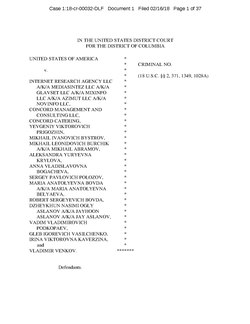
Yevgeny Viktorovich Prigozhin on the Internet Research Agency, United States indictment

Prigozhin financed and directed[165][166] a network of companies including a company called the Internet Research Agency Ltd. (Russian: ООО «Агентство интернет-исследований»),[167] Concord Management and Consulting Company and one other related company.[5] The three companies are accused of Internet trolling and attempting to influence the 2016 United States presidential election and other activity to influence political events outside Russia.

Russian journalist Andrey Soshnikov reported that Alexey Soskovets, who had participated in Russian youth political community, was directly connected to the offices of Internet Research in Olgino. His company, North-Western Service Agency, won 17 or 18 (according to different sources) contracts for organizing celebrations, forums and sport competitions for authorities of Saint Petersburg. The agency was the only participant in half of those bids. In the summer of 2013, the agency won a tender for providing freight services for participants of a Seliger camp.[168]

In February 2023, Prigozhin stated that he founded the IRA: "I've never just been the financier of the Internet Research Agency. I invented it, I created it, I managed it for a long time."[166] The admission came months after Prigozhin had admitted to Russian interference in US elections.[166]

Spin-offs

[edit]

Campaigns against opposition in 2013 involved Dmitry Bykov and the then head of RIA Novosti, Svetlana Mironyuk, while a homepage claiming to fight fake news (Gazeta O Gazetah) was used to spread fake news.[169]

International sanctions

[edit]
"Yevgeny Prigozhin's expanding network" per US Treasury Department (2021)

In December 2016, the US Treasury Department designated Prigozhin pursuant to E.O.13661 for sanctions for providing support to senior officials of the Russian Federation.[170][171][172]

In June 2017, US sanctions were imposed on one of Prigozhin's companies, Concord Management and Consulting, in connection with the war in Eastern Ukraine.[84][173][174]

In January 2018, the US Treasury Department also designated Evro Polis Ltd for sanctions. Evro Polis is a Russian company that has contracted with the Government of Syria to protect Syrian oil fields in exchange for a 25 percent share in oil and gas production from the fields. The company was designated for being owned or controlled by Prigozhin. The sanctions require that any property or interests in property of the designated persons in the possession or control of US persons or within the United States must be blocked. Additionally, transactions by US persons involving these persons (including companies) are generally prohibited.[175][176]

In September 2019, three more Prigozhin companies (Autolex Transport, Beratex Group and Linburg Industries) were sanctioned in connection with the Russian interference in the 2016 United States election.[177][g]

In February 2022, the Internet Research Agency was added to the European Union sanctions list for running disinformation campaigns to manipulate public opinion and "actively supporting actions which undermine and threaten the territorial integrity, sovereignty and independence of Ukraine".[181]

According to the United States, Prigozhin's activities of interfering in elections and subverting public opinion are extended to Asian and African countries.[182]

Prigozhin is also subject to sanctions imposed by Australia, the European Union, Canada, Japan, Switzerland and the United Kingdom. The FBI offered a reward of up to $250,000 for information leading to Prigozhin's arrest.[17][18]

In response to sanctions issued by New Zealand against 51 oligarchs and 24 Kremlin-backed officials (including Prigozhin's own children), Prigozhin went on a racist rant against Māori people in October 2022. He called Foreign Affairs minister Nanaia Mahuta a "petuh" (Russian: петух, a Russian-language derogatory term for a gay man, literally translating as "cock"), referred to her as a man, and said that her moko kauae tattoo made her and Māori women look like "criminals". A spokesperson for Mahuta dismissed the comments as "petty vitriol".[183]

U.S. criminal charges

[edit]

On 16 February 2018, Prigozhin, the Internet Research Agency, Concord Management, another related company, and other connected Russian individuals were indicted by a US grand jury. Prigozhin was charged with funding and organizing operations for the purpose of interference with the US political and electoral processes, including the 2016 presidential election, and other crimes including identity theft.[184] Charges against Concord Management were dismissed with prejudice on 16 March 2020.[185][186]

In February 2021, Prigozhin was added to the wanted list of the Federal Bureau of Investigation (FBI).[187][188]

In February 2022, the United States imposed visa restrictions and froze assets of Prigozhin and his family, due to the 2022 Russian invasion of Ukraine.[189][190]

In July 2022, the U.S. State Department offered a reward of up to $10 million for information about Prigozhin, the Internet Research Agency, and other entities involved in 2016 U.S. election interference.[191]

On 7 November 2022, Prigozhin said he had interfered in U.S. elections and would continue to interfere in the future.[192]

Financial support for Maria Butina in 2019

[edit]

In May 2019, Maria Butina (who had earlier pled guilty to acting in the United States as an unregistered agent of a foreign government; specifically the Russian Federation) appealed for help in paying her lawyer fees.[193][h] In February 2019 Valery Butin, Butina's father, told Izvestia that she owed her U.S. attorneys 40 million rubles ($US 659,000).[195][196] Through Prigozhin's Fund for the Protection of National Values, which is managed by Petr Bychkov, 5 million rubles were donated to Butina's defence lawyer costs.[149]

Personal life

[edit]

Prigozhin was married to Lyubov Valentinovna Prigozhina,[197] a pharmacist and businesswoman. She owns a network of boutique stores known as the Chocolate Museum («Музей шоколада») in Saint Petersburg. In 2012, she started the Crystal Spa & Lounge, a day spa located along Zhukovsky Street in Saint Petersburg, which won a third place award in 2013 for the Perfect Urban Day Spa.[197][198] She owns a wellness center in the Leningrad Oblast and a boutique hotel called the Crystal Spa & Residence which won the Perfect Spa Project award in 2013.[197][198] She owns the New Technologies SPA LLC (ООО «Новые технологии СПА») which is located at plot 1, Granichnaya street in Lakhta Park, Sestroretsk, Kurortny District, Saint Petersburg.[i][200][201] She is also the owner of Agat, part of the Concord group (Russian: Агат).[202]

The couple had two daughters: Polina (Полина), born 1992 and Veronika (Вероника), born 2005, and a son Pavel (Павел), born in either 1996 or 1998.[203][118][179][204] In 2004, Prigozhin published a children's picture book, with his children listed as co-authors (the book was never put on sale – Prigozhin handed out the book to friends and associates as a gift).[205] Until the invasion of Ukraine, Prigozhin's children were able to move freely across the European Union. On 20 February 2022, Prigozhin's daughter Veronika took part in equestrian competitions in Spain.[206]

Prigozhin's mother, Violetta Prigozhina,[207] is a former doctor and educator, and the current legal owner of Concord Management and Consulting LLC (ООО "Конкорд менеджмент и консалтинг") since 2011, Etalon LLC (ООО "Эталон") since 2010, and Credo LLC (ООО "Кредо") since 2011.[208]

All above family members were sanctioned by the European Union, the United States, Ukraine, and many other countries due to Prigozhin's involvement in Russia's invasion of Ukraine.[203][118][179][209][182][210][211][212][excessive citations]

Death

[edit]
Aircraft involved in the crash in which Prigozhin died

According to Russia's emergency ministry, Prigozhin died in an airplane crash on 23 August 2023.[213][214] The Embraer Legacy 600 business jet was en route from Moscow to Saint Petersburg when it crashed, killing all 10 people on board.[215] Russian state-owned media agency TASS reported that Prigozhin had been on the passenger list of the flight.[216] The passengers' deaths were officially confirmed by the Investigative Committee of Russia on 27 August, following genetic analysis of the remains recovered from the wreckage.[217]

A Wagner-associated Telegram channel claimed the jet was shot down by Russian air defenses over Tver Oblast.[218] This assertion was contested due to the lack of visible missile trails in the released footage.[219] According to U.S. and other Western officials, "preliminary intelligence reports led them to believe that an explosion on board likely brought down the aircraft in Russia, killing all the passengers aboard."[24]

Makeshift memorial to Yevgeny Prigozhin and Dmitry Utkin in Moscow

Makeshift memorials for Prigozhin and Utkin were made in several cities with candles, flowers, and Wagner flags.[220] A video of a Wagner soldier crying in front of a memorial went viral.[221]

On 29 August, Prigozhin was buried in a private ceremony at Porokhovskoe Cemetery in Saint Petersburg, beside his father.[222]

On 6 September, Ukrainian Main Directorate of Intelligence reported that it had not been able to confirm with certainty the death of Yevgeny Prigozhin.[223] On 10 September, Ukrainian President Volodymyr Zelenskyy confirmed Prigozhin's death and cited Putin breaking the agreement with Prigozhin as a reason for refusing to enter negotiations with Russia under Putin.[224]

On 22 December 2023, The Wall Street Journal cited sources within the Western and Russian intelligence agencies as saying that the Wagner Group plane crash was orchestrated by Putin's right-hand man Nikolai Patrushev. The paper alleged that Patrushev presented to Putin a plan to assassinate Prigozhin in August 2023, which led to intelligence officials inserting a bomb under the wing of Prigozhin's plane during pre-departure safety checks.[225]

Awards

[edit]

Prigozhin received a number of Russian awards, particularly the title of Hero of the Russian Federation in 2022.[226][227][228] He also received Sudan's Order of the Republic in 2018[229] and Order of the Two Niles in 2020.[230]

Memorials

[edit]

In April 2024, a monument depicting Prigozhin and Wagner co-founder Dmitry Utkin was unveiled outside the Wagner Group's chapel in Goryachy Klyuch, Krasnodar Krai, which also contains the largest cemetery for Wagner mercenaries. The municipal government said that the monument was built on private property and did not require authorization from their side.[231]

In December 2024, a statue of Prigozhin and Utkin was unveiled in the Central African Republic; the statue showed Prigozhin wearing a bulletproof vest and holding a walkie-talkie next to Utkin, who holds an AK-47 rifle.[232]

See also

[edit]

Notes

[edit]

References

[edit]
[edit]
Revisions and contributorsEdit on WikipediaRead on Wikipedia
from Grokipedia
Yevgeny Viktorovich Prigozhin (1 June 1961 – 23 August 2023) was a Russian businessman, leader, and political influencer who rose from a criminal background to become a key figure in Russia's military and informational operations. Initially known for building a empire that supplied the and earned him the nickname "Putin's chef," Prigozhin expanded into private military contracting by founding the around 2014, which conducted operations in , , and to advance Russian interests. Prigozhin also financed the , a St. Petersburg-based organization that deployed troll farms to influence foreign elections and domestic opinion, including interference in the 2016 U.S. presidential election as alleged by U.S. authorities. Under his leadership, Wagner achieved notable battlefield successes, such as the prolonged siege of in 2023, but clashed with Russia's Defense Ministry over logistics and strategy, culminating in a short-lived armed mutiny on 23–24 June 2023, where Wagner forces seized and marched toward before retreating following negotiations. The rebellion exposed fractures in the Russian command structure and led to Prigozhin's exile to , though he continued Wagner-related activities in . Two months after the , Prigozhin died in a plane crash near , , when his jet exploded mid-flight, killing him and several Wagner executives; while Russian investigators cited possible deliberate interference without confirming , U.S. assessed an onboard as the cause. His prompted speculation of retribution, given the timing and his prior defiance, though no definitive evidence has publicly confirmed .

Early Life and Formative Experiences

Childhood and Education in Leningrad

Yevgeny Viktorovich Prigozhin was born on June 1, 1961, in Leningrad (now ), . His mother, Violetta Kirovna Prigozhina, worked as a hospital nurse or physician. His father, Viktor Yevgenyevich Prigozhin, was a mining engineer who died during Prigozhin's childhood. Prigozhin attended sports No. 62 in Leningrad, a facility focused on athletic training including , where his , Samuil Zharkoi, served as a instructor. He graduated from the school in 1977 at age 16. No records indicate formal higher education prior to his early criminal activities. As a teenager, Prigozhin engaged in petty theft, marking the onset of his encounters with .

Criminal Convictions and Imprisonment

In November 1979, at the age of 18, Prigozhin was convicted by Leningrad's Kuybyshev District Court of theft after being caught reselling stolen goods, receiving a two-and-a-half-year suspended prison sentence. While on , Prigozhin engaged in a series of burglaries and robberies, including an incident where he and accomplices attacked and robbed a near an building entrance. In 1981, Prigozhin was arrested again and convicted under multiple articles of the Soviet , including , , , and involvement of minors in criminal activity; he was sentenced to 13 years' imprisonment in a high-security . He served approximately nine years of the term, gaining early release in 1990 amid the late Soviet amnesty policies and perestroika-era reforms that reduced sentences for non-political offenders. During his incarceration, Prigozhin reportedly worked in the , organizing production of canned goods and sausages, which later informed his post-release entry into the .

Business Ascendancy and Political Connections

Founding of Catering Enterprises

Following his release from in 1990, Prigozhin entered the nascent private food sector in post-Soviet St. Petersburg by establishing kiosks selling hot dogs and , capitalizing on the economic and consumer demand for Western-style street eats after decades of state-controlled shortages. A 1993 trip to the reportedly inspired him to scale this model into a fast-food chain, reflecting the era's influx of foreign commercial ideas amid Russia's transition to market capitalism. By the mid-1990s, Prigozhin shifted toward upscale dining, opening his first gourmet , "Old Customs House" (Staraia Tamozhnia), on Vasilievsky Island in 1996; this venue quickly attracted elite clientele through high-quality imported wines and cuisine, including dinners for figures like visiting U.S. presidents. In 1997, he launched a second , further solidifying his foothold in hospitality. These establishments laid the groundwork for Prigozhin's pivot to institutional catering via the creation of Concord, a holding company established in the late 1990s that encompassed large-scale food services for schools, military units, and events. Concord Catering, as a core subsidiary, began securing municipal and state contracts in St. Petersburg by the early 2000s, leveraging Prigozhin's growing network of local officials and demonstrating operational efficiency in bulk meal preparation—such as daily provisions for over 1 million schoolchildren across multiple regions by 2011. This expansion was driven by competitive bidding and reputedly superior logistics compared to state incumbents, though allegations of favoritism emerged in later investigations by opposition media.

Catering to the Kremlin and Elite Clientele

![Vladimir Putin touring Yevgeny Prigozhin's Concord food catering factory][float-right] In the late 1990s, Prigozhin established a high-end on the River in St. Petersburg, which quickly attracted Russia's emerging elite as clientele, including during his tenure as deputy mayor. This venture marked his transition from street vending to luxury catering, leveraging personal connections forged in the post-Soviet business environment. By 2001, his firm provided catering services for elite events, such as cellist Mstislav Rostropovich's hosting of at his St. Petersburg residence. Following Putin's ascension to the presidency in 2000, Prigozhin's companies secured lucrative contracts to supply meals for banquets and official functions, earning him the moniker "Putin's ." His Concord Catering enterprise expanded to include a visit by Putin to its food-processing facilities, where Prigozhin personally escorted the president, underscoring the close ties that facilitated ongoing government business. By the early 2000s, these relationships enabled Prigozhin to open the first private restaurant within the Russian parliament building, further embedding his operations among state institutions. Prigozhin's catering portfolio grew to encompass mass provisioning for public sector clients, including schools and the Russian military, with contracts exceeding 10.5 billion rubles awarded in 2012 for school meals alone. These deals, often secured through competitive tenders amid allegations of favoritism, solidified his financial base and influence within Russia's power structures, though quality issues such as food poisoning incidents in schools drew criticism from watchdog groups. Despite such controversies, the scale of operations—serving elite banquets alongside institutional feeding—positioned Prigozhin as a key supplier to both the inner circle and broader governmental clientele.

Creation and Evolution of the Wagner Group

Origins as a Private Military Contractor

Yevgeny Prigozhin established his initial foray into private military contracting through the creation of the in May 2014, amid Russia's annexation of and the ensuing conflict in . The group's founding document, dated May 1, 2014, designated , a former in Russia's (), as the operational commander responsible for training, recruitment, and discipline, while positioning Prigozhin as the primary financier and overseer. This structure allowed Wagner to function as a deniable asset for Russian interests, enabling to pursue military objectives without formally deploying regular armed forces, which could provoke international backlash. The formation of Wagner drew on Prigozhin's prior business networks and connections, evolving from his catering empire into shadowy operations that included the . Recruits were initially sourced from Russian veterans and convicts, with Utkin's military expertise providing the tactical backbone; estimates suggest the early force numbered in the hundreds, focused on rapid deployment rather than large-scale . Prigozhin's motivation aligned with supporting pro-Russian separatists in the region, where Wagner's first documented operations occurred in mid-2014, including seizures of key infrastructure and combat against Ukrainian forces. This marked a shift from Prigozhin's non-military ventures, leveraging state funding—reportedly funneled through opaque contracts—to build a proxy force that evaded Russia's legal prohibitions on mercenaries until a 2022 statute partially legitimized such entities. Prigozhin publicly denied ownership of Wagner for years, even suing media outlets for reporting his involvement, but admitted to founding it in September 2022 amid escalating tensions in the . Earlier roots trace to informal security outfits linked to Prigozhin's associates, such as the Moran Security Group founded in the late 2000s for maritime protection, but Wagner represented a distinct escalation into ground combat contracting. U.S. government assessments, including Treasury Department analyses, highlight Prigozhin's role as the central figure in expanding this network, though Russian and official narratives downplayed private involvement to maintain deniability. The opacity of Wagner's origins reflects broader patterns in Russian , where private contractors serve as force multipliers while shielding the government from direct accountability.

Deployments in Syria and Resource Acquisition

The Wagner Group began deploying personnel to Syria in late 2015, shortly after Russia's military intervention to support the Assad regime against Islamist insurgents and ISIS. These initial contingents, numbering in the hundreds, operated alongside Russian Aerospace Forces and Syrian troops, focusing on securing key terrain and conducting assaults in resource-rich eastern provinces. By securing oil fields and infrastructure from ISIS control, Wagner contractors provided deniable manpower that allowed Moscow to limit official troop exposure while advancing strategic objectives. Wagner played a prominent role in the March 2016 offensive to recapture from , contributing for close-quarters combat amid the city's ancient ruins, which resulted in heavy casualties among the mercenaries due to ISIS counterattacks with suicide vehicles and snipers. The group repeated this effort in the 2017 offensive, helping stabilize the area after ISIS briefly retook it, though operations highlighted tensions with regular Russian forces over command and credit for victories. Further deployments in central during summer 2017 involved clearing ISIS remnants, setting the stage for advances toward . A pivotal engagement occurred on , 2018, near Khasham in province, where approximately 300-500 Wagner fighters, alongside Syrian proxies, launched an unauthorized assault on U.S. and Kurdish positions guarding oil facilities. U.S. air and strikes decimated the attackers, killing up to 300 according to estimates, exposing Wagner's vulnerabilities against precision firepower and marking the first direct U.S.-Russian proxy clash. This incident stemmed from Prigozhin's push to seize resource sites, but it with Moscow's military leadership, who had deconflicted with U.S. forces. In parallel with these military efforts, Prigozhin secured resource concessions from the Assad regime as compensation for Wagner's battlefield contributions. In mid-2017, his associated firm Evro Polis signed an agreement granting it 25% of revenues from oil and gas production in recaptured eastern Syrian fields, including those around and , in exchange for guarding against ISIS resurgence. Wagner contractors took over security at sites like the al-Shaer oil field, enabling extraction operations that reportedly generated $20 million monthly for Prigozhin-linked entities by 2018. These deals exemplified a profit-driven model: mercenaries cleared and held territory, allowing Prigozhin's network to monetize phosphates, oil, and gas, with proceeds funding further Wagner expansion despite U.S. sanctions on Evro Polis.

Internal Structure and Recruitment Tactics

The Wagner Group's internal structure lacked a rigid, publicly documented hierarchy typical of formal militaries, instead operating as a flexible network of subunits tailored to operational needs, with Yevgeny Prigozhin serving as the primary financier and political overseer while delegating military command to figures like , a former officer whose callsign "Wagner" inspired the group's name. Key deputies included Sergei Troshev, a retired Interior Ministry who co-managed operations, and Ivannikov, involved in early deployments; this inner circle handled logistics, training at bases like Molkino in Russia's Territory, and coordination with Russian state entities such as the . The organization comprised a professional core of veterans and specialists for complex missions— including an elite unit dubbed "Liga" for high-risk tasks—augmented by larger formations like assault detachments, with leaked data indicating entities such as the 1st Assault Detachment (approximately 625 personnel) and similar groups up to the 5th, emphasizing maneuver-focused tactics. was enforced through severe measures, including summary executions for or disobedience, which maintained cohesion amid high casualties but drew international condemnation for resembling penal battalions more than professional contractors. Recruitment tactics evolved from selective sourcing of experienced personnel to of low-risk, high-volume labor, prioritizing numerical superiority over quality in prolonged conflicts like . Initially, Prigozhin drew from Russian military veterans, alumni, and volunteers via appeals promising high pay—around $3,000 monthly—and adventure, building a cadre of several thousand by 2014 for operations in and . From late 2022, amid heavy losses, the strategy shifted to prisons, where Prigozhin personally appeared in leaked videos at facilities across , offering full sentence remission after six months of service, financial incentives for families, and threats of death for non-compliance or escape; this yielded over 23,000 recruits by summer 2022, often deployed in "human wave" assaults with minimal training. Contracts were formalized as voluntary but coercive, with reports of guards pressuring and exclusions for certain violent offenders, though empirical outcomes showed high attrition—estimated 50% fatalities in some units—yet effective in overwhelming defenses at sites like , substantiating the tactic's utility for attritional warfare despite UN critiques of violations.

Wagner's Role in the Ukraine Conflict

Initial Operations in Donbas (2014 Onward)

The , under Yevgeny Prigozhin's direction, initiated operations in 's region in mid-2014 shortly after the conflict erupted following Russia's annexation of in of that year. Prigozhin, leveraging his ties to the Russian government, formed the group—initially drawing from veterans of Russia's unit, including commander —to provide deniable military support to pro-Russian separatist forces in the self-proclaimed (DPR) and (LPR). These early deployments consisted of small, elite detachments disguised as local volunteers or integrated into separatist militias, enabling Russia to avoid direct attribution of regular army involvement while bolstering separatist capabilities in . Wagner's initial activities focused on , , and direct assaults on Ukrainian military positions during the war's escalation in summer 2014, including support for separatist offensives around key cities like and the subsequent push toward the Russo-Ukrainian border. Fighters, often equipped with Russian-supplied gear but operating outside official chains of command, filled gaps in separatist training and firepower, contributing to tactical successes such as the disruption of Ukrainian supply lines. Ukrainian services documented Wagner's presence through captured personnel, intercepted communications, and forensic from battlefields, estimating up to 1,578 mercenaries active by late 2014, many bearing distinct Wagner-associated tattoos or using encrypted coordination linked to Russian military intelligence. Russian authorities consistently denied any state connection, portraying participants as independent volunteers, though financial flows traced to Prigozhin's entities and state contracts suggested otherwise. By early 2015, amid the ceasefire negotiations, Wagner's role shifted to lower-intensity operations, including guarding separatist and conducting targeted strikes to enforce the frozen front lines, while sustaining casualties—estimated in the dozens from ambushes and —that were concealed through covert and burials in to evade scrutiny. Prigozhin's group maintained a rotational presence of several hundred fighters through 2016, prioritizing high-value missions over mass engagements, which allowed it to refine tactics later exported to . This phase highlighted Wagner's utility as a proxy force: cost-effective for , with recruits drawn from convicts and ideologues incentivized by pay and , yet reliant on implicit state for deployment. Independent analyses, including from Western , corroborated these patterns via open-source tracking of and personnel movements, countering Russian claims of non-involvement with geospatial and signals .

Key Victories and Attrition in Bakhmut

The Wagner Group's assault on intensified in August 2022, with Prigozhin positioning his forces as the primary attackers against Ukrainian defenses in the region. By employing massed assaults with minimally trained convict recruits, Wagner units achieved incremental territorial gains, capturing the nearby town of in early January 2023 after weeks of intense fighting. Prigozhin personally oversaw operations, releasing videos from forward positions to document advances, such as the seizure of Blahodatne north of on January 29, 2023. Wagner forces continued pushing into Bakhmut's northern and eastern districts through February and March 2023, utilizing "human wave" tactics that prioritized volume over precision to overwhelm Ukrainian positions. On March 31, 2023, geolocated footage confirmed Wagner mercenaries advancing to within 400 meters of the city center, marking a significant breach despite fierce resistance from Ukrainian regulars and territorial defense units. These efforts culminated on May 20, 2023, when Prigozhin declared victory from Bakhmut's ruins, stating his fighters had fully captured the city after Ukrainian forces withdrew, though he emphasized the pyrrhic nature of the achievement due to unsustainable losses. The campaign's attrition was extreme, with Wagner suffering approximately 19,547 fatalities in , including over 17,000 convicts recruited from Russian prisons under promises of pardons after six months of service. Prigozhin had aggressively expanded recruitment, drawing from around 50,000 convicts overall for the Ukraine effort, many deployed as expendable assault troops in repeated frontal attacks that yielded ground at the cost of thousands weekly. This approach, while enabling key victories like the of Ukrainian supply lines, strained Wagner's manpower and supplies, prompting Prigozhin's public criticisms of Russian failures. By May 2023, following the capture, Wagner began withdrawing from , handing positions to regular Russian units amid internal disputes over resupply.

Public Criticisms of Russian Military Inefficiency

Yevgeny Prigozhin directed sharp public criticisms at Russian military leadership, focusing on Defense Minister and , whom he accused of incompetence, corruption, and treasonous actions that hindered operations in . His statements, disseminated via Telegram videos and posts, highlighted logistical failures such as ammunition shortages and inadequate support for frontline troops, which he claimed resulted in thousands of unnecessary Wagner casualties. On February 21, 2023, Prigozhin accused unspecified Russian officials of denying Wagner fighters sufficient and , labeling these denials as acts of "high " that betrayed Russian soldiers and aided Ukrainian forces. He contrasted Wagner's effectiveness with the regular army's performance, asserting that his mercenaries achieved results despite the Ministry of Defense's deliberate sabotage. These attacks intensified during the in May 2023, when Prigozhin announced on May 5 that Wagner forces were experiencing an "ammunition famine" orchestrated by the Defense Ministry, threatening to withdraw his remaining troops from the city by May 10 unless supplies arrived. In a graphic video filmed amid dozens of Wagner fighters' corpses on May 4, he blamed Shoigu and Gerasimov directly for the deaths, claiming their incompetence and lies had led to the loss of an entire assault unit without enemy fire. Prigozhin further alleged on May 9, 2023, that the Defense Ministry engaged in deception and issued threats against Wagner, including promises of ammunition that were not fulfilled, exacerbating frontline inefficiencies. His rants portrayed the command as pursuing personal glory over victory, warning that such leadership could result in Russia's defeat in the . These public outbursts, while rooted in Wagner's operational grievances, exposed broader systemic issues in Russian coordination and , as corroborated by multiple reports of ongoing disputes over tactics and supplies.

Expansion into African Operations

Security Contracts and Mineral Exploitation

The Wagner Group, under Yevgeny Prigozhin's direction, established a pattern of securing military and security contracts with African governments facing insurgencies or instability, often bartering protection services for concessions to exploit natural resources, particularly gold and diamonds, which generated revenue to sustain operations. This model, described as "guns for gold," involved deploying mercenaries to guard regimes and infrastructure while affiliated companies extracted minerals, with Prigozhin-linked entities handling logistics and sales to evade sanctions. By 2023, these activities spanned multiple countries, funding Wagner's expansion despite international designations of involved firms as illicit networks. In the (), Wagner forces arrived in early 2018 following a failed assassination attempt on President , providing personal security and counter-rebel operations in exchange for permits granted to Prigozhin-affiliated companies. Key assets included the Ndassima mine, located 60 kilometers north of Bambari, where Wagner secured industrial rights and oversaw extraction through entities like Ressources, a CAR-based firm designated by the U.S. Treasury in June 2023 for funneling illicit proceeds to Prigozhin. concessions were also obtained, with Wagner expanding into timber by the early 2020s, reportedly generating hundreds of millions in annual revenue despite local conflicts over resource control. Sudan's military regime under granted Wagner exclusive rights around 2017 as payment for security advisory and training services, channeled through Prigozhin's M-Invest company, which established production entities to exploit deposits. Documents from Sudanese military firms reveal ongoing Wagner ties post-Bashir's 2019 ouster, including joint ventures for near conflict zones, with proceeds smuggled via regional networks to fund Russian operations. In , Wagner deployed approximately 1,000 contractors starting in December 2021 to support the against jihadist groups, securing informal access to sites as part of broader resource-for-security arrangements, with Prigozhin's Africa Politology entity coordinating arms deals and extraction logistics by spring 2023. These contracts exemplified Wagner's prioritization of mineral wealth over formal oversight, often involving shell companies to obscure ownership and bypass export restrictions.

Impacts in Central African Republic and Sahel Region

In the , mercenaries, deployed from March 2018 onward under contracts brokered by Prigozhin, bolstered the government's defenses against coalition rebels, including the , repelling assaults on and enabling President Faustin-Archange Touadéra's reelection in December 2020 despite security threats. These operations, involving up to 2,000 fighters by 2022, secured key mining sites and urban areas, reducing rebel territorial control from over 80% of the country in 2013 to fragmented pockets by 2023, though at the cost of documented civilian casualties from indiscriminate fire and reprisals. Economically, Prigozhin's network, through entities like Lobaye Invest and M-Finance LLC, extracted and from concessions granted in exchange for protection, with U.S. estimates indicating illicit gold flows valued at tens of millions annually funding Wagner's by mid-2023. This resource-for-security model entrenched Russian influence, sidelining Western aid conditions on governance reforms, but local impacts included from unregulated and minimal revenue to the state, exacerbating in a nation where over 70% live below the poverty line. monitors reported over 100 civilian deaths linked to Wagner actions between 2018 and 2022, including and village burnings, though Central African authorities attributed such incidents to rebels and credited Wagner with stabilizing mineral-rich regions. In the , particularly , Wagner entered in December 2021 with approximately 1,000 personnel following the junta's expulsion of French Barkhane forces, conducting joint operations with Malian troops against (JNIM) and Islamic State in the Greater Sahara (ISGS), including a March 2024 offensive that temporarily cleared militants from towns like Tinzaouaten and claimed the elimination of several commanders. By 2023, similar deployments in (post-September 2022 coup) and (post-July 2023 coup) involved training 4,000-5,000 local recruits and direct raids, yielding tactical gains such as securing gold mines in northern that generated up to $50 million yearly for Prigozhin's firms through protection rackets. Counter-terrorism outcomes remained limited empirically: despite Wagner's claims of disrupting 20+ militant networks in by early 2023, the accounted for over 50% of global terrorism deaths in 2023-2024, with attacks rising 20% in post-Wagner arrival per Conflict Location & Event Data Project tracking, attributed to insufficient troop numbers, focus on sites over centers, and reprisal cycles from alleged massacres exceeding 500 civilians in 2022-2023. exploitation mirrored CAR patterns, with Prigozhin securing alluvial gold permits in Mali's Kidal region, but local juntas gained little beyond short-term , fostering dependency and enabling junta consolidation amid coups while Western critiques, often from outlets with prior French ties, emphasized abuses over any stabilization effects. Overall, Wagner's model prioritized extractive gains—estimated at $2.5 billion in African minerals from 2017-2023—over sustainable , displacing European influence but failing to curb jihadist recruitment driven by voids.

Counter-Terrorism Effectiveness vs. Western Critiques

The Wagner Group conducted counter-terrorism operations primarily in the Central African Republic (CAR) starting in early 2018, where it provided close protection to President Faustin-Archange Touadéra following a failed assassination attempt and subsequent rebel advances toward Bangui. In collaboration with CAR security forces, Wagner elements repelled offensives by the Coalition of Patriots for Change in 2021, enabling the government to regain control over approximately 80% of the country's territory by mid-2021, including securing the capital against Islamist-influenced rebels linked to groups like the Lord's Resistance Army remnants and Séléka factions. These actions contributed to a reported decline in major rebel incursions on government-held areas, with CAR officials attributing regime survival to Wagner's rapid-response tactics that prioritized kinetic operations over extended stabilization efforts. In the , particularly after Wagner's deployment in late 2021 following the withdrawal of French forces, the group supported the Malian army against jihadist affiliates of and the , including operations in the north and center. Tactical engagements yielded short-term gains, such as disrupting insurgent supply lines and providing artillery support that allowed Malian forces to hold positions previously lost, but overall jihadist violence escalated, with civilian fatalities from terrorist attacks rising by over 70% between 2021 and 2023 amid intensified ambushes and IED usage targeting Wagner convoys. Empirical assessments indicate Wagner's approach—emphasizing ruthless suppression and minimal civilian engagement—deterred some local threats through fear but failed to address underlying grievances, leading to recruitment boosts for jihadists in areas like and . Western critiques, predominantly from U.S. State Department and reports, portray these operations as counterproductive, citing documented violations including summary executions, rapes, and village burnings—such as the March 2022 Moura massacre where Malian forces with Wagner reportedly killed over 300 civilians suspected of jihadist ties. These sources argue Wagner exacerbates instability by fueling radicalization through abuses and resource extraction deals that prioritize Russian mining concessions over governance reforms, contrasting with prior UN and French missions criticized for similar inefficacy but without the same mercenary opacity. However, African client states like and have renewed contracts despite such claims, valuing Wagner's cost-effectiveness—estimated at under $10 million annually versus billions for Western coalitions—and willingness to operate without restrictive that hampered predecessors like MINUSMA, which recorded over 200 peacekeeper fatalities without curbing jihadist expansion. This divergence reflects a pragmatic focus on immediate regime protection over long-term doctrines favored by Western analysts, whose assessments may undervalue tactical deterrence in favor of emphasizing ethical lapses amid geopolitical rivalry with .

Information and Influence Operations

Establishment of the Internet Research Agency

The LLC (IRA) was established in mid-2013 in , , as a company specializing in online operations designed to influence . It operated from offices in the city, initially focusing on domestic Russian audiences before expanding internationally. Funding for the IRA's creation and operations came primarily from Yevgeny Prigozhin and companies under his control, including LLC, which provided financial support through a network of entities. Prigozhin, known for his business that supplied the Russian , leveraged this oligarchic position to direct resources toward the agency's development as part of his expanding portfolio in media and influence activities. In July 2013, shortly after its formation, the IRA posted job advertisements seeking "internet operators" and analysts to monitor and shape online narratives, signaling the onset of structured efforts. These roles involved generating content and engaging in coordinated activities, with initial staff numbers growing to support 12-hour shifts by 2014. Prigozhin confirmed his foundational role in the IRA on February 14, 2023, via a statement from his press service, admitting he had created and managed the since its inception to conduct information operations, including interference in foreign elections. This admission aligned with earlier assessments from U.S. indictments, which identified him as the key financier without his prior public acknowledgment. The agency's establishment reflected Prigozhin's strategic shift toward hybrid influence tactics, building on his prior ventures in surveillance and media production.

Troll Farms and Election Interference Claims

The (IRA), a Russian entity established around 2013 in St. Petersburg and funded by Prigozhin, functioned as a where employees generated social media content to promote interests and exacerbate divisions in target countries. Prigozhin admitted to founding the IRA on February 14, 2023, acknowledging its role in producing propaganda and disinformation. At its peak, the operation employed up to 1,000 individuals working in shifts to manage across platforms like , , and . U.S. authorities accused the IRA of interfering in the 2016 presidential election by conducting influence operations designed to favor and undermine , though activities also targeted both major parties to amplify societal discord. On February 16, 2018, a federal indicted Prigozhin, the IRA, and 12 Russian operatives on charges including conspiracy to defraud the , alleging they used false personas to post inflammatory content, organize rallies, and purchase targeted advertisements reaching millions of Americans. Specific tactics included spending roughly $100,000 on over 3,500 ads and creating groups like "Blacktivist" and "United Muslims of America" to impersonate U.S. activists. Prigozhin responded defiantly to the indictments, offering in 2018 to testify before U.S. Congress while mocking the allegations, but later confirmed involvement in a November 7, 2022, statement: "Gentlemen, we interfered, we interfere and we will have interference in the elections," made on the eve of U.S. midterm voting. These admissions aligned with U.S. Treasury sanctions on Prigozhin-linked entities for ongoing election meddling efforts, including attempts in subsequent elections. Empirical assessments of impact vary; while IRA content reached an estimated 126 million users, studies indicate limited sway on , with operations more effective at boosting engagement than altering outcomes.

Broader Disinformation Strategies

Prigozhin's disinformation operations encompassed hybrid tactics integrating online amplification, controlled media outlets, and regional influencer networks to support Wagner Group's and economic objectives while aligning with Russian state interests. These strategies often exploited local grievances, such as anti-colonial sentiments in or political divisions in , to portray Russian involvement as beneficial alternatives to Western influence. Unlike the IRA's focus on trolls, broader efforts involved funding pseudo-journalistic entities and producing tailored content, including videos framing Wagner mercenaries as anti-terrorism saviors in conflict zones. In , Prigozhin directed campaigns across the and , utilizing fake news sites and local influencers to disseminate narratives justifying Wagner's security contracts and mineral resource deals. Operations in countries like and the emphasized Pan-African solidarity and Russian protection against jihadists, while downplaying atrocities and extractive practices; for example, videos circulated online depicted Wagner as "warrior angels" countering Western-backed instability. These efforts, active by at least , extended to election manipulation and suppression of pro-democracy protests, as seen in support for coups in the region. U.S. assessments identified Prigozhin-linked networks echoing these themes to bolster deployments and objectives. Beyond Africa, Prigozhin targeted European audiences with disinformation aimed at politicians and officials to advance Russian foreign policy goals, including sanctions evasion and narrative disruption, as detailed in U.S. actions on March 3, 2022. Tactics included coordinated inauthentic behavior on platforms, blending with Russia's ecosystem for amplification via Telegram channels and proxy outlets. These operations formed part of a larger information confrontation strategy, leveraging Prigozhin's resources to test and refine influence techniques amid . Following Prigozhin's death on August 23, 2023, remnants of these networks persisted, rebranding under entities like and continuing in through adapted and local partnerships, indicating structural durability beyond individual leadership.

Escalating Tensions with Russian Establishment

Ammunition Shortages and Logistical Disputes

In February 2023, during the ongoing , Yevgeny Prigozhin publicly accused Russian Defense Minister and Chief of the General Staff of treason for deliberately withholding ammunition supplies from forces. Prigozhin claimed that Wagner detachments received no shells for several days, attributing high casualties—estimated at around 20,000 Wagner fighters killed in —to these shortages, which he said amounted to intentional sabotage by military leadership. These allegations intensified logistical disputes, as Prigozhin asserted that Wagner had to procure ammunition independently or rely on captured Ukrainian stockpiles to sustain operations, highlighting a broader over in the Russian war effort. On February 22, he released an audio message directly naming Shoigu and Gerasimov, stating they had failed to deliver promised supplies despite Wagner's frontline advances. By May 5, 2023, amid continued fighting in , Prigozhin escalated his rhetoric, threatening to withdraw Wagner forces from the city on May 10 due to acute , blaming Shoigu and Gerasimov for prioritizing their positions over . He released videos surrounded by fallen Wagner fighters, decrying the lack of shells and warning that without resupply, Russian positions risked collapse. Days later, on May 7, Prigozhin announced that had been promised following his outbursts, though he continued to criticize the adequacy of deliveries by May 9, noting shipments fell short of requirements. The disputes underscored systemic tensions, with Prigozhin portraying the Ministry of Defense as inefficient and corrupt in logistics, forcing Wagner to self-fund and source munitions amid claims of production shortfalls in Russian artillery shells. Russian officials denied systematic denial of supplies, framing Prigozhin's complaints as exaggerated, yet the revealed fractures in command unity critical to operations in .

Populist Rhetoric Against Corruption

In early 2023, Yevgeny Prigozhin escalated his public criticisms of the Russian Defense Ministry, accusing its leadership of systemic corruption that deprived Wagner Group fighters of essential ammunition and supplies during operations in Ukraine. He claimed that officials were hoarding or embezzling munitions, stating in Telegram audio messages that "they are stealing everything they can from the front lines," which forced Wagner convicts and volunteers to fight with inadequate resources while generals profited. These denunciations positioned Prigozhin as an outsider challenging entrenched bureaucratic theft, contrasting his direct involvement in combat logistics with the perceived detachment of Moscow elites. Prigozhin's rhetoric intensified in May and June 2023, targeting Defense Minister and General by name for incompetence and graft, alleging they prioritized personal enrichment over military effectiveness. In one widely circulated video, he mocked Shoigu as a figurehead who "sits in an office" while diverting funds meant for troops, declaring that such had led to unnecessary Russian casualties in battles like . He framed these accusations as a betrayal of ordinary soldiers and their families, appealing to a populist sentiment by vowing to "clean out the rot" in the system, which resonated amid reports of Wagner's battlefield successes contrasted with regular army setbacks. This narrative bolstered Prigozhin's image as a candid truth-teller against a corrupt , drawing parallels to his earlier exposure of oligarchic ties in Russian bureaucracy through affiliated media. However, his claims aligned with independent observations of scandals in the ministry, where billions in rubles for vanished, though Prigozhin's own opaque sources raised questions about selective outrage. By June 2023, these outbursts had evolved into broader calls for accountability, framing the military hierarchy as an "oligarchic clan" undermining national defense.

The June 2023 Mutiny

Triggers and March on Moscow

The immediate triggers for Yevgeny Prigozhin's mutiny stemmed from escalating disputes between and Russia's Ministry of Defense, particularly over ammunition supplies and operational autonomy during the . Prigozhin repeatedly accused Defense Minister and Chief of the General Staff of deliberately withholding ammunition, leading to unnecessary Wagner casualties estimated in the tens of thousands, as Wagner fighters advanced with minimal support from regular forces. These claims dated back to at least February 20, 2023, when Prigozhin alleged that unspecified officials denied his group sufficient shells, amounting to amid Wagner's frontline role in . By May 5, 2023, following Wagner's announced withdrawal from , Prigozhin intensified his rhetoric in a video amid a field of corpses, blaming Shoigu and Gerasimov for a 70% ammunition shortage and labeling their actions as treasonous incompetence that starved his forces. A pivotal catalyst occurred around June 10, 2023, when Shoigu ordered Wagner mercenaries to sign contracts with the regular , effectively subordinating the private force and stripping its independent status, which Prigozhin viewed as an existential threat to Wagner's structure. Prigozhin framed the not as an attack on President but as a corrective action against "fraudsters" and , initially citing a fabricated Defense Ministry on Wagner camps—later admitted by him as a to rally support—while demanding Shoigu and Gerasimov's removal. Putin responded on June 24, 2023, denouncing the actions as "" and a "stab in the back" during Russia's special operation in . The march commenced on June 23, 2023, as approximately 25,000 Wagner troops, including armored columns, crossed from into Russia's , seizing the Southern Military District's headquarters in with minimal resistance and no reported casualties. Prigozhin's forces then advanced northward along the M4 highway toward , capturing the airfield en route and reaching within 200 kilometers of the capital by evening, prompting evacuations and air defenses to down helicopters claimed by Prigozhin to be attacking his convoy—resulting in the deaths of six Russian pilots. The incursion exposed vulnerabilities in Russian command, as Wagner encountered little opposition from federal forces, highlighting logistical and loyalty fractures amid Prigozhin's populist appeals against elite corruption. By June 24, 2023, after advancing roughly 800 kilometers in under 24 hours, Prigozhin abruptly halted the march following negotiations brokered by Belarusian President , agreeing to de-escalate in exchange for no treason charges against Wagner leadership and relocation to . The stand-down avoided direct urban combat in , though it underscored Prigozhin's leverage from Wagner's battlefield successes and the Kremlin's reluctance for internal bloodshed, with federal forces reportedly outnumbered and unprepared.

Negotiated Stand-Down and Belarus Exile

On June 24, 2023, Yevgeny Prigozhin announced that his forces would halt their advance on , approximately 200 kilometers from the capital, to prevent further Russian casualties after clashes with that resulted in the downing of several helicopters and an transport plane, killing at least six pilots. The stand-down followed negotiations mediated by Belarusian President , who facilitated an agreement between Prigozhin, the , and Russian military leadership, including assurances against prosecution for the participants. The terms of the deal, as confirmed by the , included dropping the Federal Security Service's criminal case for armed rebellion against Prigozhin and Wagner commanders, with Prigozhin agreeing to relocate to for an indefinite . Wagner personnel were given options to either integrate into the Russian Ministry of Defense as contract soldiers, disband and return to civilian life with financial incentives, or transfer to Belarusian military facilities under Lukashenko's oversight, though only a fraction ultimately relocated there. This arrangement preserved Wagner's operational autonomy outside while averting escalation, though analysts noted it as a temporary exposing underlying command fractures rather than a resolution. Prigozhin arrived in via private jet on June 27, 2023, as verified by Lukashenko, who extended guarantees of safety and hosted initial meetings to coordinate Wagner's partial redeployment. The exile positioned Prigozhin in , a close Russian ally, but under heightened scrutiny, with reports indicating limited Wagner assets—estimated at several hundred fighters—establishing a presence at Belarusian bases near the Ukrainian border by early July. Despite the agreement's intent to neutralize Prigozhin's threat, his subsequent audio statements from reaffirmed criticisms of Russian military leadership, suggesting the stand-down reflected tactical restraint rather than capitulation.

Death and Subsequent Investigations

The Embraer Jet Crash

On August 23, 2023, an Embraer EMB-135BJ Legacy 600 executive jet, registered as RA-02795, crashed in a field near the village of Kuzhenkino in Russia's Tver Oblast, approximately 160 kilometers northwest of Moscow. The aircraft had departed Moscow's Sheremetyevo International Airport at around 15:58 UTC (18:58 local time), en route to St. Petersburg, carrying three crew members and seven passengers. It disappeared from radar screens shortly after 18:11 Moscow time, plummeting from an altitude of about 8,500 meters in a near-vertical descent before impacting the ground and bursting into flames. All ten occupants perished in the incident. Yevgeny Prigozhin, founder of the Wagner Group, was listed among the passengers and confirmed dead via genetic testing of remains recovered from the wreckage by Russian investigators on August 27. Other identified victims included Wagner Group's military commander Dmitry Utkin and several Wagner executives, as per passenger manifests released by Russian authorities. The Embraer Legacy 600 model involved had a strong safety record prior to the crash, with only one prior accident—a survivable mid-air collision—and compliance certifications for operations in Russia. No distress signals were reported from the aircraft before it dropped off radar. Russian emergency services responded immediately, extinguishing the fire and securing the site, while the Interstate Aviation Committee initiated an investigation into the cause, including examination of flight recorders. Preliminary visual analysis indicated a catastrophic in-flight , with the breaking apart mid-air, but no official cause has been publicly determined as of late 2023. In 2023, President stated that fragments consistent with hand grenade shrapnel were found in the bodies of victims during forensic examination, suggesting possible involvement. A U.S. similarly concluded an intentional likely downed the jet, though Russian officials have not corroborated this publicly.

Forensic Evidence and Conspiracy Theories

The Embraer Legacy 600 private jet, registration RA-02795, carrying Yevgeny Prigozhin crashed on August 23, 2023, near Kuzhenkino in Tver Oblast, Russia, killing all ten people aboard, including three crew members and seven passengers. Russian authorities confirmed Prigozhin's death through genetic testing of remains recovered from the wreckage, announced on August 27, 2023. Video footage captured by passengers on nearby flights and ground observers depicted the aircraft disintegrating mid-air at approximately 28,000 feet, with the tail section separating first, followed by rapid descent and explosion on impact, indicating a catastrophic in-flight failure rather than mechanical issues alone. On October 5, 2023, Russian President Vladimir Putin stated that preliminary investigations revealed fragments of hand grenades in the bodies of victims, suggesting an internal explosion as the cause. Russia's Interstate Aviation Committee declined to conduct a full international-standard probe, limiting the investigation to domestic forensic analysis without independent verification. Western intelligence assessments and aviation experts, analyzing telemetry data and wreckage patterns, concluded that —likely involving an —was probable, aligning with the observed structural breakup inconsistent with routine failures in the model, which had no prior fatal crashes of this type. No evidence of , interference, or has been substantiated, though Russian officials have not publicly detailed data or metallurgical tests on debris. The absence of transparency in the probe, conducted by state-controlled entities amid Prigozhin's recent against , has fueled regarding the official narrative's completeness. Conspiracy theories proliferated immediately after the crash, with the predominant view attributing it to deliberate ordered by Putin as retribution for the June 2023 Wagner mutiny, a claim echoed by U.S. officials who assessed involvement based on the timing—two months post-rebellion—and historical patterns of eliminating perceived threats. Proponents cite Prigozhin's public criticisms of Defense Minister and the Wagner Group's seizure of military headquarters as motive, arguing the grenade fragments point to planted explosives accessible only via insider access, though the has denied any role, framing the incident as accidental. Alternative speculations include Ukrainian sabotage using smuggled devices, given Wagner's role in the invasion of , but lack supporting evidence and contradict flight tracking showing no deviations suggestive of external attack. Doubts about Prigozhin's death persisted in fringe circles, fueled by his survival of a fabricated 2019 plane crash report in and viral images purporting to show him alive post-August 2023, such as a March 2024 photo of a on a train, later debunked through facial recognition and contextual analysis. These theories, often amplified on , question DNA results due to the bodies' severe but overlook confirmatory genetic matches and the absence of Prigozhin's post-crash communications, which had been frequent via Wagner channels. Russian state media's muted coverage and lack of bodycam or releases have sustained speculation, yet no credible evidence has emerged contradicting the forensic of fatalities.

Implications for Russian Power Dynamics

The death of Yevgeny Prigozhin in the August 23, 2023, crash, two months after his short-lived , served as a stark demonstration of the Kremlin's capacity to neutralize internal threats through non-confrontational means, thereby reinforcing President Putin's unchallenged over Russia's fragmented networks. Unlike the mutiny's overt march on , which exposed logistical grievances against the Ministry of Defense (MoD), the crash—officially attributed to a criminal act rather than state orchestration—avoided broader civil unrest while eliminating a vocal critic who had amassed significant leverage via the . This outcome signaled to siloviki (security service) leaders and oligarchs that negotiated amnesties offer no long-term immunity from retribution, prioritizing regime stability over public accountability. In the ensuing months, the accelerated the dismantling of Wagner's operational , integrating its frontline remnants into regular MoD contracts by July 2023 and reorienting overseas activities—particularly in —under state-supervised successors like the , commanded by figures loyal to the Defense Ministry. This shift curtailed the influence of private military companies (PMCs) as semi-independent actors, which Prigozhin had exploited to build a parallel power base funded by resource extraction deals in nations such as the and . By late 2024, reports indicated that entities like Redut PMC had absorbed much of Wagner's former portfolio, reflecting a broader policy to subordinate forces to centralized command and prevent future bids for amid the ongoing . The episode's ripple effects extended to military leadership dynamics, amplifying scrutiny on MoD inefficiencies highlighted by Prigozhin's accusations of shortages and , though without precipitating systemic upheaval. Putin's post-mutiny framing the as treasonous, combined with the crash's timing, deterred emulation by other factional players, such as rival generals or regional governors, while consolidating ideological loyalty among the by portraying as existential betrayal. Empirical indicators of regime resilience include the absence of subsequent coups, sustained for operations, and Wagner's reconfiguration without disrupting Russian foreign policy projections, suggesting that the Kremlin's handling ultimately fortified vertical power structures rather than eroding them.

Global Sanctions Regimes

Yevgeny Prigozhin was subjected to asset freezes and travel bans under sanctions regimes imposed by the , , , , , and , primarily for directing the Wagner Group's operations, funding election meddling via the , and enabling abuses in and elsewhere. These measures aimed to disrupt his financial networks supporting Russian geopolitical aims, including resource extraction in exchange for security in the and military involvement in and . The U.S. Treasury's Office of Foreign Assets Control designated Prigozhin in 2018 for bankrolling the Internet Research Agency's disinformation campaigns targeting the 2016 presidential election, blocking his U.S. assets and prohibiting transactions with American persons. Additional U.S. sanctions followed in 2020 against Prigozhin-linked firms for malign influence in Africa, and in 2021 under the Global Magnitsky Act for Wagner's extrajudicial killings and torture in the Central African Republic. In January 2023, the U.S. State Department labeled the Wagner Group a Transnational Criminal Organization, encompassing Prigozhin's operations in multiple countries. The imposed sanctions on Prigozhin in October 2020 under its Libya regime for financing Wagner's deployment to support Khalifa Haftar's forces, extending to asset freezes across member states. Further designations in 2022 tied him to Russia's invasion, and in 2023 added Wagner-linked entities for hybrid threats and violations under the bloc's sanctions framework. The sanctioned Prigozhin in December 2020 under its Libya autonomous regime, followed by broader sanctions in March 2022 designating the entirely for undermining Ukraine's sovereignty. , , and aligned with these actions, imposing parallel asset freezes on Prigozhin and by 2022-2023 for similar rationales including illicit funding 's arms procurement. Post-Prigozhin's death in August 2023, sanctions persisted on his family members and front companies to prevent evasion, as seen in U.S. and actions against circumvention networks.
JurisdictionInitial Designation Date for PrigozhinPrimary Authorities
United States2018 (election interference); expanded 2021 (human rights)OFAC, Global Magnitsky, TCO designation
European UnionOctober 2020 (Libya); April 2022 (Ukraine)Common Foreign and Security Policy, human rights regime
United KingdomDecember 2020 (Libya); March 2022 (Russia)Libya and Russia sanctions regulations
Canada/Australia/Japan2022-2023 (Wagner alignment)National autonomous sanctions mirroring G7

U.S. Indictments and Maria Butina Ties

On February 16, 2018, a U.S. federal grand jury indicted Yevgeniy Viktorovich Prigozhin, twelve other Russian nationals, and three Russian entities— LLC (IRA), Internet Research LLC, and LLC—on charges of conspiracy to defraud the in violation of 18 U.S.C. § 371. The indictment alleged that Prigozhin funded the IRA's operations, which involved creating thousands of fake accounts impersonating U.S. persons, disseminating to influence the 2016 , and organizing real-world political events such as rallies in support of both major candidates to exacerbate societal divisions. By mid-2016, IRA funding from Prigozhin and Concord exceeded $1.25 million per month, supporting a staff of hundreds producing content in multiple languages targeting U.S. audiences. The U.S. Department of the Treasury further designated Prigozhin under 13694 on March 15, 2018, for materially assisting the IRA's cyber-enabled activities aimed at election interference, prohibiting U.S. persons from transacting with him or his entities. Prigozhin confirmed his involvement in a November 7, 2022, post, admitting that his team had interfered in U.S. elections and intended to continue doing so. No arrests occurred due to the defendants' location in , but the case prompted the FBI to offer a reward of up to $250,000 for information leading to Prigozhin's arrest. Maria Butina, another Russian national linked to Kremlin influence efforts, was arrested on July 15, 2018, and pleaded guilty on December 13, 2018, to one count of conspiring to act as an unregistered foreign agent under 18 U.S.C. § 951. Her activities from 2015 to 2017 included cultivating relationships with U.S. gun rights organizations like the National Rifle Association and political operatives to promote Russian interests, including arranging back-channel communications between American conservatives and Russian officials. Butina was sentenced to 18 months in prison on April 26, 2019, and deported to Russia upon completion of her term. Direct ties between Prigozhin's IRA operations and Butina's infiltration efforts remain undocumented in U.S. legal proceedings, though both reflect parallel Kremlin-directed attempts to manipulate U.S. political . Indirect connections appear through shared personnel in Russia's propaganda ecosystem; for instance, Aleksandr Malkevich, a Prigozhin associate overseeing influence projects in and the U.S., publicly campaigned for Butina's release during her detention. U.S. assessments frame such activities within a broader pattern of malign influence coordinated by figures like Prigozhin, underscoring systemic Russian exploitation of American civil society vulnerabilities.

Personal Life and Enduring Legacy

Family Dynamics and Succession

Yevgeny Prigozhin was married to Lyubov Prigozhina (née Kryazhevaya, born June 26, 1970), a pharmacist-turned-woman who owned high-end boutiques and a wellness center in St. Petersburg. The couple had three children: son (born circa 1998) and daughters Polina (born 1992) and Veronika (born 2005). Prigozhin maintained a low public profile for his family, though relatives assisted in managing aspects of his empire, including catering and media ventures. Polina Prigozhina owned a luxury hotel in St. Petersburg and co-authored a children's book, Indraguzik, with her father and brother Pavel in the early 2000s. Both daughters, Polina and Veronika, competed extensively in international equestrian events, participating in hundreds of competitions abroad. Pavel Prigozhin, who had prior experience in his father's companies and mercenary activities in Syria, contributed to family enterprises and later pursued military-related roles. Following Prigozhin's death in the August 23, 2023, plane crash, his son Pavel inherited the bulk of his estimated $120 million fortune and assumed leadership of the Wagner Group, with the private military company resuming recruitment under his direction by early October 2023. Assets previously registered to family members, including land in elite communities, facilitated the transfer, though relatives had begun reallocating holdings in the days prior to the crash. Should Pavel predecease his successors, inheritance provisions direct the estate to Lyubov Prigozhina, the daughters, and a grandson. Lyubov Prigozhina reverted to her maiden name in September 2023, and the family maintained seclusion post-crash, with no public appearances at the funeral.

Assessments of Strategic Contributions and Controversies

Wagner Group's operations under Prigozhin demonstrated tactical effectiveness in high-intensity urban combat, particularly during the from late 2022 to May 2023, where its forces captured the city through relentless assaults involving small-unit infiltration and brutal close-quarters tactics, inflicting significant attrition on Ukrainian defenders despite suffering extraordinary casualties estimated at around 20,000 killed. This approach, which prioritized speed and shock over conservation of manpower, highlighted Wagner's agility compared to regular Russian forces, as Prigozhin publicly argued that the Ministry of Defense's bureaucratic inefficiencies and ammunition shortages hampered broader advances. However, analysts have described the victory as pyrrhic, given the disproportionate losses relative to strategic gains, with Ukrainian intelligence reports noting Wagner's reliance on recruits led to casualty rates exceeding 1,000 per month at peak. In and , Prigozhin's network advanced Russian interests by providing expeditionary forces that enabled resource extraction deals, such as and concessions in exchange for services in countries like the and , allowing to project power without direct state involvement and evading international scrutiny. Wagner's model integrated military support with networks, reportedly generating profits that funded further operations, though post-Prigozhin evaluations question its long-term amid escalating costs and local backlash. Experts assess this as a hybrid tool for , enhancing Russia's geopolitical footprint in the Global South by countering Western influence, yet fostering dependence on non-state actors that blurred lines between profit and state objectives. Controversies surrounding Prigozhin include his admitted role in founding the , a St. Petersburg-based indicted by U.S. authorities for interfering in the 2016 presidential election through campaigns on platforms, which he confirmed in February 2023 while vowing to continue such efforts. In Africa, Wagner forces have faced accusations of severe violations, including summary executions, , and civilian targeting, as documented by UN experts in the , often tied to protecting mining operations that U.S. Treasury sanctions described as illicit gold funding for the group. These activities, while enabling resource flows estimated to bolster Russian war efforts, drew criticism for exacerbating instability and predatory extraction, with reports indicating Wagner's "guns-for-minerals" bargains displaced local economies and fueled conflicts. Prigozhin's June 2023 mutiny, marching Wagner columns toward Moscow in protest of Defense Ministry leadership, exposed systemic fractures in Russia's military command, including poor logistics and inter-agency rivalries, but its rapid stand-down via Belarus mediation underscored the regime's resilience while amplifying perceptions of elite vulnerabilities. Post-mortem analyses view his legacy as introducing mercenary innovations like decentralized command and high-risk operations that the Kremlin later adapted—evident in reliance on cheaper foreign recruits—but at the cost of prioritizing loyalty over effectiveness, as evidenced by Wagner's partial absorption into state structures following his death. Overall, while Prigozhin's contributions bolstered Russia's attritional capabilities and overseas leverage, they also revealed the perils of privatized violence, with experts noting the mutiny's fallout eroded deterrence against internal challenges without yielding structural reforms.

References

Add your contribution
Related Hubs
User Avatar
No comments yet.