


Community hub
LMS Stanier Class 8F
View on Wikipedia
| LMS Stanier Class 8F | |||||||||||||||||||||||||||||||||||||||||||||||||
|---|---|---|---|---|---|---|---|---|---|---|---|---|---|---|---|---|---|---|---|---|---|---|---|---|---|---|---|---|---|---|---|---|---|---|---|---|---|---|---|---|---|---|---|---|---|---|---|---|---|
 Stanier 8F No. 48476 at Lostock Hall shed, late July 1968 | |||||||||||||||||||||||||||||||||||||||||||||||||
| |||||||||||||||||||||||||||||||||||||||||||||||||
| |||||||||||||||||||||||||||||||||||||||||||||||||
| |||||||||||||||||||||||||||||||||||||||||||||||||
| |||||||||||||||||||||||||||||||||||||||||||||||||
The London, Midland and Scottish Railway (LMS) Stanier Class 8F is a class of steam locomotives designed for hauling heavy freight. 852 were built between 1935 and 1946 (not all to LMS order), as a freight version of William Stanier's successful Black Five, and the class saw extensive service overseas during and after the Second World War.
Background
[edit]LMS freight traction suffered from the adoption of the Midland Railway's small engine policy which had left it with trains double-headed by underpowered 0-6-0s supplemented by disappointing Garratts and Fowler 7F 0-8-0s.
The 8F design incorporated the two-cylinder arrangement of the Black Fives. They were initially classified 7F, but this was later changed to 8F.[2]
On the outbreak of the World War II, the design was chosen to become the country's standard freight design, reprising the role the GCR Class 8K had in the First World War. The War Department had 208 8Fs built by Beyer Peacock and North British Locomotive Company and requisitioned 51 more.
Stanier 8F production for the WD continued until 1943 when the cheaper WD Austerity 2-8-0 was introduced. Production for British domestic use continued until 1946.
Construction
[edit]| Ordering organisation | Numbers | Quantity | Total |
|---|---|---|---|
| London, Midland and Scottish Railway | 8000–8225 | 226 | |
| 8301–8399 | 99 | ||
| 8490–8495 | 6 | ||
| LMS total | 331 | ||
| War Department | 300–449 | 150 | |
| 500–524 | 25 | ||
| 540–571 | 32 | ||
| 623 | 1 | ||
| War Dept total | 208 | ||
| Railway Executive Committee | 8400–8479 | 80 | |
| 8500–8559 | 60 | ||
| 8600–8704 | 105 | ||
| REC total | 245 | ||
| London and North Eastern Railway | 7651–7675 | 25 | |
| 3125–3167 | 43 | ||
| LNER total | 68 | ||
| Grand total | 852 | ||
| Builder | Delivered | Quantity | Original Numbers |
|---|---|---|---|
| LMS Crewe Works | 1935–44 | 137 | LMS 8000–8026, 8096–8175, 8301–8330 |
| Vulcan Foundry | 1936–37 | 69 | LMS 8027–8095 |
| North British Locomotive Co. | 1942 | 50 | LMS 8176–8225 |
| LMS Horwich Works | 1943–45 | 75 | LMS 8331–8399, 8490–8495 |
| Total | 331 | ||
LMS nos. 8012–6/8–25/8/30–2/4/8–49/51/2/8/9/61/6/8/9/71/2/7–80/5–8/91/3/4 were requisitioned by the War Department in 1941 and renumbered 572–622 (not in order).[7][8] These 51 locomotives were intended for service in Persia, but twelve never got there: four (former nos. 8066/8/71/87) were lost in the Irish Sea whilst being shipped in 1941 and eight more were damaged in transit, repaired and returned to LMS stock in 1943 (on loan from 1942), resuming their former LMS numbers 8024/69/78–80/5/8/93.[9] After the war, ten were bought from the WD by British Railways in 1949, and were given BR numbers 48012/6/8/20/39/45/6/61/77/94, being their original numbers increased by 40000. One final locomotive, originally LMS 8025, was bought by BR in 1957 and renumbered 48775.[10] Thus 299 former LMS locomotives were eventually in BR stock.[11]
| Builder | Delivered | Quantity | Original Numbers | Notes |
|---|---|---|---|---|
| North British Locomotive Co. | 1940–42 | 158 | WD 300–399, 500–524, 540–571, 623 | 300–337 delivered as LMS 8226–8263, on loan from WD |
| Beyer, Peacock & Co. | 1940–42 | 50 | WD 400–449 | 400–414 delivered as LMS 8286–8300, on loan from WD |
| Total | 208 | |||
Not all were required immediately by the War Department, and so beginning in August 1940, 53 were loaned to the LMS and given temporary LMS numbers as shown. 25 of these were subsequently transferred to the GWR, still on loan from the WD, but retained their LMS numbers. No. 407, then on loan to the GWR and running as LMS 8293, was damaged in an accident at Dolphin Junction, Slough; after repair it was bought by the LMS in 1943, retaining number 8293. The remainder were returned to the WD during 1941 and resumed their original WD numbers. Others were loaned to the LMS but initially retained their WD numbers; in 1943, 22 of these (WD 549–551, 553, 555–571 and 623) were bought by the LMS and renumbered 8264–85.[12] In 1948–49, 29 more (original WD numbers 300/1, 311/4/8, 332, 363, 376/8, 384, 394, 321, 398, 504, 518, 544, 373, 506, 401–3, 413, 438, 440/2/3/6/7/9) were bought by British Railways and renumbered 48246–63, 48286–92, 48294–7 without regard to any LMS numbers previously carried.[13] Two more, originally WD nos. 307 and 320, were bought by BR in 1957 and renumbered 48773/4.[14] 54 of the 208 locomotives ordered by the WD were eventually in BR stock.[11]
| Builder | Delivered | Quantity | Original Numbers | Notes |
|---|---|---|---|---|
| GWR Swindon Works | 1943–45 | 80 | LMS 8400–8479 | Loaned to the GWR from new |
| LNER Darlington Works | 1944–45 | 30 | LMS 8500–8509, 8540–8559 | Loaned to the LNER from new |
| LNER Doncaster Works | 1944–45 | 30 | LMS 8510–8539 | Loaned to the LNER from new |
| SR Eastleigh Works | 1943–44 | 23 | LMS 8600–8609, 8650–8662 | |
| SR Ashford Works | 1943–44 | 14 | LMS 8610–8612, 8618–8624, 8671–8674 | |
| SR Brighton Works | 1943–44 | 68 | LMS 8613–8617, 8625–8649, 8663–8670, 8675–8704 | |
| Total | 245 | |||
Although none of these was built by the LMS, all were considered to be LMS property; those built by the GWR and LNER were loaned to the railways which built them, being returned to the LMS during 1946–47. All 245 entered BR stock at the start of 1948 and subsequently had their LMS numbers increased by 40000.[15]
| Builder | Delivered | Quantity | Original Numbers | Notes |
|---|---|---|---|---|
| SR Brighton Works | 1944 | 25 | LNER 7651–7675 | renumbered LNER 3100–3124, then LNER 3500–3524 |
| LNER Darlington Works | 1945–46 | 23 | LNER 3125–3147 | renumbered LNER 3525–3547 |
| LNER Doncaster Works | 1945–46 | 20 | LNER 3148–3167 | renumbered LNER 3548–3567 |
| Total | 68 | |||
These were paid for by the LNER, which had informed the Ministry of War Transport that they were willing to buy up to 100 of these locomotives in the national interest.[16] Once replacement locomotives became available from September 1947, they were loaned to the LMS and given LMS numbers 8705–72; by nationalisation at the start of 1948, only one (LNER no. 3554) remained, and this was loaned to what was now the London Midland Region (LMR) in January 1948, duly becoming BR (LMR) no. 8759. The loan of all 68 became a permanent transfer in May 1948 and they subsequently became BR nos. 48705–72.[17]
Overseas service
[edit]

The War Department originally ordered 8Fs for service in support of the British Expeditionary Force, but they were not delivered until after the Fall of France. However, most of them did see wartime military service overseas in Egypt, Palestine, Iran and Italy. Many of these locomotives were later sold to the local railways in these countries, and some were also sold to Turkey and Iraq.[18][page needed]
Egypt
[edit]The British Army's Middle East Forces (MEF) in Egypt received 42 8Fs in 1941-42, with some having been lost at sea en route (246-304, 322, 370, 371, 415, 416, 428, 429, 444 & 445)[19] possibly on the SS Thistlegorm.[20] Some of these were loaned to Egyptian State Railways (ESR) and the others were used by the MEF on the Western Desert Extension Railway (WDER). The scarcity of water made steam locomotive operations on the WDER difficult, and their smoke also attracted unwanted attention from enemy aircraft, so once American diesels began to arrive from late 1942 the use of 8Fs on the WDER declined. Forty locomotives were sold to ESR in 1942-44. The other two locomotives had accident damage, and were made into one good locomotive which was also sold to ESR in 1945. The remains of the last locomotive were bought by ESR for spares in 1946.
The MEF received another 50 8Fs from Iran in 1944, for use in both Egypt and Palestine, although 15 of these were transferred to Italy later in the year. Some of the 50 were not in operational condition, and 4 were scrapped by the MEF in 1946 without further use. Another 59 former Iranian 8Fs were transferred to the MEF in 1946, most of which were initially used in Palestine. This brought the number of 8Fs in the Middle East Forces up to 90.
After the war the British military presence in the region waned, so the need for military locomotives declined. The MEF's fleet was largely sold off in 1947-48 to British Railways (39), Palestine Railways (24) and ESR (11). Five returned to Britain for continued WD use in 1952. MEF railway operation ended in 1954, with 10 8Fs being sold to ESR, and 1 scrapped by MEF following bomb damage.
ESR thus purchased a total of 62 8Fs from MEF between 1942 and 1954, and operated the type until 1963.
Iran
[edit]Following the occupation of Iran in 1941, WD locomotives were required to operate the Persian Corridor supply route, delivering war materials to the Soviet Union via the Trans-Iranian Railway. 163 8F were dispatched to Iran in 1941-42, but only 143 arrived (12 being lost at sea (246-444, 445, 608, 617, 619, 622 (latter 4 former LMS 8066, 8068, 8071, 8087)[19]) and 8 returned to Britain with sea damage). These operated as Iranian State Railways' Class 41.[21]
The arrival of US Army Transportation Corps units in Iran with their own locomotives (including diesels which were more suitable for use in desert regions) made many of the 8Fs redundant, and 50 locomotives were transferred to the Middle East Forces in 1944. At the end of the war the need for steam locomotives in Iran was further reduced and another 71 locomotives left for the MEF (59) and Iraq (12) in 1945-48. The remaining 22 locomotives in Iran had all been withdrawn by 1963.
Iraq
[edit]Ten WD locomotives were transferred from Iran in 1946-47, being purchased by Iraqi State Railways in 1947, and two more locomotives were purchased from Iran in 1948. These became Iraqi Class TD,[22][23][24] and operated until the 1970s. One example, no. 1429, was still in existence in Baghdad, in 2014.[25]
Italy
[edit]15 former Iranian 8F were transferred to Italy by way of the MEF during 1944. After the war they were sold to Ferrovie dello Stato, where they operated as FS Class 737 until the early 1950s.[26]
Palestine and Israel
[edit]Some MEF 8Fs were loaned to Palestine Railways during 1942, but larger numbers of former Iranian locomotives arrived in 1944, being used on the Haifa Beirut Tripoli Railway and other lines. In 1947 24 MEF 8Fs were sold to Palestine Railways. Following the 1948 Arab-Israeli War 23 of these locomotives were taken over by Israel Railways, being operated until 1958. The war stranded the other 8F, 70372 (NBL works no. 24680),[27] on a small section of the main line near Tulkarm on the West Bank side of the 1949 Armistice line.[28] It remained there, increasingly derelict, until after the 1967 Israeli invasion of the West Bank. The Israelis finally removed and scrapped it in about 1973.[29]
Turkey
[edit]Twenty-five new WD locomotives were sold to Turkish State Railways (TCDD) in 1941 for diplomatic reasons, but seven of these were lost at sea en route (338, 343-345, 354-356.[19] 343, 344 and 345 sunk when the SS Jessmore collided with Baron Pentland on 16 February 1941).[30] Two more locomotives were delivered in 1943, making a total of 20. These served as the TCDD 45151 Class, operating until the 1980s.
War Department use in UK
[edit]With their intended role in France having ceased to exist, early WD 8Fs were loaned to British railway companies in 1940-42, being given temporary numbers in the LMS series. However, by late 1941 the need for locomotives in Iran and Egypt was such that all of the WD locomotives which had been completed up to that point were recalled for military service, and 50 more locomotives were requisitioned from the LMS. Locomotive WD 407 (LMS 8293) had been damaged in an accident whilst on loan to the Great Western Railway, so a 51st LMS engine was requisitioned as a replacement.[18][page needed]
By 1942 the need for locomotives overseas had been satisfied, and the final 24 new WD 8Fs remained in the UK on loan to LMS. Also remaining in the UK were nine damaged locomotives (WD 407 and 8 requisitioned locomotives whose voyage to Iran had been aborted after the SS Pentridge Hill suffered severe storm damage – 4 other locomotives had had to be jettisoned into the sea to save the ship). Two locomotives were sold to Turkey in 1944, and the other 31 were sold to the LMS in 1943.
In 1952 five WD 8Fs returned to the UK from the MEF in poor condition. These were refurbished for WD use at the Longmoor Military Railway (LMR). Three of these were sold to British Railways in 1957 becoming Nos. 48773-75. The other two were transferred to the Cairnryan Military Railway and were scrapped in 1959, ending the WD's use of 8F locomotives.
Accidents and incidents
[edit]- On 21 January 1941, Locomotive No. 8247 of the London, Midland and Scottish Railway was derailed at Wallneuk Junction, Paisley, Renfrewshire. Three cranes were needed to recover it.[31]
- On 2 July 1941, locomotive WD 407 (LMS 8293) was hauling a freight train which was in a head-on collision with an express passenger train, hauled by GWR 4073 Class 4-6-0 No. 4091 Dudley Castle, at Slough, Berkshire. Five people were killed and 21 were injured.[18][page needed][32] Despite suffering a buckled main frame, fractured pony truck, and crushed cab, the locomotive – on loan to the Great Western Railway from the War Department – was repaired at the GWR's Swindon Works and returned to the LMS in October 1941.[33]
- On 8 May 1954, locomotive No. 48462 of British Railways was hauling a freight train that became divided and was derailed at Plumpton, Cumberland.[34]
- On 9 February 1957, locomotive No 48188 was hauling a freight train that ran away due to the failure of the steam brake pipe in the cab. It collided with a preceding freight train and a diesel multiple unit at Chapel-en-le-Frith station, Derbyshire. Staff there had enough warning to be able to evacuate the passenger train before the collision. Driver John Axon had remained with the runaway freight and was killed, as was guard Creamer of the preceding freight train. Axon was awarded a posthumous George Cross.[35]
- In 1959, locomotive No. 48193 ran into the turntable pit at Kirkby in Ashfield, Nottinghamshire.[36]
- On 17 June 1960, locomotive No. 48616 collided with some empty coaches and eventually derailed and rolled down an embankment. Nobody was hurt and the locomotive was withdrawn and scrapped a few days later.[37]
- On 12 November 1961, locomotive No. 48674 was derailed by catch points between Four Oaks and Sutton Coldfield.[38]
- On 16 December 1962, locomotive No. 48263 was derailed by trap points at Spon End, Warwickshire.[36]
- On 14 August 1964, locomotive No. 48734 collided with a train of oil tankers at Didcot, Oxfordshire. Eleven tankers were derailed and caught fire, severely damaging the locomotive. It was declared a write-off and was scrapped at Crewe Works in November 1964.[39]
British civilian use
[edit]'The Big Four' railways
[edit]Some 331 locomotives were built for the London Midland and Scottish Railway between 1935-45. A further 245 were built by the London and North Eastern Railway, Great Western Railway and Southern Railway in 1943-45 for LMS stock, though mostly retained on loan by the other railways during the war. The LNER also purchased 68 Stanier 8Fs for its own use in 1944-46, classifying them O6, though these were also sold to the LMS after the war. As noted above, 51 LMS locomotives were requisitioned by the WD in 1941, but 31 WD locomotives were subsequently purchased by the LMS in 1943 (including 8 of the requisitioned engines).
British Railways
[edit]As a result, 624 8Fs passed into British Railways ownership when Britain's railways were nationalised in 1948. A further 39 (10 requisitioned) were purchased from MEF stock in 1948, and a final 3 (1 requisitioned) from the Longmoor Military Railway in 1957, bringing the total to 666. The 8Fs were concentrated on the London Midland Region, but were also allocated to former LMS sheds on other regions. Despite some having operated in Scotland by the LMS, they were not common on the Scottish Region under BR ownership as the later WD 'Austerity' 2-8-0 and 2-10-0 types were used instead.
Withdrawal
[edit]
The 8Fs were successful and durable locomotives in BR service, with all 666 locomotives surviving until 1960 and routine withdrawals not beginning until 1964. The first to go in 1960 was 48616, followed two years later by 48009. 48773–48775 (the former Longmoor Military Railway locomotives which were the only 8Fs on the Scottish Region) were also withdrawn in 1962, but these were reinstated into London Midland Region stock in 1963. The remaining 664 were withdrawn between 1964 and 1968, with 150 surviving to the last year of steam on BR.
During the late 1960s, no. 48773 had diagonal yellow stripes painted on the cabsides to indicate that it could not run south of Crewe due to it being out of gauge for the new 25 kV AC overhead electrification.[40]
| Year | Quantity in service at start of year |
Quantity withdrawn |
Locomotive number(s) |
|---|---|---|---|
| 1960 | 666 | 1 | 48616 |
| 1961 | 665 | 0 | – |
| 1962 | 665 | 4 | 48009/773–775[41] |
| 1963 | 661 | -3 | (48773–775 reinstated)[41] |
| 1964 | 664 | 26 | 48008/69 48140/44/50/72/79 48209–10/16 48306/41/96 48420/31/55/63 48508/24 48611/42/54/57 48734/72 |
| 1965 | 638 | 95 | 48001/04/06–07/16/20/27/37/39/78/94–97/99 48102/112/116/135/138/145/148/156/173/183–184/189/198 48217/259–60/262/273/285/290/295/297 48312/314/328/330/333/355/360/366/378/387/389/391 48401/403/406/409/416/427/429–30/446/461/478/490 48500/518/525/558 48601/607/610/624/630/634/649/653/656/658/660–61/682/688–89 48704/716/719/732–33/737/759/761/769/771/774 |
| 1966 | 543 | 162 |
48002-03/05/50/64-65/79-80/83/88-89/92, 48101/03/09/18/20/27/29/33-34/37/39/42-43/47/55/75/78/81/86/88/95-96, 48203/07/13/15/19/23/25/46/48-51/54-55/63-64/70/74/77/80/84/86/89/91/96, 48302-03/09/11/18/26/31/39/42/46/49/53-54/57-58/61/67/70/72/83/85/88/97-98, 48404-05/12/14-15/18/22/26/28/32/34/43-44/47/52/57/62/72/75/77/79, 48502/11-12/14-16/20-21/23/26-27/30/39/41/43/54-55, 48600/05-06/08/15/19/21/23/25/27-29/33/35/38/41/44/47/51/59/62-63/67-68/70/72/79-80/86/91/94/98, 48706/13/18/26/36/38/47-48/55/60/62 |
| 1967 | 381 | 231 |
48000/11/17-18/24/35/53-55/57/61/67/70/73-76/82/84-85/93/98, 48100/04-06/08/10/13-14/19/21-23/25-26/28/30-31/36/41/46/49/52/54/57-66/69/71/74/76-77/80/85/87/90/94/99, 48202/04-05/08/11/14/18/20-22/56/58/61/65-66/68-69/71/75-76/79/81/83/87-88, 48301/10/13/15-16/20/24/32/36-37/43/47/50/52/59/62-64/71/75-77/79/81-82/86/94-95/99, 48402/08/11/17/25/35-36/38-40/49-50/54/56/58-60/64/66/69-70/73-74/94-95, 48501/05-06/09/13/17/22/28/31/34-38/40/42/45/47-48/50/52/56-57, 48602-04/13/18/22/36-37/40/43/45/48/50/55/64/69/71/73-76/81/85/90/93/95-97/99, 48701/03/05/07-12/14/17/21/24-25/28-29/31/35/39/41-43/51/53-54/56-58/64/66-68/70 |
| 1968 | 150 | 150 | 48010/12/26/33/36/45–46/56/60/62–63/77/81/90 48107/11/15/17/24/32/51/53/67–68/70/82/91–93/97 48200–01/06/12/24/47/52–53/57/67/72/78/82/92/94 48304–05/07–08/17/19/21–23/25/27/29/34–35/38/40/44–45/48/51/56/65/68–69/73–74/80/84/90/92–93 48400/10/21/23–24/33/37/41–42/45/48/51/53/65/67–68/71/76/91–93 48503–04/07/10/29/32–33/44/46/49/51/53/59 48609/12/14/17/20/26/31–32/39/46/52/65–66/77–78/83–84/87/92 48700/02/15/20/22–23/27/30/40/44–46/49–50/52/63/65/73/75 |
Preservation
[edit]Fourteen 8Fs are known to have survived with six LMS/BR locomotives being preserved in the UK; a seventh was used a spares donor for other preserved 8Fs as well as a number of new build projects. None of the pre-war 8Fs survived into preservation. Of the six LMS/BR locomotives that exist, only 48773 was purchased directly from BR for preservation following withdrawal from Rose Grove in July 1968; the remaining five - including 48518 which would later be used as a donor engine - were all rescued from Barry Scrapyard. Three members of the class have over the years been repatriated to the UK from Turkey, with one later sent to a museum in Israel. Two of the Turkish based 8Fs which were to be repatriated to the UK, nos 45166 & 45170 made an appearance on the Channel 5 TV programme Monster Moves,[42] this episode showed the two engines being moved 850 miles by rail across Turkey from Sivas to İzmir. 45166 would later end up in Israel as a static exhibit while 45170 is presently under restoration at Bo'ness. In addition, two Turkish Railway (TCDD) locomotives have been preserved in Turkey, and some more remain there in a derelict state. One locomotive has even survived in Iraq.[43] The complete list is shown below. Two more are also visible underwater on the wreck of the SS Thistlegorm.
Of the fourteen engines known to have survived into preservation, all the British located examples except 48173 & 45170 “Sir William McAlpine” have run in preservation (both are undergoing restoration). Two of the British-based engines have even seen main line operation: Nos. 48151 and 48773. These have been regular main line performers in recent years with 48773 being withdrawn from operation in 2000. As of 2023 none of the class is operational on the main line.
Some of the preserved examples have stars on their cabsides indicating that they have specially balanced wheelsets/motion. This practice began under the auspices of British Railways, to denote that locomotives thus treated were able to work fast, vacuum-braked goods services.[44] Other members of the class have a yellow stripe on the cab meaning that they were not permitted to run south of Crewe as the WCML south of Crewe had been electrified with overhead wires. Another difference between the British engines and the locos that were exported from Britain is the position of the driver's controls. The British based engines like all LMS engines were left hand drive, the locos exported to Turkey and other countries were right-hand drive.
Loco numbers in bold mean their current number.
| Number | Manufacturer | Built | Withdrawn | Balanced Motion | LH Drive | Location | Status | Notes | |||
|---|---|---|---|---|---|---|---|---|---|---|---|
| LMS | BR | WD | TCDD | ||||||||
| 8151 | 48151 | — | — | Crewe Works | Sept 1942 | Jan 1968 | Yes | Yes | West Coast Railway Company (Carnforth) | Under Overhaul | In November 1995 it was loaned to Tunstead Quarry to haul a 975-ton train of hopper wagons for a special train out of Tunstead, it also on 19 December 2000 worked a special one off freight train along the Settle and Carlisle line from Hellifield to Ribblehead Quarry where the hopper wagons were loaded and it then worked the loaded train on from Ribblehead Quarry to Carlisle. |
| 8173 | 48173 | — | — | Crewe Works | Jun 1943 | Jul 1965 | Yes | Yes | Churnet Valley Railway | Under restoration. | Restoration started in 2018. |
| 8233 | 48773 | 307 | — | North British Locomotive Co. | Jun 1940 | Aug 1968 | Yes | Yes | Severn Valley Railway | Static Display | Built as WD 307 and loaned to LMS as 8233. To Iran as 41.109, then War Department (MEF) 70307, WD (Longmoor Military Railway) 500 and BR 48773. Currently on static display in the Engine House awaiting overhaul. |
| 8305 | 48305 | — | — | Crewe Works | Nov 1943 | Jan 1968 | Yes | Yes | Great Central Railway | Stored | Built at Crewe Works, 48305 spent much of its career operating across the Midlands. It was withdrawn in 1968, just before the end of steam. During the time spent at Barry scrapyard it was sprayed with the words "Please don't let me die!" on the smokebox door, but was saved by Roger Hibbert in 1985 and was restored back to steam in the next 10 years. In 2011, half way through its boiler ticket the decision was taken to perform another overhaul, which was completed in 2019. It was withdrawn from service in 2025 due to a cracked firebox.[45] |
| 8431 | 48431 | — | — | Swindon Works | Mar 1944 | May 1964 | No | Yes | Keighley and Worth Valley Railway | Static Display | Only surviving Swindon-built example. |
| 8624 | 48624 | — | — | Ashford Works | Dec 1943 | Jul 1965 | Yes | Yes | Great Central Railway | Under overhaul | Only surviving Southern-built example. Restored to working order in 2009 by Peak Rail in fictional LMS Crimson Lake livery as 8624, now based at the Great Central Railway as British Railways 48624 in black. Boiler certificate expired in July 2019. |
| — | — | 357 | 45153 | North British Locomotive Co. | 1941 | 1986 | No | No | Turkey | Stored | Dumped in Çankırı |
| 8274 | 48274 | 348 | 45160 | North British Locomotive Co. | Jun 1942 | 1986 | No | No | Great Central Railway (Nottingham) | Stored | Exported as a kit of parts to Turkey in 1940, returned to UK in 1989 and restored to operational condition. This engine has variously run as TCDD 45160, LMS 8476 and British Railways 48274. Currently carries the LMS number 8274. |
| — | — | 522 | 45161 | North British Locomotive Co. | 1941 | 1986 | No | No | Preserved in Turkey | Static Display | On display in Çamlık Railway Museum |
| 8279 | - | 353 | 45165 | North British Locomotive Co. | 1940 | 1986 | No | No | Turkey | Stored | Dumped in Alasehir, Photographed in 2008. Cosmetically restored about 2012 and plinthed outside Sincan railway station, Ankara. See https://www.google.co.uk/maps/@39.9643631,32.5829825,3a,75y,8.79h,98.05t/data=!3m6!1e1!3m4!1sT4CicBY3dpms-bry_46CeQ!2e0!7i16384!8i8192 |
| 8267 | — | 341 | 45166 | North British Locomotive Co. | 1940 | 1986 | No | No | Be'er Sheva Turkish Railway Station | Static Display | Recovered from Sivas in December 2010 by the Churchill 8F Trust; later sold to the Municipality of Beersheba, Israel in December 2012. Currently displayed at the former Be'er Sheva Turkish Railway Station on the former Railway to Beersheba as Israel Railways No. 70414.[46][47] |
| 8266 | — | 340 | 45168 | North British Locomotive Co. | 1940 | 1986 | No | No | Preserved in Turkey | Static Display | Static display in İzmit old railway station Pictures from 2009 |
| — | — | 554 | 45170 | North British Locomotive Co. | 1942 | 1986 | No | No | Bo'ness and Kinneil Railway | Stored awaiting restoration. | Recovered from Sivas in December 2010 by the Churchill 8F Trust. Recently purchased by the Scottish Railway Preservation Society. Recently been named “Sir William McAlpine” in preservation as of October 2018. |
| 8188 | — | 547 | — | North British Locomotive Co. | 1942 | No | No | Iraqi Republic Railways (IRR), Baghdad | Stored | Built as WD 547, then to Iran as 41.222, WD (Iraq) 70547, to ISR as 909 then 1429. Currently in storage pending formal preservation, formerly dumped near a railway yard in Baghdad minus tender. 33°20′43.20″N 44°21′13.90″E / 33.3453333°N 44.3538611°E | |
No 48518, formerly LMS 8518, built in 1944, was the only surviving LNER-built example. Formerly part of the 'Barry Ten', 48518 was used as a parts donor for 1014 County of Glamorgan and 45551 The Unknown Warrior. It was consequently dismantled and the frames were scrapped at Bury in mid-2013.
Gallery
[edit]-
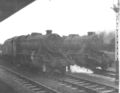 48392 and 48216 at Water Orton
 -
 48101
48101 -
 48730 at Lostock Hall MPD in 1968
 -
 48538 sat outside Saltley Shed during the running down of steam in 1967
 -
 48324 sat at Birds scrapyard awaiting its fate
 -
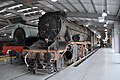 A recently repatriated 8F from Turkey, 2011
 -
 Preserved 8274 on the Gloucestershire and Warwickshire Railway
 -
 Preserved 8274
 -
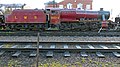 Preserved 8624 on the Great Central Railway
 -
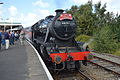 48151 at Llandudno Junction with The Welsh Mountaineer in 2014
 -
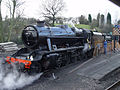 48773 at Bridgnorth shed on the Severn Valley Railway
 -
 48624 running around its train at Leicester North on the Great Central Railway
 -
 48173 awaiting restoration at Bitton on the Avon Valley Railway
 -
 48151 & 45690 Leander shunting empty coaches at Blaenau Ffestiniog in Aug 2019.
 -
 48305 running round its train at Loughborough on the GCR, 9 August 2022


.jpg)
.jpg)
.jpg)


.jpg)


.jpg)

.jpg)
See also
[edit]References
[edit]- ^ Hughes 1981, pp. 122–124.
- ^ Mcintosh., Jeff Ryan, George Moon, David (2006). Power of the 8fs. Opc Railprint. ISBN 0-86093-594-9. OCLC 712130766.
{{cite book}}: CS1 maint: multiple names: authors list (link) - ^ Cook 1990, pp. 73–88.
- ^ Haresnape 1981, pp. 62–68.
- ^ Hunt et al. 2005, pp. 3, 11–21, 124–9, 134–6.
- ^ Rowledge 1975, pp. 25–28, 88.
- ^ Hunt et al. 2005, p. 15.
- ^ Rowledge 1975, p. 26.
- ^ Hunt et al. 2005, pp. 15, 136.
- ^ Hunt et al. 2005, pp. 22–23.
- ^ a b Rowledge 1975, p. 28.
- ^ Hunt et al. 2005, pp. 16–18.
- ^ Rowledge 1975, pp. 28, 88–93.
- ^ Rowledge 1975, pp. 28, 89.
- ^ Hunt et al. 2005, pp. 19, 21–22.
- ^ Boddy et al. 1983, p. 108.
- ^ Boddy et al. 1983, pp. 109, 110, 111.
- ^ a b c Tourret 1995.
- ^ a b c HaRakevet: Rothschild PhD, Rabbi Walter (March 1991), ROD 2-8-0s in Palestina, 11942-1946. Issue 12
- ^ In the fins of Cousteau … The S.S. Thistlegorm and its incredible cargo
- ^ Hughes 1981, p. 124.
- ^ "The Restoration & Archiving Trust: Image no. br670327". Archived from the original on 20 November 2008.
- ^ "The Restoration & Archiving Trust: Image no. br670616".[permanent dead link]
- ^ "The Restoration & Archiving Trust: Image no. br670315".[permanent dead link]
- ^ "8F still intact... in Iraq". The Railway Magazine. Vol. 160, no. 1362. September 2014. p. 65. ISSN 0033-8923.
- ^ Kalla-Bishop, P.M. (1986). Italian state railways steam locomotives: together with low-voltage direct current and three-phase motive power. Abingdon: Tourret. pp. 68–9. ISBN 0905878035.
- ^ Cotterell 1984, p. 132.
- ^ Cotterell 1984, p. 69.
- ^ Cotterell 1984, p. 70.
- ^ Allen, Tony (1 July 2013). "Wrecksite - SS Jessmore 1921-1941". Wrecksite. Retrieved 7 December 2023.
- ^ Trevena, Arthur (1981). Trains in Trouble: Vol. 2. Redruth: Atlantic Books. p. 28. ISBN 0-906899-03-6.
- ^ Earnshaw, Alan (1989). Trains in Trouble: Vol. 5. Penryn: Atlantic Books. p. 29. ISBN 0-906899-35-4.
- ^ Maidment, David (2015). The Great Western Eight Coupled Heavy Freight Locomotives. Pen and Sword. pp. 131–134. ISBN 9781473857322.
- ^ Earnshaw, Alan (1990). Trains in Trouble: Vol. 6. Penryn: Atlantic Books. p. 32. ISBN 0-906899-37-0.
- ^ Earnshaw, Alan (1991). Trains in Trouble: Vol. 7. Penryn: Atlantic Books. p. 35. ISBN 0-906899-50-8.
- ^ a b Earnshaw, Alan (1993). Trains in Trouble: Vol. 8. Penryn: Atlantic Books. pp. 31, 35. ISBN 0-906899-52-4.
- ^ "Train Crashes at Turvey!". The Turvey Website. Retrieved 27 June 2020.
- ^ "Lucky escapes in derailment", "The Birmingham Post", Birmingham, 13 November 1961.
- ^ Kelly, Pat (15 July 2016). "While Didcot slept". Steam Railway. No. 456. Peterborough: Bauer Consumer Media Ltd. pp. 50–52. ISSN 0143-7232.
- ^ Hunt et al. 2005, p. 117.
- ^ a b Rowledge 1975, p. 29.
- ^ http://www.windfallfilms.com/show/1756/monster-moves-episode-3-titanic-trains.aspx Archived 20 December 2019 at the Wayback Machine Monster Moves, Windfall Films
- ^ "Railways of Iraq: Locomotives and rolling stock in Iraq". Archived from the original on 24 July 2011. Retrieved 19 June 2011.
- ^ Foster, Michael (1998). Hornby Dublo, 1938-1964: The Story of the Perfect Table Railway. London: New Cavendish. ISBN 0-904568-18-0.
- ^ "GCR '8F' bows out early". The Railway Magazine. Vol. 171, no. 1496. November 2025. p. 57.
- ^ "GWR - Gloucestershire's mainline heritage railway - Monster Moves Turkish adventure". Archived from the original on 10 August 2011. Retrieved 27 August 2011.
- ^ Stanier 8F sold to museum in Israel Deprecated link archived 25 September 2013 at archive.today, Robin Jones, Heritage Railway, 6 December 2012
Bibliography
[edit]- Boddy, M.G.; Brown, W.A.; Neve, E.; Yeadon, W.B. (November 1983). Fry, E.V. (ed.). Locomotives of the L.N.E.R., part 6B: Tender Engines - Classes O1 to P2. Kenilworth: RCTS. ISBN 0-901115-54-1.
- Cook, A.F. (1990). Greenwood, William (ed.). LMS Locomotive Design and Construction. Lincoln: RCTS. ISBN 0-901115-71-1.
- Cotterell, Paul (1984). The Railways of Palestine and Israel. Tourret Publishing. ISBN 0-905878-04-3.
- Haresnape, Brian (May 1981) [1970]. Stanier Locomotives: A Pictorial History. Shepperton: Ian Allan. p. 62. ISBN 0-7110-1098-6. EX/0581.
- Hudson, Mike; Atkins, Philip (September 2007). "Locos lost at sea. The all-time definitive record". The Railway Magazine. Vol. 153, no. 1277. IPC Media Ltd. pp. 14–19. ISSN 0033-8923.
- Hughes, Hugh (1981). Middle East Railways. Continental Railway Circle. ISBN 0-9503469-7-7.
- Hunt, David; Jennison, John; James, Fred; Essery, R.J. (2005). LMS Locomotive Profiles, no. 8 - The Class 8F 2-8-0s. Didcot: Wild Swan. ISBN 1-905184-08-5.
- Rowledge, J.W.P. (1975). Engines of the LMS built 1923–51. Oxford: Oxford Publishing Company. ISBN 0-902888-59-5.
- Tourret, R. (1995). Allied Military Locomotives of the Second World War. Abingdon, Oxon: Tourret Publishing. ISBN 0-905878-06-X.
External links
[edit]
LMS Stanier Class 8F
View on GrokipediaDevelopment and Design
Historical Background
In the interwar period, the London, Midland and Scottish Railway (LMS) faced significant challenges in handling its freight traffic, which was dominated by heavy coal and mineral hauls from industrial regions in the North and Midlands. The LMS had inherited a diverse and aging fleet from its constituent companies, including numerous small 0-6-0 locomotives that were inadequate for the era's demanding loads, often requiring double-heading or banking to manage long-distance trains. This inefficiency stemmed from the pre-Grouping policies of companies like the London and North Western Railway and Lancashire and Yorkshire Railway, which emphasized smaller engines for lighter duties, leaving the system ill-equipped for the interwar economic recovery's increased freight volumes.[4][1] The design of the Class 8F emerged under the leadership of William Stanier, who became Chief Mechanical Engineer (CME) of the LMS in 1932 after a distinguished career at the Great Western Railway (GWR). Stanier sought to address these freight shortcomings by drawing on his GWR experience, particularly prototypes like the 28XX class 2-8-0 introduced in 1903, which had proven effective for heavy goods work, and incorporating elements from earlier LMS efforts such as Somerset and Dorset Railway locomotives. His prior designs, including the LMS Class 8 2-6-0 mixed-traffic engine, influenced the 8F's development by emphasizing robust power and reliability, while adapting GWR practices like tapered boilers and long-travel valves to suit LMS routes. This approach marked a departure from the fragmented inherited fleet toward more capable, unified freight solutions.[5][6][1] To meet the urgent need for heavy freight capability, the LMS placed an initial order in 1935 for 30 Class 8F 2-8-0 locomotives, intended specifically for long-distance coal and mineral services.[7] This order represented a key step in Stanier's broader standardization program, which aimed to rationalize the LMS's locomotive stock by reducing the variety of classes, simplifying maintenance, and improving overall efficiency across the network. By prioritizing designs that could handle the heaviest loads without excessive assistance, the 8F helped modernize the LMS's freight operations amid the interwar period's industrial demands.[4][5][6]Technical Specifications
The LMS Stanier Class 8F featured a 2-8-0 wheel arrangement, with driving wheels measuring 4 feet 8.5 inches in diameter and leading wheels of 3 feet 3.5 inches.[7][1] The locomotive's overall length, including tender, was 63 feet 0.5 inches (approximately 19.2 meters), while the engine alone weighed 72.1 long tons (73.26 metric tonnes).[8][7] Its boiler operated at a pressure of 225 pounds per square inch, utilizing a Stanier Class 3C type with a Belpaire firebox.[1][7] The two outside cylinders measured 18.5 inches in diameter by 28 inches in stroke, driving the coupled wheels via Walschaerts valve gear.[8][1] The tractive effort of the Class 8F was calculated at 32,440 pounds-force, providing substantial hauling power for heavy freight duties.[8][1] This value is derived from the standard empirical formula for steam locomotive tractive effort at 85% cutoff:Production
Manufacturing Details
The LMS Stanier Class 8F production program resulted in a total of 852 locomotives constructed between 1935 and 1946, establishing it as one of the most prolific steam locomotive classes in British railway history.[1][10] The initial phase began with an LMS order for heavy freight locomotives, with the first batch of 12 units completed at Crewe Works in 1935, followed by additional LMS batches through 1936 that totaled 331 engines overall for the railway.[4][1] Production then expanded significantly during World War II, as the class was adopted as the standard freight locomotive for the War Department in 1939, leading to accelerated output from 1940 to 1945 to meet urgent military logistics demands across multiple builders.[1][7] Wartime pressures drove this rapid scaling, with 208 units built specifically for the War Department between 1940 and 1942, alongside further domestic orders that pushed annual production rates higher than pre-war levels to support freight transport essential for the war effort.[1] Although exact per-unit costs varied by builder and era, the class's relatively high production expense—compared to simpler austerity designs—reflected its robust engineering, yet Stanier's emphasis on component standardization across batches helped mitigate overall manufacturing expenses and enhanced maintenance efficiency by allowing interchangeable parts.[10][11]Builders and Variants
The LMS Stanier Class 8F locomotives were constructed by several key manufacturers during their production run from 1935 to 1946, with a total of 852 units built to meet the demands of the London, Midland and Scottish Railway (LMS), the War Department (WD), and other railway companies during and after World War II. The primary builders included LMS-owned works and private contractors, each contributing significant batches to the class. Crewe Works, the main LMS facility, produced 137 locomotives between 1935 and 1944, focusing on early LMS orders. Horwich Works, another LMS site, built 75 units from 1943 to 1945. Private contractors such as the North British Locomotive Company in Glasgow assembled 208 locomotives, primarily for WD contracts between 1940 and 1942, while Beyer, Peacock & Company in Manchester constructed 50 units, all for the WD in 1940–1942. Other builders, including Vulcan Foundry (69 units in 1936–1937) and various wartime facilities like Swindon, Eastleigh, and Doncaster, contributed the remainder to reach the total production figure.[7][4]| Builder | Location | Period | Quantity Built | Primary Orders |
|---|---|---|---|---|
| Crewe Works | Crewe, England | 1935–1944 | 137 | LMS |
| Horwich Works | Horwich, England | 1943–1945 | 75 | LMS |
| North British Locomotive Co. | Glasgow, Scotland | 1940–1942 | 208 | WD and LMS |
| Beyer, Peacock & Co. | Manchester, England | 1940–1942 | 50 | WD |
| Vulcan Foundry | Newton-le-Willows, England | 1936–1937 | 69 | LMS |
United Kingdom Service
Pre-War LMS Operation
The Stanier Class 8F locomotives entered service on the London, Midland and Scottish Railway (LMS) in 1935, primarily deployed on mainline freight routes to handle the demanding coal traffic from North Wales and the Midlands coalfields. These 2-8-0 engines were assigned to key sheds such as those in Crewe, Derby, and Stoke-on-Trent, where they tackled long-distance hauls of mineral wagons over challenging gradients and distances, often exceeding 200 miles per working turn. Their introduction marked a shift toward more efficient heavy freight operations, filling a gap left by older inherited designs from pre-Grouping companies.[15][1] In terms of performance, the Class 8F demonstrated exceptional reliability for heavy haulage right from their debut, outperforming the Lancashire and Yorkshire Railway (LYR) and London and North Western Railway (LNWR) 0-8-0 classes that had previously dominated such duties. Capable of sustaining average speeds of 40-50 mph on level sections with loads up to 1,000 tons, they reduced the need for double-heading on many routes, thereby improving turnaround times and operational economy. Their robust taper boiler and long-travel valve gear contributed to consistent power output, making them a staple for time-sensitive freight like coal destined for southern power stations and industrial centers.[1][4] Integration with the existing LMS fleet was seamless, as the 8Fs complemented rather than directly competed with lighter freight classes like the Fowler 0-6-0s, taking over the heaviest duties while allowing older engines to shift to secondary lines. Early examples, such as Nos. 8000-8011, featured domeless boilers as a cost-saving measure, but subsequent builds incorporated domes for improved steam circulation, reflecting minor route-specific adaptations for better performance on undulating Midlands terrain. Overall, the class's immediate success minimized disruptions, with availability rates exceeding 90% in their first years of service.[1][4] Initial operational challenges included minor teething issues with boiler priming under high-load conditions in the damp Welsh coal districts, which were addressed through adjustments to water treatment and feed systems by 1937. These refinements ensured the locomotives' enduring suitability for the LMS's expanding freight network through the late 1930s.[15]World War II War Department Use
In 1941, the War Department requisitioned 51 LMS Stanier Class 8F locomotives for military service in the United Kingdom, renumbering them WD 572–622 (not in sequence).[1] These engines, drawn from existing LMS stock, supplemented the pre-war freight operations by shifting to urgent wartime priorities.[16] From 1941 to 1945, the Class 8F locomotives under War Department control performed critical roles in domestic support for the Allied effort, hauling troop trains to mobilization points, transporting munitions and supplies to factories and depots, and facilitating movements for Home Guard defensive preparations across rail networks.[7][4] Their robust design proved ideal for these heavy-haul demands amid intensified rail traffic.[1] The War Department's total acquisitions of Stanier Class 8F locomotives reached 259, comprising the 51 requisitioned units plus 208 newly built examples diverted from production lines by manufacturers such as Beyer Peacock and the North British Locomotive Company between 1940 and 1942.[1][17] These batches were initially allocated WD numbers in the 300–539 series (later adjusted to 70300–70539 for some).[1] Maintenance of these locomotives fell under War Department oversight, emphasizing efficiency through austerity measures that prioritized essential repairs and material conservation to align with wartime resource shortages.[18] Adaptations for blackout conditions included dimmed or screened headlamps and reduced lighting on cabs and tenders to prevent aiding enemy air reconnaissance during night operations.[19] Overhauls were conducted at facilities like Derby Works, ensuring operational reliability despite the strains of prolonged military use.[1]Post-War British Railways Service
Upon nationalisation in 1948, the London, Midland and Scottish Railway's fleet of 311 Stanier Class 8F locomotives, along with many returned from War Department service, were integrated into British Railways stock and renumbered by adding 40,000 to their original LMS numbers, resulting in the series 48000–48764.[1][7] This brought a total of 624 8Fs into BR ownership initially, with an additional 39 ex-War Department examples purchased and renumbered in 1948 after overhaul at Crewe Works.[20] The majority were allocated to the London Midland Region, where they formed the backbone of heavy freight operations during the 1950s and 1960s, hauling coal and mineral trains over demanding routes.[1][7] A smaller number, including the 80 Swindon-built examples (48400–48479), were assigned to the Western Region for duties such as coal traffic from South Wales valleys.[1][21] They also performed hump shunting at major yards like Toton and Carlisle, leveraging their powerful 2-8-0 wheel arrangement for precise control in marshalling operations, and occasionally provided relief on passenger services when demand exceeded available motive power.[1] As British Railways modernized its network in the late 1950s and early 1960s, the 8Fs encountered conflicts with electrification schemes, particularly on key freight corridors like the West Coast Main Line, leading to their displacement from electrified sections to remaining steam-worked areas.[7] Despite these challenges, their reliability ensured continued versatility in freight roles until dieselisation advanced further.[20]Withdrawal and Scrapping
The withdrawal of Stanier Class 8F locomotives from British Railways (BR) service commenced in 1959 with the final two examples remaining under War Department (WD) ownership, which were transferred to the Cairnryan Military Railway in Scotland and subsequently scrapped there.[22] Routine withdrawals of BR-owned locomotives began in 1960 with the decommissioning of No. 48616, though the process accelerated significantly from 1964 onward as part of BR's modernization efforts to replace steam traction with diesel-electric locomotives.[1] In 1964, 25 locomotives were withdrawn, followed by 95 in 1965, 162 in 1966, 231 in 1967, and a final 150 in 1968, marking the end of steam operations on BR.[1] The last Class 8F to be withdrawn was No. 48773 in August 1968 from Rose Grove depot.[2] Of the 666 Class 8F locomotives that entered BR stock, the majority were scrapped following withdrawal, driven by the BR Modernisation Plan of 1955, which prioritized diesel and electric traction to improve efficiency and reduce operating costs, rendering the steam fleet redundant.[4] Approximately 659 were ultimately scrapped, with key sites including Woodham Brothers' yard at Barry in South Wales—where around 200 steam locomotives, including numerous 8Fs, were processed and some later preserved—and G.H. Campbell & Sons at Airdrie in Scotland, which handled several dozen examples.[23] Other notable scrapping locations included David Cashmore's yards at Great Bridge and Newport, contributing to the rapid disposal of the class amid the broader phase-out of steam.[24] A small number were exported or preserved, but the vast majority met this fate by the late 1960s.[1]Overseas Service
Egypt
During World War II, the War Department supplied 42 Stanier Class 8F locomotives to support British military operations in Egypt, with arrivals beginning in late 1941 and continuing through 1942; these were transported via routes including Palestine to avoid Mediterranean hazards and deployed primarily on the Egyptian State Railways for hauling military freight and logistics trains in the North African theater.[4][1] The locomotives, drawn from WD production in the UK, were initially operated by Royal Engineers railway companies on extensions like the Western Desert Extension Railway and the Dabaa-Mersa Matruh line before being loaned to the Egyptian State Railways (ESR) in 1942. An additional 50 arrived from Iran via the Middle East Forces (MEF) in 1944 (of which 15 were later transferred to Italy), followed by 59 more in 1946. Following the war, the ESR purchased 40 of the initial batch in 1942-44, plus 1 repaired in 1945 (total 41 by early 1945), with additional acquisitions in 1949, 1951, and 1954–1956 for a total of 62, retaining them for civilian heavy freight duties on key routes such as the Cairo-Alexandria main line into the 1970s.[1][25] Based at depots like el-Gabbari in Alexandria, they handled general merchandise and bulk goods traffic, proving reliable in the post-war economic recovery despite the challenging environment. The ESR renumbered them into series such as 850–890 and later additions like 832–849 and 891–893, while retaining LMS-style cabside plates. To suit desert operations, the locomotives underwent tropical modifications, including conversion to oil firing (with one exception) in 1943 for better performance in sandy conditions, addition of cowcatchers for track protection, and removal of wartime Westinghouse air brakes by 1947; they were painted unlined black with vermilion buffer beams and yellow Arabic numerals added from 1946. Most were withdrawn by 1963 as dieselization advanced, though some tenders were repurposed for mazout (heavy fuel oil) transport as late as 1977, with the entire class scrapped by the early 1980s.[1]Palestine and Transjordan
During the Second World War, the War Department allocated Stanier Class 8F locomotives to the Middle East Forces for critical logistics support in the North African Campaign, with some loaned to the Palestine Railways from 1942 and larger numbers of former Iranian locomotives arriving via the port of Haifa in Palestine in 1944 (50 transferred to MEF for use in both Egypt and Palestine) to facilitate freight transport on local rail networks such as the Haifa-Beirut-Tripoli route.[1] Their robust 2-8-0 design, with a tractive effort of 32,440 lbf, enabled efficient operation in support of Allied military efforts, including troop movements and materiel distribution across the Levant.[1] In 1947, the Middle East Forces sold 24 War Department 8Fs—primarily those that had served in Iran and Palestine—to the Palestine Railways for continued freight duties on standard-gauge lines.[1] Following the 1948 Arab-Israeli War, 23 of these locomotives were incorporated into the newly established Israel Railways fleet, renumbered in the 704 series (such as 704–713), and employed for essential freight hauling, including coal and goods trains, until the late 1950s.[1] Examples like No. 70513, built by the North British Locomotive Company in 1941, were photographed in service taking water at Zichron Ya'akov as late as January 1949, underscoring their post-war utility amid infrastructure disruptions.[1] During the 1948 conflict, the 8Fs played a key role in securing supply lines for Israeli forces, operating amid active combat zones to transport munitions and provisions despite sabotage and blockades on rail routes.[1] One notable incident involved No. 70372 (North British works No. 24680), which became stranded near Tulkarm in the West Bank during the fighting; it remained derelict there until scrapped around 1973 following the 1967 Six-Day War.[1] By the early 1960s, the surviving Israeli 8Fs faced progressive withdrawal as dieselization advanced, with most undergoing scrapping or cannibalization for spare parts to sustain older rolling stock.[1]Iran and Iraq
In 1941-1942, the War Department dispatched 163 Stanier Class 8F locomotives to Iran for operation on the Trans-Iranian Railway, with 143 arriving to play a vital role in the Allied "Persian Corridor," hauling essential supplies—including munitions, vehicles, and raw materials—from Persian Gulf ports such as Bandar Shahpur to the Caspian Sea ports for onward transport to the Soviet Union, supporting the Eastern Front effort against Nazi Germany. Built primarily by British manufacturers like the North British Locomotive Company, the locomotives were adapted for the region's harsh environment with dust filters to protect against fine sand ingress into cylinders and valves, alongside minor adjustments for local operating conditions; although the Trans-Iranian Railway was standard gauge (1,435 mm), some loading gauge compatibility challenges arose due to tighter clearances on certain sections. Of these, 50 were transferred to the Middle East Forces in 1944 and 71 to MEF (59) and Iraq (12) in 1945-48, with the remaining 22 withdrawn and scrapped by 1963 as the railway modernized with more suitable motive power.[1][14][26] In 1946-1948, 12 Stanier Class 8F locomotives were purchased by the Iraqi State Railways from surplus in Iran, classified as TD, to bolster logistics in the Middle East theater. Primarily utilized for hauling oil from northern fields to export terminals and for troop movements along key routes like Baghdad to Basra, these engines operated under both War Department and local control, enduring the dusty Mesopotamian plains. Adaptations included dust filters similar to those in Iran, as well as reinforced sand domes for traction in arid conditions, addressing the lack of original desert-specific features in the Stanier design. Retained after the war for freight duties, the locomotives remained in service through the 1950s and into the 1970s, until progressive dieselization rendered them obsolete.[1][26]Italy and Turkey
During the Allied advance in Italy from 1944 to 1945, fifteen War Department Stanier Class 8F locomotives, transferred from Iran via the Middle East Forces as part of the broader overseas WD program, were used to support operations on the Italian Military Railway. These heavy freight engines, typically numbered in the WD 70300 series, were vital for transporting supplies over war-damaged infrastructure amid the challenging Apennine terrain, necessitating on-site repairs and modifications such as reinforced frames to handle steep gradients and bomb craters. Their robust design proved effective in restoring rail logistics during the Italian Campaign, hauling munitions and troops northward.[1] Post-war, the Italian State Railways (Ferrovie dello Stato Italiane, or FS) acquired these locomotives in 1946, classifying them as FS 737.001–737.015 and integrating them into the national network for general freight duties. Retained until the early 1950s, they underwent further adaptations for peacetime use, including boiler overhauls to address accumulated war damage, before being withdrawn and scrapped as dieselization advanced. No examples survive from this batch.[1] In Turkey, 25 Stanier Class 8F locomotives were sold by the War Department to the Turkish State Railways (TCDD) in 1941 (WD temporary Nos. including 246-338, 343-345, 354-356, with 7 lost at sea en route, so 18 arrived), plus 2 more in 1943, for freight support on Anatolian lines amid wartime supply pressures; these became the TCDD 45151–45170 series. They focused on regional hauls but faced significant hurdles in the rugged Taurus Mountains, including insufficient power for prolonged heavy grades and the need for tender modifications to accommodate local water and coal supplies. Intensive wartime operations led to frequent repairs for wear and minor sabotage damage. The class persisted in secondary and shunting roles until the 1980s.[1][27]Incidents and Preservation
Notable Accidents
One of the most serious incidents involving a Stanier Class 8F occurred on 2 July 1941 at Dolphin Junction near Slough, Berkshire, where War Department locomotive WD 407 (formerly LMS 8293) was hauling a freight train that collided head-on with an express passenger train pulled by GWR Castle Class No. 4091 Dudley Castle. The collision was caused by a signalman's error in failing to protect the passenger train's path, resulting in the derailment of the 8F's locomotive and tender, along with several passenger coaches; five passengers were killed and around 24 others injured. An official investigation by the Ministry of Transport attributed the accident to human error in signaling and recommended improvements in signal interlocking systems.[28] Another significant derailment took place on 21 January 1941 at Wallneuk Junction, Paisley, Renfrewshire, when LMS No. 8247, operating a freight service, derailed due to excessive speed on a sharp curve combined with track irregularities. The locomotive overturned, requiring three cranes for recovery, but fortunately caused no fatalities or serious injuries to crew or passengers. The incident highlighted vulnerabilities in junction design under wartime loading conditions, prompting minor track reinforcements in the area.[1] In British Railways service, a notable runaway incident unfolded on 9 February 1957 near Chapel-en-le-Frith, Derbyshire, involving BR No. 48188 hauling a 33-wagon coke freight from Rowsley to Guide Bridge. A fracture in the steam brake pipe rendered the locomotive's brakes inoperable, causing the train to accelerate uncontrollably down a gradient; driver John Axon remained at the controls in a heroic but fatal attempt to mitigate the disaster by applying the tender handbrake and warning signals, ultimately perishing when the train collided with a stationary mineral train at Runger Lane. The collision killed Axon and the guard of the stationary train, injuring several others, and led to a boiler explosion from impact damage. The Ministry of Transport inquiry cited material failure in the brake system as the primary cause and praised Axon's actions, awarding him a posthumous George Cross for gallantry. This event underscored the risks of brake dependency in heavy freight operations and influenced subsequent maintenance protocols for steam locomotives.[29] The robust design of the Stanier 8F, with its stable 2-8-0 wheel arrangement and high tractive effort, contributed to an overall low rate of major accidents relative to the class's extensive wartime and postwar usage, where over 700 examples saw heavy freight duty across diverse conditions with few derailments or collisions attributable to mechanical flaws.[4] Overseas, Class 8F locomotives faced unique hazards; for instance, in 1941, two examples en route to Egypt aboard the SS Thistlegorm were destroyed when the ship was bombed and sunk by German aircraft in the Red Sea, representing a wartime loss rather than operational sabotage, though it delayed reinforcements for North African rail logistics. In Iran during 1942, WD No. 70307 (later BR 48773) derailed after colliding with a camel on the line on 4 August, causing minor damage but no injuries, an event attributed to unfamiliar desert operating environments and later rectified by enhanced headlight modifications.[17][2]Surviving Locomotives
Several LMS Stanier Class 8F locomotives have survived into preservation, reflecting the class's widespread use and enduring popularity among heritage railways. Out of the 852 built between 1935 and 1946, at least 14 are known to exist today, with eight preserved in the United Kingdom and eight others surviving overseas or in unusual circumstances. These survivors include examples from both LMS/BR allocations and War Department exports, many rescued from Woodham Brothers scrapyard in Barry, South Wales, during the 1970s and 1980s.[7] In the UK, the preserved fleet consists primarily of operational or restorable examples based at heritage lines, with a focus on mainline certification for select locomotives to support railtours. No. 48151, built in September 1942 at Crewe Works, was preserved in 1975 from Barry and restored to operation in 1988 at Steamtown Carnforth; it remains the only mainline-certified 8F, owned by West Coast Railways and limited to 50 mph speeds, but withdrawn for overhaul as of 2025. No. 48305, constructed in November 1943 at Crewe Works, entered preservation in 1985 from Barry and was restored by 1995 for the Great Central Railway, where it operated until withdrawn for overhaul in October 2025 due to firebox cracks.[7][8][30] Other notable UK survivors include No. 48173 (built June 1943 at Crewe Works), preserved in 1965 from Barry and currently under restoration at the Churnet Valley Railway using components from scrapped sister No. 48518; No. 48431 (built March 1944 at Swindon Works), preserved in 1972 from Barry, restored to operation in the 1990s for the Keighley & Worth Valley Railway, and withdrawn in 2025 for overhaul due to a cracked firebox; No. 48624 (built December 1943 at Ashford Works), rescued in 1982 from Barry, restored in 2009 for the Great Central Railway, but withdrawn in 2019 awaiting overhaul; and No. 48773 (built August 1940 by North British Locomotive Co.), preserved in 1968 by the Stanier 8F Locomotive Society and serving as a static exhibit in the Severn Valley Railway's Engine House since 2008 after overseas service in Iran. Repatriated ex-Turkish examples add to the UK total: No. 8274 (originally TCDD 45160, built 1940 by North British), returned in 1989 and restored for the Great Central Railway's Nottingham transport section, currently withdrawn awaiting overhaul due to firebox cracks; and No. 45170 (built early 1942 by North British), repatriated in 2010 to the Bo'ness & Kinneil Railway for restoration by the Scottish Railway Preservation Society.[7][31][32]| Locomotive No. | Builder & Year | Preservation Date & Source | Current Location & Status |
|---|---|---|---|
| 48151 | Crewe Works, 1942 | 1975, Barry Scrapyard | West Coast Railways, Carnforth; Withdrawn for overhaul, mainline certified |
| 48173 | Crewe Works, 1943 | 1965, Barry Scrapyard | Churnet Valley Railway; Under restoration |
| 48305 | Crewe Works, 1943 | 1985, Barry Scrapyard | Great Central Railway; Withdrawn for overhaul as of October 2025 (firebox issues) |
| 48431 | Swindon Works, 1944 | 1972, Barry Scrapyard | Keighley & Worth Valley Railway; Withdrawn for overhaul as of 2025 (cracked firebox) |
| 48624 | Ashford Works, 1943 | 1982, Barry Scrapyard | Great Central Railway; Withdrawn awaiting overhaul |
| 48773 | North British, 1940 | 1968, BR Withdrawal | Severn Valley Railway; Static exhibit |
| 8274 (ex-45160) | North British, 1940 | 1989, Repatriated from Turkey | Great Central Railway; Withdrawn awaiting overhaul (firebox cracks) |
| 45170 | North British, 1942 | 2010, Repatriated from Turkey | Bo'ness & Kinneil Railway; Under restoration |