


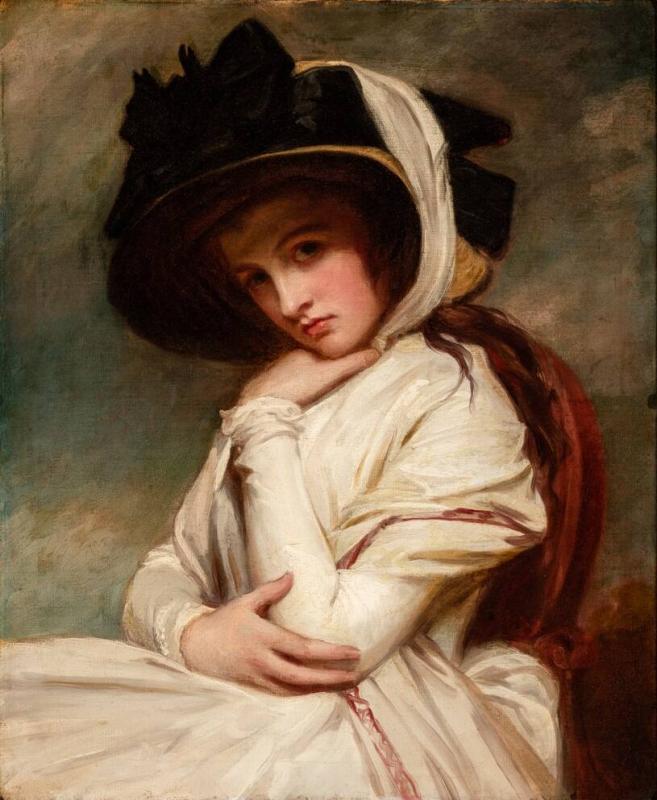
Community hub
Recent from talks
Contribute something
Nothing was collected or created yet.
Emma, Lady Hamilton
View on Wikipedia
Emma, Lady Hamilton (born Amy Lyon; 26 April 1765 – 15 January 1815), was an English model, dancer and actress. She began her career in London's demi-monde, becoming the mistress of a series of wealthy men, culminating in the naval hero Lord Nelson, and was the favourite model and muse of the portraitist George Romney.
Key Information


In 1791, at the age of 26, she married Sir William Hamilton, British ambassador to the Kingdom of Naples, where she was a success at court, befriending the queen who was a sister of Marie Antoinette, and meeting Nelson.
Early life
[edit]She was born Amy Lyon on April 26, 1765,[1] in Ness near Neston, Cheshire, England,[2] the daughter of Henry Lyon, a blacksmith[1] who died when she was two months old. She was baptised on 12 May 1765. She was raised by her mother, Mary Kidd (later Cadogan), and grandmother, Sarah Kidd, at Hawarden, and received no formal education.[3][4] She later went by the name of Emma Hart.[1]
With her grandmother struggling to make ends meet at the age of 60, and after Mary went to London in 1777, Emma began work, aged 12, as a nurse-maid at the Hawarden[3] home of John Thomas, father of Honoratus Leigh Thomas[4] (then 8 years old). A "Miss Thomas" (presumably Honoratus' sister) is the first person known to sketch Emma.[4] The sketch survives.
She moved to London late 1779 or early 1780.[4] She started to work for the Budd family in Chatham Place, Blackfriars, London, and began acting at the Drury Lane theatre in Covent Garden. She worked as a maid for actresses, including Mary Robinson.[4] Emma next worked as a model and dancer at the "Goddess of Health" for James Graham,[1] a Scottish "quack" doctor.

At 15, Emma met Sir Harry Fetherstonhaugh, who hired her for several months as hostess and entertainer at a lengthy stag party at his Uppark country estate in the South Downs. She is said to have danced nude on his dining room table.[1][5] Fetherstonhaugh took Emma there as a mistress, but frequently ignored her in favour of drinking and hunting with his friends. Emma soon befriended the Honourable Charles Francis Greville (1749–1809). It was about this time (late June-early July 1781) that she conceived a child by Fetherstonhaugh.[1][4]

Greville took her in as his mistress on condition that the child was fostered out.[4] Once the child (Emma Carew)[1] was born, she was removed to be raised by her great-grandmother at Hawarden for her first three years,[4] and subsequently (after a short spell in London with her mother) deposited with Mr John Blackburn, schoolmaster, and his wife in Manchester.[6] As a young woman, Emma's daughter saw her mother frequently, but later when Emma fell into debt, her daughter worked abroad as a companion or governess.[7]
Greville kept Emma in a small house at Edgware Row, Paddington Green, London, at this time a village on the rural outskirts of London. At Greville's request, she changed her name to "Mrs Emma Hart", dressed in modest outfits in subdued colours and eschewed a social life. He arranged for Emma's mother to live with her as housekeeper and chaperone. Greville also taught Emma to enunciate more elegantly, and after a while, started to invite some of his friends to meet her.[4]

Seeing an opportunity to make some money by taking a cut of sales, Greville sent her to sit for his friend, the painter George Romney, who was looking for a new model and muse.[4][1] It was then that Emma became the subject of many of Romney's most famous portraits, and soon became London's biggest celebrity.[3] So began Romney's lifelong obsession with her, sketching her nude and clothed in many poses that he later used to create paintings in her absence. Through the popularity of Romney's work and particularly of his striking-looking young model, Emma became well known in society circles, under the name of "Emma Hart". She was witty, intelligent, a quick learner, elegant and, as paintings of her attest, extremely beautiful. Romney was fascinated by her looks and ability to adapt to the ideals of the age. Romney and other artists painted her in many guises, foreshadowing her later "attitudes".[4]

In 1783, Greville needed to find a rich wife to replenish his finances, and found a fit in the form of eighteen-year-old heiress Henrietta Middleton. Emma would be a problem, as he disliked being known as her lover (this having become apparent to all through her fame in Romney's artworks), and his prospective wife would not accept him as a suitor if he lived openly with Emma Hart. To be rid of Emma, Greville persuaded his uncle, Sir William Hamilton, British Envoy to Naples and younger brother of his mother, to take her off his hands.[1][3]
Greville's marriage would prove useful to Sir William, as it relieved him of having Greville as a poor relation. To promote his plan, Greville suggested to Sir William that Emma would make a very pleasing mistress, assuring him that, once married to Henrietta Middleton, he would come and fetch Emma back. Sir William, then 55 and newly widowed, had arrived back in London for the first time in over five years.[4] Emma's famous beauty was by then well known to Sir William, so much so that he even agreed to pay the expenses for her journey to ensure her speedy arrival. He had long been happily married until the death of his wife in 1782, and he liked female companionship. His home in Naples was well known all over the world for hospitality and refinement. He needed a hostess for his salon, and from what he knew about Emma, he thought she would be the perfect choice.[citation needed]
Greville did not inform Emma of his plan, but instead in 1785 suggested the trip as a prolonged holiday in Naples while he (Greville) was away in Scotland on business,[3] not long after Emma's mother had suffered a stroke.[4] Emma was thus sent to Naples, supposedly for six to eight months, little realising that she was going as the mistress of her host. Emma set off for Naples with her mother and Gavin Hamilton on 13 March 1786 overland in an old coach, and arrived in Naples on her 21st birthday on 26 April.[4]
-
 Lady Hamilton (as Nature) c.1782
 -
 Emma as a Bacchante, by George Romney, 1785
 -
 Emma as a Sibyl, by George Romney, c. 1785
 -
 Emma as a Bacchante, by George Romney
 -
 Emma as Miranda, by George Romney
 -
 Lady Emma Hamilton, as Cassandra, by George Romney
 -
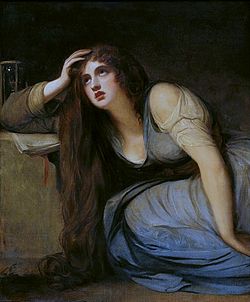 Lady Hamilton as The Magdalene, by George Romney, before 1792
 -
 Lady Hamilton as Titania with Puck and Changeling, by George Romney, 1793
 -
 Lady Hamilton as a Bacchante, by Marie Louise Élisabeth Vigée-Lebrun, 1790–1791
 -
 Pastel by Johann Heinrich Schmidt, c. 1800, owned by Nelson
.jpg)
_3.jpg)
_2.jpg)
.jpg)


.jpg)
.jpg)

Marriage to Sir William Hamilton
[edit]
After about six months of living in apartments in the Palazzo Sessa with her mother (separately from Sir William) and begging Greville to come and fetch her, Emma came to understand that he had cast her off. She was furious when she realised what Greville had planned for her,[3] but eventually started to enjoy life in Naples and responded to Sir William's intense courtship just before Christmas in 1786. They fell in love, Sir William forgot about his plan to take her on as a temporary mistress, and Emma moved into his apartments, leaving her mother downstairs in the ground floor rooms. Emma was unable to attend Court yet, but Sir William took her to every other party, assembly and outing.[4]
.jpg)
They were married on 6 September 1791 at St Marylebone Parish Church, then a plain small building, having returned to England for the purpose and Sir William having gained the King's consent.[1] She was twenty-six and he was sixty.[3] Although she was obliged to use her legal name of Amy Lyon on the marriage register, the wedding gave her the title Lady Hamilton which she would use for the rest of her life. Hamilton's public career was now at its height and during their visit he was inducted into the Privy Council. Shortly after the ceremony, Romney painted his last portrait of Emma from life, The Ambassadress, after which he plunged into a deep depression and drew a series of frenzied sketches of Emma.
The newly married couple returned to Naples after two days. After the marriage, Greville transferred the cost of Emma Carew's upkeep to Sir William, and suggested that he might move her to an establishment befitting the stepdaughter of an envoy. However, Sir William preferred to forget about her for a while.[4]
The marriage was not favorable to Sir William's family and relations, to the point that Sir William wrote to Thomas Graham, the husband of his niece Mary Graham (another great beauty of the Georgian Period), defending his marriage to Emma. Emma also wrote seeking approval from Graham and other family relations.
Life in Naples and the "Attitudes"
[edit]
She lived for some time in a house in Caserta rented by Sir William. Lady Hamilton became a close friend of Queen Maria Carolina, sister of Marie Antoinette and wife of Ferdinand I of Naples, and soon acquired fluency in both French and Italian. She was also a talented amateur singer. She sang one of the solo parts of Joseph Haydn's Nelson Mass and entertained guests at her home. At one point, the Royal Opera in Madrid tried to engage her for a season, in competition with their star, Angelica Catalani, but this offer was turned down. Sir William commissioned many portraits of Emma, although not for their sentimental value; he almost always sold them for a profit, usually in England. M. de Talleyrand, the youngest son of the ambassador at Naples, responded to a remark about Sir William's interest in the arts by saying "Rather, it is the arts that look out for Sir William's interests".
Emma's vulgar toilette, unaristocratic mannerisms, and drinking sometimes raised the eyebrows of her refined company. During a dinner in Naples, the Duc de Bourbon remarked on the manner in which Emma drank port- noting it must have been a "habit of hers as she did not become drunk after finishing two or three bottles."[8]

Sharing Sir William Hamilton's enthusiasm for classical antiquities and art, she developed what she called her "Attitudes"—tableaux vivants in which she portrayed sculptures and paintings before British visitors.[9] Emma developed the attitudes, also known as mimoplastic art, by using Romney's idea of combining classical poses with modern allure as the basis for her act. Emma had her dressmaker make dresses modelled on those worn by peasant islanders in the Bay of Naples, and the loose-fitting garments she often wore when modelling for Romney. She would pair these tunics with a few large shawls or veils, draping herself in folds of cloth and posing in such a way as to evoke popular images from Greco-Roman mythology.[3] This cross between postures, dance and acting was first revealed to guests in the spring of 1787 by Sir William at his home in Naples. It formed a sort of charade, with the audience guessing the names of the classical characters and scenes Emma portrayed.[10]
.png)
With the aid of her shawls, Emma posed as various classical figures from Medea to Queen Cleopatra, and her performances charmed aristocrats, artists such as Élisabeth-Louise Vigée-Le Brun, writers—including the great Johann Wolfgang von Goethe[11]—and kings and queens alike, setting off new dance trends across Europe and starting a fashion for a draped Grecian style of dress.
"Attitudes" were taken up by several other (female) artists, among them Ida Brun from Denmark, who became Emma's successor in the new art form.[12] The famed sculptor Bertel Thorvaldsen admired her art.
Meeting with Nelson
[edit]As wife of the British Envoy, Emma welcomed Nelson (who had been married to Fanny Nisbet for about six years at that point) after his arrival in Naples on 10 September 1793,[4] when he came to gather reinforcements against the French. She is described in 1797 in the diary of 18-year-old Elizabeth Wynne as "a charming woman, beautiful and exceedingly good humoured and amiable."[13] When he set sail for Sardinia on 15 September after only five days in Naples, it was clear that he had already fallen a little in love.[4]
After four years of marriage, Emma had despaired of having children with Sir William, although she wrote of him as "the best husband and friend". It seems likely that he was sterile. She once again tried to persuade him to allow her daughter to come and live with them in the Palazzo Sessa as her mother Mrs Cadogan's niece, but he refused this as well as her request to make enquiries in England about suitors for the young Emma.[4]
Nelson returned to Naples five years later, on 22 September 1798[14] a living legend, after his victory at the Battle of the Nile, with his step-son Josiah Nisbet, then 18 years old. By this time, Nelson's adventures had prematurely aged him; he had lost an arm and most of his teeth, and was afflicted by coughing spells. Before his arrival, Emma had written a letter passionately expressing her admiration for him.[4] Nelson even wrote effusively of Emma to his increasingly estranged wife.[15] Emma and Sir William escorted Nelson to their home, the Palazzo Sessa.

Emma nursed Nelson under her husband's roof and arranged a party with 1,800 guests to celebrate his 40th birthday on 29 September. After the party, Emma became Nelson's secretary, translator and political facilitator. They soon fell in love and began an affair. Hamilton showed admiration and respect for Nelson, and vice versa; the affair was tolerated. By November, gossip from Naples about their affair reached the English newspapers. Emma Hamilton and Horatio Nelson were famous.[4]
Emma had by then become not only a close personal friend of Queen Maria Carolina, but had developed into an important political influence. She advised the queen on how to react to the threats from the French Revolution. Maria Carolina's sister Marie Antoinette had fallen a victim to the Revolution.

In 1799, Naples was the scene of a strange revolution led by members of the aristocracy; the common people did not agree with the revolution. The French troops were not welcome, but the royal family fled to Sicily. From here, Nelson tried to help the royal family put down the revolutionaries. He had no support from the British government. He even allowed one of the leaders of the revolution, Admiral Francesco Caracciolo, to be executed for treason. Emma played an important role in helping to put an end to the revolution when she arrived near Naples with Nelson's fleet on 24 June 1799.[16] She acted as a go-between, conveying messages from the queen to Nelson and from Nelson to the queen.
Life in London and at Merton
[edit]Nelson's recall to Britain[17] shortly afterwards coincided with the government finally granting Hamilton's request for relief from his post in Naples. Emma must have become pregnant around April 1800.[16] Nelson, Emma, her mother and William travelled together—taking the longest possible route back to Britain via Central Europe (hearing the Missa in Angustiis by Joseph Haydn, now known as the "Nelson Mass", in Vienna in 1800 and meeting the composer as well in the Esterhazy palace in Eisenstadt). They eventually arrived in Yarmouth to a hero's welcome on 6 November 1800.[17][4]
Upon arrival in London on 8 November, the three of them took suites at Nerot's Hotel after a missed communication from Nelson to his wife about receiving the party at their home, Roundwood. Lady Nelson and Nelson's father arrived and they all dined at the hotel. Nelson's wife Fanny was deeply unhappy to see Emma pregnant. The affair soon became public knowledge and, much to the delight of the newspapers, Fanny did not accept the affair as placidly as Sir William. Emma was winning the media war at that point, and every fine lady was experimenting with her "look." Nelson himself contributed to his wife Fanny's misery by being cruel to her when not in Emma's company. Emma's husband, Sir William, was mercilessly lampooned in the press. However, his sister observed that he doted on Emma and she was very attached to him.[4]
The Hamiltons moved into William Beckford's mansion at 22 Grosvenor Square, and Nelson and Fanny took an expensive furnished house at 17 Dover Street, a comfortable walking distance away, until December, when Sir William rented a home at 23 Piccadilly, opposite Green Park. On 1 January, Nelson's promotion to vice admiral was confirmed and he prepared to go to sea on the same night. After his departure on 13 January, he sent Fanny a few brief and hostile letters (many of which she burned) before finally cutting her off in March. He never saw her again after being hustled out of town by an agent. While he was at sea, Nelson and Emma exchanged many letters, using a secret code to discuss Emma's condition. Emma kept her first daughter Emma Carew's existence a secret from Nelson, and Sir William continued to provide for her.[4]
Birth of Horatia
[edit]
On 29 January 1801[18] at 23 Piccadilly, Emma gave birth to Nelson's daughter Horatia, who was taken soon afterwards to a Mrs Gibson for care and hire of a wet nurse. On 1 February, Emma made a spectacular appearance at a concert at the house of the Duke of Norfolk in St James' Square, and Emma worked hard to keep the press onside.
Soon after this, the Prince of Wales (later King George IV) became infatuated with Emma, leading Nelson to be consumed by jealousy, and inspiring a remarkable letter by Sir William to Nelson, assuring him that she was being faithful. In late February, Nelson returned to London and met his daughter at Mrs Gibson's. Nelson's family were aware of the pregnancy, and his clergyman brother Rev. William Nelson wrote to Emma praising her virtue and goodness. Nelson and Emma continued to write letters to each other when he was away at sea, all of which she kept. While he was away too, she arranged for her mother to visit the Kidds in Hawarden and her daughter in Manchester.[4]
By the autumn of the same year, upon Emma's advice, Nelson bought Merton Place, a small ramshackle house at Merton, near Wimbledon, for £9,000, borrowing money from his friend Davison. He gave her free rein with spending to improve the property, and her vision was to transform the house into a celebration of his genius. There they lived together openly, with Sir William and Emma's mother, in a ménage à trois that fascinated the public.[19] Emma turned herself to winning over Nelson's family, nursing his 80-year-old father Edmund for 10 days at Merton, who loved her and thought of moving into the home with them, but he could not bear to leave his beloved Norfolk. Emma also made herself useful to Nelson's sisters Kitty (Catherine), married to George Matcham, and Susanna, married to Thomas Bolton, by helping to raise their children and to make ends meet. Nelson's sister-in-law Sarah (married to William), also pressed him for assistance and favours, including the payment of their son Horatio's school fees at Eton. Around this time, Emma finally told Nelson about her daughter Emma Carew, now known as Emma Hartley, and found that she had had nothing to worry about; he invited her to stay at Merton and soon grew fond of "Emma's relative". An unpublished letter shows that Nelson assumed responsibility for upkeep of young Emma at this time.[4][7] Emma continued to display her Attitudes to audiences, and at this point of her life grew obese and her drinking intensified. In April 13, Joseph Farington wrote in his diary;
...she is bold & unguarded in her manner, is grown fat, & drinks freely.
After the Treaty of Amiens on 25 March 1802, Nelson was released from active service, but wanted to keep his new-found position in society by maintaining an aura of wealth, and Emma worked hard to live up to this dream. Nelson's father became seriously ill in April, but Nelson did not visit him in Norfolk, staying home to celebrate Emma's 37th birthday on the very day Edmund died; the son did not attend his father's funeral.[4]
Death of Sir William
[edit]The newspapers reported on their every move, including trips to Wales to inspect Sir William's estates and a holiday to Ramsgate intended to give him some peace and quiet, and looked to Emma to set fashions in dress, home decoration and even dinner party menus. By the autumn of 1803, Sir William's health was declining, at the same time that the peace with France was disintegrating. A "Children's Ball" was thrown after New Year, in honour of Horatia, and a concert for 100 guests staged in February.
Soon afterwards, Sir William collapsed at 23 Piccadilly and on 6 April died in Emma's arms. Charles Greville was the executor of the estate and he instructed her to leave 23 Piccadilly, but for the sake of respectability, she had to keep an address separate from Nelson's and so moved into 11 Clarges Street, not far away, a couple of months later. The artist Le Brun, who visited Emma in 1802, remarked that Emma did not seem convincingly moved by her husband's death, and had 'grown horribly fat' in this point of time (the last time they had met was in Naples, when Nelson was courting Emma).[8]
Nelson had been offered the position of commander-in-chief of the Mediterranean Fleet, and they rushed to have Horatia christened at Marylebone Parish Church before he left. On her baptism record, her name was recorded as Horatia Nelson Thompson, and her date of birth falsely recorded as 29 October 1800 in order to continue the pretence that she had been born in Naples and was godchild of Emma and Nelson, according to Kate Williams and based on an unpublished letter;[4] however the only publicly available transcription of the record shows 29 October 1801.[20] Nelson later wrote a letter explaining that the child was an orphan "left to his care and protection" in Naples.[4]
Emma planned, paid for and hosted the wedding of Nelson's niece Kitty Bolton (daughter of Susanna) and her cousin Captain Sir William Bolton (Nelson's sister Susanna's husband's brother's son) at 23 Piccadilly on 18 May 1803,[21] the same day as Nelson's early morning departure to fight in the Napoleonic Wars, leaving Emma pregnant with their second child (although neither knew it at this time).[4] The marriage was witnessed by Charlotte Mary Nelson (the daughter of Nelson's brother William) and Emma Hartley (Emma's daughter Emma Carew).[21][7]
Nelson at sea again
[edit]
She was desperately lonely, preoccupied with attempting to turn Merton Place into the grand home Nelson desired,[3] suffering from several ailments and frantic for his return. The child, a girl (reportedly named Emma), died about 6 weeks after her birth in early 1804,[22] and Horatia became ill at her home with Mrs Gibson on Titchfield Street. Emma kept the infant's death a secret from the press (her burial is unrecorded), kept her deep grief from Nelson's family and found it increasingly difficult to cope alone. She reportedly distracted herself by gambling, and succumbed to binges of heavy drinking and eating and spending lavishly.[4]
Emma received several marriage proposals during 1804, all wealthy men, but she was still in love with Nelson and believed that he would become wealthy with prize money and leave her rich in his will, and she refused them all. She continued to entertain and help Nelson's relatives, especially William and Sarah's "obstreperous son Horace" and their daughter Charlotte, who was referred to as Emma's "foster daughter" in a letter. Nelson urged her to keep Horatia at Merton, and when his return seemed imminent in 1804, Emma ran up bills on furnishing and decorating Merton. Five-year-old Horatia came to live at Merton in May 1805. There were reports that she took holidays with Emma Carew.[4]
But there still remained one problem: Fanny. As long as Fanny lived Emma could not marry Nelson. This increasingly got on Emma's nerves and on July 24, 1804, she wrote Davison:
The apoticary's widdow, the Creole with Her Heart Black as Her feind-like looking face, was never destined for a Nelson, for so noble-minded a Creature. She never loved Him for Himself. She loved Her poor dirty Escalopes [Aesculapius] if she had love, and the 2 dirty negatives made that dirty affirmative that is a disgrace to the Human Species. She then starving took in an evil hour our Hero. She made him unhappy. She disunited Him from His family. She wanted to raise up Her own vile spue at the expence and total abolation of the family which shall be immortalized for having given birth to the Saviour of His Country. When He came home, maimed, lame, and covered with Glory, She put in derision His Honnerable wounds. She raised a clamour against Him, because He had seen a more lovely, a more virtuous woman, who had served with him in a foreign country and who had her heart and senses open to His Glory, to His greatness, and His virtues. If He had lived with this daemon, the blaster of His fame and reputation, He must have fallen under it, and His Country would have lost their greatest ornament. ... No, let him live yet to gain more victory and to be blessed with his idolizing Emma.[23]
On October 30, that same year she signed one of her letters off to Davison, "I am ever your affectionate Emma. I would say N. but I am afraid such happiness and honour is not in store for me for She will never burst."[24]
After a brief visit to England in August 1805, Nelson once again had to return to service. Emma received letters from him on 1, 7 and 13 October. On the ship, he wrote a note intended as a codicil to his will requesting that, in return for his legacy to King and Country that they should give Emma "ample provision to maintain her rank in life", and that his "adopted daughter, Horatia Nelson Thompson...use in future the name of Nelson only".[4]
Nelson's death
[edit]On 21 October 1805, Nelson's fleet defeated a joint Franco-Spanish naval force at the Battle of Trafalgar. Nelson was seriously wounded during the battle and died three hours later. When the news of his death arrived in London, a messenger was sent to Merton Place to bring the news to Lady Hamilton. She later recalled,
They brought me word, Mr Whitby from the Admiralty. 'Show him in directly,' I said. He came in, and with a pale countenance and faint voice, said, 'We have gained a great Victory.' – 'Never mind your Victory,' I said. 'My letters – give me my letters' – Captain Whitby was unable to speak – tears in his eyes and a deathly paleness over his face made me comprehend him. I believe I gave a scream and fell back, and for ten hours I could neither speak nor shed a tear.[3][25]
Emma lay in bed prostrate with grief for many weeks, often receiving visitors in tears. It was some weeks before she heard that Nelson's last words were of her and that he had begged the nation to take care of her and Horatia. After Nelson's brother William and his wife Sarah distanced themselves from her (William being elated upon hearing that Nelson had not changed his will), she relied on Nelson's sisters (Kitty Matcham and Susanna Bolton) for moral support and company. Like her, the Boltons and Matchams had spent lavishly in expectation of Nelson's victorious return, and Emma gave them and other of his friends and relations money.[4]
Final years
[edit]
Nelson's will was read in November; William inherited his entire estate (including Bronte) except for Merton, as well as his bank accounts and possessions. The government had made William an Earl and his son Horatio (also known as Horace) a Viscount – the titles Nelson had aspired to – and now he was also Duke of Bronte. Emma received £2000, Merton, and £500 per annum from the Bronte estate – much less than she had when Nelson was alive, and not enough to maintain Merton.[4] In spite of Nelson's status as a national hero, the instructions he left to the government to provide for Emma and Horatia were ignored;[17] they also ignored his wishes that she should sing at his funeral.
The funeral was lavish, costing the state £14,000, but Emma was excluded. Only the men of the Bolton and Matcham family were invited, and Emma spent the day with her family and the women. She gave both families dinner and breakfast and accommodated the Boltons.[4]
After the funeral, the begging letters began. William would not help, so everybody turned to Emma. Lord Grenville sent the codicil to Nelson's will to his solicitor with a note saying that nothing could be done; instead, the Boltons and Matchams received £10,000 each (but still left their adolescent daughters with Emma to educate), while William was awarded £100,000 to buy an estate called Trafalgar as well as £5000 for life.
Relations between William and Emma became strained, and he refused to give her the £500 pension due to her. Emma was especially hurt by Lady Charlotte's rebuff, partly because she had spent about £2000 paying for her education, clothes, presents and holidays and because she had grown fond of her.[4]
She spent 1806 to 1808 keeping up the act, continuing to spend on parties and alterations to Merton to make it a monument to Nelson. Goods that Nelson had ordered arrived and had to be paid for. The annual annuity of £800 from Sir William's estate was not enough to pay off the debts and keep up the lifestyle, and Emma fell deeply into debt.[26][17][4]
She moved from Clarges Street to a cheaper home at 136 Bond Street, but could not bring herself to relinquish Merton. Her brother, William, blackmailed her into giving him money, and Mrs Cadogan's sister's family, the Connors, were expecting handouts. Emma Carew came for a short summer visit in late June 1806, at which point Sir Harry Fetherstonhaugh sent £500 for the benefit of mother and daughter. Emma hosted and employed James Harrison for six months to write a two-volume Life of Nelson, which made it clear that Horatia was his child. She continued to entertain at Merton, including the prince of Wales and the dukes of Sussex and Clarence, but no favours were returned by the royals.[4]
Within three years, Emma was more than £15,000 in debt. In June 1808, Merton failed to sell at auction.[4] She was not completely without friends; her neighbours had rallied, and Sir John Perring hosted a group of influential financiers to help organise her finances and sell Merton. It was eventually sold in April 1809. However, her lavish spending continued, and a combination of this and the steady depletion of funds due to people fleecing her meant that she remained in debt, although unbeknownst to most people. Her mother, Mrs Cadogan, died in January 1810.[27] For most of 1811 and 1812 she was in a virtual debtors' prison, and in December 1812 either chose to commit herself (her name does not appear in the record books)[4] or was sentenced to a prison sentence at the King's Bench Prison in Southwark, although she was not kept in a cell but allowed to live in rooms nearby with Horatia,[3] per the system whereby genteel prisoners could buy the rights to live "within the Rules", a three-square-mile area around the prison.
In early 1813, she petitioned the prince of Wales, the government and friends, but all of her requests failed, and she was obliged to have an auction of many of her possessions, including many Nelson relics, at low prices. However she continued to borrow money to maintain appearances. Public opinion turned against her after the Letters of Lord Nelson to Lady Hamilton were published in April 1814.[4]
Emma was anxious to leave the country, but owing to the risk of arrest if she travelled on a normal ferry, she and Horatia hid from her creditors for a week before boarding a private vessel bound for Calais on 1 July 1814, with £50 in her purse. Initially taking apartments at the expensive Dessein's Hotel, she initially maintained a social life and fine dining by relying on creditors. Her old housekeeper, Dame Francis, came to run the household and hired other servants. However soon she was deeply in debt and suffered from longstanding health problems, including stomach pains, nausea and diarrhoea. She turned to the Roman Catholic church and joined the St Pierre congregation.
Death
[edit]In November, they moved into a cheap flat at 27 Rue Française; Emma started drinking heavily and taking laudanum. She died on 15 January 1815, aged 49.[28] Emma was buried in Calais[3] on 21 January in public ground outside the town, with her friend Joshua Smith paying for a modest funeral at the local Catholic church. Her grave was subsequently lost due to wartime destruction, but in 1994 a dedicated group unveiled the memorial which stands today in the Parc Richelieu in her honour.[29][30]
Lady Hamilton's death incentivized her creditors to submit an application to Robert Fulke Greville, the trustee of her annuity and the person she sought for financial assistance. To enable the creditor to collect his reward, Greville got a copy of the death certificate from the Calais Mairie. Colonel "Wellbred" as he was called finally closed all his former aunt in law's debts.[31]
Henry Cadogan cared for the 14-year-old Horatia in the aftermath of Emma's death and paid for her travel to Dover. The Matchams took her in to care for their younger children until she was sent to live with the Boltons two years later, Susanna having died in 1813.[4] Horatia subsequently married the Rev. Philip Ward, had 10 children (the first of whom was named Horatio Nelson), and lived until 1881. Horatia never publicly acknowledged that she was the daughter of Emma Hamilton.
Jason M. Kelly summarized her: "In a world of aristocratic privilege and powerful men, her common birth and gender ultimately circumscribed her options".[32]
Honours and heraldry
[edit]Emma Hamilton is generally known by the courtesy title of Lady Hamilton, to which she was entitled from 1791 as the wife and then widow of Sir William Hamilton. In 1800, she became a member of the Order of Malta. This was an unusual honour,[33][34] awarded to Lady Hamilton by the then Grand Master of the Order, Paul I of Russia, in recognition of her role in the defence of the island of Malta against the French.[35][36]
Subsequently, she used her new title in formal circumstances,[37][33] and was acknowledged as Dame Emma Hamilton in official British contexts;[38] most notably, this was the title under which she was formally granted her own coat of arms by the English College of Arms in 1806, Per pale Or and Argent, three Lions rampant Gules, on a chief Sable, a Cross of eight points of the second.[39] The lions evidently refer to her maiden surname of Lyons, and the addition of the Maltese Cross, which has puzzled heraldic scholars unaware of her connection to the Order.[40]
In popular culture
[edit]- In cover artwork for many books, including Lady Hamilton as Circe on the cover of the Bantam Classics publication of Wuthering Heights by Emily Brontë.[41]
- The 1926 operetta Lady Hamilton by the German composer Eduard Künneke. The operetta was revived in Cologne in 2004.
- The 1919 silent British film The Romance of Lady Hamilton directed by Bert Haldane and starring Malvina Longfellow as Hamilton and Humberston Wright as Nelson.
- The 1921 silent German film Lady Hamilton directed by Richard Oswald with Liane Haid as Hamilton and Conrad Veidt as Nelson.
- Mentioned in the play La Tosca by Victorien Sardou.
- The 1929 Vitaphone part-silent film The Divine Lady. Corinne Griffith played Lady Hamilton and Victor Varconi played Admiral Nelson.
- The 1934 film Boots! Boots!, George Formby mentions Lady Hamilton and her relationship with Nelson in his song Why Don't Women Like Me
- The 1941 film That Hamilton Woman starring Vivien Leigh as Emma and Laurence Olivier as Horatio.[42] Leigh took publicity photos for the film arranged in poses very similar to paintings of Emma.[43] The film is said to have been a favourite of Winston Churchill.
- The 1951 opera Nelson by Lennox Berkeley.
- The 1953 Soviet film Attack from the Sea. Emma Hamilton was portrayed by Yelena Kuzmina.
- The 1968 film Emma Hamilton. Emma Hamilton was portrayed by Michèle Mercier.
- The 1973 film Bequest to the Nation (released in the United States as The Nelson Affair). Emma Hamilton was portrayed by Glenda Jackson, and Peter Finch plays Nelson.
- The 1979 song "Bang Bang", performed by B. A. Robertson, mentions both Lord Nelson ("Lord Nel") and Lady Hamilton.
- The 1980s sitcom Blackadder the Third, the show's antihero Edmund Blackadder (Rowan Atkinson), repeatedly mocks both Lord Nelson and Lady Hamilton.
- Susan Sontag's 1992 novel The Volcano Lover: A Romance is a fictionalised portrait of Lady Emma and the times in which she lived.
- The 1999 song "I'd Like That" on English pop band XTC's 13th studio album Apple Venus Vol. 1 refers to the famous lovers in the line "I'd be your Nelson if you'd be my Hamilton."
- Lady Hamilton features in Jasper Fforde's novel Lost in a Good Book where, in a parallel to the main character Thursday Next whose husband has been erased from history, Emma remembers a timeline where Nelson divorced his wife and the two were happily married until time-travelling “revisionists” arranged for Nelson's death at Trafalgar.
- During the first episode of Doctor Who (2005) Season 10, a black and white portrait of Emma Hamilton (Aged 17) can be found hanging on the wall in the doctor's office (opposite his desk and to the right).
- In Jamaica, a vacation resort is named after her as the Grand Palladium Lady Hamilton. This resort is home to the largest swimming pool in Jamaica, and one of the largest in the world.
Bibliography
[edit]Popular biographies
[edit]- Williams, Kate (2006). England's Mistress: The Infamous Life of Emma Hamilton. Ballantine Books
- Colville, Quintin, ed. (2016). Emma Hamilton Seduction and Celebrity. Thames & Hudson. Emma Hamilton Seduction and Celebrity Archived 5 June 2023 at the Wayback Machine
- Hibbert, Christopher (1994). Nelson: A Personal History. London: Viking. ISBN 978-0-201-62457-1.
- Hudson, Roger, ed. (1994). Nelson and Emma. London: Folio Society.
- Fraser, Flora (1986). Beloved Emma: The Life of Emma, Lady Hamilton. London: Weidenfeld & Nicolson. ISBN 978-0-297-78895-9.
- Warner, Oliver (1960). Emma Hamilton and Sir William. London: Chatto & Windus.
- Lofts, Norah (1978). Emma Hamilton. New York: Coward, McCann & Geoghegan. ISBN 978-0-698-10912-4.
- Russell, Jack (1972). Nelson and the Hamiltons. New York: Penguin. ISBN 067120324X.
Research studies
[edit]- Hardwick, Mollie (1969). Emma, Lady Hamilton: A Study. London: Cassell.
- Schachenmayr, Volker (1997). "Emma Lyon, the Attitude, and Goethean Performance Theory," in: New Theatre Quarterly vol. 13, pp. 3–17.
- Vincent, Edgar (2003). Nelson: Love & Fame. New Haven: Yale University Press. ISBN 978-0-300-09797-9.
- Contogouris, Ersy (2018). Emma Hamilton and Late Eighteenth-Century European Art: Agency, Performance, and Representation. London and New York: Routledge. ISBN 9780815374237.
Further reading
[edit]- The Volcano Lover, a novel by Susan Sontag, features Emma prominently as a partially fictionalized character.
- Celebrating Waddesdon's women blog article
Notes
[edit]References
[edit]- ^ a b c d e f g h i j k Johnson, Ben. "Emma Lady Hamilton, mistress of Lord Nelson". Historic UK. Retrieved 28 March 2018.
- ^ "Lady Hamilton". The Nelson Society. Retrieved 29 March 2018.
- ^ a b c d e f g h i j k l Cavendish, Richard (1 January 2015). "Emma, Lady Hamilton dies in Calais". History Today. Retrieved 28 March 2018.
- ^ a b c d e f g h i j k l m n o p q r s t u v w x y z aa ab ac ad ae af ag ah ai aj ak al am an ao ap aq Williams, Kate (2009). England's Mistress: The Infamous Life of Emma Hamilton (Large Print ed.). BBC Audiobooks Ltd by arr. with Random House. ISBN 9781408430781.
- ^ Bingley, Randal (2010). Behold the painful plough. Thurrock Unitary Council Museum Service. p. 53. citing Uppark and its people by M Meade-Fetherstonhaugh.
- ^ Sichel, Walter Sydney (1905). Emma lady Hamilton: from new and original sources and documents, together with an appendix of notes and new letters. A. Constable. p. 479. Retrieved 8 August 2012.
- ^ a b c "Finding the Lost Daughter of Lady Hamilton". Global Maritime History. 24 March 2014. Retrieved 8 May 2018.
- ^ a b c Vigee Le Brun, Elisabeth (1989). Souvenirs de Madame Louise Elisabeth Vigee Lebrun. Bloomington, Indiana University Press.
- ^ Quintin Colville, p52 BBC History Magazine, December 2016
- ^ Schachenmayr, Volker (1997). "Emma Lyon, the Attitude, and Goethean performance theory". New Theatre Quarterly. 13 (49): 3–17. doi:10.1017/S0266464X00010757. S2CID 191576149.
- ^ Her Attitudes are described by Goethe in his Italian Journey, diary of March 16 and May 27, 1787.
- ^ Barrow, R. J., Rosemary J. (2010). "Toga Plays and Tableaux Vivants: Theatre and Painting on London's Late-Victorian and Edwardian Popular Stage". Theatre Journal. 62 (2). Washington, D.C.: 209–226. doi:10.1353/tj.0.0369. S2CID 192208725.
- ^ Fremantle, Anne, ed. (1952). The Wynne Diaries 1789–1820. World's Classics. London: Oxford University Press. pp. 262–263.
- ^ Vincent 2003, p. 283.
- ^ Vincent 2003, p. 297.
- ^ a b North, Jonathan (2018). Nelson at Naples. Stroud: Amberley. p. 304. ISBN 978-1445679372.
- ^ a b c d Williams, Kate (17 February 2011). "British History in depth: Nelson and Lady Hamilton: A Very Public Affair". BBC History. Retrieved 29 March 2018.
- ^ Vincent 2003, p. 396.
- ^ Vincent 2003, p. 460.
- ^ "England Births and Christenings, 1538-1975," database, FamilySearch (https://familysearch.org/ark:/61903/1:1:JQYW-Z3J : 11 February 2018, Horatia Nelson Thompson, 29 Oct 1801)
- ^ a b Doc via Ancestry, from London, England, Church of England Marriages and Banns, 1754-1932, for Catherine Bolton Westminster St George, Hanover Square 1800-1805, from London Metropolitan Archives; London, England; Reference Number: DL/T/089/002
- ^ Vincent 2003, p. 520.
- ^ Russell, p. 365
- ^ Russell, p. 373
- ^ Hibbert 1994, p. 379.
- ^ Quintin Colville, p54 BBC History Magazine, December 2016
- ^ London Metro Archives, London, England, Church of England Baptisms, Marriages and Burials, 1538-1812, Westminster, St Mary, Paddington Green,1790-1812.
- ^ "- the marking plaque -". Archived from the original on 25 April 2023. Retrieved 29 March 2020.
- ^ The first memorial to Emma, Lady Hamilton, Parc Richelieu, Calais, France, erected by The 1805 Club in 1994.[1]
- ^ Lady Hamilton, Historic site and monument. Office de Tourisme Calais Côte d'Opale.[2]
- ^ Fraser, Flora (1988). Emma, Lady Hamilton. Internet Archive. New York : Paragon House Publishers. ISBN 978-1-55778-008-9.
{{cite book}}: CS1 maint: publisher location (link) - ^ Quintin Colville, ed. (2016). "3". Emma Hamilton: Seduction & Celebrity. London: Thames & Hudson. p. 137. ISBN 9780500252208. Archived from the original on 5 June 2023. Retrieved 8 May 2018.
- ^ a b Williams 2006, p, 234.[3]
- ^ Anon. (1837), "Nelsonian Reminiscences", Metropolitan Magazine, 19 (1837), p. 252.p. 252
- ^ Pettigrew 1849, vol. i., p. 324.
- ^ Nicolas 1845, vol. iv, p. 192, n. 3.[4]
- ^ Pettigrew 1849, vol. ii., p. 631, n.1.[5]
- ^ "No. 15964". The London Gazette. 11 October 1806. p. 1336.
- ^ Pettigrew 1849, vol. ii., pp. 619-20.[6]
- ^ Dennys, Rodney (1952). Heraldry and the Heralds. London: Jonathan Cape. p. 54.
- ^ "Reusable Cover Art in Historical Novels: A Gallery". Retrieved 8 April 2010.
- ^ Crowther, Bosley (4 April 1941). "That Hamilton Woman, the Story of a Historic Love Affair". The New York Times. Retrieved 8 April 2010.
- ^ "That Hamilton Woman". Jane Austen Today. 10 May 2018. Retrieved 8 April 2010.
External links
[edit]

- Lady Hamilton as a Bacchante in the Lady Lever Art Gallery
- "Archival material relating to Emma, Lady Hamilton". UK National Archives.
- "Finding the Lost Daughter of Lady Hamilton". Article about Emma Carew by Jacqui Livesey. (Global Maritime History, 24 March 2014)
- "Dispelling the myths around Lady Emma Hamilton and Admiral Lord Nelson", article by the curator of the 2017 Emma Hamilton exhibition at the National Maritime Museum, Quintin Colville. (Cheshire Life, 3 November 2016)
- Paintings of Emma Hart in the Waddesdon Manor collection


Emma, Lady Hamilton
View on GrokipediaEmma, Lady Hamilton (born Amy Lyon; 26 April 1765 – 15 January 1815) was an English courtesan, dancer, actress, and artist's model who ascended from poverty in a Cheshire mining village to international notoriety through her beauty, performative talents, and liaisons with influential men.[1][2] Baptized as Amy Lyon, the daughter of a blacksmith who died shortly after her birth, she relocated to London as a teenager, working as a maid and dancer before becoming the mistress of Charles Greville, who introduced her to society as Emma Hart.[3] In 1782, she began posing for the portraitist George Romney, who painted her over 100 times in classical and allegorical roles, establishing her as a muse whose features evoked antique sculpture and captivated Regency-era audiences.[4] By 1791, she had married Sir William Hamilton, the British envoy to Naples, where she honed her "attitudes"—a mimed dance form imitating ancient Greek and Roman figures from vase paintings and sculptures, performed in private salons and later publicized through engravings.[5] Her most defining relationship was with Admiral Horatio Nelson, whom she met in 1793; their affair, openly conducted after the Battle of the Nile in 1798, produced a daughter, Horatia, born in 1801, amid widespread scandal that ignored Nelson's prior marriage and Hamilton's tolerance of the ménage à trois.[6] Following Nelson's death at Trafalgar in 1805 and Sir William's in 1803, Emma faced financial ruin from debts and extravagance, fleeing to France where she died impoverished and alcoholic, her legacy intertwined with naval heroism yet marked by personal profligacy and social transgression.[2]
Origins and Early Career
Birth and Childhood Poverty
Emma Hamilton, originally named Amy or Emy Lyon, was born on 26 April 1765 in the rural mining village of Ness, near Neston in Cheshire, England, to parents of humble origins.[7] [8] Her father, Henry Lyon, worked as a blacksmith but died roughly six weeks after her birth, leaving the family without his income.[7] [9] Her mother, Mary Lyon (née Kidd), an illiterate woman from a poor background, subsequently returned to domestic service as a housemaid to provide for them, highlighting the immediate economic vulnerability of the household.[9] [3] With her mother unable to care for her full-time, young Amy was raised primarily by her maternal grandmother in the nearby town of Hawarden, Flintshire, Wales, where conditions remained austere amid a landscape of coal mining and limited prospects.[7] [8] The Lyon family's circumstances exemplified the hardships faced by working-class rural families in mid-18th-century Britain, including reliance on manual labor, absence of formal education, and chronic financial instability following the loss of a primary breadwinner.[10] [9] By age 12 or 13, around 1777 or 1778, she relocated to Liverpool and then London, taking up employment as a maidservant or kitchen helper in wealthier households to contribute to the family's survival and escape the cycle of deprivation.[10] [6] This early immersion in service work reflected the pragmatic necessities imposed by poverty, as formal schooling or apprenticeships were inaccessible luxuries for children in her position.[3]Entry into London Society and Initial Relationships
![Emma Hart in a Straw Hat, by George Romney][float-right] Emma Lyon, born on 26 April 1765 in Ness, Cheshire, to a blacksmith father who died shortly after her birth, was raised in poverty by her mother in nearby Great Neston.[11] [12] At around age 13, circa 1778, she moved to London with her mother to live with relatives and entered domestic service as a maidservant to a lady in Westminster.[12] [3] Seeking better prospects, she transitioned to employment at Dr. James Graham's "Temple of Health" establishment around 1780, where she performed as a dancer and model, appearing semi-nude as the "Goddess of Health" (Hygeia) in lectures promoting quack electrical therapies for vitality and fertility.[12] [3] At this venue, circa 1780, Lyon attracted the attention of Sir Harry Fetherstonhaugh, a wealthy baronet, who became her first significant protector and lover, installing her at his Uppark estate in Sussex.[11] [3] The relationship lasted about a year; by mid-1781, upon discovering her pregnancy, Fetherstonhaugh dismissed her and urged an abortion, which she refused, leading her to return to London where she gave birth to a daughter, also named Emma, later placed in foster care or with relatives.[11] [12] In late 1781, Hon. Charles Francis Greville, a politician and nephew of diplomat Sir William Hamilton, took Lyon under his protection, providing her financial support and a home in London shared with her mother.[11] [12] To elevate her social standing and obscure her origins, Greville insisted she adopt the name "Mrs. Emma Hart," styling her as a respectable widow, and imposed a regimen of education in etiquette, music, dancing, and reading to refine her manners and prepare her for genteel society.[11] [3] Through Greville's connections in artistic and intellectual circles, Hart gained entry into London high society, including introductions to prominent figures; in 1782, Greville brought her to painter George Romney, who became infatuated and produced over 60 portraits of her between 1782 and 1792, depicting her in classical and allegorical roles that enhanced her reputation as a muse and beauty.[11] [12] This period marked her initial ascent, transforming her from a working-class performer into a recognized figure among the elite, albeit as Greville's kept mistress.[3]Marriage and Elevation
Relationship with Charles Greville
In early 1782, Emma Hart, then pregnant from a prior liaison, contacted Charles Francis Greville, an English politician and nephew of diplomat Sir William Hamilton, seeking support after meeting him during her time at Uppark, the estate of Greville's sister.[3] Greville agreed to take her as his mistress on strict terms: she was to relinquish the child upon birth, sever ties with family and friends except her mother, adopt the surname Hart, and submit to his efforts to educate and refine her manners and appearance.[3] The child, a daughter, was born in May 1782 and placed with a foster family in Wales, receiving financial support from Greville but limited contact from Hart.[6] Greville installed Hart and her mother in a modest London residence at 133 Pall Mall, where he visited regularly but did not cohabitate, maintaining the arrangement as a semi-clandestine patronage rather than a marital union.[5] Under his guidance, Hart received instruction in music, dancing, French, and elocution to elevate her from her working-class origins, while Greville introduced her to artist George Romney, who produced numerous portraits of her between 1782 and 1786, depicting her in classical and sentimental poses that enhanced her social allure.[12] This period marked Hart's transformation into a cultured companion, though Greville's financial constraints—stemming from inherited debts and political expenses—limited their lifestyle to genteel rather than opulent circumstances.[13] By 1786, facing mounting debts and ambitions to marry a wealthy heiress, Greville orchestrated Hart's relocation to Naples to join his uncle Sir William Hamilton, framing the six-month visit as temporary while concealing his intent to end their liaison permanently.[14] Hart departed England on 14 March 1786, protesting in letters to Greville that she loved only him and viewed the trip as a dutiful favor, unaware of his ulterior motive to secure financial relief through Hamilton's interest in her.[7] Greville's scheme succeeded in freeing him from the relationship, though his subsequent marriage pursuits failed; Hart's correspondence reveals her distress and pleas for return, which he rebuffed coldly.[14] This betrayal underscored Greville's pragmatic treatment of Hart as an asset rather than a lifelong partner, prioritizing his economic stability over her emotional dependence.[6]Marriage to Sir William Hamilton
In 1786, following arrangements by her prior patron Charles Greville, Emma Hart traveled to Naples to join his uncle, Sir William Hamilton, the British envoy to the Kingdom of Naples, initially in the capacity of housekeeper and companion. Their association, which began platonically, evolved into a romantic one by November 1786, with Emma becoming Hamilton's mistress amid his growing admiration for her intelligence and vivacity.[15] This shift defied social conventions, given Hamilton's aristocratic status and Emma's humble origins as a former artist's model and courtesan, yet it fostered a genuine companionship centered on shared interests in art and antiquities.[7] By 1791, after five years in Naples where their bond had strengthened, Hamilton proposed marriage, surprising his family and peers who viewed Emma's background as incompatible with his position. The couple returned to England in May 1791, and on September 6, they wed at Marylebone Old Church in London, a modest ceremony reflecting caution over public scrutiny; Emma signed the register using her birth name, Amy Lyon, underscoring her non-aristocratic roots. At the time, Emma was 26 years old and Hamilton 61, a disparity that highlighted the union's unconventional nature but also Hamilton's deliberate choice for personal compatibility over dynastic expectations.[16] No dowry or formal settlements were emphasized in contemporary accounts, with the marriage elevating Emma's social standing while securing her financial stability through Hamilton's estates and diplomatic income.[12] The union produced no children, consistent with Hamilton's age and prior childless state, though it granted Emma the title Lady Hamilton and facilitated her integration into European high society upon their return to Naples later that year.[3] Hamilton's decision, motivated by affection rather than mere convenience, contrasted with prevailing norms that prioritized lineage over individual attachment, enabling Emma's subsequent diplomatic and cultural roles in Naples.[7]Life in Naples
Integration into Neapolitan Court
Upon her marriage to Sir William Hamilton on 12 April 1791 in Marylebone, London, Emma Hamilton accompanied him to Naples, his posting as British envoy extraordinary to the Kingdom of Naples under King Ferdinand IV of Bourbon and Queen Maria Carolina of Austria.[17] As the ambassador's wife, she was formally presented at the Neapolitan court later that year, marking her entry into the highest echelons of Bourbon society despite her humble origins and unconventional path to prominence.[18] This integration was facilitated by the court's relatively relaxed protocols compared to more rigid northern European monarchies, allowing Emma's vivacity and social adaptability to secure her position among the aristocracy and royalty.[19] Emma rapidly cultivated a close personal friendship with Queen Maria Carolina, the influential sister of the executed Marie Antoinette, who found in her a confidante amid the political turbulence of the French Revolution's spillover effects.[20] The queen, known for her Austrian heritage and staunch anti-revolutionary stance, appreciated Emma's loyalty and charm, leading to frequent private audiences where they conversed in French and shared intellectual pursuits such as reading.[21] Unlike Sir William, whose diplomatic role emphasized formality and antiquarian interests over courtly intimacy, Emma bridged personal and social gaps, hosting salons at their Palazzo Sesso residence that drew Neapolitan nobles and British expatriates.[7] Her fluency in Italian, acquired during prior visits to Naples since 1786, further aided her assimilation, enabling unmediated interactions that enhanced the Hamiltons' influence.[20] This favor extended to tangible privileges, including access to royal hunts and balls, where Emma's beauty and performative graces—though not yet formalized as her famous Attitudes—captivated attendees.[22] Her role as a court favorite solidified by 1793, when British naval officers like Horatio Nelson first encountered her hospitality, underscoring her successful navigation of Neapolitan hierarchies through personal rapport rather than inherited status.[20] While some aristocratic whispers persisted about her background, the queen's endorsement quelled overt snobbery, positioning Emma as a key figure in Anglo-Neapolitan relations.[22]Invention of the Attitudes
Following her arrival in Naples on 26 April 1786, Emma Hamilton devised the Attitudes, a series of silent tableaux vivants in which she embodied classical figures from ancient Greek and Roman art, drawing on her established proficiency in sustaining dramatic poses.[3] These performances, conducted in the dimly lit apartment of the Palazzo Sessa, involved Hamilton draping herself in white muslin or shawls to mimic statues and vase paintings from Sir William Hamilton's extensive collection of antiquities, holding each posture for several minutes under subdued lamp light to evoke emotional depth without speech or movement.[5][23] The Attitudes originated from Hamilton's prior modeling sessions with George Romney in London between 1781 and 1786, during which she posed as mythological characters such as Circe, a Bacchante, and Nature, refining her capacity for expressive, statuesque immobility that blended classical form with contemporary vitality.[11] In Naples, this skill was adapted to live improvisation inspired by Etruscan vases and Pompeian frescoes in Sir William's possession, whom she credited with encouraging the displays as elegant entertainment for diplomatic guests, including royalty and intellectuals.[23][5] The performances gained early acclaim through Johann Wolfgang von Goethe's detailed observations during his 1787 visit, as recorded in his Italian Journey, where he described Hamilton's fluid transitions between roles—like Ariadne, Cassandra, or the Persian Sibyl—as surpassing antique sculptures in lifelike grace and emotional intensity, declaring her "a vision such as the Greeks might have beheld in their dreams."[24] Sir William further promoted the Attitudes by commissioning outline drawings from artists like Wilhelm Tischbein in 1787 and Friedrich Rehberg in 1791, which were engraved and distributed across Europe, disseminating the poses and influencing neoclassical fashion, dance, and portraiture.[25][5]Diplomatic Activities and Influence
Upon her arrival in Naples in late 1791 as the wife of British envoy Sir William Hamilton, Emma Hamilton cultivated a close personal friendship with Queen Maria Carolina, leveraging her charm and social performances to gain access to the Neapolitan court and exert informal influence on matters of British foreign policy.[26] This relationship positioned her as an unofficial mediator between the Hamiltons and the court, particularly amid the escalating French Revolutionary Wars, where the queen's anti-French stance aligned with British interests in countering revolutionary expansion.[26] In July 1793, amid tensions over potential Neapolitan neutrality, Hamilton reassured British officials in Naples of the court's commitment to an alliance against France, facilitating the negotiation and signing of the Anglo-Neapolitan treaty that secured Neapolitan naval and military support for Britain.[26] Her interventions extended to logistical aid; prior to the Battle of the Nile on August 1, 1798, she persuaded Maria Carolina to authorize the resupply of water and provisions for British ships at Syracuse in neutral Sicilian ports under Neapolitan influence, enabling Admiral Horatio Nelson's fleet to pursue and engage the French armada effectively.[26] As French forces advanced, Hamilton's role intensified in 1799. When unrest erupted in Naples leading to the short-lived Parthenopean Republic, she supported the queen's flight to Palermo aboard Nelson's flagship Vanguard in December 1798, alongside Sir William, helping safeguard the royal family from revolutionary forces.[27] Upon the British-backed restoration of the monarchy in June 1799, she advocated for severe reprisals against rebels, including executions, which bolstered Bourbon rule but drew criticism in Britain for their brutality.[26] Additionally, she influenced Maria Carolina to dispatch food supplies and £10,000 in aid to the besieged Maltese population resisting French occupation, for which Hamilton received the Maltese Cross in recognition of her efforts.[26] Though lacking formal diplomatic authority, Hamilton's access to the queen—stemming from shared interests in art, performance, and anti-revolutionary fervor—enabled her to channel British requests through personal persuasion, often bypassing slower official channels and proving instrumental in maintaining Neapolitan alignment with Britain until the court's collapse under Napoleonic pressure in 1806.[26] Her influence waned post-1799 as scandals and debts mounted, yet it underscored the informal power wielded by ambassadorial spouses in 18th-century European courts.[26]Affair with Horatio Nelson
Meeting and Romantic Development
Horatio Nelson first met Emma Hamilton on 12 September 1793 in Naples, where she resided with her husband, Sir William Hamilton, the British envoy to the Kingdom of Naples.[28] Nelson, then a 35-year-old post-captain commanding HMS Agamemnon, had arrived in the Bay of Naples on 11 September to recruit Neapolitan troops and secure local support for British naval operations against French forces in the Mediterranean.[29] Introduced by Sir William at the Palazzo Sessorino, Nelson found Emma, aged 28, strikingly beautiful, though their interaction remained formal and brief, with no evidence of romantic interest at the time.[30] Nelson departed soon after, resuming his duties, while Emma continued her role in Neapolitan society.[6] The pair did not meet again until September 1798, following Nelson's decisive victory over the French fleet at the Battle of the Nile on 1 August 1798, which elevated his status to rear-admiral and national hero.[30] Nelson arrived in Naples on 24 September, weakened by prior wounds—including the loss of his right arm in 1797 and partial blindness in one eye—and reliant on the Hamiltons' hospitality at their Palazzo Santa Lucia residence.[28] Emma organized lavish celebrations, including a grand ball attended by over 1,700 guests, to honor Nelson's triumph, fostering immediate admiration and rapport.[6] Emma personally nursed Nelson during his recovery from exhaustion and ailments, an intimate role that accelerated their emotional bond amid the shared excitement of his success and Naples' anti-French fervor.[31] By early 1799, their relationship had evolved into a romantic affair, conducted openly with Sir William's apparent tolerance, as he valued Nelson's strategic importance and personal friendship.[30] Nelson's correspondence from this period reflects deepening infatuation, addressing Emma with affectionate terms and crediting her influence on his morale, though he maintained discretion in official dispatches.[28] The liaison, adulterous by contemporary standards, marked a shift from Emma's prior companionships, driven by mutual attraction, her demonstrated loyalty, and Nelson's isolation from his estranged wife, Fanny Nisbet.[9]Wartime Correspondence and Support
Following the Battle of the Nile on 1 August 1798, Nelson's extended recovery in Naples fostered a romantic attachment with Emma Hamilton, after which their separation prompted an extensive exchange of letters during his subsequent Mediterranean campaigns, including the blockade of Malta and operations against French forces. Nelson's surviving correspondence to her, numbering over 300 in total, reveals his deep emotional dependence, with frequent professions of love and requests for her reassurance amid the stresses of command, such as in dispatches from Syracuse and Palermo in late 1798 and early 1799 where he described naval maneuvers while yearning for her presence.[32] These letters, often carried by diplomatic couriers via Sir William Hamilton, provided Nelson with morale-boosting affirmations of loyalty and domestic stability, contrasting the isolation of sea duty.[33] Emma extended practical wartime support beyond emotional encouragement by organizing relief shipments of grain and funds to the besieged Maltese population during the British blockade of the island, which began in 1798 and culminated in French capitulation on 5 September 1800. Her efforts, coordinated through Neapolitan and British channels, alleviated civilian suffering under siege conditions and earned her the Cross of St. John of Malta from Russian Emperor Paul I in 1799, marking her as the first Englishwoman to receive the honor.[34] [35] This initiative complemented Nelson's strategic objectives, as the blockade aimed to starve French garrisons while minimizing local hardship to secure Allied loyalty. Their epistolary bond persisted through Nelson's later commands, including the 1803–1805 blockade of Toulon and the Trafalgar campaign, where his final letters to her from HMS Victory on 20 October 1805 conveyed strategic confidence alongside personal concerns for her welfare and finances, underscoring her role as confidante until his death.[36] Emma's responses, though fewer survive due to Nelson's practice of burning them for discretion, similarly urged caution and celebrated his victories, sustaining their mutual resolve amid escalating Napoleonic threats.[37]Domestic Life and Birth of Horatia
After Horatio Nelson's victory at the Battle of the Nile on August 1, 1798, he took up residence at the Palazzo Sesso in Naples with Sir William and Emma Hamilton, where Emma provided personal care during his recurring health issues, fostering their romantic liaison. Sir William, then aged around 68 and childless with Emma, tolerated the affair, treating Nelson as a surrogate son and benefactor whose military prowess offered protection amid Neapolitan unrest; the three formed an unconventional domestic unit, residing and traveling together.[30][28] In September 1799, facing French advances, the trio evacuated to Palermo, Sicily, aboard Nelson's ship HMS Vanguard, continuing their shared household where Emma hosted dinners and entertained, blending social duties with private intimacy. They returned to Naples later that year, but by early 1800, Emma's pregnancy with Nelson's child prompted their departure from Italy in June 1800 via Leghorn (Livorno), arriving in England by late November. Nelson promptly separated from his estranged wife Frances Nisbet and cohabited with the Hamiltons in London, prioritizing his bond with Emma.[30] Emma gave birth to their daughter Horatia on January 29, 1801, at Sir William's residence, 23 Piccadilly Terrace, London, while Nelson prepared for the Baltic expedition, departing in March. To mask illegitimacy, Horatia was baptized Horatia Nelson Thompson on February 7, 1801, with a falsified birth date of October 29, 1800, implying conception prior to the affair's notoriety; "Thompson" likely alluded to a cover name or relative. The infant was immediately placed with wet nurse Mrs. Gibson in Hackney, later moved to rural care, and publicly portrayed as Nelson's godchild or ward to evade scandal. Nelson's letters express paternal joy, referring to Horatia as "our child," though wartime duties delayed family integration until after his return in July 1801.[38][39]Post-Naples Challenges
Return to England and Merton Place
In early 1800, Sir William Hamilton was recalled from his post as British envoy to Naples, replaced by Sir Arthur Paget, prompting the departure of the Hamiltons and Horatio Nelson.[40] On 10 June 1800, Emma, Sir William, and Nelson left Naples, traveling overland through Europe to evade sea travel amid ongoing conflicts.[41] They arrived in London on 9 November 1800, with Emma visibly pregnant from her affair with Nelson, which had intensified since 1799.[41] [30] Upon return, the trio established a domestic arrangement in rented London lodgings, defying social conventions as Nelson's open liaison with Emma strained his marriage to Fanny Nisbet.[30] Emma gave birth to their daughter Horatia on 29 January 1801 at Sir William's Welsh estate in Llangollen, with Nelson acknowledging paternity privately while the baptism listed a false surname and date to obscure origins.[38] Nelson resumed sea duties shortly after, but sought a rural retreat for respite. In autumn 1801, Emma selected and arranged the purchase of Merton Place, a modest 52-acre estate in Surrey near Wimbledon, which Nelson acquired for £9,000 on 18 September 1801 despite a surveyor's negative assessment of its condition.[30] [42] The group renovated the dilapidated house and grounds, expanding to over 160 acres by 1805, transforming it into a haven where Nelson, Emma, and Sir William cohabited amicably.[42] Nelson referred to Merton as "Paradise" in correspondence, enjoying gardening, entertaining naval colleagues, and family life with Emma and young Horatia, who joined the household.[42] This period marked a brief idyll of stability amid Nelson's mounting fame and Emma's role as de facto hostess, though financial strains from purchases and entertainments foreshadowed later debts.[30]Death of Hamilton and Nelson's Final Campaigns
Sir William Hamilton, suffering from longstanding health issues exacerbated by age, collapsed at his Piccadilly residence and died on 6 April 1803 at 10:10 a.m., aged 72.[43] [44] Emma attended him in his final hours, having returned to England with her husband and Nelson after their departure from Naples in 1800. In his will, Hamilton provided Emma with an annuity of £800 annually—incorporating £100 for her mother—along with minor bequests for household servants, but directed the majority of his estate, including valuable collections sold to the British Museum, to his nephew Charles Greville as executor.[45] This modest provision for Emma, amid her established lifestyle at Merton Place, strained her finances from the outset, as she continued to maintain the property and entertain in a manner befitting her status.[6] With the Peace of Amiens collapsing into renewed war in May 1803, Nelson received orders to resume command of British naval forces in the Mediterranean, shifting focus from domestic life with Emma to countering French naval threats. He hoisted his flag on HMS Victory on 18 May and sailed from England shortly thereafter, joining the fleet off Toulon by early July to enforce a blockade against the French squadron under Admiral Latouche Tréville.[46] Emma remained at Merton Place, overseeing their shared household and young daughter Horatia (born 1801), while corresponding extensively with Nelson; his letters urged frugality amid her spending on improvements and social obligations, reflecting mutual affection but growing practical concerns.[47] Nelson's strategy emphasized intelligence gathering and tight blockade to starve French ships of provisions, enduring gales, scurvy outbreaks, and logistical strains that reduced his fleet's effectiveness at times.[48] The campaign intensified in 1805 when Nelson, after 18 months of vigilance, detected the French fleet's sortie under Vice-Admiral Villeneuve in late March; he pursued across the Atlantic to the Caribbean—covering over 3,000 miles without decisive action—before returning to European waters by July.[49] Villeneuve, evading blockade, linked with Spanish allies at Cadiz, prompting Nelson to shadow from a distance while refining tactics for close-quarters combat. Correspondence from this period, including Nelson's final pre-battle letter to Emma on 15 September 1805, affirmed his devotion to her and Horatia while preparing for confrontation, underscoring the personal stakes amid strategic imperatives to secure British naval supremacy.[50] [51] The blockade and pursuit set the stage for Trafalgar, where Nelson sought to annihilate the enemy combined fleet threatening British interests.[30]Nelson's Death and Immediate Aftermath
Horatio Nelson sustained fatal wounds during the Battle of Trafalgar on October 21, 1805, succumbing aboard HMS Victory later that day after dictating provisions for Emma Hamilton, including a codicil to his will urging the British government to provide for her and their daughter Horatia with an annuity of £2,000 each as recompense for his services.[45] News of the victory and Nelson's death reached London on November 6, 1805, prompting immediate national mourning.[52] Emma Hamilton, residing at Merton Place with Horatia, received confirmation of the loss shortly thereafter and collapsed in profound grief, reportedly remaining bedridden for weeks and declaring her heart and head irreparably broken.[7] [2] Her distress was compounded by exclusion from Nelson's state funeral on January 9, 1806, at St. Paul's Cathedral, as organizers deemed her relationship with the admiral incompatible with official proceedings, reflecting societal disapproval of their affair despite public admiration for Nelson.[6] In the ensuing months, Hamilton sought to execute Nelson's wishes, petitioning the government and Prince Regent for the stipulated support, but initial responses were noncommittal, leaving her reliant on the contested estate, which included the leasehold of Merton Place and personal effects bequeathed to her, while executors scrutinized claims amid her mounting debts from wartime expenditures.[45] Horatia, aged four, remained under her care, with Hamilton emphasizing the child's legitimacy in appeals, though paternity was publicly unacknowledged to shield her from scandal.[38] Hamilton's efforts to preserve Nelson's artifacts, such as commissioning copies of his letters, underscored her determination to safeguard his legacy amid personal devastation.[28]Decline and Death
Mounting Debts and Legal Troubles
Following Lord Nelson's death at the Battle of Trafalgar on October 21, 1805, Emma Hamilton's financial security deteriorated rapidly despite inheritances from both Nelson and her late husband, Sir William Hamilton, who had died in April 1803. Sir William had bequeathed her an annuity of £800 per year, while Nelson left her £2,000 outright along with ownership of Merton Place, the Surrey estate they had shared.[6][45] However, these resources proved inadequate to sustain her accustomed lifestyle of lavish entertaining, fashionable attire, and estate maintenance, exacerbated by her increasing reliance on alcohol.[45] Nelson's will included a codicil urging provision for her welfare, but executors and the government disregarded it, denying her the £2,000 annual pension he had requested from the nation.[45][2] By 1808, Emma's debts exceeded £15,000, prompting attempts to sell Merton Place at auction, which initially failed due to low bids.[53] She resorted to liquidating personal assets, including artworks and furnishings, and sought aid from former benefactors and the government, receiving sporadic loans but no sustained relief.[45] The loss of key supporters, such as financiers Abraham Goldsmid (who died by suicide in 1810) and the Duke of Queensberry, further strained her position, as did the death of her mother in 1814, which eliminated a household dependent.[45] Creditors, including tradesmen and moneylenders, intensified pursuits, reflecting the era's harsh debtor laws that prioritized repayment over personal circumstance. Legal troubles culminated in 1813 when Emma was arrested for unpaid debts and confined to the King's Bench Prison in Southwark, though she was permitted lodgings in adjacent rooms rather than the main facility.[45][2] This imprisonment stemmed directly from accumulated obligations, including sums owed to local merchants for goods supplied during her residency at Merton, underscoring the causal link between her protracted extravagance and the absence of institutional support Nelson had anticipated.[45] Despite appeals to figures like the Prince Regent, relief was minimal, marking the nadir of her financial collapse before her eventual flight abroad.[45]Flight to France
Following her repeated incarcerations for debt in the King's Bench Prison during 1813, where she resided within the prison's "Rules" in Southwark and sold cherished items including Lord Nelson's mementos to fund her upkeep, Emma Hamilton faced unrelenting pursuit by creditors.[45][2] In July 1814, loyal friends raised sufficient funds by disposing of her remaining valuables, enabling her temporary release and hasty departure from England to evade further legal action.[2][30] Accompanied by her daughter Horatia, Hamilton crossed the Channel to Calais, France, seeking refuge beyond British jurisdiction.[28][30] Upon arrival in Calais, Hamilton initially leased relatively upscale rooms in an effort to preserve appearances, employing a housekeeper and maintaining a modest household.[45] Her resources soon proved inadequate, however, compelling relocation to cheaper quarters in a nearby farmhouse before settling in cramped, inexpensive lodgings.[45][2] This flight marked the culmination of her financial ruin, exacerbated by years of extravagant spending and failed appeals for government support honoring Nelson's service.[45]Final Days and Burial
In late 1814, Emma Hamilton, accompanied by her daughter Horatia, resided in Calais, France, after fleeing England to evade creditors amid mounting financial distress.[2] She occupied modest lodgings at 27 Rue Française, living in penury without sufficient means for basic sustenance.[2] Her health had deteriorated due to chronic alcoholism and the hardships of exile, exacerbated by separation from Horatia, whom she had sent to England for safety but who later rejoined her briefly.[38] Emma died on January 15, 1815, at the age of 49, in her Calais residence.[2] [54] The immediate cause remains unconfirmed in primary accounts, though contemporaries noted her emaciated state and reliance on alcohol in her final weeks.[2] Her burial occurred on January 21, 1815, in the churchyard of St. Pierre in Calais, funded minimally through local charity—an oak coffin and basic church expenses totaling a small sum.[2] [55] The funeral drew attendance from local gentlemen, reportedly out of lingering respect for her association with Horatio Nelson rather than personal regard.[2] The original grave site was later disturbed during 19th-century urban development, rendering her remains lost until recent efforts; in 2025, French forensic analysis of bones from the area provisionally identified them as hers based on age, dental records, and contextual evidence, though confirmation awaits further verification.[56] A memorial plaque now stands in Calais's Parc Richelieu, near the presumed original burial ground, erected in 1994 by the 1805 Club to commemorate her.[57]Artistic and Cultural Legacy
Influence on Neoclassical Art
Emma Hamilton served as the primary muse for the English portraitist George Romney from approximately 1782 to 1792, during which he produced over 70 paintings and sketches depicting her in neoclassical guises inspired by ancient Greek and Roman sculptures and mythology.[8] [58] These works, including portrayals as Circe, a Bacchante, and Nature, emphasized her classical features—regular proportions evoking antique statuary combined with dynamic, expressive poses—that aligned with neoclassicism's revival of idealized antiquity amid the Enlightenment's archaeological interests.[11] [59] Romney's fixation on Hamilton, whom he deemed "superior to all womankind," resulted in a prolific output that popularized her as an embodiment of neoclassical beauty, influencing the genre's emphasis on historical and mythological female figures in British portraiture.[60] Hamilton's development of the "Attitudes"—a series of living tableaux vivant performed starting in 1787 in Naples—in further amplified her impact on neoclassical aesthetics by translating static antique poses into fluid, performative art using draped shawls and classical draperies to mimic sculptures from the Greco-Roman canon.[5] These performances, observed by figures like Johann Wolfgang von Goethe, blended mimetic representation of classical motifs with personal charisma, inspiring artists to capture similar dynamic interpretations of antiquity rather than rigid copies, thus bridging neoclassicism's rational formalism with emerging Romantic expressiveness.[61] [62] Goethe's accounts highlight how Hamilton's Attitudes rendered classical art "fun" and accessible, potentially broadening neoclassicism's appeal beyond elite antiquarian circles by demonstrating the vitality of ancient forms in contemporary embodiment.[61] Beyond Romney, Hamilton modeled for continental neoclassicists such as Angelica Kauffmann and Marie Louise Élisabeth Vigée-Lebrun, who rendered her in poses evoking sibyls and Ariadne, reinforcing her role in disseminating neoclassical iconography across Europe during the late 18th century.[63] These depictions, often eroticized yet rooted in canonical sources, contributed to a cultural vogue for female figures as vessels of classical virtue and sensuality, though some contemporary caricatures critiqued the blend of high art and personal allure as campy or commodified.[64] [62] Her influence persisted in the era's artistic output, as evidenced by prints and etchings replicating her Attitudes, which standardized neoclassical posing techniques for wider emulation in painting and sculpture.[65]
Portrayals in Popular Culture
In the 1941 British-American film That Hamilton Woman, directed by Alexander Korda, Vivien Leigh portrayed Emma Hamilton as a former courtesan who ascends socially through her marriage to Sir William Hamilton and subsequent affair with Admiral Horatio Nelson, emphasizing her beauty, ambition, and eventual downfall amid debt and scandal.[66] The film, starring Laurence Olivier as Nelson, drew on historical accounts of her life but framed the narrative as wartime propaganda highlighting British resilience, with Leigh's performance noted for its range in depicting Hamilton's transformation from youthful opportunist to devoted lover.[67] Earlier depictions include the 1929 American silent film The Divine Lady, directed by Frank Lloyd, where Corinne Griffith played Hamilton, focusing on her romantic entanglement with Nelson and her role as a muse in Regency-era society.[68] The 1921 German film Lady Hamilton, directed by Richard Oswald, featured Lya de Putti in the title role, dramatizing her rise from humble origins to influential consort during the Napoleonic Wars.[69] In the 1973 British film The Nelson Affair (also known as Bequest to the Nation), Glenda Jackson embodied Hamilton as a complex figure navigating loyalty to both Hamilton and Nelson, portraying her attitudes performances and political influence in Naples.[68] Television adaptations have included the 1982 BBC miniseries I Remember Nelson, with Geraldine James as Hamilton, which explored her personal correspondence and the trio's domestic life at Merton Place following Nelson's victories.[68] In literature, Hamilton appears as a character in historical fiction such as Alexandre Dumas's The Neapolitan Lovers (originally published in French as Les Amants de Naples in the 19th century), where she is depicted amid intrigue at the Neapolitan court, blending her real diplomatic role with romantic embellishments.[70] She features as a minor figure in Christine Trent's 2015 novel A Royal Likeness, set against the backdrop of waxwork exhibitions and Regency scandals, highlighting her modeling for artists like George Romney without altering core historical events.[71] Hamilton's life has inspired non-fictional works that border on cultural myth-making, such as Kate Williams's 2006 biography England's Mistress: The Infamous Life of Emma Hamilton, which portrays her as a self-made celebrity leveraging her attitudes—tableau vivant performances of classical poses—for fame, though the book critiques romanticized views by emphasizing her financial imprudence post-Nelson.[72] Flora Fraser's Beloved Emma (1986) similarly depicts her through letters and diaries, underscoring her agency in Neapolitan politics while noting the era's moral double standards for women of her background.[73] These portrayals often amplify her physical allure and tragic arc, but primary sources like her correspondence reveal a pragmatic survivor rather than a passive icon.[74]Modern Historical Reassessments
In the late 20th and early 21st centuries, historians have increasingly reassessed Emma Hamilton's legacy, moving beyond Victorian-era condemnations of her as a manipulative adventuress toward recognizing her agency in a rigidly patriarchal society. Scholars highlight her ascent from impoverished origins—born Amy Lyon in 1765 to a blacksmith's family in Ness, Cheshire—as evidence of shrewd self-invention, leveraging beauty, charisma, and performative skills to secure patronage from figures like George Romney and Sir William Hamilton. This revision emphasizes her "Attitudes," a series of tableau vivants mimicking classical sculptures, performed from the 1780s onward in Naples, as an innovative fusion of neoclassical revival and proto-feminist expression, influencing Goethe and early modern dance forms.[75][8] Recent scholarship contextualizes her relationship with Horatio Nelson (1768–1805) not merely as scandalous infidelity but as a partnership of mutual emotional and practical support amid naval campaigns; Nelson's 1803 will bequeathed her £800 annually plus Merton Place, underscoring her role in his personal stability, though British authorities later disregarded these provisions, contributing to her 1813 bankruptcy with debts exceeding £13,000. Biographers like Kate Williams argue that Hamilton's financial profligacy stemmed from emulating aristocratic norms under male oversight, rather than inherent irresponsibility, while her diplomatic efforts—hosting foreign dignitaries in Naples from 1791 and relaying intelligence during the Napoleonic Wars—demonstrate political acumen often overlooked in favor of moral judgments.[76][77] Exhibitions such as the National Maritime Museum's 2016 "Emma Hamilton: Seduction and Celebrity" portray her as commodified yet resilient, challenging 19th-century caricatures that depicted her post-1805 decline as self-inflicted moral failing; instead, they stress societal abandonment of Nelson's favored companion, exacerbated by gender biases in inheritance laws. Forensic advancements, including a 2025 digital reconstruction of skeletal remains from Calais confirming her identity and physical toll from alcoholism and poverty, have prompted renewed empathy for her final years (1813–1815), framing her as a casualty of fame's ephemerality rather than personal vice alone. Critics of overly sympathetic narratives caution that primary sources, including Hamilton's own letters, reveal impulsive decisions, such as rejecting Horatia Nelson's overtures, underscoring limits to revisionism without excusing agency in her misfortunes.[56][78]References
- https://en.wikisource.org/wiki/Dictionary_of_National_Biography%2C_1885-1900/Hamilton%2C_Emma
- https://en.wikisource.org/wiki/Dictionary_of_National_Biography%2C_1885-1900/Hamilton%2C_William_%281730-1803%29