Hubbry Logo
OpahOpahMain
Open search
Opah
Community hub
Opah
logo
8 pages, 0 posts
0 subscribers
Be the first to start a discussion here.
Opah
Opah
from Wikipedia

Opah
Temporal range: Late Miocene–present [1]
Lampris guttatus
Scientific classification Edit this classification
Kingdom: Animalia
Phylum: Chordata
Class: Actinopterygii
Order: Lampriformes
Family: Lampridae
Gill, 1862
Genus: Lampris
Retzius, 1799
Species

See text

The opah, also commonly known as moonfish, sunfish (not to be confused with Molidae), cowfish, kingfish, and redfin ocean pan are large, colorful, deep-bodied pelagic lampriform fishes comprising the genus Lampris, of the small family Lampridae (also spelled Lamprididae).

Species

[edit]

Two living species were traditionally recognized, but a taxonomic review in 2018 suggests the idea of splitting L. guttatus into several species, each with a more restricted geographic range, bringing the total to six. The six species of Lampris have mostly non-overlapping geographical ranges, and can be recognized based on body shape and coloration pattern.

Extinct species

[edit]
  • Lampris zatima, also known as Diatomœca zatima, is a very small, extinct species from the late Miocene of what is now Southern California known primarily from fragmentary fossils, and occasional headless specimens.[6]
  • Megalampris keyesi is an extinct species estimated to be about 4 m (13 ft) in length. Fossil remains date back to the late Oligocene of what is now New Zealand, and it is the first fossil lampridiform found in the Southern Hemisphere.[7]

Description

[edit]

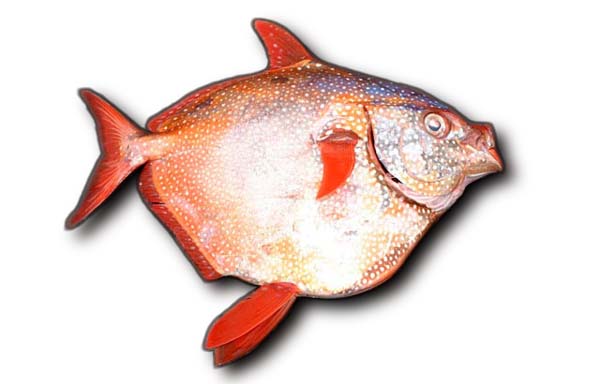
Opahs are deeply keeled, laterally compressed, discoid fish with conspicuous coloration: the body is a deep red-orange grading to rosy on the belly, with white spots covering the flanks. Both the median and paired fins are a bright vermilion. The large eyes stand out as well, ringed with golden yellow. The body is covered in minute cycloid scales and its silvery, iridescent guanine coating is easily abraded. The snout of the opah is pointed as the lateral line (the sensory system in fish) forms a high arch over the pectoral fins before sweeping down to the caudal peduncle. The Lampris species vary in size. For instance, the larger Lampris species, Lampris guttatus, has a small, terminal, and toothless mouth and can reach a total length of 2 m (6.6 ft) and a weight of 86 kg (190 lb), but has been reported up to 270 kg (600 lb), while the lesser-known Lampris immaculatus reaches a recorded total length of just 1.1 m (3.6 ft).

Ventral view of an opah

Opahs closely resemble the shape of the unrelated butterfish (family Stromateidae). Both have falcated (curved) pectoral fins and forked, emarginated (notched) caudal fins. Aside from being significantly larger than butterfish, opahs have enlarged, falcated pelvic fins with about 14 to 17 rays, which distinguish them from superficially similar carangids—positioned thoracically; adult butterfish lack pelvic fins. The pectorals of opahs are also inserted horizontally rather than vertically. The anterior portion of an opah's single dorsal fin (with about 50–55 rays) is greatly elongated, also in a falcated profile similar to the pelvic fins. The anal fin (around 34 to 41 rays) is about as high and as long as the shorter portion of the dorsal fin, and both fins have corresponding grooves into which they can be depressed.

The genome of Lampris megalopsis was analyzed in 2022.[8]

Endothermy

[edit]
Skeleton

Opah fishes use two methods for thermogenesis: pectoral muscle metabolism and specialized tissues in their brain. The opah is the only fish known to exhibit whole body endothermy where all the internal organs are kept at a higher temperature than the surrounding water.[9] This feature allows opahs to maintain an active lifestyle in the cold waters they inhabit.[10] Unlike birds and mammals, the opah is not a homeotherm despite being an endotherm: while its body temperature is raised above the surrounding water temperature, it still varies with the external temperature and is not held constant.[11] In addition to whole body endothermy, the opah also exhibits regional endothermy by raising the temperature of its brain and eyes above that of the rest of the body.[11] Regional endothermy also arose by convergent evolution in tuna, lamnid sharks and billfishes where the swimming muscles and cranial organs are maintained at an elevated temperature compared with the surrounding water.

The large muscles powering the pectoral fins generate most of the heat in the opah. In addition to the heat they generate while moving, these muscles have special regions that can generate additional heat without contracting.[12] The opah has a thick layer of fat that insulates its internal organs and cranium from the surrounding water. However, fat alone is insufficient to retain heat within a fish's body. The gills are the main point of heat loss in fishes as this is where blood from the entire body must continuously be brought in close contact with the surrounding water. Opahs prevent heat loss through their gills using a special structure in the gill blood vessels called the rete mirabile. The rete mirabile is a dense network of blood vessels where the warm blood flowing from the heart to the gills transfers its heat to the cold blood returning from the gills. Hence, the rete mirabile prevents warm blood from coming in contact with the cold water (and losing its heat) and also ensures that the blood returning to the internal organs is warmed up to body temperature. Within the rete, the warm and cold blood flow past each other in opposite directions through thin vessels to maximize the heat transferred. This mechanism is called a counter-current heat exchanger.

In addition to the rete mirabile in its gills, the opah also has a rete in the blood supply to its brain and eyes. This helps to trap heat in the cranium and further raise its temperature above the rest of the body. While the rete mirabile in the gills is unique to the opah,[9] the cranial rete mirabile has also evolved independently in other fishes. Unlike in billfish which have a specialized non-contractile tissue that functions as a brain heater, the opah cranium is heated by the contractions of the large eye muscles.[11]

Behavior

[edit]
Lampris guttatus

Much research explores the endothermic attributes of the Opah but knowledge is limited to the specific aspects of the Lampris genus, and live specimens are rarely observed.[13] They are presumed to live out their entire lives in the open ocean, at mesopelagic depths of 50 to 500 m (160 to 1,640 ft) with possible forays into the bathypelagic zone. They are apparently solitary, but are known to school with tuna and other scombrids. The fish propel themselves by a lift-based labriform mode of swimming, that is, by flapping their pectoral fins. This, together with their forked caudal fins and depressible median fins, indicates they swim at constantly high speeds like tuna.

The opah can be found worldwide in temperate and tropical oceans.[14] However, their migration is determined by season and temperature.[14] In Diel Vertical Migration opah fishes do not pass 50 meters (160 ft) from the surface, to avoid predation, and they prefer to remain in ocean waters above 7 °C (45 °F).[15] For instance, in the North Pacific, during the day, opah fish can be found in the 100-to-400-meter (330 to 1,310 ft) range that is between 8 and 22 °C (46 and 72 °F); and at night, the fish are restricted to the 50-to-100-meter (160 to 330 ft) range; they rarely surpass a depth of 400 meters.[15]

Lampris guttatus are able to maintain their eyes and brain at 2 °C (3.6 °F) warmer than their bodies, a phenomenon called cranial endothermy and one they share with sharks in the family Lamnidae, billfishes, and some tunas. This may allow their eyes and brains to continue functioning during deep dives into water below 4 °C (39 °F).

Large pelagic sharks, such as great white sharks and mako sharks, are the primary predators of the Opah as shown from archival transmitting tagging operations. The opah fish eats a lot of food, typically, smaller fishes, invertebrates like squid and euphausiids (krill) – that make up the bulk of the opah diet – and large pelagic organisms. Opah fish also carry many parasites such as the tetraphyllidean tapeworm, which has been found in L. guttatus, which may be an intermediate or paratenic host.

The planktonic opah larvae initially resemble those of ribbonfishes (Trachipteridae), but are distinguished by the lack of dorsal and pelvic fin ornamentation. The slender hatchlings later undergo a marked and rapid transformation to a deep-bodied form; this transformation is complete by 10.6 mm (0.42 in) standard length in L. guttatus.

References

[edit]
Revisions and contributorsEdit on WikipediaRead on Wikipedia
from Grokipedia
Opah are large, deep-bodied in the genus Lampris (family Lampridae, order ), comprising several ; , the most widespread and studied, is also known as the moonfish and renowned as the only known with whole-body endothermy, allowing it to maintain an internal body temperature 6–8°C warmer than surrounding through specialized vascular structures like a rete mirabile in its gills and heat-generating . It features a distinctive short and deep body covered in dark steely blue scales with silver spots, a rosy belly, and vibrant crimson-red fins, growing to a maximum length of 2 m (6.6 ft) and weighing as much as 270 kg (600 lb). Lampris guttatus inhabits epi- and mesopelagic zones of the open ocean, typically at depths of 50–150 meters in tropical and temperate waters worldwide, ranging from 75°N to 60°S latitude across the Atlantic, Pacific, and Indian Oceans, though they remain solitary and uncommon in many regions. This endothermic adaptation enhances their agility for long-range migrations and labriform swimming using pectoral fins, enabling efficient pursuit of prey in cold deep waters where most fish are ectothermic. They are opportunistic carnivores with a high trophic level of 4.2, primarily feeding on midwater squid, krill, crustaceans, and small fishes, while facing predation from species like great white sharks, mako sharks, and orcas. Reproduction likely occurs seasonally, though details remain limited due to their deep-sea habits, and the species is classified as Least Concern by the IUCN, with no major threats identified despite incidental capture in fisheries. Their striking appearance and rarity have made opah a prized bycatch in commercial tuna fisheries, particularly in the North Pacific, where they are valued for their flavorful meat.

Taxonomy

Etymology and common names

The genus name Lampris is derived from the word lampros, meaning "brilliant," "radiant," or "shining," alluding to the opah's distinctive iridescent coloration. The species epithet guttatus originates from the Latin term for "spotted" or "speckled," referencing the irregular white spots on the body, though this name is now specifically applied to one within a that includes several others. The opah was first scientifically described in 1788 by Danish zoologist Morten Thrane Brünnich, who placed it in the genus as Zeus guttatus, based on specimens from the North Atlantic. In scientific literature, it has since been reclassified into the monotypic family Lampridae under , reflecting its unique morphological traits. Common names for the opah vary widely by region and culture, often highlighting its round shape, vibrant hues, or rarity. In , it is known as "opah," a term derived from the Hawaiian word for moonfish, emphasizing its disk-like form reminiscent of the . Other widespread English names include moonfish, sunfish (distinct from the unrelated Mola mola), kingfish, and Jerusalem , while additional regional variants encompass cravo in Portuguese-speaking areas, Gotteslachs in German, and poisson lune or lampris in French. Less common aliases such as redfin ocean pan and cowfish also appear in fishing communities, particularly in the Pacific.

Classification

The opah (genus Lampris) is classified within the kingdom Animalia, phylum Chordata, class Actinopterygii (ray-finned fishes), order Lampriformes, family Lampridae, and genus Lampris. This hierarchical placement situates the opah among the teleost fishes, specifically within the diverse and specialized order Lampriformes, which includes approximately 20 genera of primarily oceanic, midwater to deep-sea species adapted to pelagic lifestyles. Lampriformes are characterized by unique morphological traits, such as reduced or absent swim bladders, elongate body forms in many taxa, and specialized dorsal fin structures that aid in buoyancy and maneuverability in open water environments. The family Lampridae, known as opahs, is a relatively small and distinctive group within , historically treated as monotypic with a single (Lampris) encompassing few . Evolutionarily, as an order have a record extending to the , with the diversification of living lineages coinciding with the aftermath of the Cretaceous-Paleogene around 66 million years ago, enabling their radiation into pelagic niches. Within Lampridae, the record is more recent, with unambiguous family-level fossils appearing in the late (Chattian stage) from deposits in , represented by the large-bodied extinct Megalampris, indicating early adaptation to deep-sea habitats. The Lampris itself is documented from the onward, with such as the extinct Lampris zatima known from marine sediments in , suggesting a relatively recent evolutionary origin for the modern opah lineage compared to broader lampriforms. A significant advancement in opah classification occurred in , when a comprehensive taxonomic revision, integrating sequence data and detailed morphological and meristic analyses, recognized six distinct within the genus Lampris. This revision restricted the type Lampris guttatus to the North Atlantic, resurrected Lampris lauta from synonymy, and described three new (Lampris australensis, Lampris incognitus, and Lampris megalopsis), while confirming Lampris immaculatus as a separate . In 2021, Kukuev proposed the subgenus Paralampris for L. immaculatus based on its spotless body and other traits. These findings resolved longstanding confusion over the apparent morphological variability in what was previously viewed as a single cosmopolitan L. guttatus, highlighting cryptic diversity driven by genetic divergence across ocean basins.

Species

The genus Lampris comprises six recognized living species, as established by a comprehensive taxonomic review utilizing genetic and morphological analyses. These species exhibit non-overlapping geographic distributions across tropical and temperate oceans, with subtle variations in body depth, fin ray counts, pectoral fin length, eye size, and spotting patterns distinguishing them. Lampris guttatus (Brünnich, 1788), the type species, inhabits the North Atlantic Ocean, featuring a deep body, prominent silvery spots in irregular rows, and a relatively short pectoral fin. Lampris immaculatus (Gilchrist, 1905) is restricted to southern oceans, characterized by fewer and smaller spots, a more elongate body shape, and longer dorsal and anal fins compared to northern congeners. Lampris australensis Underkoffler, Luers, Hyde & Craig, 2018, occurs in the Southern Hemisphere, notable for dense spotting extending onto the fins and a shallower body profile. Lampris incognitus Underkoffler, Luers, Hyde & Craig, 2018, is found in the central and northeastern Pacific, with reduced spotting, a smaller eye relative to head size, and proportionally shorter pectoral fins. Lampris lauta (Lowe, 1838) occupies the eastern Atlantic, displaying bolder coloration with larger spots and extended fin bases. Lampris megalopsis Underkoffler, Luers, Hyde & Craig, 2018, has a cosmopolitan distribution in temperate to tropical waters, distinguished by enlarged eyes, prominent spotting on the head, and a more robust body form. Two extinct species are known from the fossil record, providing insights into the evolutionary history of the Lampridae. Lampris zatima Jordan, 1908, from the Late Miocene of Southern California, is represented by fragmentary fossils including vertebral columns and partial skeletons, indicating a small-bodied form (estimated at 35–50 cm total length) with a similar deep, discoid body shape to modern Lampris but fewer preserved diagnostic traits. Megalampris keyesi Gottfried, Fordyce & Spallanzani, 2006, from the Late Oligocene (approximately 26 million years ago) of New Zealand and belonging to an extinct genus within Lampridae, is known from a large, nearly complete skeleton estimated at 4 m in total length—substantially larger than any extant opah—and exhibits an elongated dorsal fin and robust skeletal features suggestive of a giant, piscivorous relative within the lamprid lineage. Species delineation within Lampris relies on integrated evidence from mitochondrial DNA sequencing (e.g., and cytochrome oxidase I genes), meristic counts (such as fin ray numbers and vertebral counts), (including body proportions and fin lengths), and pigmentation patterns like spot density and distribution, often corroborated by allopatric distributions that limit . These criteria resolved prior lumping of populations under L. guttatus into distinct taxa, emphasizing subtle but consistent inter-oceanic variations.

Physical characteristics

Size and morphology

The opah exhibits a deep, oval body that is laterally compressed, resembling a disc, with a single extending the length of the body and a matching anal . The head is blunt with large eyes encircled by gold, and the mouth is small and terminal, bearing simple teeth. The pectoral fins are long and fan-like, while the body is covered in scales that are easily shed; the opah lacks a and relies on for control. Opah reach a maximum reported total length of 2 m (6.6 ft) and reported weight up to 270 kg (600 lb), though verified records as of 2025 reach up to 82 kg (181 lb); possible slight size differences exist between sexes, with males potentially growing slightly larger. Growth rates are estimated at 10-15 cm per year in early life.

Coloration and anatomy

The opah displays vibrant live coloration, featuring a steely blue dorsally grading to rosy on the belly, with a silvery body covered in white spots scattered across the flanks and dorsum. Recent taxonomic reviews suggest that what was traditionally considered may comprise multiple cryptic with potentially varying morphology. This iridescent pigmentation provides and signaling in the open ocean, contrasting sharply with the duller appearances of preserved specimens, where scale loss reveals underlying silvery-gray tones with dorsal sheens and rosy ventral hues. Fins exhibit to deep red tones, while the area around the eyes is golden. In some , such as , the white spots are absent, resulting in patchy, less brilliant patterns. Internally, the opah's is robust, composed of cellular tissue akin to that in tunas, which enhances structural support for its discoid body and active swimming. The include numerous ossified lepidotrichia (fin rays), with the bearing 50–55 soft rays and the anal fin 34–41, contributing to its distinctive falcate profiles. The apparatus is specialized, possessing a large surface area relative to body size that facilitates efficient oxygen extraction from the oxygen-poor waters of mesopelagic depths. This supports sustained aerobic performance during dives. The opah's sensory systems are tuned for pelagic life, with large eyes ringed in gold that enable effective low-light vision for detecting prey in dim conditions below the . These eyes, combined with cranial adaptations, improve during deep dives. The system, consisting of mechanoreceptors along the body, detects vibrations and changes in surrounding , aiding in and predator avoidance. Unlike some groups, the opah lacks electroreceptors, depending instead on visual and mechanosensory inputs for environmental awareness. Sexual dimorphism is evident in the opah, particularly in the pectoral girdle, where males possess a thick, concave structure and an enlarged abdomen, while females exhibit a narrow, convex girdle. Females typically develop larger ovaries to support egg production, reflecting their role in reproduction. During breeding periods, male fin coloration may intensify, though this varies by individual condition.

Endothermy

The opah (Lampris guttatus) is the first known fish to exhibit whole-body endothermy, a trait that allows it to maintain elevated body temperatures throughout its tissues, unlike the regional endothermy seen in tunas and billfishes. This enables the opah to keep its core body temperature 5–8°C above ambient water levels, even in the cold mesopelagic zone. The phenomenon was confirmed in a landmark 2015 study, which measured brain and heart temperatures reaching approximately 36°C (97°F) in surrounding water at 10°C (50°F), highlighting the opah's ability to sustain warmth across all major organs. Heat generation in the opah occurs primarily through the continuous contraction of its dark red aerobic pectoral muscles, which power the flapping of large, wing-like fins for propulsion and produce metabolic heat as a byproduct. Retention of this heat relies on specialized vascular counter-current heat exchangers, including a rete mirabile—a dense arterial-venous capillary network—in the gills that minimizes thermal loss by transferring warmth from outgoing arterial blood to incoming cooler venous blood from the gills. Similar counter-current arrangements in the musculature further distribute warmed blood systemically, ensuring even heating of the heart, brain, and other vital tissues without reliance on external insulation like blubber. This endothermic strategy confers significant physiological advantages, including boosted red muscle contraction rates for enhanced sustained swimming performance, far exceeding those of ectothermic counterparts in similar environments. Warmer ocular tissues enhance visual sensitivity and reaction times in dim, depths, while elevated cardiac and neural temperatures support prolonged aerobic activity and efficient in nutrient-rich waters below the . Overall, whole-body endothermy positions the opah as a high-performance predator capable of exploiting mesopelagic habitats inaccessible to many other fishes.

Distribution and habitat

Geographic range

The genus Lampris, comprising several species of opah following a 2018 taxonomic revision, occurs worldwide in tropical, temperate, and some subpolar waters across all major basins, from approximately 75°N to 60°S . These distributions reflect an oceanic, pelagic lifestyle without incursions into freshwater or polar regions. The 2018 revision split the formerly global Lampris guttatus into five species based on genetics, morphology, and geography. Lampris guttatus is now primarily restricted to the Atlantic Ocean, including the North Atlantic and parts of the eastern Atlantic. Lampris immaculatus inhabits southern temperate waters circumglobally around southern continents, from 34°S to the Antarctic Polar Front. Lampris megalopsis is found off eastern Pacific coasts and extends into temperate and tropical waters of the Indian and Pacific Oceans. Lampris australensis occupies southern portions of the Pacific and Indian Oceans. A fifth species, L. incognitus, is known from the central Pacific. Opah display seasonal movements, migrating toward coastal waters in warmer months and withdrawing to the open ocean during winter, influenced by temperature gradients. Historical records trace opah to 18th-century Atlantic voyages, with the first formal description of L. guttatus in 1788 based on European specimens. Contemporary distribution mapping relies on fisheries landings and genetic analyses from global surveys.

Depth preferences and environment

The opah () primarily inhabits the , occupying depths between 50 and 500 meters, though it occasionally appears near the surface and can dive as deep as 1,000 meters. It exhibits a reverse pattern, descending to deeper waters (typically 200–500 meters) during the day and ascending to shallower depths, often within 10 meters of the surface, at night. Opah prefer the open of oligotrophic, nutrient-poor waters in tropical and temperate oceans, where they associate with thermoclines and oxygen minimum zones. Their optimal ambient temperatures range from 10 to 20°C, with captures commonly occurring in around 13°C, though their whole-body endothermy enables tolerance of colder conditions down to approximately 5°C during deep dives. Adaptations to this habitat include efficient structures that support high oxygen extraction in hypoxic conditions, facilitated by countercurrent retia mirabilia that retain metabolic post- perfusion while maintaining effective . These features allow opah to thrive in low-oxygen mesopelagic environments without significant physiological stress. Opah distribution is confirmed through captures using deep longline gear deployed at 275–550 meters, targeting areas just above the , as well as mid-water trawls that sample the 50–400 meter range. These methods reveal a consistent bathymetric preference for mid-depth pelagic layers across their global oceanic range.

Behavior and ecology

Locomotion and swimming

The opah employs a distinctive labriform locomotion, oscillating its large pectoral fins to produce both lift and for , in contrast to the caudal fin-driven typical of many other fishes. This fin-based mechanism enables the opah to glide, hover, and maneuver efficiently in the open ocean, supported by extensive aerobic red musculature in the pectorals that accounts for up to 16% of body weight. Endothermy enhances the opah's swimming efficiency by elevating muscle temperatures approximately 5°C above ambient water, allowing sustained activity and reducing fatigue during prolonged cruising in cold mesopelagic depths. The achieves typical vertical descent and ascent rates below 0.25 m/s during routine movements, with occasional bursts reaching 4 m/s to adjust position or pursue opportunities. This physiological supports active locomotion without the limitations faced by ectothermic counterparts in low-temperature environments. Opah are predominantly solitary but occasionally associate in loose schools with tunas or billfishes, likely for mutual protection during horizontal travel. They perform regular vertical migrations, tracking prey distributions or thermal gradients between 50 and 400 m depths and 8–22°C temperatures, which aligns with their pectoral-driven suited to precise depth adjustments rather than rapid horizontal sprints. The elevated metabolic rate fueled by continuous pectoral muscle activity—primarily aerobic and heat-generating—facilitates these energy-demanding excursions in nutrient-rich but thermally challenging waters.

Feeding habits and diet

The opah (Lampris guttatus), formerly known as Lampris regius, is an opportunistic predator with a diet dominated by soft-bodied prey in the pelagic zone. Stomach content analyses indicate that cephalopods, particularly squid and octopuses, form the bulk of its consumption, often comprising the majority of identifiable remains, alongside crustaceans such as krill and shrimp, and smaller fishes including epipelagic species like saury and anchovies, as well as deeper-water forms like barracudinas. This broad prey selection reflects the opah's adaptability to available resources in mid- to deep-water environments, where it targets both epipelagic and mesopelagic organisms. The opah's feeding strategy involves active pursuit in mid-water layers, where it swims efficiently to chase down agile prey. Its large eyes and enhance in low-light conditions, allowing detection of bioluminescent cephalopods and other prey during dives to depths of 200 meters or more. Studies of stomach contents from specimens in the central , for instance, show highly digested remains primarily of meso-bathypelagic cephalopods like Galiteuthis armata, underscoring a reliance on these soft-bodied invertebrates. As a mid-level predator, the opah occupies a of 4.2, preying on secondary consumers such as smaller pelagic fishes and , thereby linking lower trophic tiers to higher marine predators in the open ocean . This position highlights its role in maintaining balance within epipelagic food webs, though specific quantitative data on daily intake remain limited due to the challenges of studying this solitary, deep-diving .

Reproduction and life cycle

Little is known about opah reproduction. The opah (Lampris guttatus) is an oviparous broadcast spawner, with females releasing pelagic eggs into open water where by males occurs. These eggs are small and buoyant, with mature ova measuring up to 0.82 mm in diameter and containing a single oil droplet that aids flotation in the . The size and age at maturity, as well as , remain unknown. Spawning likely occurs in spring in subtropical and temperate zones, and year-round in tropical regions when sea surface temperatures exceed 24°C. Following fertilization, eggs hatch into planktonic larvae that remain in the epipelagic zone for several weeks, feeding primarily on and growing from lengths under 4.7 mm to about 10.5 mm, at which point fin rays develop and they resemble miniature adults. These larvae eventually settle to midwater depths of 50–100 m as post-larvae. Juveniles grow rapidly in their initial years before growth slows, with the overall lifespan estimated at 5–10 years and low natural mortality rates supporting resilience. No is provided, resulting in high mortality of eggs and early larvae due to predation and environmental factors.

Predators and parasites

Adult opah fall prey to large pelagic predators, including shortfin mako and sharks, as evidenced by tagging data showing predation events. Some marine mammals also prey on adults. Juveniles are particularly vulnerable to smaller predatory fishes, such as other midwater species. Opah serve as hosts to various metazoan parasites, including trematodes, nematodes, and , which inhabit sites such as the gills, intestines, and external surfaces like the fins. Specific examples include the copepod Peniculus fistula, recorded on the body surface of opah. Metazoan parasites have also been documented in the olfactory organs of opah, potentially affecting sensory functions. These parasites generally cause minor tissue lesions but are seldom lethal, contributing to low overall parasitic impact on host fitness. Predation represents a significant natural mortality factor for opah, particularly among adults, though exact rates remain unquantified due to limited assessments. To mitigate these threats, opah exhibit schooling behavior with faster-swimming like tunas and billfishes, which may provide associative protection against predators. Their unique whole-body endothermy further aids defense by enabling rapid escape bursts, enhanced swimming speeds, and quicker reactions to approaching threats compared to ectothermic prey .

Human interactions

Fisheries and commercial use

Opah are primarily captured as in longline fisheries targeting tunas and , with deep-set longlines deployed in the accounting for the majority of U.S. landings. In , these operations yield the bulk of the catch, while off , opah are incidentally taken in drift gillnet fisheries aimed at . Occasional targeted hook-and-line fishing occurs in and , though it represents a minor portion of total harvest due to the species' pelagic and unpredictable distribution. Commercially, opah are valued for their firm, flavorful meat, particularly the tender top loin, which is suitable for due to its light salmon-orange color, sweet taste, and lean texture. Annual U.S. landings, predominantly from , averaged around 400-800 metric tons in the 2010s, peaking above 800 metric tons by 2017 before declining to approximately 209 metric tons in 2021; these are exported primarily to for high-end markets, with smaller volumes to and the U.S. mainland. The species' nutritional profile, including high levels of omega-3 fatty acids (about 1,800 mg of DHA and EPA per 4-ounce serving), protein, and low sodium, enhances its appeal in health-conscious markets. Opah are sold fresh or frozen, with the Hawaii fishery reaching its commercial height in the 2010s when ex-vessel prices ranged from approximately $3-9 per , generating values up to $3 million annually at peak landings. Historically, opah have been a in Hawaiian cuisine, often prepared grilled, in poke, or as , reflecting their cultural significance in local diets. Modern trials for opah remain limited, constrained by the ' preference for deep, open-ocean habitats that complicate captive rearing.

Conservation status

The opah () is classified as Least Concern on the , with the assessment conducted in 2013. This status reflects its wide global distribution across tropical and temperate oceans and the absence of evidence indicating significant declines. No major threats are currently identified for the , though it is occasionally caught as in pelagic longline fisheries targeting and . In the United States, opah landings occur primarily as incidental catch in these fisheries around the Pacific Islands and off , with no directed commercial fishery established. Regulations, including gear modifications and observer programs, help minimize impacts on opah and other non-target . Population size and trends remain unknown due to limited data, but there is no indication of or degradation affecting the . U.S. wild-caught opah is considered sustainably managed under federal regulations, supporting its continued Least Concern status as of the latest IUCN version in 2025. Ongoing monitoring in key fishing regions is recommended to track any potential future changes.

References

Add your contribution
Related Hubs
User Avatar
No comments yet.