
Hubbry Logo
Most recent common ancestorMost recent common ancestorMain
Open search
Most recent common ancestor
Community hub
Most recent common ancestor
logo
7 pages, 0 posts
0 subscribers
Be the first to start a discussion here.
Most recent common ancestor
from Wikipedia

A most recent common ancestor (MRCA), also known as a last common ancestor (LCA) or concestor (a term coined by Nicky Warren[1]), is the most recent individual from which all organisms of a set are inferred to have descended. The most recent common ancestor of a higher taxon is generally assumed to have been a species. The term is also used in reference to the ancestry of groups of genes (haplotypes) rather than organisms.

The ancestry of a set of individuals can sometimes be determined by referring to an established pedigree, although this may refer only to patrilineal or matrilineal lines for sexually-reproducing organisms with two parents, four grandparents, etc. However, in general, it is impossible to identify the exact MRCA of a large set of individuals, but an estimate of the time at which the MRCA lived can often be given. Such time to most recent common ancestor (TMRCA) estimates can be given based on DNA test results and established mutation rates as practiced in genetic genealogy, or by reference to a non-genetic, mathematical model or computer simulation.

In organisms using sexual reproduction, the matrilineal MRCA and patrilineal MRCA are the MRCAs of a given population considering only matrilineal and patrilineal descent, respectively. The MRCA of a population by definition cannot be older than either its matrilineal or its patrilineal MRCA. In the case of Homo sapiens, the matrilineal and patrilineal MRCA are also known as "Mitochondrial Eve" (mt-MRCA) and "Y-chromosomal Adam" (Y-MRCA) respectively. The age of the human MRCA is unknown. It is no greater than the age of either the Y-MRCA or the mt-MRCA, estimated at 200,000 years.

Unlike in pedigrees of individual humans or domesticated lineages where historical parentage is known for some number of generations into the past, ancestors are not directly observable or recognizable in the inference of relationships among species or higher groups of taxa (systematics or phylogenetics). Ancestors are inferences based on patterns of relationship among taxa inferred in a phylogenetic analysis of extant organisms and/or fossils.[2]

The last universal common ancestor (LUCA) is the most recent common ancestor of all current life on Earth, estimated to have lived some 3.5 to 3.8 billion years ago (in the Paleoarchean).[3][4][note 1]

MRCA of different species

[edit]
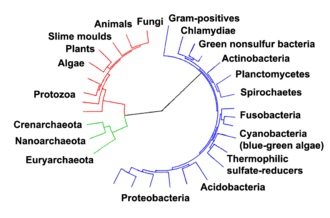
EuryarchaeotaNanoarchaeotaThermoproteotaProtozoaAlgaePlantSlime moldsAnimalFungusGram-positive bacteriaChlamydiotaChloroflexotaActinomycetotaPlanctomycetotaSpirochaetotaFusobacteriotaCyanobacteriaThermophilesAcidobacteriotaPseudomonadota
Evolutionary tree showing the divergence of modern species from the last universal ancestor in the center.[6] The three domains are colored, with bacteria blue, archaea green, and eukaryotes red.

The project of a complete description of the phylogenetic relationships among all biological species is dubbed the "tree of life". This involves inference of ages of divergence for all hypothesized clades; for example, the MRCA of all Carnivora (cats, dogs, etc.) is estimated to have diverged some 42 million years ago (Miacidae).[7]

The concept of the last common ancestor from the perspective of human evolution is described for a popular audience in The Ancestor's Tale by Richard Dawkins. Dawkins lists "concestors" of the human lineage in order of increasing age, including hominin (human–chimpanzee), hominine (human–gorilla), hominid (human–orangutan), hominoid (human–gibbon), and so on in 40 stages in total, down to the last universal common ancestor (human–bacteria).

MRCA of a population identified by a single genetic marker

[edit]

It is also possible to consider the ancestry of individual genes (or groups of genes, haplotypes) instead of an organism as a whole. Coalescent theory describes a stochastic model of how the ancestry of such genetic markers maps to the history of a population.

Unlike organisms, a gene is passed down from a generation of organisms to the next generation either as perfect replicas of itself or as slightly mutated descendant genes. While organisms have ancestry graphs and progeny graphs via sexual reproduction, a gene has a single chain of ancestors and a tree of descendants. An organism produced by sexual cross-fertilization (allogamy) has at least two ancestors (its immediate parents), but a gene always has one ancestor per generation.

Patrilineal and matrilineal MRCA

[edit]
Through random drift or selection, lineage will trace back to a single person. In this example over 5 generations, the colors represent extinct matrilineal lines and black the matrilineal line descended from the mt-MRCA.

Mitochondrial DNA (mtDNA) is nearly immune to sexual mixing, unlike the nuclear DNA whose chromosomes are shuffled and recombined in Mendelian inheritance. Mitochondrial DNA, therefore, can be used to trace matrilineal inheritance and to find the Mitochondrial Eve (also known as the African Eve), the most recent common ancestor of all humans via the mitochondrial DNA pathway.

Likewise, Y chromosome is present as a single sex chromosome in the male individual and is passed on to male descendants without recombination. It can be used to trace patrilineal inheritance and to find the Y-chromosomal Adam, the most recent common ancestor of all humans via the Y-DNA pathway.

Approximate dates for Mitochondrial Eve and Y-chromosomal Adam have been established by researchers using genealogical DNA tests. Mitochondrial Eve is estimated to have lived about 200,000 years ago. A paper published in March 2013 determined that, with 95% confidence and that provided there are no systematic errors in the study's data, Y-chromosomal Adam lived between 237,000 and 581,000 years ago.[8][9]

The MRCA of all humans alive today would, therefore, need to have lived more recently than either.[10][note 2]

It is more complicated to infer human ancestry via autosomal chromosomes. Although an autosomal chromosome contains genes that are passed down from parents to children via independent assortment from only one of the two parents, genetic recombination (chromosomal crossover) mixes genes from non-sister chromatids from both parents during meiosis, thus changing the genetic composition of the chromosome.

Time to MRCA estimates

[edit]

Different types of MRCAs are estimated to have lived at different times in the past. These time to MRCA (TMRCA) estimates are also computed differently depending on the type of MRCA being considered. Patrilineal and matrilineal MRCAs (Mitochondrial Eve and Y-chromosomal Adam) are traced by single gene markers, thus their TMRCA are computed based on DNA test results and established mutation rates as practiced in genetic genealogy. The time to the genealogical MRCA (most recent common ancestor by any line of descent) of all living humans cannot be traced genetically because the DNA of the great majority of ancestors is completely lost after a few hundred years. It is therefore computed based on non-genetic, mathematical models and computer simulations.

Since Mitochondrial Eve and Y-chromosomal Adam are traced by single genes via a single ancestral parent line, the time to these genetic MRCAs will necessarily be greater than that for the genealogical MRCA. This is because single genes will coalesce more slowly than tracing of conventional human genealogy via both parents. The latter considers only individual humans, without taking into account whether any gene from the computed MRCA actually survives in every single person in the current population.[12]

TMRCA via genetic markers

[edit]

Mitochondrial DNA can be used to trace the ancestry of a set of populations. In this case, populations are defined by the accumulation of mutations on the mtDNA, and special trees are created for the mutations and the order in which they occurred in each population. The tree is formed through the testing of a large number of individuals all over the world for the presence or lack of a certain set of mutations. Once this is done it is possible to determine how many mutations separate one population from another. The number of mutations, together with estimated mutation rate of the mtDNA in the regions tested, allows scientists to determine the approximate time to MRCA (TMRCA) which indicates time passed since the populations last shared the same set of mutations or belonged to the same haplogroup.

In the case of Y-Chromosomal DNA, TMRCA is arrived at in a different way. Y-DNA haplogroups are defined by single-nucleotide polymorphism in various regions of the Y-DNA. The time to MRCA within a haplogroup is defined by the accumulation of mutations in STR sequences of the Y-Chromosome of that haplogroup only. Y-DNA network analysis of Y-STR haplotypes showing a non-star cluster indicates Y-STR variability due to multiple founding individuals. Analysis yielding a star cluster can be regarded as representing a population descended from a single ancestor. In this case the variability of the Y-STR sequence, also called the microsatellite variation, can be regarded as a measure of the time passed since the ancestor founded this particular population. The descendants of Genghis Khan or one of his ancestors represents a famous star cluster that can be dated back to the time of Genghis Khan.[13]

TMRCA calculations are considered critical evidence when attempting to determine migration dates of various populations as they spread around the world. For example, if a mutation is deemed to have occurred 30,000 years ago, then this mutation should be found amongst all populations that diverged after this date. If archeological evidence indicates cultural spread and formation of regionally isolated populations then this must be reflected in the isolation of subsequent genetic mutations in this region. If genetic divergence and regional divergence coincide it can be concluded that the observed divergence is due to migration as evidenced by the archaeological record. However, if the date of genetic divergence occurs at a different time than the archaeological record, then scientists will have to look at alternate archaeological evidence to explain the genetic divergence. The issue is best illustrated in the debate surrounding the demic diffusion versus cultural diffusion during the European Neolithic.[14]

TMRCA of all living humans

[edit]

The age of the MRCA of all living humans is unknown. It is necessarily no older than the age of either the matrilinear or the patrilinear MRCA, both of which have an estimated age of between roughly 100,000 and 200,000 years ago.[15]

A study by mathematicians Joseph T. Chang, Douglas Rohde and Steve Olson used a theoretical model to calculate that the MRCA may have lived remarkably recently, possibly as recently as 2,000 years ago. It concludes that the MRCA of all living humans probably lived in East Asia, which would have given them key access to extremely isolated populations in Australia and the Americas. Possible locations for the MRCA include places such as the Chuckchi and Kamchatka Peninsulas that are close to Alaska, places such as Indonesia and Malaysia that are close to Australia or a place such as Taiwan or Japan that is more intermediate to Australia and the Americas. European colonization of the Americas and Australia was found by Chang to be too recent to have had a substantial impact on the age of the MRCA. In fact, if the Americas and Australia had never been discovered by Europeans, the MRCA would only be about 2.3% further back in the past than it is.[16][17][18]

Note that the age of the MRCA of a population does not correspond to a population bottleneck, let alone a "first couple". It rather reflects the presence of a single individual with high reproductive success in the past, whose genetic contribution has become pervasive throughout the population over time. It is also incorrect to assume that the MRCA passed all, or indeed any, genetic information to every living person. Through sexual reproduction, an ancestor passes half of his or her genes to each descendant in the next generation; in the absence of pedigree collapse, after just 32 generations the contribution of a single ancestor would be on the order of 2−32, a number proportional to less than a single basepair within the human genome.[19]

Identical ancestors point

[edit]

The MRCA is the most recent common ancestor shared by all individuals in the population under consideration. This MRCA may well have contemporaries who are also ancestral to some but not all of the extant population. The identical ancestors point is a point in the past more remote than the MRCA at which time there are no longer organisms which are ancestral to some but not all of the modern population. Due to pedigree collapse, modern individuals may still exhibit clustering, due to vastly different contributions from each of ancestral population.[20]

See also

[edit]

Notes

[edit]

References

[edit]

Further reading

[edit]
Revisions and contributorsEdit on WikipediaRead on Wikipedia
from Grokipedia
The most recent common ancestor (MRCA) of a set of organisms, also known as the last common ancestor (LCA), is the most recent individual from which all members of that set are descended through their evolutionary lineages. This concept is central to , as it defines the point of for related taxa and underpins the of phylogenetic trees, where the MRCA is represented by the node at which lineages from the group converge. In , the MRCA helps quantify relatedness: taxa sharing a more recent MRCA are more closely related than those whose lineages split earlier. For example, on a of mammals, the MRCA of humans and chimpanzees is a hominid ancestor from approximately 6–7 million years ago, while the MRCA of all dates back further to around 60–80 million years. In , the models the time to the MRCA for lineages within a , often tracing back rapidly due to , with the expected time to coalescence for a sample of size n approximating 2N(1 - 1/n) generations in a Wright-Fisher model, where N is the . Notable examples illustrate the MRCA's application across scales. The matrilineal MRCA of all living humans, termed "," is estimated to have lived in between 100,000 and 200,000 years ago, based on variation. Similarly, the patrilineal MRCA, or "," dates to around 200,000–300,000 years ago. At the broadest level, the Last Universal Common Ancestor () is the MRCA of all cellular life on , hypothesized to have been a prokaryote-like organism existing approximately 4.2 billion years ago, with a complex cellular structure including membranes and metabolic pathways. These MRCAs do not imply a single founding population but rather the latest point where ancestry coalesces for the specified lineage or group.

Definition and Concepts

Basic Definition

The most recent common ancestor (MRCA) of a set of organisms, such as or , is defined as the latest from which all members of that set descend through an unbroken lineage of parent-offspring relationships. This concept applies broadly in to genes, populations, or taxa, where the MRCA represents the point of lineage coalescence most proximal to the present. In the framework of descent with modification, the MRCA embodies the shared heritage among descendants, marking the most recent juncture at which their evolutionary paths diverged while retaining common genetic or phenotypic traits derived from that ancestor. All descendants inherit elements from this ancestor, but earlier common ancestors exist further back in time, emphasizing that the MRCA is specifically the chronologically latest such shared forebear. To illustrate, consider a family tree: the MRCA of two first cousins is typically a shared , from whom both lineages descend directly without further branching convergence, whereas a great-grandparent serves as a common but is not the most recent one.

Distinction from Other Ancestors

The most recent common ancestor (MRCA) is frequently compared to the last common ancestor (LCA), with the two terms often employed interchangeably in phylogenetic analyses to denote the shared of a group of taxa. However, subtle distinctions arise in usage: the MRCA emphasizes the recency of the shared for a specific subset of lineages, marking the point of their most recent convergence, whereas the LCA can specifically refer to the basal at the root of a or , encompassing all descendants from that divergence event. This differentiation helps clarify relationships within nested clades, where an MRCA for sister taxa may be more recent than the LCA of the broader group. The MRCA should not be confused with the "first" or original ancestor of a lineage, as it does not represent the earliest evolutionary origin but rather the latest temporal point where descendant lineages unite before diverging. This conceptual focus on recency avoids implying a singular starting point for all , instead highlighting bifurcation events in lineage histories. For instance, on a , the MRCA of two terminal taxa is the internal node closest to the present that connects them, distinct from deeper ancestral nodes that might qualify as earlier common ancestors. A prevalent misconception portrays the MRCA as invariably a single individual, yet in population-level contexts, it often comprises a contemporaneous group of individuals whose collective descendants include all members of the studied set. Mathematical models of ancestry demonstrate that, in expanding populations like that of modern humans, the MRCA can span multiple individuals within one or more generations, rather than pinpointing one person as the sole progenitor. This population-based view aligns with demographic realities, where ancestry coalesces through overlapping contributions rather than linear descent from a lone figure. In gene trees, the MRCA applies specifically to the coalescence of particular alleles or gene copies sampled from individuals, rather than the entire or species history, which can result in topologies that deviate from the species tree due to processes like incomplete lineage sorting. For a given locus, the MRCA traces the most recent union of those allelic lineages, providing insights into localized evolutionary histories without assuming uniformity across the . This allele-specific nature underscores the modular structure of genetic , where different genomic regions may have distinct MRCAs.

MRCA in Phylogenetics

MRCA of Species

The most recent common ancestor (MRCA) of two or more is the last or individual from which their distinct evolutionary lineages diverged, represented as the internal node in a where the branches split. This node signifies the point of , after which the descendant lineages evolve independently, accumulating genetic and morphological differences that define separate . In , identifying the MRCA of species is fundamental to reconstructing the branching patterns of life's history, as it delineates the boundaries between monophyletic groups. A prominent example is the MRCA of humans (Homo sapiens) and chimpanzees (Pan troglodytes), estimated to have lived between 5 and 7 million years ago based on analyses and fossil correlations. Fossil evidence supporting this timeframe includes Sahelanthropus tchadensis, a 7-million-year-old hominid from whose cranial features—such as a small similar to chimpanzees and a more anteriorly positioned suggesting possible —indicate it may represent a form close to the human-chimpanzee split. This ancestor likely inhabited forested environments in , bridging ape-like and early human traits. The MRCA concept is essential for classifying clades, which are monophyletic assemblages comprising the MRCA and all its descendants, thereby organizing into hierarchical units like genera, families, and orders. By anchoring phylogenetic trees, MRCAs enable the dating of events through -calibrated molecular phylogenies, providing temporal frameworks for understanding adaptive radiations and patterns. For instance, the MRCA of all extant s is estimated at approximately 180 million years ago during the , derived from genomic reconstructions across diverse mammal orders that align with fossil records of early mammaliaforms.

MRCA within Populations

The most recent common ancestor (MRCA) within a refers to the most recent individual from whom all members of a defined group—such as a local , , or ethnic cohort—descend through genetic . Unlike broader phylogenetic contexts, this focuses on intra-species dynamics, where the MRCA represents the point of coalescence for lineages within a single breeding or geographic unit, often influenced by localized evolutionary processes. A representative example is the MRCA of all modern Europeans, estimated to have lived approximately 1,000 years ago, due to extensive historical intermixing and migration across the , as inferred from genetic models of shared recent ancestry. This recency highlights how interconnected European populations have become through centuries of movement and admixture, forming the basis of contemporary . The recency of a population's MRCA is profoundly shaped by demographic factors. Larger effective population sizes (Ne) extend the expected time to MRCA (TMRCA), as the coalescence rate slows proportionally to 1/(2Ne), leading to older shared ancestors in stable, sizable groups; for instance, in models, the expected TMRCA for a sample of two individuals is 4Ne generations. Conversely, migration enhances between subgroups, effectively increasing Ne and delaying coalescence, which can push the MRCA further into the past by incorporating diverse lineages. Bottlenecks, however, drastically reduce Ne temporarily, accelerating coalescence and rendering the MRCA more recent, as lineages merge rapidly during periods of low numbers, such as during glacial maxima or plagues. In expanding populations, the MRCA often proves surprisingly recent due to founder effects, where small vanguard groups establish new territories, concentrating ancestry in a limited set of individuals whose lineages then radiate outward, minimizing deep coalescence through serial bottlenecks at expansion fronts. This dynamic is evident in models of human dispersal, where rapid growth from modest founding cohorts compresses genealogical timelines, contrasting with the deeper splits seen in isolated or contracting populations.

Genetic Lineages

Patrilineal MRCA

The patrilineal most recent common ancestor (MRCA), commonly known as , is the most recent individual male from whom all living males inherit their through direct paternal descent, representing the coalescence of all extant Y-chromosome lineages. This concept traces unbroken male-line inheritance, excluding females who do not carry a . Early genetic studies estimated Y-chromosomal Adam's lifespan at 60,000 to 140,000 years ago, based on initial Y-chromosome sequencing and phylogenetic modeling. Subsequent refinements, incorporating larger datasets and advanced sequencing, pushed this back; a 2023 analysis of 43 diverse Y chromosomes dated the TMRCA to approximately 183,000 years ago (95% highest posterior density interval: 160,000–209,000 years), with a 2025 study refining this to about 187,000 years ago (173,000–203,000 years) based on an ancestral-like Y reference sequence; evidence from deep-rooted African lineages confirms an origin in . The Y chromosome's largely non-recombining structure—spanning the male-specific region (MSY) of about 23 million s, with recombination limited to small pseudoautosomal boundaries—preserves paternal lineages intact across s, facilitating straightforward phylogenetic tracing. Single nucleotide polymorphisms (SNPs) in this region accumulate steadily, with an estimated rate of roughly 3 × 10^{-8} per per (assuming ~30 years per ), enabling reliable dating of lineages through accumulated variants. In , this translates to an effective rate of about one phylogenetically informative SNP every 100–150 years along the Y-chromosome tree. Importantly, was not the sole progenitor of modern humans; descent from him occurs only via the patrilineal line, and he coexisted with numerous other males whose lineages have since gone extinct. For context, this timeline now aligns more closely with that of the matrilineal MRCA (), estimated at 150,000–200,000 years ago, though the two ancestors were not contemporaries and represent separate uniparental inheritance paths.

Matrilineal MRCA

The matrilineal most recent common ancestor (MRCA), often referred to as , is the most recent woman from whom all living humans inherit their () through an unbroken maternal line. This uniparental inheritance pattern traces back to a single female ancestor in , whose mtDNA lineage coalesced due to the non-recombining nature of mtDNA, which is passed exclusively from mother to all offspring without contribution from the father. Unlike nuclear DNA, mtDNA evolves rapidly, with a approximately 5–10 times higher than nuclear DNA, accumulating about one substitution every 3,500–3,600 years across the entire 16,569-base-pair . This high makes mtDNA a valuable tool for studying uniparental inheritance and maternal lineages in human . Initial estimates placed Mitochondrial Eve's lifetime at approximately 200,000 years ago, based on mtDNA sequence variation from global populations. Subsequent refinements using for calibration have narrowed and adjusted this to around 150,000–200,000 years ago, with a 2013 study estimating 157,000 years ago (95% highest posterior density interval: 120,000–197,000 years) via sequences from 10 ancient modern humans spanning 40,000 years. Analyses up to 2023, incorporating larger datasets, continue to support a coalescence time of about 200,000 years ago, confirming her African origin during the emergence of anatomically modern humans. These estimates derive from phylogenetic analyses of complete mtDNA genomes, calibrated against radiocarbon-dated ancient samples to account for purifying selection and varying substitution rates. Importantly, was not the only woman alive at her time, nor the first modern human; thousands of contemporaries existed, but all other maternal mtDNA lineages eventually went extinct through , leaving only hers in the present-day population. , the random fluctuation of allele frequencies in finite populations, favored the persistence of her lineage over millennia, particularly during population bottlenecks and expansions in . The timeline for the matrilineal MRCA overlaps potentially with that of the patrilineal MRCA (Y-chromosomal Adam), estimated at approximately 180,000–190,000 years ago (160,000–210,000 years), though the two ancestors were not contemporaries and represent separate uniparental histories.

Estimation Methods

Using Genetic Markers

Genetic markers such as single nucleotide polymorphisms (SNPs), short tandem repeats (STRs), and whole-genome sequencing data are essential for tracing lineages and estimating the most recent common ancestor (MRCA) by identifying shared variations that indicate coalescence events in evolutionary history. SNPs, which are single base-pair changes, provide stable markers for deep-time ancestry due to their low mutation rates, allowing reconstruction of phylogenetic trees and haplogroup assignments that pinpoint MRCA points. In contrast, STRs, consisting of repeating DNA segments, mutate more rapidly and are particularly useful for resolving recent genealogical relationships within the last few hundred to thousand years. Whole-genome sequencing enhances resolution by capturing millions of SNPs across the genome, enabling finer detection of distant kinship and lineage divergence compared to targeted marker approaches. The process begins with sequencing DNA from relevant chromosomes, such as the Y-chromosome for patrilineal lines or (mtDNA) for matrilineal lines, followed by alignment to reference genomes to detect variants like SNPs that signal coalescence points where lineages merge. These variants are then compared across individuals to construct networks or phylogenetic trees, estimating the MRCA by counting shared mutations and applying mutation rate models. In , assignment exemplifies this: for instance, identifying specific SNPs on the Y-chromosome, such as those defining , groups individuals sharing a common patrilineal ancestor and refines MRCA dating through shared blocks. This method applies similarly to mtDNA like H, tracing maternal coalescence via non-recombining sequences. Key tools and databases facilitate marker analysis and lineage tracing. The provides a comprehensive catalog of , including SNP data from diverse populations, supporting alignment and coalescence inference for global ancestry studies. For Y-chromosome analysis, FamilyTreeDNA's test sequences over 100 million base pairs to discover novel SNPs, building a public haplotree that estimates patrilineal MRCAs through shared private variants. mtDNA databases like MitoSearch and PhyloTree enable haplotype matching for maternal lines by compiling global sequences, allowing users to identify shared mutations and potential MRCAs in non-recombining mtDNA. These resources integrate user-submitted data with reference panels for robust comparisons. Recent advances from 2023 to 2025 in ancient DNA (aDNA) integration have refined marker-based MRCA estimates by calibrating mutation rates and coalescence models with radiocarbon-dated genomes, improving accuracy for both modern and archaic human lineages. For example, aDNA from Neolithic and medieval samples has been used to validate SNP and mtDNA phylogenies, reducing uncertainties in TMRCA predictions by anchoring genetic clocks to fossil records. This calibration enhances the reliability of tools like whole-genome SNP analysis for tracing population-specific MRCAs.

Mathematical Models

Coalescent theory provides a foundational mathematical framework for modeling the time to the most recent common ancestor (TMRCA) by tracing lineages backward in time through a population's . In Kingman's coalescent model, introduced in , the process is approximated as a where pairs of lineages coalesce at a rate proportional to the inverse of the , assuming a large, randomly with no selection or migration. This model simplifies the complex of a sample of genes, focusing on the merging of ancestral lineages until they unite at the MRCA. For a sample of two genes in a diploid of constant effective size NeN_e, the expected TMRCA, denoted E[T2]E[T_2], is 2Ne2N_e generations. The derivation begins with the probability that two lineages coalesce in any given generation, which is approximately 1/(2Ne)1/(2N_e) under the Wright-Fisher model, as this represents the chance that they share a common . The waiting time to coalescence follows a with success probability 1/(2Ne)1/(2N_e), yielding an of 2Ne2N_e generations; more generally, for kk lineages, the coalescence rate is (k2)/(2Ne)\binom{k}{2}/(2N_e), and the expected time scales linearly with , emphasizing how larger populations lead to longer TMRCA due to reduced coalescence probabilities. Extensions to Kingman's basic model address real-world complexities, such as population structure. The structured coalescent incorporates spatial or demographic subdivision, where lineages in different coalesce within their group but migrate between them, altering coalescence rates based on migration rates and deme sizes; for instance, formulation in models this as a multi-type coalescent process. Population bottlenecks, modeled as sudden reductions in NeN_e, accelerate coalescence by increasing the probability of lineage merging during the low-size period, thereby shortening the overall TMRCA compared to constant-size scenarios. These models predict that TMRCA is shorter in small or bottlenecked populations, where heightened coalescence rates compress genealogical depth, a pattern observed theoretically and applied to conservation genetics of with reduced effective sizes.

Time to MRCA Examples

TMRCA for All Living

The most recent common ancestor (TMRCA) of all living can be examined through both genetic and genealogical lenses. The genetic TMRCA refers to the point at which the lineages of specific genetic markers in all modern coalesce, while the genealogical TMRCA identifies the most recent individual from whom every living person descends through any combination of ancestral lines. These concepts highlight how ancestry converges more recently than might be expected given our ' age of approximately 300,000 years. For genetic markers, mitochondrial DNA (mtDNA), inherited solely from the mother, traces to a TMRCA known as , estimated at 155,000–160,000 years ago based on 2023 analyses of global mtDNA variation showing an African origin. Similarly, the Y-chromosome, passed from father to son, points to a with a TMRCA around 200,000–300,000 years ago, derived from 2023 sequencing of diverse worldwide Y-chromosomes that reveal punctuated demographic expansions. In contrast, for autosomal DNA—the bulk of the nuclear genome inherited from both parents—coalescence times vary across loci due to recombination, typically ranging from 100,000 to over 1 million years ago. The genealogical TMRCA, representing the last individual ancestor of all humans regardless of genetic contribution, is estimated at 2,000–3,000 years ago according to computational models incorporating population substructure, migration, and growth rates. This surprisingly recent date arises from global interconnectivity: even isolated populations eventually share ancestors through intermarriage, compressing the pedigree backward in time. Recent demographic simulations continue to support these estimates without major revisions through 2025. Key factors influencing these TMRCA estimates include the Out-of-Africa migration event around 60,000–70,000 years ago, which created a severe that reduced outside and shaped subsequent patterns. Exponential population growth and widespread human migrations have further shortened the genealogical TMRCA by rapidly mixing lineages worldwide. Ancient DNA analyses from 2023 affirm an African origin for modern humans while revealing Eurasian back-migrations into starting around 5,000–3,000 years ago, introducing up to 40% non-African ancestry in some groups and underscoring the dynamic that influences both genetic and genealogical convergence.

Last Universal Common Ancestor

The (LUCA) represents the most recent common ancestor of all extant life on , hypothesized as a prokaryotic from which the domains and diverged, while eukaryotes emerged later through endosymbiotic events. LUCA is not considered eukaryotic but rather a complex, single-celled microbe adapted to extreme conditions. A 2024 study using Bayesian molecular clock methods, calibrated against geological and isotopic evidence, estimates LUCA's existence at approximately 4.2 billion years ago, with a 95% of 4.0–4.3 billion years ago. This timeline pushes LUCA closer to 's formation around 4.5 billion years ago than earlier models, which placed it at 3.5–3.8 billion years ago based on less refined phylogenetic dating and fossil correlations. The revision stems from improved handling of substitution rate variations and incorporation of Hadean-era environmental data. LUCA's reconstructed genome spanned roughly 2.6 million base pairs, encoding about 2,600 proteins dedicated to core processes like synthesis, , and energy metabolism via an anaerobic Wood–Ljungdahl pathway. It inhabited a thermophilic, anaerobic niche near deep-sea hydrothermal vents, relying on and as energy sources in a . Phylogenetic reconstruction identifies 399 conserved protein families as likely present in LUCA, supporting its autotrophic lifestyle and resistance to environmental stresses. Widespread horizontal gene transfer in early microbial communities further obscures LUCA's vertical inheritance, as genes could have been exchanged across lineages, necessitating rigorous tests to confirm ancestral origins over lateral acquisitions. Recent analyses from 2023 to 2025 reinforce these core genes while highlighting LUCA's role in an interconnected primordial ecosystem.

Advanced Topics

Identical Ancestors Point

The identical ancestors point (IAP), also known as the genetic isopoint, represents the most recent time depth in a population's history at which every individual from that era is either a genealogical ancestor of all living members of the population or an ancestor of none, due to the effects of pedigree collapse where ancestral lines increasingly overlap. This point lies beyond the most recent common ancestor (MRCA) and marks a transition where the collective pedigree of the present population converges to a universal set of forebears, with no partial contributions from individuals outside that set. The mathematical basis for the IAP arises in expanding populations, where the expected number of genealogical ancestors doubles each backward , leading to that quickly exceeds the historical size and forces overlaps through . Simulations accounting for factors such as migration, bottlenecks, and varying growth rates demonstrate that the IAP emerges when these overlapping lineages fill all ancestral slots, resulting in a binary outcome for past individuals: universal ancestry or complete lineage in the present. For humans, the IAP is estimated to have occurred between approximately 5,300 and 2,200 BCE, based on computational models of global . Recent analyses incorporating identity-by-descent (IBD) tracking, which measures shared DNA segments inherited from common ancestors, have refined these estimates by simulating ancestry propagation in structured populations, confirming the IAP's position several thousand years ago while highlighting its sensitivity to historical migration patterns. This concept underscores the profound genealogical interconnectedness of all living humans, revealing that despite geographic and cultural separations, our shared ancestry converges rapidly in the relatively recent past, emphasizing the unity of the human .

Genealogical vs. Genetic MRCA

The genealogical most recent common ancestor (MRCA) refers to the most recent individual from whom an entire group of descendants is linked through all possible ancestral lines in a complete pedigree, representing a holistic connection across the full . This concept requires tracing every lineage without breaks, making it challenging to reconstruct empirically due to incomplete historical records, though mathematical models demonstrate that such an MRCA can exist relatively recently in large populations. In contrast, the genetic MRCA pertains to the most recent individual who contributed a specific or genetic segment to all members of the group at a particular locus, such as a (mtDNA) haplotype or a Y-chromosome marker. For uniparentally inherited markers like mtDNA, which do not undergo recombination, the genetic MRCA—often termed "" for humans—traces unbroken maternal lineages, providing a precise but partial view of ancestry limited to that single genetic pathway. Autosomal genetic MRCAs, however, are influenced by recombination, which shuffles genetic material during , resulting in fragmented inheritance where adjacent DNA segments may derive from different ancestors. The primary distinction lies in scope and traceability: the genealogical MRCA encompasses the entire pedigree and is holistic yet elusive without exhaustive records, whereas the genetic MRCA is locus-specific, offering high precision for targeted genes but capturing only a fraction of overall ancestry. Recombination further accentuates this gap for autosomal DNA, as it breaks into segments with independent coalescent histories, meaning a single can have multiple genetic MRCAs rather than a unified one. This fragmentation implies that while a genealogical MRCA may connect all descendants broadly, their genetic contribution dilutes over generations, potentially leaving no direct DNA traces in modern individuals despite the pedigree link. Recent ancient DNA studies have illuminated these dynamics through evidence of mosaic ancestry, where individual genomes exhibit patchwork contributions from diverse sources, underscoring multiple genetic MRCAs per in admixed populations. For instance, analyses of prehistoric East Asian samples reveal complex admixture patterns, with autosomal regions sourcing from varied ancestral components, challenging simplistic single-MRCA models and highlighting how recombination integrates multiple lineages into contemporary genetic profiles. These findings update understandings of by demonstrating that genetic ancestry is not monolithic but segmented, with implications for interpreting admixture events in evolutionary contexts.

References

Add your contribution
Related Hubs
User Avatar
No comments yet.