


Community hub
Recent from talks
Contribute something
Nothing was collected or created yet.
Latik
View on Wikipedia
 | |
| Type | Dessert topping |
|---|---|
| Place of origin | The Philippines |


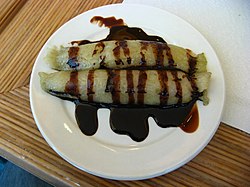
Latík (Tagalog: [laˈtɪk]) refers to two different coconut-based ingredients in Filipino cuisine. In the Visayan region it refers to a syrupy caramelized coconut cream (coconut caramel) used as a dessert sauce.[1] In the northern Philippines, it refers to solid by-products of coconut oil production (coconut curds), used as garnishing for a variety of desserts.
Visayan Latik
[edit]Latík in its original sense in the Visayan languages literally means 'syrup' (equivalent to arnibal in Hiligaynon). It can refer to any type of thick sweetened liquids including jam.[2] In the most common usage, however, latik means a syrupy condiment derived from reducing coconut milk and sugar.[3][4]
It is used much in the same way as syrup, in dishes like kalamay and suman.[5] It is usually Anglicized as "coconut caramel."[1] A commercial version of the Visayan latik is marketed internationally as coconut syrup, although it should not be confused with coconut sugar derived from coconut sap.[6][7]
Tagalog Latík
[edit]Latík in Luzon is made from coconut milk simmered in a saucepan until it reduces to coconut oil and solids ("coconut curds") begin to form at the top surface. These solids are left to fry in the coconut oil until golden brown.[8][9] In the Visayas, these solids are known as lunok in Cebuano; and balutai in Karay-a.[10]
Latík is commonly used as a topping for a variety of Philippine dishes including maja blanca, sapin-sapin, and ube halaya.[11][12] It is sometimes mistaken for fried, caramelized coconut flesh- another type of garnishing/dessert known as bukayo in Bisaya.[8]
See also
[edit]- Coconut jam
- Kalamay
- List of condiments
- List of dessert sauces
- List of Philippine dishes
- Maglalatik (literally "latik maker"), an indigenous Philippine dance
- Philippine condiments
References
[edit]- ^ a b Goldstein, Darra (2015). The Oxford Companion to Sugar and Sweets. Oxford University Press. p. 530. ISBN 9780199313396.
- ^ "latik". Binisaya.com. Retrieved July 5, 2011.
- ^ "Bisaya translation for "latik"". Bisaya Translator and Cebuano Dictionary. Archived from the original on August 11, 2013. Retrieved July 5, 2011.
- ^ "Philippine quarterly of culture and society". 32. University of San Carlos. 2004: 31.
{{cite journal}}: Cite journal requires|journal=(help) - ^ "Suman Latik". Lutong Bahay. Archived from the original on October 1, 2011. Retrieved July 5, 2011.
- ^ Thampan, Palakasseril Kumaran (1981). Handbook on Coconut Palm. Oxford & IBH. p. 199.
- ^ Grimwood, Brian E. (1975). Coconut Palm Products: Their Processing in Developing Countries. Food & Agriculture Organization. pp. 183–187. ISBN 9789251008539.
- ^ a b "Latik / Fried Coconut Milk Solids". Market Manila. August 5, 2008. Retrieved July 5, 2011.
- ^ Vanjo Merano (March 25, 2010). "How to Make Latik". Panlasang Pinoy. Retrieved July 5, 2011.
- ^ Edgie Polistico (2017). Philippine Food, Cooking, & Dining Dictionary. Anvil Publishing, Incorporated. ISBN 9786214200870.
- ^ Reynaldo G. Alejandro; Doreen G. Fernandez (1998). Food of the Philippines. Tuttle Publishing. p. 102. ISBN 978-962-593-245-3.
- ^ Philippines. Dept. of Education, Culture, and Sports (1989). Duyan ng magiting: the folk culture of the southern Tagalog region. Kalinangan series. Vol. 3. IMC. ISBN 978-971-10-1241-0.
{{cite book}}: CS1 maint: multiple names: authors list (link)


Latik
View on GrokipediaOverview
Definition and Regional Variations
Latik is a fundamental coconut-derived ingredient in Filipino cuisine, characterized by significant regional differences in its form and characteristics. In the Visayan regions of the central and southern Philippines, latik denotes a thick, syrupy caramelized coconut cream, essentially a sweet sauce achieved by reducing coconut cream with sugar until it develops a bronze hue and glossy texture.[1] Conversely, in Tagalog-speaking areas of Luzon in the north, latik refers to the solid, toasted curds that form as a byproduct when coconut cream is simmered until the oil separates, resulting in crispy, golden-brown bits with a nutty flavor.[1][4] The primary composition of latik across both variants stems from kakang gata, the thick first extraction of fresh coconut milk, which is heated to evaporate water content and caramelize natural sugars.[1] This reduction process transforms the creamy liquid into either a pourable condiment in Visayan style or separable solids in the Tagalog version, highlighting the ingredient's adaptability to local culinary preferences.[1] These variations underscore the diversity within Philippine gastronomy, where the same term encapsulates contrasting textures: a liquid, sauce-like element in the Visayas for drizzling and coating, versus discrete, crunchy particles in Luzon for garnishing and adding contrast.[1] The term "latik" is consistently spelled without diacritics in Visayan usage, while in Tagalog it is often written as "latík" and pronounced /laˈtik/ (la-TIK), emphasizing the accented second syllable.[5]Etymology and Terminology
In Tagalog, latik denotes the residue or solids that form and settle when coconut milk is reduced, specifically referring to the browned curds resulting from the extraction of coconut oil. This linguistic root emphasizes the byproduct's physical characteristic as a settled sediment in traditional processing.[6][3] In regional terminology, latik carries divergent meanings across the Philippines. In the Visayas, it primarily signifies a thick, caramelized syrup made by reducing coconut milk with sugar, akin to "coconut caramel" and used as a sweet condiment. Conversely, in Tagalog-speaking areas of Luzon, latik exclusively describes the toasted coconut curds, though it is occasionally conflated with generic "coconut bits" due to superficial similarities in appearance. These distinctions underscore the ingredient's dual identities shaped by local culinary lexicons.[7][1] Common misnomers arise from overlaps in coconut-derived ingredients; latik (curds or syrup) differs from gata, the fresh, unprocessed coconut milk extracted from grated meat, and bukayo, a distinct candied preparation of shredded young coconut simmered in sugar syrup to form chewy sweets. Such confusions often stem from shared coconut bases but ignore their unique preparation outcomes.[2][8]Preparation Methods
Visayan Latik Process
The Visayan latik is prepared primarily from fresh coconut cream, known as kakang gata, with brown sugar added to achieve caramelization.[1] To obtain the coconut cream, start by grating the meat of a mature coconut using a fine grater, then squeeze the grated meat by hand or through a cheesecloth without adding water to extract the thick, rich first pressing, which yields the pure kakang gata. For approximately 1 cup of coconut cream, one large mature coconut typically suffices. The preparation involves combining the coconut cream with about ½ to 1 cup of brown sugar in a wide pan or wok. Place over low to medium heat and simmer, stirring constantly with a wooden spoon to prevent scorching and ensure even caramelization. The mixture will first bubble and separate slightly, then thicken as the liquids evaporate and the natural sugars in the coconut cream begin to caramelize, taking about 20-30 minutes until it reaches a dark, syrupy consistency with a glazed bronze hue.[1] The final product is a glossy, pourable caramel sauce with a rich, nutty aroma and silky texture, offering a balanced caramel flavor that is not overly sweet. From 1 cup of starting coconut cream, the yield is approximately ½ cup of latik. Unlike the solid curds formed in the Tagalog style, this Visayan version remains a liquid sauce.[1] For authenticity, always use freshly grated coconut meat to capture the full, vibrant flavor, as canned coconut cream lacks the nuanced taste of the fresh extraction; monitor the heat closely during simmering to avoid bitterness from over-browning.[1]Tagalog Latik Process
In Tagalog regions, latik refers to the toasted curds formed from reducing coconut cream, distinct from the caramelized syrup prepared in Visayan traditions. This version emphasizes the natural separation and toasting of coconut solids without added sugar, resulting in a crunchy topping prized for its nutty flavor in local cuisine.[9] The primary ingredient is coconut cream, or kakang gata, extracted from mature coconuts, which provides the rich base for curd formation. No sugar is typically added, allowing the inherent sweetness of the coconut to shine through during the toasting process.[4] Preparation begins by simmering the coconut cream in a wide pan over medium heat, stirring occasionally to prevent scorching. After about 15 to 25 minutes, the liquid reduces as water evaporates, causing the coconut proteins and fats to separate into oil and solid curds. The heat is then lowered, and cooking continues for an additional 10 to 15 minutes, stirring frequently until the curds turn golden-brown and crispy, releasing a fragrant, toasted aroma. The resulting mixture separates into clear coconut oil and the desired latik solids; the oil can be strained and reused for frying or other cooking applications.[1] The finished latik curds exhibit a crunchy texture with a slightly chewy bite, featuring a deep golden-brown appearance and a nutty, subtly sweet flavor enhanced by the Maillard reaction during toasting. These toasted bits provide textural contrast when used as a garnish, while the byproduct oil adds richness to dishes.[1] In modern adaptations, canned coconut milk or cream offers convenience for home cooks, often yielding approximately 1/2 cup of latik curds from a standard 400 ml can, though stirring is essential to ensure even toasting and avoid burning. This method preserves the traditional outcome while simplifying sourcing and preparation.[1]Culinary Applications
Use in Visayan Dishes
In Visayan cuisine, latik, prepared as a thick caramel syrup from reduced coconut milk and brown sugar, serves primarily as a drizzling sauce over rice cakes such as suman and biko. For suman, particularly the steamed glutinous rice rolls wrapped in banana leaves, latik is poured generously atop each piece to provide a sweet, viscous coating that complements the subtle, chewy texture of the rice.[10] Similarly, in biko, a glutinous rice cake popular across Cebu and other Visayan islands, latik acts as an essential topping that soaks into the warm cake, enhancing its inherent coconut essence.[11] A key application of latik is in suman lihiya, where the ash-water treatment of the glutinous rice imparts a unique alkaline chewiness, and the caramelized latik offers a contrasting richness and depth of flavor through its toasted coconut notes and molasses-like sweetness.[12] In kalamay, a pudding-like dessert made from glutinous rice flour and coconut milk, latik is sprinkled as a topping to create a glossy finish that highlights the region's abundance of coconut products.[13] For baye-baye, a corn-infused glutinous rice cake from areas like Iloilo, latik is applied as a final topping to add a caramelized sheen and intensified sweetness to the otherwise mildly flavored base.[14] The syrup's role in Visayan flavor profiles is to impart a multifaceted sweetness—derived from brown sugar—along with a creamy richness and nutty undertones from the caramelized coconut milk, resulting in a glossy finish that elevates coconut-forward desserts common in Cebu and surrounding islands.[10] This preparation of latik, as detailed in the Visayan process, ensures a balanced viscosity ideal for drizzling. Typically, 2-3 tablespoons of latik per serving suffice to coat rice cakes without overwhelming their delicate textures, allowing the dessert's natural moisture to meld with the sauce.[12]Use in Tagalog and Luzon Dishes
In Tagalog cuisine, particularly in Luzon, latik refers to the toasted coconut curds produced during the rendering of coconut cream, as detailed in the Tagalog latik preparation process. These golden-brown curds are primarily used as a crunchy topping sprinkled over various kakanin, or sticky rice cakes and puddings, to enhance texture and flavor. Common applications include maja blanca, a creamy coconut pudding made with cornstarch and corn kernels, where latik provides a contrasting crispiness; and sapin-sapin, a layered glutinous rice cake colored with purple yam or pandan, topped with latik after steaming for added aroma.[15][16] Specific examples highlight latik's versatility in these dishes. It serves as an essential garnish for biko, a glutinous rice cake cooked in coconut milk and brown sugar, where the curds add a toasty crunch that complements the chewy base and caramelized topping. Similarly, latik is mixed into kalamay na mais, a corn-based pudding, to introduce textural contrast against its smooth, sweet consistency derived from coconut milk and fresh corn. In terms of flavor profile, latik contributes a nutty, subtly sweet essence with toasty notes from the browning process, offering umami depth and crunch that offsets the creamy, rich bases of these desserts; this combination is especially prevalent in sweets from Metro Manila and Pampanga, such as tibok-tibok, a carabao milk pudding topped with latik for a luxurious finish reflective of regional traditions.[17][3][18] For optimal enjoyment, latik curds should be stored in airtight containers to maintain their crispiness, lasting up to one week in the refrigerator when sprinkled fresh onto dishes.[17][3]Cultural and Historical Context
Origins in Filipino Cuisine
Latik's origins trace back to pre-colonial Austronesian societies in the Philippines, where coconut processing was a fundamental practice due to the abundance of coconuts across the archipelago. Indigenous communities utilized coconuts for essential nourishment, extracting milk (gatas ng niyog) and oil through grating and squeezing the meat for use in stews, rice dishes, and early sweets.[19] These techniques, shared among Malay-Polynesian groups, emphasized coconut's versatility in providing protein, fats, and umami without refrigeration, forming the basis for resourceful elements in everyday rural cooking.[20] During the Spanish colonial period from the 16th to 19th centuries, coconut products became integrated into festive preparations, particularly for Catholic celebrations and town fiestas, where they garnished native rice cakes and puddings. The arrival of refined sugar from Spanish trade routes contributed to sweeter confections blending indigenous methods with imported ingredients, reflecting broader colonial adaptations in resource-limited settings.[21] By the 20th century, latik had become a deliberate specialty ingredient in household recipes, highlighting its enduring presence in Filipino foodways. Commercialization accelerated in the 1970s, coinciding with the Philippines' dominance in global coconut exports—producing about 70% of the world's copra and oil—and the widespread availability of canned coconut milk, which simplified latik production for urban and exported goods.[19] This shift marked latik's evolution into a more standardized, accessible component of Filipino gastronomy.Regional Significance and Traditions
In the Visayan regions, particularly Eastern Visayas such as Leyte and Samar, latik in its syrupy caramelized form serves as a key component in traditional delicacies like suman latik, embodying communal bonds and culinary heritage passed down through generations.[22] These rice cakes, often prepared for local fiestas and family gatherings, symbolize abundance and resourcefulness, utilizing readily available coconut milk to create a sweet sauce that enhances sticky rice wrappers in banana leaves.[23] In Tagalog-speaking areas of Luzon, latik takes the form of toasted coconut curds and holds prominence in urban and rural traditions, notably featured in Biñan, Laguna's annual Puto Latik Festival. This nine-day event, held in honor of San Isidro Labrador, the patron saint of farmers, celebrates puto biñan topped with latik while incorporating the maglalatik folk dance—a rhythmic performance using coconut shells that highlights agricultural roots dating to the Spanish colonial era.[24][25] The festival preserves Biñan's identity as a former hacienda, blending culinary preparation contests with processions and street dances to foster community pride. Additionally, latik-adorned kakanin appear in All Saints' Day observances, known as Undas, where families prepare these sweets as offerings to honor the departed, evoking nostalgic home rituals.[26] The dual interpretations of latik—syrup in Visayan (Bisaya) contexts versus curds in Tagalog ones—underscore linguistic and regional divides in Filipino cuisine, reflecting adaptive use of coconut, the country's dominant crop, to craft versatile toppings for rice-based desserts. This embodies broader Filipino ingenuity in transforming simple ingredients into symbols of hospitality and festivity across islands. In contemporary settings, latik's role extends to diaspora communities, where shared recipes online revive these traditions among overseas Filipinos.References
- https://en.wiktionary.org/wiki/latik