Hubbry Logo
Lax pairLax pairMain
Open search
Lax pair
Community hub
Lax pair
logo
7 pages, 0 posts
0 subscribers
Be the first to start a discussion here.
Lax pair
Lax pair
from Wikipedia

In mathematics, in the theory of integrable systems, a Lax pair is a pair of time-dependent matrices or operators that satisfy a corresponding differential equation, called the Lax equation. Lax pairs were introduced by Peter Lax to discuss solitons in continuous media. The inverse scattering transform makes use of the Lax equations to solve such systems.

Definition

[edit]

A Lax pair is a pair of matrices or operators dependent on time, acting on a fixed Hilbert space, and satisfying Lax's equation:

where is the commutator. Often, as in the example below, depends on in a prescribed way, so this is a nonlinear equation for as a function of .

Isospectral property

[edit]

It can then be shown that the eigenvalues and more generally the spectrum of L are independent of t. The matrices/operators L are said to be isospectral as varies.

The core observation is that the matrices are all similar by virtue of

where is the solution of the Cauchy problem

where I denotes the identity matrix. Note that if P(t) is skew-adjoint, U(ts) will be unitary.

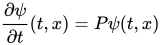
In other words, to solve the eigenvalue problem = λψ at time t, it is possible to solve the same problem at time 0, where L is generally known better, and to propagate the solution with the following formulas:

 (no change in spectrum),

Through principal invariants

[edit]

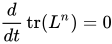
The result can also be shown using the invariants for any . These satisfy due to the Lax equation, and since the characteristic polynomial can be written in terms of these traces, the spectrum is preserved by the flow.[1]

[edit]

The above property is the basis for the inverse scattering method. In this method, L and P act on a functional space (thus ψ = ψ(tx)) and depend on an unknown function u(tx) which is to be determined. It is generally assumed that u(0, x) is known, and that P does not depend on u in the scattering region where The method then takes the following form:

  1. Compute the spectrum of , giving and
  2. In the scattering region where is known, propagate in time by using with initial condition
  3. Knowing in the scattering region, compute and/or

Spectral curve

[edit]

If the Lax matrix additionally depends on a complex parameter (as is the case for, say, sine-Gordon), the equation defines an algebraic curve in with coordinates By the isospectral property, this curve is preserved under time translation. This is the spectral curve. Such curves appear in the theory of Hitchin systems.[2]


Zero-curvature representation

[edit]

Any PDE which admits a Lax-pair representation also admits a zero-curvature representation.[3] In fact, the zero-curvature representation is more general and for other integrable PDEs, such as the sine-Gordon equation, the Lax pair refers to matrices that satisfy the zero-curvature equation rather than the Lax equation. Furthermore, the zero-curvature representation makes the link between integrable systems and geometry manifest, culminating in Ward's programme to formulate known integrable systems as solutions to the anti-self-dual Yang–Mills (ASDYM) equations.

Zero-curvature equation

[edit]

The zero-curvature equations are described by a pair of matrix-valued functions where the subscripts denote coordinate indices rather than derivatives. Often the dependence is through a single scalar function and its derivatives. The zero-curvature equation is then It is so called as it corresponds to the vanishing of the curvature tensor, which in this case is . This differs from the conventional expression by some minus signs, which are ultimately unimportant.

Lax pair to zero-curvature

[edit]

For an eigensolution to the Lax operator , one has If we instead enforce these, together with time independence of , instead the Lax equation arises as a consistency equation for an overdetermined system.

The Lax pair can be used to define the connection components . When a PDE admits a zero-curvature representation but not a Lax equation representation, the connection components are referred to as the Lax pair, and the connection as a Lax connection.

Examples

[edit]

Korteweg–de Vries equation

[edit]

The Korteweg–de Vries equation

can be reformulated as the Lax equation

with

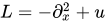
(a Sturm–Liouville operator),

where all derivatives act on all objects to the right. This accounts for the infinite number of first integrals of the KdV equation.

Kovalevskaya top

[edit]

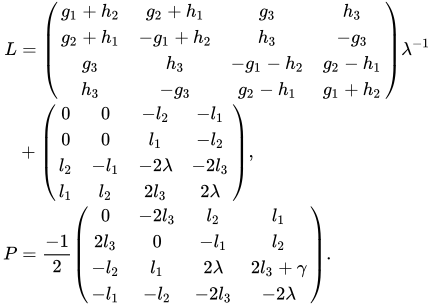
The previous example used an infinite-dimensional Hilbert space. Examples are also possible with finite-dimensional Hilbert spaces. These include Kovalevskaya top and the generalization to include an electric field .[4]

Heisenberg picture

[edit]

In the Heisenberg picture of quantum mechanics, an observable A without explicit time t dependence satisfies

with H the Hamiltonian and ħ the reduced Planck constant. Aside from a factor, observables (without explicit time dependence) in this picture can thus be seen to form Lax pairs together with the Hamiltonian. The Schrödinger picture is then interpreted as the alternative expression in terms of isospectral evolution of these observables.

Further examples

[edit]

Further examples of systems of equations that can be formulated as a Lax pair include:

The last is remarkable, as it implies that both the Schwarzschild metric and the Kerr metric can be understood as solitons.

References

[edit]
Revisions and contributorsEdit on WikipediaRead on Wikipedia
from Grokipedia
A Lax pair consists of a pair of time-dependent matrices or operators (L(t),A(t))(L(t), A(t)) that encode the dynamics of integrable systems, where the nonlinear evolution equations are equivalent to the linear Lax equation L˙=[L,A]\dot{L} = [L, A], ensuring the spectrum of LL remains invariant under . This expresses the compatibility condition between the eigenvalue equation Lψ=λψL \psi = \lambda \psi and the equation ψt=Aψ\psi_t = A \psi, transforming complex nonlinear problems into solvable linear ones. The concept was introduced by American mathematician Peter D. Lax in 1968 as a tool to identify conserved quantities, or integrals, in nonlinear evolution equations associated with solitary waves. Lax's original work focused on demonstrating how such pairs generate infinite sequences of conservation laws, proving integrability for systems like the Korteweg–de Vries (KdV) equation. Lax pairs are central to the theory of integrable systems in , enabling the inverse scattering method to construct exact solutions, including multi-soliton configurations. They apply to both finite-dimensional mechanical systems, such as the and Toda lattice, and infinite-dimensional field theories, including the and sine-Gordon model. In these contexts, the pairs facilitate the computation of conserved quantities through traces of powers of LL or properties of the monodromy matrix. The zero-curvature representation extends Lax pairs to spatial dimensions via the condition UtVx+[U,V]=0U_t - V_x + [U, V] = 0, unifying discrete and continuous integrable hierarchies. This framework has influenced diverse areas, from random matrix theory to algebraic geometry, by associating systems with spectral curves or surfaces that parameterize solutions.

Fundamentals

Historical development

The concept of the Lax pair was introduced by in 1968 as a mathematical framework to demonstrate the existence of infinitely many conservation laws for the Korteweg–de Vries (KdV) equation, thereby establishing its infinite-dimensional symmetry structure. This formulation generalized earlier ideas from finite-dimensional integrable systems in , such as the Euler equations for motion, which can be expressed in an analogous isospectral form, and drew inspiration from structures resembling Heisenberg's commutation relations in . Lax's approach provided a unified way to associate nonlinear evolution equations with linear operators whose spectra remain invariant under , highlighting the isospectral property as a core mechanism for integrability. In the , the Lax pair gained prominence through its integration with the , pioneered by Gardner, Greene, Kruskal, and Miura in 1967, which offered a method to solve the initial-value problem for the KdV equation and revealed the nature of its solutions. This connection positioned Lax pairs at the heart of soliton theory, enabling the identification of conserved quantities and the analysis of nonlinear wave interactions in continuous media. The framework's influence expanded rapidly, facilitating the discovery of broader classes of integrable partial differential equations beyond the KdV equation. In the 1970s, the Lax pair formulation had been extended to infinite hierarchies of integrable systems, notably through the work of Ablowitz, Kaup, Newell, and Segur on the AKNS hierarchy, which generalized the inverse scattering method to a wider range of nonlinear equations. This development marked a shift in application, adapting the originally infinite-dimensional tools from partial differential equations to finite-dimensional systems, including generalizations of rigid body dynamics like the Kowalevski top. These advancements solidified the Lax pair as a cornerstone of integrable systems theory, bridging classical and modern mathematical physics.

Formal definition

A Lax pair consists of two time-dependent operators L(t)L(t) and M(t)M(t) acting on a , satisfying the Lax equation Lt=[M,L]=MLLM,\frac{\partial L}{\partial t} = [M, L] = ML - LM, where [M,L][M, L] denotes the Lie bracket or of the operators. This equation encapsulates the of a in a form that reveals its integrable structure. Typically, L(t)L(t) is a , often realized as a such as a Sturm-Liouville type (e.g., L=ix+u(x,t)L = -i \partial_x + u(x,t) in one dimension), ensuring a real suitable for spectral analysis. In contrast, M(t)M(t) is frequently skew-adjoint (i.e., M=MM^\dagger = -M) or trace-class to preserve essential operator like boundedness of traces in infinite-dimensional settings. These facilitate the compatibility of the pair with the underlying structure. The Lax equation directly implies an isospectral evolution, meaning the spectrum of L(t)L(t) is independent of time: if λ\lambda is an eigenvalue of L(t0)L(t_0), it remains an eigenvalue for all tt, with the eigenspaces evolving unitarily. This time-invariance of eigenvalues yields conserved quantities, such as the traces of powers of LL (i.e., Tr(Ln)\operatorname{Tr}(L^n)), which generate integrals of motion for the system. Lax pairs are inherently tied to structures, with the [M,L][M, L] representing the adjoint action in the Lie algebra g\mathfrak{g} (e.g., sl(n)\mathfrak{sl}(n) or loop algebras), though a full derivation of this representation is beyond the scope here. In finite-dimensional realizations, applicable to systems with finitely many like the Toda lattice, LL and MM are simply matrices in g\mathfrak{g}. For infinite-dimensional systems, such as those governed by partial differential equations (e.g., the ), LL and MM become pseudo-differential or differential operators on infinite-dimensional function spaces. This formulation originated as a tool to demonstrate the complete integrability of the .

Isospectral Evolution

Principal invariants approach

The isospectral property of the Lax equation Lt=[M,L]\frac{\partial L}{\partial t} = [M, L] ensures that the eigenvalues of the operator LL remain constant over time. This follows from the fact that the can be expressed as a similarity transformation L(t)=U(t)L(0)U1(t)L(t) = U(t) L(0) U^{-1}(t), where UU satisfies Ut=MU\frac{\partial U}{\partial t} = M U, preserving the since similar matrices share the same eigenvalues. The principal invariants of LL, which are the coefficients of its , serve as conserved quantities under this evolution; equivalently, the power sums Tr(Lk)\operatorname{Tr}(L^k) for k=1,2,k = 1, 2, \dots provide another set of invariants. These traces generate an infinite hierarchy of conserved quantities when LL is infinite-dimensional, as in many equations, offering a key criterion for integrability, such as linkage to the Painlevé property. To derive their conservation, consider the time derivative: ddtTr(Lk)=Tr(kLk1Lt)=kTr(Lk1[M,L])=kTr([Lk1,M]L),\frac{d}{dt} \operatorname{Tr}(L^k) = \operatorname{Tr}\left( k L^{k-1} \frac{\partial L}{\partial t} \right) = k \operatorname{Tr}\left( L^{k-1} [M, L] \right) = k \operatorname{Tr}\left( [L^{k-1}, M] L \right), which vanishes by the cyclicity of the trace and the skew-symmetry of the . For a finite-dimensional example, such as a 2×22 \times 2 matrix LL, the principal invariants reduce to Tr(L)\operatorname{Tr}(L) and det(L)\det(L), corresponding to linear and quadratic conserved quantities, respectively. These can be visualized via the spectral curve in the .

Connection to inverse scattering

The inverse scattering transform (IST) provides a powerful method for solving initial-value problems for certain nonlinear partial differential equations by associating them with a Lax pair, which linearizes the nonlinear evolution. In this framework, the spatial operator LL in the Lax pair defines a linear spectral problem analogous to a scattering problem in , used to compute the scattering data from the initial condition of the nonlinear equation. The temporal operator MM governs the time evolution such that the Lax equation tL=[M,L]\partial_t L = [M, L] ensures the scattering data evolves in a simple, often integrable manner, typically through multiplication by exponential phase factors for the continuous spectrum or remaining constant for discrete parts, facilitating the reconstruction of the solution at arbitrary times via the . The scattering data generated by the operator LL includes reflection and transmission coefficients associated with the continuous , as well as discrete eigenvalues corresponding to bound states. Under the dynamics imposed by the Lax pair, the for the continuous acquires only phase shifts that are explicitly computable, while the discrete eigenvalues are time-independent, reflecting the isospectral flow. This simple evolution allows the full time-dependent solution to be obtained by solving the inverse scattering problem, often formulated as a Gelfand-Levitan-Marchenko or, more generally, a Riemann-Hilbert . The principal invariants derived from the Lax pair can be viewed as conserved quantities linked to norms of this scattering data. Soliton solutions emerge directly from the discrete spectrum of the Lax operator: each isolated eigenvalue in the contributes a single , and for NN such eigenvalues, the IST yields an exact NN- formula through the nonlinear superposition inherent in the inverse reconstruction process. This feature underscores the role of Lax pairs in generating multi- interactions that preserve individual soliton parameters over time. The Zakharov-Shabat formulation extends the Lax pair to a 2×2 matrix structure, providing a unified framework known as the Ablowitz-Kaup-Newell-Segur (AKNS) system, which applies to a broad class of nonlinear equations including the modified Korteweg-de Vries and nonlinear Schrödinger equations. In this setup, the Lax operators are first-order matrix differential operators, enabling the computation of data via Jost solutions and their analytic properties in the . A key criterion for the integrability of a nonlinear via IST is the existence of a whose operators admit well-behaved asymptotic forms for large spatial arguments, ensuring that the scattering data for generic initial conditions can be defined and analyzed perturbatively. This condition, often verified through the zero-curvature representation, guarantees the method's applicability and the infinite number of conserved quantities implied by the pair.

Spectral curve

In the context of Lax pairs for integrable systems with periodic potentials, the spectral curve is an that encodes the eigenvalues of the Lax operator. Specifically, it is the consisting of points (λ,μ)(\lambda, \mu) satisfying det(L(λ)μI)=0\det(L(\lambda) - \mu I) = 0, where L(λ)L(\lambda) is the Lax operator depending on the spectral parameter λ\lambda, and μ\mu denotes the eigenvalues. For the canonical example of the Schrödinger operator L=d2dx2+u(x)L = -\frac{d^2}{dx^2} + u(x) with periodic potential u(x)u(x), the spectral curve takes the form of a hyperelliptic defined by the equation μ2=P2g+1(λ)=j=12g+1(λEj),\mu^2 = P_{2g+1}(\lambda) = \prod_{j=1}^{2g+1} (\lambda - E_j), where P2g+1(λ)P_{2g+1}(\lambda) is a of degree 2g+12g+1, the EjE_j are distinct branch points on the real line, and gg is the of the curve. This structure arises from the Floquet-Bloch theory, where the branch points EjE_j mark the boundaries of the spectral bands. The finite-gap spectra of integrable systems are characterized by the property that the spectrum of the Lax operator comprises a finite number of allowed energy bands separated by forbidden gaps, with the number of finite gaps equal to g1g-1 for a of gg. This finite-band distinguishes integrable periodic potentials from generic ones, which exhibit infinitely many gaps, and enables the complete parameterization of the isospectral manifold by the choice of branch points EjE_j and associated normalization constants. The gg thus quantifies the complexity of the potential, with g=0g=0 corresponding to free motion (constant potential) and higher gg yielding more intricate quasi-periodic solutions. Novikov's algebro-geometric method provides a framework for constructing solutions using data from the spectral curve, relying on Baker-Akhiezer functions defined as meromorphic functions on the curve with specific analytic properties, such as essential singularities at the marked points and prescribed divisor behavior. These functions serve as common eigenfunctions for the commuting Lax operators in the , and the solutions to the nonlinear evolution equations are expressed in terms of theta functions on the curve, ensuring quasi-periodic dependence on time and space variables. For the Korteweg–de Vries (KdV) hierarchy, the spectral curve is a of gg, which generates gg-gap periodic potentials as the stationary solutions, with the branch points EjE_j determining the band edges. The time evolutions under the KdV flows correspond to linear translations on the of the spectral curve, preserving the curve itself while shifting the position of the effective of the Baker-Akhiezer function. In periodic settings, the spectral curve visualizes the allowed and forbidden energy bands through plots of the real μ(λ)\mu(\lambda) branches, where the allowed bands appear as intervals of continuous and the gaps as regions of evanescence, often represented in band structure diagrams to illustrate the finite-gap topology.

Zero-Curvature Formulation

Zero-curvature equation

The zero-curvature equation offers a gauge-theoretic perspective on integrable nonlinear evolution equations, representing them as the flatness condition for a connection on a over a (1+1)-dimensional . Developed by Zakharov and Takhtajan in 1979 as an alternative formulation to the operator-based Lax pair approach, it emphasizes the geometric structure underlying compatibility conditions for linear systems. Consider a connection form A=Udx+VdtA = U \, dx + V \, dt on a with structure group having g\mathfrak{g}, where U(x,t)U(x,t) and V(x,t)V(x,t) are g\mathfrak{g}-valued one-forms depending on the fields of the (PDE). Equivalently, one may view AA as the space component Ax=x+UA_x = \partial_x + U and the time component B=t+VB = \partial_t + V. The curvature two-form is then F=dA+AA=(tUxV+[U,V])dxdtF = dA + A \wedge A = \left( \partial_t U - \partial_x V + [U, V] \right) dx \wedge dt, where [,][\cdot, \cdot] denotes the Lie bracket in g\mathfrak{g}. The zero-curvature equation imposes F=0F = 0, yielding tUxV+[U,V]=0.\partial_t U - \partial_x V + [U, V] = 0. This compatibility condition ensures the existence of a parallel frame for the bundle, implying the original nonlinear PDE through the embedding of the fields into UU and VV. The equation guarantees that the (x,t)(x,t)-connection is flat, meaning its representation is trivial for contractible loops in the base manifold, which facilitates the of conserved quantities via traces of powers of the matrix. This flatness condition directly parallels the Maurer-Cartan equations, which characterize left-invariant connections on groups and ensure the integrability of the Maurer-Cartan form. In this framework, UU and VV reside in a specific g\mathfrak{g} (such as sl(2,C)\mathfrak{sl}(2, \mathbb{C}) for the ), with the term encoding the nonlinear interactions, and gauge transformations preserve the flatness while relating equivalent representations of the same PDE. This formulation proves advantageous for extending integrable structures to multidimensional cases, where the flatness condition generalizes naturally to connections over higher-dimensional manifolds, as seen in reductions of Yang-Mills theories or multidimensional Toda lattices. It also simplifies reductions, allowing consistent embeddings of lower-dimensional flows into higher-dimensional gauge systems without altering the core integrability condition. The zero-curvature is equivalent to the standard Lax pair representation, providing a unified geometric viewpoint.

Equivalence to Lax pair

The zero-curvature formulation and the standard Lax pair representation are equivalent for integrable evolution equations admitting structures, with a direct mapping between their components unifying the two approaches. Specifically, given connection matrices U(x,t)U(x,t) and V(x,t)V(x,t) satisfying the zero-curvature equation tUxV+[U,V]=0\partial_t U - \partial_x V + [U, V] = 0, define the spatial Lax operator L=UL = -U and the temporal operator M=x+VM = -\partial_x + V; under this , the zero-curvature condition transforms into the Lax equation tL=[M,L]\partial_t L = [M, L]. To verify this equivalence, substitute the mapping into the zero-curvature equation: t(L)x(M+x)+[L,M+x]=0\partial_t (-L) - \partial_x (M + \partial_x) + [-L, M + \partial_x] = 0 simplifies, via direct computation and integration by parts, to tL+[M,L]+x2x2=0-\partial_t L + [M, L] + \partial_x^2 - \partial_x^2 = 0, yielding tL=[M,L]\partial_t L = [M, L], assuming suitable boundary conditions such as decay at spatial infinity to ensure boundary terms vanish. This correspondence holds under specific conditions on the operators: LL must be a differential operator of order nn with leading coefficient 1 (monic), while MM is of order n1n-1, ensuring the resulting system aligns with the spectral theory of the Lax pair. The mapping is bidirectional; any Lax pair consisting of differential operators LL and MM of the requisite orders can be recast into a zero-curvature form by setting U=LU = -L and V=MxV = M - \partial_x, with the Lax equation recovering the zero-curvature condition through the reverse substitution. This equivalence facilitates the transfer of analytical techniques across representations, such as deriving Bäcklund transformations from one form and applying them to the other, thereby enriching the toolkit for solving integrable systems.

Applications and Examples

Korteweg–de Vries equation

The is a given by ut+6uux+uxxx=0,u_t + 6 u u_x + u_{xxx} = 0, where subscripts denote partial derivatives with respect to time tt and space xx. This equation models shallow water waves and exhibits solutions that maintain their shape upon interaction. A Lax pair for the KdV equation consists of the linear operator L=xx+uL = -\partial_{xx} + u, known as the Schrödinger operator, and the time-evolution operator M=4xxx+6(ux+ux)M = -4 \partial_{xxx} + 6 (u \partial_x + u_x). The compatibility condition for this Lax pair is the zero-curvature equation tL=[M,L]\partial_t L = [M, L], where [M,L]=MLLM[M, L] = M L - L M is the . Direct computation of the yields [M,L]=6uuxuxxx[M, L] = -6 u u_x - u_{xxx}, and since tL=tu\partial_t L = \partial_t u, the equation tu=[M,L]\partial_t u = [M, L] reproduces the KdV equation. This demonstrates that the KdV equation governs the of the potential uu in the Lax formulation. The of the operator LL is invariant under the KdV flow due to the isospectral property of the Lax equation, which preserves eigenvalues. In the , the discrete () eigenvalues of LL correspond to soliton components of the solution, while the continuous relates to the dispersive . For a single , the corresponding one-soliton solution is u(x,t)=2η2\sech2(η(x4η2t)),u(x, t) = 2 \eta^2 \sech^2 \bigl( \eta (x - 4 \eta^2 t) \bigr), where η>0\eta > 0 determines the amplitude and speed. The Lax pair implies an infinite number of conservation laws for the KdV equation, obtained from the time-independence of traces of powers of LL, such as Tr(Lk)\operatorname{Tr}(L^k) for integer k1k \geq 1, which yield conserved integrals over the spatial domain assuming suitable boundary conditions (e.g., u0u \to 0 as x|x| \to \infty). The first few are udx\int u \, dx (related to momentum) and (u2+12ux2)dx\int \bigl( u^2 + \frac{1}{2} u_x^2 \bigr) \, dx (related to energy). The KdV equation belongs to an infinite hierarchy of commuting higher-order flows, all sharing the same spatial operator LL. Higher flows are generated by tL=[Mn,L]\partial_t L = [M_n, L], where the MnM_n are obtained recursively from the Lax operator, with the original KdV corresponding to n=1n=1. These higher equations, such as the fifth-order KdV, share the same solutions and conservation laws.

Kovalevskaya top

The Kovalevskaya top describes the motion of a heavy asymmetric rotating about a fixed point, with principal moments of inertia satisfying A=B=2CA = B = 2C and the center of mass lying in the equatorial plane perpendicular to the axis of CC. This configuration represents the third known integrable case of with a fixed point, following the Euler and Lagrange tops. The are the Euler-Poisson system: M˙=M×Ω,Γ˙=Γ×Ω,\dot{\mathbf{M}} = \mathbf{M} \times \boldsymbol{\Omega}, \quad \dot{\boldsymbol{\Gamma}} = \boldsymbol{\Gamma} \times \boldsymbol{\Omega}, where M\mathbf{M} is the in the body frame, Ω=I1M\boldsymbol{\Omega} = I^{-1} \mathbf{M} is the with inertia tensor I=diag(A,A,C)I = \operatorname{diag}(A, A, C), and Γ\boldsymbol{\Gamma} is the from the fixed point to the center of mass. The Hamiltonian is the total H=12MΩ+gΓe3H = \frac{1}{2} \mathbf{M} \cdot \boldsymbol{\Omega} + g \boldsymbol{\Gamma} \cdot \mathbf{e}_3, where gg is the and e3\mathbf{e}_3 is the vertical in the body frame. In 1888, Sofia Kovalevskaya obtained an analytic solution to these equations for initial conditions on a specific invariant manifold, expressing the solution in terms of elliptic functions and thereby demonstrating integrability; this work earned her the Prix Bordin from the . The integrability was later reformulated using a Lax pair in the late , embedding the system into the framework of the e(3)e(3) or equivalently so(4)so(4)^*. The Lax pair takes the form L(λ)so(4)L(\lambda) \in so(4)^*, a 4×44 \times 4 matrix depending on a spectral parameter λ\lambda: L(λ)=(λ0Γ300λΓ20Γ3Γ2λM300M3λ),L(\lambda) = \begin{pmatrix} \lambda & 0 & \Gamma_3 & 0 \\ 0 & \lambda & -\Gamma_2 & 0 \\ -\Gamma_3 & \Gamma_2 & \lambda & M_3 \\ 0 & 0 & -M_3 & \lambda \end{pmatrix},
Add your contribution
Related Hubs
User Avatar
No comments yet.