Hubbry Logo
Leeuwin CurrentLeeuwin CurrentMain
Open search
Leeuwin Current
Community hub
Leeuwin Current
logo
8 pages, 0 posts
0 subscribers
Be the first to start a discussion here.
Leeuwin Current
Leeuwin Current
from Wikipedia
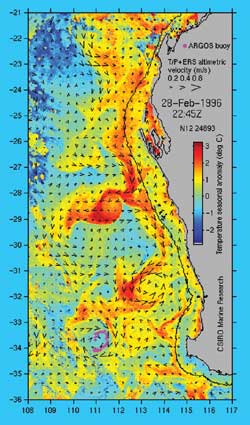
Data from two satellite instruments is used in constructing this image of the Leeuwin Current.

The Leeuwin Current is a warm ocean current which flows southwards near the western coast of Australia. It rounds Cape Leeuwin to enter the waters south of Australia where its influence extends as far as Tasmania.

Discovery

[edit]
Ocean currents surrounding Australia. The Leeuwin Current can be seen off the Western Australian Coast.
CSIRO NOAA polar orbiting satellites obtain the data generating sea surface temperature images. (Composite 15-day image showing the extension of the Leeuwin Current around Tasmania)

The existence of the current was first suggested by William Saville-Kent in 1897. Saville-Kent noted the presence of warm tropical water offshore in the Houtman Abrolhos, making the water there in winter much warmer than inshore at the adjacent coast. The existence of the current was confirmed over the years, but not characterised and named until Cresswell and Golding did so in the 1980s.[1]

Track

[edit]

The West Australian Current and Southern Australian Countercurrent, which are produced by the West Wind Drift on the southern Indian Ocean and at Tasmania, respectively, flow in the opposite direction, producing one of the most interesting oceanic current systems in the world.

The ‘core’ of the Leeuwin Current can generally be detected as a peak in the surface temperature with a strong temperature decrease further offshore. The surface temperature difference across the Current is about 1 °C at North West Cape, 2° to 3° at Fremantle and can be over 4° off Albany in the Great Australian Bight. The current frequently breaks out to sea, forming both clockwise and anti-clockwise eddies.

Physical properties

[edit]

Its strength varies through the year; it is weakest during the summer months (winter in the northern hemisphere) from November to March when the winds tend to blow strongly from the south west northwards. The greatest flow is in the autumn and winter (March to November) when the opposing winds are weakest. Evaporation from the Leeuwin current during this period contributes greatly to the rainfall in the southwest region of Western Australia.

Typically the Leeuwin Current's speed and its eddies are about 1 knot (50 cm/s), although speeds of 2 knots (1 m/s) are common, and the highest speed ever recorded by a drifting satellite-tracked buoy was 3.5 knots (6.5 km/h). The Leeuwin Current is shallow for a major current system, by global standards, being about 300 m deep, and lies on top of a northwards countercurrent called the Leeuwin Undercurrent.

Because of the Leeuwin Current, the continental shelf waters of Western Australia are warmer in winter and cooler in summer than the corresponding regions off the other continents. The Leeuwin Current is also responsible for the presence of the most southerly true corals at the Abrolhos Islands and the transport of tropical marine species down the west coast and across into the Great Australian Bight.

The Leeuwin Current is influenced by El Niño conditions, characterised by slightly lower sea temperatures along the Western Australian coast and a weaker Leeuwin Current, with corresponding effects upon rainfall patterns.

Comparisons

[edit]

The Leeuwin Current is very different from the cooler, equatorward flowing currents found along coasts at equivalent latitudes such as the southwest African Coast (the Benguela Current); the long Chile-Peru Coast (the Humboldt Current), where upwelling of cool nutrient-rich waters from below the surface results in some of the most productive fisheries; the California Current, which brings foggy conditions to San Francisco; or the cool Canary current of North Africa.

See also

[edit]

References

[edit]

Further reading

[edit]
[edit]
Revisions and contributorsEdit on WikipediaRead on Wikipedia
from Grokipedia
The Leeuwin Current is a warm, poleward-flowing ocean boundary current that dominates the circulation along the western and southern coasts of Australia, transporting tropical and subtropical waters southward from North West Cape (approximately 22°S) to Cape Leeuwin (34°S), before extending eastward into the Great Australian Bight and southward along Tasmania's west coast, forming a continuous system spanning about 5,500 kilometers—the longest such boundary current globally. This current is driven primarily by large-scale sea level gradients resulting from prevailing winds and the Indonesian Throughflow, with mean poleward volume transport estimated at 3.7 Sverdrups (Sv), peaking seasonally in autumn and winter. Unlike typical eastern boundary currents, it flows against the prevailing winds, carrying nutrient-poor warm waters that moderate regional climates by warming coastal areas and supporting the southward migration of tropical marine species, though it often creates oligotrophic "oceanic deserts" with limited phytoplankton except during eddy-induced blooms. The Leeuwin Current's water primarily originates from the Indonesian Throughflow (contributing 50–66% of its seasonal variability) and other northern tropical Indian Ocean sources (60–78% overall), with subtropical inputs from the western Indian Ocean, enabling inter-ocean exchange between the Pacific and Indian Oceans via the eastern Indian Ocean basin. Its dynamics are characterized by intense mesoscale eddies and meanders, particularly intensifying in autumn when faster flows stir nutrients from deeper waters, fostering seasonal plankton blooms observable in satellite chlorophyll data, such as those captured by MODIS in June 2014. These features not only influence local biodiversity—boosting fish stocks temporarily during upwelling events—but also play a critical role in regional weather patterns, enhancing rainfall in southwestern Australia through increased atmospheric moisture. Paleoceanographic records indicate the current's strength has varied over millennia, with weaker flow during the compared to glacial and deglacial periods, underscoring its long-term significance in heat transport and connectivity, while modern observations from altimetry and drifting buoys highlight its vulnerability to climate variability, including marine heatwaves.

Location and Formation

Geographic Extent

The Leeuwin Current originates near the North West Cape on the Northwest Shelf of and flows southward along the continental shelf edge, reaching at approximately 34°S before turning eastward along the southern coastline toward the . This path positions the current as a key feature of the eastern Indian Ocean's circulation, transporting warm tropical waters poleward in a manner atypical for eastern boundary currents. The current's primary water source is the Indonesian Throughflow, which delivers tropical Pacific waters into the eastern via passages including the and , subsequently feeding into the Leeuwin Current along Western Australia's northwest coast. These influxes introduce low-salinity, warm waters that characterize the current's core properties throughout its trajectory. Spatially, the Leeuwin Current spans a latitudinal range of approximately 22°S to 34°S, with its flow intensifying during austral winter. Its positioning is closely confined by the underlying topography, which varies markedly in width from over 300 km along the broader northern sections near the Northwest Shelf to 50–100 km in the narrower southern regions south of Perth. This topographic variation influences the current's lateral extent and stability, channeling it more tightly against the coast in southern latitudes.

Driving Mechanisms

The Leeuwin Current is primarily driven by a meridional steric gradient, with higher sea levels in the warmer Indonesian seas to the north compared to the cooler southern , generating a poleward that propels the flow southward along Western Australia's coast. This gradient arises from differential heating and the influx of warm, low-density water from the Indonesian Throughflow, which contributes to the elevated steric heights in the northern region. In geostrophic balance, this is countered by the , which in the deflects the southward flow westward (offshore); however, the continental slope constrains the current, maintaining its poleward trajectory close to the coast. Unlike typical eastern boundary currents, such as the , which are driven by equatorward winds inducing coastal , the Leeuwin Current flows poleward against the prevailing southerly winds that exert an opposing equatorward stress. These winds, while capable of generating offshore Ekman transport, are insufficient to overcome the dominant steric , allowing the current to accelerate into the wind along much of its path. The onshore geostrophic component of the flow, driven by the cross-shelf slope, further reinforces this poleward motion by countering any wind-induced offshore . Seasonal variations in the current's strength are tied to enhanced pressure differences, particularly during the austral winter, when monsoonal winds in the northwest Australian region build up coastal sea levels that propagate southward as Kelvin waves, amplifying the steric gradient. Recent moored observations as of 2025 confirm this cycle, with maximum poleward transport from May to July, while weaker gradients in summer lead to reduced flow. The monsoon-driven in the , for instance, initiates this cycle by increasing the overall meridional pressure head across the current's extent.

Path and Flow Dynamics

Coastal Track

The Leeuwin Current maintains a year-round poleward flow along the western Australian coastline, originating as a narrow coastal jet near North West Cape at approximately 22°S adjacent to Exmouth Gulf and progressing southward to Cape Leeuwin at 34°S. This path generally hugs the continental shelf break, with the current intensifying progressively southward, reaching enhanced velocities off Perth around 32°S and achieving its maximum strength near 30°S where the core aligns closely with the 300-m isobath. The overall geographic boundaries span from 22°S to 34°S, as detailed in the geographic extent section. Seasonal variations significantly influence the current's track, with the flow becoming broader and stronger during the austral winter from May to , when opposing southerly winds weaken and allow for greater offshore extension. In contrast, during austral summer from November to February, the track narrows and weakens due to intensified equatorward wind stresses that counteract the pressure-driven flow, confining the current more tightly to the . Upon reaching , the Leeuwin Current rounds the headland and extends eastward into the , continuing as the South Australian Current along the southern Australian shelf. This eastward continuation contributes warm tropical waters to the broader system. Interactions with prominent coastal features, such as capes and headlands, induce and meanders along the track; for instance, at Cape Naturaliste near 33°S, the current encounters bathymetric changes that promote lateral deflections and undulations in its path.

Eddies and Variability

The Leeuwin Current exhibits significant mesoscale instabilities, primarily manifesting as warm-core anticyclonic eddies formed through baroclinic instability, with contributions from mixed barotropic processes. These eddies arise due to the current's strong vertical and horizontal density gradients, particularly during its peak strength in austral autumn and winter. Formation is prominent off the North West Shelf near North West Cape (around 21–22°S) and along the southwest shelf (28–32°S), where meanders in the current amplify into closed eddies. Eddies are typically shed from the current at a of 1–3 per year, coinciding with the seasonal intensification of the flow, and possess diameters ranging from 100–200 km. These features propagate westward into the interior, transporting warm surface waters, heat, and nutrients offshore from the coastal zone, thereby influencing cross-shelf exchanges. Anticyclonic eddies retain elevated temperatures and levels in their cores, derived from nearshore waters, facilitating the offshore of biologically active material. Interannual variability in eddy formation and current strength is closely tied to the El Niño-Southern Oscillation (ENSO), with the Leeuwin Current and associated eddy activity intensifying during La Niña phases due to enhanced gradients and weakened during El Niño events. This modulation affects eddy shedding rates and offshore transport volumes. Post-2000 observations, derived from satellite altimetry, indicate a statistically significant increase in mesoscale eddy along the Leeuwin Current at approximately 2.5% per decade, attributed to climate-driven alterations in and wind patterns that amplify instabilities.

Physical Characteristics

Temperature and Salinity

The Leeuwin Current transports warm tropical waters southward, with surface temperatures typically ranging from 26–29°C in its northern reaches near 22°S to 18–22°C further south near 34°S, reflecting a poleward decrease of approximately 0.5°C per degree of latitude. This thermal gradient arises from the advection of Indonesian Throughflow waters, which maintain elevated temperatures despite mixing with cooler subtropical waters offshore. The current exhibits a characteristically low profile of 35.0–35.7 practical salinity units (PSU) at the surface, significantly fresher than the surrounding waters that exceed 35.0 PSU. This haline signature originates from the low-salinity surface waters of the Indonesian Throughflow, which enter the via the Indonesian seas and form the primary source for the Leeuwin Current, contrasting with the saltier, evaporative subtropical waters to the west. Vertically, the Leeuwin Current features a shallow of 50–100 m depth overlying a pronounced , with the current core generally confined to the upper 200–300 m. Minimal along the coast preserves the warmth and oligotrophic nature of these surface waters, limiting entrainment from deeper layers and maintaining low in the euphotic zone. Seasonal variations enhance these properties, with the surface waters becoming warmer and fresher during austral summer (December–February) due to increased regional , reduced wind-driven mixing, and a shallower that isolates the surface from cooler subsurface waters. In contrast, winter (June–August) sees slightly cooler and saltier conditions from stronger and deeper mixing, though the core low- signal persists. These thermohaline characteristics contribute to the alongshore gradient that drives the current. Recent moored observations (2011–2024) confirm seasonal minima in during winter at depths of 27–68 m off .

Speed and Volume Transport

The Leeuwin Current exhibits mean surface speeds that increase along its southward path before decreasing toward its terminus. Off Perth, around 32°S, typical speeds range from 0.15 to 0.33 m/s, with maximum values reaching 0.33 m/s in the core near the shelf break during peak flow periods in winter, based on recent moored observations. These velocities reflect the current's due to narrowing coastal geometry and steric height gradients, though they generally diminish south of as the flow turns eastward into the . Volume transport for the Leeuwin Current totals approximately 2.4 Sverdrups (Sv; 1 Sv = 10^6 m³/s) annually (adjusted from moored data as of 2025), with seasonal peaks up to 3 Sv in winter; earlier estimates indicated 3.4 Sv mean with surface core flow of 2–3 Sv. These estimates derive primarily from shipboard (ADCP) surveys, which capture velocity profiles across transects, and satellite altimetry, which infers geostrophic transport from sea surface height anomalies. The current's flow integrates over depths of 500–800 m, but remains strongest in the upper 200 m where warm, low-salinity waters dominate. Transport exhibits significant interannual variability, particularly in response to El Niño-Southern Oscillation (ENSO) phases, with reductions of 20–30% during El Niño events relative to La Niña conditions due to weakened sea level gradients. For instance, annual-mean poleward transport at 32°S averages 3.4 Sv overall but drops to about 3.0 Sv in El Niño years and rises to 4.2 Sv in La Niña years. This variability underscores the current's sensitivity to remote equatorial forcing, which modulates the density-driven pressure gradients sustaining the flow.

Discovery and Scientific Study

Historical Discovery

The Leeuwin Current is named after Cape Leeuwin, the southwestern tip of Western Australia, which British navigator Matthew Flinders formally designated in 1801 to honor the Dutch East India Company ship Leeuwin—meaning "lioness"—that first charted the cape in 1622 during its voyage along the coast. Formal scientific recognition of the Leeuwin Current came in 1897 from English marine biologist , who inferred its existence while serving as a government fisheries expert in . Observing the unusual southward distribution of tropical fish species, including coral reef-associated forms, around the Islands at approximately 29°S—far beyond their typical range—Saville-Kent attributed this to a warm poleward-flowing current carrying northern waters southward along the continental margin. He detailed these findings in his seminal book The Naturalist in Australia, emphasizing the implications for fisheries and marine . Further confirmation arrived in the early through hydrographic analysis by Australian surveyor G.H. Halligan, who examined data collected by merchant vessels during the 1910s and early 1920s. Halligan's maps revealed a distinct warm surface layer flowing poleward off the southwest coast near , with estimated speeds of 0.3–0.4 knots and a southward trajectory that turned eastward into the . In his 1921 paper "The Ocean Currents around ," Halligan synthesized these measurements to delineate the current's basic path, marking the first instrumental evidence of its flow dynamics. From the 1950s to the 1970s, Australia's Commonwealth Scientific and Industrial Research Organisation (CSIRO) advanced understanding through systematic hydrographic surveys along the Western Australian shelf, relying on ship-based temperature and salinity profiles without satellite or remote sensing capabilities. Initiated in the 1950s, routine measurements at Rottnest Island near Fremantle documented seasonal warm-water incursions, while dedicated cruises in the 1960s mapped geopotential topographies and confirmed the current's core structure off Perth with poleward velocities up to 0.5 m/s. By the early 1970s, CSIRO's deployment of approximately a dozen surface drifters traced the flow's coastal adherence and offshore meanders, solidifying the mapped track prior to advanced observational eras.

Modern Research and Observations

Since the 1990s, satellite altimetry missions such as TOPEX/Poseidon and the subsequent Jason series have provided high-resolution observations of sea surface height anomalies, enabling detailed mapping of the Leeuwin Current's mesoscale eddies and interannual transport variability. These measurements have revealed that the current's southward flow strengthens during austral autumn and weakens in summer, with eddy activity contributing significantly to cross-shelf exchanges and nutrient distribution along Western Australia's coast. Paleoceanographic reconstructions using proxies from sediment cores have illuminated long-term variations in the Leeuwin Current's intensity. Records indicate a stepwise weakening during the epoch (approximately 3–5 million years ago), attributed to reduced Indonesian Throughflow connectivity during sea-level lowstands, which limited the supply of warm source waters. In contrast, over the last 60,000 years, the current exhibited variability, with weakening during the and the but intensification during deglacial periods, facilitating enhanced poleward heat transport and influencing regional paleoclimate patterns. Recent observational efforts from the 2010s to 2025, including moorings from the Integrated Marine Observing System (IMOS) and data from floats, have documented variability in the Leeuwin Current's transport, including weakening during El Niño events like 2016–2019 linked to increased upper-ocean stratification driven by and anomalous freshening from the Indonesian Throughflow. Recent efforts also include autonomous underwater gliders deployed by IMOS, complementing floats to resolve fine-scale variability in current strength and eddies. These in-situ measurements, spanning depths up to 500 meters, capture intraseasonal to interannual fluctuations. Long-term projections indicate a potential decline of 15–20% by mid-century. Climate model projections aligned with IPCC assessments forecast further weakening of the Leeuwin Current by around 11% by 2100 under high-emissions scenarios (RCP8.5), primarily due to differential warming between the basins that alters pressure gradients and reduces throughflow volume, with even greater weakening (up to 17%) projected for the subsurface Leeuwin Undercurrent. These simulations emphasize the current's sensitivity to forcing, with implications for altered heat redistribution in the southeastern .

Ecological and Climatic Influences

Marine Ecosystems

The Leeuwin Current's oligotrophic characteristics, driven by its warm, nutrient-poor waters, suppress coastal and result in persistently low primary productivity along Western Australia's shelf, with surface chlorophyll-a concentrations typically below 0.5 mg/m³. This low-nutrient environment limits growth and overall biological productivity, contrasting with more nutrient-rich eastern boundary currents elsewhere. However, the current's transport of warm tropical waters supports the development and maintenance of diverse ecosystems, such as Ningaloo Reef, where temperatures conducive to enable high despite the oligotrophic conditions. The Leeuwin Current plays a crucial role in larval dispersal, carrying planktonic larvae of and southward from northern source populations, facilitating poleward range extensions for these . For instance, modeling studies indicate that tropical damselfish larvae (e.g., Abudefduf sexfasciatus) can be transported over 330 km from the Islands to during the current's peak autumn flow, aligning with observed recruitment patterns. Similarly, the current enables southward dispersal of (Acanthaster planci) larvae, contributing to outbreaks at Ningaloo Reef and subsequent coral degradation, as evidenced by genetic connectivity and historical infestation events in the 1980s–1990s. Mesoscale eddies generated by the Leeuwin Current introduce variability to this otherwise low-productivity system by injecting nutrients offshore, promoting localized blooms that enhance trophic support. Cold-core eddies, in particular, elevate the pycnocline to bring subsurface nutrients into sunlit surface waters, fostering higher chlorophyll-a levels and compared to the surrounding oligotrophic flow. These nutrient-enriched patches benefit fisheries, such as the western (), where eddy-influenced areas improve larval nutrition through abundant, high-quality , correlating with stronger settlement and recruitment success. Climate change exacerbates vulnerabilities in Leeuwin Current-influenced marine ecosystems through intensified s, which have already triggered significant ecological disruptions. The 2011 Ningaloo Niño event, fueled by anomalous Leeuwin Current during La Niña conditions, raised sea surface temperatures by up to 5°C above average, causing widespread at Ningaloo Reef and mass mortality of fish and invertebrates. The 2010/11 heatwave similarly led to unprecedented bleaching across 12° of latitude, resulting in habitat loss for corals, seagrasses, and macroalgae, alongside southward shifts in distributions and localized extinctions of sensitive species like . More recently, the 2024–2025 , the warmest on record for Australian waters as of November 2025, caused severe across Western Australian reefs, including Ningaloo, and mass fish mortalities, driven by prolonged elevated sea surface temperatures exceeding 3–4°C above average. Projections under continued warming indicate frequent heatwaves will drive substantial declines in these s by mid-century, with risks of ecosystem reconfiguration and reduced resilience in coastal habitats.

Regional Climate Effects

The Leeuwin Current plays a significant role in poleward heat transport within the , contributing to the overall southward along the western Australian coast. This transport contributes to warmer coastal sea surface temperatures that moderate air temperatures in , maintaining them 1–2°C above global averages and thereby reducing the frequency of winter frosts compared to inland regions. The current enhances precipitation in the Leeuwin Current Core zone through moisture advection from warmer tropical waters, supporting wetter winter conditions in southwest Australia. Stronger flow during austral winter promotes onshore moisture transport, intensifying frontal systems and cloud bands that deliver rainfall to coastal areas. The Leeuwin Current's intensity interacts closely with the El Niño-Southern Oscillation (ENSO), strengthening during La Niña phases due to enhanced Indonesian Throughflow and equatorial wind anomalies, which can lead to increased coastal flooding from elevated sea levels and storm surges. Conversely, an observed weakening of the current over recent decades, by approximately 10–30% since the mid-20th century, has coincided with drier conditions and declining winter rainfall in southwest Australia. The current amplifies marine heatwaves by advecting anomalously warm water southward, as seen in the 2010–2011 event off , where La Niña-driven intensification raised sea surface temperatures by up to 3°C above average. Climate projections indicate that such events will become 2–3 times more frequent by 2050 under moderate-to-high emissions scenarios, driven by ongoing ocean warming and ENSO variability.

Comparisons with Other Currents

Eastern Boundary Currents

The Leeuwin Current stands out among eastern boundary currents due to its poleward flow along the western Australian coast, contrasting with the predominantly equatorward flows of systems like the California Current and Humboldt Current, which are driven by wind-induced Ekman transport and coastal upwelling. While the California Current transports cooler waters southward (equatorward) from the subarctic to subtropical latitudes, and the Humboldt Current similarly moves southward along the South American coast, the Leeuwin Current's southward progression is sustained by a steric sea-level gradient originating from the Indonesian Throughflow, overriding the typical wind-driven dynamics of other eastern boundary regimes. This pressure-gradient dominance results in a surface-intensified flow that lacks the equatorward Ekman component prominent in the California and Humboldt systems. In terms of nutrient dynamics, the Leeuwin Current maintains an oligotrophic regime with warm, nutrient-poor tropical waters, fostering low primary productivity along its path, unlike the nutrient-rich, cold zones of the and Humboldt Currents that support exceptionally high biological productivity. The Current's brings subsurface nutrients to the surface, enhancing blooms and sustaining major fisheries, while the Humboldt Current's intense similarly drives one of the world's most productive marine ecosystems, with nutrient concentrations often exceeding 20 μmol L⁻¹ of in upwelled waters. In contrast, the Leeuwin Current suppresses through its poleward , resulting in surface levels typically below 1 μmol L⁻¹ and subdued productivity rates around 360–760 mg C m⁻² d⁻¹ (average 545 mg C m⁻² d⁻¹). Winds play a subordinate role in the Leeuwin Current compared to their driving influence in other eastern boundary systems, where equatorward reinforce the current and induce . Along the Australian west coast, prevailing southerly winds oppose the poleward flow, reducing its speed but failing to reverse it due to the overriding . By comparison, in the and Humboldt regions, alongshore winds align with and amplify the equatorward surface flow while generating Ekman that lifts nutrient-laden deep waters, with often exceeding 0.1 N m⁻² during peak seasons. ENSO variability affects the Leeuwin Current in a phase-opposite manner to the , with the Leeuwin strengthening during La Niña events—when enhanced Indonesian Throughflow boosts its volume transport by 20–50%—and weakening during El Niño, whereas the experiences relaxed and warmer intrusions during El Niño, diminishing its typical equatorward vigor. This inverse response highlights the Leeuwin's remote forcing from equatorial Pacific dynamics, contrasting with the 's more direct coupling to local wind anomalies during ENSO phases.

Unique Aspects

The Leeuwin Current stands out as a rare poleward-flowing eastern , transporting warm tropical waters southward along Western 's coast year-round, in contrast to the typical equatorward flow of other eastern boundary systems driven by . This anomalous direction persists despite prevailing southerly winds that would otherwise promote , making it the only subtropical eastern globally without direct input from a subtropical gyre's western intensification. Instead, its flow is primarily sustained by a strong alongshore sea-level , arising from the elevated sea levels off northwest due to the influx of Indonesian Throughflow waters, which overrides wind forcing. A distinctive hydrographic signature of the Leeuwin Current is its transport of low-salinity waters (typically 34.0–34.5) originating from the Indonesian Throughflow, which carries fresher Pacific inflow into the , unlike the saltier subtropical waters (salinity >35.5) that characterize currents like the or . This low-salinity tropical component imparts a unique thermohaline structure, with the current's core exhibiting warmer surface temperatures (up to 2–3°C above surrounding waters) and reduced density that enhances its surface intensification. In comparison, the draws from evaporative North Atlantic subtropical gyre waters with higher salinity, while the Agulhas conveys saline intermediate waters, highlighting the Leeuwin's dependence on equatorial rather than subtropical sources. Despite the equatorward wind stress along its path, the Leeuwin Current exhibits minimal and instead fosters -favorable conditions, suppressing nutrient entrainment from deeper waters and maintaining oligotrophic surface layers unique among eastern boundaries. This is driven by the current's poleward momentum and offshore , which together create a persistent coastal sea-level setup that inhibits vertical mixing, even during periods of stronger southerly winds. Such dynamics contrast sharply with upwelling-dominated eastern boundaries like the or Currents, where wind forcing reliably brings nutrient-rich waters to the surface. Paleoceanographic records reveal the Leeuwin Current's high sensitivity to glacial-interglacial transitions, with intensification during interglacials and weakening during glacials, driven by variations in Indonesian Throughflow strength and regional sea-level changes. For instance, proxy data from sediment cores indicate the current was weakest during the due to reduced throughflow and lower sea levels, but it strengthened markedly during and the as westerly winds shifted poleward and tropical water influx increased. This variability contrasts with more stable western boundary currents like the , which show less pronounced glacial-interglacial fluctuations in intensity.

References

Add your contribution
Related Hubs
User Avatar
No comments yet.