Hubbry Logo
Leopard-class frigateLeopard-class frigateMain
Open search
Leopard-class frigate
Community hub
Leopard-class frigate
logo
8 pages, 0 posts
0 subscribers
Be the first to start a discussion here.
Leopard-class frigate
from Wikipedia

Leopard class
HMS Jaguar
Class overview
NameLeopard class or Type 41
Operators
Built1953–1960
In commission
  • 1957–1982 (British service)
  • 1958–1992 (Indian service)
  • 1978–2013 (Bangladesh service)
Planned5 British & 3 Indian
Completed4 British & 3 Indian
Cancelled1 British
Retired7
General characteristics
TypeAir-defence frigate
Displacement
  • 2,300 long tons (2,337 t) standard
  • 2,520 long tons (2,560 t) full load
Length340 ft (100 m) o/a
Beam40 ft (12 m)
Draught16 ft (4.9 m)
Propulsion
  • 8 × Admiralty Standard Range ASR1 diesels, 14,400 shp (10,738 kW), 2 shafts
  • 220 tons oil fuel[1]
Speed24 knots (28 mph; 44 km/h)
Range7,500 nmi (13,900 km) at 16 kn (30 km/h)
Complement205 or 235
Sensors &
processing systems
  • Type 960 air search radar, later;
  • Type 965 AKE-1 air search radar
  • Type 293Q target indication radar, later;
  • Type 993 target indication radar
  • Type 277Q height finding radar
  • Type 974 navigation radar
  • Type 275 fire control radar on director Mark 6M
  • Type 262 fire control radar on director CRBF
  • Type 262 fire control radar on STAAG mount
  • Type 1010 Cossor Mark 10 IFF
  • Type 174 search sonar
  • Type 164 attack sonar
Armament

The Type 41 or Leopard class were a class of anti-aircraft defence frigates built for the Royal Navy (four ships) and Indian Navy (three ships) in the 1950s.[2][3] The Type 41, together with the Type 61 variant, introduced diesel propulsion into the Royal Navy, the perceived benefits being long range, low fuel use, reduced crew (especially skilled artificers), and reduced complexity.

Although successful, improvements in traditional steam turbine technology erased the fuel economy advantage of the diesel powerplants and led to production being curtailed in favour of the Type 12 frigate, which was similar in overall design.

Design

[edit]

These ships were designed to provide anti-aircraft escorts to convoys and amphibious groups and act as light destroyers on detached duties. They were not intended to operate with fleet carrier task forces which had speeds of over 28 knots and were escorted by destroyers and similar vessels, and therefore made only 24 knots (44 km/h). They were envisioned in late World War II and immediately after as part of a 1945 project for anti-submarine, anti-aircraft, and Aircraft Direction frigates which would all share a common hull and propulsion, and the design of the Type 41 was completed by December 1947.[4]

Like the 1950 RAN Battle-class variant (actually the Royal Navy variant, for war emergency production) and the unbuilt 1942 two-turret RN G destroyer, which the 1944 common hull escort closely resembles (shipyards building the Type 41, like Dennys Glasgow yard, had been provided with the full 1944 Gallant-class plans[5]), the Type 41 Leopard class used the latest twin semi-auto 4.5" Mk6 turrets. This meant that, unlike other post-war frigates, the Type 41 had a full destroyer armament of two twin 4.5" Mk6 gun turrets, giving them a more powerful armament than the Battle- or Weapon-class destroyers.

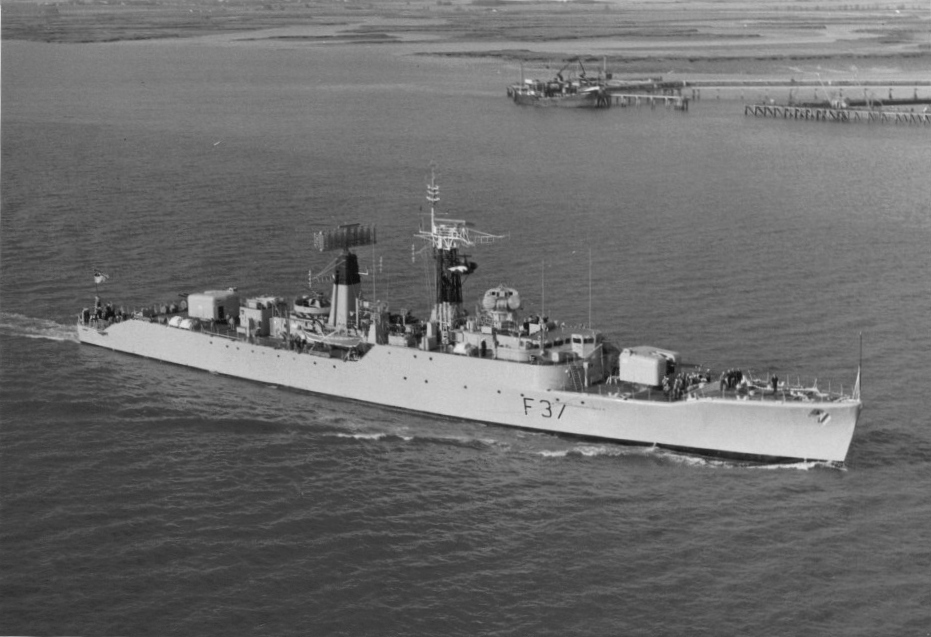
Jaguar underway

The first production orders were in the 1951/2 and 1952/3 programmes. In 1953 eleven additional Type 41s, also with "cat" names like Cougar and Cheetah, were planned, together with ten Type 61 (Salisbury-class) frigates,[6] with which they shared a common hull and machinery.

Distinct from the Type 61, the Type 41 radar fit also supported surface fighting, whereas the radar fit of the Type 61 "Aircraft Direction" (AD) frigates was, when introduced, largely identical to the reconstructed Dido-class AD cruiser Royalist. To that end, HMS Leopard carried navigation radar, the new Type 992 for long-range surface target indication, and the Type 960M for Long Range Air Warning; the Type 61 had four dedicated systems: types 293, 977M, 960M and 982M.

An intended A/S version, the Type 11 (see Type system of the Royal Navy), was cancelled as the low (24-knot) top speed was insufficient for accompanying fast carrier task forces, particularly HMS Eagle, the flagship, commissioned in 1951. However, in practice, frigates and destroyers moving at more than 25 knots create turbulence which blinds their own sonars and can only engage fast-moving subs by using a helicopter with its own sonar. Thus the Type 41s were still fitted with the best late-1950s RN sonars, types 170 and 174 (which remained a good passive sonar into the 1970s), but were equipped with only a minimal A/S mortar battery.

Through their diesel propulsion, the Type 41s achieved long range through their low fuel use. The ships had a total of twelve Admiralty Standard Range Mk.1 (ASR1) diesel engines disposed four-each in three engine rooms. In the fore and aft engine rooms, two engines were connected to the drive shafts by fluid clutches and reduction gearboxes, while the other two were not connected to the shafts, but instead drove 360 kW alternators to provide electrical power. In the centre engine room, all four engines were connected to the shafts.[7] Jaguar was fitted with controllable-pitch propellers.[8] Initially the diesel engines proved somewhat unreliable, but these teething troubles were gradually overcome and reliability eventually became very satisfactory.[4]

The Leopard class was also fitted with an early type of hydraulic stabiliser system consisting of two fins that could be extended outside the main hull, to port and starboard, from a compartment between the two engine rooms. Gyro controlled with a relatively simple control system, they proved very effective in use. During testing every three months at sea, the ship could be easily driven into a 20°+ roll from the manual control on the bridge. Prior warning had to be given over the ship's tannoy system before testing was carried out, to allow stowage of loose items. A slight reduction in top speed was also noticed when in use.

However, by 1955 success had been achieved, with difficulty and limitations, in developing new steam turbines giving 30-knot speed and the range to take convoys across the Atlantic, embodied in the Whitby-class Type 12 frigates. As a result, the orders for the new diesel-electric frigates were cancelled, changed to orders for Type 12, or sold to India.

Within a few years of the Type 41's introduction in the late 1950s they were regarded as obsolete for their intended function as anti-aircraft convoy escorts. This was emphasized when the planned replacement of the 4.5" guns with 3"/70 AA guns was abandoned (in January 1955) due to cost and the view that AA guns were obsolete against jets and missiles.[9] The addition of power-ramming for the twin 4.5" guns, intended to boost the rate of fire from 14rpm to 24rpm, failed. Replacement of the unreliable STAAG 40mm Bofors gun mount by Seacat surface to air missiles was cancelled on economic grounds, and the guns eventually replaced by a single, manually operated Bofors gun.[8] Replacement of the experimental version of the fast rotating 992 target indicators with the slower standard 993 was also abandoned. Only a short range 262 radar MRS1 provided secondary AA fire control for the main armament.

Service

[edit]
Jaguar in Amsterdam, 1968

In service, the Leopard class were used mainly as patrol frigates, notably on the South American station, where their long range and destroyer-like appearance were particularly advantageous.[citation needed] Operating out of Simonstown naval base in South Africa,[8] they in part replaced the Dido-class cruisers HMS Euryalus and Cleopatra usually deployed on these duties during 1946–1954. It was hoped that a pair of Type 41s with four twin 4.5-inch guns would between them be adequate to deter a single Russian Sverdlov-class cruiser, which British Naval Intelligence saw as having been in part conceived of to threaten trade routes from Buenos Aires to Britain Later they were extensively used in the Far East during the 1963–68 confrontation with Indonesia over Borneo and Malaysia, for which all-gun-armed Type 41s were again well suited. In the 1970s they saw service on Cod War duties.[10]

In 1972 it was decided not to refit HMS Puma again; purchasing the half-sister of the class, the former Black Star ordered by Ghana, and commissioning it as HMS Mermaid would cost less than the refit. HMS Leopard finished its service in the 1975–1976 Cod War, having given an Icelandic gunboat a 30-second warning that it would open fire with its 4.5-inch guns. HMS Lynx was the last of the class operational and attend the Spithead fleet review in 1977. HMS Jaguar was reactivated from the standby squadron for the Third Cod War, but sprang too many leaks on the voyage to Iceland and returned to Chatham.

HMS Jaguar and HMS Lynx were sold to the Bangladesh Navy in 1978 and March 1982 respectively. Had they been retained a few more years they could have been ideal during the Falklands War for specialized bombardment and the air defence of ships unloading in San Carlos Water.[11] The destroyers and frigates remaining in RN service in 1982 had only one gun turret, the new 4.5 inch Mk.8 often jammed, and those with the Mk.6 twin 4.5 inch (which required 40–45 men required for each turret) rarely even test fired the guns. As it was, the Bangladesh Navy found the Leopard-class satisfactory and the ships were active until they were retired in 2013.

Construction programme

[edit]
Pennant Name (a) Hull builder
(b) Main machinery manufacturers
Ordered Laid down Launched Accepted into service Commissioned Estimated building cost[12] Fate
F14 HMS Leopard (a) HM Dockyard, Portsmouth
(b) Vickers Armstrong (Engineers) Ltd, Barrow-in-Furness
(b) Peter Brotherhood Limited, Peterborough[13]
21 August 1951[14] 25 March 1953[15] 23 May 1955[15] December 1958[13] 30 September 1958[15] £3,545,000[13] Paid off for last time 12 December 1975.[16] Broken up 1977.[15]
F27 HMS Lynx (a) John Brown and Co Ltd, Clydebank
(b) Crossley Brothers Ltd, Manchester
(b) British Polar Engines Ltd, Glasgow[17]
28 June 1951[14] 13 August 1953[15] 12 January 1955[15] 14 March 1957[17] 14 March 1957[15] £2,720,000[17] Sold to Bangladesh 12 March 1982, renamed BNS Abu Bakr.[18] Decommissioned 22 January 2013.
F34 HMS Puma (a) Scotts Shipbuilding and Engineering Co Ltd, Greenock
(b) HM Dockyard, Chatham
(b) British Polar Engines Ltd, Glasgow[19]
28 June 1951[14] 16 November 1953[15] 30 June 1954[15] April 1957[19] 27 April 1957[15] £2,914,000[19] Paid off for last time June 1972.[16] Broken up 1976.[15]
F37 HMS Jaguar (a) Wm Denny Bros Ltd, Dumbarton
(b) Crossley Bros Ltd, Manchester[20]
28 June 1951[14] 2 November 1953[15] 20 July 1957[15] December 1959[20] 12 December 1959[15] £3,772,000[20] Sold to Bangladesh 6 July 1978 for £2 million,[18] renamed BNS Ali Haider.[15] Decommissioned 22 January 2013.
F34 INS Brahmaputra (ex-HMS Panther) (a) John Brown and Co Ltd, Clydebank[21] 1954[21] 20 October 1955[21] 13 March 1957[21] 31 March 1958[21] Ordered HMS Panther, but transferred to India 1953.[15] Decommissioned 30 June 1986[22] Broken Up 1986.[21]
F37 INS Beas (a) Vickers Armstrongs (Shipbuilders) Ltd, Newcastle upon Tyne[21] 1954[21] 29 November 1956[21] 9 October 1958[21] 24 May 1960[21] Decommissioned 22 December 1992[22] Broken up 1992.[21]
F38 INS Betwa (a) Vickers Armstrongs (Shipbuilders) Ltd, Newcastle upon Tyne[21] 1954[21] 29 May 1957[21] 15 September 1959[21] 8 December 1960[21] Decommissioned 31 December 1991[22] Broken Up 1988.[21]

A fifth Royal Navy vessel, HMS Panther was ordered twice. The first was transferred to India in 1953 before being laid down, a replacement was cancelled in 1957, before being laid down.[15]

Footnotes

[edit]

References

[edit]
Revisions and contributorsEdit on WikipediaRead on Wikipedia
from Grokipedia
The Leopard-class frigates, designated Type 41, were a class of seven anti-aircraft defence vessels constructed during the , with four ships commissioned for the Royal Navy—HMS Leopard (F14), Lynx (F27), Puma (F34), and (F37)—and three for the —INS Brahmaputra, , and Betwa. These frigates displaced approximately 2,300 tons standard and 2,520 tons full load, measured 100 meters in length with a beam of 12 meters, and achieved speeds of 24 knots via diesel propulsion providing a range of 7,500 nautical miles at 16 knots. Armament centered on two twin 4.5-inch (114 mm) Mk 6 gun turrets for primary anti-aircraft fire, supplemented by a twin 40 mm mount and a anti-submarine mortar, with sensors including Type 960 air search and Type 293Q target indication . Developed from 1945 designs for post-World War II AA escorts, the class represented an early effort to prioritize air defence over , incorporating diesel engines for fuel economy and endurance on patrol duties despite reliability challenges that later favored steam turbines in successor designs. Ordered between 1951 and 1953, the ships entered service from 1957 to 1961, serving the Royal Navy in regions such as the South Atlantic, , and for protection. Notably, HMS Leopard participated in the 1970s , a series of fisheries disputes with where British frigates escorted trawlers and engaged in ramming actions against vessels to assert rights. The Indian Navy's vessels provided versatile service through the late 20th century, with decommissioning occurring by 1992, while two ex-Royal Navy ships transferred to between 1978 and 1982 remained operational until around 2013–2014. Though transitional in due to limitations, the class exemplified economical long-range escort capabilities and contributed to imperial and post-colonial without major engagements but with sustained peacetime operational demands.

Development

Origins and requirements

The Royal Navy's post-World War II frigate programs addressed the obsolescence of wartime escorts amid emerging threats, particularly the need for dedicated anti-aircraft (AA) vessels to safeguard convoys and amphibious forces "," where carrier air cover was often unavailable. Initiated in 1945 as successors to the Bay-class AA frigates, these designs aimed to counter improved Soviet aviation and surface threats, such as Sverdlov-class cruisers operating on global trade routes. The Type 41 (Leopard) class evolved from broader efforts to standardize hulls for both AA and (ASW) roles, with the AA variant finalized by December 1947 under Admiralty influence from Battle-class destroyers and Bay-class precedents. Initial requirements prioritized escort and light duties, specifying a displacement of 2,300 tons standard (2,520 tons full load), of 340 feet, speed of 24 knots maximum, and range of 7,500 nautical miles at 16 knots to support extended patrols without frequent refueling. Propulsion emphasized Admiralty Standard Range diesels (12 units delivering 14,400 shaft horsepower via two shafts) for fuel efficiency over high-speed steam turbines, reflecting economic constraints and the anticipated low-to-medium threat environment. Armament focused on AA defense with two twin 4.5-inch Mk VI gun turrets fore and aft, supplemented by a twin 40 mm STAAG mount and a ASW mortar for secondary protection roles. The 1951 frigate construction program categorized the Type 41 as a specialized AA type alongside ASW (Type 12), air-direction (Type 61), and (Type 81) variants, with prototype orders placed in 1948—one AAW unit () and one air-direction unit ()—and final Board approval in 1950. This reflected Admiralty assessments that diesel-powered "super-s" could economically fill gaps left by reduced numbers, though subsequent advancements in classes like the Type 12 highlighted the Type 41's transitional nature.

Design evolution

The design of the Type 41 Leopard-class frigate originated in 1945 as a successor to the Bay-class anti-aircraft frigates, with an emphasis on providing medium-range air defense for convoys and amphibious groups operating . Initial concepts drew from late destroyer designs, including the 1942 "G"-class and the 1950 Battle-class variant, adapting elements for a smaller, more economical escort vessel capable of independent operations. By December 1947, the core design was finalized, marking a departure from prior anti-submarine warfare-focused frigates toward dedicated anti-aircraft roles, with a common hull form shared with the Type 61 Salisbury-class for aircraft direction duties. Key evolutions included the adoption of diesel propulsion—unprecedented in frigates—to prioritize endurance over speed, utilizing Admiralty Standard Range engines for a range exceeding 6,000 nautical miles at economical speeds. Armament configuration stabilized by with two twin 4.5-inch QF Mark VI turrets forward and aft for medium-range gunnery, supplemented by lighter anti-aircraft guns, though plans for surface-to-air missiles were ultimately abandoned due to integration challenges. Hull modifications incorporated hydraulic stabilisers to mitigate rolling in ocean swells, enhancing gunnery stability, while the enclosed bridge and transom stern improved seaworthiness compared to open designs of wartime escorts. Further development in 1953 envisioned expanding the class to 11 additional units under "cat" naming conventions, alongside a proposed Type 11 anti-submarine variant using the same hull but optimized for sonar and depth charges; however, the ASW version was cancelled owing to its 24-knot top speed being inadequate for fleet screening. By 1955, advancements in steam turbine efficiency eroded the diesel's fuel economy advantage, prompting the Royal Navy to halt further Type 41 production in favor of the faster, more versatile Type 12 Whitby-class, limiting the Leopard class to just four Royal Navy ships plus exports. This shift reflected broader post-war prioritization of multi-role capabilities amid budget constraints and evolving threat perceptions, with initial diesel engine reliability issues addressed through iterative refinements during early trials.

Technical specifications

Hull and general characteristics

The Leopard-class frigates utilized an all-welded steel hull with a raised forecastle, full beam structure amidships, and a transom stern, incorporating counter-keels and stabilizer fins to mitigate rolling. Hydraulic stabilisers were fitted to further reduce motion in rough seas. These vessels displaced 2,300 long tons (2,337 t) at standard load and 2,520 long tons (2,560 t) at full load. Overall length measured 340 ft (104 m), with a beam of 40 ft (12 m) and a draught of 16 ft (4.9 m). The crew complement consisted of 235 personnel.
General CharacteristicsSpecification
Class and typeAnti-aircraft frigate
Displacement2,300 long tons (standard); 2,520 long tons (full load)
340 ft (104 m) overall
Beam40 ft (12 m)
Draught16 ft (4.9 m)
Complement235

Armament and weaponry

The Leopard-class frigates, designed primarily for anti-aircraft defense, featured a of two twin-mount 4.5-inch (114 mm) QF turrets, with one positioned forward and the other aft to provide balanced firepower against both aerial and surface threats. These guns, derived from designs, fired 55-pound shells at a rate of up to 14 rounds per minute per barrel, emphasizing rapid anti-aircraft barrages supported by radar-directed fire control. Secondary anti-aircraft armament consisted of one twin 40 mm STAAG Mark II mount amidships, equipped with gyro-stabilized automatic aiming for close-range defense against low-flying aircraft, supplemented by two single 40 mm "" mounts aft for additional light AA coverage. These lighter guns addressed limitations in the main battery's elevation and against dive-bombers or torpedo planes, reflecting post-World War II lessons in layered air defense. For , the class incorporated two triple-tube ahead-throwing mortars forward, capable of launching 60-pound up to 300 yards ahead to create patterns against submerged targets, along with racks and throwers for stern-launched attacks. No tubes were fitted in the original design, prioritizing gun-based versatility over dedicated ASW weaponry like the mortar used in contemporary escorts. Export variants for the retained this configuration without significant modifications to the core armament suite.

Propulsion and performance

The Leopard-class frigates utilized an all-diesel propulsion arrangement, featuring eight Admiralty Standard Range ASR1 V16-cylinder diesel engines arranged in two engine rooms, each group driving one propeller shaft via reduction gearing. Each engine delivered 1,800 brake horsepower, yielding a combined output of 14,400 shaft horsepower. This setup marked the Royal Navy's first adoption of diesel power for major warships, selected for its superior fuel economy and extended operational endurance compared to alternatives prevalent in contemporary designs. The system enabled a maximum sustained speed of 24 knots (44 km/h; 28 mph) on trials, with cruising speeds typically around 16 knots for optimal efficiency. Fuel capacity totaled 220 tons of diesel oil, supporting a range of 7,000–7,500 nautical miles (13,000–13,900 km) at 16 knots, which exceeded that of steam-powered frigates of similar displacement and facilitated extended protection duties without frequent refueling. Performance characteristics emphasized reliability over acceleration, with the diesel engines providing steady power for anti-aircraft screening roles rather than high-speed pursuits; minimum was approximately 8 knots, and the twin-screw configuration offered against single-shaft failure. The design's focus on low fuel consumption—achieved through the ASR1's efficient operation—reduced logistical demands, though it limited top-end sprint capability relative to later gas-turbine equipped classes.

Electronics and sensors

The Leopard-class frigates were equipped with systems optimized for , reflecting their primary design role in providing long-range air warning and target acquisition. The initial air search was the Type 960, a VHF-band system operating at 450 kW with frequencies of 86-90 MHz and a detection range of 175 nautical miles. Surface target indication relied on the Type 992 long-range , while target designation used the Type 293Q (500 kW), later upgraded to Type 993 on some vessels. Height-finding was provided by the Type 277Q S-band (2,940-3,060 MHz, 30 km range), and navigation by the Type 974 X-band system (9,345-9,405 MHz, 25 nautical miles). Fire control systems integrated radar directors for armament operation. The twin 4.5-inch gun turrets were directed by the Mark 6M system, incorporating the Type 275 F-band (16 nautical miles range). Secondary close-range blind fire (CRBF) directors used the Type 262 X-band (29 nautical miles) for anti-aircraft guns, including STAAG mounts for 40 mm . Mid-service refits, such as on HMS Jaguar, introduced the advanced Type 965 AKE-1 air search , enhancing detection capabilities. For anti-submarine warfare, the class featured basic passive sonar suites. The Type 174 provided search functions, remaining effective as a passive set into the 1970s, complemented by the Type 170 medium-range passive search sonar. These supported limited ASW operations with Squid mortars, though the frigates lacked advanced active sonars or variable-depth systems typical of later designs. No dedicated electronic warfare suites were fitted, with sensor emphasis on radar-directed gunnery over comprehensive countermeasures.

Construction and acquisition

Shipbuilding contracts

The four Royal Navy Leopard-class frigates were ordered under Admiralty contracts in 1951 to support post-war fleet modernization, with construction distributed across royal dockyards and private shipbuilders to leverage specialized capabilities in diesel-electric propulsion and anti-aircraft fittings. HMS Leopard (F14) was contracted on 21 August 1951 to HM Dockyard , laid down on 25 March 1953, at an estimated cost of £3,545,000 including engines supplied by Armstrong. The remaining three—HMS Lynx (F27), HMS Puma (F34), and HMS Jaguar (F37)—were ordered on 28 June 1951 to private yards: at for Lynx (cost £2,720,000), Scotts Shipbuilding and Engineering at for Puma (£2,914,000), and William Denny & Brothers at for Jaguar (£3,772,000). These contracts emphasized economical diesel machinery over steam turbines, reflecting fiscal constraints after the 1945-1951 Labour government's defense reviews, though delays in trials pushed completions into the late 1950s.
ShipBuilder/YardOrder DateLaid DownCost (£)
HMS Leopard (F14)21 Aug 195125 Mar 19533,545,000
HMS Lynx (F27)John Brown & Co, 28 Jun 195113 Aug 19532,720,000
HMS Puma (F34), 28 Jun 195116 Nov 19532,914,000
HMS Jaguar (F37)Wm. Denny & Bros, 28 Jun 19512 Nov 19533,772,000
India's three Type 41 derivatives, adapted with minor modifications for tropical service and transferred under post-independence defense aid agreements, were built under separate UK contracts in the mid-1950s to bolster Commonwealth naval ties amid rising Indo-Pakistani tensions. INS Brahmaputra (ex-Panther) was laid down at John Brown & Company, Clydebank, on 20 October 1955 following a 1953 order. INS Beas and INS Betwa were contracted in 1954 to Vickers-Armstrongs at Newcastle upon Tyne, with Beas laid down on 29 November 1956 and Betwa on 29 May 1957; these emphasized radar enhancements over the RN baseline but retained core diesel-electric plants. No public cost figures for Indian builds were disclosed, though they aligned with RN unit prices adjusted for export fittings. Later acquisitions by Bangladesh involved transfers of decommissioned RN hulls (Jaguar as BNS Ali Haider in 1978 and Lynx as BNS Abu Bakar in 1982) rather than new contracts.

Commissioning timeline

The first Leopard-class frigate, HMS Lynx (F27), was commissioned into the Royal Navy on 14 March 1957 after construction by at . This was followed by HMS Puma (F34), built by Scotts Shipbuilding and Engineering Company at , which entered service on 27 April 1957. The lead ship, HMS Leopard (F14), constructed at HM Dockyard , was commissioned later on 30 September 1958 due to delays in fitting out.) The final British-commissioned vessel, HMS Jaguar (F37), built by William Denny & Brothers at , joined the fleet on 12 December 1959.
ShipPennantCommissioned (Royal Navy)Notes
HMS LynxF2714 March 1957Transferred to in 1982 as BNS Abu Bakr, decommissioned 2014.
HMS PumaF3427 April 1957Decommissioned 1972, scrapped 1976.
HMS LeopardF1430 September 1958Decommissioned 1975, scrapped 1977.)
HMS JaguarF3712 December 1959Transferred to in 1978 as BNS Ali Haider, decommissioned 2014.
Post-commissioning transfers extended the class's service life abroad. HMS Jaguar was sold to and recommissioned as BNS Ali Haider in 1978 following refit and handover ceremonies. HMS Lynx followed suit, transferred on 12 March 1982 and entering service as BNS Abu Bakr. No Leopard-class vessels were directly commissioned by the ; references to Indian service in some accounts likely pertain to design influences on indigenous builds rather than transferred hulls.

Operational history

Royal Navy deployments

The Leopard-class frigates entered service between 1958 and 1962, primarily fulfilling anti-aircraft escort roles during the , with deployments emphasizing trade route protection in distant stations such as the , , , and South Atlantic. These ships, designed for extended endurance with diesel propulsion, supported imperial commitments including screening and station patrols, often operating independently due to their robust hulls and sensor suites optimized for air defense against low-altitude threats. HMS Leopard (F14), commissioned in 1958, initiated class deployments with service in the South Atlantic and as part of the 7th Frigate Squadron, later rotating to the in August 1966 for exercises and duties amid the Indonesia-Malaysia conflict (1963–1966), where all-gun armament proved suitable for surface engagements. In 1968–1970, she conducted a half-commission tour followed by a to , demonstrating operational reliability despite engine issues delaying some sailings. Leopard also participated in the Beira Patrol (1966–1975), enforcing sanctions against Rhodesia's unilateral independence by intercepting oil shipments via Mozambique's Beira port. By 1973, she supported British trawlers during the Third Cod War with , involving fishery protection in North Atlantic waters. HMS Jaguar (F37), commissioned in 1957, joined early post-launch exercises like Forthex in July 1957, involving nearly 40 vessels, before and rotations. Returning to the in December 1969 after extended foreign service, she deployed to Icelandic waters for the Second War in 1973, sustaining a collision with an Icelandic vessel on 10 September during enforcement of exclusive fishing zones, highlighting the class's role in low-intensity maritime disputes. HMS Lynx (F27), commissioned in 1960, focused on South Atlantic operations, becoming the last Royal Navy vessel based at Simon's Town, South Africa, in March 1967 after the station's disbandment, with subsequent duties in the Persian Gulf and Caribbean. Like Leopard, Lynx contributed to Beira Patrol enforcement, leveraging the class's range for sustained presence off Mozambique. HMS Puma (F34), the final unit commissioned in 1957, mirrored squadron deployments in trade protection across Middle East and Far East theaters, recommissioning in 1962 for Gulf and patrols before refits supporting ongoing station duties into the late . By the , as missile-equipped escorts proliferated, the class shifted to secondary roles including fishery protection, with all units decommissioned between 1972 and 1978 amid evolving naval priorities.

Indian Navy service

The Indian Navy operated three purpose-built Leopard-class (Type 41) frigates: INS Brahmaputra, commissioned on 31 March 1958; INS Beas (F137), commissioned on 20 April 1960; and INS Betwa (F139), commissioned on 4 February 1960. These vessels, constructed by Vickers-Armstrong at and John Brown at , primarily served in anti-aircraft escort roles and fleet screening duties in the and . During Operation Vijay in December 1961, aimed at liberating Portuguese-held enclaves in , INS Beas and INS Betwa participated in the bombardment of the Portuguese frigate NRP Afonso de Albuquerque at Harbour, , contributing to its destruction and the subsequent Portuguese surrender. INS Brahmaputra supported and patrol operations in the same campaign, enforcing naval isolation of the enclaves. In the , INS Betwa joined the Western Fleet's task group, including cruiser INS Mysore and destroyer INS Ranjit, to conduct shore bombardments on Pakistani ports at and Jiwani along the Coast on 4-5 December, disrupting enemy logistics without sustaining damage. INS Beas and INS Brahmaputra provided escort and air defense support to Eastern Fleet convoys, though they saw no direct combat engagements. Post-war, the frigates undertook routine deployments for maritime patrols, training exercises, and goodwill visits in the region through the 1970s and 1980s, with periodic refits to maintain operational readiness. INS Brahmaputra was decommissioned in 1986, INS Betwa in 1991, and INS Beas in 1992, after which they were scrapped, marking the end of Type 41 service in the .

Assessment and legacy

Operational effectiveness

The Leopard-class frigates, designed primarily for anti-aircraft defense of convoys, demonstrated moderate operational effectiveness in service during the , though their capabilities were constrained by design choices prioritizing endurance over speed. With a top speed of 24 knots, they were unsuitable for integration into high-speed carrier task groups, limiting their role to independent patrols and escort duties rather than frontline fleet operations. The adoption of diesel propulsion provided extended range and fuel efficiency, enabling deployments such as HMS Leopard's 1,600-mile transit across the South Atlantic to in December 1961 for humanitarian support. Initial teething problems with the diesel engines affected early reliability, but subsequent improvements yielded satisfactory performance, allowing consistent operations in varied theaters including the and Mediterranean. Advanced sonar systems for the era enhanced their secondary capabilities, contributing to effective duties amid evolving threats. However, rapid advancements in guided rendered their gun-based anti-air armament obsolete by the mid-1960s, leading to repurposing as general-purpose vessels. In export service, the class proved durable for less demanding roles. The Indian Navy's three Leopard-class ships, commissioned in the late , supported regional operations with modifications for local needs, maintaining viability into the through upgrades. Bangladesh's acquisition of a single vessel, operational until 2013, reflected satisfaction with its reliability for coastal defense and patrol missions in a lower-threat environment. Overall, the frigates excelled in endurance and low-maintenance operations but fell short in high-intensity combat scenarios due to speed and armament limitations.

Criticisms and limitations

The Leopard-class frigates suffered from several design and performance limitations inherent to their mid-1950s origins, rendering them increasingly obsolete by the amid rapid advancements in naval technology. Their top speed of 24 knots proved inadequate for integration into fast carrier task groups, limiting their tactical flexibility in high-threat environments. Additionally, the single-screw propulsion, while enabling good endurance with Y-100 diesel engines, compromised maneuverability, as evidenced in confrontations during the where similar single-shaft designs hindered evasive actions against vessels. Early unreliability in the Admiralty Standard Range Mk.1 diesels required extensive teething fixes over the first decade of service, and stabilizer fins added drag that further reduced maximum speeds. Armament systems highlighted further shortcomings, with the primary 4.5-inch Mk.6 guns and STAAG 40mm mounts considered outdated by the late 1950s, prompting unsuccessful attempts to integrate Sea Cat surface-to-air missiles. Later upgrades to power-rammed 4.5-inch Mk.8 turrets were plagued by frequent jamming, while the original Mk.6 demanded crews of 40-45 personnel per turret, straining operational efficiency. The absence of facilities left anti-submarine warfare capabilities reliant on obsolete mortars and early sonars (Types 170 and 174), which lacked effectiveness without dedicated support assets. These vessels were rapidly supplanted in service by steam-powered Type 12 frigates, which offered superior speed and versatility, with Leopard-class hulls exhibiting severe rust by the 1970s and full decommissioning by 1977. Export operators like the Indian and navies extended their use as interim platforms until 1999 and 2013, respectively, but maintenance challenges from aging 1940s-era electronics underscored their role as stopgaps rather than frontline assets. Diesel exhaust trunking routed through lattice masts accelerated corrosion, necessitating remedial plating on ships like HMS Puma. Overall, the class bridged postwar gaps but failed to adapt to missile-era demands, reflecting budgetary and technological constraints of the era.

Post-service fate

HMS Leopard was decommissioned on 12 December 1975 and subsequently scrapped in 1977. HMS Puma underwent disassembly of valuable components at Blyth Dry Docks in 1976 prior to being scrapped. HMS Jaguar was placed in reserve before being sold to the Bangladesh Navy on 6 July 1978 for £2 million, entering service as BNS Ali Haider (F17). The vessel participated in regional operations, including anti-piracy patrols, until her decommissioning on 22 January 2014 at Chittagong, after which she was scrapped. HMS Lynx followed a similar path, sold to Bangladesh on 12 March 1982 and renamed BNS Abu Bakr (F15). She served in escort and patrol roles until decommissioning alongside BNS Ali Haider in 2014 and was then scrapped. The three Type 41 frigates built for the —INS Talwar, INS Trishul, and INS Tabar—were decommissioned between 1979 and the late 1980s following extensive service in regional conflicts and patrols; all were ultimately broken up for scrap.

References

Add your contribution
Related Hubs
User Avatar
No comments yet.