Hubbry Logo
Lewis ArmisteadLewis ArmisteadMain
Open search
Lewis Armistead
Community hub
Lewis Armistead
logo
8 pages, 0 posts
0 subscribers
Be the first to start a discussion here.
Lewis Armistead
Lewis Armistead
from Wikipedia

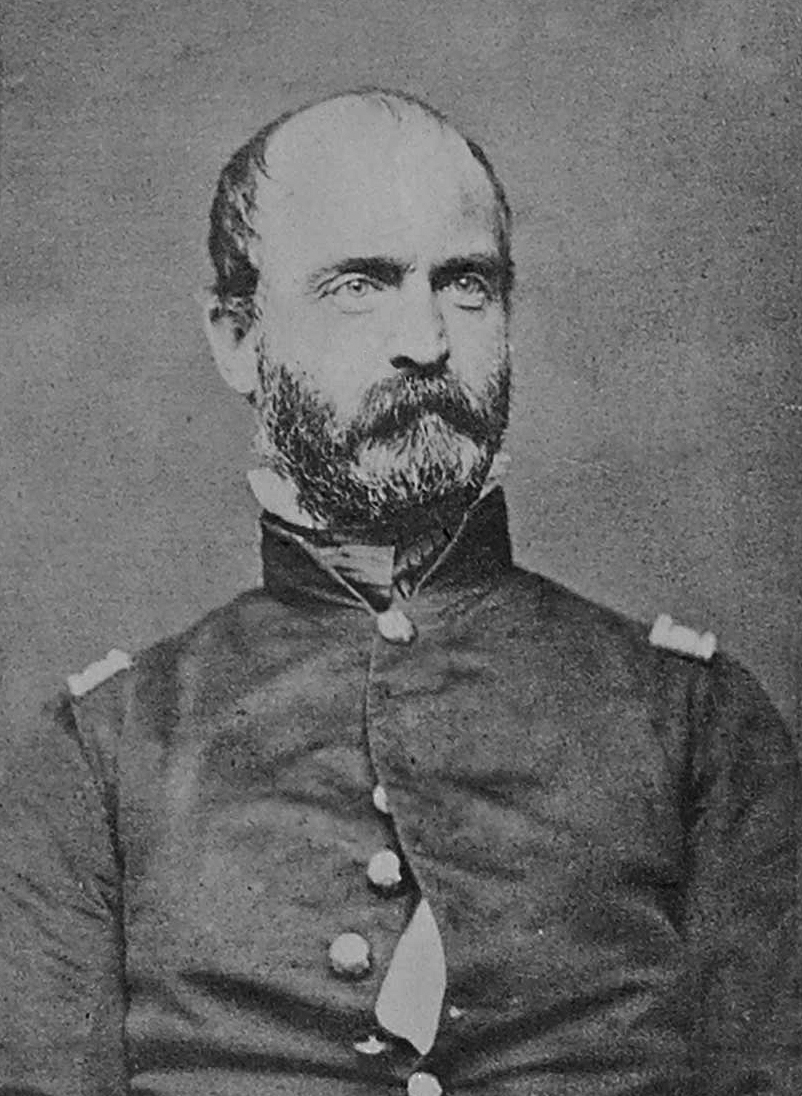
Lewis Addison Armistead (February 18, 1817 – July 5, 1863) was a career United States Army officer who became a brigadier general in the Confederate States Army during the American Civil War. On July 3, 1863, as part of Pickett's Charge during the Battle of Gettysburg, Armistead led his brigade to the farthest point reached by Confederate forces during the charge, a point now referred to as the high-water mark of the Confederacy. However, he and his men were overwhelmed, and he was wounded and captured by Union troops. He died in a field hospital two days later.

Key Information

Early life

[edit]

Armistead, known to friends as "Lo" (for Lothario),[1] was born in the home of his great-grandfather, John Wright Stanly, in New Bern, North Carolina, to Walker Keith Armistead and Elizabeth Stanly.[2] He came from an esteemed military family.[3] Armistead was of entirely English descent, and all of his ancestry had been in Virginia since the early 1600s.[4] The first of his ancestors to emigrate to North America was William Armistead from Yorkshire, England.[4][5][6] Armistead's father was one of five brothers who fought in the War of 1812; another was Major George Armistead, the commander of Fort McHenry during the battle that inspired Francis Scott Key to write "The Star-Spangled Banner", which would later become the national anthem of the United States. On his mother's side, his grandfather John Stanly was a U.S. Congressman, and his uncle Edward Stanly served as military governor of eastern North Carolina during the Civil War.[citation needed]

Armistead attended the United States Military Academy, joining in 1833 but resigning the same year. He rejoined in 1834 but was found deficient and had to repeat his class once more. In 1836 he resigned again following an incident in which he broke a plate over the head of fellow cadet (and future Confederate general) Jubal Early.[7] He was also having academic difficulties, however, particularly in French (a subject of difficulty for many West Point cadets of that era), and some historians cite academic failure as his true reason for leaving the academy.[8]

His influential father managed to obtain for his son a second lieutenant's commission in the 6th U.S. Infantry on July 10, 1839, at roughly the time his classmates graduated. He was promoted to first lieutenant on March 30, 1844. Armistead's first marriage was to Cecelia Lee Love, a distant cousin of Robert E. Lee, in 1844.[9] They had two children: Walker Keith Armistead and Flora Lee Armistead.

Armistead then served in Fort Towson, Oklahoma and Fort Washita near the Oklahoma border. Serving in the Mexican War, he was appointed brevet captain for Contreras and Churubusco, wounded at Chapultepec, and was appointed a brevet major for Molino del Rey and Chapultepec.[2]

Armistead continued in the Army after the Mexican War, assigned in 1849 to recruiting duty in Kentucky, where he was diagnosed with a severe case of erysipelas, but he later recovered. In April 1850, the Armisteads lost their little girl, Flora Love, at Jefferson Barracks. Armistead was posted to Fort Dodge, but in the winter he had to take his wife Cecelia to Mobile, Alabama, where she died December 12, 1850, from an unknown cause. He returned to Fort Dodge. In 1852 the Armistead family home in Virginia burned, destroying nearly everything. Armistead took leave in October 1852 to go home and help his family. While on leave Armistead married his second wife, the widow Cornelia Taliaferro Jamison, in Alexandria, Virginia, on March 17, 1853.[citation needed] They both went west when Armistead returned to duty shortly thereafter.

The new Armistead family traveled from post to post in Nebraska, Missouri, and Kansas. The couple had one child, Lewis B. Armistead, who died on December 6, 1854, and was also buried at Jefferson Barracks next to Flora Lee Armistead. He was promoted to captain on March 3, 1855.[10] His second wife, Cornelia Taliaferro Jamison, died on August 3, 1855, at Fort Riley, Kansas, during a cholera epidemic.[citation needed]

Between 1855 and 1858 Armistead served at posts on the Smoky Hill River in Kansas Territory, Bent's Fort, Pole Creek, Laramie River, and Republican Fork of the Kansas River in Nebraska Territory. In 1858, his 6th Infantry Regiment was sent as part of the reinforcements sent to Utah in the aftermath of the Utah War. Not being required there, they were sent to California with the intention of sending them on to Washington Territory. However, a Mohave attack on civilians on the Beale Wagon Road diverted his regiment to the southern deserts along the Colorado River to participate in the Mojave Expedition of 1858–59.

Lt. Col. William Hoffman, at the head of a column of six companies of infantry, two of dragoons, and some artillery, struggled up the Colorado River from Fort Yuma. On April 23, 1859, Colonel Hoffman dictated a peace to the overawed Mohave chiefs, threatening annihilation to the tribe if they did not cease hostilities, make no opposition to the establishment of posts and roads through their country, and allow travel free from their harassment. Hoffman also took some of their leading men or family members hostage. Afterward he left for San Bernardino, taking most of his force with him; others went down river by steamboat or overland to Fort Tejon.

Captain Armistead was left with two infantry companies and the column's artillery to garrison Hoffman's encampment at Beale's Crossing on the east bank of the Colorado River, Camp Colorado. Armistead renamed the post Fort Mojave. In late June 1859 the Mohave hostages escaped from Fort Yuma. Trouble broke out with the Mohave a few weeks later when they stole stock from a mail station that had been established two miles south of Fort Mojave, and attacked it. Mohaves tore up melons planted by the soldiers near the fort, and the soldiers shot a Mohave who was working in a garden. Eventually after a few weeks of aggressive patrolling and skirmishes, Armistead attacked the Mohave who returned fire in a battle between about 50 soldiers and 200 Mohave, resulting in three soldiers wounded. Twenty-three Mohave bodies were found but more were killed and wounded and removed by the Mohave. Following this defeat, the Mohave made a peace, which they kept from then on.[11]

Civil War

[edit]
This monument on the Gettysburg Battlefield marks the approximate place where Armistead was mortally wounded. The wall behind the monument marks the Union lines.

When the Civil War began, Captain Armistead was in command of the small garrison at the New San Diego Depot[12] in San Diego, which was occupied in 1860. He was a close friend of Winfield Scott Hancock, serving with him as a quartermaster in Los Angeles, before the Civil War. Accounts say that in a farewell party before leaving to join the Confederate army, Armistead told Hancock, "Goodbye; you can never know what this has cost me."[13]

When the war started, Armistead departed from California to Texas with the Los Angeles Mounted Rifles, then traveled east and received a commission as a major, but was quickly promoted to colonel of the 57th Virginia Infantry regiment. He served in the western part of Virginia, but soon returned to the east and the Army of Northern Virginia. He fought as a brigade commander at Seven Pines, and then under General Robert E. Lee in the Seven Days Battles (where he was chosen to spearhead the bloody assault on Malvern Hill), and Second Bull Run. At Antietam, he served as Lee's provost marshal, a frustrating job due to the high levels of desertion that plagued the army in that campaign. Then he was a brigade commander in Maj. Gen. George Pickett's division at Fredericksburg. Because he was with Lt. Gen. James Longstreet's First Corps near Suffolk, Virginia in the spring of 1863, he missed the Battle of Chancellorsville.

In the Battle of Gettysburg, Armistead's brigade arrived the evening of July 2, 1863. Armistead was mortally wounded the next day while leading his brigade towards the center of the Union line in Pickett's Charge. Armistead led his brigade from the front, waving his hat from the tip of his saber, and reached the stone wall at The Angle, which served as the charge's objective. The brigade got farther in the charge than any other, an event sometimes known as the high-water mark of the Confederacy, but it was quickly overwhelmed by a Union counterattack. Armistead was shot three times just after crossing the wall. Union Captain Henry H. Bingham received Armistead's personal effects and carried the news to Union Major General Winfield Hancock, Armistead's friend from before the war.[14][15]

Armistead's wounds were not believed to be mortal; he had been shot in the fleshy part of the arm and below the knee, and according to the surgeon who tended him, none of the wounds caused bone, artery, or nerve damage.[16] He was then taken to a Union field hospital at the George Spangler Farm[17] where he died two days later. Dr. Daniel Brinton, the chief surgeon at the Union hospital there, had expected Armistead to survive because he characterized the two bullet wounds as not of a "serious character." He wrote that the death "was not from his wounds directly, but from secondary bacterium, fever and prostration."[18]

Lewis Armistead is buried next to his uncle, Lieutenant Colonel George Armistead, commander of the garrison of Fort McHenry during the Battle of Baltimore, at the Old Saint Paul's Cemetery in Baltimore, Maryland.[19]

Legacy

[edit]

Armistead's sword was returned to the South at a reunion of Civil War veterans held at Gettysburg in 1906.[20]

His death is memorialized in the Friend to Friend Masonic Memorial located on the Gettysburg Battlefield, dedicated in 1994.[citation needed]

[edit]

In Gettysburg, the film version of Michael Shaara's novel The Killer Angels, Armistead was portrayed by actor Richard Jordan, who died shortly afterwards.[21] In the film, the meeting between Armistead and Bingham at the High Water Mark was altered with Lt. Thomas Chamberlain (portrayed by C. Thomas Howell), brother of Col. Joshua Lawrence Chamberlain, taking Bingham's place. In the original novel and in the movie, Armistead was shot in the chest; in the novel, Armistead dies on the spot, but that is corrected to two days afterward in the movie end titles.

Actor John Prosky depicted Armistead for a special appearance in Gods and Generals, accompanying Pickett at Fredericksburg.

Armistead is a character in the alternate history novel Gettysburg: A Novel of the Civil War (2003) by Newt Gingrich and William Forstchen.

See also

[edit]

Notes

[edit]

References

[edit]

Further reading

[edit]
[edit]
Revisions and contributorsEdit on WikipediaRead on Wikipedia
from Grokipedia

Lewis Addison Armistead (February 18, 1817 – July 5, 1863) was a in the who served in the during the .
A career in the United States prior to the war, Armistead was commissioned as a in the 6th U.S. in and earned distinction for bravery in the Mexican-American War.
He resigned his U.S. commission in 1861 following 's secession and was appointed colonel of the 57th before rising to brigade command under .
Armistead is most noted for leading his brigade in the assault known as on July 3, 1863, at the , where his men temporarily penetrated the Union center before he was mortally wounded near the stone wall at .

Early Life

Family Background and Upbringing

Lewis Addison Armistead was born on February 18, 1817, in , to Walker Keith Armistead, a who had served with distinction in the , and Elizabeth Stanly Armistead. The Armistead family traced its roots to English immigrants from who settled in in the 1630s, establishing a longstanding tradition of military service that included Armistead's father and several uncles. Walker's career in the U.S. Army Corps of Engineers influenced the family's mobility and emphasis on martial values, though specific details on Armistead's early siblings or immediate household dynamics remain sparsely documented in primary records. Raised primarily in , after his family's relocation from , Armistead grew up in an environment steeped in planter society and heritage, which shaped his aspiration for an army career from a young age. He received a through local public schools before seeking formal training, reflecting the era's expectations for sons of families to pursue West Point. On September 1, 1834, at age 17, he was admitted to the , intending to emulate his father's path, though disciplinary issues—stemming from a reported altercation—led to his before completion. This early setback did not deter his inclinations, as family connections facilitated his later entry into the U.S. Army as a in the 6th U.S. Infantry.

Entry into Military Service

Armistead initially sought a military career through the at West Point, entering as a cadet in 1834 amid his family's strong martial tradition. However, he was dismissed in 1836 following an altercation in which he broke a mess-hall plate over the head of fellow cadet Jubal A. Early, compounded by ongoing academic deficiencies and disciplinary issues. Undeterred, Armistead attended a school in to bolster his qualifications. Leveraging influential family connections, particularly those of his father, Colonel Walker Keith Armistead, he secured a direct commission as a in the 6th U.S. Infantry on July 10, 1839, bypassing formal graduation at a time when his West Point classmates were entering service. This appointment marked his formal entry into the Regular U.S. Army, where he initially undertook garrison duties in the western territories. His early service reflected the era's practice of commissioning officers through rather than standardized education, enabling Armistead to begin a career that would span decades despite his irregular path.

Pre-Civil War Military Career

Mexican-American War Service

Armistead served in the Mexican-American War (1846–1848) as a in the 6th United States Infantry Regiment, participating in Major General Winfield Scott's campaign to capture . His unit advanced from , engaging in operations that included the Siege of Veracruz in March 1847 and subsequent battles en route to the capital. During the Mexico City campaign, Armistead demonstrated gallantry that earned him two brevet promotions. At the on September 13, 1847, he was wounded in the shoulder and noted for being among the first to leap into the enemy's great ditch during the assault on the fortified hill, contributing to the storming of the Mexican defenses. By the war's end with the in February 1848, Armistead had been promoted to the permanent rank of in recognition of his service.

Frontier Duties and Professional Challenges

Following the Mexican-American War, in which Armistead earned brevet promotions to and major for gallantry at on September 13, 1847, he returned to peacetime duties with the 6th U.S. Infantry. In , he undertook recruiting service in but was temporarily incapacitated by a severe case of , an acute bacterial skin infection that required medical leave. His subsequent assignments shifted to the western frontier, reflecting the U.S. Army's focus on securing territories amid rapid settlement and conflicts with Native American tribes. During the 1850s, Armistead served at isolated outposts including those along the in (a region tense with "" violence over ), Bent's Fort in present-day , Pole Creek, the Laramie River in , and Republican Fork of the . These postings involved arduous tasks such as escorting emigrant wagon trains on the and Santa Fe Trails, foraging for supplies in harsh plains environments, constructing temporary fortifications, and participating in skirmishes against and other resisting encroachment. Armistead's frontier service highlighted the logistical and physical demands of maintaining federal authority in vast, under-resourced territories, where troops often faced supply shortages, , and guerrilla-style raids. By the late 1850s, his duties included responsibilities, managing provisions and transportation for garrisons amid the Army's expansion following the and migrations. Despite these contributions, Armistead encountered professional stagnation typical of the era's 16,000-man Army, where promotions were scarce without major conflicts; he achieved permanent captaincy around 1855 but saw no further advancement before resigning on May 26, 1861, as a captain at San Diego Barracks in Territory. This slow progression, despite his earlier brevets, stemmed from systemic constraints rather than documented misconduct, though the isolation and monotony of life strained many officers' careers. In , Armistead bonded with fellow over shared hardships, a later tested by .

Confederate Military Service

Resignation from U.S. Army and Initial Role

Armistead, serving as a brevet major and acting captain in the 6th U.S. Infantry Regiment stationed at in Territory, resigned his commission on May 26, 1861, following Virginia's from the Union on April 17, 1861. His decision reflected the loyalty of many Southern officers to their home states amid escalating sectional conflict, though it severed long-standing professional ties, including his close friendship with Union officer . Prior to departing westward posts, Armistead attended an emotional farewell gathering hosted by Almira Hancock, wife of his comrade Hancock, where sentiments of regret over divided allegiances were expressed; Armistead reportedly placed his hat on a table as a symbolic of parting. He then traveled eastward across the continent, joining other resigned Southern officers under General en route to Richmond. Upon arrival in the Confederate capital, Armistead received a commission as in the Provisional Confederate Army and assumed command of the 57th Infantry , a unit composed largely of volunteers from southwestern . In this initial role, he led the regiment during operations in western , including participation in the Romney Expedition in January 1862 under Thomas J. Jackson, marking his early contributions to Confederate defensive efforts in the region before transfer to the .

Key Engagements Prior to Gettysburg

Armistead received a commission as colonel of the 57th Virginia Infantry in September 1861, marking his initial Confederate command during the early phases of the Peninsula Campaign. On April 1, 1862, he was promoted to brigadier general and assigned to lead a brigade consisting primarily of Virginia regiments in John B. Magruder's division, later transferred to Benjamin Huger's division within the Army of Northern Virginia. This brigade, which included units such as the 9th, 14th, 38th, 53rd, and 57th Virginia Infantry, would see action in several major engagements under Robert E. Lee's command before the Gettysburg Campaign. His brigade's first significant combat occurred during the on May 31–June 1, 1862, where Armistead's men were committed late in the fighting amid heavy rain and swampy terrain; though the brigade initially faltered due to coordination issues, Armistead personally rallied troops and demonstrated personal bravery under fire. The engagement resulted in approximately 6,000 Confederate casualties overall, with Armistead's unit contributing to the tactical success that halted Union advances but at the cost of Joseph E. Johnston's wounding. During the Seven Days Battles from June 25 to July 1, 1862, Armistead's brigade participated in assaults around Richmond, culminating in the costly frontal attack at Malvern Hill on July 1, where he led the vanguard of Huger's division against entrenched Union and positions. Exposed to devastating canister fire, the brigade suffered over 25 percent losses, exceeding 500 men, in an assault later criticized for its tactical futility despite Armistead's aggressive leadership. This phase of the campaign forced George B. McClellan's to retreat, though Confederate casualties totaled around 20,000. Armistead's brigade saw further service at the Second Battle of Bull Run (August 28–30, 1862), supporting Lee's flanking maneuvers, and at Antietam (September 17, 1862), where it remained largely in reserve near Sharpsburg with minimal direct engagement; Armistead himself was slightly wounded by a spent cannonball to the foot, forcing temporary withdrawal. In December 1862, during the , his command contributed to the Confederate defensive victory on Marye's Heights, repelling repeated Union assaults amid brutal winter conditions. By May 1863, at Chancellorsville, Armistead's operated in James Longstreet's detached but rejoined the in time for flanking actions that exploited Union disarray following Stonewall Jackson's wounding, securing another Confederate triumph despite overall losses nearing 13,000. These engagements honed Armistead's into a battle-tested unit, though repeated combat eroded its strength through attrition.

Role in the Battle of Gettysburg and Pickett's Charge

Lewis Armistead commanded the third brigade of George E. Pickett's division in Lieutenant General James Longstreet's First Corps of the during the third day of the on July 3, 1863. His brigade comprised five infantry regiments: the 9th, 14th, 38th, 53rd, and 57th. As the oldest brigadier in Pickett's division, Armistead, a veteran of over two decades in the U.S. , led approximately 1,800 men into the assault known as . The charge targeted the Union center along , following a prolonged Confederate bombardment intended to soften Federal defenses. Armistead's advanced on foot across roughly one mile of open fields under intense enfilading fire from Union positioned on , , and along the ridge, as well as small-arms fire from entrenched infantry. Positioned behind the brigades of Brigadier Generals and , Armistead's men closed ranks amid mounting casualties, maintaining cohesion longer than many observers anticipated given the terrain's exposure to converging fire. Elements of Armistead's brigade reached the Emmitsburg Road and pressed forward to the at , a salient in the Union line defended by Major General Winfield Scott Hancock's II Corps. There, Confederate troops under Armistead's leadership temporarily breached the Federal position in fierce , marking the deepest penetration of Union lines during the battle and later designated the "." Armistead himself vaulted the wall, hat atop his upraised sword to urge his men onward, shouting orders to press the attack with bayonets before sustaining multiple wounds that removed him from command. His brigade suffered devastating losses, with over 50% casualties contributing to the near-total destruction of Pickett's division as a cohesive fighting force.

Death and Final Days

Wounding and Capture

During the afternoon of July 3, 1863, as part of Pickett's Charge at the Battle of Gettysburg, Brigadier General Lewis Armistead commanded the third brigade of Major General George Pickett's division in the Army of Northern Virginia. Advancing on foot with his hat skewered on the tip of his sword, Armistead led his approximately 500-man brigade across open fields under intense Union artillery and musket fire toward the center of the Union line along Cemetery Ridge. His brigade reached the stone wall at "The Angle," the farthest Confederate penetration of Union defenses, where Armistead and about 100 Virginians briefly crossed the barrier, seizing abandoned Union cannons from Cushing's battery. Armistead was struck by balls near one of the captured cannons, sustaining wounds to the fleshy part of his below the and either the upper arm or the pectoral area of the chest, with no initial damage to bones, arteries, or major nerves reported. These injuries, while not immediately deemed fatal, occurred amid the chaos as Union reinforcements repelled the Confederate assault. Unable to retreat with the withdrawing survivors, Armistead was captured by Union forces, including assistance from Henry H. Bingham, who secured his personal effects such as spurs and a watch. Evacuated to a Union at the George Spangler farm, Armistead received initial treatment from Surgeon D.G. Brinton of the 11th Corps, who dressed the wounds and noted the patient's exhaustion from heat, prior , and combat stress as complicating factors. Accounts from primary sources, including Brinton's report and prisoner testimonies from Armistead's brigade, confirm the wounds stemmed from small-arms fire during the breach at , with secondary infection and systemic prostration contributing to his decline thereafter.

Interactions with Union Officers

During Pickett's Charge on July 3, 1863, Lewis Armistead was mortally wounded after leading his brigade over the Union defenses on , where he briefly placed his hand on a captured before collapsing from gunshot wounds to the arm, chest, and leg. As he fell within Union lines, Armistead issued the Masonic , which was recognized by Captain Henry H. Bingham, an on Hancock's staff and a fellow Freemason. Bingham attended to the exhausted and thirsty Confederate general, providing immediate aid before Armistead was transported to a Union field hospital at the George Spangler Farm. Armistead inquired about his prewar friend Hancock, learning from Bingham that the Union general had also been severely wounded earlier in the assault, an outcome that visibly distressed him. He then entrusted Bingham with personal effects—including his spurs, watch, chain, seal ring, and pocketbook—to deliver to Hancock, accompanied by a message expressing remorse: "Tell General Hancock for me that I have done him and done you all an injury which I shall regret or repent the longest day I live." Bingham conveyed these items and sentiments to Hancock, though the two former comrades never met again amid their mutual incapacitation. Armistead succumbed to infection and exhaustion under Union medical care on July 5, 1863, without further documented exchanges with officers.

Personal Life

Marriages and Family

Armistead was born on February 18, 1817, in , to Walker Keith Armistead, a brevet in the U.S. Army, and Elizabeth Russell Stanly, whose family included prominent political figures in . He was raised primarily in , on his family's estate, amid a lineage of military service that included his uncle , commander at during the War of 1812. On February 13, 1844, Armistead married Lee Love in ; she was the granddaughter of , a signer of of Independence, and a distant cousin of . The union produced two children: a son, Walker Keith Armistead, born December 11, 1844, in St. David's Parish, Alabama, who later served as a , and a daughter, Flora Lee Armistead, born in 1846. died of on December 12, 1850, in , shortly after the family arrived there with Armistead's regiment; their daughter Flora succumbed to the same disease four days earlier on December 8. Following a period of mourning and resignation from the U.S. Army, Armistead remarried on March 17, 1853, in , to Cornelia Lee Taliaferro, the widow of John Parke Jamison and daughter of a Virginia planter family. The couple relocated to frontier postings with Armistead's return to duty, where they had a son, Lewis B. Armistead, in 1854; the infant died that December and was buried at . Cornelia herself died in 1855, leaving Armistead a widower for the second time with only his son Walker Keith surviving into adulthood.

Notable Friendships and Personal Motivations

Armistead's most prominent pre-war friendship was with Union Major General , forged during their joint service in the U.S. Army's 6th Infantry Regiment on the western frontier, including postings in in the 1850s. The two officers developed a close bond, with Armistead, as the senior captain, offering mentorship to the younger lieutenant Hancock amid shared hardships of frontier duty. This camaraderie persisted until sectional tensions fractured it; on May 26, 1861, following Virginia's secession, Armistead resigned his U.S. Army commission during an emotional farewell gathering hosted by Hancock's wife, , in , reportedly tearfully telling Hancock, "Goodbye; you can never know what this has cost me." The friendship's tragic irony culminated at the on July 3, 1863, when Armistead, commanding a in , advanced directly against Hancock's II positioned on . Mortally wounded during the assault, Armistead was captured by Union forces; upon learning from a captured aide that Hancock had also been seriously injured, he entrusted his personal effects, including a watch, for delivery to his old , underscoring the enduring personal tie amid fratricidal combat. Armistead succumbed to his wounds on July 5, 1863, in a Union . Armistead's decision to join the Confederacy stemmed primarily from loyalty to his native , which seceded from the Union on April 17, 1861, prompting his resignation less than six weeks later despite a 32-year career in federal service. This choice reflected the era's prevalent Southern officer ethic prioritizing state allegiance over national union, influenced by family military traditions—his uncle, Lieutenant Colonel , had defended against British bombardment in 1814. In motivating his men during , Armistead invoked personal stakes, exhorting them to "remember what you are fighting for—your homes, your friends, your sweethearts," framing the conflict as defense of kin and community rather than abstract ideology. His actions throughout the war demonstrated a commitment to duty and honor, traits honed in pre-war service and unyielding even in the face of divided loyalties among former comrades.

Legacy and Historical Assessment

Contemporary and Post-War Views

In the immediate aftermath of the , Confederate accounts began elevating Lewis Armistead's actions at Gettysburg to emblematic status within emerging narratives of Southern valor and defeat. Survivors from his brigade, such as those publishing in veteran recollections, described Armistead as personally urging his men forward with his hat on his sword, achieving the deepest penetration of Union lines by scaling the stone wall at before falling wounded. These depictions, often appearing in periodicals like the Southern Historical Society Papers starting in the 1870s, framed his death on July 5, 1863, as a poignant amid the charge's failure, though such sources, produced by former Confederates seeking to preserve their perspective, occasionally embellished tactical details to emphasize heroism over strategic critique. By the early , Armistead's legacy solidified in Confederate commemorative efforts, intertwining his prewar U.S. Army service and friendship with Union General into "Lost Cause" motifs of fraternal tragedy. An address by Rev. James E. Poindexter to R. E. Lee Camp No. 1, Confederate Veterans, on January 29, , lauded Armistead's "gallant leadership" and presented a of him, underscoring enduring admiration among ex-Confederates for his role in what they termed the "high tide" of the Confederacy. Union wartime records of his capture and medical care, including aid from Freemason Dr. John Julian, fostered reciprocal respect in Northern accounts, yet post-war Southern emphases on his charge overshadowed any contemporaneous critiques of his pre-Gettysburg record, such as the Malvern Hill incident where a subordinate anonymously derided him as the "Poplar General" for seeking cover.

Modern Historiography and Debates

Modern historians portray Lewis Armistead as a capable but unremarkable Confederate brigade commander whose pre-war U.S. Army service in frontier posts and the demonstrated competence in logistics and small-unit tactics, though he lacked the strategic acumen of peers like . His decision to resign his commission on May 1, 1861, following Virginia's , reflected personal loyalty to his adopted state rather than ideological fervor over , as evidenced by his correspondence expressing regret over sectional division. Assessments emphasize his brigade's disproportionate role in on July 3, 1863, where it advanced over 1,300 yards under artillery fire, suffering approximately 65% casualties (around 500 of 800 men), yet briefly breaching the Union center before repulse, highlighting tactical bravery amid strategic miscalculation. A central debate concerns the romanticized friendship with Union General , popularized in Michael Shaara's 1974 novel and the 1993 film Gettysburg, which depict Armistead as Hancock's closest confidant, entrusting him with family letters before the charge. Recent scholarship, notably Tom McMillan's 2021 analysis, argues this narrative is overstated, drawing primarily from post-war reminiscences by Hancock's wife , who embellished their California garrison acquaintance (circa 1850s) into a profound bond unsupported by contemporary records like shared correspondence or joint assignments beyond routine postings. McMillan contends the story aligns with post-war reconciliationist themes promoting national unity over Southern defeat, potentially amplified by Almira's efforts to bolster Hancock's 1880 presidential candidacy, though some evidence of cordiality exists in mutual army acquaintances. Historiographical contention also surrounds Armistead's depiction in iconography, such as the apocryphal image of him impaling his hat on his sword to rally troops, sourced from survivor accounts like that of Captain John Holmes in 1870s memoirs but questioned for dramatic embellishment amid chaotic retreat. Modern analyses, informed by battlefield archaeology and casualty data, affirm his personal leadership in scaling wall—verified by Union witnesses like Alonzo Cushing's battery logs—but frame it as emblematic of Confederate overconfidence rather than heroism altering the war's outcome, critiquing Lost Cause interpretations that glorify the charge's futility. These views prioritize empirical reconstruction over , noting Armistead's mortal wounding by canister fire at approximately 3:00 p.m. on , captured after refusing aid until comrades fell.

Cultural Depictions

Literature and Film Representations

Lewis Armistead features prominently as a character in Michael Shaara's Pulitzer Prize-winning historical novel (1974), which dramatizes the from multiple perspectives. Shaara portrays Armistead as a resolute Confederate leading his brigade in on July 3, 1863, emphasizing his pre-war friendship with Union General , his loyalty to despite personal reservations about , and his fatal wounding at the . The depiction underscores Armistead's sense of duty and tragic heroism, including reflections on the war's brother-against-brother nature, though later has questioned the extent of his Hancock friendship as romanticized. Armistead also appears in the alternate history novel Gettysburg: A Novel of the Civil War (2003) by Newt Gingrich and William R. Forstchen, where his brigade contributes to a fictional Confederate success at the Angle during Pickett's Charge, altering the battle's outcome. This portrayal builds on historical events but diverges into speculative narrative, highlighting Armistead's tactical aggression and leadership under altered circumstances. In film, Armistead is depicted by actor Richard Jordan in the 1993 epic Gettysburg, directed by Ronald F. Maxwell and adapted from Shaara's novel. Jordan's performance captures Armistead's Virginian pride in a pre-charge speech to his men, his interactions with British observer Arthur Fremantle, and his advance over the wall before being mortally wounded, marking one of Jordan's final roles before his death in 1993. The film emphasizes Armistead's fatalistic resolve and the charge's high-water mark, aligning closely with the novel's interpretation while using reenactment footage for authenticity.

Memorials and Commemorations

A monument commemorating Lewis Armistead stands on the near , marking the approximate location where he was mortally wounded during on July 3, 1863. The , four and a half feet tall and carved to resemble an opened scroll inscribed with Armistead's name and rank, was dedicated on July 12, 1887, by the Pickett-Garnett-Bicketts Association to honor Confederate officers who fell there. The Masonic Memorial, located in the Gettysburg National Military Park's Soldiers' National Cemetery Annex, depicts Armistead being aided by Union Captain Henry H. Bingham after his wounding, symbolizing Masonic brotherhood across battle lines. Sculpted by Ron Tunison in bronze atop a base, it was dedicated on , 1993, by the Grand Lodge of Free and Accepted Masons, drawing on historical accounts of the encounter verified through Masonic records and battlefield testimonies. Armistead's remains were initially buried near the spot of his death in Gettysburg but later exhumed and reinterred at Old Saint Paul's Cemetery in Baltimore, Maryland, where a memorial marker notes his service and death on July 5, 1863. The cemetery's records confirm the relocation by family, preserving his grave as a site of commemoration amid post-war Confederate remembrance efforts. A separate marker for Armistead's on West Confederate Avenue at Gettysburg acknowledges his leadership in the assault, though it primarily honors the unit rather than the individual. No large-scale statues of Armistead exist outside these battlefield sites, reflecting his niche historical prominence tied to the .

References

Add your contribution
Related Hubs
User Avatar
No comments yet.