


Community hub
Recent from talks
Contribute something
Nothing was collected or created yet.
Liberty bond
View on Wikipedia


A liberty bond or liberty loan was a war bond that was sold in the United States to support the Allied cause in World War I. Subscribing to the bonds became a symbol of patriotic duty in the United States and introduced the idea of financial securities to many citizens for the first time.
Liberty Bond issues 1917–1918
[edit]There were four issues of Liberty Bonds:[1]
- April 24, 1917: Emergency Loan Act (Pub. L. 65–3) authorizes issue of $1.9 billion in bonds at 3.5 percent.
- October 1, 1917: Second Liberty Loan offers $3.8 billion in bonds at 4 percent
- April 5, 1918: Third Liberty Loan offers $4.1 billion in bonds at 4.15 percent.
- September 28, 1918: Fourth Liberty Loan offers $6.9 billion in bonds at 4.25 percent.
Interest on up to $30,000 in the bonds was tax exempt only for the First Liberty Bond.[1]
| [2] | First | Second | Third | Fourth | Victory |
|---|---|---|---|---|---|
| Duration | 30-year | 25-year | 10-year | 20-year | 4-year |
| Coupon | 3+1⁄2% | 4% | 4+1⁄4% | 3+3⁄4 or 4+3⁄4 | |
| Dated | June 15, 1917 | Nov 15, 1917 | May 9, 1918 | Oct 24, 1918 | May 20, 1919 |
| First Call Date | June 15, 1932 | Nov 15, 1927 | not callable | Oct 15, 1933 | Jun 15, 1922 |
| Maturity | Jun 15, 1947 | Nov 15, 1942 | Sep 15, 1928 | Oct 15, 1938 | May 20, 1923 |
| Subscription | May 14-Jun 15, 1917 | Oct 1-27, 1917 | Apr 6-May 4, 1918 | Sep 28-Oct 19, 1918 | Apr 21-May 10, 1919 |
| in billions of dollars | |||||
| Offered | 2.0 | 3.0 | 3.0 | 6.0 | 4.5 |
| Subscribed | 3.0 | 4.6 | 4.2 | 7.0 | 5.2 |
| Sold | 2.0 | 3.8 | 4.2 | 7.0 | 4.5 |
First Liberty Bond Act
[edit]The Emergency Loan Act established a $5 billion aggregate limit on the amount of government bonds issued at 30 years at 3.5% interest, redeemable by the government after 15 years. It raised $2 billion with 5.5 million people purchasing bonds.
Second Liberty Bond Act
[edit]
The 2nd Liberty Loan Act established a $15 billion aggregate limit on the amount of government bonds issued, allowing $3 billion more offered at 25 years at 4% interest, redeemable after 10 years. The amount of the loan totaled $3.8 billion with 9.4 million people purchasing bonds.
Sales difficulties and the subsequent campaign
[edit]The response to the first Liberty Bond was unenthusiastic and although the $2 billion issue reportedly sold out, it probably had to be done below par because the notes traded consistently below par.[3] One reaction to this was to attack bond traders as "unpatriotic" if they sold below par. The Board of Governors of the New York Stock Exchange conducted an investigation of brokerage firms who sold below par to determine if "pro-German influences" were at work. The board forced one such broker to buy the bonds back at par and make a $100,000 donation to the Red Cross.[4] Various explanations were offered for the weakness of the bonds ranging from German sabotage to the rich not buying the bonds because it would give an appearance of tax dodging (the bonds were exempt from some taxes).

A common consensus was that more needed to be done to sell the bonds to small investors and the common man, rather than large concerns. The poor reception of the first issue resulted in a convertible re-issue five months later at the higher interest rate of 4% and with more favorable tax terms. When the new issue arrived it also sold below par, although the Times noted that "no Government bonds can sell at par except temporarily and by accident."[5] The subsequent 4.25% bond priced as low as 94 cents upon arrival.[6]
Secretary of the Treasury William Gibbs McAdoo reacted to the sales problems by creating an aggressive campaign to popularize the bonds.[7] The government used a division of the Committee on Public Information called the Four Minute Men to help sell Liberty Bonds and Thrift Stamps.[8][9][10] Famous artists helped to make posters and movie and stage stars hosted bond rallies. Harry Lauder, Al Jolson, Elsie Janis, Mary Pickford, Theda Bara, Ethel Barrymore, Marie Dressler, Lillian Gish, Fatty Arbuckle, Mabel Normand, Douglas Fairbanks, and Charlie Chaplin were among the celebrities that made public appearances promoting the idea that purchasing a liberty bond was "the patriotic thing to do" during the era.[11] Chaplin also made a short film, The Bond, at his own expense for the drive.[12] The Boy Scouts and Girl Scouts sold the bonds, using the slogan "Every Scout to Save a Soldier".
Beyond these effective efforts, in 1917 the Aviation Section of the U.S. Army Signal Corps established an elite group of Army pilots assigned to the Liberty Bond campaign. The plan for selling bonds was for the pilots to crisscross the country in their Curtiss JN-4 "Jenny" training aircraft in flights of 3 to 5 aircraft. When they arrived over a town, they would perform aerobatic stunts, and put on mock dog fights for the populace.
After performing their air show, they would land on a road, a golf course, or a pasture nearby. By the time they shut down their engines, most of the townspeople, attracted by their performance, would have gathered. At that point, most people had never seen an airplane, nor ridden in one. Routinely each pilot stood in the rear cockpit of his craft and told the assemblage that every person who purchased a Liberty Bond would be taken for a ride in one of the airplanes. The program raised a substantial amount of money. The methodology developed and practiced by the Army was later followed by numerous entrepreneurial flyers known as Barnstormers, who purchased war surplus Jenny airplanes and flew across the country selling airplane rides.


Vast amounts of promotional materials were manufactured. For example, for the third Liberty Loan nine million posters, five million window stickers and 10 million buttons were produced and distributed.[13] The campaign spurred community efforts across the country and resulted in glowing, patriotically tinged reports on the "success" of the bonds.[14] For the fifth and final loan drive (the Victory Loan) in 1919 the Treasury Department produced steel medallions made from melted down German cannon that had been captured by American troops at Château-Thierry in NW France. The inch-and-a-quarter wide medallions suspended from a red, white, and blue ribbon were awarded by the Department to Victory Liberty Loan campaign volunteers in appreciation of their service in the drive.
Despite all these measures, recent research[15] has shown that patriotic motives played only a minor role in investors' decisions to buy these bonds.
Through the selling of "Liberty bonds", the government raised around $17 billion for the war effort. Considering that there were approximately 100 million Americans at the time, each American, on average, raised $170 on Liberty bonds.
According to the Massachusetts Historical Society, "Because the first World War cost the federal government more than $30 billion (by way of comparison, total federal expenditures in 1913 were only $970 million), these programs became vital as a way to raise funds".[16]
Peak US indebtedness was in August 1919 at a value of $25,596,000,000 for Liberty Bonds, Victory Notes, War Savings Certificates, and other government securities. As early as 1922 the possibility that the war debt could not be paid in full within the expected schedule was raised, and that debt rescheduling may be needed. In 1921 the Treasury Department began issuing short term notes maturing in three to five years to repay the Victory Loan.[17]
Federal Reserve’s role
[edit]The Federal Reserve also took an active role in promoting war bonds to commercial banks and the general public.[18] The Federal Reserve provided loans at preferential rates for banks to purchase war bonds, which generated significant profits for member banks, led to a massive increase in the Fed’s balance sheet, and caused inflation rates ranging from 13 to 20%.[19]
Victory Liberty Loan
[edit]A fifth bond issue relating to World War I was released on April 21, 1919. Consisting of $4.5 billion of gold notes at 4.75% interest, they matured after four years but could be redeemed by the government after three. Exempt from all income taxes, they were called at the time "the last of the series of five Liberty Loans."[20] However they were also called the "Victory Liberty Loan", and appear this way on posters of the period.
Repayment
[edit]The first three bonds and the Victory Loan were partially retired during the course of the 1920s, but the majority of these bonds were simply re-financed through other government securities. The Victory Loan, which was to mature in May 1923, was retired with money raised by short term treasury notes which matured after three to five years and issued at 90-day intervals until sufficient funds were raised in 1921. The likelihood of successfully retiring all of the war debt (within the amount of time) was noted as early as 1921.[17] In 1927, the 2nd and 3rd, together worth five billion dollars (25% of all government debt at the time), were called for redemption and refunded through the issuance of other government securities through the Treasury Department. Some of the principal was retired. For example, of the 3.1 billion dollars owed on the 2nd Liberty Bond, 575 million in principal was retired and the rest refinanced. At this same time, the 1st Liberty Bond still had 1.9 billion dollars outstanding in 1927 with a call date for 1932 while the fourth Liberty Bond, with six billion dollars, had a call date for 1932 as well.[21]
Default of the Fourth Liberty Bond
[edit]
The first three Liberty bonds, and the Victory Loan, were retired during the course of the 1920s. However, because the terms of the bonds allowed them to be traded for the later bonds which had superior terms, most of the debt from the first, second, and third Liberty bonds was rolled into the fourth issue.
The fourth Liberty Bond had the following terms:[22]
- Date of Bond: October 24, 1918
- Coupon Rate: 4.25%
- Callable Starting: October 15, 1933
- Maturity Date: October 15, 1938
- Amount Originally Tendered: $6 billion
- Amount Sold: $7 billion
The terms of the bond included: "The principal and interest hereof are payable in United States gold coin of the present standard of value."[23] This type of "gold clause" was common in both public and private contracts of the time, and was intended to guarantee that bond-holders would not be harmed by a devaluation of the currency.
However, when the US Treasury called the fourth bond on April 15, 1934,[23] it defaulted on this term by refusing to redeem the bond in gold, and neither did it account for the devaluation of the dollar from $20.67 per troy ounce of gold (the 1918 standard of value) to $35 per ounce. The 21 million[1] bond holders therefore lost 139 million troy ounces of gold, or approximately 41% of the bond's principal.
The legal basis for the refusal of the US Treasury to redeem in gold was the gold clause resolution (Pub. Res. 73–10), dated June 5, 1933.[24] The Supreme Court later held the gold clause resolution to be unconstitutional under section 4 of the Fourteenth Amendment:[25]
We conclude that the Joint Resolution of June 5, 1933, insofar as it attempted to override the obligation created by the bond in suit, went beyond the congressional power.
However, due to President Franklin D. Roosevelt's elimination of the open gold market with the signing of Executive Order 6102 on April 5, 1933, the Court ruled that the bond-holders' loss was unquantifiable, and that to repay them in dollars according to the 1918 standard of value would be an "unjustified enrichment".[23] The ruling therefore had little practical effect.
Impact
[edit]According to a 2020 study, "counties with higher liberty bond ownership rates turned against the Democratic Party in the presidential elections of 1920 and 1924. This was a reaction to the depreciation of the bonds prior to the 1920 election (when the Democrats held the presidency) and the appreciation of the bonds in the early 1920s (under a Republican president), as the Federal Reserve raised and then subsequently lowered interest rates."[26]
Liberty Bond posters
[edit]- Various posters published to publicize the buying of liberty bonds over time
-

-
 1
1 -
 2
2 -
 3
3 -
 4
4 -
 5
5 -
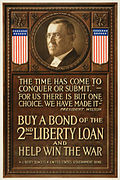 6
6 -
 7
7 -
 8
8 -
 9
9 -
 10
10 -
 12
12 -
 13
13 -
 14
14 -
 15
15 -
 16
16 -
 17
17 -
 18
18 -
 19
19


See also
[edit]References
[edit]- ^ a b c Sakolski, Aaron Morton. "Wall Street and the Security Markets". 1925
- ^ Garbade, Kenneth D. (July 2008). "Why The U.S. Treasury Began Auctioning Treasury Bills in 1929" (PDF). FRBNY Economic Policy Review. 14 (1). Retrieved April 27, 2011.
- ^ The Electric Journal, September 1917, p. 51.
- ^ The Financier, June 23, 1917, p. 1741.
- ^ New York Times, November 20, 1917.
- ^ Investment Bankers Association of America Bulletin, Vol. VII, No. 2, October 1, 1918. p. 30.
- ^ Abbott, Charles Cortez (1999). Wall Street and the Security Markets. Harvard Economic Studies, volume 59. Harvard University Press.
- ^ The American Year Book: A Record of Events and Progress, Volume 1918. T. Nelson & Sons. 1919.
- ^ Stone, Oliver; Kuznick, Peter (2014). The Untold History of the United States. Vol. 1 (Young Readers, 1898-1945 ed.). Simon and Schuster. ISBN 9781481421751.
- ^ The Four Minute Men of Chicago. Chicago, Illinois: United States Committee on Public Information. 1919. p. 25.
- ^ Gale Encyclopedia of U.S. Economic History
- ^ Chaplin, Charlie. My Autobiography (1964)
- ^ New York Times Magazine, Mar 10, 1918
- ^ New York Times, March 27, 1918, page 4.
- ^ Kang Sung Won, Rockoff Hugh, (2006), "Capitalizing patriotism: the Liberty Loans of WW1", NBER Working Paper No. W11919, 55p.
- ^ Massachusetts Historical Society, "Focus on Women and War", June 2002.
- ^ a b Los Angeles Times, October 5, 1922, page IV9.
- ^ Davies, Phil. "The Federal Reserve's Role During WWI". www.federalreservehistory.org. Retrieved November 24, 2025.
- ^ "How the Fed Helped Pay for World War I | Mises Institute". mises.org. February 12, 2021. Retrieved November 24, 2025.
- ^ "New Loan Fixed at $4,500,000,000; Interest at 4 3/4%" (PDF). New York Times. April 14, 1919. Retrieved March 29, 2012.
- ^ Los Angeles Times, January 2, 1928
- ^ Garbade, Kenneth D. "Why the U.S. Treasury Began Auctioning Treasury Bills in 1929." FRBNY Economic Policy Review, July 2008.
- ^ a b c Perry v United States, 294 US 330 (1935)
- ^ Records of the 73rd Congress of the United States, Session I, Chapters 46-48, pp. 112–3.
- ^ Perry v United States, 294 US 330 (1935), Page 294 U. S. 354
- ^ Hilt, Eric; Rahn, Wendy (2020). "Financial Asset Ownership and Political Partisanship: Liberty Bonds and Republican Electoral Success in the 1920s". The Journal of Economic History. 80 (3): 746–781. doi:10.1017/S0022050720000297. ISSN 0022-0507. S2CID 158736064.
Bibliography
[edit]- Chase, Philip M. (2008). William Gibbs McAdoo: The Last Progressive, (1863--1941). p. 130ff. ISBN 9780549982326.
- Childs, C. Frederick. "United States Government Bonds." Annals of the American Academy of Political and Social Science 88 (1920): 43–50. in JSTOR
- Garbade, Kenneth D. (2012). Birth of a Market: The U.S. Treasury Securities Market from the Great War to the Great Depression. MIT Press. pp. 69ff, ch. 5. ISBN 9780262016377.
- Hart Jr, Henry M. "The Gold Clause in United States Bonds" Harvard Law Review 48 (1934): 1057.
- Hollihan, Thomas A. "Propagandizing in the interest of war: A rhetorical study of the committee on public information." Southern Journal of Communication 49.3 (1984): 241–257.
- Kang, Sung Won, and Hugh Rockoff. "Capitalizing Patriotism: The Liberty Loans of World War I" (Paper No. w11919. National Bureau of Economic Research, 2006)
- Kimble, James J. Mobilizing the home front: war bonds and domestic propaganda (Texas A&M University Press, 2006)
Primary sources
[edit]External links
[edit]

- Posters for Liberty Bonds from the Elisabeth Ball Collection of World War I posters
- Liberty Loan documents, and other War Finance documents available on FRASER
- Circulars of the Federal Reserve Bank of New York, including circulars on Liberty Loans

Liberty bond
View on GrokipediaLiberty bonds were war bonds issued by the United States Treasury to finance the American entry into World War I following the declaration of war on Germany in April 1917. Sold through intensive public campaigns known as Liberty Loan drives, these bonds symbolized patriotic duty and were marketed to ordinary citizens as a means to support the Allied cause against the [Central Powers](/page/Central Powers). Under the leadership of Treasury Secretary William G. McAdoo, who also chaired the Federal Reserve, the government conducted five major bond sales between May 1917 and June 1919, raising approximately $21.5 billion—equivalent to over $5 trillion in today's dollars—to cover roughly two-thirds of the war's costs, with the remainder funded by taxes.[1][2][3] The bonds were offered in denominations as low as $50, with smaller War Savings Stamps starting at 25 cents enabling broader participation through installment purchases, which drew in over 20 million individual subscribers—representing more than one-third of Americans aged 18 or older—and transformed savings into a national wartime virtue.[1][2] Sales relied on volunteer networks, celebrity endorsements, parades, and ubiquitous posters rather than traditional banking channels, achieving oversubscription in each drive despite initial hesitancy among investors accustomed to lower-risk peacetime securities.[1][3] This mobilization not only averted reliance on foreign loans but also cultivated long-term habits of retail investing, correlating with higher postwar stock and bond ownership rates among participants.[2] While the bonds carried interest rates rising from 3.5% in the first issue to 4.25% later, with tax exemptions enhancing appeal, their success stemmed from framing purchase as a moral imperative amid propaganda equating bond-buying with battlefield victory.[3] Postwar redemption strained some holders due to inflation eroding real returns, yet the campaigns' legacy endures in the precedent for government appeals to public finance during crises, distinct from later inflationary financing mechanisms.[1][4]
Historical Context and Legislative Authorization
World War I Financing Needs
Upon entering World War I on April 6, 1917, the United States faced unprecedented fiscal demands, with total war expenditures reaching approximately $32 billion, equivalent to 52 percent of the nation's gross national product at the time.[5] Federal spending escalated rapidly from $477 million in fiscal year 1916 to a peak of $8.45 billion in 1918, driven by military mobilization, supply production, and allied support.[6] This surge necessitated innovative financing mechanisms beyond the era's limited peacetime revenues, which relied heavily on tariffs and excise taxes yielding under $1 billion annually pre-war. Liberty Bonds emerged as the primary instrument to meet these needs, raising over $17 billion through public subscriptions—accounting for roughly two-thirds of wartime funds—while taxation contributed about $8.8 billion.[1] Policymakers, led by Secretary of the Treasury William Gibbs McAdoo, favored bonds over immediate steep tax increases to harness public patriotism and channel idle savings into the war effort, avoiding the political resistance and administrative burdens of conscripting wealth through direct levies.[7] This approach also mitigated risks of inflation from excessive money creation, as bonds absorbed excess liquidity without forcing broad wealth redistribution via progressive income taxes, which were then novel and unpopular among many segments of society. Prior to 1917, the U.S. bond market was dominated by institutional investors, with retail participation minimal; stock and bond ownership was uncommon among households, limited largely to the affluent and confined to bank deposits or corporate securities for most Americans.[8] The war's scale exposed these limitations, as traditional channels could not mobilize the required capital quickly from a populace unaccustomed to securities markets, prompting the development of mass subscription campaigns to democratize investing and align personal financial contributions with national defense.[9]First Liberty Bond Act
The First Liberty Bond Act, enacted on April 24, 1917, shortly after the United States declared war on Germany on April 6, authorized the Secretary of the Treasury to issue bonds totaling up to $5 billion to finance war expenditures, with interest rates not exceeding 4.5 percent.[10][11] This legislation provided a critical debt-financing mechanism amid urgent military mobilization needs, allowing the government to borrow from the public rather than relying solely on taxation or short-term notes, thereby distributing the war's financial burden across a broad base of citizens while minimizing immediate inflationary pressures from deficit spending.[1] Under Treasury Secretary William Gibbs McAdoo, the bonds were structured for widespread accessibility, with denominations starting at $50 to encourage participation from average households, and interest payments exempted from federal income and excess-profits taxes (though subject to estate and inheritance taxes) to enhance their attractiveness relative to taxable alternatives.[12][13] The first issuance under the Act targeted $2 billion in 3.5 percent bonds, maturing in 10 to 30 years with options for conversion to higher rates if subsequent issues offered better terms, reflecting a pragmatic approach to investor confidence in a novel mass-securities program unprecedented in scale for the U.S. government.[1][14] Despite the unfamiliarity of such public war bond drives, the offering was oversubscribed by approximately 50 percent, with subscriptions exceeding $3 billion and over 4 million accepted from individual and institutional buyers, ultimately raising about $1.9 billion net after allotments.[1][15] This strong response validated the Act's framework, demonstrating public willingness to support the war effort through voluntary lending while establishing a template for future Liberty Loans that collectively financed over $17 billion of World War I costs.[1]Second Liberty Bond Act
The Second Liberty Bond Act, enacted on September 24, 1917, authorized the Secretary of the Treasury to issue and sell bonds in an aggregate amount not exceeding $3 billion, with interest rates not to exceed 4 percent per annum, payable semiannually.[16][17] This followed the First Liberty Bond Act's $2 billion authorization at 3.5 percent and responded to rapidly mounting U.S. war expenditures after entry into World War I in April 1917.[18] The Act's higher interest ceiling accommodated market conditions where yields had risen amid surging capital demands for defense and Allied support.[17] By granting the Treasury broader discretion over bond forms, denominations, maturities (up to 30 years), and issuance purposes without tying debt to specific projects, the legislation marked a shift toward flexible fiscal policy for prolonged conflict funding.[17][19] This built directly on the initial bond drive's demonstrated viability for public borrowing, elevating total authorized Liberty debt to enable scaled-up procurement and operations as U.S. forces mobilized overseas.[1] The Act's expansion aligned with causal pressures from summer 1917 troop shipments to France—totaling over 14,000 by July—and escalating loans to Britain and France exceeding $2 billion by September, which strained Treasury reserves without immediate tax hikes.[17][1] Bond reliance, funding roughly two-thirds of the $33 billion total war cost, curbed dependence on Federal Reserve credit expansion, preserving monetary stability over inflationary alternatives.[1]Third and Fourth Liberty Bond Acts
The Third Liberty Bond Act, approved on April 4, 1918, authorized the Secretary of the Treasury to issue up to $4 billion in additional bonds to address surging wartime financing demands as U.S. troop deployments to Europe accelerated.[18] These bonds bore a 4.25% interest rate, higher than the 4% of the Second Liberty Loan, to sustain investor participation amid rising national debt.[1] A provision enabled conversion of outstanding Second Liberty Loan bonds into the new 4.25% Third Loan securities, incentivizing holders to upgrade rather than redeem or sell, which helped preserve liquidity for ongoing war expenditures without disrupting capital markets. The Fourth Liberty Bond Act, enacted July 9, 1918, permitted issuance of up to $7 billion more in bonds, scaling borrowing to match peak military outlays during the final offensives of 1918.[18] Like the Third, these bonds offered 4.25% interest with convertibility from prior lower-rate issues, further encouraging long-term holding by allowing seamless upgrades to competitive yields.[1] Combined with earlier authorizations, the Liberty Bond program under these acts contributed to total wartime bond sales exceeding $17 billion, financing roughly two-thirds of U.S. World War I costs as confirmed by Treasury accounting.[1] This legislative expansion demonstrated causal reliance on domestic debt markets to bridge fiscal gaps unmet by taxation alone, prioritizing scalable investor incentives over immediate revenue hikes.Bond Issues and Terms
First Liberty Loan (1917)
The First Liberty Loan was authorized under the Emergency Loan Act of April 24, 1917, and launched as the initial war bond drive to finance U.S. entry into World War I, targeting $2 billion in subscriptions.[1] The bonds carried a 3.5% annual coupon rate, payable semiannually, with a 30-year maturity and callable after 15 years.[1] Dated June 15, 1917, they were offered in denominations starting at $50 to encourage broad participation beyond traditional institutional investors.[20] The subscription campaign ran from May 14 to June 15, 1917, coordinated through the Federal Reserve Banks and commercial institutions, emphasizing voluntary purchases from banks, corporations, and the public.[21] By the close, subscriptions totaled over $3 billion, oversubscribing the target by approximately 50%, prompting proration of allotments to manage demand.[22] Ultimately, about $1.98 billion was accepted, validating the approach of patriotic mass financing as a viable alternative to tax increases.[1] Over four million subscribers were accepted, representing roughly one in every 25 Americans at the time and signaling an early shift toward retail investment by middle-class households, though large institutional buyers dominated initial volumes.[1] This broad base included wage earners and small savers, facilitated by low denominations and local bank drives, laying groundwork for subsequent loans' expanded public engagement.[23]Second Liberty Loan (1917)
The Second Liberty Loan campaign opened on October 1, 1917, seeking to raise at least $3 billion through 4 percent bonds, an increase from the 3.5 percent rate of the first loan to better compete with rising market interest rates and attract more investors.[1][20] These bonds featured maturities ranging from 10 to 25 years with convertibility options, providing flexibility that addressed investor concerns over long-term commitments observed in the initial drive's slower uptake among smaller buyers.[24] The drive closed on November 15, 1917, after six weeks, ultimately oversubscribing to yield $3.8 billion in subscriptions.[1][25] To enhance engagement, the Treasury intensified promotional efforts, incorporating celebrity endorsements from figures in entertainment and sports alongside widespread use of the Four Minute Men—a volunteer network delivering short, patriotic speeches in theaters, churches, and public gatherings to urge bond purchases as a civic duty.[26][24] These tactics built on lessons from the first loan's modest $2 billion haul, emphasizing accessible denominations and installment payment plans to broaden participation beyond large institutions.[20] The second loan elevated cumulative Liberty Bond sales to approximately $6 billion, enabling expanded procurement of munitions, ships, and supplies critical to Allied forces amid escalating U.S. involvement in World War I.[27][20]Third Liberty Loan (1918)
The Third Liberty Loan was authorized by the Third Liberty Bond Act enacted on April 5, 1918, permitting the U.S. Treasury to issue up to $3 billion in bonds to finance World War I efforts amid escalating U.S. military commitments in Europe.[28] The subscription campaign ran from April 6 to May 4, 1918, offering 4.25% gold bonds maturing in 10 to 30 years, designed to attract broad investor participation during a period of intensified doughboy deployments to the Western Front.[1] This drive marked peak efficiency in Liberty Loan mobilization, with the Treasury assigning strict quotas to Federal Reserve districts and local communities to ensure rapid fund raising without resorting to excessive money printing that could destabilize the domestic economy.[29] Subscriptions exceeded the $3 billion target, reaching over $4 billion from approximately 17 million subscribers, demonstrating unprecedented public engagement as quotas were met or surpassed in most areas through coordinated local drives.[29] Community-level quotas fostered competitive participation, with cities like Bemidji, Minnesota, rapidly fulfilling obligations through volunteer committees that targeted households and businesses.[30] Women's committees played a pivotal role, organizing events and appeals that boosted female involvement, as evidenced by Philadelphia women's groups leading national efforts in per capita sales.[31] Immigrants and diverse ethnic groups were also mobilized via tailored outreach, contributing to the loan's success in sustaining Allied offensives without immediate fiscal strain on U.S. reserves.[32] The oversubscription reflected refined administrative tactics honed from prior loans, enabling the Treasury to allocate funds efficiently for troop reinforcements and materiel shipments critical to operations like the Meuse-Argonne Offensive later in 1918.[1] By avoiding reliance on short-term certificates of indebtedness, the Third Liberty Loan helped maintain economic stability, as long-term bond financing distributed the war's cost over time and prevented acute liquidity crises that might have hampered industrial production.[29] This issue underscored the scalability of voluntary subscription models under quota pressure, achieving record breadth in participation while aligning fiscal policy with strategic military imperatives.[33]Fourth Liberty Loan (1918)
The Fourth Liberty Loan campaign opened on September 28, 1918, and closed on October 19, 1918, targeting $6 billion in bonds at an interest rate of 4.25 percent.[20][1] These bonds featured maturities ranging from 20 to 30 years, with principal and interest payable in United States gold coin of the standard in effect in 1918, a provision intended to protect investors from currency devaluation but which later became contentious during the 1930s gold clause disputes.[34][35] Issued amid the final push of World War I, the drive occurred just weeks before the Armistice on November 11, 1918, yet proceeded to finance ongoing military efforts toward victory.[36] Subscriptions for the Fourth Liberty Loan reached nearly $7 billion, marking the highest total raised in any single Liberty Loan drive and surpassing the previous campaigns' amounts of approximately $2 billion, $3 billion, and $3 billion respectively.[37] Nearly 23 million Americans purchased these bonds, representing over 20 percent of the U.S. population and reflecting widespread participation driven by patriotic appeals even as the war's end loomed.[37] This success underscored the effectiveness of the loan drives in mobilizing retail investment, though the gold payment clause in the bonds' terms would face legal challenges in the 1930s when the U.S. abandoned the gold standard, leading to Supreme Court cases affirming the government's ability to repudiate such clauses without constitutional violation.[35][38]Victory Liberty Loan (1919)
The Victory Liberty Loan, the fifth and final issuance in the series of Liberty Loans, was authorized by the Victory Liberty Loan Act approved on March 3, 1919, allowing the U.S. Treasury to issue up to $4.5 billion in bonds to address remaining World War I financial obligations.[16] Subscriptions opened on April 21, 1919, and continued through May, offering two series of convertible gold notes: Series A three-year notes bearing 4.75% interest, which could be converted after one year into Series B fifteen-year notes at 3.75% interest.[39] This structure provided flexibility for investors while ensuring funds for debt consolidation.[3] The loan's primary purpose was to retire short-term Treasury certificates and other wartime debts accumulated during the conflict, facilitating the transition from war to reconstruction by funding troop demobilization and repatriation efforts amid rapid post-Armistice military drawdowns.[40] Unlike prior wartime drives, it emphasized fiscal stabilization over active combat support, marking the end of the Liberty Loan era with a focus on reducing the national debt burden rather than expansionary borrowing.[41] Despite waning public fervor following the November 1918 Armistice, the campaign succeeded through a final patriotic mobilization, attracting approximately 15 million subscribers and meeting the $4.5 billion quota primarily from individual purchases without heavy reliance on banks.[42] Secretary of the Treasury Carter Glass anticipated oversubscription, and the drive closed successfully by early June 1919, underscoring sustained civic engagement even as enthusiasm had notably declined from peak wartime levels.[43]Sales Strategies and Public Campaigns
Initial Sales Challenges
Prior to the First Liberty Loan campaign launched in May 1917, bond ownership among American households was minimal, with few individuals familiar with government securities as an investment vehicle, as most savings were held in bank accounts or other low-risk forms.[1] This unfamiliarity contributed to initial skepticism regarding the bonds' safety and appeal, particularly amid the uncertainties of U.S. entry into World War I on April 6, 1917, and competing yields from savings accounts offering 3.5-4% and municipal bonds at 3.9-4.2%.[1] The First Liberty Loan, authorized under the Emergency Loan Act of April 24, 1917, targeted $2 billion but faced slow initial subscriptions due to its 3.5% interest rate, deemed unattractive under prevailing market conditions.[3] High minimum denominations—starting at $50, equivalent to roughly two weeks' wages for an average industrial worker earning about 35 cents per hour—further limited accessibility for retail investors, confining early purchases largely to wealthier individuals.[1] Sales relied heavily on Federal Reserve member banks, which prioritized institutional and affluent clients, resulting in uneven geographic and demographic distribution that undersold potential in rural and working-class areas.[1] These hurdles prompted a pivot toward broader retail outreach, including educational efforts to build public confidence, though the campaign ultimately oversubscribed the issue by 50% with over 4 million subscribers by June 1917.[1] The initial lukewarm reception, marked by concerns over undersubscription signaling insufficient patriotic support, underscored the need for innovative distribution strategies beyond traditional banking channels.[30]Patriotic Mobilization and Propaganda
The Liberty Bond campaigns framed purchases as a voluntary expression of patriotism and civic duty, positioning financial support as a complement to military enlistment for those physically unable or otherwise ineligible to serve. This ideological approach emphasized individual agency in defending national liberty, with Treasury Secretary William G. McAdoo promoting bonds as a means for ordinary citizens to actively contribute to the war effort without compulsion.[1] Slogans like "Invest or Enlist" and "If you can't enlist, invest" explicitly tied bond ownership to personal sacrifice equivalent to frontline service, fostering a sense of shared responsibility for victory.[1][44] National and local Liberty Loan committees coordinated mobilization efforts, establishing subscription quotas for states, counties, banks, and even households to drive widespread participation. These volunteer-driven organizations, comprising business leaders, civic groups, and community influencers, conducted rallies, public speeches, and targeted outreach, resulting in over 22 million subscribers for the largest drive alone and total participation encompassing roughly one in five adults across the campaigns.[45][1] A notable example from the Victory Liberty Loan drive was the "Victory Way" exhibit on Park Avenue in New York City in 1919, which featured pyramids constructed from approximately 85,000 captured German Pickelhaube helmets. These displays celebrated the Allied victory in World War I and promoted sales of the fifth and final bond issue by using the helmets as propaganda symbols of the defeated enemy.[46][47] This structure incentivized communal competition to meet targets, reinforcing bonds as symbols of collective resolve rather than mere transactions.[23] Empirical evidence from post-war economic surveys indicates these patriotic drives causally elevated household savings rates by habituating participants to financial instruments and disciplined saving, with counties exhibiting higher subscription rates showing persistent increases in asset accumulation and reduced reliance on short-term debt.[9][23] Such outcomes stemmed from the campaigns' success in broadening financial literacy and patriotism-linked thrift, independent of wartime inflation pressures.[48]Role of Posters and Media
Posters constituted a primary visual medium in the Liberty Loan campaigns, with renowned illustrators such as Howard Chandler Christy producing designs that depicted themes of sacrifice and national defense to encourage subscriptions. Christy's "Fight or Buy Bonds" poster for the Third Liberty Loan, issued in April 1918, portrayed a resolute soldier advancing, symbolizing the imperative for civilians to contribute financially if unable to serve militarily.[49] Similarly, his "Clear the Way!! Buy Bonds Fourth Liberty Loan" featured a flag-draped Liberty figure clearing a path forward, reinforcing imagery of progress through public investment in the war.[50] These works, leveraging Christy's established style from earlier illustrations, aimed to evoke emotional responses tied to duty and victory, distributed across public spaces to maximize visibility.[51] Complementing posters, broader media strategies integrated print, film, and oratory to extend reach, particularly into less urbanized areas. The Committee on Public Information coordinated efforts including newspaper inserts and short films screened in theaters, which portrayed bond purchases as direct support for troops.[52] Public speeches by the Four Minute Men volunteers, delivered in venues like movie houses and town halls, urged immediate action on loans, framing non-participation as disloyalty.[53] Celebrity-driven events, such as the 1918 cross-country tour by actors Douglas Fairbanks, Mary Pickford, and Charlie Chaplin for the Third Liberty Loan, attracted mass audiences and correlated with localized surges in subscriptions through rallies and personal endorsements.[54] Empirical indicators of effectiveness include the campaigns' success in oversubscribing quotas, with total Liberty Bond sales reaching approximately $17 billion, a figure attributable in part to the pervasive visual and communicative saturation that shifted public perception from voluntary savings to patriotic obligation.[7] Regional data from drives showed heightened participation following intensive poster placements and media blitzes, as local committees reported amplified community pressure and awareness leading to rapid fulfillment of allotment targets.[9] While isolating causal impact remains challenging amid multifaceted mobilization, the scale of production—encompassing millions of posters and ancillary materials—aligned temporally with subscription peaks, underscoring their role in driving retail investor engagement.[1]Coercive Tactics and Voluntary Participation Debate
Some accounts describe coercive elements in Liberty Bond sales, particularly through corporate quotas imposed by business leaders on employees and social ostracism of perceived non-supporters. National banks and firms were assigned allotment targets by the Treasury, with executives facing dismissal or reputational damage for shortfalls; for example, the Comptroller of the Currency reportedly fired a bank president who had not personally purchased a bond.[55] These pressures created workplace expectations that non-participation could harm career prospects, though such tactics were decentralized and varied by locality rather than mandated federally.[55] Social shaming tactics, borrowed from British World War I efforts against draft evaders, occasionally targeted bond refusers. In Luverne, Minnesota, on August 19, 1918, German-American farmer John Meints was tarred, feathered, and paraded by a mob for alleged slowness in buying bonds and voicing anti-war sentiments, an act condemned by state officials including Governor J.A.O. Preus.[56][57] Similar vigilante incidents, though rare, fueled progressive critics' claims of exploited patriotism, with figures like Senator Robert La Follette decrying bond drives as tools of jingoistic conformity in states like Wisconsin, labeled a "traitor state" for resistance.[58] Counterarguments emphasize voluntary enthusiasm, evidenced by consistent oversubscriptions and broad retail uptake. The first Liberty Loan in May 1917 sought $2 billion but received $3 billion in pledges, a 50% excess, from over four million subscribers—one in six Americans at the time.[1] Subsequent drives, including the third and fourth in 1918, similarly exceeded quotas, raising $21.5 billion total from roughly 20 million individuals, or one-fifth of the adult population, per Treasury tallies.[8][48] Installment plans facilitated small-denomination purchases, with patriotism—stoked by rallies and media—driving participation across socioeconomic lines, as econometric analyses of county-level data confirm positive correlations with local war fervor rather than top-down compulsion.[9] These metrics undermine narratives of systemic exploitation, as high fulfillment rates on deferred payments and post-war bond holdings reflect sustained commitment, not grudging compliance. While localized excesses occurred amid wartime hysteria, Treasury records and subscription patterns affirm that public support was predominantly self-motivated, aligning with first-hand reports of communal pride in contributing to victory. Left-leaning interpretations, often from anti-interventionist sources, overstate coercion by discounting empirical participation breadth, which prioritized small investors to foster genuine ownership.[8][9]Economic Features and Investor Incentives
Interest Rates, Denominations, and Maturity Structures
The Liberty Bonds featured interest rates that progressively increased from 3.5 percent for the First Liberty Loan to 4.25 percent for the Third and Fourth, reflecting adjustments to compete with prevailing market yields and attract broader participation beyond institutional investors. Denominations began at $50, enabling small savers to invest alongside larger purchasers, with higher options up to $100,000 for registered forms in some cases. Maturities typically ranged from 20 to 30 years for the wartime issues, providing long-term government funding while offering convertibility provisions in earlier loans to allow holders to exchange for subsequent higher-rate bonds, thereby reducing reinvestment risk upon partial redemption options after 10 to 15 years. The Victory Liberty Loan deviated with shorter maturities of approximately four years to facilitate quicker post-armistice repayment.| Liberty Loan | Interest Rate | Denominations | Maturity Structure |
|---|---|---|---|
| First (1917) | 3.5% | $50 to $10,000 | 30 years, convertible to Second Loan; redeemable after certain period with option for higher yield exchange[12][59][60] |
| Second (1917) | 4% | $50 and above | 30 years, callable by holder after 15 years; convertible features for flexibility[24][61][60] |
| Third (1918) | 4.25% | $50, $100, $500, $1,000, and higher | Long-term (approximately 20-30 years), with standard redemption provisions[28][59] |
| Fourth (1918) | 4.25% | $50, $100, $500, $1,000, $5,000, $10,000 (coupon); registered up to higher | 20 years (maturing 1938), dated October 24, 1918[62][34][59] |
| Victory (1919) | 3.5% (tax-exempt series) or 4.5% (taxable series) | $50 to $10,000 (bearer); $50 to $100,000 (registered) | Short-term: redeemable after 3 years (1922), maturing 1923[39][63][64] |