Hubbry Logo
LoamLoamMain
Open search
Loam
Community hub
Loam
logo
8 pages, 0 posts
0 subscribers
Be the first to start a discussion here.
Loam
Loam
from Wikipedia
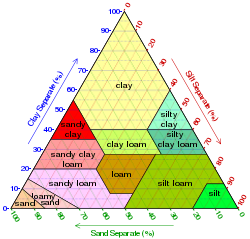
Soil types by clay, silt and sand composition as used by the United States Department of Agriculture

Loam (in geology and soil science) is soil composed mostly of sand (particle size > 63 micrometres (0.0025 in)), silt (particle size > 2 micrometres (7.9×10⁻⁵ in)), and a smaller amount of clay (particle size < 2 micrometres (7.9×10⁻⁵ in)).[citation needed] By weight, its mineral composition is about 40–40–20% concentration of sand–silt–clay, respectively.[1] These proportions can vary to a degree, however, and result in different types of loam soils: sandy loam, silty loam, clay loam, sandy clay loam, silty clay loam, and loam.[1]

In the United States Department of Agriculture, textural classification triangle, the only soil that is not predominantly sand, silt, or clay is called "loam". Loam soils generally contain more nutrients, moisture, and humus than sandy soils, have better drainage and infiltration of water and air than silt- and clay-rich soils, and are easier to till than clay soils. In fact, the primary definition of loam in most dictionaries is soils containing humus (organic content) with no mention of particle size or texture, and this definition is used by many gardeners. The different types of loam soils each have slightly different characteristics, with some draining liquids more efficiently than others. The soil's texture, especially its ability to retain nutrients and water, are crucial.[2] Loam soil is suitable for growing most plant varieties.

Bricks made of loam, mud, sand, and water, with an added binding material such as rice husks or straw, have been used in construction since ancient times.

Classifications

[edit]

Loam soils can be classified into more specific subtypes. Some examples are sandy loam, silt loam, clay loam, and silty clay loam. Different soil phases have some variation in characteristics like stoniness and erosion that are too minor to affect native vegetative growth but can be significant for crop cultivation.[3]

Use in farming

[edit]
Fine, loam-rich field ideal for farming vegetables in the UK

Loam is considered ideal for gardening and agricultural uses because it retains nutrients well and retains water while still allowing excess water to drain away.[4] A soil dominated by one or two of the three particle size groups can behave like loam if it has a strong granular structure, promoted by a high content of organic matter. However, a soil that meets the textural (geological) definition of loam can lose its characteristic desirable qualities when it is compacted, depleted of organic matter, or has clay dispersed throughout its fine-earth fraction.[clarification needed]

For example, pea can be cultivated in sandy loam and clay loam soils, but not more compacted sandy soils.[5]

Use in house construction

[edit]

Loam (the high-humus definition, not the soil texture definition) may be used for the construction of houses, for example in loam post and beam construction.[6] Building crews can build a layer of loam on the inside of walls, which can help to control air humidity. Loam, combined with straw, can be used as rough construction material to build walls. This is one of the oldest technologies for house construction in the world. Within this there are two broad methods: the use of rammed earth, or unfired bricks (adobe).[7]

See also

[edit]
  • Loess – Sediment of accumulated wind-blown dust
  • Grain size – Diameter of individual grains of sediment, or of lithified particles in clastic rocks
  • Soil texture – Property of a soil

References

[edit]
[edit]
Revisions and contributorsEdit on WikipediaRead on Wikipedia
from Grokipedia
Loam is a soil texture class defined by the United States Department of Agriculture (USDA) as containing 7 to 27 percent clay, 28 to 50 percent silt, and 23 to 52 percent sand by weight, providing a balanced proportion of these mineral particles that distinguishes it from other soil types. This composition results in a friable, easily workable soil that combines the drainage benefits of sand with the water- and nutrient-retention capabilities of silt and clay. Loam exhibits optimal physical properties for plant growth, including moderate permeability, adequate aeration, and sufficient cation exchange capacity to support nutrient availability without excessive compaction or erosion risk. It typically forms a loose, crumbly ball when moist and squeezed, feeling smooth yet slightly gritty, which reflects its even distribution of particle sizes ranging from 0.002 to 2 millimeters in diameter. These attributes make loam highly fertile and resilient, contributing to its prevalence in productive agricultural regions worldwide. In classification systems like the USDA soil texture triangle, loam represents the central, medium-textured category among the 12 principal classes, serving as a benchmark for soil quality assessments in farming, forestry, and environmental management. While natural loams occur in diverse ecosystems such as river valleys and glacial deposits, they are often amended in gardens and crop fields to approximate this ideal texture for enhanced yields.

Overview

Definition

Loam is a balanced soil texture class characterized by roughly equal proportions of sand, silt, and clay particles. According to the United States Department of Agriculture (USDA) standards, loam specifically encompasses soils with 7–27% clay, 28–50% silt, and 23–52% sand, distinguishing it from coarser sandy soils or finer clay-dominated ones. This composition makes loam particularly suitable for agriculture and gardening, as it offers optimal physical properties for plant roots, including adequate drainage to prevent waterlogging, sufficient aeration for oxygen exchange, and effective water retention to sustain moisture during dry periods. University extension services highlight that loam's structure supports robust root development and nutrient availability, rendering it the preferred medium for a wide range of crops. The word "loam" derives from Old English lām, signifying clay or earthy mud, reflecting its historical association with fertile, workable ground.

Historical Context

The concept of loam as a fertile mixed soil can be traced back to ancient agricultural texts, where Roman agronomist Lucius Junius Moderatus Columella described optimal soils for cultivation in his comprehensive work De Re Rustica during the 1st century AD. Columella emphasized the value of balanced, deep, and "fat" soils combining elements like clay, sand, and organic matter for supporting diverse crops, particularly vines and grains, distinguishing them from less productive sandy or overly clayey types. These early references highlight loam's recognition as a premium medium for Roman farming practices across the empire. In medieval Europe, loam was identified as ideal arable land in farming communities, particularly in England, where 12th-century manorial records documented its role in enhancing productivity on estate lands. Documents from manors in regions like the Midlands noted loam's friable texture and moisture retention as key to higher yields of wheat and barley under the three-field system, often commanding higher rents or labor obligations compared to poorer sandy or heavy clay soils. This period saw loam soils prioritized for enclosure and intensive cultivation, contributing to the agricultural surplus that supported feudal economies. The 19th century marked a scientific advancement in understanding loam through the lens of nutrient dynamics, with German chemist Justus von Liebig's pioneering research linking soil fertility to crop yields. In his 1840 treatise Organic Chemistry in Its Application to Agriculture and Physiology, Liebig's "law of the minimum" highlighted how deficiencies in essential mineral nutrients could limit plant growth, influencing the study of balanced soil chemistry for agriculture. His work promoted the idea that soils with adequate nutrient availability sustained higher output, though physical texture classifications like loam developed later in soil science. Non-Western traditions also utilized loamy soils historically, as evidenced by ancient Mesopotamian practices around 2000 BCE, where irrigation systems on fertile alluvial loams along the Tigris and Euphrates rivers enabled large-scale barley and emmer wheat production. These silt-rich, loamy deposits, replenished by annual floods, formed the basis of Sumerian and Akkadian agriculture, supporting urban centers through canal networks that distributed water to maintain soil productivity.

Composition

Soil Particle Components

Loam soil consists of a balanced mixture of primary mineral particles classified by size into sand, silt, and clay, each contributing distinct mineralogical characteristics derived from parent rock weathering. Sand particles, ranging from 0.05 to 2 mm in diameter, are typically composed of resistant primary minerals such as quartz, with lesser amounts of feldspar and mica, providing the coarsest fraction that imparts a gritty texture. Silt particles, measuring 0.002 to 0.05 mm, include a mix of quartz, feldspars, and micas, often with finer primary minerals that weather more readily than sand, resulting in smoother, flour-like particles. Clay particles, smaller than 0.002 mm, are predominantly secondary minerals like kaolinite, illite, and smectite (a type of montmorillonite), formed through intense chemical weathering of primary silicates and aluminosilicates, which give loam its plasticity and fine structure. Organic matter in loam, primarily in the form of humus, typically constitutes 5% of the soil mass in ideal fertile examples and arises from decomposed plant and animal residues, though content can vary from 1% to over 10% depending on soil formation and management; it enhances particle aggregation without overwhelming the mineral framework. Humus, the stable end-product of this decomposition, binds mineral particles into stable aggregates, supporting soil fertility while maintaining the balanced texture characteristic of loam. Beyond the primary particles, loam includes inorganic components such as rock fragments—angular or rounded pieces greater than 2 mm from unweathered parent material—that add coarseness and vary depending on the soil's origin, influencing overall texture. Minor elements like iron oxides (e.g., hematite and goethite) occur as coatings or discrete particles and impart characteristic colors such as red or yellow hues to the soil while subtly affecting its surface properties.

Ideal Proportions

Loam is defined by a balanced mixture of sand, silt, and clay particles that provides optimal water retention, drainage, and aeration for plant growth, as established by the United States Department of Agriculture (USDA) soil texture classification system. According to the USDA texture triangle, loam soil consists of 23% to 52% sand, 28% to 50% silt, and 7% to 27% clay by weight, ensuring no single component dominates while maintaining fertility and workability. Deviations from these ideal proportions result in loam subtypes, each with adjusted ranges that shift the balance toward one particle type while still retaining loam-like qualities. Sandy loam, for instance, features higher sand content (43% to 85% sand, 0% to 50% silt, and 0% to 20% clay), promoting better drainage but reduced water-holding capacity. Silt loam emphasizes finer particles (0% to 50% sand, 50% to 88% silt, and 0% to 27% clay), enhancing moisture retention at the risk of compaction. Clay loam, conversely, increases clay (20% to 45% sand, 15% to 53% silt, and 27% to 40% clay), improving nutrient storage but potentially leading to poorer aeration. These subtypes are delineated precisely within the USDA texture triangle to guide soil management practices. To determine these proportions, soil scientists employ the hydrometer method, a standard laboratory technique that separates particles by size through sedimentation in a water suspension and measures their concentrations over time based on Stokes' law. The process involves dispersing a soil sample, allowing sand to settle first (within minutes), followed by silt and clay (over hours), with a hydrometer reading the density to calculate percentages of each fraction relative to the total soil mass. This quantitative analysis confirms whether a soil meets loam criteria or falls into a subtype, providing essential data for classification.

Properties

Physical Properties

Loam soil exhibits a balanced texture that imparts a somewhat gritty yet smooth feel when moist. This texture contributes to excellent tilth, defined as the soil's physical condition suitable for plant growth, with a crumbly structure that is friable—meaning it crumbles easily under light pressure without being sticky or hard. The friability arises from stable aggregates formed by organic matter and mineral interactions, which enhance workability and resist crusting. Aggregate stability in loam is often measured using wet sieving tests, showing higher resistance to slaking compared to sandy soils due to the binding effects of clay and silt. Porosity in loam soil typically ranges from 40% to 60% by volume, comprising a mix of macropores (greater than 0.06 mm) for aeration and root penetration and micropores (less than 0.06 mm) for water storage, resulting in about 50% pore space in well-structured examples. This pore distribution supports moderate permeability, with infiltration and drainage rates generally between 0.2 and 0.4 inches per hour, allowing adequate water movement while preventing rapid leaching—faster than clay soils (less than 0.2 inches per hour) but slower than sands (greater than 0.8 inches per hour). The balanced permeability facilitates oxygen diffusion to roots and reduces erosion risk under moderate rainfall. Loam soil demonstrates strong water retention capacity, holding water at field capacity (the amount retained after free drainage) of approximately 35% to 45% by volume, significantly higher than sandy soils (15% to 25%) but lower than clays (45% to 55%). The permanent wilting point, below which plants cannot extract water, occurs around 10% to 15% volumetric moisture, providing a plant-available water capacity of about 20% to 30%—a key advantage over coarser textures that dry out quickly or finer ones that remain waterlogged. This retention is influenced by the soil's pore size distribution, where silt and clay components enhance capillary action without excessive saturation. Bulk density in loam soil averages 1.0 to 1.4 g/cm³, reflecting its loose aggregation and high organic content, which promote root proliferation by minimizing compaction. Values below 1.40 g/cm³ indicate optimal conditions for aeration and drainage, while densities exceeding 1.80 g/cm³ signal compaction that restricts root growth; for comparison, this range is lower than in sandy loams (up to 1.60 g/cm³ ideal) due to loam's finer particle mix. Bulk density is inversely related to porosity, with ideal loam maintaining around 1.33 g/cm³ for 50% pore space.

Chemical Properties

Loam soils typically exhibit a pH range of 6.0 to 7.5, rendering them neutral to slightly acidic and optimal for many nutrient availabilities, as this range minimizes toxicity from elements like aluminum while facilitating cation exchange. This pH level directly influences the soil's reactivity, where lower values enhance the retention of certain cations but may limit phosphorus availability if acidity increases beyond 6.0. The cation exchange capacity (CEC) of loam is typically 10-20 meq/100g, primarily due to contributions from clay minerals and organic matter, enabling the soil to hold and release essential nutrients such as potassium (K+), calcium (Ca2+), and magnesium (Mg2+). This capacity supports nutrient availability without excessive leaching, as the balanced particle sizes in loam enhance surface area for ionic interactions. Organic carbon content in loam ranges from 1-3%, fostering microbial activity that drives nutrient cycling and decomposition processes critical for soil fertility. Base saturation, often 70-90% in these soils, reflects a high proportion of basic cations relative to total CEC, promoting fertility while avoiding excess acidity that could impair plant growth. The physical structure of loam, with its even distribution of particle sizes, aids these chemical properties by providing pathways for ion movement and retention.

Formation and Classification

Natural Formation Processes

Loam soils develop primarily through the weathering of diverse parent materials, including glacial till, alluvium, and loess, where physical disintegration and chemical decomposition gradually produce a balanced mixture of sand, silt, and clay particles over extended periods. Glacial till, consisting of unsorted sediments deposited by retreating glaciers, undergoes mechanical breakdown and mineral alteration to yield loamy textures with varied particle sizes that approximate the ideal loam composition. Similarly, alluvium from riverine deposits and loess from wind-blown silt contribute to this balance, as their fine-to-medium fractions weather at rates that prevent dominance by any single particle type. This process results in the characteristic balanced proportions of sand, silt, and clay found in loam soils. Climatic conditions in temperate regions, featuring moderate annual rainfall and mild temperatures, promote the steady accumulation of humus while avoiding extreme leaching or erosion that could disrupt particle balance. Such precipitation levels support consistent chemical weathering without washing away essential nutrients or fines, while temperatures enhance microbial decomposition of organic matter into stable humus layers. These factors foster the translocation and accumulation of clays and organics in the subsoil, refining the loamy profile without leading to overly sandy or clayey dominance. Biotic influences, particularly plant root activity and earthworm burrowing prevalent in temperate climates, further enhance aggregation and structure in developing loam soils by binding particles and improving porosity. Plant roots exude organic compounds that stabilize microaggregates, while their physical penetration mixes horizons and incorporates organic residues, promoting the crumbly texture typical of loam. Earthworms, abundant in these environments, ingest soil and excrete casts that bind particles into larger aggregates, increasing water infiltration and aeration essential for sustained pedogenesis. The overall formation of loam in stable landscapes unfolds over thousands of years, providing ample duration for interactive weathering, biotic, and climatic processes to mature the soil profile. In post-glacial settings, such as those in the Midwestern United States, this period aligns with landscape stabilization following ice retreat around 11,000-14,000 years ago, allowing gradual evolution into productive loams.

Classification Systems

In soil science, loam is classified primarily as a textural class within formal taxonomic systems, defined by the relative proportions of sand, silt, and clay particles. The United States Department of Agriculture (USDA) Soil Taxonomy recognizes loam as one of twelve standard soil texture classes, characterized by 7 to 27 percent clay, 28 to 50 percent silt, and 23 to 52 percent sand, which provides a balanced structure for water retention and drainage. Soils exhibiting loamy textures are commonly found in orders such as Inceptisols, which feature early stages of horizon development, and Mollisols, known for their dark, fertile A horizons formed under grasslands; for instance, the Clarion series, classified as fine-loamy, mixed, superactive, mesic Typic Hapludolls (a Mollisol subgroup), typically has loam or clay loam textures in its surface horizons. Internationally, the Food and Agriculture Organization (FAO) and UNESCO soil classification system, part of the World Reference Base for Soil Resources, categorizes soils with loamy profiles under reference soil groups like Luvisols and Cambisols. Luvisols are characterized by a clay-enriched subsurface horizon (argillic horizon) overlying a loamy or coarser-textured surface, often resulting from moderate weathering in humid to subhumid climates, while Cambisols represent soils with incipient horizon differentiation and commonly loamy textures due to their weak development on various parent materials. These classifications emphasize diagnostic horizons rather than texture alone, but loamy textures are prevalent in many Luvisol and Cambisol profiles across temperate and tropical regions. Field identification of loam relies on simple, practical keys that assess texture without laboratory equipment. The ribbon test involves moistening a soil sample and attempting to form a ribbon by extruding it between thumb and forefinger; loam typically forms a ribbon 1 to 2 inches long before breaking, indicating moderate clay content that allows cohesion without excessive plasticity. Complementing this, the jar test determines particle proportions by suspending soil in water in a clear jar, allowing layers to settle: sand settles first (coarse layer), followed by silt, then clay (finest); loam shows roughly equal sand and silt layers with a thinner clay layer at the bottom, corresponding to proportions within the loam class on the USDA texture triangle. Loam soils are widely distributed globally, particularly in fertile alluvial and loess-derived landscapes. In the United States, they dominate the Midwest, where Mollisols with loamy textures support extensive agriculture across states like Iowa and Illinois. In Europe, loamy soils, often silt loams from loess deposits, cover about one-fifth of the continent, especially the plains of northern France, Germany, and the Danube basin. Similarly, the Indo-Gangetic Plains of South Asia feature extensive loam to sandy clay loam soils formed from Himalayan alluvium, spanning India, Pakistan, and Bangladesh, and forming the backbone of rice-wheat cropping systems.

Applications

Agricultural Uses

Loam soil's balanced composition of sand, silt, and clay particles provides optimal nutrient retention and aeration, making it highly suitable for a wide variety of crops including corn, wheat, vegetables such as tomatoes and carrots, and root crops like onions. This fertility stems from its ability to hold essential nutrients while allowing sufficient root penetration, supporting robust plant growth without the extremes of waterlogging or drought common in clay or sandy soils. Studies indicate that crops grown in loam often achieve higher yields relative to those in sandy soils due to improved water and nutrient availability, though exact margins vary by crop and management. In agricultural management, minimal tillage practices are recommended for loam soils to preserve their granular structure and prevent compaction, which can otherwise reduce porosity and root development. Integrating cover crops, such as rye or clover, further enhances these benefits by adding organic matter, suppressing weeds, and maintaining soil stability during off-seasons. These conservation techniques not only sustain long-term productivity but also minimize erosion risks inherent to more intensive tillage. Loam soils generally require fewer amendments for irrigation and fertilization compared to coarser or finer textures, thanks to their moderate water-holding capacity—retaining about 25-35% volumetric moisture at field capacity—and inherent nutrient balance. However, for optimal nutrient uptake, pH adjustments using lime may be necessary if acidity limits availability of elements like phosphorus; applications of 1.5-3 tons per acre of agricultural lime can raise pH by 1 unit in many loamy soils, depending on buffering capacity. Irrigation strategies emphasize infrequent, deep watering to leverage the soil's drainage, applying about 1 inch weekly during peak growth to avoid over-saturation. Economically, loam soils underpin significant agricultural output, particularly in regions like the US Corn Belt where they form the basis of highly productive mollisols supporting corn and soybean cultivation essential for national and global food security. These soils enable consistent high yields that contribute to stable grain supplies, though sustainable practices are critical to counter topsoil loss rates exceeding formation by a factor of 5-10 in intensive farming areas.

Construction and Engineering Uses

Loam, with its balanced composition of sand, silt, and clay, exhibits sufficient plasticity—primarily due to the cohesive clay content—to be molded into durable building units without cracking during drying. This property makes it ideal for traditional adobe and cob construction methods, where moist loam is hand-formed into sun-dried bricks or sculpted into monolithic walls. Historically, adobe bricks made from loam have been extensively used in the arid regions of the Southwestern United States, such as in Pueblo architecture by Native American communities, and in the Middle East, where ancient Mesopotamian and Egyptian civilizations employed similar mud-brick techniques for homes and fortifications. These materials typically achieve a compressive strength of 1-2 MPa, sufficient for low-load bearing structures in stable climates, though performance varies with soil mix and curing conditions. In rammed earth construction, moist loam is compacted layer by layer within formwork to create solid walls, leveraging the soil's natural cohesion for structural integrity. This technique, dating back millennia, relies on loam's ability to achieve high density under compression, but modern applications often incorporate 5-10% cement stabilization to enhance water resistance and long-term durability against weathering. Stabilized rammed earth walls from loam can withstand typical residential loads while maintaining breathability, reducing the need for additional vapor barriers in construction. From an engineering perspective, loam's undrained shear strength typically ranges from 50-150 kPa, making it suitable for foundations in low-rise buildings on stable sites, where it provides moderate bearing capacity without excessive settlement. However, its susceptibility to erosion under prolonged moisture exposure necessitates binders or protective coatings to prevent degradation in areas prone to heavy rainfall or seismic activity. Contemporary applications of loam in construction emphasize sustainability, with loam-based earthen plasters gaining favor in green building projects certified under programs like LEED for their low embodied energy and recyclability. These plasters, applied as interior or exterior finishes, offer thermal insulation with an R-value of approximately 0.5-1 per inch, contributing to energy efficiency in passive house designs while promoting indoor air quality through natural moisture regulation.

Environmental Role

Ecological Importance

Loam soil plays a vital role in supporting diverse microbial and invertebrate communities that drive essential ecosystem processes such as decomposition and nutrient cycling. A single gram of loam can harbor up to 101010^{10} bacterial cells, fostering high biodiversity among bacteria, fungi, and protozoa that break down organic matter and recycle nutrients. Invertebrates like earthworms, springtails, and mites thrive in loam's balanced texture, which provides ample pore space for aeration and moisture retention, enhancing litter decomposition rates and soil organic matter turnover. These communities contribute to overall ecosystem resilience by maintaining soil health without human intervention. In terms of carbon sequestration, loam's stable aggregates protect organic carbon from decomposition, allowing topsoil layers to store 50-100 tons of carbon per hectare, which helps mitigate climate change by locking away atmospheric CO2. The formation of these water-stable aggregates in loam binds soil particles and organic residues, reducing erosion and promoting long-term carbon stabilization in natural settings like grasslands and forests. Loam also facilitates water cycling by acting as a natural buffer in watersheds, where its moderate permeability reduces surface runoff compared to compacted soils, thereby minimizing flooding and sediment transport. This infiltration capacity supports groundwater recharge and sustains stream flows during dry periods. As a foundational soil type, loam underlies biodiversity hotspots such as North American tallgrass prairies, where loamy mollisols enable the growth of diverse plant communities including big bluestem and wildflowers, sustaining herbivores, pollinators, and associated wildlife. These ecosystems rely on loam's fertility and structure to maintain high plant productivity and species richness in semi-natural habitats.

Conservation Practices

Conservation practices for loam soils focus on preventing degradation through targeted interventions that address erosion, compaction, and structural loss, ensuring long-term soil productivity and environmental stability. Erosion control is a primary strategy for loam, which can be vulnerable due to its fine particle components that facilitate detachment during runoff. Contour plowing, where furrows follow the land's contour lines rather than running up and down slopes, slows water flow and reduces soil loss by minimizing gully formation and sediment transport. Terracing complements this by constructing earthen ridges or benches on slopes to intercept runoff and promote infiltration, effectively trapping sediment. Combined, these practices can substantially reduce sediment yield compared to conventional tillage, as demonstrated in agricultural studies on erosion-prone landscapes. Soil amendment addresses compaction in loam, often exacerbated by heavy machinery that compresses pore spaces and impairs root growth and drainage. Incorporating compost or other organic materials into the topsoil layers restores tilth by increasing aggregate stability and microbial activity. This practice helps maintain organic matter content above 2%, a threshold essential for loam's fertility and resilience, as lower levels lead to reduced water-holding capacity and nutrient cycling. Regular applications, typically 2-4 inches tilled into the surface, counteract degradation without altering the soil's balanced texture. Policy frameworks bolster adoption of these practices through incentives and technical support. The U.S. Department of Agriculture's Natural Resources Conservation Service (NRCS) administers programs like the Conservation Reserve Program (CRP), launched in 1985, which pays landowners to retire marginal, erosion-prone loam acres from cultivation and establish permanent vegetative covers such as grasses or trees. This has enrolled millions of acres of highly erodible loam soils, significantly curbing national sediment loads and enhancing biodiversity. Restoration techniques rebuild degraded loam structures after events like overcultivation or drought. No-till farming preserves soil architecture by avoiding plow disturbance, allowing organic residues to protect against further erosion while fostering earthworm activity and carbon sequestration. Agroforestry integrates trees or shrubs with crops to anchor soil via root systems and reduce wind and water impacts, improving infiltration and nutrient retention in restored sites. Historical case studies from the Dust Bowl recovery in the 1930s Great Plains, where degraded silt loams were rehabilitated through federal conservation districts promoting contouring and cover crops, illustrate how such methods can restore productivity within decades, preventing recurrence of widespread topsoil loss.

References

Add your contribution
Related Hubs
User Avatar
No comments yet.