
_(zoom).svg/250px-Greater_London_in_England_(wo_City_of_London)_(zoom).svg.png)


_(zoom).svg/1647px-Greater_London_in_England_(wo_City_of_London)_(zoom).svg.png)
Community hub
Recent from talks
Contribute something
Nothing was collected or created yet.
London boroughs
View on Wikipedia
| London borough | |
|---|---|
_(zoom).svg) The thirty-two London boroughs in England | |
| Category | Local authority districts |
| Location | Greater London |
| Created by | London Government Act 1963 |
| Created |
|
| Number | 32 |
| Possible types |
|
| Possible status |
|
| Populations | 150,000–400,000 |
| Areas | 12–150 km2 |
| Government |
|
| This article is part of a series within the Politics of the United Kingdom on the |
 |
|---|

The London boroughs are the current 32 local authority districts that together with the City of London make up the administrative area of Greater London, England; each is governed by a London borough council. The present London boroughs were all created at the same time as Greater London on 1 April 1965 by the London Government Act 1963 (c. 33) and are a type of local government district. Twelve were designated as Inner London boroughs and twenty as Outer London boroughs. The City of London, the historic centre, is a separate ceremonial county and sui generis local government district that functions quite differently from a London borough. However, the two counties together comprise the administrative area of Greater London as well as the London Region, all of which is also governed by the Greater London Authority, under the Mayor of London.
The London boroughs have populations of between 150,000 and 400,000. Inner London boroughs tend to be smaller, in both population and area, and more densely populated than Outer London boroughs. The London boroughs were created by combining groups of former local government units. A review undertaken between 1987 and 1992 led to a number of relatively small alterations in borough boundaries. London borough councils provide the majority of local government services (schools, waste management, social services, libraries), in contrast to the strategic Greater London Authority, which has limited authority over all of Greater London.
The councils were first elected in 1964, and acted as shadow authorities until 1 April 1965. Each borough is divided into electoral wards, subject to periodic review, for the purpose of electing councillors. Council elections take place every four years, with the most recent elections in 2022, and the next elections due in 2026. The political make-up of London borough councils is dominated by the Conservative, Labour and Liberal Democrat parties. Twenty-eight councils follow the leader and cabinet model of executive governance, while five have directly elected mayors (Croydon, Hackney, Lewisham, Newham, and Tower Hamlets). The City of London is instead governed by the City of London Corporation (and the Inner and Middle Temples, which are not governed by the City of London Corporation).
List
[edit]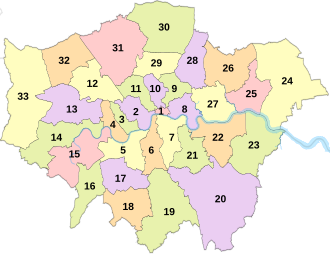 |
There are four boroughs that do not have "London Borough" in their official names: the City of Westminster, and the Royal Boroughs of Kingston upon Thames, Kensington and Chelsea, and Greenwich.
History
[edit]Creation
[edit]From the mid-1930s, the Greater London area comprised four types of local government authorities. There were county boroughs, municipal boroughs, urban districts and metropolitan boroughs. The large county boroughs provided all local government services and held the powers usually invested in county councils. The municipal borough and urban district authorities had fewer powers. The situation was made more complex because county councils could delegate functions such as elementary education and library provision to the municipal borough and district councils, and this was implemented piecemeal. Reform of London local government sought to regularise this arrangement.
The Royal Commission on Local Government in Greater London was established in 1957 and the report was published on 19 October 1960. It proposed 52 "Greater London Boroughs" with a population range of 100,000 to 250,000.[1] This was made up of a mixture of whole existing units, mergers of two or three areas, and two boroughs formed as the result of a split. In December 1961 the government proposed that there would be 34 boroughs rather than 52, and detailed their boundaries. The proposed number was further reduced to 32 in 1962.
On 1 April 1965, the 32 London boroughs and Greater London were created by the London Government Act 1963. Twelve boroughs in the former County of London area were designated Inner London boroughs and the 20 others were designated Outer London boroughs. Outer London borough councils were local education authorities, but Inner London borough councils were so designated primarily to continue the existence of an Inner London Education Authority, praised by official Opposition and government who further noted that unusually the former County of London's many small local authorities had no history of providing education. The City of London continued to be administered by the City of London Corporation, and the Inner and Middle Temples continued to govern their own areas.[note 1]
Elections were held on 7 May 1964, with the new councils acting as shadow authorities before coming into their powers the following year.
Former authorities
[edit]The boroughs were created as follows. Some relatively minor changes have been made to the boundaries of boroughs since 1965, and two have changed their names.
 |
Key to modern boroughs |
Greater London Council
[edit]Between 1965 and 1986 the boroughs were part of a two-tier system of government and shared power with the Greater London Council (GLC). The split of powers and functions meant that the Greater London Council was responsible for "wide area" services such as fire, ambulance, flood prevention, and refuse disposal; with the London borough councils responsible for "personal" services such as social care, libraries, cemeteries and refuse collection. Several London borough councils and the GLC were involved in the rate-capping rebellion of 1985. On 1 April 1986 the GLC was abolished and the borough councils gained responsibility for some services that had been provided by the Greater London Council, such as waste disposal. The Inner London Education Authority continued to exist as an ad hoc authority. In 1990 it was abolished and the Inner London borough councils also became local education authorities.
Name and boundary changes
[edit]The Local Government Act 1972 provided a mechanism for the name of a London borough and its council to be changed. This was used by the London Borough of Hammersmith (changed to Hammersmith and Fulham) on 1 April 1979 and the London Borough of Barking (changed to Barking and Dagenham) on 1 January 1980. Borough names formed by combining two locality names had been discouraged when the boroughs were created.
The London boroughs were created by combining whole existing units of local government and it was realised that this might provide arbitrary boundaries in some places. The London Government Act 1963 provided a mechanism for communities on the edge of Greater London to petition for transfer from London boroughs to a neighbouring county district.[2] This was used in 1969 in the transfers of Knockholt in Bromley to Kent, and of Farleigh and Hooley in Croydon to Surrey. The Act also provided for transfers between London boroughs and neighbouring counties where there was consensus for the change between all the relevant local authorities. This provision was used to exchange two islands on the River Thames between Richmond upon Thames and Surrey. (See List of Greater London boundary changes.)
The Local Government Boundary Commission for England was established by the Local Government Act 1972 to review periodically the boundaries of Greater London and the London boroughs. The first review of boundaries commenced on 1 April 1987 and reported in 1992.[3] Following the review a series of relatively minor adjustments were made to borough boundaries, for example uniting the whole of the Becontree estate in Barking and Dagenham. The commission noted that many of its recommendations were strongly opposed and were not implemented. The boundary of the City of London with adjacent boroughs was adjusted to remove some anomalies.[4]
The London boroughs were incorporated using the provisions of the Municipal Corporations Act 1882.[5] In the London boroughs the legal entity is not the council, as elsewhere in the country, but the inhabitants incorporated as a legal entity by royal charter (a process abolished elsewhere in England and Wales under the Local Government Act 1972). Thus, a London authority's official legal title is "The Mayor and Burgesses of the London Borough of X" (or "The Lord Mayor and Citizens of the City of Westminster").[6]
Greater London Authority
[edit]In 2000 the Greater London Authority was created, comprising the Mayor of London and the London Assembly. As a strategic authority, it absorbed only limited powers, such as major highways and planning strategy, from the borough councils.
London borough councils
[edit]| This article is part of a series within the Politics of England on the |
| Politics of London |
|---|
 |


The London boroughs are administered by London borough councils (sometimes abbreviated LBCs), which are elected every four years. They are the principal local authorities in London and are responsible for running most local services, such as schools, social services, waste collection and roads. Some London-wide services are run by the Greater London Authority, and some services and lobbying of government are pooled within London Councils. Some councils group together for services such as waste collection and disposal. The boroughs are local government districts and have similar functions to metropolitan boroughs. Each borough council is a local education authority.
| Service | Greater London Authority | London borough councils |
|---|---|---|
| Education | 
| |
| Housing |
|
|
| Planning applications |
| |
| Strategic planning |
|
|
| Transport planning |
|
|
| Passenger transport |
|
|
| Highways |
|
|
| Police |
|
|
| Fire |
|
|
| Social services |
| |
| Libraries |
| |
| Leisure and recreation |
| |
| Waste collection |
| |
| Waste disposal |
| |
| Environmental health |
| |
| Revenue collection |
|
Shared services
[edit]Shared services are borough council services shared between two or more boroughs. Shared services were previously resisted due to councils guarding their authority. However, as the need for budget cuts in the late 2000s became apparent some councils have sought service mergers.[7] Westminster and Hammersmith & Fulham were due to merge their education services, including school admissions and transport, by 2011.[8] In October 2010, Hammersmith & Fulham, Kensington & Chelsea and Westminster announced plans to merge all their services to create a "super-council". Each would retain its own political identity, leadership and councillors but staff and budgets would be combined for cost savings.[9] Lambeth and Southwark likewise expressed an interest in sharing services.[10]
The management thinker and inventor of the Vanguard Method, Professor John Seddon, claims that shared service projects based on attempts to achieve economies of scale are a mix of a) the plausibly obvious and b) a little hard data[clarification needed], brought together to produce two broad assertions, for which there is little hard factual evidence.[11] He argues that shared service projects fail (and often end up costing more than they hoped to save) because they cause a disruption to the service flow by moving the work to a central location, creating waste in hand-offs, rework and duplication, lengthening the time it takes to deliver a service and consequently creating failure demand (demand caused by a failure to do something or do something right for a customer).[12] Seddon referred directly to the so-called tri-borough shared services in an article in 2012.[13]
Gallery of London-wide election results
[edit]-
 2002 results map
 -
 2006 results map
 -
 2010 results map
 -
 2014 results map
 -
 2018 results map
 -
 2022 results map


See also
[edit]- Borough
- ISO 3166-2:GB, subdivision codes for the United Kingdom
- Political make-up of local councils in the United Kingdom
Notes
[edit]References
[edit]- ^ Sharpe, LJ (1961). The Report of The Royal Commission on Local Government in Greater London.
- ^ London Government Act 1963 Section 6 (4)
- ^ "The Local Government Boundary Commission for England, The Boundaries of Greater London and The London Borough, Report 627" (PDF). Lgbce.org.uk. 1992. Retrieved 21 December 2017.
- ^ "The City and London Borough Boundaries Order 1993". Legislation.gov.uk. Retrieved 22 December 2017.
- ^ "London Government Act 1963 (as amended)". legislation.gov.uk. Retrieved 15 February 2024.
The Municipal Corporations Act 1882 shall apply to every London borough
- ^ "Local Government Act 1933" (PDF). legislation.gov.uk. Retrieved 15 February 2024.
The municipal corporation of a borough shall [...] (a) in the case of a borough being a city, the mayor of which is entitled to bear the title of lord mayor, bear the name of the lord mayor, aldermen and citizens of the city; (b) in the case of any other borough being a city, bear the name of the mayor, aldermen and citizens of the city; and (c) in the case of any other borough, bear the name of the mayor,' aldermen and burgesses of the borough.
- ^ Jane Dudman (20 October 2010). "Public sector cuts will not hit 'back office' hardest", The Guardian.
- ^ Jaimie Kaffash (7 July 2010). "London boroughs to share education services", Public Finance.
- ^ /"Pickles backs plan to merge Tory councils", BBC News, 22 October 2010.
- ^ "Lambeth and Southwark councils to merge some services under Labour plan". London SE1. 30 March 2010. Retrieved 22 December 2017.
- ^ Seddon, John (8 July 2010). "Why do we believe in economy of scale?". The Systems Thinking Review. Archived from the original on 8 October 2011. Retrieved 6 October 2010.
- ^ Systems Thinking in the Public Sector, John Seddon, Page 57.
- ^ "Shared illusions | Public Finance Opinion". Archived from the original on 21 April 2013. Retrieved 13 July 2012.
External links
[edit]| Region | |
|---|---|
| County | |
| District and civil parish | |
London boroughs
View on GrokipediaOverview
Definition and legal basis
The London boroughs constitute 32 statutory local government districts established as the primary units of sub-national administration within Greater London, excluding the separate City of London. Enacted through the London Government Act 1963, which received royal assent on 31 July 1963 and came into effect on 1 April 1965, the boroughs were formed by consolidating areas previously governed by approximately 80 local authorities, including the 28 metropolitan boroughs under the County of London, urban and rural districts in Middlesex and adjoining counties such as Essex, Hertfordshire, Kent, and Surrey, and portions of the administrative County of London itself.[8] This restructuring dissolved fragmented entities like municipal boroughs, urban districts, and rural districts to create viable units capable of delivering coordinated services amid London's post-war population growth and suburban expansion, which had rendered smaller Victorian-era parishes inefficient for modern needs such as housing, transport, and planning. The Act defines each London borough as a body corporate with the legal status akin to a non-metropolitan district, empowered to exercise functions including education, social services, highways, and waste management, subject to oversight by the Greater London Council (GLC) for strategic metropolitan matters until its abolition in 1986.[9] This framework balanced localized decision-making with regional coordination, reflecting the empirical assessment that borough populations of 150,000 to 400,000—larger than antecedent bodies but smaller than the entire metropolis—optimized administrative scale without eroding community ties. The statutory boundaries, detailed in the Act's schedules, prioritize functional contiguity over historical parish lines, as evidenced by mergers like those forming the London Borough of Haringey from parts of Hornsey, Tottenham, and Wood Green urban districts. In contrast to the boroughs, the City of London preserves its pre-existing corporate identity as an ancient sui generis authority, exempt from the 1963 reforms and retaining privileges such as independent policing, livery companies, and the election of common councilmen, thereby excluding it from designation as a London borough despite inclusion in Greater London for certain planning purposes. This delineation stems from the Act's explicit provisions, which treat the City's one-square-mile area and its Inns of Court as distinct from the borough framework, underscoring a legislative choice to safeguard entrenched governance amid broader rationalization.[10] The reforms originated from the 1957 Royal Commission on Local Government in Greater London—chaired by Sir Edwin Herbert—which, in its September 1960 report, diagnosed administrative fragmentation as a barrier to effective management of London's 8 million residents and proposed boroughs as efficient, self-contained units to supplant obsolete boundaries, a view adopted with modifications in the Act to favor pragmatic utility over sentimental preservation.[11]Scope and exclusions
The 32 London boroughs form the core local government districts of Greater London, excluding the City of London, and collectively span approximately 1,572 km² while accommodating over 8.8 million residents as per the 2021 Census conducted by the Office for National Statistics.[12] These boroughs are subdivided into Inner London (12 boroughs, historically aligned with the former County of London) and Outer London (20 boroughs), delineating a central core from surrounding suburbs based on criteria from the London Government Act 1963, which emphasized density, historical precedents, and administrative efficiency.[13] Population projections by the Greater London Authority forecast sustained growth driven by net migration and natural increase, with estimates indicating the resident total will exceed 9 million by 2025.[14] Key exclusions define the boroughs' precise limits: the City of London, covering 2.9 km² with its unique sui generis status as a ceremonial county and self-governing corporation preserving medieval privileges, operates independently and is not integrated into the borough structure despite ceremonial ties to Greater London.[13] The framework also omits unparished lands within boroughs where civil parishes are absent or vestigial, and boundaries strictly adhere to the 1965 delineation without incorporating adjacent counties like Essex or Surrey, even amid periodic debates on expansion to address housing pressures—proposals historically rejected to maintain fiscal and jurisdictional clarity.[13] Functionally, boroughs focus on localized, non-strategic responsibilities including waste collection, housing allocation, and social care delivery, as delegated under the Greater London Authority Act 1999, while ceding oversight of pan-London matters such as public transport via Transport for London, policing through the Mayor's Office for Policing and Crime, and fire services to the London Fire Brigade—all coordinated by the Greater London Authority to avoid fragmentation in a high-density urban context.[15] This division ensures borough-level responsiveness to community needs without duplicating strategic imperatives.[16]Enumeration
Current list and classifications
The 32 London boroughs were established on 1 April 1965 under the London Government Act 1963, replacing previous metropolitan boroughs, urban districts, and rural districts to form the administrative structure of Greater London, excluding the City of London.[17] Twelve are designated as Inner London boroughs, characterized by higher density and centrality in 1960s urban planning, while the remaining 20 are Outer London boroughs, oriented toward suburban expansion and containment of sprawl.[18] The classifications have remained consistent since inception, with Inner London encompassing Camden, Greenwich, Hackney, Hammersmith and Fulham, Islington, Kensington and Chelsea, Lambeth, Lewisham, Southwark, Tower Hamlets, Wandsworth, and Westminster.[18]| Borough | Classification | Creation Date | ISO 3166-2 Code | Population (mid-2023) |
|---|---|---|---|---|
| Barking and Dagenham | Outer | 1 April 1965 | GB-BBD | 220,540 |
| Barnet | Outer | 1 April 1965 | GB-BRN | 392,874 |
| Bexley | Outer | 1 April 1965 | GB-BEX | 248,430 |
| Brent | Outer | 1 April 1965 | GB-BEN | 339,818 |
| Bromley | Outer | 1 April 1965 | GB-BRY | 332,336 |
| Camden | Inner | 1 April 1965 | GB-CMN | 218,119 |
| Croydon | Outer | 1 April 1965 | GB-CRY | 392,265 |
| Ealing | Outer | 1 April 1965 | GB-EAL | 370,371 |
| Enfield | Outer | 1 April 1965 | GB-ENF | 333,794 |
| Greenwich | Inner | 1 April 1965 | GB-GRE | 294,604 |
| Hackney | Inner | 1 April 1965 | GB-HCK | 260,890 |
| Hammersmith and Fulham | Inner | 1 April 1965 | GB-HMF | 184,167 |
| Haringey | Outer | 1 April 1965 | GB-HRY | 268,164 |
| Harrow | Outer | 1 April 1965 | GB-HRW | 262,945 |
| Havering | Outer | 1 April 1965 | GB-HAV | 262,052 |
| Hillingdon | Outer | 1 April 1965 | GB-HIL | 314,160 |
| Hounslow | Outer | 1 April 1965 | GB-HOU | 288,201 |
| Islington | Inner | 1 April 1965 | GB-ISL | 216,387 |
| Kensington and Chelsea | Inner | 1 April 1965 | GB-KEC | 143,887 |
| Kingston upon Thames | Outer | 1 April 1965 | GB-KTT | 168,063 |
| Lambeth | Inner | 1 April 1965 | GB-LBH | 317,336 |
| Lewisham | Inner | 1 April 1965 | GB-LEW | 299,044 |
| Merton | Outer | 1 April 1965 | GB-MRT | 215,622 |
| Newham | Outer | 1 April 1965 | GB-NWM | 351,030 |
| Redbridge | Outer | 1 April 1965 | GB-RDB | 310,276 |
| Richmond upon Thames | Outer | 1 April 1965 | GB-RUT | 195,278 |
| Southwark | Inner | 1 April 1965 | GB-SWK | 307,637 |
| Sutton | Outer | 1 April 1965 | GB-SUT | 209,664 |
| Tower Hamlets | Inner | 1 April 1965 | GB-TWH | 310,300 |
| Waltham Forest | Outer | 1 April 1965 | GB-WFT | 278,013 |
| Wandsworth | Inner | 1 April 1965 | GB-WND | 327,506 |
| Westminster | Inner | 1 April 1965 | GB-WSM | 205,312 |
Comparative statistics
The London boroughs exhibit marked disparities in population density and economic output per capita, driven primarily by proximity to high-productivity sectors such as finance and professional services concentrated in central areas, rather than uniform redistribution mechanisms. Inner boroughs, closer to the City of London and Westminster, sustain higher densities and GDP contributions due to land value gradients and agglomeration effects that favor economic clustering over dispersed development. These patterns underscore causal factors like market-driven location choices for businesses and workers, exacerbated by post-1965 boundary rationales that preserved inner-outer divides without mitigating central overconcentration.[21] Population densities vary widely, with inner boroughs averaging over 10,000 persons per square kilometre based on 2021 census figures, compared to outer boroughs at around 4,500 per square kilometre; this reflects constrained land availability and infrastructure focused on radial transport links rather than balanced regional equity.[22]| Borough | Density (persons per km², 2021) |
|---|---|
| Tower Hamlets | 15,695 |
| Camden | 9,647 |
| Kensington and Chelsea | ~5,800 (estimated from GLA projections aligned with census) |
| Newham | ~9,000 (aligned with inner east averages) |
Historical development
Antecedent authorities
Prior to the mid-20th-century reforms, local government across the territory that would form Greater London operated through a disparate array of over 80 independent authorities, reflecting 19th-century administrative divisions ill-suited to the region's expanding metropolitan character. The inner core, designated as the County of London since 1889, was subdivided into 28 metropolitan boroughs established by the London Government Act 1899, each managing services such as sanitation, highways, and poor relief within tightly bounded parishes or districts like Westminster, Stepney, and Hampstead.[6] Beyond this, the outer periphery encompassed municipal boroughs, urban districts, and rural districts in counties including Middlesex, Essex, Surrey, Kent, and Hertfordshire, alongside autonomous county boroughs such as Croydon, which operated outside the London County Council's oversight and handled broader functions independently.[30] This structure totaled approximately 86 bodies, with populations ranging from under 10,000 in some rural districts to over 300,000 in larger urban entities like West Ham.[31] The fragmentation engendered systemic inefficiencies, most acutely during post-World War II reconstruction after the Blitz, which devastated over 1.5 million homes and commercial sites across London between 1940 and 1945. Coordination among the numerous authorities faltered in key areas like land use planning and resource allocation, as hierarchical mismatches between local boroughs, county councils, and central government led to disjointed replanning efforts; for instance, bomb-damaged sites often remained undeveloped due to jurisdictional disputes over compulsory purchase and funding.[32] Duplicated administrative functions—evident in parallel efforts for housing provision and utilities—exacerbated fiscal strains, with smaller districts unable to leverage economies of scale and frequently defaulting on debt servicing amid ratepayer resistance to increased local taxes.[33] These empirical shortcomings were systematically critiqued by the Royal Commission on Local Government in Greater London, appointed in 1957 under Sir Edwin Herbert, which documented how the patchwork system hindered responses to cross-boundary challenges like traffic congestion and industrial relocation, rooted in outdated boundaries that ignored functional urban realities.[34] While defenders invoked historical localism to preserve parish-level autonomy, such arguments disregarded causal evidence of under-resourcing: many authorities derived over 50% of revenues from national grants by the 1950s, masking inherent weaknesses in self-sustaining governance for a conurbation exceeding 8 million residents. This rational diagnosis prioritized administrative efficacy over sentimental attachments, setting the stage for consolidation.[30]Establishment and rationale
The London Government Act 1963 received royal assent on 31 July 1963 and established the framework for reorganizing local government in Greater London, with its core provisions operative from 1 April 1965.[13] This legislation created 32 London boroughs as primarily unitary authorities—handling most local functions such as education, housing, social services, and planning—replacing a fragmented array of over 100 antecedent councils across the former County of London and parts of surrounding counties. The boroughs operated alongside the new Greater London Council for strategic oversight, forming a two-tier structure adapted to metropolitan scale, while excluding the ancient City of London Corporation. The reform stemmed from the Royal Commission on Local Government in Greater London (1957–1960), chaired by Sir Edwin Herbert, which empirically assessed London's post-war administrative inefficiencies amid population growth exceeding 8 million and suburban sprawl.[35] The Commission's data-driven analysis concluded that small, numerous authorities—often with populations under 50,000—lacked the capacity for viable service delivery, recommending consolidation into around 52 "Greater London boroughs" with 100,000–250,000 residents each to enable economies of scale in resource allocation and expertise. The government modified this to 32 larger entities, averaging 250,000–300,000 inhabitants, prioritizing administrative robustness for handling complex urban demands like traffic management and welfare provision over maximal decentralization.[36] This restructuring consolidated disparate rating and governance systems from Victorian-era municipalities, reducing administrative duplication and enabling more uniform fiscal mechanisms for local services, though rates (the precursor to council tax) remained borough-levied.[37] Empirical imperatives of metropolitan efficiency drove the changes, as evidenced by the Commission's surveys of service delivery gaps, yet the process drew contemporary criticism for prioritizing functional scale over historical community boundaries, fostering later disputes in areas where merged identities diluted local traditions.[38]Post-creation modifications
Following the establishment of the London boroughs in 1965 under the London Government Act 1963, minor boundary adjustments were implemented in the late 1960s to resolve administrative anomalies arising from the amalgamation of antecedent authorities. These included small-scale transfers and realignments, such as refinements between boroughs like Camden and Barnet or Bexley and Greenwich, aimed at smoothing irregular borders inherited from pre-1965 local government structures.[39] Such changes were limited in scope and did not alter the overall number or classification of boroughs, focusing instead on practical efficiencies without significant population shifts.[40] More systematic reviews occurred in the 1990s under the Local Government Commission for England, established by the Local Government Act 1992 to assess local authority structures. The Commission conducted periodic boundary examinations, resulting in targeted modifications effective from 1 April 1994, including the East London Boroughs (London Borough Boundaries) Order, which adjusted perimeters between several outer and inner boroughs to better align with natural features, transport links, and community identities. For instance, reports recommended and implemented tweaks to the boundaries of Lewisham with Greenwich and Tower Hamlets, transferring small parcels to reduce enclaves and improve service delivery coherence.[41] These alterations addressed localized electoral and administrative imbalances but preserved the 32-borough framework, deferring broader reforms to population disparities and fiscal equalization that stemmed from uneven rateable values and central grant dependencies.[42] The abolition of the Greater London Council (GLC) on 31 March 1986, enacted via the Local Government Act 1985, marked a pivotal non-boundary modification by devolving strategic powers to the boroughs and ad hoc bodies. Boroughs assumed direct responsibility for services previously coordinated at the GLC level, such as major highways, waste disposal, and certain parks, leading to fragmented planning and increased operational burdens on individual councils. This shift eliminated unified oversight, compelling boroughs to navigate inter-authority coordination independently while remaining reliant on central government funding mechanisms that perpetuated disparities in local revenue-raising capacity, as evidenced by varying needs for rate support grants post-1986.[43] The resulting structure prioritized borough autonomy but exposed underlying vulnerabilities in addressing cross-borough issues like traffic congestion and housing without a metropolitan tier, a gap not rectified until the later establishment of the Greater London Authority.[44]Recent and proposed alterations
The Local Government Boundary Commission for England (LGBCE) has undertaken periodic electoral reviews in several London boroughs during the 2020s, focusing on ward configurations and councillor allocations to ensure equitable representation amid population shifts, though these do not involve alterations to borough boundaries themselves. In Waltham Forest, for example, the LGBCE initiated a review leading to proposed new ward boundaries published on 11 June 2025, with consultations open to adjust electoral divisions based on updated electorate data from 2023, potentially increasing the total number of councillors from 60 to better reflect demographic growth.[45] Similar ward-level adjustments occurred earlier in boroughs like Islington and Camden via orders effective from 2020, implementing LGBCE recommendations to standardize councillor-to-elector ratios.[46] [47] The Boundary Commission for England's 2023 parliamentary constituency review, finalized for implementation at the 2024 general election, redrew 75 constituencies across Greater London, often crossing borough lines and thereby indirectly influencing local political dynamics and councillor oversight of MPs, without impacting borough administrative boundaries.[48] No structural boundary reviews for borough mergers or expansions have advanced to enactment in this period, despite empirical pressures such as London's housing delivery shortfall—where only 25,000 homes were completed in 2023 against a 66,000 target—and escalating borough homelessness expenditures totaling £5.5 million daily by September 2025.[49] Proposals for borough-level reforms, including mergers to achieve economies of scale, have surfaced sporadically in policy discussions but stalled amid fiscal and political hurdles, with critics noting that such changes overlook entrenched inefficiencies like those in Haringey, which topped national rankings for upheld Local Government and Social Care Ombudsman complaints at 20 per 100,000 residents in 2023-2024 data. In response to the 2024-2025 housing crisis, government interventions emphasized planning deregulations—such as reducing affordable housing thresholds to 20% and offering Community Infrastructure Levy relief—over territorial reconfiguration, yielding no new borough creations or consolidations as of October 2025.[50] [51] These patterns reflect causal constraints from devolved governance structures, where borough autonomy limits broader restructuring absent central legislative overrides.Administrative framework
Council operations
Each London borough is administered by an elected council consisting of between 40 and 66 councillors, with most falling in the 40 to 60 range, elected from multi-member wards for four-year terms.[52] Following the Local Government Act 2000, the predominant governance structure is the leader and cabinet model, in which councillors elect a leader who appoints a cabinet of up to 10 members responsible for executive decisions, while the full council retains oversight on major policies and budgets.[53] Operational mechanics include regular full council meetings to approve strategies and finances, cabinet sessions for service delivery, and specialized committees such as planning committees for development approvals and overview and scrutiny committees to review executive actions and performance.[54] To optimize resources, councils increasingly utilize shared services coordinated by London Councils, including joint procurement frameworks that have facilitated collective purchasing for items like electric vehicles and professional services, yielding cost savings through economies of scale.[55][56] Efficiency variations persist, as evidenced by the Office for Local Government's (OfLog) 2024 data dashboards tracking over 20 metrics on finance, workforce, and outcomes; for instance, boroughs like Westminster demonstrate stronger positions in financial resilience indicators compared to others facing pressures in reserves and spending controls.[57][58]Devolved powers
London borough councils possess devolved authority over operational delivery of essential local services, encompassing education at the school level, social care for children and adults, housing provision and maintenance, waste collection and recycling, leisure and cultural facilities, and environmental health enforcement.[59] [60] These competencies enable borough-specific adaptations, such as customized social services protocols or local planning decisions on non-strategic development, distinct from the Greater London Authority's (GLA) remit for overarching strategies in economic development, spatial planning, and environment.[61] Boroughs exercise no jurisdiction over Transport for London (TfL), which manages the capital's public transport network under GLA direction, nor over the Metropolitan Police Service, whose operational command falls outside local council purview despite borough-level community safety partnerships.[62] [63] This devolved framework permits boroughs to address localized challenges through mechanisms like selective licensing of private rented properties, introduced under the Housing Act 2004 to combat issues such as antisocial behaviour and substandard housing in high-risk areas. Examples include Tower Hamlets' schemes in wards like Weavers and Whitechapel, aimed at improving tenancy management and property standards, and Bexley's designation for Belvedere Ward to target deprivation-linked rental problems.[64] [65] Such powers facilitate granular responses unavailable at the GLA level, yet persistent resource constraints have engendered service deficiencies, evidenced by 2025 reports of over 1,100 missed welfare alerts in one borough's social work department and borough-wide escalations in unmet care demands amid a £500 million collective funding gap.[66] [67] The devolution model's emphasis on central grants—often mismatched to London's elevated deprivation and service costs—cultivates fiscal dependency, curtailing borough autonomy in precept-setting via council tax and incentivizing reliance on Whitehall allocations over efficiency-driven local revenue optimization.[68] [69] This dynamic underscores devolution's incomplete scope, where boroughs execute devolved functions but contend with exogenous fiscal pressures that amplify vulnerabilities in core service delivery.Fiscal mechanisms and dependencies
London boroughs' revenue primarily comprises council tax, which accounted for approximately 45.6% of local authority funding in England during 2024-25, with the balance derived from central government grants including the Revenue Support Grant (RSG) and dedicated funding streams such as social care allocations.[70] [71] This structure underscores heavy reliance on Whitehall, where unringfenced grants constitute about 24% of total resources alongside ringfenced elements for specific services.[71] Since 2010, successive reductions in the RSG—part of broader grant cuts totaling around 40% in real terms by 2019-20—have compelled boroughs to pursue cost efficiencies and elevate council tax yields, yet fostered dependencies manifesting in bailouts and insolvencies.[72] [73] The London Borough of Croydon, under Labour control, issued a section 114 notice in November 2020, signaling effective bankruptcy amid £1.5 billion in accumulated debt from overspending on regeneration projects, necessitating a £120 million central government loan repayable at £47 million annually.[74] [75] Projections for 2024-25 reveal London boroughs collectively facing overspends exceeding £700 million against original budgets, driven by escalating demands in homelessness and social care, with Labour-administered authorities disproportionately strained due to pre-existing spending trajectories.[76] [77] This fiscal precarity highlights how central grant dominance erodes local incentives for restraint, as funding flows decoupled from performance metrics incentivize expenditure over sustainability; jurisdictions like Conservative-led Bromley, emphasizing tax stability and targeted efficiencies, have averted such crises despite analogous pressures, sustaining balanced budgets through 2024 without equivalent deficits.[78] Empirical patterns from UK local authorities indicate that elevated per-capita spending, absent rigorous controls, correlates with heightened insolvency risks rather than superior service delivery, as unchecked outlays on non-essential procurement yield marginal employment gains but precipitate long-term fiscal imbalances.[79] [80] Central overrides thus undermine causal accountability, prioritizing national redistribution over localized prudence that demonstrably preserves solvency in restrained models.[81]Political dynamics
Electoral processes
Elections to London borough councils occur every four years in an all-out format, with all seats up for election simultaneously, as established under the cycle commencing in 2022.[82] This schedule aligns with broader English local government practices, ensuring periodic renewal of council composition without partial elections by thirds, a system some boroughs previously followed.[83] The voting mechanism utilizes the first-past-the-post system within multi-member wards, where each borough is divided into wards electing two or three councillors. Voters cast ballots for an equal number of candidates as seats available, with winners determined by the highest vote totals regardless of majority threshold.[84] This plurality block voting approach prioritizes simplicity and direct linkage between representatives and local electorates, though it can result in disproportionate outcomes favoring larger parties.[85] In the May 5, 2022, elections across all 32 boroughs, average voter turnout stood at approximately 35%, markedly lower than national parliamentary levels and varying widely—such as below 30% in central boroughs like Westminster versus higher in outer areas—reflecting persistent challenges like civic disengagement and perceived inefficacy of local governance.[86] Despite advocacy for proportional representation to enhance minority voice and proportionality, as seen in the London Assembly's additional member system, borough councils have retained first-past-the-post to maintain councillor accountability to specific wards rather than party lists.[85]Control and ideological variances
As of October 2025, the Labour Party maintains majority control over 24 of London's 32 borough councils, a dominance established following substantial gains in the May 2022 local elections and sustained through subsequent by-elections. The Conservative Party retains control in four outer boroughs—Bexley, Bromley, Havering, and Hillingdon—characterized by more affluent, suburban demographics. The Liberal Democrats govern three boroughs (Kingston upon Thames, Richmond upon Thames, and Sutton), while Tower Hamlets operates under an independent majority led by the Aspire party, headed by Lutfur Rahman.[87] Ideological variances manifest in correlated policy outcomes, with Conservative-led boroughs exhibiting relatively stronger fiscal resilience amid central government austerity measures; for instance, outer Conservative councils have historically relied less on exceptional financial support packages compared to inner Labour strongholds.[88] Labour-dominated areas, by contrast, record elevated governance complaints, as evidenced by Haringey Council's designation as England's "most rotten" borough in 2025, with 20.2 upheld complaints per 100,000 residents—the highest nationally—often linked to administrative failures in housing and welfare services.[89] Critiques highlight Labour boroughs' susceptibility to cronyism allegations in contract awards and service outsourcing, potentially inflating costs without commensurate improvements in equity metrics like poverty reduction or service equity, undermining claims of superior social outcomes under progressive control.[90] Conservative councils face accusations of nimbyism, exemplified by Harrow's approval of just 38% of major planning applications in recent years, constraining housing supply and economic mobility in outer areas despite fiscal prudence.[91] Empirical analyses conditioning on grants reveal minimal partisan impact on core fiscal policies, suggesting demographic and geographic factors—such as outer boroughs' higher property values—drive much of the observed disparities rather than ideology alone.[92]Performance accountability
The Office for Local Government (Oflog), launched in October 2024, evaluates local authority performance through dashboards covering 27 indicators across domains such as waste management, corporate finance, adult social care, planning, and roads, enabling comparisons that reveal operational variances among London boroughs.[93] For instance, in waste management, 2023/24 provisional data indicate household waste contamination/rejection rates below the London median in boroughs like Harrow (3.90%), while others exceed it, reflecting differences in collection efficiency and resident compliance enforcement.[94] These metrics underscore causal factors like inadequate infrastructure investment or lax oversight, rather than inherent urban constraints, as outer boroughs with lower population densities often achieve superior recycling outcomes through streamlined operations. In children's and adult social care, oversight relies on Ofsted inspections and Oflog assessments, with national data as of March 2024 showing 60% of local authorities rated good or outstanding for children's services, though London boroughs exhibit wide disparities tied to case load management and funding allocation.[95] Borough-specific dashboards highlight underperformance in high-need inner areas, where chronic staffing shortages and delayed interventions correlate with elevated risks of service breakdown, as evidenced by focused Ofsted visits in 2024 to entities like the City of London Corporation.[96] Adult care metrics similarly expose variances, with Oflog data pointing to inefficiencies in resource deployment that amplify costs without proportional outcomes. Housing delivery shortfalls further illustrate accountability gaps, as detailed in CBRE's 2025 Borough by Borough report, which documents only 1,210 new home starts in London during Q1 2025—the lowest quarterly figure on record—with 23 of 32 boroughs registering zero activity and the capital collectively 50,000 units below its 2021 targets.[97][98] Boroughs like Greenwich face acute deficits (approximately 5,000 homes short), attributable to stalled planning approvals and insufficient site preparation, rather than land scarcity alone.[98] Government interventions enforce accountability in cases of systemic failure, exemplified by the appointment of commissioners to Croydon London Borough Council in November 2022 and July 2025, following findings of financial imprudence, including risky commercial property investments that precipitated near-bankruptcy and depleted reserves to critical levels.[99] These measures, authorized under the Local Government Act 1999 and 2000, impose external oversight to restore viability, directly linking underperformance to causal mismanagement such as unchecked borrowing and opaque decision-making under extended single-party administrations.[100] Oflog's emphasis on comparative rankings counters tendencies to normalize deficits, as outer boroughs demonstrate higher efficiency in fiscal controls and service delivery—evident in lower intervention rates—compared to inner counterparts burdened by entrenched operational inertia.[70]Sociodemographic profile
Population dynamics
The population of Greater London, comprising its 32 London boroughs excluding the City of London, stood at approximately 7.4 million in 1965, following a post-war decline from earlier peaks, before recovering to 8.8 million by the 2021 census.[101] Mid-year estimates for 2023 reached about 9.0 million, with Office for National Statistics-informed projections from the Greater London Authority forecasting further expansion to roughly 9.2 million by 2025 under principal variant assumptions incorporating recent migration trends.[14] This growth has disproportionately occurred in outer boroughs, which have accommodated net inflows through suburban expansion, contrasting with slower or negative trends in denser inner areas during certain periods.[22] Net international migration accounts for the predominant share of recent population gains, driving over 80% of the increase since the early 2000s when adjusted for natural change components, as evidenced by decomposition analyses of mid-year estimates.[102] Domestic internal migration has often been outward from London, offsetting some international gains, while natural increase contributes modestly amid sub-replacement fertility.[103] Fertility rates in Greater London remain below the replacement threshold of 2.1 children per woman across most boroughs, with the area's total fertility rate averaging around 1.6 in recent years—higher than the England and Wales figure of 1.41 due to demographic compositions but insufficient for self-sustaining growth without immigration.[104] Births have stabilized or declined slightly post-2020, yielding limited natural increase that relies on younger migrant cohorts to counter aging and mortality patterns.[105] These dynamics reveal a causal dependence on sustained net inflows for expansion, with empirical correlations between migration surges and infrastructure bottlenecks—such as housing supply shortfalls leading to protracted social housing waitlists in high-growth outer boroughs—indicating pressures from growth exceeding planned capacity.[106]Diversity patterns and implications
The 2021 Census recorded that 36.8% of Greater London's population identified as White British, a decline from 44.9% in 2011, reflecting broader trends of ethnic diversification driven by immigration.[107] Boroughs in east and inner London exhibit the highest concentrations of non-White British residents; for instance, Newham had 69.2% non-White residents, with significant proportions from South Asian (predominantly Bangladeshi and Indian) and Black African/Black Caribbean backgrounds.[108] Across London, 40.6% of residents were non-UK born, rising to over 60% in boroughs like Newham and Tower Hamlets, where specific ethnic enclaves predominate.[109] These patterns correlate with empirical challenges to social cohesion, including the persistence of parallel communities where residential segregation by ethnicity remains high despite some dispersal. Studies indicate that ethnic minority density positively associates with property crime rates in London boroughs, even after controlling for socioeconomic factors, suggesting cultural or community-specific dynamics beyond deprivation alone.[110] Similarly, education outcomes show persistent gaps: Black African and Pakistani pupils in London attain GCSE scores 10-15 months below White British peers on average, with higher absenteeism and lower progression rates in high-diversity boroughs.[111] Such disparities undermine the notion of unalloyed benefits from diversity, as concentrated immigrant groups often form networks with limited inter-ethnic interaction, hindering broader assimilation.[112] Specific risks emerge in outcomes like group-based child sexual exploitation, where 2025 government audits revealed disproportionate involvement of men from Pakistani heritage backgrounds in London cases, such as those investigated in Tower Hamlets and other east London boroughs, with authorities historically under-recording ethnicity due to sensitivity concerns.[113] This pattern, echoed in national grooming gang inquiries, links to insular community structures that enable predation while impeding external scrutiny. On welfare and fiscal fronts, while skilled migrants contribute positively, low-skilled non-EEA inflows—prevalent in diverse boroughs—impose net costs exceeding £1,000 per person annually in public services like housing and education, straining local budgets without commensurate economic offsets.[114] These data challenge assertions of inherent "diversity dividends," highlighting instead causal links between rapid demographic shifts and elevated social frictions, as measured by trust surveys and service demands in high-immigration areas.[115]Economic functions
Sectoral contributions
The 32 London boroughs collectively produced approximately £472 billion in gross value added (GVA) in 2023, accounting for a disproportionate share of UK economic output relative to their population.[116] This figure reflects London's service-dominated economy, where financial and insurance activities contributed 11% of total GVA in 2021, alongside professional, scientific, and technical services at a similar share.[117] Inner boroughs generated 66% of London's GVA that year, underscoring the concentration of high-value sectors in central areas.[117] Central boroughs like Westminster specialize in finance, leveraging proximity to the City of London for banking, insurance, and related professional services that drive elevated productivity. GVA per head in such areas exceeds £100,000 annually, far above the UK average, due to workplace-based measurement capturing commuter inflows. In contrast, outer boroughs exhibit lower per capita GVA, around £20,000-£30,000, with sectors like logistics dominating in places such as Havering, where distribution and warehousing benefit from M25 access and port linkages. Technology clusters, notably Tech City around Shoreditch in Tower Hamlets and Hackney, have emerged as entrepreneurial hubs, attracting fintech investment that surged to $9.9 billion in 2022 from $495 million in 2014.[118] These areas host startups and scale-ups in digital services, contributing to London's 11% share in professional and technical GVA. While such hubs demonstrate organic clustering effects from talent and infrastructure, critics argue that targeted public subsidies risk inefficient resource allocation by favoring select industries over broader market signals.[117]Inequality and mobility factors
Income inequality across London boroughs remains pronounced, with the ratio of household equivalised income for the top 10% to the bottom 10% exceeding 10:1 citywide, driven by disparities in earnings and access to high-value sectors. For instance, average gross household incomes in affluent boroughs like Wandsworth reached approximately £74,000 in recent estimates, over 60% higher than in deprived areas such as Barking and Dagenham at £46,000. Pay gaps amplify this, as the top 20% of earners in London receive nearly 2.5 times the hourly wage of the bottom 20%, a rate exceeding England's average. Child poverty rates underscore intra-borough divides, with 2025 data indicating peaks in inner and east London boroughs: Tower Hamlets, Newham, Hackney, and Islington exceeding 40% of children in low-income households after housing costs, compared to under 20% in outer boroughs like Richmond upon Thames or Sutton.[119][120][121][122] Social mobility metrics reveal persistent gaps linked to these inequalities, with overall London performance outpacing other UK regions—occupying the top 20 parliamentary constituencies for intergenerational opportunity in 2025 analyses—but lower rates in deprived inner boroughs due to concentrated poverty and limited local prospects. The Social Mobility Commission's 2024 index highlights strong educational attainment for disadvantaged pupils in London boroughs, yet absolute mobility stagnates in high-deprivation areas like those in east London, where childhood disadvantage correlates with reduced earnings progression into adulthood. Outer boroughs exhibit higher residential turnover and access to expanding job markets, facilitating upward movement, while inner zones trap residents through geographic mismatches between skills and opportunities.[123][124][125] Policy-induced factors exacerbate these divides, including restrictive zoning and planning regulations that constrain housing supply and inflate costs, thereby limiting low-income households' ability to relocate to higher-opportunity areas and perpetuating spatial inequality. Enterprise zones, such as those designated in outer east London under national programs, have demonstrated causal boosts to employment and income mobility by offering business rate relief and simplified planning, with evidence from similar UK initiatives showing 10-15% higher firm entry and job creation in treated areas compared to controls. In contrast, extended welfare dependencies in high-poverty boroughs can create disincentives for labor market entry, as marginal tax rates exceed 70% for some recipients, reducing incentives for skill acquisition or geographic moves. Market-driven growth in regenerating districts generates net employment gains—lifting median wages by up to 5% in proximate low-income zones—but induces gentrification displacements, where rising rents force out 10-20% of original residents without adequate relocation support, though empirical studies indicate overall poverty reductions from such expansions outweigh localized losses when paired with targeted retraining.[126][127]| Borough Example | Child Poverty Rate (2025, after housing costs) | Key Mobility Factor |
|---|---|---|
| Tower Hamlets | ~45% | High deprivation traps; limited local high-skill jobs |
| Wandsworth | ~15% | Access to enterprise incentives; higher residential mobility |
| Newham | ~42% | Zoning constraints on affordable integration |