



Community hub
Long March 7
View on Wikipedia
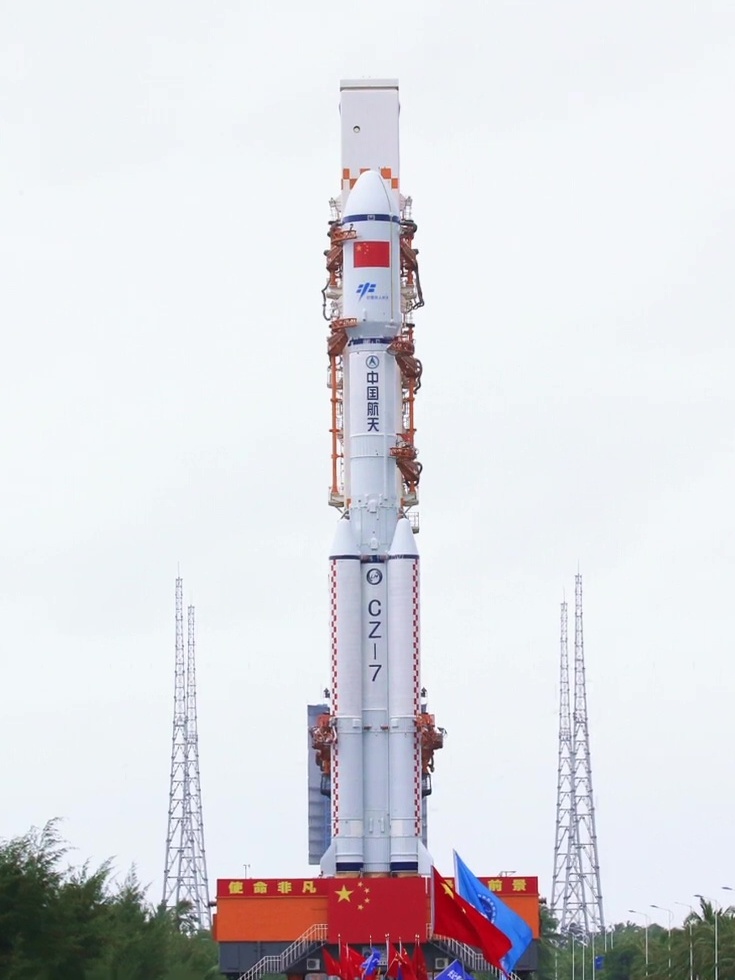
 Long March 7 Y6 transporting to launch site | |
| Function | Medium to heavy-lift launch vehicle |
|---|---|
| Manufacturer | China Academy of Launch Vehicle Technology |
| Country of origin | China |
| Size | |
| Height |
|
| Diameter | 3.35 m (11 ft) |
| Mass | |
| Stages |
|
| Capacity | |
| Payload to LEO | |
| Altitude | 200 km × 400 km (120 mi × 250 mi) |
| Orbital inclination | 42° |
| Mass | 13,500 kg (29,800 lb) |
| Payload to GTO | |
| Mass | 7,000 kg (15,000 lb)[3] |
| Payload to TLI | |
| Mass | 5,000 kg (11,000 lb) |
| Payload to SSO | |
| Altitude | 700 km (430 mi) |
| Mass | 5,500 kg (12,100 lb) |
| Associated rockets | |
| Family | Long March |
| Comparable | |
| Launch history | |
| Status | Active |
| Launch sites | Wenchang, LC-2 |
| Total launches | 24 (7: 10, 7A: 14) |
| Success(es) | 23 (7: 10, 7A: 13) |
| Failure | 1 (7: 0, 7A: 1) |
| First flight |
|
| Last flight |
|
| Boosters – K2 | |
| No. boosters | 4 |
| Height | 27 m (89 ft) |
| Diameter | 2.25 m (7 ft 5 in) |
| Powered by | 1 × YF-100 |
| Maximum thrust | SL: 1,200 kN (270,000 lbf) vac: 1,340 kN (300,000 lbf) |
| Total thrust | SL: 4,800 kN (1,100,000 lbf) vac: 5,360 kN (1,200,000 lbf) |
| Specific impulse | SL: 300 s (2.9 km/s) vac: 335 s (3.29 km/s) |
| Propellant | RP-1 / LOX |
| First stage – K3 | |
| Diameter | 3.35 m (11.0 ft) |
| Powered by | 2 × YF-100 |
| Maximum thrust | SL: 2,400 kN (540,000 lbf) vac: 2,680 kN (600,000 lbf) |
| Specific impulse | SL: 300 s (2.9 km/s) vac: 335 s (3.29 km/s) |
| Propellant | RP-1 / LOX |
| Second stage | |
| Diameter | 3.35 m (11.0 ft) |
| Powered by | 4 × YF-115 |
| Maximum thrust | 706 kN (159,000 lbf) |
| Specific impulse | 342 s (3.35 km/s) |
| Propellant | RP-1 / LOX |
| Third stage (CZ-7A) | |
| Diameter | 3.0 m (9.8 ft) |
| Empty mass | 2,800 kg (6,200 lb) |
| Gross mass | 21,000 kg (46,000 lb) |
| Propellant mass | 18,200 kg (40,100 lb) |
| Powered by | 2 × YF-75 |
| Maximum thrust | 167.17 kN (37,580 lbf) |
| Specific impulse | 4,295 m/s (438.0 s) |
| Burn time | 478 seconds |
| Propellant | LH2 / LOX |
| Fourth stage (optional) – YZ-1A | |
| Powered by | 1 × YF-50D |
| Maximum thrust | 6.5 kN (1,500 lbf) |
| Specific impulse | 315.5 s (3.094 km/s) |
| Propellant | N2O4 / UDMH |
The Long March 7 (Chinese: 长征七号运载火箭), or Chang Zheng 7 in pinyin, abbreviated LM-7 for export or CZ-7 within China, originally Long March 2F/H or Chang Zheng 2F/H, nicknamed Bingjian (冰箭; 'the Ice Arrow'), is a Chinese liquid-fuelled launch vehicle of the Long March family, developed by the China Aerospace Science and Technology Corporation (CAST).[4] It made its inaugural flight on 25 June 2016.
Designed as a replacement of the Long March 2F, Long March 7 and its variants was expected to be the workhorse of the fleet, projected to account for around 70% of all Chinese launches. Long March 7 plays a critical role in the Chinese Space Station program: it is used to launch the Tianzhou robotic cargo and resupply spacecraft to the station. The rocket was intended to replace the Long March 2F as China's crew-rated launch vehicle in the future,[4] although by 2023 this role has apparently been taken over by the under-development Long March 10 and Long March 10A.
Since 2020, in addition to the base Long March 7 configuration, there is the Long March 7A (CZ-7A etc.) variant which differs from the base CZ-7 by the addition of a liquid hydrogen-liquid oxygen third stage inherited from the third stage of the Long March 3B.[3] The rocket has also been developed into the Long March 8 (using fewer boosters).
History
[edit]
The Long March 7 project started in 2008 with the formation of the development team within the traditional designer of space launch vehicles, CALT.[5] With the acquisition of the RD-120 technology and development of the YF-100 and YF-115 engines, the original plan was to re-engine the Long March 2F. The Long March 2F/H, as it would have been called, would "just" switch from N2O4 / UDMH to a LOX / kerosene propellant and improved thrust engines to offer better performance. But the switch resulted in a cascade of changes that increased the project complexity significantly.[6]
At the same time, the original Long March 5 project was expected to include heavy, medium and light versions. Since the Long March 2F/H and the medium Long March 5 had significant overlaps, it was decided to merge both projects. This way, the high reliability and flight legacy components and technologies of the Long March 2F were merged with the new technologies developed for the Long March 5.[6] Although finished nearly at the same time, the Long March 6 was a completely separate product developed by a young team within SAST. As such, it shares little more than tank diameters and propulsion with the LM-5 and LM7, but does cover the range of payloads between the medium Long March 7 and the very light Long March 11.[7]
In 2010, the project name was changed officially to Long March 7. According to the project deputy manager, Zhang Tao, the project required eleven new major technologies. But the innovation was not only at the product level, but one at the process itself. This was, according to the project manager, Wang Xiaojun, the first time the whole process was developed in digital 3D, using computer-aided design directly to computer-aided manufacturing.[8]
The inaugural flight was successfully performed on 25 June 2016, at 12:00 UTC from the Wenchang, LC-2 launch pad. It launched in the LM-7 configuration with the addition of the simultaneously debuting Yuanzheng-1A upper stage; the flight performed its multi-orbit mission successfully.[9]
Design
[edit]The Long March 7 is the medium-lift variant of a new generation rocket family that includes the heavier-lift Long March 5 and the small-mid cargo Long March 6. The structure is based on the reliable, human-rated Long March 2F launch vehicle. It inherited the 3.35 m-diameter core stage and 2.25 m-diameter liquid rocket boosters, but with new engines. Where the earlier Long March 2 rocket family used expensive and dangerous N2O4 / UDMH propellants, the Long March 7 uses LOX and kerosene. The engines are shared with the Long March 5 and 6. The goal was to build a more cost-effective and less hazardous rocket family to replace today's Long March 2 and eventually the Long March 3.[10] It is capable of placing a 5,500 kg (12,100 lb) payload into a Sun-synchronous orbit (SSO) of 700 km (430 mi).[11]
Stages
[edit]The Long March 7 inherits the modular stages of the original Long March 5 project. As such, its first stage is the same module as the LM-5 boosters. It also shares tank diameters and engines with the Long March 6, but the design groups were completely different. The LM-5 and LM-7 were developed by China Academy of Launch Vehicle Technology (CALT), while the LM-6 was done by Shanghai Academy of Spaceflight Technology (SAST). Even the avionics are different.[7]
The basic Long March 7 can be optimized by varying the number of boosters or enhanced by the addition of upper stages. These stages allow more mission flexibility, like direct injection to higher orbits or multiple orbit deployment. They can also increase the performance significantly. Thanks to this modularity, performance can be dialed between 4,000 kg (8,800 lb) and 13,500 kg (29,800 lb) for LEO, 2,000 kg (4,400 lb) and 8,000 kg (18,000 lb) for SSO and 4,000 kg (8,800 lb) and 7,000 kg (15,000 lb) to Geostationary transfer orbit (GTO).[12][13]
Boosters
[edit]The Long March 7 can use 0, 2 or 4 boosters using RP-1 / LOX propellant.[14] They are powered by a single oxidizer-rich staged combustion YF-100 engine. Each boosters supplies 1,200 kN (270,000 lbf) at sea level and 1,340 kN (300,000 lbf) in vacuum of thrust. Its specific impulse is 300 s (2.9 km/s) at sea level and 335 s (3.29 km/s) in vacuum. Each module has its own single axis thrust vector control, and thus it required a special design in the control systems of the rocket to coordinate all the rocket's nozzles.[11][14] They use the legacy 2.25 m (7 ft 5 in) width of the Long March 2 and Long March 3 families, but due to the increased thrust of the YF-100 with respect to the YF-20 and YF-25, the boosters are almost twice as long, at 27 m (89 ft).[14]
Re-entry of a Long March 7 rocket booster created a fireball visible from portions of Utah, Nevada, Colorado, Idaho and California on the evening of 27 July 2016; its disintegration was widely reported on social media, and the uncontrolled re-entry of such a five-ton object was regarded as a rare event.[15]
First stage
[edit]The first stage has 3.35 m (11.0 ft) diameter tanks carrying RP-1/LOX propellant. It is powered by two YF-100 engines, sharing the same propulsion elements as the boosters, only that for the first stage the engines can gimbal in two axes.[14] Also, this first stage is the same basic module as the Long March 5 boosters. The diameter was designed for land transport and as such, it will be able to launch from all the Chinese launch sites. This is a critical difference to the LM-5 that requires water transport for its 5 m (16 ft) diameter core stages.[11] While it shares diameter and engines with the Long March 6 first stage, the development was completely separated and done by different groups.[7]
Second stage
[edit]The second stage also shares the first 3.35 m (11.0 ft) diameter tanks and propellant. It is powered by four oxidizer-rich staged combustion RP-1/LOX YF-115 engines. Two are fixed and two can gimbal in two axis.[14] It offers 706 kN (159,000 lbf) of thrust in vacuum with a specific impulse of 341.5 s (3.349 km/s).[11] While it shares engines with the Long March 6 second stage, the development were completely separated and done by different groups.[7]
Optional stages
[edit]Yuanzheng-1A
[edit]It can use the Yuanzheng-1A upper stage to increase payload to higher energy orbits and enable multiple ignition missions. Particularly, allows direct injection to SSO orbits.[16] The inaugural flight successfully used this upper stage to deliver multiple payloads to different orbits.[12]
Hydrogen stage
[edit]The Long March 7 is expected to be enhanced by a high-energy liquid hydrogen and liquid oxygen stage. This stage and the low inclination of Wenchang would enable to launch payload between 4,000 kg (8,800 lb) and 7,000 kg (15,000 lb) to Geostationary transfer orbit (GTO) orbit. That would be a 25% increase with respect to the previously most powerful Chinese launcher, the Long March 3B, but well below the Long March 5.[12] The Long March 7A variant, active since March 2020, accomplishes just this enhancement; it is made of the initial two stages of Long March 7, with a third stage powered by liquid hydrogen and liquid oxygen.
In the 2013 presentation of variations, a hydrogen-powered stage was also used as a second stage. It was not clear if it would be the same stage used as the second stage or a different stage. In both cases (second and third stage) they would be powered by the YF-75 or the YF-75D.[14]
Solid boosters
[edit]The 2013 presentation of the variation also proposed smaller 2 m (6 ft 7 in) diameter solid boosters as a cheaper option for smaller payloads.[14]
Avionics
[edit]After the inaugural flight, Song Zhengyu, Deputy Chief Control Systems Designer for the Long March 7 project, stated that the flight had proven indigenous avionics. They had to work with the local industry to develop space rated dual processor PLCs. It was also stated that the real-time operating system was also an indigenous development. The general design was based on a distributed architecture to enable scalability and fault tolerance. This avionics would be the base for most future developments and had been designed with reusability in mind.[17]
2013 proposed variations
[edit]In a paper published on the Manned Spaceflight publication of the CMSEO, the Long March 7 was presented as a family of launch vehicles.[14] The variations would be codified by a two number plus variable letters code, and a CZ-7 prefix in the form CZ-7##. The first digit would mean the number of stages in the core, which could be either 2 or 3. The second number would mean the number of boosters, which could be 0, 2 or 4, with an S appended if the boosters were of solid type. There was also proposed an alternative second stage powered by the LH/LOX propellant and dual YF-75 engines would be identified by appending an (HO) to the designation. At last, it could have an additional upper stage, later identified as the Yuanzheng-1A, that would be identified by appending to the designation /SM.[14]
For example, the version that debuted was codified under this nomenclature as the CZ-724/SM, since it had two RP-1/LOX core stages, four liquid boosters and was enhanced by the Yuanzheng-1A stage. A CZ-720 would have two RP-1/LOX stages and no boosters. A CZ-724S(HO) would have a RP-1/LOX first stage, a LH/LOX second stage and four solid boosters. A CZ-732 would have two RP-1/LOX stages, a LH/LOX third stage, and two liquid boosters. The paper expected the following performance from certain versions.[14]
| Version | LEO | SSO | GTO |
|---|---|---|---|
| CZ-720 | 2000 kg | – | |
| CZ-722 | 7500 kg | 1300 kg | |
| CZ-724 | 13500 kg | 5500 kg | |
| CZ-720/SM | 1000 kg | ||
| CZ-722/SM | 4500 kg | ||
| CZ-724/SM | 8500 kg | ||
| CZ-722S/SM | 1800 kg | ||
| CZ-724S/SM | 3900 kg | ||
| CZ-730 | 1200 kg | ||
| CZ-732 | 4500 kg | ||
| CZ-734 | 7000 kg | ||
| CZ-720(HO) | 5500 kg | 2900 kg | 1500 kg |
| CZ-722S(HO) | 7500 kg | 4400 kg | 2400 kg |
The paper also presented the propulsion options for each stage. The RP-1/LOX second stage had only two YF-115 instead of the normal four, when used in the version with no boosters. It might have implied a different smaller upper stage or an under filled one.[14]
| Version | Boosters | 1st Stage | 2nd Stage | 3rd Stage | Maneuver Stage |
|---|---|---|---|---|---|
| CZ-720 | 0 | YF-100 × 2 | YF-115 × 2 | / | / |
| CZ-722 | 2.25 m liquid × 2 | YF-100 × 2 | YF-115 × 4 | / | / |
| CZ-724 | 2.25 m liquid × 4 | YF-100 × 2 | YF-115 × 4 | / | / |
| CZ-720/SM | 0 | YF-100 × 2 | YF-115 × 2 | / | YF-50 × 1 |
| CZ-722/SM | 2.25 m liquid × 2 | YF-100 × 2 | YF-115 × 4 | / | YF-50 × 1 |
| CZ-724/SM | 2.25 m liquid × 4 | YF-100 × 2 | YF-115 × 4 | / | YF-50 × 1 |
| CZ-722S/SM | 2 m solid × 2 | YF-100 × 2 | YF-115 × 4 | / | YF-50 × 1 |
| CZ-724S/SM | 2 m solid × 4 | YF-100 × 2 | YF-115 × 4 | / | YF-50 × 1 |
| CZ-720(HO) | 0 | YF-100 × 2 | YF-75 × 2 | / | / |
| CZ-722(HO) | 2.25 m liquid × 2 | YF-100 × 2 | YF-75 × 2 | / | / |
| CZ-724(HO) | 2.25 m liquid × 4 | YF-100 × 2 | YF-75 × 2 | / | / |
| CZ-722S(HO) | 2 m solid × 2 | YF-100 × 2 | YF-75 × 2 | / | / |
| CZ-724S(HO) | 2 m solid × 4 | YF-100 × 2 | YF-75 × 2 | / | / |
| CZ-730 | 0 | YF-100 × 2 | YF-115 × 2 | YF-75 × 2 | / |
| CZ-732 | 2.25 m liquid × 2 | YF-100 × 2 | YF-115 × 4 | YF-75 × 2 | / |
| CZ-734 | 2.25 m liquid × 4 | YF-100 × 2 | YF-115 × 4 | YF-75 × 2 | / |
CZ-7A variant
[edit]
Since 2020, the base two-stage CZ-7 configuration has been supplemented by the CZ-7A variant. This variant employs the boosters and the first two stages of the base configuration, and add to this a third stage that employs two cryogenic YF-75 engines operating on LH2 and LOX liquid fuels; the third stage of the 7A variant is inherited from the third stage of the Long March 3B. (Note that the 7A variant is similar to the CZ-73X variants first proposed in 2013; see previous subsection).
The maiden CZ-7A was launched on 16 March 2020 at 13:34 UTC from Wenchang Satellite Launch Center on Hainan island. Two hours after launch, state news sources announced that the flight ended in failure; no causes for the failure were indicated initially. Launch preparations for the maiden flight continued in the weeks prior to launch despite measures taken to combat the spread of the COVID-19 virus in China.[18] In 2021, some observers speculated, based on unconfirmed Chinese Baidu posts, that the failure of the CZ-7A's maiden flight was caused by the loss of pressurization in one of its four boosters just prior to main engine cutoff and the staging of the first stage (about 168 seconds into the flight).[19]
The second CZ-7A launched successfully from Wenchang on 11 March 2021.[20] The launch vehicle carried the Shiyan-9 satellite to test new technologies such as space environmental monitoring, according to the China Aerospace Science and Technology Corporation (CASC).[21]
Launch Statistics
[edit]Launch outcomes :
- Failure
- Partial failure
- Success
- Planned
List of launches
[edit]| Flight number | Date (UTC) | Variant | Launch site | Upper stage | Payload | Orbit | Result | References |
|---|---|---|---|---|---|---|---|---|
| Y1 | 25 June 2016 12:00[12] |
7 | Wenchang, LC-2 | YZ-1A | Next-Generation Crew Capsule Scale Model • Star of Aoxiang • Aolong-1 • Tiange-1 • Tiange-2 | LEO | Success | zh:长征七号首飞[22][23] |
| Y2 | 20 April 2017 11:41[24] |
7 | Wenchang, LC-2 | None | Tianzhou 1 | LEO | Success | [25][26] |
| 7A-Y1 | 16 March 2020 13:34 |
7A | Wenchang, LC-2 | None | XJY 6 | GTO | Failure | [3][27][28] |
| 7A-Y2 | 11 March 2021 17:51 |
7A | Wenchang, LC-2 | None | Shiyan 9 | GTO | Success | [21][20] |
| Y3 | 29 May 2021 12:55 |
7 | Wenchang, LC-2 | None | Tianzhou 2 | LEO | Success | [29] |
| Y4 | 20 September 2021 07:10 |
7 | Wenchang, LC-2 | None | Tianzhou 3 | LEO | Success | [30] |
| 7A-Y3 | 23 December 2021 10:12 |
7A | Wenchang, LC-2 | None | Shiyan 12-01 Shiyan 12-02 |
GTO | Success | [31] |
| Y5 | 9 May 2022 17:56 |
7 | Wenchang, LC-2 | None | Tianzhou 4 | LEO | Success | [32] |
| 7A-Y5 | 13 September 2022 13:18 |
7A | Wenchang, LC-2 | None | ChinaSat 1E | GTO | Success | [33] |
| Y6 | 12 November 2022 02:03 |
7 | Wenchang, LC-2 | None | Tianzhou 5 | LEO | Success | [34] |
| 7A-Y4 | 8 January 2023 22:00 |
7A | Wenchang, LC-2 | None | Shijian 23 | GTO | Success | [35] |
| Y7 | 10 May 2023 13:22 |
7 | Wenchang, LC-2 | None | Tianzhou 6 | LEO | Success | [36] |
| 7A-Y6 | 3 November 2023 14:54 |
7A | Wenchang, LC-2 | None | TJS-10 | GTO | Success | [37] |
| Y8 | 17 January 2024 14:27 |
7 | Wenchang, LC-2 | None | Tianzhou 7 | LEO | Success | [38] |
| 7A-Y8 | 29 June 2024 11:57 |
7A | Wenchang, LC-2 | None | ChinaSat 3A | GTO | Success | [37] |
| 7A-Y9 | 22 August 2024 12:25 |
7A | Wenchang, LC-2 | None | ChinaSat 4A | GTO | Success | [37] |
| Y9 | 15 November 2024 15:13 |
7 | Wenchang, LC-2 | None | Tianzhou 8 | LEO | Success | [39] |
| 7A-Y11 | 29 March 2025 16:05 |
7A | Wenchang, LC-2 | None | TJS-16 | GTO | Success | [37] |
| 7A-Y15 | 20 May 2025 11:50 |
7A | Wenchang, LC-2 | None | ChinaSat 3B | GTO | Success | [37] |
| Y10 | 14 July 2025 21:34 |
7 | Wenchang, LC-2 | None | Tianzhou 9 | LEO | Success | [40] |
| 7A-Y14 | 9 September 2025 02:00 |
7A | Wenchang, LC-2 | None | Yaogan 45 | MEO | Success | [37] |
| 7A-Y13 | 3 November 2025 03:47 |
7A | Wenchang, LC-2 | None | Yaogan 46 | MEO | Success | |
| 7A-Y10 | 30 November 2025 12:20 |
7A | Wenchang, LC-2 | None | Shijian 28 | GTO | Success | |
| 7A-Y7 | 30 December 2025 22:40 |
7A | Wenchang, LC-2 | None | Shijian 29 A & B | GTO | Success | |
| 7A-Y? | NET April 2026 | 7A | Wenchang, LC-2 | None | Unknown Payload | GTO | Planned | |
| Y11 | 2026 |
7 | Wenchang, LC-2 | None | Tianzhou 10 | LEO | Planned | [40] |
See also
[edit]

References
[edit]- ^ a b Jones, Andrew (16 February 2020). "China quietly rolls out new rocket to launch mystery satellite". SpaceNews. Retrieved 16 February 2020.
- ^ [1] - 8 May 2020
- ^ a b c d Jones, Andrew (14 February 2020). "China prepares to launch new rockets as part of push to boost space program". SPACE.com. Retrieved 14 February 2020.
- ^ a b "2016年,还有哪些航天大事值得期待?| 科学人 | 果壳网 科技有意思" [What aerospace event to look for in 2016]. guokr.com (in Chinese). 3 March 2016. Retrieved 27 April 2016.
长征七号火箭原名长征二号F/H,最初可以看做长征二号F火箭换用YF-100和YF-115液氧煤油发动机的产物,但在实际研制中它应用了全数字化设计手段,代表了我国60年来运载火箭研制的最高水平
- ^ 8年历程 拓荒与先行 [The Eight Year Tale of Pioneer and Leading]. spacechina.com (in Chinese). 25 June 2016. Retrieved 27 June 2016.
- ^ a b 立项论证 平地起高楼 [Demonstration project launches]. spacechina.com (in Chinese). 25 June 2016. Retrieved 27 June 2016.
- ^ a b c d 突破运力"下限"的长征6号 [Advances in Light Capacity Long March 6] (in Chinese). Tencent Military Channel. 19 December 2013. Retrieved 3 August 2015.
- ^ 正式更名 迈出新一步 [Change of official name for a new step]. spacechina.com (in Chinese). 25 June 2016. Retrieved 27 June 2016.
- ^ Barbosa, Rui C. (25 June 2016). "China successfully debuts Long March 7 – Recovers capsule". NASASpaceFlight.com. Retrieved 2 July 2015.
- ^ SINA News Sina, 19 November 2010, [2]
- ^ a b c d "Chang Zheng-7 (Long March-7)". SinoDefence. Retrieved 2 July 2015.
- ^ a b c d 长征七号首飞成功 空间实验室任务大幕拉开 [Successful maiden flight of the Long March 7 mission Damulakai]. spacechina.com (in Chinese). 25 June 2016. Archived from the original on 6 October 2016. Retrieved 25 June 2016.
- ^ 未来,长征七号火箭将"挑大梁" [Long March 7 to play the leading role in the future]. calt.com (in Chinese). China Academy of Launch Vehicle Technology. 28 June 2016. Archived from the original on 17 August 2016. Retrieved 30 June 2016.
- ^ a b c d e f g h i j k Fan, Ruixiang; Rong, Yi (2013). 代中型运载火箭的发展展望 [Our prospective next-generation medium launch vehicle development]. 载人航天 [Manned Spaceflight] (in Chinese). 2013 (2013, 01). China Manned Space Engineering Office. doi:10.16329/j.cnki.zrht.2013.01.009. ISSN 1674-5825. Retrieved 30 June 2016.
- ^ Mike, Wall (28 July 2016). "Amazing Fireball Over Western US Caused by Chinese Space Junk". SPACE.com. Retrieved 28 July 2016.
- ^ 长征七号搭载的缩比返回舱成功着陆 [Scaled down return capsule that launched by the Long March-7 has landed successfully]. xinhuanet.com (in Chinese). 27 June 2016. Archived from the original on 22 August 2016. Retrieved 27 June 2016.
- ^ 控制系统多项"国产化"技术护航长七首飞成功 [Successful maiden flight of the Long March 7 demonstrate indigenous avionics]. cmse.gov.cn (in Chinese). China Manned Space Engineering Office. 27 June 2016. Archived from the original on 14 September 2016. Retrieved 29 June 2016.
- ^ Jones, Andrew (16 March 2020). "Launch of China's new Long March 7A ends in failure". SpaceNews. Retrieved 16 March 2020.
- ^ "FAILURE: XJY-6 - CZ-7A (Y1) - WSLC - March 16, 2020 (13:34 UTC)". NASA Spaceflight.com. Retrieved 20 September 2021.
- ^ a b Weitering, Hanneke (March 2021). "China's Long March 7A rocket launches on 1st successful flight". SPACE.com. Retrieved 13 March 2021.
- ^ a b Jessie Yeung (12 March 2021). "China successfully launches Long March 7A rocket after failed first attempt". CNN. Retrieved 13 March 2021.
- ^ "Long March 7 Maiden Flight – T–1 minute to upper stage separation". youtube.com (in Chinese). CNTV. 24 June 2016. Archived from the original on 15 December 2021.
- ^ Kevin Anthony (27 July 2016). "ROCKET REENTRY – Lights up night sky! (Chang Zheng 7 Rocket)". Youtube. Archived from the original on 15 December 2021.
- ^ Ping, Wu (June 2016). "China Manned Space Programme: Its Achievements and Future Developments" (PDF). China Manned Space Agency. Retrieved 28 June 2016.
- ^ Rui C. Barbosa (19 April 2017). "Tianzhou-1 – China launches and docks debut cargo resupply". NASAspaceFlight.com.
- ^ "China's 'Heavenly Vessel' Sails into Orbit atop Long March 7 Rocket on Space Logistics Demonstration". Spaceflight 101. 20 April 2017. Archived from the original on 21 April 2017. Retrieved 20 April 2017.
- ^ "EPIC FAILURE: XJY-6 - CZ-7A (Y1) - WSLC - 16 March 2020 (13:34 UTC)". NASASpaceFlight.com. 16 March 2020. Retrieved 16 March 2020.
- ^ Barbosa, Rui (16 March 2020). "Long March 7A fails during Xinjishu Yanzheng-6 mission". NASASpaceFlight.com. Retrieved 16 March 2020.
- ^ "China launches new cargo ship to Tianhe space station module". space.com. 29 May 2021. Retrieved 30 May 2021.
- ^ "China launches cargo craft for space station supplies". Xinhua. 20 September 2021. Retrieved 20 September 2021.
- ^ Jones, Andrew (23 December 2021). "Long March 7A launches classified Shiyan-12 satellites". SpaceNews. Retrieved 23 December 2021.
- ^ Clark, Stephen (9 May 2022). "China launches Tianzhou 4 cargo ship for space station". Spaceflight Now. Retrieved 9 May 2022.
- ^ Davenport, Justin (13 September 2022). "Chang Zheng 7A launches military communications satellite". NASASpaceFlight. Retrieved 13 September 2022.
- ^ China Spaceflight [@CNSpaceflight] (18 April 2022). "Key takeaways from the press conference: 7 launches in total from Wenchang
[...]
07/24 CZ5B Wentian
08/.. CZ7A ❓
10/.. CZ5B Mengtian
11/.. CZ7 Tianzhou-5
12/.. CZ7A ❓
2 crewed launches from Jiuquan
06/05 SZ14
12/.. SZ15" (Tweet). Retrieved 18 April 2022 – via Twitter. - ^ China Spaceflight [@CNSpaceflight] (18 December 2022). "The next Long March 7A launch planned in December has been postponed to January 09, 2023. The rocket has been recently transported to Wenchang" (Tweet). Retrieved 18 December 2022 – via Twitter.
- ^ "China launches cargo mission to Tiangong space station". Space.com. 10 May 2023. Retrieved 10 May 2023.
- ^ a b c d e f "China launches new communication technology experiment satellite". Xinhua. 4 November 2023. Retrieved 4 November 2023.
- ^ "Long March 7 | Tianzhou 7". nextspaceflight.com. 17 January 2024. Retrieved 31 December 2025.
- ^ "Long March 7 | Tianzhou 8". nextspaceflight.com. Retrieved 15 November 2024.
- ^ a b "China's next cargo spacecraft arrives at launch site ahead of early 2024 liftoff". Space. 23 November 2023. Retrieved 5 January 2024.

| Rockets |  | |
|---|---|---|
| Launch sites | ||
| Manufacturers | ||
| Designers | ||
| Components |
| ||||
|---|---|---|---|---|---|
| Spaceflights |
| ||||
| Rockets | |||||
| Sites and facilities | |||||
| Precursors |
| ||||
| |||||
