Hubbry Logo
Nigella damascenaNigella damascenaMain
Open search
Nigella damascena
Community hub
Nigella damascena
logo
8 pages, 0 posts
0 subscribers
Be the first to start a discussion here.
Nigella damascena
Nigella damascena
from Wikipedia

Nigella damascena
Scientific classification Edit this classification
Kingdom: Plantae
Clade: Tracheophytes
Clade: Angiosperms
Clade: Eudicots
Order: Ranunculales
Family: Ranunculaceae
Genus: Nigella
Species:
N. damascena
Binomial name
Nigella damascena

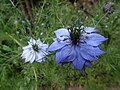
Nigella damascena, love-in-a-mist,[1] or devil in the bush,[2] is an annual garden flowering plant, belonging to the buttercup family Ranunculaceae. It is native to southern Europe (but adventive in more northern countries of Europe), north Africa and southwest Asia, where it is found on neglected, damp patches of land.

The specific epithet damascena relates to Damascus in Syria.[3] The plant's common name "love-in-a-mist" comes from the flower being nestled in a ring of multifid, lacy bracts.

Description

[edit]

It grows to 20–50 cm (8–20 in) tall, with pinnately divided, thread-like, alternate leaves. The flowers, blooming in early summer, are most commonly different shades of blue, but can be white, pink, or pale purple, with 5 to 25 sepals. The actual petals are located at the base of the stamens and are minute and clawed. The sepals are the only colored part of the perianth. The four to five carpels of the compound pistil have each an erect style.[4]

The fruit is a large and inflated capsule, growing from a compound ovary, and is composed of several united follicles, each containing numerous seeds. This is rather exceptional for a member of the buttercup family. The capsule becomes brown in late summer. The plant self-seeds, growing on the same spot year after year.[5]

Cultivation

[edit]
Selection of cultivars

This easily grown plant has been a familiar subject in English cottage gardens since Elizabethan times, admired for its ferny foliage, spiky flowers and bulbous seed-heads. It is now widely cultivated throughout the temperate world, and numerous cultivars have been developed for garden use. 'Persian Jewels' is a mixture of white, pink, lavender and blue flowers. 'Persian Rose' is pale pink. Other cultivars are 'Albion', 'Blue Midget', 'Cambridge Blue', 'Mulberry Rose', and 'Oxford Blue'. 'Dwarf Moody Blue' is around 15 cm (6 in) high. The pale blue ‘Miss Jekyll’[6] and the double white-flowered 'Miss Jekyll Alba' have gained the Royal Horticultural Society's Award of Garden Merit.[7][8]

[edit]

The related Nigella sativa (and not N. damascena) is the source of the spice variously known as nigella, kalonji or black cumin.

Toxicity

[edit]

Damascenine is a toxic alkaloid found in Nigella damascena seed.[9]

However, an in vivo study in mice and in vitro assessment on human cell lines has not shown any toxicity.[10]

References

[edit]
Revisions and contributorsEdit on WikipediaRead on Wikipedia
from Grokipedia
Nigella damascena, commonly known as love-in-a-mist, is an upright annual herbaceous plant in the buttercup family, Ranunculaceae, native to southern Europe, northern Africa, and parts of western Asia including the Mediterranean region to Iran. It typically grows 1 to 2.5 feet tall with a spread of 0.5 to 2 feet, featuring finely divided, thread-like green leaves that resemble fennel foliage and give the plant a delicate, lacy texture. The plant produces solitary, showy flowers, 1 to 3 inches across, from spring to early summer, with five petal-like sepals in shades of pale blue, purple, lavender, or white, surrounded by a distinctive collar of thread-like bracts that create the "mist" effect around the blooms. Following pollination, the flowers develop into inflated, balloon-like seed capsules up to 2 inches long, often green with purple or bronze stripes and covered in bristles, which persist and add ornamental interest. In its native habitats, N. damascena thrives in fields, roadsides, rocky areas, and waste ground, preferring full sun and well-drained, fertile soils with a of 6.0 to 8.0. It is a cool-season annual with a rapid growth rate and low maintenance needs, though its long makes transplanting challenging; direct of seeds in early spring, about ⅛ inch deep and spaced 8 to 10 inches apart, is recommended for cultivation. The plant tolerates light frost but performs poorly in hot, humid conditions, and successive sowings every 3 to 4 weeks can extend the blooming period for 1 to 2 months. It readily self-seeds in suitable climates, making it ideal for informal gardens, borders, containers, or mass plantings. Widely cultivated as an ornamental since ancient times, N. damascena is prized for its unique floral display and is commonly used in cottage gardens and cut-flower arrangements, with the dried seed pods providing long-lasting decorative elements. The aromatic seeds have historical culinary and medicinal uses in traditional Eastern medicine, though they are considered inferior to those of the related . In some regions, it has naturalized or escaped cultivation but remains non-invasive in most areas.

Taxonomy and Etymology

Classification

Nigella damascena is classified within the kingdom Plantae, phylum Tracheophyta, class Magnoliopsida, order , and family , commonly known as the buttercup family. This placement reflects its membership in the basal eudicot lineage, characterized by diverse herbaceous plants with simple to compound leaves and varied reproductive structures. The species belongs to the genus L., which comprises approximately 22 species of annual herbs native primarily to the Mediterranean region and western Asia, with recent estimates recognizing up to 25 accepted species. N. damascena itself is an annual herbaceous plant, completing its life cycle in one . The binomial name Nigella damascena was first formally described by in his seminal work in 1753, establishing it as a distinct species based on its morphological traits observed in southern European habitats. Taxonomic revisions of the genus have refined species delimitations, with a notable 1983 study by Michael Zohary recognizing 14 acceptable species amid over 80 historical binomials, emphasizing morphological and distributional evidence. A key distinction for N. damascena from congeners, such as N. sativa, lies in its structure: it features large, inflated follicles with horizontally spreading styles, contrasting with the elongated capsules and styles in related species. This characteristic inflated capsule aids in its identification and underscores ongoing refinements in based on reproductive morphology.

Naming and Synonyms

The scientific name Nigella damascena was formally established by in his seminal work in 1753, marking a key point in its within the family. The genus name is derived from the Latin niger, meaning "black," a reference to the plant's distinctive . The specific epithet damascena originates from in , reflecting the species' presumed native origins in the eastern Mediterranean region. Common names for N. damascena vary by region and emphasize its ethereal appearance, such as "love-in-a-mist," which describes the flower's delicate, lacy bracts that surround it like a . Other English names include "devil-in-the-bush," alluding to the intricate, bushy foliage that envelops the blooms, and "Persian jewel," often applied to colorful cultivars evoking gem-like qualities. In German-speaking areas, it is known as "Gretchen im Busch," translating to "little Greta in the bush," highlighting similar visual motifs. In botanical literature following Linnaeus, the evolved through the recognition of morphological variations, leading to several historical synonyms. Notable examples include Nigella multifida Gaterau (from early French floras) and Nigella bithynica Azn. (proposed for Anatolian specimens), as well as Erobathos damascenum (L.) Spach, reflecting shifts in generic classifications during the . These synonyms were largely consolidated under N. damascena in modern , based on Linnaean types and extensive studies.

Description

Morphology

Nigella damascena is an annual herb growing 20–60 cm tall, with erect, slender, glabrous stems that may branch occasionally. The plant features a long . The leaves are alternate, bright green to blue-green, and finely divided, appearing feathery or lacy due to their ternately dissected structure, with segments that are linear to filiform and up to 3 cm long. Basal leaves are petiolate with broader segments, while cauline leaves are nearly sessile and narrower, measuring 2–16 cm in length. Flowers are solitary at the ends of stems, measuring 3–5 cm in diameter, with five petal-like sepals that are pale blue to (sometimes or violet in cultivars) and short-clawed, 8–25 mm long, their apices entire to lobed. Beneath the sepals lie five small, clawed petals with glands, and the center displays numerous stamens (many, often more than 25) surrounding 5–10 fused carpels. Following , the flowers develop into inflated, bladder-like seed capsules that are ovoid to egg-shaped, 1–3.5 cm long, smooth or bristly, and often horned with persistent slender beaks from the styles. These capsules consist of 5–10 fused follicles and contain numerous small, black, flattened to triangular seeds.

Life Cycle and Reproduction

Nigella damascena is an herb that completes its life cycle in a single , typically spanning from spring germination to autumn seed maturation. Seeds germinate in early spring under cool temperatures ranging from 10–18°C, with light exposure essential for successful emergence, often taking 10–14 days. The develops quickly, reaching heights of 15–60 cm, and begins vegetative growth shortly after sprouting. Flowering occurs from to , primarily between May and in temperate regions, with each flower lasting only a few days before the formation of characteristic inflated seed pods. is mainly entomophilous, facilitated by such as honey bees (Apis mellifera), which are the primary visitors, along with bumblebees (Bombus spp.) and occasionally flies and wasps; these pollinators are attracted to secreted by hidden floral nectaries and guided by pseudonectary structures on the petals that mimic nectar droplets. While the species is self-fertile, allowing for autogamous , outcrossing predominates due to the structure of the flowers and reliance on insect vectors, promoting . After , the develops into an inflated, balloon-like schizocarpic capsule consisting of 5–10 fused one-seeded carpels (follicles), often with persistent slender beaks from the styles. maturation occurs by late summer to autumn, at which point the dry fruit undergoes dehiscence along suture lines, explosively releasing the small, black . This autochorous dispersal mechanism is augmented by , enabling to scatter short distances and self-sow effectively, often leading to naturalized populations in suitable habitats. Each pod contains 20–50 , ensuring prolific reproduction.

Distribution and Ecology

Native Range

Nigella damascena is native to the Mediterranean Basin, spanning , , and western Asia. In , it occurs in countries such as , , , , and , including island regions like the and . Populations are also found in North African nations including , , , and , as well as in western Asian areas such as , , , and extending to northwestern . Archaeological evidence indicates the historical presence and possible early range expansion of N. damascena, with carbonized seeds discovered at a site (circa 1410–920 BCE) in , suggesting human-mediated dispersal from its native Mediterranean origins during prehistoric or migration. Current wild populations of N. damascena remain widespread in its native range but face threats in certain locales due to habitat loss from agricultural intensification, , and land-use changes. Globally, the species has not been formally assessed for , though it is locally vulnerable in fragmented habitats across the Mediterranean. The species thrives in temperate to subtropical climate zones with Mediterranean characteristics, featuring hot, dry summers and mild, wet winters, which support its growth in natural disturbed or open-ground settings.

Habitat Preferences

Nigella damascena prefers well-drained, sandy or loamy soils with neutral to slightly alkaline pH levels between 6.0 and 7.0, and it demonstrates tolerance to low-fertility conditions, enabling growth in nutrient-poor substrates commonly found in its ecological niches. These soil characteristics support the plant's annual life cycle in open, arid-leaning environments where water retention is minimal, reducing the risk of root rot in its native Mediterranean settings. The species thrives in full sun and exhibits strong once established, allowing it to persist in regions with irregular rainfall patterns. It is frost-hardy, withstanding temperatures down to approximately -10°C, which contributes to its adaptability in cool temperate climates and enables early spring emergence after winter . In natural habitats, N. damascena occupies disturbed and open sites such as fields, vineyards, groves, lands, roadsides, and scrub openings, often from to elevations of 1500–2070 m. It has naturalized extensively in temperate introduced ranges, including eastern —particularly in disturbed areas like roadsides and fields—and , where it invades similar anthropogenic habitats. Ecologically, N. damascena functions as a pioneer species in grasslands and ruderal zones, facilitating soil stabilization in early successional stages through its fibrous root system. Its flowers attract generalist pollinators, including honeybees and bumblebees, providing essential nectar resources in these transient habitats.

Cultivation and Uses

Growing Requirements

_Nigella damascena thrives in well-drained, fertile soil with a neutral pH range of 6.0 to 8.0, tolerating textures such as clay, loam, or sand, but it requires avoidance of waterlogged conditions to prevent root rot. The plant performs best in full sun, receiving at least 6 hours of direct sunlight daily, though it can adapt to partial shade with reduced blooming. As a cool-season annual, Nigella damascena should be sown in early spring as soon as the ground can be worked, ideally when soil temperatures reach around 60°F (15°C), and it tolerates light frost while struggling in prolonged hot weather above 72°F (22°C). Water moderately to keep consistently moist during , providing deep watering until the top 2 inches of are saturated, after which the becomes drought-tolerant and requires minimal supplemental in average conditions. Fertilization requirements are low, with the plant succeeding in soils of average fertility without additional inputs; a single application of a balanced, general-purpose at planting is sufficient to support growth. Common cultivation challenges include susceptibility to damping-off fungal disease in overly wet or poorly drained soils, which can be mitigated by ensuring proper drainage and spacing seedlings adequately. The plant's long taproot makes transplanting difficult, potentially leading to stunted growth if not direct-sown, and it may self-sow prolifically, requiring thinning to manage spread.

Propagation Methods

Nigella damascena is primarily propagated through , as it is an species that readily self-sows in suitable conditions. Direct sowing is the preferred method, with planted in early spring once the is workable or in autumn in mild climates to leverage natural overwintering for improved establishment. should be sown shallowly at a depth of about ⅛ inch (3 ) in well-drained , spaced 8-10 inches apart after , and they typically germinate within 10-21 days at temperatures of 60-65°F (16-18°C). Scarification is not necessary for N. damascena seeds, but cold stratification can enhance rates, particularly for spring ; this involves exposing moist seeds to 39°F (4°C) for 4-6 weeks prior to planting. Autumn direct naturally provides this cold period, leading to stronger seedlings in the following season. rates can vary based on and consistency. Seed viability generally persists for 2-3 years when stored in cool, dry conditions, allowing for reliable use in subsequent seasons. Vegetative propagation is rarely employed for N. damascena due to its nature and the development of a long , which complicates root division or cuttings; attempts at stem cuttings typically yield low success rates and are not recommended for practical cultivation. Hybridization within the Nigella is relatively straightforward, enabling the creation of colored variants through controlled crosses; for example, selections from N. damascena crosses have produced diverse cultivars like those in the 'Persian Jewels' group, featuring mixed blue, purple, and white blooms.

Ornamental and Culinary Applications

Nigella damascena is widely appreciated in ornamental for its delicate, lace-like foliage and star-shaped flowers, which add a whimsical touch to various designs. It thrives in cottage gardens, where its airy blooms complement informal plantings, and is commonly used in borders to create soft edges or fill gaps between perennials. The plant also suits meadows, enhancing naturalized areas with its self-sowing habit and pollinator-attracting qualities. As a cut flower, N. damascena offers a vase life of 5-7 days when stems are harvested at the bud stage and lower leaves are removed to prevent rot. Its inflated seed pods, which develop after flowering, are harvested for dried arrangements, providing long-lasting texture and form in bouquets or wreaths; these pods retain their striped appearance when cut while still green and hung upside down in a dry environment. In culinary applications, the seeds of N. damascena serve as a with a mild nutmeg-like flavor, often used raw or cooked to season breads, pastries, and dishes, imparting a subtle, aromatic note similar to but milder than (). However, the seeds contain alkaloids with mildly narcotic properties and may cause digestive upset if overconsumed; use in moderation. Young leaves can be added to salads for a slightly bitter taste, though they are used sparingly due to their . Modern cultivars, such as the double-flowered 'Miss Jekyll' series, enhance ornamental value with fuller blooms in shades of blue, rose, and white, making them popular for extended visual interest in gardens and cut-flower production. These varieties maintain the plant's traditional charm while offering improved aesthetics for contemporary designs.

Cultural and Historical Aspects

Historical Cultivation

Nigella damascena has been cultivated since the , with the oldest archaeological evidence of its seeds dating to approximately 1410–920 BCE at a slag-washing site in , suggesting early introduction via Mediterranean trade routes possibly originating from regions like or the . During the medieval period, N. damascena spread to northern and through established trade routes, where it was grown for its ornamental qualities. Its cultivation in these regions facilitated self-seeding and adaptation to cooler climates, as evidenced by archaeobotanical finds from late medieval sites. By the , the appeared in English , reflecting its established role in European . The 19th century marked a surge in N. damascena's popularity during the , driven by the ornamental boom and interest in exotic annuals for cottage and formal beds. Breeders developed varieties like 'Miss Jekyll,' introduced in the late 1800s with semi-double blue flowers, enhancing its appeal for cut-flower arrangements and seed pod decorations in Victorian landscapes. European colonists introduced N. damascena to the , where it was grown in colonial gardens for its striking blooms and self-sowing habit. Over time, it naturalized in eastern and other temperate regions worldwide, escaping cultivation to form persistent populations in disturbed areas, as documented in modern floristic surveys from the onward.

Symbolism and Folklore

Nigella damascena, commonly known as love-in-a-mist, carries rich symbolic meanings rooted in its ethereal appearance, where delicate flowers emerge from a haze of feathery bracts, evoking themes of , mystery, and enigma. In the Victorian , or floriography, the plant signifies , often interpreted as "you puzzle me," reflecting the intricate and elusive of emotions. It also represents openness to and a gentle invitation with the meaning " me," making it a favored choice for conveying subtle romantic sentiments during the era. Additionally, its misty foliage has inspired associations with eternal and cherished memories, symbolizing enduring affection amid uncertainty. Folklore surrounding N. damascena draws from its distinctive structure, particularly the tangled seed heads that form after flowering. In English traditions, it earned the name "devil-in-a-bush" due to these intricate, horn-like pods resembling a mischievous figure ensnared in foliage, highlighting a whimsical yet cautionary folk narrative. Other common names like "love-in-a-tangle" and "jack-in-prison" further emphasize themes of entanglement and confinement, suggesting folklore tales of love's binding or puzzling hold. In broader cultural contexts, N. damascena holds protective connotations, with its seed pods believed in some Mediterranean and European traditions to ward off evil spirits, tying into its use in charms for safeguarding and home. During the , brides incorporated the plant into their hair as "bride-in-hair," symbolizing and innocence through its light, unbound foliage. Though less documented in Eastern traditions, its native range across and influenced folk practices, including potential roles in charms to foster affection and resolve romantic puzzles. In contemporary gardening, N. damascena evokes and whimsy, often planted in cottage-style borders to recapture the charm of Victorian-era gardens and self-seeding abundance. Its transformative seed pods, shifting from flowers to ornamental structures, symbolize renewal and reflection, enhancing modern designs focused on serenity and emotional depth. Nigella damascena belongs to the genus Nigella, which comprises approximately 25 accepted species of annual herbs primarily distributed in the Mediterranean region, southwestern Asia, and North Africa. These species are characterized by finely dissected leaves, solitary flowers, and dry, dehiscent fruits containing numerous small black seeds. Among its closest relatives in the genus, N. sativa, commonly known as , is distinguished by its utilitarian value, with edible seeds widely used as a spice in culinary applications due to their aromatic oils rich in thymoquinone, in contrast to the primarily ornamental flowers of N. damascena. Similarly, N. arvensis, or field nigella, is often considered weedy, thriving in disturbed habitats with pale blue flowers and a more sprawling growth habit compared to the upright, feathery foliage of N. damascena. Another relative, N. hispanica, features larger, more inflated seed pods that are particularly prized in dried arrangements, differing from the star-shaped, horned capsules typical of N. damascena. Within the broader family, species share superficial floral similarities with genera like , which also exhibit spurred or irregular blooms, but is uniquely identified by its dry, multi-seeded follicles that dehisce along the midline, rather than the fleshy or capsular fruits found in many relatives.

Toxicity and Safety

contains the toxic damascenine, a major in its seeds at concentrations of 0.1–0.3% dry weight, along with other alkaloids that contribute to its mild toxicity profile. In studies on mice, oral administration of methanolic seed extract up to 5 g/kg showed no mortality or abnormal behavior. However, sub-chronic exposure at doses of 100–400 mg/kg over 28 days resulted in mild effects, including reduced feed intake and body weight , without significant changes in organ or biochemical markers like liver enzymes. Ingestion of N. damascena seeds or plant parts by humans can cause gastrointestinal upset, including , , and , particularly if consumed raw in larger quantities; greater doses may lead to more severe reactions such as convulsions, , and , though fatalities are rare. Skin contact with the plant may result in mild due to its , and it is advisable to avoid handling without gloves, especially for sensitive individuals. Due to these risks, consumption is not recommended, particularly during or for children, as no specific data exists for these groups, and the plant's alkaloids could pose developmental concerns. For pets, all parts of N. damascena, especially the , are toxic and can induce , , and potential liver damage in dogs and cats if ingested; immediate veterinary attention is advised if exposure occurs. In ornamental contexts, the is safe for external use, but should not be ingested, contrasting with the and medicinal seeds of the related N. sativa, which exhibit lower and broader margins. Traditional culinary applications, such as in or cheese, involve minimal amounts and are not endorsed for regular use without further toxicological validation.

References

Add your contribution
Related Hubs
User Avatar
No comments yet.