Hubbry Logo
LygodiumLygodiumMain
Open search
Lygodium
Community hub
Lygodium
logo
8 pages, 0 posts
0 subscribers
Be the first to start a discussion here.
Lygodium
Lygodium
from Wikipedia

Lygodium
Temporal range: Cretaceous–Recent
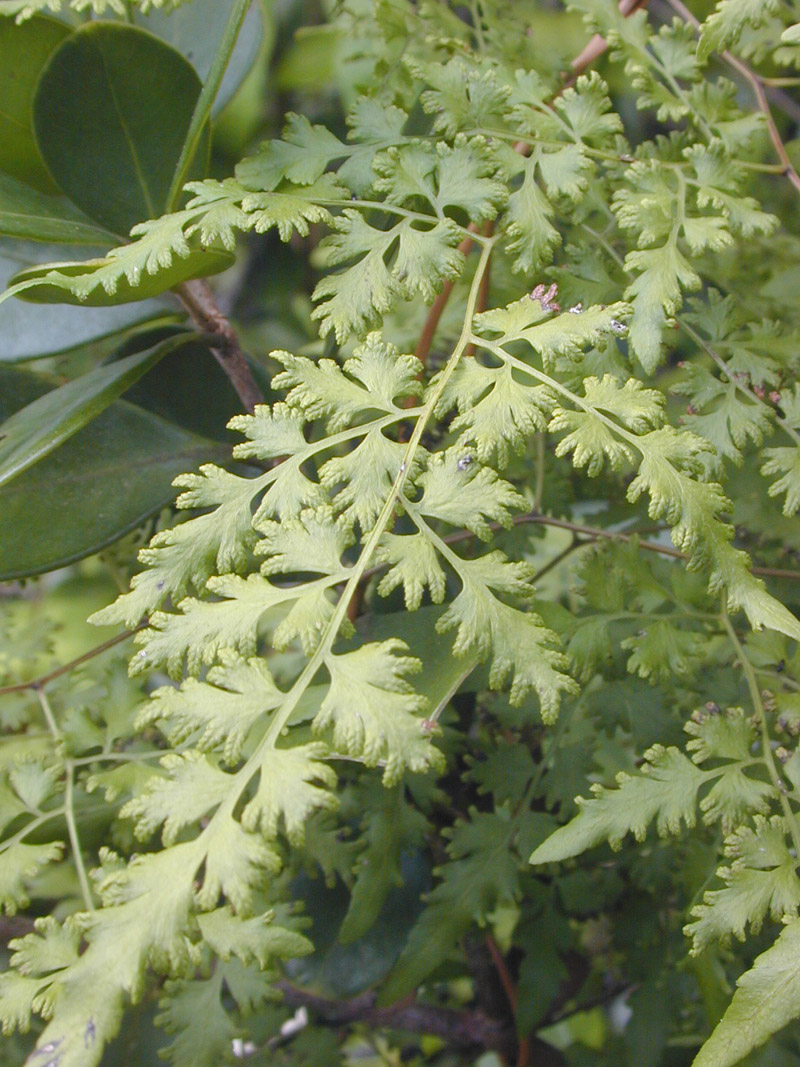
Lygodium japonicum
Scientific classification Edit this classification
Kingdom: Plantae
Clade: Tracheophytes
Division: Polypodiophyta
Class: Polypodiopsida
Order: Schizaeales
Family: Lygodiaceae
C.Presl
Genus: Lygodium
Sw.
Type species
Lygodium scandens
(L.) Sw.
Species

See text

Synonyms[1]
  • Arthrolygodes Presl 1845
  • Cteisium Michaux 1803
  • Gisopteris Bernh. 1800
  • Hugona Cavanilles ex Roemer 1801
  • Hydroglossum Willdenow 1802
  • Lygodictyon Smith ex Hook. 1842
  • Odontopteris Bernhardi 1800 non (Brongniart 1822) Sternberg 1825
  • Ramondia de Mirbel 1801
  • Ugena Cavanilles 1801
  • Vallifilix Du Petit-Thouars 1806

Lygodium (climbing fern) is a genus of about 40 species of ferns, native to tropical regions across the world, with a few temperate species in eastern Asia and eastern North America. It is the sole genus in the family Lygodiaceae in the Pteridophyte Phylogeny Group classification of 2016 (PPG I).[1] Alternatively, the genus may be placed as the only genus in the subfamily Lygodioideae of a more broadly defined family Schizaeaceae,[2] the family placement used in Plants of the World Online as of November 2019.[3] Per recent molecular evidence, Lygodiaceae is thought to have diverged relatively early from the other members of the Schizaeales due to the relatively high level of synonymous sequence divergence between the families within the Schizaeales.[4]

Description

[edit]

Lygodium are unusual in that the rachis, or midrib, of the frond is thin, flexible, and long, the frond unrolling with indeterminate growth and the rachis twining around supports, so that each frond forms a distinct vine. The fronds may be from 3–12 m (9.8–39.4 ft) long, depending on the species. They are also easily identifiable by their possession of apical buds that lay dormant until damage to the rachis occurs, allowing them a high degree of endurance.[5]

Range

[edit]

Lygodium is a wide ranging genus with native populations existing in Asia, Australasia, Africa, and North and South America. The genus is largely pan-tropical, with the center of diversity being Pacific islands, such as Borneo, the Philippine islands, and New Guinea.[5]There do exist several species tolerant of temperate climates such as Lygodium palmatum, which is endemic to the Appalachian region of eastern North America, and Lygodium japonicum, which is native to Japan, but highly invasive in the Southeastern United States. For more on this, refer to the "As invasive species" section below. The lack of extant Lygodium species in Europe is commonly attributed to the Pleistocene glaciation wiping them out. Similar extirpations did not occur in other high middle and high latitude areas, such as the United States and Japan that do have Lygodium populations at present. This discrepancy is thought to be due to the East-West orientation of the European Alps preventing southward migration of Lygodium members, among other extirpated species, while the relatively North-South orientations of the Appalachian mountains and Japanese Alps allowed such southward migration.[5]

Uses

[edit]

Lygodium species, known as nito, are used as a source of fibers in the Philippines. The fibers are used as material for weaving, most notably of traditional salakot headgear.[6][7]

As invasive species

[edit]

Some Lygodium species are now considered very problematic invasive weeds in the southeastern United States. Populations of Lygodium have increased more than 12-fold over the past decade, as noted by Florida's Institute of Food and Agricultural Sciences.[8]

Japanese climbing fern (Lygodium japonicum) was added to the Florida Noxious Weed List in 1999. It is also a major problem in pine plantations, causing contamination and harvesting problems for the pine straw industry. Old World climbing fern (Lygodium microphyllum) infests cypress swamps and other hydric sites, forming a monoculture. This massive infestation displaces all native flora and fauna, completely changing the ecosystem of the area.[9]

Plants in this genus have basal chromosome counts of n=28, 29, 30.

Phylogeny

[edit]
Phylogeny of Lygodium[10][11] Unassigned species:
section

L. articulatum A.Rich.[12] (Mangemange; Bushman's mattress)

L. reticulatum Schkuhr

L. microphyllum (Cav.) R. Br. (Old World climbing fern)

L. volubile Sw.

Volubilia
section

L. palmatum (Bernh.) Swartz (American climbing fern)

Palmata
section

L. circinatum (Burm.fil.) Sw.

L. radiatum Prantl

L. polystachyum Wall. ex Moore

L. japonicum (Thunb.) Sw. (Japanese climbing fern)

L. venustum Sw.

L. lanceolatum Desv.

L. kerstenii Kuhn

L. cubense Kunth

L. oligostachyum (Willd.) Desv.

L. smithianum Presl

Lygodium

References

[edit]
[edit]
Revisions and contributorsEdit on WikipediaRead on Wikipedia
from Grokipedia
Lygodium is a of approximately 40 of climbing ferns in the Lygodiaceae, distinguished by their long, twining, indeterminate fronds that function as vines, allowing the plants to climb and spread extensively. These ferns feature slender, wiry rachises that twine around supports, with compound leaves bearing alternately arranged pinnae; sterile segments are often palmately lobed or pinnate, while fertile segments are dimorphic, with reduced lamina bearing indusiate sporangia on elongated sorophores. Native primarily to and subtropical regions across , , , and the Americas, the genus extends into some temperate areas, particularly in eastern and , where species like L. palmatum are endemic to moist, acidic habitats. The morphology of Lygodium species reflects their adaptation to climbing habits, with creeping, dichotomously branched rhizomes bearing protostelic vascular systems and producing fronds up to 30 meters in length in some tropical species. Spores are tetrahedral-globose and trilete, with thick walls enabling long-distance dispersal, and prothalli are typically heart-shaped, showing in certain species such as L. microphyllum. Ecologically, these thrive in humid, shaded environments like forests and wetlands, contributing to in native ranges but posing significant threats as invasives elsewhere; for instance, L. japonicum and L. microphyllum have naturalized in the , forming dense mats that smother vegetation and alter habitats. In addition to their ecological roles, Lygodium species have cultural and potential medicinal significance; some, like L. venustum, are used in traditional remedies for ailments such as skin conditions, while their ornamental value has led to introductions that sometimes result in invasiveness. Taxonomically, the genus is monophyletic within Lygodiaceae, with ongoing research refining distinctions based on traits like pubescence and lobe morphology, as seen in recent descriptions of variants like L. palmatum subsp. puskariorum.

Taxonomy and phylogeny

Classification and history

Lygodium is a of ferns classified within the kingdom Plantae, division Polypodiophyta, class Polypodiopsida, order Schizaeales, and Lygodiaceae, as outlined in the Pteridophyte Phylogeny Group I (PPG I) classification of 2016. This framework recognizes Lygodiaceae as a distinct separate from Schizaeaceae, based on robust molecular phylogenetic analyses and supporting morphological traits, such as the unique climbing habit and indeterminate growth characteristic of Lygodium . The comprises a single , Lygodium, encompassing approximately 30 distributed primarily in tropical regions. Historically, the genus Lygodium was formally established by Swedish botanist Olof Swartz in 1801, published in the Journal für die Botanik (Schrader), volume 1800(2), pages 7 and 106. Prior to this, species now assigned to Lygodium were indirectly described by in his (1753), notably under the name scandens, which served as the for the type species Lygodium scandens (L.) Sw. The type species, L. scandens, was officially designated in 1842, solidifying the genus's nomenclatural foundation. Earlier classifications often placed Lygodium within the broader family Schizaeaceae, specifically as the subfamily Lygodioideae, reflecting its close affinity to other schizaealean ferns before the advent of molecular data prompted the 2016 familial separation. The nomenclatural history of Lygodium includes its first in and the accumulation of numerous synonyms over time, with approximately 40 recorded names reflecting early taxonomic confusion and revisions. Key synonyms for the genus include Arthrolygodes Presl (1836), Cteisium Michx. (1803), Gisopteris Bernh. (1802), Hydroglossum Willd. (1809), Lygodictyon J. Sm. (1846), Odontopteris Bernh. (), Ophioderma Presl (1836), and Ugena Cav. (). These synonyms arose from 19th-century efforts to delineate the climbing ferns based on limited morphological observations, prior to the integrative evidence that underpins modern .

Phylogenetic relationships

Lygodium represents an early-diverging lineage within the leptosporangiate (Polypodiopsida), placed in the order Schizaeales based on molecular phylogenetic analyses of chloroplast genes such as rbcL and trnL-F. These studies indicate that Schizaeales split from other leptosporangiate lineages during the Permian-Triassic boundary, approximately 200–250 million years ago, marking a basal position in the fern phylogeny. At the family level, Lygodium is the sole genus in the monotypic Lygodiaceae, which is sister to Schizaeaceae (encompassing genera like Schizaea, , and Mohria) within Schizaeales. This close relationship is supported by phylogenomic data from hundreds of nuclear loci, alongside shared morphological traits like marginal sori, though Lygodiaceae is distinguished by its climbing habit and planar gametophytes. Infragenerically, Lygodium has traditionally been divided into sections based on architecture and morphology, such as section Volubilia (twining species like L. japonicum and L. radiatum) and section Palmata (with palmate fronds, e.g., L. palmatum). However, recent phylogenomic investigations reveal that these sectional divisions are largely unsupported, with evidence of reticulate evolution through hybridization and complicating resolution among major clades. The fossil record underscores Lygodium's ancient origins, with the earliest definitive fossils appearing in the of , including sorophores and spores from impressions. These records (ca. 90–66 million years ago) indicate continuity from an earlier molecular-estimated divergence, with no pre- megafossils assigned to the genus despite its deep phylogenetic roots.

Species diversity

The genus Lygodium encompasses approximately 30 species of climbing ferns, along with one recognized hybrid , exhibiting high particularly in . Recent phylogenetic analyses support this refined count, down from earlier estimates exceeding 100 synonyms and provisional names to 29 accepted species plus infraspecific variants. The majority of species are confined to the , with only a few extending into temperate zones in eastern and . Notable species include L. japonicum (Thunb.) Sw., native to and known for its twining habit and potential as an invasive; L. microphyllum (Cav.) R.Br., widespread in tropics with finely divided fronds and invasive tendencies in disturbed areas; L. palmatum (Bernh.) Sw., the sole temperate species in featuring distinctive palmate pinnae; L. articulatum A.Rich., restricted to the with articulate rhizomes; L. reticulatum Schkuhr, from characterized by reticulate venation in its pinnules; L. volubile Sw., a Neotropical species with voluble climbing stems; L. circinatum (Burm.f.) Sw., endemic to and nearby Pacific islands with circinate fronds; L. radiatum Sw., distributed across with radiating fertile segments; L. polystachyum (P.Beauv.) Alston, an African representative with multi-spiked fertile fronds; and L. venustum Sw., found in the noted for its delicate, heart-shaped pinnules. The type species, originally described as L. scandens (L.) Sw., is now synonymous with the pantropically distributed L. flexuosum (L.) Sw., reflecting early taxonomic foundations. Diversity patterns within Lygodium highlight a pantropical distribution, with centers of highest species richness in the Asian and American tropics, including the Indo-Pacific region where over 10 species occur in areas like Borneo. Taxonomic sections such as Volubilia (dominant in the Old World) and Polystachya underscore these biogeographic divisions, with many species showing adaptation to climbing habits in forest understories. Recent taxonomic revisions include the description of L. palmatum subsp. puskariorum in 2025 from the northeastern and mid-Atlantic United States, distinguished by glabrous leaf undersides and hairless petioles, adding to infraspecific diversity. Ongoing synonymizations, such as merging L. mexicanum into L. venustum and L. polymorphum into L. flexuosum, have further stabilized the genus's nomenclature.

Description and biology

Morphology and growth

Lygodium species are perennial, rhizomatous ferns characterized by their distinctive climbing habit, with long, indeterminate twining fronds that can reach lengths of 3–12 m or more in tropical species. These fronds arise from slender, creeping rhizomes and feature a flexible rachis that coils around supports, enabling the plant to ascend trees, shrubs, or other vegetation. In many species, fronds exhibit dimorphism, with sterile fronds typically broader and more vegetative, while fertile fronds bear narrower, modified segments adapted for spore production. The s of Lygodium are slender, hairy, and protostelic, growing horizontally just below the soil surface at depths of 1–3 cm, and they produce adventitious that provide anchorage and nutrient uptake. These emerge along the rhizome and help secure the plant in loose or vertical substrates, supporting the growth form. Fronds emerge from the rhizome in a spiral arrangement and are pinnate to tripinnatifid, with alternate pinnae that are often lanceolate or ovate, measuring 5–20 cm in length and varying in dissection. The rachis apex forms cirrate, tendril-like structures that facilitate initial attachment, and dormant apical buds allow for continued, indefinite elongation even after damage. Growth in Lygodium is adapted for vertical , with the rachis exhibiting responses to mechanical stimuli for twining and support. Fronds can persist for several months to years, with mean lifespans around 5–6 months in some tropical species but extending up to 30 months under favorable conditions. Tropical species, such as L. japonicum and L. microphyllum, display vigorous growth, with fronds capable of rapid extension up to 6.5 cm per day and reaching 30 m in length. In contrast, temperate species like L. palmatum are shorter, typically 1–2.5 m, with less aggressive climbing suited to seasonal climates and dying back in winter.

Reproduction and life cycle

Lygodium species follow the characteristic life cycle, featuring between a prominent diploid phase and a smaller, independent haploid phase. The is homosporous, with each producing a single type of that gives rise to the bisexual . Sporangia develop on specialized fertile pinnae, arranged in marginal sori along the edges of the segments. These sori are protected by reniform indusia that resemble flanges subtending the sporangia, with each sorus typically containing one sporangium. The spores are tetrahedral-globose and trilete, measuring 50–90 μm in diameter, and appear green when fresh due to the presence of chloroplasts. Each sporangium yields 128–256 spores, which are released upon maturation and dehiscence. Upon germination, typically within 6 days under suitable moist conditions, the spores develop into thalloid gametophytes that transition from a filamentous to a heart-shaped (cordate) prothallus. These gametophytes are photosynthetic and typically hermaphroditic, though some develop as unisexual ( or ), producing both antheridia and archegonia on the same individual where bisexual, enabling intragametophytic self-fertilization; antheridiogen, a produced by developing archegonia, promotes antheridia formation on nearby gametophytes, facilitating where possible. Fertilization occurs when multiflagellated from the antheridia swim through a of to reach the within the , a dependent on environmental . The resulting develops into a young that emerges from the , initially forming a tuberous structure before producing its first leaves and . This phase dominates the life cycle, growing into the climbing, indeterminate fronds characteristic of the . Recent genomic studies, such as the 2025 reference genome of L. microphyllum, have revealed differences in transcriptomic and epigenomic landscapes between the and phases, aiding understanding of their distinct functions in the life cycle. Spore dispersal is primarily anemochorous, aided by the vine-like habit that elevates fertile fronds into the canopy for wind release. Long-distance spread can also occur via epizoochory on birds or through human activities such as trade in contaminated or . Spores maintain viability for 1–2 years or longer under dry conditions, contributing to the genus's wide dispersal potential.

Distribution and ecology

Geographic range

The genus Lygodium is in its native distribution, occurring across tropical , , , and the , with extensions into subtropical and temperate regions. It comprises approximately 30–40 , with the center of diversity in the region, where more than half of the are concentrated in the tropics, with significant diversity in (encompassing , the , , and surrounding islands). In subtropical and temperate zones, Lygodium has limited outliers, such as L. japonicum in eastern (from to the ) and L. palmatum in eastern . Biogeographically, the genus shows a division between (primarily , , and ) and () elements, with disjunct distributions like that of L. palmatum restricted to the from to . Several Lygodium species have been introduced outside their native ranges through ornamental trade and human activities, becoming established in new regions. For example, L. microphyllum was introduced to in the mid-20th century (first recorded in cultivation around 1958 and naturalized by the 1960s) and has since spread widely there, while L. japonicum is naturalized in the , , , and parts of . Fossil records indicate that Lygodium has ancient origins, with evidence of its presence in Gondwanan landmasses during the Tertiary period in and , suggesting early diversification. Temperate species like L. palmatum exhibit post-glacial expansions, having recolonized eastern North American refugia following the last .

Habitats and ecological interactions

Lygodium species primarily inhabit moist tropical and subtropical environments, including lowland to lower montane vine forests, open woodlands, riparian zones, and margins of streams, swamps, and bogs. They favor shaded conditions with well-drained soils, often acidic (pH 4.5-6.5) but ranging to neutral, that are sandy or peaty and nutrient-poor, occurring from to elevations around 1500-2000 m. Representative examples include L. palmatum in acidic swamps and moist woods of eastern , and L. flexuosum in tropical Asian forests and open sites. Recent taxonomic work has described variants like L. palmatum subsp. puskariorum (Metzgar, 2025), which grows in moist, acidic soils in the northeastern . In their natural ecosystems, Lygodium ferns function as hemiepiphytic climbers, originating from terrestrial rhizomes but ascending host trees and shrubs via twining fronds to access sunlight, thereby altering light availability in the . They provide microhabitats for , such as arthropods sheltering in mats, contributing to local in canopies. Their climbing habit, briefly referencing the elongate rachises detailed in morphological descriptions, enables vertical stratification and dispersal facilitation within these habitats. Ecological interactions of Lygodium involve competition with native canopy trees and plants through shading and physical smothering, potentially reducing host vigor in dense infestations. Herbivory occurs primarily from specialized , including fern moths like Lygomusotima stria, which feed on fronds and may regulate densities. Symbiotic associations with arbuscular mycorrhizal fungi (AMF) enhance nutrient uptake, particularly , supporting growth in nutrient-limited soils; for instance, AMF colonization promotes in like L. microphyllum. Temperate , such as L. palmatum, exhibit sensitivity to fire, with burns often reducing regrowth and increasing mortality in smaller individuals due to shallow rhizomes. Adaptations to environmental stresses include extensive, creeping rhizomes that store carbohydrates and enable by facilitating resprouting after dry periods or disturbances. Lygodium species are adept at colonizing light gaps created by treefalls, acting as early successional pioneers that rapidly exploit disturbed areas through wind-dispersed spores and vegetative proliferation. These traits underscore their resilience in dynamic understories.

Human uses and status

Cultivation and traditional uses

Lygodium species are cultivated primarily as ornamental vining ferns in greenhouses and tropical gardens, valued for their lacy, climbing fronds that can reach up to 30 meters in length. L. japonicum and L. reticulatum are among the most common in the horticultural trade, with L. japonicum introduced to the as an ornamental in the 1880s and several species becoming widely cultivated in and elsewhere during the mid-19th to early 20th centuries for their decorative appeal in conservatories. These ferns thrive in environments mimicking their native tropical habitats, requiring high humidity levels above 70%, indirect or filtered light to prevent scorching, and acidic to neutral, well-draining soils enriched with to maintain consistent moisture without waterlogging. Propagation is achieved through spores, which are wind-dispersed and germinate in moist conditions, or by dividing rhizomes and using serpentine layering, where frond nodes are pinned to to encourage rooting. In cultivation, roots are often kept in shaded, humid spots while fronds climb toward brighter areas, and the plants perform well in zones with pronounced dry seasons if is provided. Modern hybrids of Lygodium are rare, with most trade relying on wild-collected or established nursery stock. In the , L. circinatum, known locally as "nito," has traditional uses where its wiry stems are harvested for weaving into hats such as the , baskets, and other handicrafts, providing a flexible for tying and plaiting. Medicinal applications in include the use of L. japonicum fronds and roots as poultices for wounds and inflammation in folk remedies, with decoctions serving as diuretics and expectorants to alleviate urinary issues, coughs, and swelling. Economically, Lygodium plays a minor role in the global trade, particularly through the export of nito-based basketry from the and , where sustainable harvesting guidelines emphasize selective collection to avoid of wild populations in secondary forests. Community-based practices, such as those among indigenous groups, promote rotation of harvest sites to ensure regeneration, supporting local livelihoods without depleting resources.

Invasiveness

Several species within the genus Lygodium have become invasive in non-native regions, particularly L. microphyllum (Old World climbing fern) and L. japonicum (Japanese climbing fern), which were introduced to the through horticultural trade. L. microphyllum was first documented in in 1965 and has since expanded dramatically, infesting over 48,000 hectares in southern by 2005, with continued growth despite management efforts. Similarly, L. japonicum, introduced around 1903, has shown explosive spread in the , with populations increasing significantly from the 1990s to early 2000s due to favorable conditions in disturbed habitats. These pose severe ecological threats by forming dense mats that smother native vegetation, block sunlight, and alter forest canopies, leading to and increased intensity as dry fronds serve as ladder fuels. The invasive spread of Lygodium species is facilitated by multiple mechanisms, including prolific spore enabling long-distance wind dispersal, vegetative propagation through extensive rhizomes, and human-mediated transport via ornamental plantings and contaminated equipment. A single fertile leaflet of L. microphyllum can produce up to 28,600 viable spores, which remain dormant for years and germinate in moist conditions to establish new infestations far from parent plants; estimates suggest mature vines release millions of spores annually. Rhizomes allow local expansion, forming interconnected networks that regenerate after disturbance, while historical use in landscaping has aided unintentional introductions across regions. In the southeastern U.S., particularly 's wetlands, swamps, and , Lygodium infestations degrade habitats and contribute to broader invasive plant management costs exceeding $100 million annually in the state alone. Beyond , L. microphyllum invades wetlands in non-native regions including Pacific islands such as and , and has become problematic in parts of its native range in . Economic burdens include direct control expenditures and indirect losses to and , with U.S.-wide efforts for L. microphyllum alone costing over $2 million yearly. Management of invasive Lygodium integrates chemical, mechanical, and biological approaches, supported by regulatory measures. Both L. microphyllum and L. japonicum were designated federal noxious weeds in 2010, following an interim rule in 2009, prohibiting interstate transport and mandating . Herbicides like and are applied aerially or manually to kill fronds and rhizomes, though regrowth necessitates repeated treatments; mechanical cutting disrupts vines but risks dispersal. Biological controls include the defoliating Neomusotima conspurcatalis, released in since 2008, which larvae consume foliage and reduce plant vigor in trials, alongside the leaf-galling Floracarus perrepae introduced in the 2010s. Integrated strategies, including prescribed to suppress growth, have shown promise in reducing coverage by up to 98% in targeted areas, though long-term monitoring is essential due to the ferns' resilience.

Conservation status

The conservation status of Lygodium species is generally favorable for most tropical taxa, which are classified as Least Concern on the IUCN Red List owing to their broad distributions across the Old and New World tropics. However, several species with more restricted ranges, particularly temperate or subtropical disjuncts, exhibit heightened vulnerability at regional or national scales. For example, L. palmatum (American climbing fern) holds a global rank of G4 (apparently secure) from NatureServe, reflecting stable but localized populations in eastern North America, yet it is imperiled (S1) or imperiled/vulnerable (S2) in multiple U.S. states such as Michigan and Georgia due to fragmented habitats. A recently described subspecies, L. palmatum subsp. puskariorum, endemic to the northeastern and mid-Atlantic United States, is less widely distributed than the nominate subspecies and is considered data deficient pending dedicated assessments as of 2025, with known occurrences limited to a handful of sites. Similarly, L. flexuosum receives a Near Threatened (NT) designation in Sri Lanka, highlighting localized pressures despite its overall tropical range. The IUCN has evaluated around five Lygodium species, with vulnerable or higher threat levels assigned to select taxa in specific contexts, such as endemics in island ecosystems. Principal threats to native Lygodium populations encompass loss from , agricultural expansion, and , alongside overcollection for ornamental trade and the indirect on moisture-dependent temperate populations. Hybridization with invasive congeners, such as L. japonicum or L. microphyllum, further endangers genetic integrity in overlapping ranges. For L. palmatum specifically, documented risks include conversion via development and rights-of-way maintenance, recreational disturbances, causing canopy closure and shading, and competition from non-native . Native Lygodium species are represented in various protected areas, including state and federal reserves across the eastern U.S. for L. palmatum, though management of invasive ferns within these sites can challenge native conservation priorities. Recovery initiatives emphasize ex-situ preservation through botanic gardens, with the Royal Botanic Gardens, Kew maintaining extensive records and efforts for the to support potential reintroductions. , NatureServe coordinates ongoing monitoring to inform , while 2025 taxonomic updates underscore the urgency of subspecies-level evaluations to refine global rankings.

References

Add your contribution
Related Hubs
User Avatar
No comments yet.