Hubbry Logo
NephrolepisNephrolepisMain
Open search
Nephrolepis
Community hub
Nephrolepis
logo
8 pages, 0 posts
0 subscribers
Be the first to start a discussion here.
Nephrolepis
Nephrolepis
from Wikipedia

Nephrolepis
Nephrolepis exaltata
Scientific classification Edit this classification
Kingdom: Plantae
Clade: Tracheophytes
Division: Polypodiophyta
Class: Polypodiopsida
Order: Polypodiales
Suborder: Polypodiineae
Family: Nephrolepidaceae
Pic.Serm.
Genus: Nephrolepis
Schott
Type species
Nephrolepis exaltata
(L.) Schott
Species

See text

Synonyms
  • Lepidoneuron Fée
  • Leptopleuria Presl
  • Lindsayoides Nakai

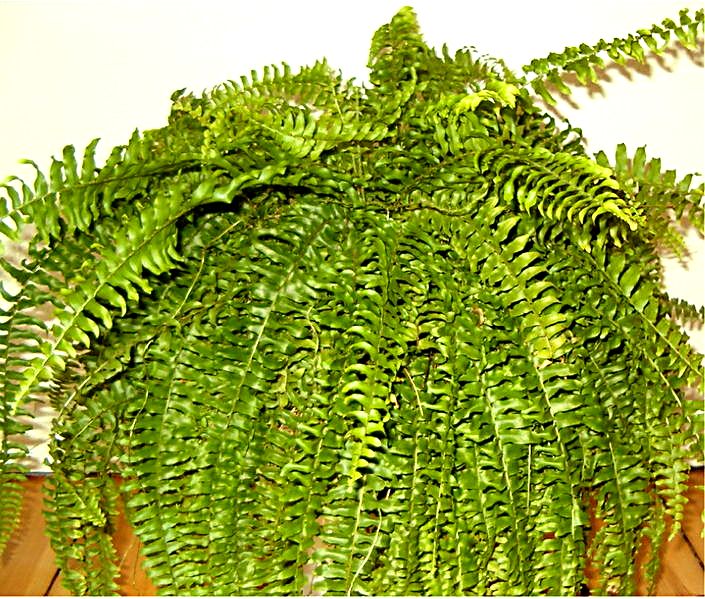
Nephrolepis is a genus of about 30 species of ferns. It is the only genus in the family Nephrolepidaceae, placed in the suborder Aspleniineae (eupolypods I) of the order Polypodiales in the Pteridophyte Phylogeny Group classification of 2016 (PPG I).[1] (It is placed in the Dryopteridaceae in some other classifications.[2]) Species in this genus include plants commonly referred to as Boston ferns.[3] The fronds are long and narrow, and once-pinnate, in the case of one Bornean species reaching thirty feet (nine meters) in length.[4]

Phylogeny

[edit]

The following cladogram for the suborder Polypodiineae (eupolypods I), based on the consensus cladogram in the Pteridophyte Phylogeny Group classification of 2016 (PPG I),[1] shows a likely phylogenetic relationship between Nephrolepidaceae and the other families of the clade.

External phylogeny[1] Internal phylogeny[5][6] Other species include:
Polypodiineae
(eupolypods I)
  • N. arida Jones 1988
  • N. ×averyi Nauman
  • N. cocosensis Rojas 2017
  • N. ×copelandii Wagner 1999
  • N. delicatula (Decaisne) Pichi Sermolli
  • N. dicksonioides Christ 1895
  • N. duffii Moore
  • N. equilatera Rojas
  • N. favosa Skuratenko 1968
  • N. grayumiana Rojas
  • N. ×hippocrepidis Miyam. 2005
  • N. kurotawae Makino 1895
  • N. ×medlerae Wagner 1999
  • N. multiflora (Roxburgh) Jarrett ex Morton
  • N. obtusiloba A. Rojas
  • N. occidentalis Kunze
  • N. penduliformis Skuratenko 1968
  • N. pickelii Rosenstock ex Sampaio 1930
  • N. ×pseudobiserrata Miyam. 2005
  • N. sibirica Skuratenko 1968
  • N. tuberosa (Bory ex Willdenow) Presl

Selected species

[edit]

Some species of Nephrolepis are grown as ornamental plants. Nephrolepis exaltata and Nephrolepis obliterata are reported to be good plants for cleaning indoor air.[7]

Some Nephrolepis species may prove to be a good source of new antimicrobial chemicals.[8]

References

[edit]

Further reading

[edit]
[edit]
Revisions and contributorsEdit on WikipediaRead on Wikipedia
from Grokipedia
Nephrolepis is a of approximately 25–30 of ferns in the Nephrolepidaceae, comprising terrestrial, epiphytic, or rupestral native to regions with the greatest diversity in . These ferns feature erect or short-creeping rhizomes that produce wiry stolons for vegetative propagation, sometimes forming underground tubers, and bear monomorphic, fronds that are typically 1-pinnate and narrowly elliptic to linear-lanceolate in shape. The sori are round and protected by reniform to lunate indusia, from which the genus name derives: Greek nephros () and lepis (scale). The base chromosome number is x = 41, and spores are brownish and tuberculate to rugose. Taxonomically, Nephrolepis was established by Heinrich Wilhelm Schott in and is placed in the order , suborder Aspleniineae. Although some classifications formerly included it in Dryopteridaceae, it is now recognized as the sole in Nephrolepidaceae according to the Phylogeny Group I system. A conspectus recognizes around 19 , three varieties, and several hybrids, though broader estimates account for up to 30 when including regional variants. The exhibits a complex , with origins traced to ancient dispersals across the , and several have become naturalized or widely cultivated outside their native ranges. Notable species include N. exaltata, commonly known as the Boston fern, which is prized as an ornamental for its arching, feathery fronds and air-purifying qualities, and N. cordifolia, the ladder fern, valued for its compact growth and tolerance of varied conditions. Many cultivars, such as 'Bostoniensis' and 'Fluffy Ruffles', have been developed for , featuring variations in texture from 1-pinnate to more divided forms. In natural habitats, Nephrolepis species thrive in humid, shaded environments like forest floors or on tree trunks, contributing to tropical , while their stolons enable rapid colonization.

Taxonomy and Phylogeny

Etymology

The genus name Nephrolepis derives from the Greek words nephros (νεφρός), meaning "," and lepis (λεπίς), meaning "scale," in reference to the kidney-shaped indusia that cover the sori on the fronds of these . This nomenclature highlights a key morphological feature distinguishing the within . The was established by Austrian Heinrich Wilhelm Schott in 1834, in his Genera Filicum, where he segregated previously placed in genera such as Aspidium and Polypodium. Schott's work provided the foundational description, emphasizing the distinctive indusial structure that inspired the name.

Classification

Nephrolepis is classified as the sole genus within the family Nephrolepidaceae, which is placed in the suborder Aspleniineae (also known as eupolypods I) of the order , according to the Pteridophyte Phylogeny Group classification (PPG I) of 2016. This placement reflects molecular phylogenetic evidence supporting its and distinction from related groups. Historically, Nephrolepis has been classified in other families, including Dryopteridaceae in some systems due to shared morphological traits like structure, and Lomariopsidaceae in earlier treatments that grouped it with genera such as Lomariopsis based on sorus and indusium characteristics. The Nephrolepis was established by Heinrich Wilhelm Schott in 1834, with synonyms including Lepidoneuron Fée, Leptopleuria C. Presl, and Lindsayoides Nakai, which were later synonymized based on nomenclatural revisions. The is N. exaltata (L.) Schott, lectotypified by John Smith in Historia Filicum in 1875. The comprises approximately 28 accepted (as of POWO 2024), primarily tropical ferns characterized by their sword-like fronds and creeping rhizomes, with estimates varying up to 30 when including varieties and hybrids.

Phylogeny

Nephrolepidaceae, the family to which the genus Nephrolepis belongs, is positioned within the suborder Aspleniineae of the order , forming part of the eupolypods I clade among leptosporangiate ferns. This placement reflects its evolutionary relationships resolved through extensive molecular phylogenetic studies, where Nephrolepidaceae emerges as sister to the remaining families in Aspleniineae, including Thelypteridaceae, Aspleniaceae, and Cystopteridaceae. Molecular evidence from the Phylogeny Group I (PPG I) classification strongly supports the of Nephrolepidaceae, based on analyses of multiple loci (e.g., rbcL, atpA) and limited nuclear data, confirming the family's coherence as a single-genus lineage distinct from neighboring groups. The 2016 PPG I framework integrated over 300 genera across , highlighting Nephrolepidaceae's robust support ( >0.95) within eupolypods I. Complementing this, the (FTOL) project in 2022 generated a comprehensive, time-calibrated phylogeny using transcriptomic and genomic data from hundreds of species, depicting Nephrolepidaceae's divergence from other polypod in the mid-Cretaceous, approximately 100–120 million years ago, amid the radiation of angiosperms. Historically, taxonomic treatments of Nephrolepis relied heavily on morphological traits such as creeping rhizomes, pinnate fronds, and linear sori with kidney-shaped indusia, leading to variable placements in families like Davalliaceae, Oleandraceae, or even Dryopteridaceae in 19th- and early 20th-century systems. DNA , particularly from the onward, revolutionized this understanding by revealing morphological convergence in sori and venation patterns across polypod ferns, ultimately affirming Nephrolepidaceae's independent status through cladistic analyses that prioritize molecular synapomorphies over superficial similarities.

Description

Morphology

Nephrolepis species are terrestrial, epiphytic, or lithophytic ferns characterized by long, narrow, arching fronds that are once-pinnate and arise from a short, ascending to erect or crown, often forming a dense, fountain-like tuft of foliage. The fronds emerge from the rhizome in a rosette pattern, with blades that are narrowly elliptic to linear-lanceolate and herbaceous to papery in texture, gradually tapering to a minute pinnatifid apex. This structure contributes to their graceful, cascading habit, particularly in cultivated varieties like the Boston fern (N. exaltata). Frond lengths exhibit significant variation across the , ranging from approximately 20 cm in compact to over 3 m in robust forms such as the Bornean N. biserrata, where mature s can reach 120–300 cm or more under optimal conditions. The petioles, comprising about 1/10 to 1/2 the blade length, are not swollen at the base and feature multiple vascular bundles arranged in an arc. Pinnae are articulate to the rachis and often , arranged alternately and typically lanceolate or oblong, with entire, crenulate, or biserrate margins; proximal pinnae are reduced and sessile, displaying equilateral or inequilateral bases. In like N. biserrata and N. undulata, pinnae measure 5–15 cm long and 1–3 cm wide, with acute to acuminate apices and serrated edges. The is scaly, creeping or erect, and produces wiry stolons that facilitate vegetative spread, along with adventitious for anchorage and uptake. Some species, notably N. cordifolia, develop small, scaly underground tubers (1–1.5 cm in diameter) on the stolons, aiding in propagation and survival in varied habitats. Sori are borne in one or two rows near the margins on the abaxial surface of the pinnae, appearing round and covered by persistent, kidney-shaped (reniform) indusia with a deep sinus, measuring 1–1.7 mm wide.

Reproduction

Nephrolepis exhibits the typical alternation of , characterized by a dominant diploid phase and a free-living haploid phase. The , consisting of rhizomes, roots, and pinnate fronds, produces haploid spores through in sporangia clustered into sori on the undersides of fertile fronds. These sori are typically brown and kidney-shaped, protected by a membranous indusium. The spores of Nephrolepis are bilateral and monolete, featuring a linear and often tuberculate or verrucate exospores, with dimensions ranging from 27–39 μm in length. Upon dispersal, the spores germinate on moist substrates to form heart-shaped prothallia, the gametophytes, which are small, green, and thalloid structures bearing rhizoids for anchorage. These prothallia produce antheridia (male gametangia) on their undersides, releasing multiflagellated spermatozoids, and archegonia (female gametangia) at their notches, each containing a single egg. Fertilization occurs in the presence of , allowing spermatozoids to swim to and enter the to fuse with the , forming a diploid that develops into a young . The grows into a new attached to the prothallus until it becomes independent. In some cultivated forms of Nephrolepis, apogamy can occur, where a haploid develops directly from cells without fertilization, often induced by environmental factors such as high light or temperature. Asexual reproduction in Nephrolepis is common, particularly through vegetative means that bypass the sexual cycle. Species like N. cordifolia produce underground tubers along rhizomes, which can sprout new plants, as well as wiry stolons or runners that root at nodes to form daughter plants.

Distribution and Habitat

Geographic Range

The genus Nephrolepis is native to tropical and subtropical regions worldwide, encompassing parts of the and , with approximately 19 recognized species distributed across , , , the Pacific Islands, the , and the . In the Old World, species occur natively in (e.g., N. cordifolia in , , , ; N. biserrata including African regions), (e.g., N. exaltata and N. cordifolia in , , , ; N. brownii in ), (e.g., N. cordifolia in and , N. brownii in , N. acutifolia native to and the Palaeotropics), and the Pacific Islands (e.g., N. exaltata in , N. cordifolia in and , N. brownii in and ). In the , Nephrolepis species are native to the and , with N. exaltata originating in tropical America including , , , , and parts of such as , , and . N. biserrata exhibits a range extending to the (e.g., Central and ) and islands like and , where N. cordifolia is also naturalized. Several Nephrolepis species have been introduced beyond their native ranges through cultivation and have become naturalized or invasive in subtropical and temperate areas. N. exaltata is pantropical and naturalized in regions such as , , , and parts of . N. cordifolia is widespread and invasive in subtropical zones, established from northward to Georgia and in the . N. brownii, native to , has been introduced to the tropical Americas and is invasive in .

Ecological Preferences

Nephrolepis species primarily inhabit humid, shaded understories of tropical rainforests, where they grow as terrestrial plants on forest floors or as epiphytes on tree trunks and branches. They also occur on rocky slopes and in streamsides, favoring environments with consistent moisture and partial shade to protect against . Some species, such as N. cordifolia, exhibit tuberous rhizomes that enable occasional in marginally drier microhabitats. These ferns prefer well-drained soils rich in , ranging from acidic to neutral , often in humus-laden substrates like decaying leaf litter or loamy forest soils. They thrive in tropical climates with temperatures between 20–30°C and high relative humidity exceeding 70%, conditions prevalent in lowland to montane forests. Altitudinally, Nephrolepis extends from to approximately 2000 m, with many species concentrated below 1200 m in wetter zones. Nephrolepis forms symbiotic associations with arbuscular mycorrhizal fungi, which enhance nutrient uptake, particularly , in nutrient-poor soils. Certain act as pioneers in disturbed areas, rapidly colonizing cleared or eroded sites through vegetative spread.

Species

Diversity and Selected Species

The genus Nephrolepis comprises approximately 28 accepted , exhibiting high diversity particularly in the region, where many are native to tropical and subtropical forests, often as epiphytes or terrestrials. Several species have become widely distributed through human activity, with some establishing as weedy invasives in non-native habitats or gaining popularity as ornamentals due to their attractive fronds and adaptability. One prominent species is , commonly known as the Boston or sword , which features arching, pinnate fronds typically 50–100 cm long and supported by long, ladder-like stolons that facilitate vegetative spread. Native to tropical and subtropical America but widely cultivated, it forms dense clumps with broadly lanceolate pinnae that give a feathery appearance. Nephrolepis cordifolia, the tuberous sword fern, is distinguished by its underground tubers that enable persistent regrowth and contribute to its invasive potential in disturbed areas. This species produces erect to arching fronds up to 60 cm long, with narrow, entire pinnae, and is native to , , and the Pacific but has spread aggressively in regions like and . Native to , Papuasia, and the western Pacific, Nephrolepis obliterata (commonly associated with the Kimberley Queen ) is notable for its compact, upright growth and tolerance to drier conditions compared to other congeners. It features dense, leathery fronds 40–70 cm long with closely spaced, lanceolate pinnae, thriving in the tropical savannas of . The fishtail sword fern, Nephrolepis falcata, is characterized by its distinctive serrated or forked pinnae that resemble a tail, adding unique texture to its 80–150 cm long fronds. Native to and the Pacific, it grows epiphytically or terrestrially, with stipes bearing pale brown scales. Among the largest in the , Nephrolepis biserrata (giant sword ) can form expansive mounds with fronds reaching up to 2.5 m in length, featuring broadly serrated pinnae that provide a bold, tropical aesthetic. Native to the of the , , and , it spreads via creeping rhizomes and is often used in large-scale .

The majority of Nephrolepis species are considered of least concern or by the International Union for the Conservation of Nature (IUCN), owing to their broad tropical and subtropical distributions across the Old and New Worlds. As of 2025, no species in the are globally assessed as Endangered or higher by the IUCN, with most being Least Concern or . For instance, the widespread N. exaltata is assessed as Least Concern, with no major global threats identified beyond localized pressures. Similarly, many other species in the genus, such as N. cordifolia in its native range, face minimal risk due to their adaptability and occurrence in diverse habitats. However, habitat loss from , , and in tropical regions poses significant threats to some endemic or range-restricted Nephrolepis species. In , N. biserrata is state-listed as threatened, primarily due to degradation of hammocks and coastal wetlands, which reduces available epiphytic and terrestrial sites for this species. Such pressures are exacerbated in island and fragmented ecosystems, where endemics like certain Southeast Asian Nephrolepis taxa experience population declines from land conversion. Several Nephrolepis species have become invasive beyond their native ranges, impacting native flora by forming dense monocultures that outcompete and displace local vegetation. N. cordifolia is classified as an environmental weed in eastern , including and , where it aggressively spreads via tubers and spores in rainforests and open forests, altering composition. In , N. cordifolia is designated a Category I invasive by the Florida Exotic Pest Plant Council, proliferating in disturbed areas and wetlands to the detriment of native ferns and groundcovers. Likewise, N. brownii (formerly known as N. multiflora) is invasive in central and southern , invading hammocks and rocklands where it suppresses regeneration of endemic species through rapid colonization. Conservation measures for Nephrolepis emphasize habitat protection and management, as there is no dedicated global Red List for the ; assessments occur at the level via IUCN. Native Australian , such as N. hirsutula and N. obliterata, are safeguarded within Queensland's protected areas, including national parks and regional ecosystems like vine thickets, where they contribute to diversity. Efforts in include tracking threatened taxa like N. biserrata and control programs for invasives, such as manual removal and herbicide application in natural areas, to preserve . Ongoing monitoring through botanical surveys supports these initiatives, focusing on vulnerable populations in tropical hotspots.

Cultivation and Uses

Ornamental Cultivation

Nephrolepis species, particularly N. exaltata, have been popular ornamental plants since the of the , when they were prized for their graceful, arching fronds in hanging baskets and indoor displays. The N. exaltata 'Bostoniensis', known as the Boston fern, emerged as a favorite for parlor decor after its introduction to in the late 1800s, symbolizing the era's fascination with ferns in domestic settings. In modern cultivation, N. exaltata is valued for its air-purifying qualities, as demonstrated in the 1989 , which found that the plant removes 1860 micrograms of and 360 micrograms of per hour per plant under controlled conditions in sealed chambers. This capability makes it a recommended for improving air quality in homes and offices. Additionally, extracts from the fronds of N. biserrata exhibit potential properties, inhibiting the growth of bacteria such as Staphylococcus aureus and Escherichia coli , suggesting possible applications in natural antimicrobial agents. Over 100 cultivars of Nephrolepis exist, offering diverse options for ornamental use, including dwarf forms like N. exaltata 'Marissa' for compact spaces and variegated varieties such as N. exaltata 'Tiger Fern' with its striking green-and-yellow striped fronds. These selections enhance aesthetic versatility in hanging baskets, terrariums, and garden borders.

Propagation and Care

Nephrolepis ferns are commonly propagated through division of rhizomes or clumps, a straightforward method that involves separating the root ball with a sharp knife during repotting in spring, ensuring each division has several fronds and roots. For species such as N. exaltata, propagation via runners or stolons is effective; these slender structures root when they contact moist soil, allowing new plants to form naturally or be encouraged by pinning them down. Spore propagation is possible but less common in cultivation, as it requires sterile conditions and does not preserve cultivar traits. In N. cordifolia, underground tubers along stolons can be divided and potted individually for reliable reproduction. In cultivation, Nephrolepis requires bright indirect to maintain lush fronds, such as from an east-facing or filtered southern exposure, while avoiding direct sun that can scorch leaves. Optimal temperatures range from 18-24°C (65-75°F) during the day, with nights 5-6°C cooler to mimic natural conditions, and levels of 50-70% to prevent tip browning. Watering should keep the well-drained, peat-based evenly moist but never waterlogged, using room-temperature to avoid shock, and allowing the surface to dry slightly between applications. Fertilize with a balanced formula at half strength every 4-6 weeks during the growing season (spring to fall), reducing or withholding in winter to match slower growth. These ferns are susceptible to pests such as scale insects and spider mites, which thrive in dry indoor conditions and can be managed by isolating affected plants, washing fronds with mild soapy water, or applying sprays as a natural treatment. Their slow-growing habit supports medium-term storage under cool conditions of around 15°C (59°F) with low light and moderate humidity, preserving viability without significant decline for several weeks.

References

Add your contribution
Related Hubs
User Avatar
No comments yet.