


Community hub
Recent from talks
Contribute something
Nothing was collected or created yet.
Lysistrata
View on Wikipedia | This article has multiple issues. Please help improve it or discuss these issues on the talk page. (Learn how and when to remove these messages)
|


| Lysistrata | |
|---|---|
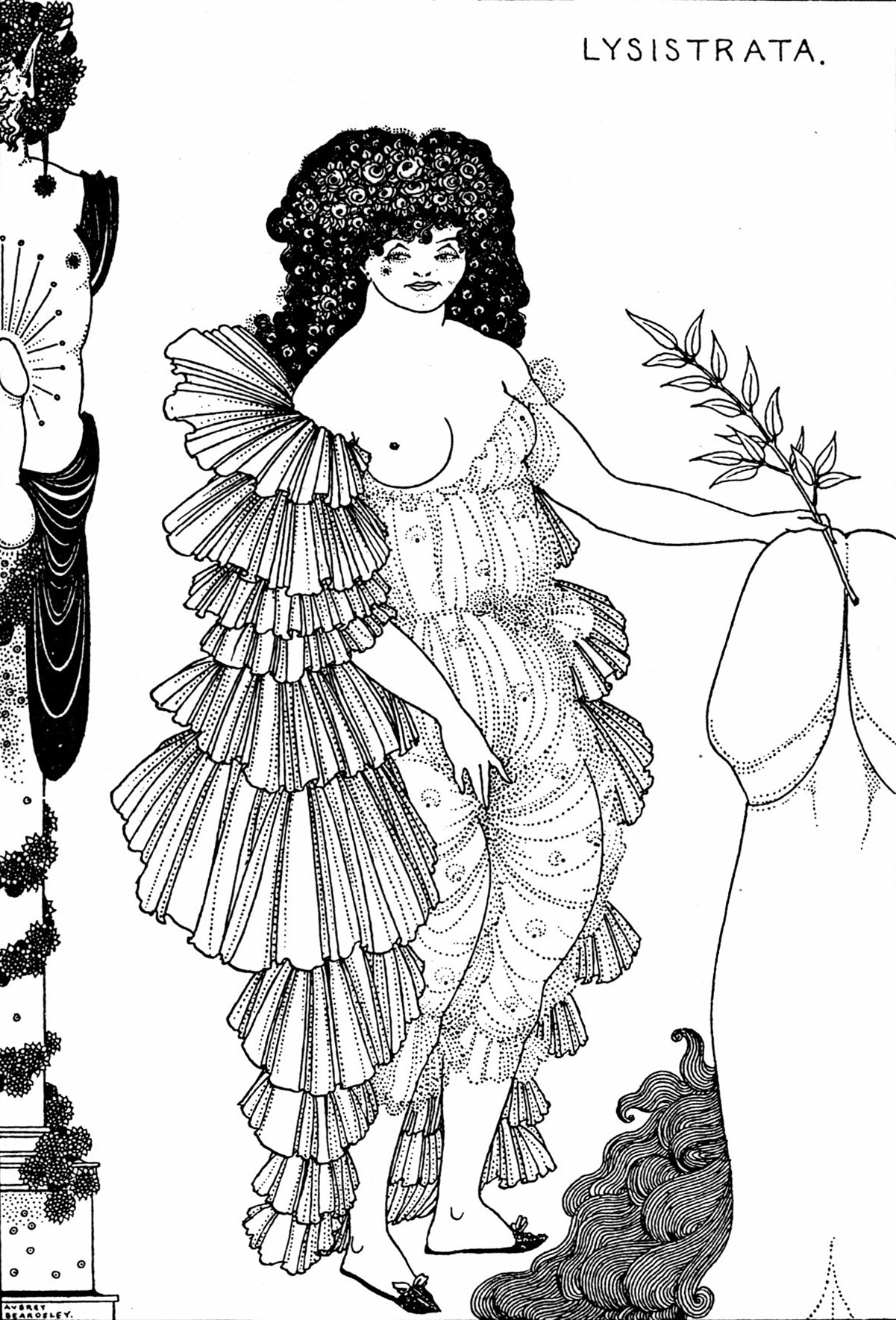
 Illustration by Aubrey Beardsley, 1896 Dramatis Personae in ancient comedy depend on scholars' interpretation of textual evidence. This list is based on Alan Sommerstein's 1973 translation.[1] | |
| Written by | Aristophanes |
| Chorus |
|
| Characters |
|
| Mute |
|
| Setting | Before the Propylaea, or gateway to the Acropolis of Athens, 411 BC |
Lysistrata (/laɪˈsɪstrətə/ or /ˌlɪsəˈstrɑːtə/; Attic Greek: Λυσιστράτη, Lysistrátē, lit. 'army disbander') is an ancient Greek comedy by Aristophanes, originally performed in classical Athens in 411 BC[2]: xi . It is a comic account of a woman's mission to end the Peloponnesian War between Greek city states by denying all the men of the land any sex, which was said to be the only thing they truly and deeply desired. Lysistrata persuades the women of the warring cities to engage in a sex strike as a means of forcing the men to negotiate peace – a strategy that inflames the battle between the sexes.[citation needed]
The play is notable for being an early exposé of sexual relations in a male-dominated society. Its structure represents a shift from the conventions of Old Comedy, a trend typical of the author's career.[3] It was produced in the same year as the Thesmophoriazusae, another play with a focus on gender-based issues, just two years after Athens's defeat in the Sicilian Expedition.[citation needed]
Plot
[edit]
- LYSISTRATA
There are a lot of things about us women
That sadden me, considering how men
See us as rascals.
- CALONICE
As indeed we are!
The play begins with these lines spoken by the Athenian Lysistrata and her friend Calonice.[4] Women, as represented by Calonice, are sly hedonists in need of firm guidance and direction. In contrast, Lysistrata is portrayed to be an extraordinary woman with a large sense of individual and social responsibility. She has convened a meeting of women from various Greek city-states that are at war with each other. Soon after she confides in her friend her concerns for the female sex, the women begin arriving.
With support from the Spartan Lampito, Lysistrata persuades the other women to withhold sexual privileges from their menfolk as a means of forcing them to conclude the Peloponnesian War. The women are reluctant, but the deal is sealed with a solemn oath around a wine bowl in which the women abjure all their sexual pleasures, including the "lioness on the cheese-grater".[7]
Soon after the oath is finished, a cry of triumph is heard from the nearby Acropolis—the old women of Athens have seized control of it at Lysistrata's instigation, since it holds the state treasury, without which the men cannot long continue to fund their war. Lampito goes off to spread the word of revolt, and the other women retreat behind the barred gates of the Acropolis to await the men's response.
A Chorus of Old Men arrives, planning on burning down the gate of the Acropolis if the women do not open up. They are still making preparations to assault the gate when a Chorus of Old Women arrives, bearing pitchers of water. The Old Women complain about the difficulty they had getting the water, but they are ready for a fight in defence of their younger comrades. Threats are exchanged, and the Old Men are defeated with the water.
The magistrate then arrives with some Scythian Archers (the Athenian version of police constables). He reflects on the nature of women, their devotion to wine, promiscuous sex, and exotic cults (such as to Sabazius and Adonis), but above all he blames men for poor supervision of their womenfolk. He has come for silver from the state treasury to buy oars for the fleet and he instructs his Scythians to begin levering open the gate. However, they are quickly overwhelmed by groups of women with long names.[8]
Lysistrata restores order and allows the magistrate to question her. She explains the frustrations that women feel at a time of war when the men make decisions that affect everyone, and further complains that their wives' opinions are not listened to. She drapes her headdress over him, gives him a basket of wool and tells him that war will be a woman's business from now on. She then explains the pity she feels for young, childless women, aging at home while the men are away on endless campaigns. When the magistrate points out that men also age, she reminds him that men can marry at any age whereas a woman has only a short time before she is considered too old. She then dresses the magistrate like a corpse for laying out, with a wreath and a fillet, and advises him that he's dead. The magistrate storms off to report the incident to his colleagues, while Lysistrata returns to the Acropolis.
The debate is continued between the Chorus of Old Men and the Chorus of Old Women until Lysistrata returns to the stage with the news that her comrades are desperate for sex and they are beginning to desert on the silliest pretexts (for example, one woman says she has to go home to air her fabrics by spreading them on the bed). After rallying her comrades and restoring their discipline, Lysistrata again returns to the Acropolis to continue waiting for the men's surrender.
A man suddenly appears, desperate for sex. It is Kinesias, the husband of Myrrhine. Lysistrata instructs her to torture him. Myrrhine informs Kinesias that she will have sex with him but only if he promises to end the war. He promptly agrees to these terms and the young couple prepares for sex on the spot. Myrrhine fetches a bed, a mattress, a pillow, a blanket, and a flask of oil, and after delaying the act for some time, locks herself in the Acropolis once more.
A Spartan herald then appears with a large burden (an erection) scarcely hidden inside his tunic and he requests to see the ruling council to arrange peace talks. The magistrate laughs at the herald's situation, but agrees that peace talks should begin.
They go off to fetch the delegates. While they are gone, the Old Women make overtures to the Old Men. The two Choruses merge, singing and dancing in unison. Peace talks commence and Lysistrata introduces the Spartan and Athenian delegates to a woman called Reconciliation. The delegates cannot take their eyes off the woman; meanwhile, Lysistrata scolds both sides for past errors of judgment. The delegates briefly squabble over the peace terms, but with Reconciliation before them, they overcome their differences and retire to the Acropolis for celebrations. The war is ended.
Historical background
[edit]Some events that are significant for understanding the play:[citation needed]
- 424 BC: The Knights won first prize at the Lenaia. Its protagonist, a sausage-seller named Agoracritus, emerges at the end of the play as the improbable saviour of Athens (Lysistrata is its saviour thirteen years later).
- 421 BC: Peace was produced. Its protagonist, Trygaeus, emerges as the improbable champion of universal peace (Lysistrata's role 10 years later). The Peace of Nicias was formalised this same year, ending the first half of the Peloponnesian War (referred to in Lysistrata as "The Former War").[9]
- 413 BC: The Athenians and their allies suffered a catastrophic defeat in the Sicilian Expedition, a turning-point in the long-running Peloponnesian War.
- 411 BC: Both Thesmophoriazusae and Lysistrata were produced; an oligarchic revolution (one of the consequences of the Sicilian disaster) proved briefly successful.
Old Comedy was a topical genre and the playwright expected his audience to be familiar with local identities and issues. The following list of identities mentioned in the play gives some indication of the difficulty faced by any producer trying to stage Lysistrata for modern audiences:[citation needed]
- Korybantes: Devotees of the Asiatic goddess Cybele—Lysistrata says that Athenian men resemble them when they do their shopping in full armour, a habit she and the other women deplore.[10]
- Hermokopidae: Vandals who mutilated the herms in Athens at the onset of the Sicilian Expedition. They are mentioned in the play as a reason why the peace delegates should not remove their cloaks, in case they too are vandalized.[11]
- Hippias: An Athenian tyrant, he receives two mentions in the play, as a sample of the kind of tyranny that the Old Men can "smell" in the revolt by the women[12] and secondly in connection with a good service that the Spartans once rendered Athens (they removed him from power by force)[13]
- Aristogeiton: A famous tyrannicide, he is mentioned briefly here with approval by the Old Men.[14]
- Cimon: An Athenian commander, mentioned here by Lysistrata in connection with the Spartan king Pericleides who had once requested and obtained Athenian help in putting down a revolt by helots.[15]
- Myronides: An Athenian general in the 450s, he is mentioned by the Old Men as a good example of a hairy guy, together with Phormio, the Athenian admiral who swept the Spartans from the sea between 430 and 428 BC.[16]
- Peisander: An Athenian aristocrat and oligarch, he is mentioned here by Lysistrata as typical of a corrupt politician exploiting the war for personal gain.[17] He was previously mentioned in Peace[18] and The Birds[19]
- Demostratus: An Athenian who proposed and carried the motion in support of the Sicilian Expedition, he is mentioned briefly by the magistrate.[20]
- Cleisthenes: A notoriously effete homosexual and the butt of many jokes in Old Comedy, he receives two mentions here, firstly as a suspected mediator between the Spartans and the Athenian women[21] and secondly as someone that sex-starved Athenian men are beginning to consider a viable proposition.[22]
- Theogenes: A nouveau riche politician, he is mentioned here[23] as the husband of a woman who is expected to attend the meeting called by Lysistrata. He is lampooned earlier in The Wasps,[24] Peace[25] and The Birds.[26]
- Lycon: A minor politician who afterwards figured significantly in the trial of Socrates,[27] he is mentioned here merely as the husband of a woman that the Old Men have a particular dislike for[28] (he is mentioned also in The Wasps).[29]
- Cleomenes I: A Spartan king, who is mentioned by the Old Men in connection with the heroism of ordinary Athenians in resisting Spartan interference in their politics.[30]
- Leonidas: The famous Spartan king who led a Greek force against the Persians at Thermopylae, he is mentioned by the Spartan envoys in association with the Athenian victory against the Persian fleet at the Battle of Artemisium.[31]
- Artemisia: A female ruler of Ionia, famous for her participation in the naval Battle of Salamis, she is mentioned by the Old Men with awe[32] as a kind of Amazon.
- Homer: The epic poet is quoted in a circuitous manner when Lysistrata quotes her husband[33] who quotes from a speech by Hector in the Iliad as he farewells his wife before going to battle: "War will be men's business."[34]
- Aeschylus: The tragic poet is mentioned briefly[35] as the source of a ferocious oath that Lysistrata proposes to her comrades, in which a shield is to be filled with blood; the oath is found in Aeschylus's Seven Against Thebes.[36]
- Euripides: The dramatic poet receives two brief mentions here, in each case by the Old Men with approval as a misogynist.[37]
- Pherecrates: A contemporary comic poet, he is quoted by Lysistrata as the author of the saying: "to skin a flayed dog."[38]
- Bupalus: A sculptor who is known to have made a caricature of the satirist Hipponax[39] he is mentioned here briefly by the Old Men in reference to their own desire to assault rebellious women.[40]
- Micon: An artist, he is mentioned briefly by the Old Men in reference to Amazons[41] (because he depicted a battle between Theseus and Amazons on the Painted Stoa).
- Timon: The legendary misanthrope, he is mentioned here with approval by the Old Women in response to the Old Men's favourable mention of Melanion, a legendary misogynist[42]
- Orsilochus and Pellene: An Athenian pimp and a prostitute,[43] mentioned briefly to illustrate sexual desire.[44]
Pellene was also the name of a Peloponnesian town resisting Spartan pressure to contribute to naval operations against Athens at this time. It was mentioned earlier in the Birds.[45]
Writing conventions
[edit]Lysistrata belongs to the middle period of Aristophanes's career when he was beginning to diverge significantly from the conventions of Old Comedy. Such variations from convention include:
- The divided Chorus: The Chorus begins this play being divided (Old Men versus Old Women), and its unification later in the play is meant to exemplify reconciliation. A doubling of the role of the Chorus occurs in two other middle-period plays, The Frogs and Thesmophoriazusae, but in each of those plays the two Choruses appear consecutively rather than simultaneously. The nearest equivalent to Lysistrata's divided Chorus is found in the earliest of the surviving plays, The Acharnians, where the Chorus very briefly divides into factions for and against the protagonist.[46]
- Parabasis: In Classical Greek comedy, parabasis is 'a speech in which the chorus comes forward and addresses the audience'. A parabasis is not featured in Lysistrata. Most plays have a second parabasis near the end, and a feature akin to a parabasis is used in this play as a replacement, however it comprises exclusively two songs (strophe and antistrophe) which are separated by an episodic scene of dialogue.[47]
- Agon: The plays of Aristophanes contain formal disputes or agons that are constructed for rhetorical effect. Lysistrata's debate with the proboulos (magistrate) is an unusual agon[48] in that one character (Lysistrata) does a majority of the talking, while the antagonist's dialogue (the magistrate) is reserved for questions or expressions of emotion. The informality of the agon draws attention to the absurdity of a classical woman engaging in public debate.[49] Like most agons, it is structured symmetrically in two sections, each half comprising long verses of anapests that are introduced by a choral song and that end in a pnigos.
Influence and legacy
[edit]- c. 1611: John Fletcher wrote his play The Woman's Prize, or The Tamer Tamed, which echoes Lysistrata's sex-strike plot.
- 1902: Adapted as an operetta by Paul Lincke.
- 1910: Performed at the Little Theatre in the Adelphi in London with Gertrude Kingston in the title role.
- 1941: Adapted as a ballet by Richard Mohaupt, followed by a ballet suite (1946)[50] and a new ballet version titled Der Weiberstreik von Athen (1957).
- 1956: Made into the movie musical The Second Greatest Sex, with songs by Henry Mancini produced at Universal Studios and directed by George Marshall, starring Jeanne Crain, George Nader and Bert Lahr. It was re-set in the 19th-century American wild west.
- 1961: The play was adapted into an episode of Wanted Dead or Alive (TV series) titled "To the Victor". In this episode, the sheriff of the town of Coronado sends for bounty hunter Josh Randall and offers him $500 if he can get the women of the town to end their boycott of men. The women's terms are that the men give up their guns.[51]
- 1961: The play served as the basis for the musical The Happiest Girl in the World. The play was revived in the National Theatre's 1992–93 season, transferring successfully from the South Bank to Wyndham's Theatre.
- 1968: Feminist director Mai Zetterling made the film Flickorna (released in English as The Girls),[52] starring three reigning Swedish film actresses: Bibi Andersson, Harriet Andersson and Gunnel Lindblom, who were depicted playing roles in Lysistrata.


- 1982: Utopia's album Swing to the Right featured an anti-war song entitled "Lysistrata" that loosely paraphrases the content of the drama as dialogue between the song's protagonist and his female significant other.
- 1983: Şalvar Davası, a Turkish movie adaptation based loosely on Lysistrata, directed by Kartal Tibet and starring Müjde Ar.
- 1984: On the Perimeter by Caroline Blackwood compared activists at Greenham Common Women's Peace Camp to women of Lysistrata.[53]
- 1985: David Brin's post-apocalyptic novel The Postman, which had themes of duty, war, peace, and gender roles, is dedicated: "To Benjamin Franklin, devious genius, and to Lysistrata, who tried".
- 2001: A titular opera was composed by Mikis Theodorakis. It is dedicated to global peace.
- 2003: In reaction to the Iraq disarmament crisis, a peace protest initiative, The Lysistrata Project, was based on readings of the play held worldwide on March 3, 2003.[54]
- 2004: A 100-person show called Lysistrata 100 was performed in Brooklyn, New York.[55] Edward Einhorn wrote the adaptation, which was performed in a pub. The play was set at the Dionysia, much as the original may have been.
- 2005: An opera, Lysistrata, or The Nude Goddess, composed by Mark Adamo, premiered at the Houston Grand Opera in March.
- 2011: Lysistrata Jones, a contemporary riff by Douglas Carter Beane (book) and Lewis Flinn (music, lyrics) for the Transport Group Theater Company, starred Patti Murin and Liz Mikel, and opened in New York at the Judson Memorial Church Gymnasium and later transferred to Broadway.
- 2011: Valerie Schrag adapted and illustrated the play for volume one of the graphic-novel anthology The Graphic Canon, edited by Russ Kick and published by Seven Stories Press.[56]
- 2011: Radu Mihăileanu directed The Source (French: La Source des femmes) set in a village in North Africa, focusing on a group of women who go on strike against having to fetch water for the village from a distant well.
- 2012: Isabelle Ameganvi, a civil-rights lawyer in Togo (Africa), called on the women of Togo to deny sexual relations with their men in protest against President Faure Gnassingbé.[57]
- 2015: American filmmaker Spike Lee's film Chi-Raq transposes the events of the play into modern-day inner-city Chicago, substituting gun violence among African-Americans for the Peloponnesian War and rhyming rap dialogue for Greek poetry.[58]
- 2016: Animator Richard Williams's Oscar-nominated short film, Prologue, is "the first part of a feature film loosely based on Aristophanes's anti-war play Lysisrata."[59]
- 2016: Writer-director Matt Cooper's film comedy Is That a Gun in Your Pocket? is about a Texas town whose women go on a sex strike to make their menfolk abandon their love of guns.[60]
English translations
[edit]- 1872, William James Hickie, The Comedies of Aristophanes. A New and Literal Translation, Vol 2 (London: Bohn's Library).
- 1912, published by the Athenian Society, London; unknown translator rumored to be Oscar Wilde. At Wikisource
- 1924, Benjamin B. Rogers, verse
- 1925, Jack Lindsay, verse[61]
- 1934, Arthur S. Way, verse
- 1944, Charles T. Murphy, prose and verse
- 1954, Dudley Fitts, prose and verse
- 1961, Donald Sutherland, prose and verse[62]
- 1963, Douglass Parker, verse
- 1972, Germaine Greer, prose
- 1973, Alan H. Sommerstein, prose and verse: available for digital loan
- 1988, Jeffrey Henderson, verse
- 1991, Nicholas Rudall
- 2000, George Theodoridis, 2000, prose[63]
- 2002, David Landon, prose and verse
- 2003, Sarah Ruden
- 2004, Paul Roche, verse and prose
- 2005, Edward Einhorn, prose and verse[64]
- 2003/06, Chris Tilley, musical version with prose and songs
- 2008, Ian C. Johnston, verse[65]
- 2010, David Stuttard, prose and verse[66]
- Anonymous translator, prose[67]
See also
[edit]References
[edit]- ^ Sommerstein 1973, p. 37.
- ^
Robson, James (2023). Aristophanes: Lysistrata. Bloomsbury Ancient Comedy Companions. 50 Bedford Square, London, WC1B 3DP, UK: Bloomsbury Publishing Plc. ISBN 978-1-3500-9032-3.
{{cite book}}: CS1 maint: location (link) - ^ David Barrett's edition Aristophanes: the Frogs and Other Plays (Penguin Classics, 1964), p. 13
- ^ Lysistrata in Aristophanis Comoediae Tomus II, ed. F. Hall and W. Geldart (Oxford University Press, 1907), lines 10–11, Wikisource original Greek "Λυσιστράτη - Βικιθήκη". Archived from the original on 12 February 2009. Retrieved 10 February 2009.
- ^ Dübner, Friedrich (1843). Scholia Graeca in Aristophanem. Paris: Didot. p. 251.
- ^ Rogers, Benjamin Bickley (1902). The Comedies of Aristophanes. Vol. 4. London: G. Bell and Sons. p. 30.
- ^ "Lioness" is a sexual position. A scholium on the line says σχῆμα δέ ἐστιν ἀκολάστον καί ἑταιρικόν (it is a licentious and whorish position).[5] The ancient cheese-grater "was a knife with a bronze or ivory handle, [on which] it was customary to carve all sorts of animal figures, some indeed couching upon the handle, but others standing upright, and touching the handle only with their feet."[6]
- ^ Lysistrata Wikisource original Greek "Λυσιστράτη - Βικιθήκη". Archived from the original on 12 February 2009. Retrieved 10 February 2009. lines 457-58
- ^ Lysistrata Wikisource original Greek line 507
- ^ Lysistrata Wikisource original Greek line 558
- ^ Lysistrata Wikisource original Greek line 1094
- ^ Lysistrata line 619
- ^ Lysistrata Wikisource original Greek line 1153
- ^ Lysistrata Wikisource original Greek line 633
- ^ Lysistrata Wikisource original Greek lines1138-44
- ^ Lysistrata Wikisource original Greek lines 801-4
- ^ Lysistrata Wikisource original Greek line 489-91
- ^ Peace lines 395
- ^ The Birds line 1556
- ^ Lysistrata Wikisource original Greek lines 391-93
- ^ Lysistrata Wikisource original Greek line 621
- ^ Lysistrata Wikisource original Greek line 1092
- ^ Lysistrata Wikisource original Greek line 63
- ^ Wasps line 1183
- ^ Peace line 928
- ^ Birds lines 822, 1127, 1295
- ^ The Apology, Wikisource English translation section [29]
- ^ Lysistrata Wikisource original Greek line 270
- ^ Wasps line 1301
- ^ Lysistrata Wikisource original Greek line 274
- ^ Lysistrata Wikisource original Greek lines 1247–61
- ^ Lysistrata Wikisource original Greek line 675
- ^ Lysistrata Wikisource original Greek line 520
- ^ Iliad Book 6, line 492
- ^ Lysistrata Wikisource original Greek line 188
- ^ Seven Against Thebes lines 42–48
- ^ Lysistrata Wikisource original Greek lines 283, 368
- ^ Lysistrata Wikisource original Greek line 158
- ^ Sommerstein 1973, p. 250.
- ^ Lysistrata Wikisource original Greek line 361
- ^ Lysistrata Wikisource original Greek line 679
- ^ Lysistrata Wikisource original Greek lines 785–820
- ^ Sommerstein 1973, pp. 251–252.
- ^ Lysistrata Wikisource original Greek lines 725, 996
- ^ Lysistrata Wikisource original Greek line 1421
- ^ The Acharnians, Wikisource "Αχαρνείς - Βικιθήκη". Archived from the original on 17 February 2009. Retrieved 10 February 2009. lines 557-71
- ^ Lysistrata Wikisource original Greek "Λυσιστράτη - Βικιθήκη". Archived from the original on 12 February 2009. Retrieved 10 February 2009. lines 1043–71 and 1189–1215
- ^ Lysistrata Wikisource original Greek "Λυσιστράτη - Βικιθήκη". Archived from the original on 12 February 2009. Retrieved 10 February 2009. lines 476–607
- ^ Pelling, C. B. R. (2000). Literary texts and the Greek historian. London: Routledge. pp. 213–17.
- ^ Publisher information about Richard Mohaupt's ballet suite. Archived 2016-05-24 at the Wayback Machine Retrieved 2016-05-24.
- ^ "To the Victor". IMDb.
- ^ The Girls at IMDb. Retrieved on 2008-04-08.
- ^ Blackwood, Caroline (1984). On the Perimeter. Pearson Education New Zealand Limited. pp. 108–109. ISBN 978-0-434-07468-6.
- ^ Schwartz, Robyn (27 February 2003). "We Can't Make Love if There's War: The Lysistrata Project". Columbia Daily Spectator. Archived from the original on 3 May 2018. Retrieved 8 March 2008.
- ^ "Lysistrata 100, by Aristophanes". Untitled Theater Company. Archived from the original on 10 May 2007. Retrieved 22 April 2007.
- ^ "Contributors". wordpress.com. 26 April 2012. Archived from the original on 8 May 2013.
- ^ "'Lysistrata in Togo' under 'The World on a Page'". Newsweek. Archived from the original on 9 September 2012. Retrieved 10 September 2012.
- ^ "Spike Lee Sounds Off on Chi-Raq, Gun Violence, and Rahm". Chicago Magazine. Archived from the original on 23 October 2015. Retrieved 23 October 2015.
- ^ "Interview: Richard Williams Talks About His Oscar and BAFTA-Nominated Short 'Prologue'". Cartoon Brew. 15 January 2016. Archived from the original on 6 February 2016. Retrieved 4 February 2016.
- ^ "Is That a Gun in Your Pocket?". 16 September 2016. Archived from the original on 23 September 2016 – via IMDb.
- ^ "Lysistrata". upenn.edu. Archived from the original on 4 May 2006.
- ^ "The Donald Sutherland Papers". Archived from the original on 29 October 2007. Retrieved 8 November 2007.
- ^ "Lysistrata Λυσιστράτη". Bacchicstage. 25 February 2011. Archived from the original on 11 June 2014.
- ^ "Lysistrata excerpt - Theater 61 Press". theater61press.com. Archived from the original on 22 October 2013.
- ^ "ARISTOPHANES LYSISTRATA (e-text)". johnstoniatexts.x10host.com.
- ^ Stuttard, David, Looking at Lysistrata: Eight Essays and a New Version of Aristophanes' Provocative Comedy (Duckworth 2010)
- ^ "Drama: Lysistrata". drama.eserver.org. Archived from the original on 12 October 2006.
Sources
[edit]- Aristophanes (1973). The Acharnians: And The Clouds and Lysistrata. Translated by Sommerstein, Alan H. Penguin. ISBN 978-0-14-044287-8.
Further reading
[edit]- "Lysistrata". Oxford Reference.
- Yaari, Nurit (2018). "Lysistrata: Between Entertainment and Protest". Between Jerusalem and Athens. pp. 211–244. doi:10.1093/oso/9780198746676.003.0007. ISBN 978-0-19-874667-6.
- Westlake, H. D. (1980). "The 'Lysistrata' and the War". Phoenix. 34 (1): 38–54. doi:10.2307/1087757. JSTOR 1087757.
- Severini, Giorgia (2010). From elite to exclusive: Lysistrata and gender, democracy, and war (Thesis). doi:10.7939/R3Z118.
- Ugolini, Gherardo (31 December 2019). "Women Against War. The Trojan Women, Helen, and Lysistrata at Syracuse". Skenè. 5 (2): 155–172. doi:10.13136/sjtds.v5i2.261.
- Diamantakou-Agathou, Kaiti (2020). "From Aspasia to Lysistrata. Literary Versions and Intertextual Diffusions of the Feminine Other in Classical Athens". Logeion. 10: 238–260. ProQuest 2900989364.
External links
[edit]

- Full script of "Lysistrata" in English (by Jack Lindsay) and original Greek via the Perseus Project.
- Full script of Lysistrata as adapted by Edward Einhorn.
- Excerpts from Lysistrata with illustrations by Aubrey Beardsley.
- Lysistrata & the War: A Comic Opera in Mozartian Style – updated from the ancient Greek play (ISBN 0-912424-07-9).
- Lysistrata text in English – The EServer Drama Collection (Iowa State University).
- Lysistrata audiobook – Listen to streaming audio online and download in MP3 format.
- Negro Repertory Company: Lysistrata, on the controversial 1937 production of the play by the Seattle Branch of the Federal Theater Project.
 Lysistrata public domain audiobook at LibriVox

