Hubbry Logo
Mail carrierMail carrierMain
Open search
Mail carrier
Community hub
Mail carrier
logo
8 pages, 0 posts
0 subscribers
Be the first to start a discussion here.
Mail carrier
Mail carrier
from Wikipedia

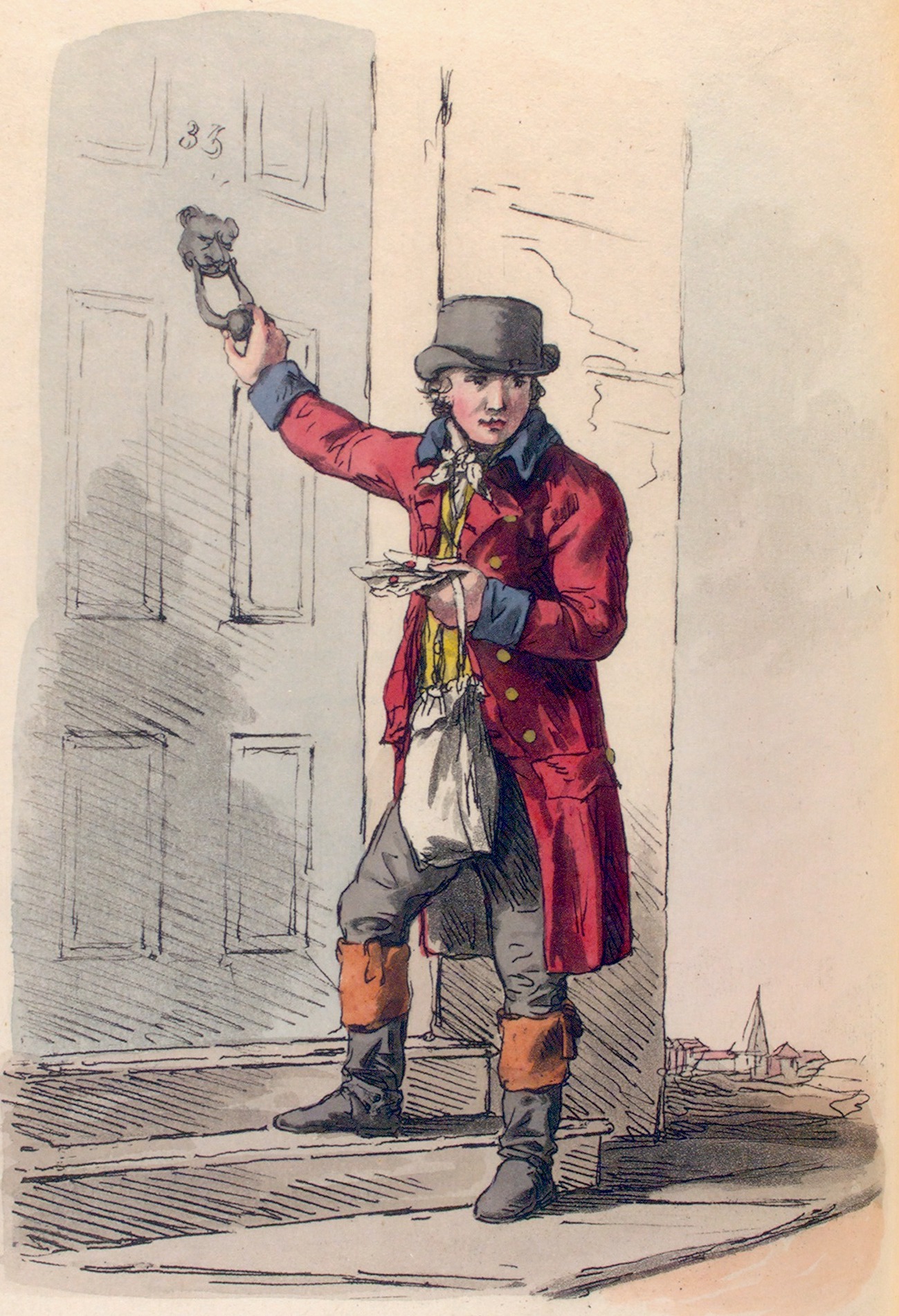
19th-century English postman

A mail carrier, also referred to as a mailman, mailwoman, mailperson, postal carrier, postman, postwoman, postperson, person of post,[1] letter carrier (in American English), or colloquially postie (in Australia,[2] Canada,[3] New Zealand,[4] and the United Kingdom[5]), is an employee of a post office or postal service who delivers mail and parcel post to residences and businesses. The term "mail carrier" came to be used as a gender-neutral substitute for "mailman" soon after women began performing the job. In the Royal Mail, the official name changed from "letter carrier" to "postman" in 1883,[6] and "postwoman" has also been used for many years.[7]

United States

[edit]

In the United States, there are three types of mail carriers: City Letter Carriers, who are represented by the National Association of Letter Carriers; Rural Carriers, who are represented by the National Rural Letter Carriers' Association; and Highway Contract Route carriers, who are independent contractors. While union membership is voluntary, city carriers are organized nearly 93 percent nationally.[8]

City letter carriers are paid hourly with the potential for overtime. They are also subject to "pivoting" on a daily basis. When a carrier's assigned route will take less than 8 hours to complete, management may "pivot" said carrier to work on another route to fill that carrier up to 8 hours. Postal management uses this tool to redistribute and eliminate overtime costs, based on consultation with the carrier about his/her estimated workload for the day and mail volume projections from the DOIS (Delivery Operations Information System) computer program. Routes are adjusted and/or eliminated based on information (length, time, and overall workload) controlled by the program, consultations with the carrier assigned to the route, and a current PS Form 3999 (street observation by a postal supervisor to determine accurate times spent on actual delivery of mail).[citation needed]

Postmen walking in the laneway beside Brisbane's General Post Office, c. 1936

Rural carriers are under a form of salary called "evaluated hours", usually with overtime built into their pay. The evaluated hours are created by having all mail counted for a period of two or four weeks, and a formula used to create the set dollar amount they will be paid for each day worked until the next time the route is counted. [citation needed]

Highway Contract Routes are awarded to the lowest bidder,[9] and that person then either carries the route themselves or hires carriers to fulfill their contract to deliver the mail.

Letter carriers typically work urban routes that are high density and low mileage. Such routes are classified as either "mounted" routes (for those that require a vehicle) or "walking" routes (for those that are done on foot). When working a mounted route, letter carriers usually drive distinctive white vans with the logo of the United States Postal Service on the side and deliver to curbside and building affixed mailboxes.

Carriers who walk generally also drive postal vehicles to their routes, park at a specified location, and carry one "loop" of mail, up one side of the street and back down the other side, until they are back to their vehicle. This method of delivery is referred to as "park and loop". Letter carriers may also accommodate alternate delivery points if "extreme physical hardship" is confirmed.[10] In cases where mail carriers do not have assigned vehicles, they may also get undelivered mail from relay boxes placed along their routes.[11]

20th-century mounted postman in Buenos Aires

Rural carriers typically work routes that have a lower density and higher mileage than those of letter carriers.[12] They all work mounted routes, leaving their vehicles only to deliver to group mailboxes or to deliver an article that must be taken to a customer's door. However, with former rural areas being urbanized, their routes are growing very similar to mounted "city routes." Rural carriers often use their own vehicles and are not required to wear a uniform. Because of urbanization around cities and because rural carriers deliver mail at less cost to the Postal Service, the rural carrier craft is the only craft in the Postal Service that is growing.[citation needed] Highway Contract Route carriers work routes that were established with a density of less than one customer per mile driven (some later become denser and can then be converted to rural delivery). They are only mounted routes, and all HCR carriers use their own vehicle. These routes are typically found in outlying areas, or around very small communities.

21st-century postman in London delivering mail from a modern mail cart

The three types of mail carriers are also hired differently. A new letter carrier begins as a City Carrier Assistant (CCA).[13] Rural carriers are hired as Rural Carrier Associate (RCA) carriers, without benefits. There is normally an RCA assigned to each rural route and they typically work less frequently than city CCAs. As a result, there are thousands of RCA positions that go unfilled due to lack of applicants that are instead covered by other RCAs until hiring improves[14] for the hiring process explained). Highway Contract Route carriers are hired by the winning bidder for that route. They are not United States Postal Service employees and normally receive lower pay than carriers on city or rural routes.

Female carriers

[edit]
Jeanne Decorne, a female auxiliary mail carrier collecting mail in Paris during World War I about 1915

Women have been transporting mail in the United States since the late 1800s. According to the United States Post Office archive, "the first known appointment of a woman to carry mail was on 3 April 1845, when Postmaster General Cave Johnson appointed Sarah Black to carry the mail between Charlestown Md P.O. & the Rail Road "daily or as often as requisite at $48 per annum". For at least two years Black served as a mail messenger, ferrying the mail between Charlestown's train depot and its post office."[15]

At least two women, Susanna A. Brunner in New York and Minnie Westman in Oregon, were known to be mail carriers in the 1880s. Mary Fields, nicknamed "Stagecoach Mary", was the first black woman to work for the USPS, driving a stagecoach in Montana from 1895 until the early 1900s.[16] When aviation introduced airmail, the first woman mail pilot was Katherine Stinson who dropped mailbags from her plane at the Montana State Fair in September 1913.[17]

The first women city carriers were appointed in World War I and by 2007, about 59,700 women served as city carriers and 36,600 as rural carriers representing 40 per cent of the carrier force.[18]

Famous carriers

[edit]
Postmen homage in Rosario, Argentina; opus by Erminio Blotta, Palace General Post Office

Famous real-life letter carriers include:

Fictional carriers

[edit]
Mr. McFeely delivering a letter
Postman Pat

In heraldry

[edit]

The coat of arms of Daugailiai, Lithuania features a postman playing post horn.[citation needed]

See also

[edit]

References

[edit]
[edit]
Revisions and contributorsEdit on WikipediaRead on Wikipedia
from Grokipedia

A mail carrier, also referred to as a letter carrier or postal carrier, is an employee of a national or private responsible for sorting, transporting, and delivering —including letters, packages, and periodicals—to designated residences, businesses, and post office boxes along assigned routes, typically using , foot , or bicycles. The role demands physical stamina for handling loads often exceeding 35 pounds, navigating urban and rural terrains, and adhering to strict delivery schedules regardless of weather conditions. Originating from early post riders in colonial America, the modern profession emerged with the establishment of free city delivery in , enabling systematic service that expanded nationwide and facilitated national connectivity. While essential for —reaching approximately 167 million addresses daily in the United States—carriers face occupational hazards such as extreme temperatures, vehicle accidents, and animal attacks, contributing to rates higher than the national average for similar roles.

Definition and Role

Core Responsibilities

Mail carriers, also referred to as letter carriers or postal delivery workers, primarily sort incoming into delivery sequence, load it into vehicles, and transport it along assigned routes to distribute to residences and businesses. This process begins with casing —arranging letters and by at a distribution case—typically requiring carriers to stand and sort for several hours daily while handling loads weighing up to 70 pounds. Delivery involves traveling routes by foot, , or , depositing in mailboxes or hand-delivering to doors, and ensuring items reach correct destinations without delay. Carriers collect outgoing from roadside boxes and customers, verify addresses, and manage special handling for items like certified or , which may require signatures or secure transport. They also perform vehicle safety inspections before departure, report infrastructure issues such as hazardous conditions or undeliverable mail, and assist customers with basic services like selling stamps or processing change-of-address forms when encountered on route. Physical demands include lifting, walking up to 8 miles per day, and exposure to varying weather, with efficiency measured by completing routes within evaluated time standards.

Regional Variations

In , particularly the , mail carriers employed by the (USPS) are required to provide universal delivery to over 160 million addresses six days a week, adapting methods to terrain: right-hand-drive vehicles for curbside delivery in suburbs, foot or in dense urban areas, and longer rural routes averaging 450 miles weekly per carrier. In , carriers follow similar protocols but face amplified challenges from , with community mailboxes increasingly used in new developments to consolidate delivery points and reduce carrier exposure to harsh winters. European postal systems emphasize universal service obligations under EU directives, yet delivery frequencies and methods vary: the United Kingdom's maintains daily door-to-door service with carriers often walking urban routes and using vans rurally, while collecting from iconic red pillar boxes; in contrast, Germany's DHL Group, operating in a liberalized market since 1998, designates universal coverage to a single operator but permits competition on parcels, leading carriers to prioritize efficient hub-to-door logistics with electric vehicles in cities. Scandinavian countries like supplement land-based carriers with postal ferries for coastal and island deliveries, serving remote communities where traditional road access is infeasible, ensuring coverage to 5.4 million inhabitants across vast archipelagos. In , high population density drives motorcycle-based delivery as the norm in urban , where Post carriers weave through traffic on two-wheelers to achieve same-day turnaround in and , contrasting with Post's bicycle-centric urban routes—carriers there sort mail at local offices and deliver precisely timed services up to seven days a week, supporting Japan's 99.9% on-time rate for domestic mail. diverges by deploying smart lockers via SingPost, where carriers deposit parcels at automated stations for self-collection, minimizing direct interactions and optimizing for high-rise living in a city-state of 5.9 million. Oceania and Latin America reflect geographic extremes: Australia Post carriers in urban Brisbane walk laneways or drive short routes, but remote outback areas necessitate aerial drops or partnerships with regional airlines for the 80% of landmass classified as sparsely populated. In Argentina, Correo Argentino carriers historically delivered on foot in Buenos Aires neighborhoods circa 1920, though modern practices blend vans with centralized apartment boxes amid economic volatility affecting service reliability.

Historical Development

Origins and Early Systems

The earliest organized mail delivery systems emerged in ancient civilizations, where couriers primarily served governmental and royal needs rather than public use. In around 2000 BCE, pharaohs employed messengers to transport written decrees and reports between administrative centers, utilizing runners or boats along the for efficiency. This system relied on trusted individuals carrying scrolls, but it lacked standardization and was limited to elite communications. The Achaemenid Persian Empire established one of the first relay-based postal networks circa 550 BCE under , later refined by Darius I, featuring chapar khaneh stations spaced along the 2,500-kilometer from to . Mounted couriers exchanged fresh horses at these outposts, enabling messages to traverse the route in about seven days—a speed praised for its reliability "neither snow nor rain nor heat nor gloom of night stays these couriers from the swift completion of their appointed rounds." This state-controlled apparatus facilitated imperial administration across diverse territories, emphasizing rapid official dispatches over personal mail. Rome adapted Persian relay principles in the , instituted by Emperor Augustus around 27 BCE as a for imperial correspondence, military orders, and legal documents. The network comprised over 800 stations (mutationes) for horse changes and 170 larger inns (mansiones), spanning the empire's 80,000 kilometers of roads, with couriers (cursores) covering up to 50 miles daily. Access was restricted to authorized users bearing warrants, underscoring its role in centralized governance rather than commercial or private delivery. In medieval , following the Roman system's decline after the 5th-century empire collapse, mail carriage reverted to ad hoc private messengers, often monks, merchants, or university scholars traveling for trade or pilgrimage. Italian city-states like and developed merchant-led courier networks by the 13th century to support commerce, employing relays for bills of exchange and contracts across Alpine routes. Royal courts sporadically used mounted heralds for , but widespread public systems awaited 16th-century innovations, such as the Thurn und Taxis family's relay service under Habsburg patronage, which by 1555 connected major European capitals with professional carriers. These early frameworks prioritized speed and security for elites, laying causal foundations for institutionalized postal roles through relay logistics and dedicated human transport.

Expansion and Modernization

The expansion of mail carrier services accelerated in the late 19th century with the implementation of (RFD) on October 1, 1896, in select communities, providing door-to-door mail service to rural residents who previously traveled to distant post offices. This initiative, made permanent by in 1902, rapidly grew to cover over 30,000 routes by 1905, employing thousands of carriers who initially delivered by horseback or wagon over rugged terrain, thereby integrating isolated rural populations into the national communication network and spurring and . Early 20th-century modernization began with the system introduced on January 1, 1913, which empowered carriers to handle packages alongside letters, dramatically increasing delivery volumes—rural parcel traffic alone surged from negligible levels to millions annually—and necessitating improved efficiency in sorting and transport. Concurrently, automotive adoption transformed carrier operations; experimental electric vehicles collected mail in cities as early as 1899, with formal contracts for electric autos signed in 1901, and by 1912, over 30 urban areas deployed motor cars to ferry carriers and loads, reducing reliance on horses and enabling longer routes. Rural carriers transitioned from horses to motorcycles in the for speed on unpaved roads, followed by widespread automobile use by the 1930s, when horse-drawn urban vehicles dropped to just 2% of the fleet. By mid-century, full motorization of city delivery routes in the allowed carriers to handle greater mail volumes over expanded suburban areas, supported by innovations since the 1860s that presorted en route via trains, minimizing carrier handling time at local levels. These shifts, driven by and industrialization, elevated mail carriers from pedestrian or equestrian couriers to motorized professionals, though they introduced new demands for mechanical maintenance and route optimization.

Operational Practices

Training and Qualifications

In the United States, prospective mail carriers for the (USPS) must meet basic eligibility criteria, including being at least 18 years old, possessing a valid , and demonstrating a safe driving record. A or equivalent GED is typically required, though not universally mandated, with approximately 93% of mail carriers holding no beyond high school. Applicants must also pass a examination, such as the Virtual Entry Assessment for Mail Carrier (VEA-MC 474), which evaluates skills in memory, attention to detail, and situational judgment relevant to delivery tasks. No formal postsecondary or prior certification is required for entry-level positions, emphasizing practical aptitude over academic credentials. Physical fitness is assessed implicitly through job demands, including the ability to lift up to 70 pounds and walk or drive extensively, though no standardized medical certification beyond background checks and screening is specified. Following hiring, new carriers undergo (OJT) lasting several weeks, often starting with a structured program for city letter carriers that includes an initial 8-hour shadow day observing an experienced carrier, followed by four days of classroom instruction on USPS policies, safety protocols, and route management. Subsequent OJT is limited to 8 hours daily to balance learning with operational needs, focusing on route memorization, , and customer interaction. Internationally, training standards vary by postal operator but generally align with national or employment norms, prioritizing basic literacy, physical capability, and local licensing without universal certification. For instance, operators affiliated with the Universal Postal Union emphasize operational efficiency over standardized global training, with many systems relying on employer-provided OJT similar to USPS models. Rural carriers may receive abbreviated training focused on independent route evaluation, often without formal classroom components, reflecting the job's demands for quick adaptation over structured pedagogy. USPS policy underscores training as a tool for proficiency maintenance rather than a barrier to entry, with ongoing development tied to performance rather than mandatory recertification.

Equipment and Delivery Methods

Mail carriers employ delivery methods adapted to route type, including , vehicle-mounted, and bicycle-assisted approaches, with the choice determined by factors such as , street layout, and mail volume. In the United States, delivery predominates in high-density urban zones, where carriers walk routes averaging 8-12 miles daily, delivering to doors or curbside boxes after casing mail at the . Vehicle-mounted delivery suits suburban and rural areas, allowing carriers to drive between points and dismount for final delivery. delivery, used on about 50 routes mainly in and as of 2025, facilitates navigation in congested spaces via pedal-powered transport with relay drops from support vehicles. Essential equipment for pedestrian and dismount deliveries includes the double canvas , standard since 1997, which features adjustable padded shoulder straps, a belt, water-repellent fabric, and compartments for segregated handling; it holds up to 35 pounds of excluding its own 5-7 pound to minimize strain. Carriers also carry —specialized tools etched with an arrow under "U.S. "—to unlock cluster boxes, apartment panels, and collection units, though these have been targeted in thefts prompting enhanced security measures like electronic alternatives. Digital tools comprise the Mobile Delivery Device (MDD), a rugged handheld scanner deployed to all city carriers by 2016 and updated with touch-screens by 2021, enabling scanning for real-time tracking, delivery confirmation, GPS logging, and electronic forms submission to reduce paper use and errors. MDDs integrate with USPS systems for parcel look-ahead functions, displaying upcoming deliveries to optimize sequencing. For vehicle delivery, the primary equipment remains the Long Life Vehicle (LLV), a right-hand-drive with corrosion-resistant aluminum body, tight , and 1,000-pound capacity; over 142,000 units built since 1987 have logged billions of miles, though replacements via the Next Generation Delivery Vehicle began rolling out in 2024 for improved safety and efficiency. routes equip carriers with standard or modified bikes featuring front baskets for loads up to several hundred pounds, often paired with satchels for dismounts. These methods prioritize reliability, with foot and bike options cutting vehicle emissions where feasible.

Daily Routines and Efficiency Factors

City carriers typically begin their shift by reporting to the local , where they perform office duties such as casing mail—sorting letters and into delivery sequence within specialized cases—and scanning parcels for tracking. This preparation phase, which includes pulling down sorted mail and loading it into vehicles, often consumes 2 to 3.5 hours, depending on volume. Carriers then proceed to their assigned routes, delivering to mailboxes or doors via foot, vehicle, or a combination, covering distances of 4 to 12 miles daily while carrying loads up to 35 pounds. Delivery operations last 4 to 6 hours on average, involving collection of outgoing mail, customer interactions, and handling undeliverable items, with shifts structured around an 8-hour tour that may extend to 12 hours with mandatory during peak periods. Upon return, carriers scan returned or undelivered mail and may assist with incoming volume sorting. Rural carriers follow a similar sequence but often manage longer, vehicle-dependent routes with less walking, incorporating personal vehicle reimbursement for mileage beyond standard allotments. Shifts start early, around 6-7 a.m., to align with processing plant arrivals, and end after route completion, with variations for package-heavy days requiring additional scanning and stacking. Efficiency in mail delivery hinges on route optimization, where initiatives like the U.S. Postal Service's Dynamic Route Optimization (DRO) program adjust paths dynamically to reduce travel time and fuel use, potentially yielding cost savings through fewer miles driven. Carrier experience and training directly influence productivity, as seasoned workers leverage local knowledge for faster sequencing and fewer errors, while inadequate preparation from processing plants delays street departure. External variables such as mail volume fluctuations—declining letter mail offset by rising packages—increase addresses served without proportional staff growth, straining fixed delivery costs that exceed 30% of operations. , , and further impact on-time performance, with recent network reforms aiming to cut truck trips but contributing to first-class mail on-time rates dipping to 83% in early 2024. adaptations, including parcel lockers and curbside boxes, enhance efficiency in high-package areas by minimizing handling time.

Employment Conditions

United States Postal Service Context

City letter carriers, represented by the (NALC), operate under the 2023-2026 National Agreement with the (USPS), which governs wages, hours, and working conditions for approximately 200,000 career employees. Full-time city carriers typically work a 40-hour schedule over five days, though actual hours often exceed this due to mail volume fluctuations, with overtime pay at 1.5 times the base rate after eight hours daily or 40 hours weekly. As of June 14, 2025, starting hourly wages for newly converted career carriers stand at $24.82 under Step B of the , equating to an annual base of approximately $51,631 assuming a , with progression to higher steps yielding top rates around $35-40 per hour after several years. The agreement includes annual general wage increases of 1.3-1.5% and cost-of-living adjustments (COLAs) tied to the , totaling over $2,000 in projected COLAs through 2026. Benefits for career carriers include comprehensive federal health and life insurance options through the , with USPS covering about 72% of premiums; retirement under the (FERS) for those hired after 1983, featuring a defined benefit annuity (1.1% of high-3 average salary per year of service), mandatory 4.4% employee contributions matched by agency contributions to the (TSP), and eligibility for Social Security; and paid leave accruing 13-26 days annually plus 13 sick days. Non-career city carrier assistants (CCAs) lack full benefits initially but convert to career status after 36 months or sooner based on office needs, providing a pathway to in a unionized federal workforce with strong protections against arbitrary dismissal.

International Comparisons and Alternatives

In the United Kingdom, Royal Mail postal delivery workers, operating under a partially privatized model since 2013, earn average annual salaries of approximately £25,000 to £30,000, with starting hourly rates around £12 for full-time roles involving 40-48 hour weeks that include weekend shifts. These conditions have drawn criticism for high workloads, with reports of back-breaking delivery targets and low morale amid ongoing disputes with the Communication Workers Union (CWU) over pay and pensions, leading to multiple strikes between 2022 and 2024. In comparison to the (USPS), where carriers average $57,870 annually with federal benefits including pensions and health coverage, UK workers face relatively lower compensation and greater exposure to performance-based pressures post-privatization. Germany's , privatized since 2000 while retaining a obligation, employs mail carriers under agreements with union, yielding gross monthly wages of €2,500 to €3,500 (approximately $33,000 to $46,000 annually) for full-time roles with 38-40 hour weeks and strong protections against dismissal. This exceeds UK levels but trails USPS medians when adjusted for and benefits; German workers benefit from statutory 30+ vacation days and training, though parcel volume growth has intensified physical demands similar to USPS rural routes. In , carriers earn average annual salaries of AUD 60,000 to 70,000 ($39,000 to $46,000 USD), supported by enterprise agreements mandating pay and protocols, reflecting a hybrid public-private structure with higher baseline wages than European counterparts due to labor market dynamics and floors.
CountryAverage Annual Salary (USD equiv.)Key ConditionsSource
(USPS)$57,87040-hour weeks, federal pensions, unionized
United Kingdom (Royal Mail)$32,000–$38,00040–48-hour weeks, strike-prone, partial privatization
(Deutsche Post)$33,000–$46,00038–40-hour weeks, strong unions, apprenticeships
(Australia Post)$39,000–$46,000Overtime premiums, safety-focused agreements
Alternatives to traditional government postal employment include roles with private express carriers like , , and UPS, which prioritize parcel delivery over letter mail and often provide higher starting wages—such as UPS drivers in averaging €30,000–€40,000 annually with performance incentives—but with reduced , variable hours, and exposure to market fluctuations absent mandates. In liberalized markets like the (), former state postal wages post-privatization align closely with comparable logistics sectors, sometimes offering premiums for skilled labor but resulting in net job losses and subcontracting to non-unionized firms. These private models emphasize efficiency gains through technology and flexible staffing, contrasting public postal rigidity, though empirical studies indicate no consistent wage depression in competitive postal segments when benchmarked against national averages.

Safety and Occupational Hazards

Common Risks Faced

Mail carriers face a range of occupational hazards stemming from delivery in varied environments, including animal attacks, vehicular incidents, slips and falls, ergonomic strains, and exposure to adverse weather. bites represent one of the most frequent threats, with the documenting over 6,000 attacks on employees in 2024, the highest in seven years, often occurring during residential deliveries where unrestrained pets surprise carriers. Motor vehicle accidents pose significant risks, both from operating delivery vehicles and pedestrian exposure in traffic; the Postal Service reported an accident rate of 13.48 incidents per 100 employees in fiscal year 2021, with many involving straight-line travel on routes. Slips, trips, and falls are prevalent, particularly on uneven sidewalks, stairs, or in inclement conditions, accounting for a substantial portion of injuries leading to restricted work or days away from duty. Ergonomic injuries arise from repetitive tasks such as sorting, lifting heavy parcels, and awkward postures, contributing to musculoskeletal disorders like back strains and tendonitis, as identified in assessments of parcel handling workflows. Exposure to extreme weather exacerbates these dangers, with carriers at risk of in high temperatures or in cold snaps, compounded by the requirement to complete deliveries regardless of conditions. While the notes that the occupation is not exceptionally hazardous overall compared to others, these cumulative risks underscore the physical demands of the role.

Injury Statistics and Prevention

In the United States, mail carriers employed by the (USPS) face elevated rates compared to the average, driven by physical demands such as extended walking, parcel handling, and vehicle operation on varied terrains. A 2021 Government Accountability Office analysis found city carriers exhibited the highest injury rates among USPS occupational groups, with incidence rising with employee age and disproportionately affecting females due to factors like route assignments and physical exertion. In 2023, USPS recorded a total case rate of 5.81 nonfatal injuries and illnesses per 100 employees, exceeding the national private industry average of approximately 2.4. Musculoskeletal disorders, often from repetitive lifting of heavy packages and mail satchels, constitute the predominant injury type, comprising over 60% of occupational illness claims in some analyses; package-related injuries among carriers reached a peak of 3.4 cases per 1,000 workers in the fourth quarter of 2020 amid surging volumes, later declining to 2.2 per 1,000 by early 2022 through targeted interventions. incidents during delivery accounted for about 36% of total USPS injuries in 2012, with over 11,700 cases linked to on-road activities including right-of-way errors and collisions. Slips, trips, and falls on uneven sidewalks or porches, alongside assaults like dog bites, further contribute, with emergency department-treated rates for postal workers climbing from 264 per 10,000 full-time equivalents in 2015 to 337 in 2017. USPS prevention efforts emphasize training in and safe practices, such as bending at the knees with a straight back during lifts to shift load to leg muscles and avoiding overhead reaches in vehicles, which reduce strain on shoulders and spines common in use. Defensive driving programs address vehicular s by promoting techniques like maintaining following distances and scanning intersections, given accidents as a leading severe source. Equipment upgrades, including padded , parcel tubs, and mobile scanners to minimize manual sorting, alongside route assessments and employee reporting protocols, aim to curb environmental risks; these measures correlated with post-2020 declines in package despite volume increases. Annual safety campaigns, such as slip-trip-fall prevention weeks, encourage clearing walkways and using traction aids, supported by data showing proactive controls lower overall incidence.

Cultural and Symbolic Significance

Notable Historical Figures

served as postmaster in the small Illinois village of New Salem from May 7, 1833, to May 30, 1836, where he managed the office from his , sorted incoming —which arrived irregularly by —and personally delivered letters and packages to residents on foot or horseback in a community of fewer than 100 people. He often extended credit for postage fees, reflecting the informal, hands-on nature of mail service, and later recounted carrying mailbags during his travels as a . William F. "Buffalo Bill" Cody claimed to have worked as a Pony Express rider starting at age 15 in 1860, covering routes in Nebraska, Wyoming, and Kansas under station agent Jack Slade, enduring harsh conditions to relay mail and small parcels across 1,900 miles from St. Joseph, Missouri, to Sacramento, California, in runs as short as 10-15 miles at speeds up to 10 miles per hour. While Cody's autobiography and Wild West show narratives popularized this role, contributing to the Pony Express's enduring legacy as a symbol of rugged American expansion, some historians question the claim due to incomplete rider rosters and Cody's youth, suggesting it may blend fact with embellishment for dramatic effect. The service employed about 200 riders overall, selected for their lightweight build and endurance, delivering an estimated 35,000 letters before telegraph lines rendered it obsolete in October 1861. Other early figures include riders like Robert Haslam, who survived multiple attacks and completed legendary 380-mile emergency runs in 1860-1861, earning recognition for bravery in Pony Express annals, though fame came posthumously through historical accounts rather than contemporary celebrity. In colonial America, , as deputy from 1753, occasionally transported mail during inspections across the colonies, but his primary contributions were administrative reforms rather than routine delivery.

Fictional and Media Portrayals

In British children's programming, , which debuted on on September 16, 1981, features Pat Clifton as a dedicated rural mail carrier navigating daily deliveries in the fictional village of Greendale alongside his black-and-white cat , emphasizing community ties and problem-solving. The series, produced by Woodland Animations, ran for eight series until 2017, portraying Pat as reliable and resourceful in handling mishaps during his rounds. American public television's (1968–2001) includes Mr. McFeely, played by , as the operator of Speedy Delivery Service, delivering parcels and letters to underscore themes of communication and haste with his catchphrase "Speedy Delivery!" Newell portrayed the character from the show's inception, appearing in over 900 episodes to model courteous service and interpersonal connections. Sitcom depictions often add humor through eccentric traits; in (1982–1993), Cliff Clavin, portrayed by , serves as a Boston mail carrier prone to verbose trivia digressions, reflecting a stereotypical know-it-all within the postal workforce. Similarly, 's Newman, played by , embodies inefficiency and scheming as a postal employee from 1992 to 1998, frequently clashing with protagonist over workplace antics. Films have explored dramatic roles; The Postman (1997), directed by and starring , adapts David Brin's 1985 novel, depicting a drifter impersonating a U.S. Postal Service inspector in a post-apocalyptic 2013 America, using mail delivery to restore societal order amid survivalist factions. The Italian film Il Postino (1994) centers on Mario Ruoppolo, a shy Sicilian mail carrier in the who befriends poet , learning metaphor and romance through delivering his correspondence. Literature includes satirical takes, such as Terry Pratchett's (2004), the 33rd novel, where con artist reforms a corrupt, explosion-prone postal service in the city of using innovative strategies like the clacks towers. These portrayals collectively highlight mail carriers as symbols of routine dependability, occasional heroism, or comedic folly, varying by medium and cultural context.

Heraldic and Symbolic Uses

The , a valveless used by postal riders to signal their arrival or departure since at least the , serves as a prominent heraldic charge symbolizing communication and mail delivery. In European , it appears in numerous coats of arms associated with postal operations, often depicted as a coiled or straight horn to evoke the rapid transmission of messages across regions. The Thurn und Taxis family, operators of a pan-European postal monopoly from 1520 until the 19th century, incorporated the into their emblems to represent their networks, which relied on horn signals for efficiency and security. Figures of mail carriers, particularly mounted post riders, have symbolic roles in postal emblems, denoting reliability and the foundational role of human couriers in establishing national communication systems. , the Department adopted a seal in 1837 featuring a and rider—depicting an early mail carrier—worn on letter carrier uniforms until 1970 to honor the horseback delivery that began in the colonial period. This imagery persisted in embroidered patches on carrier jackets, with the rider facing right to symbolize forward progress, and was phased out alongside the shift to motorized and pedestrian delivery. Such symbols underscore the mail carrier's historical embodiment of in timely information exchange, distinct from later abstract icons like the introduced in 1970.

Controversies and Reforms

Management and Financial Criticisms

The (USPS) has reported cumulative net losses of $87 billion from fiscal years 2007 through 2020, driven primarily by declining mail volumes and escalating costs, including a congressionally mandated to prefund retiree health benefits. The of 2006 imposed annual prefunding payments averaging $5.5 billion into the Postal Service Retiree Health Benefits Fund, a obligation unique to USPS among federal entities and accounting for approximately 84 percent of reported losses over that period. These payments, intended to amortize liabilities over 75 years, have strained liquidity despite partial relief from the Postal Service Reform Act of 2022, which eliminated future prefunding mandates but left $70 billion in projected 10-year losses as of April 2023. Recent fiscal years reflect ongoing deficits, with a $6.5 billion net loss in FY 2023 and $9.5 billion in FY 2024, despite revenue growth from package services insufficient to offset fixed costs and workforce expenses. Management practices have faced scrutiny for contributing to inefficiencies amid a structural shift from letter mail to electronic alternatives, with first-class mail volume declining by over 40 percent since 2007. The Government Accountability Office (GAO) has highlighted USPS's slow network modernization and excess processing facilities, estimating potential annual savings of $2 billion from consolidation, yet implementation has lagged due to statutory constraints on facility closures and agreements limiting operational flexibility. Critics, including the USPS Office of , point to inadequate cost controls in controllable expenses, which rose despite efforts under the 2021 Delivering for America plan to reduce them by $1.5 billion annually through pricing adjustments and automation. Workforce productivity issues persist, with labor comprising 80 percent of costs and absenteeism rates exceeding private-sector peers, exacerbated by union protections that hinder performance-based adjustments. Financial reporting and strategic planning have drawn further criticism for opaque assumptions in capital investments, such as the $9.6 billion next-generation vehicle fleet procurement in 2022, where identified deficiencies in justifying cost projections and utilization rates. Total unfunded liabilities stood at $188 billion as of 2020, including pensions and , underscoring the need for legislative relief from prefunding and borrowing limits, as USPS cannot issue tax-exempt without congressional approval. While package revenue surged 10 percent in FY 2024, management has been faulted for over-dependence on subsidized obligations, which inflate costs relative to competitors like UPS and , who operate without similar mandates. recommends enhanced performance metrics and congressional reforms to align incentives with market realities, rather than perpetuating a model reliant on backstops.

Labor Union Dynamics

The primary labor unions representing mail carriers in the United States are the National Association of Letter Carriers (NALC), which covers city delivery carriers, and the National Rural Letter Carriers' Association (NRLCA), focused on rural routes. These organizations negotiate collective bargaining agreements with the United States Postal Service (USPS) on wages, benefits, working conditions, and grievance procedures, often through interest arbitration when talks stalemate. The NALC, affiliated with the AFL-CIO, has historically emphasized rank-and-file activism, as seen in its leadership transitions following militant actions. A landmark event in postal union dynamics was the 1970 wildcat strike, initiated by letter carriers on March 17, involving approximately 200,000 workers across eight crafts, including NALC members, who walked out over substandard wages and lack of bargaining rights under the pre-reorganization Post Office Department. The strike, defying federal law against public employee walkouts, pressured President Nixon to invoke the Taft-Hartley Act and deploy troops, but ultimately led to the of 1970, establishing USPS as a semi-independent entity with statutory protections and pay comparability to the . This mandated that USPS compensation align with equivalents, though arbitrators have interpreted this to include comparisons with unionized private roles, resulting in negotiated structures where city carriers reach top Step P pay after progression, with recent adjustments yielding a 6.3% annual increase of $4,758 for that step as of April 2025 under the Nolan arbitration award. Union contracts have secured robust benefits, including defined-benefit pensions, health coverage, and paid leave, often exceeding norms for delivery roles; analyses indicate postal wages average 28% higher than comparable non-postal positions after controlling for skills and location, contributing to USPS labor costs exceeding $50 billion annually amid pressures from declining mail volume. These dynamics foster tensions, as unions prioritize and workload limits—such as caps on daily delivery points—over operational flexibility, leading to disputes over staffing and overtime, with USPS citing contractually obligated escalations as a driver of financial deficits projected at $9.5 billion for 2024. In recent years, NALC and affiliated groups like the (APWU), which overlaps in motor vehicle and support roles for carriers, have opposed USPS modernization initiatives, including the 10-year Delivering for America plan's network consolidations and , arguing they threaten service reliability and employment; for instance, in September 2024, APWU welcomed partial reversals of plant closures while vowing continued resistance. By March 2025, unions organized nationwide protests against cost-cutting proposals tied to Department of Government Efficiency (DOGE) reviews, framing them as preludes to privatization that could erode obligations, though critics contend such union stances hinder efficiency gains observed in privatized foreign systems like Germany's . Negotiations remain protracted, with 2024-2027 contracts delayed into 2025 arbitrations, underscoring unions' leverage in binding arbitration but also their role in perpetuating cost structures that strain USPS solvency without corresponding productivity mandates.

Privatization Debates and Efficiency Comparisons

Debates over privatizing postal services, including mail carrier operations, center on balancing obligations with incentives for cost control and innovation. Proponents argue that government-run monopolies stifle due to political constraints and lack of competitive pressures, potentially leading to $20 billion in annual U.S. savings if matched private firms. Critics contend erodes affordable access in low-volume rural areas, raising prices and reducing delivery frequency, as private entities prioritize profitable routes. Empirical outcomes vary by regulatory framework, with partial often yielding mixed results: enhanced parcel handling but persistent letter volume declines. Efficiency comparisons reveal private couriers outperforming public postal services in key metrics like transit speed and tracking reliability, though public entities maintain broader geographic coverage. For instance, UPS and achieve faster delivery times and superior real-time visibility compared to the U.S. Postal Service (USPS), attributed to flexible routing and technology investments unconstrained by statutory mandates. A comparative study of postal operators found higher in liberalized markets, with private or partially privatized firms reducing unit costs through and scale in parcels, which now comprise up to 48% of in some cases. Public services, burdened by universal obligations, exhibit lower margins amid declining letter mail, offset partially by subsidized last-mile advantages for partners. In Germany, Deutsche Post's privatization from 1995 onward transformed it into a profitable logistics giant, with full market liberalization by 2005 enabling DHL expansion and €3.3 billion net profit in 2024, driven by express segment revenue of €24.5 billion. Efficiency gains included automation and global scaling, though accompanied by 38,000 job cuts at the core operator, offset by private sector job creation. The United Kingdom's Royal Mail, privatized in 2013, showed pre-privatization inefficiency relative to European peers, with post-IPO cash flow turning positive from -£493 million (2008-09) to +£334 million (2012-13) and EBIT margin rising to 4.0%, fueled by £0.5 billion annual productivity benefits from a £2.8 billion transformation program. Parcel volumes grew 4.6% annually (2010-13), but service quality metrics remained challenged by competition and strikes. U.S. debates highlight USPS's structural deficits—$9.5 billion operating loss in fiscal 2023—versus private carriers' profitability, with calls for to eliminate redundancies and renegotiate labor costs. However, simulations suggest privatized models could hike rates and curtail delivery, undermining the 1970 Postal Reorganization Act's universal mandate, while international precedents indicate sustained is needed to preserve rural access. Overall, evidence supports boosting operational efficiency in competitive segments but requiring safeguards against service erosion in obligated areas.

References

  1. https://commons.wikimedia.org/wiki/Category:Post_and_hunting_horns_in_heraldry
Add your contribution
Related Hubs
User Avatar
No comments yet.