Hubbry Logo
Mandibular notchMandibular notchMain
Open search
Mandibular notch
Community hub
Mandibular notch
logo
8 pages, 0 posts
0 subscribers
Be the first to start a discussion here.
Mandibular notch
Mandibular notch
from Wikipedia
Mandibular notch
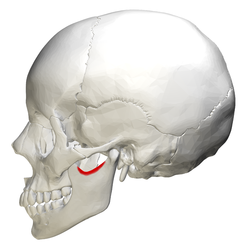
Position of mandibular notch in skull, shown in red.
Position of mandibular notch in mandible, shown in red.
Details
Part ofmandible
Systemskeletal
Identifiers
Latinincisura mandibulae
TA98A02.1.15.034
A02.1.15.008
TA2871
FMA59481
Anatomical terms of bone

The mandibular notch, also known as the sigmoid notch, is a groove in the ramus of the mandible. It is the gap between the coronoid process anteriorly and the condyloid process posteriorly.

Structure

[edit]

The mandibular notch is a concave groove at the top of the ramus of the mandible. It is the gap between the coronoid process anteriorly and the condyloid process posteriorly.

Function

[edit]

The mandibular notch allows for the passage of the masseteric nerve (a branch of the mandibular nerve (V3) division of the trigeminal nerve), the masseteric artery, and the masseteric vein.

Clinical significance

[edit]

The mandibular notch may be palpated to locate the parotid duct,[1] the facial artery,[1] the facial vein,[1] and the medial pterygoid muscle.[2]

Other animals

[edit]

The mandibular notch can be found in other mammals, such as dogs and cats.[1] There can be significant variation in its shape even within the same species.[3] Archaeological evidence shows that the mandibular notch is different in other hominidae, such as neanderthals, and may be asymmetrical.[4]

Additional images

[edit]

References

[edit]
[edit]
Revisions and contributorsEdit on WikipediaRead on Wikipedia
from Grokipedia
The mandibular notch, also known as the sigmoid notch or mandibular incisure, is a concave U-shaped depression located on the superior border of the ramus of the , separating the coronoid process anteriorly from the condylar process posteriorly. This notch forms part of the skeletal framework that supports mandibular mobility and the structures that articulate with the . The anterior border of the mandibular notch is defined by the triangular coronoid process, which serves as an attachment site for the , while the posterior border is formed by the condylar process, which articulates with the to facilitate movements such as mastication and speech. The notch itself has an average depth of approximately 13-14 mm, though its morphology varies among individuals, often presenting as rounded, oval, or triangular in shape, with implications for surgical planning. Passing through the notch are the masseteric nerve (a branch of the mandibular division of the , CN V3) and accompanying masseteric artery and vein, which supply the deep surface of the . Clinically, the mandibular notch is significant in maxillofacial surgery, , and , as its variable depth and shape guide approaches for procedures like masseteric nerve blocks, condylar reconstructions, and denture fabrication. Fractures or deformities in this region, often resulting from trauma, can disrupt function and require precise imaging for , such as cone-beam computed tomography to assess notch dimensions. Variations in notch morphology show , with males tending to exhibit deeper notches, aiding in and personalized surgical interventions.

Anatomy

Gross anatomy

The mandibular notch, also known as the sigmoid notch, is a concave indentation on the superior border of the ramus of the , separating the coronoid process anteriorly from the condylar process posteriorly. This U- or S-shaped (sigmoid) feature forms a smooth, bony depression that contributes to the structural contour of the posterior . In , it is referred to as the incisura mandibulae. In adults, in a study of Chinese adults, the mandibular notch typically exhibits a depth averaging approximately 15 mm (15.3 mm in males and 14.5 mm in females), with variations reported in other populations around 13-15 mm, and features smooth, rounded margins without prominent irregularities in typical morphology. The shape of the notch varies, often appearing rounded, oval, or triangular. The notch's concave profile provides a transitional boundary between the two processes, enhancing the ramus's vertical extension. Positioned as the superior limit of the posterior ramus, the mandibular notch integrates into the overall architecture of the lower jaw, supporting the alignment of the with the during jaw positioning. The term "mandibular notch" derives from "mandibular" (pertaining to the or lower jaw) and "notch" (a concave cut or indentation), reflecting its descriptive anatomical role.

Development

The mandibular notch originates from the first during embryogenesis, as part of the mandibular prominence that contributes to the lower jaw formation. The develops primarily through around the supportive , a derivative of the first arch's . Within this process, the notch emerges as a U-shaped depression between the nascent coronoid process anteriorly and the condylar process posteriorly, delineating the superior border of the mandibular ramus as these regions differentiate in the early fetal period. Ossification of the mandibular notch region follows a coordinated timeline involving secondary centers. The coronoid process begins differentiating and ossifying around weeks 7-10 of via , with secondary appearing around 10-14 weeks, initial observed in its basal portion and extension from the primary mandibular site. The condylar process develops secondary around weeks 10-12 of , undergoing that progresses upward and laterally starting around week 12. As these centers expand and remodel, the notch forms through the apposition and resorption of bone, achieving a preliminary contour by birth. Postnatally, the mandibular notch undergoes remodeling, deepening and widening progressively through childhood and under the influence of masticatory muscle forces, such as those from the temporalis and masseter, and ongoing condylar growth. This adaptive change supports increasing mobility and load-bearing, with significant alterations noted from infancy to 36 months and continuing until the late teens, when the adult morphology is typically attained. Molecularly, the contributes to condylar , regulating proliferation and differentiation in the secondary that influences notch formation. Expression of Notch1 is evident in mesenchymal and chondrogenic cells from embryonic stages, promoting organized tissue development without which condylar elongation may be impaired.

Function

Mechanical role

The mandibular notch, also known as the sigmoid notch, contributes to (TMJ) function by separating the coronoid process from the condylar process, allowing for the condylar process's translation and rotation during mouth opening, closing, and lateral excursions. This configuration allows the condyle to glide anteriorly along the articular eminence while rotating within the , enabling smooth hinge-like and sliding motions essential for jaw mobility. In mastication, the overall mandibular structure, including the ramus, permits movements through coordinated contractions of nearby masticatory muscles, such as the temporalis inserting on the coronoid process and the masseter on the ramus. Biomechanically, finite element analyses indicate that the is a site of during , with high compressive and tensile stresses occurring at the sigmoid notch under occlusal loads. The TMJ facilitates the path of condylar movement, enabling a wide gape of up to 40-50 mm in normal interincisal opening.

Neurovascular passages

The mandibular notch provides a passageway for the , consisting of the masseteric nerve, , and masseteric vein, which collectively supply the . The masseteric nerve arises as a branch from the anterior division of the (cranial nerve V3) and delivers motor innervation to both the superficial and deep layers of the . The masseteric artery originates from the second part of the within the and furnishes the primary arterial supply to the masseter, anastomosing with branches of the facial and transverse facial arteries. Accompanying these, the masseteric vein drains venous blood from the masseter and joins the as its tributary. These structures follow a consistent anatomical course in relation to the notch: the masseteric nerve crosses over the notch, while the masseteric artery passes through it; emerging from the posteriorly near the mandibular condyle, they arch superiorly over the notch, and then course anteriorly toward the coronoid process to penetrate the deep surface of the . This trajectory positions the bundle in close relation to the superior border of the mandibular ramus, facilitating efficient supply to the muscle's deep aspect. The superficial location of the relative to the mandibular notch renders it accessible during procedures such as masseteric blocks or orthognathic surgeries, yet it also heightens vulnerability to iatrogenic injury, including transection or vascular disruption, which can lead to masseter weakness or formation. Anatomical variations in the masseteric or bundle routing have been observed and may influence surgical planning in the infratemporal region.

Clinical significance

Diagnostic applications

The mandibular notch, also known as the sigmoid notch, serves as an important external landmark during of the head and neck, where it can be palpated just inferior to the . This technique involves placing the examiner's fingers along the inferior border of the zygomatic arch and gently pressing medially to feel the concave depression of the notch. In clinical settings, this method is routinely employed to guide procedures like masseteric blocks or to assess for tenderness related to (TMJ) issues without invasive measures. In diagnostic imaging, the mandibular notch is prominently visualized on panoramic radiographs, where it appears as a characteristic U-shaped concavity on the posterior border of the mandibular ramus, aiding in the evaluation of overall mandibular morphology and TMJ positioning. Computed tomography (CT) scans, particularly cone-beam CT, allow precise measurement of the notch's depth—typically averaging 13-14 mm in adults—and its variations, which are useful for preoperative planning in maxillofacial procedures. (MRI) further delineates the notch's relations to surrounding soft tissues, including the and neurovascular bundles, providing high-contrast details for assessing joint disc position and muscle integrity. These modalities collectively enable non-invasive assessment of the notch's configuration in relation to the vessels, which course superficially along its anterior margin. Within , the mandibular notch contributes to TMJ alignment evaluations during orthodontic assessments by serving as a reference point for on radiographs, helping to quantify mandibular asymmetry or retrognathia that may influence treatment planning. It also plays a role in bite registration techniques, where the notch's position relative to the condyle informs the accurate capture of , ensuring proper articulation of orthodontic appliances like functional regulators to correct Class II malocclusions. This application is particularly valuable in growing patients, as deviations in notch depth or angulation can indicate underlying skeletal discrepancies affecting occlusal harmony.

Pathological conditions

The mandibular notch, also known as the sigmoid notch, can be involved in fractures during mandibular trauma owing to the relative thinness of the in the ramus , though such fractures occur infrequently (2-4% of mandibular fractures). These fractures are often classified as condylar neck fractures, where the fracture line lies more than one-third above the sigmoid notch line on lateral views, or as coronoid base fractures extending into the notch from the coronoid process. Treatment typically involves open reduction and internal fixation (ORIF) to restore anatomic alignment and function, particularly for displaced fractures. Congenital anomalies affecting the mandibular notch are rare and may include a shallow notch configuration, often associated with micrognathia or mandibular in conditions such as craniofacial microsomia. In these cases, the sigmoid notch appears distorted or underdeveloped, contributing to altered jaw mechanics and potential airway issues. Another anomaly is the bifid coronoid process, which can alter the shape of the notch by creating a divided coronoid structure; this is a rare finding reported primarily in case studies. Pathological involvement of the mandibular notch occurs in (TMJ) disorders, such as , where erosive changes can lead to flattening or shallowing of the notch alongside . Tumor invasion, exemplified by , may extend into the notch, causing destructive lesions from the ramus to the sigmoid notch and inferior border, necessitating wide surgical resection. Iatrogenic damage to the notch can arise during third molar extractions, particularly when excessive force leads to mandibular fractures involving the ramus and notch area. The mandibular notch serves as a model site in experimental studies for regeneration, including critical-size defect in miniature pigs, where bilateral notch defects are created to evaluate healing and scaffold interventions, though spontaneous regeneration may occur without treatment.

Comparative anatomy

Presence in mammals

The mandibular notch, a defining feature of the mammalian dentary , is evolutionarily conserved across most mammalian species, serving as a homologous structure to that observed in humans and facilitating the insertion and function of the adductor muscles, such as the masseter and temporalis, which enable efficient mastication. This conservation stems from the unification of the lower into a single dentary during the transition from non-mammalian synapsids to crown-group mammals in the , where the notch consistently separates the coronoid and condylar processes to support mobility. In common mammalian , the notch exhibits basic structural presence adapted to dietary needs; it is prominently defined in carnivores like dogs and cats, accommodating a wide gape for prey capture and tearing, while appearing shallower in herbivores such as to prioritize lateral grinding motions during feeding. These variations maintain the notch's core role in articulating the with the via the conserved coronoid and condylar processes. Fossil evidence confirms the notch's antiquity, with clear manifestations in early mammals like from the Triassic period, where the dentary features a distinct separation between the coronoid process and emerging condyle, indicative of early mammalian jaw mechanics. Asymmetry in the notch has also been documented in hominid fossils, notably Neanderthals, where it contributes to distinct ramus morphology compared to modern humans. In veterinary practice, the mandibular notch is routinely identified during dissections of domestic mammals, aiding in the anatomical mapping of structures.

Interspecies variations

The mandibular notch, also known as the sigmoid notch, exhibits notable morphological variations across mammalian species, reflecting adaptations to diverse feeding strategies and biomechanical demands. In , the notch tends to be deeper and more U-shaped in species like (Gorilla gorilla), where it is anteroposteriorly compressed and positioned close to the condyle, facilitating enhanced leverage for powerful bites during versatile folivorous and frugivorous diets. In contrast, humans (Homo sapiens) possess a wider and shallower notch with a superiorly angled coronoid process, which supports greater but reduced vertical bite force compared to great apes. These differences emerge early in and persist, influencing overall masticatory efficiency. Size and depth of the mandibular notch often correlate with ramus height and body size, scaling proportionally in larger mammals to accommodate increased muscle attachments and load-bearing capacity. For instance, in large felids such as lions (Panthera leo), the notch is proportionally larger relative to smaller felids like leopards (Panthera pardus), aligning with broader mandibular dimensions that enhance bite force for subduing large prey. Similarly, in small mammals like rats (Rattus norvegicus), the notch is diminutive and integrated into a compact ramus suited for rapid gnawing motions. In rodents generally, the notch contributes to a V-like configuration in the ramus profile, optimizing for incisor-directed forces during burrowing and foraging. Asymmetry in the mandibular notch occurs in carnivores, though it is typically infrequent and often linked to pathological or compensatory adaptations rather than inherent dietary traits. In piscivorous species like sea otters (Enhydra lutris), the notch is notably narrow and shallow, adapting to specialized crushing of with tools, which demands precise but limited jaw gape compared to terrestrial carnivores. These interspecies variations hold adaptive significance for bite force distribution and (TMJ) mobility; deeper notches in enhance vertical force transmission for varied diets, while shallower notches in some ungulates, such as archaic forms like Periptychus carinidens, correlate with reduced TMJ excursion and emphasis on lateral grinding motions in herbivory, minimizing stress concentrations during repetitive mastication. Overall, notch morphology modulates biomechanical efficiency, with deeper profiles supporting higher bite forces in predatory or folivorous species and shallower ones facilitating sustained, low-force processing in grazers.

References

Add your contribution
Related Hubs
User Avatar
No comments yet.