Hubbry Logo
PremaxillaPremaxillaMain
Open search
Premaxilla
Community hub
Premaxilla
logo
8 pages, 0 posts
0 subscribers
Be the first to start a discussion here.
Premaxilla
Premaxilla
from Wikipedia
Premaxilla
Skull of Spinosaurus aegyptiacus, premaxilla in orange
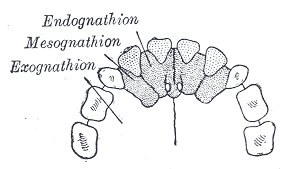
Human premaxilla and its sutures
Details
PrecursorMedian nasal prominence
Identifiers
TA98A02.1.12.031
TA2833
FMA77231
Anatomical terminology

The premaxilla (or praemaxilla) is one of a pair of small cranial bones at the very tip of the upper jaw of many animals, usually, but not always, bearing teeth. In humans, they are fused with the maxilla. The "premaxilla" of therian mammals has been usually termed as the incisive bone. Other terms used for this structure include premaxillary bone or os premaxillare, intermaxillary bone or os intermaxillare, and Goethe's bone.

Human anatomy

[edit]
Incisive bone
The bony palate and alveolar arch. (Premaxilla is not labeled, but region is visible.)
Details
Identifiers
Latinos incisivum
TA98A02.1.12.031
TA2833
FMA77231
Anatomical terms of bone

In human anatomy, the premaxilla is referred to as the incisive bone (os incisivum) and is the part of the maxilla which bears the incisor teeth, and encompasses the anterior nasal spine and alar region. In the nasal cavity, the premaxillary element projects higher than the maxillary element behind. The palatal portion of the premaxilla is a bony plate with a generally transverse orientation. The incisive foramen is bound anteriorly and laterally by the premaxilla and posteriorly by the palatine process of the maxilla. [1]

It is formed from the fusion of a pair of small cranial bones at the very tip of the jaws of many animals, usually bearing teeth, but not always. They are connected to the maxilla and the nasals. While Johann Wolfgang von Goethe was not the first one to discover the incisive bone in humans, he was the first to prove its presence across mammals. Hence, the incisive bone is also known as Goethe's bone.[2]

Incisive bone and premaxilla

[edit]

Incisive bone is a term used for mammals, and it has been generally thought to be homologous to premaxilla in non-mammalian animals. However, there are counterarguments. According to them, the incisive bone is a novel character first acquired in therian mammals as a composition of premaxilla derived from medial nasal prominence and septomaxilla derived from maxillary prominence. In the incisive bones, only the palatine process corresponds to the premaxilla, while the other parts are the septomaxilla. Based on this, the incisive bone is not completely homologous to the non-mammalian premaxilla. This was hypothesized by Ernst Gaupp in 1905[3] and demonstrated by developmental biological- and paleontological experiments in 2021.[4] This issue is still under debate.

Embryology

[edit]

In the embryo, the nasal region develops from neural crest cells which start their migration down to the face during the fourth week of gestation. A pair of symmetrical nasal placodes (thickenings in the epithelium) are each divided into medial and lateral processes by the nasal pits. The medial processes become the septum, philtrum, and premaxilla.[5]

The first ossification centers in the area of the future premaxilla appear during the seventh week above the germ of the second incisor on the outer surface of the nasal capsule. After eleven weeks an accessory ossification center develops into the alar region of the premaxilla. Then a premaxillary process grow upwards to fuse with the frontal process of the maxilla; and later expands posteriorly to fuse with the alveolar process of the maxilla. The boundary between the premaxilla and the maxilla remains discernible after birth and a suture is often observable up to five years of age. [1]

It is also common in non-mammals, such as chickens, that premaxilla is derived from medial nasal prominence. However, experiments using mice have shown a different result. The bone that has been called the "premaxilla" (incisive bone) in mice consists of two parts: most of the bone covering the face originates from the maxillary prominence, and only a part of the palate originates from the medial nasal prominence.[4] This may be due to the replacement of most of the incisive bone with septomaxilla in the therian mammal, as following section. In any case, the development and evolution of this region is complex and needs to be considered carefully.

In bilateral cleft lip and palate, the growth pattern of the premaxilla differs significantly from the normal case; in utero growth is excessive and directed more horizontally, resulting in a protrusive premaxilla at birth.[6]

Evolutionary variation

[edit]

Forming the oral edge of the upper jaw in most jawed vertebrates, the premaxillary bones comprise only the central part in more primitive forms. They are fused in blowfishes and absent in cartilaginous fishes such as sturgeons.[7]

Reptiles and most non-mammalian therapsids have a large, paired, intramembranous bone behind the premaxilla called the septomaxilla. Because this bone is vestigial in Acristatherium (a Cretaceous eutherian) this species is believed to be the oldest known therian mammal. Intriguingly the septomaxilla is still present in monotremes.[8][9]

However, embryonic and fossil studies in 2021 suggest that the incisive bone, which has been called "premaxilla" in therian mammals, has been largely replaced by septomaxilla; and that only a palatal part of the incisive bone remains a vestige of premaxilla.[4] If this hypothesis is accurate, the bones that have been called "premaxilla" in therian mammals are not entirely homologous to the original premaxilla of other vertebrates. This homology is, however, contended.[10]

The differences in the size and composition in the premaxilla of various families of bats is used for classification.[11]

The premaxillae of squamates are fused; this feature can be used to distinguish fossil squamates from relatives.[12]

History

[edit]

In 1573, Volcher Coiter was the first to illustrate the incisive suture in humans. Pierre Marie Auguste Broussonet and Félix Vicq-d'Azyr were the first to describe the incisive bone as a separate bone within the skull in 1779 and 1780, respectively.[2]

In the 1790s, Johann Wolfgang von Goethe began studying zoology, and formed the impression that all animals are similar, being bodies composed of vertebrae and their permutations. The human skull is one example of a metamorphosed vertebra, and within it, the intermaxillary bone rests as evidence linking the species to other animals.[13]

References

[edit]
Revisions and contributorsEdit on WikipediaRead on Wikipedia
from Grokipedia
The premaxilla, also known as the incisive bone or intermaxillary bone, is a paired cranial forming the anterior portion of the upper in many vertebrates, typically bearing the teeth and contributing to the primary . In humans, it constitutes the intermaxillary segment of the , housing the four upper teeth, and develops embryonically from the fusion of medial nasal and maxillary processes around the 4th to 8th weeks of . begins independently in the 7th month of intrauterine life, initially as a distinct structure separated from the by a suture that typically fuses by early childhood, though remnants may persist into adulthood in approximately 6% of cases. Anatomically, the premaxilla comprises an for tooth support, a facial process extending upward, a palatine process forming part of the , and the Stenonianus process connecting to the and , acting as a stabilizing "keystone" in the midfacial akin to a Roman arch. Its boundaries are defined posteriorly by the incisive foramen and extend to the canine region, influencing midface growth, , and anteroposterior expansion. In evolutionary terms, the premaxilla represents a key innovation in therian mammals, enabling specialized rostral jaw morphology and dietary adaptations through its integration with surrounding dermal bones like the and nasals. Abnormal development or fusion can lead to craniofacial malformations, such as cleft lip and palate, or conditions like , underscoring its clinical significance in and maxillofacial surgery.

Anatomy

Structure and components

The premaxilla consists of a pair of small dermal bones located at the anterior tip of the upper in many vertebrates, forming the rostral-most portion of the and typically bearing the teeth. These bones are part of the dermatocranium and articulate with adjacent elements such as the maxillae, nasals, and vomers to create a stable framework for the or muzzle. In therian mammals, the premaxilla represents a composite structure derived evolutionarily from elements of the maxillary prominence and frontonasal prominence. Key components of the premaxilla include the body, which forms the main bony mass and articulates laterally with the maxilla and dorsally with the nasal bones. The alveolar process extends inferiorly from the body to house the sockets for anterior teeth, such as incisors, enabling precise occlusion during feeding. The palatal shelf, or palatine process, projects medially to contribute to the secondary hard palate, separating the oral and nasal cavities. Additionally, the nasal surface forms part of the medial boundary of the nasal cavity and septum, often positioned ventrolateral to the nostrils in mammals. The Stenonianus process extends posteriorly to connect with the nasal septum and vomer, acting as a stabilizing "keystone" in the midfacial skeleton. Functionally, the premaxilla supports the anterior , facilitating prey capture in carnivores or mastication in herbivores through its tooth-bearing capacity. It also anchors facial musculature involved in protrusion and closure, while delineating the boundaries of the nasal and oral cavities to aid respiration and chemosensation. In with mobile snouts, such as mammals, it contributes to tactile and olfactory functions by forming the muzzle's framework. The tooth-bearing capacity of the premaxilla varies across lineages; it consistently supports incisors in mammals, but in reptiles, it may be edentulous in some forms like certain squamates, while remaining dentigerous in others such as crocodilians. In birds and turtles, the premaxilla is often toothless and modified to support a keratinous . In humans, the premaxillae fuse early in development to form the incisive bone.

In humans

In humans, the premaxillae fuse with the maxilla during early childhood, forming the incisive bone (os incisivum), a small component of the anterior maxilla located between the central incisors and the anterior nasal spine. This fused structure supports the alveoli of the upper incisors and contributes to the anterior aspect of the upper jaw. The incisive bone borders the nasal cavity superiorly, with the incisive canal and foramen transmitting the nasopalatine nerve and associated vessels from the nasal cavity to the oral cavity. It forms the anterior portion of the hard palate via its palatine process and articulates with the vomer posteriorly and the contralateral maxilla laterally. Key features include the incisive fossa, a shallow depression on the anterior surface above the incisors, and the anterior nasal spine, a midline projection serving as an attachment for the nasal septum and muscles. Clinically, the premaxilla is implicated in congenital anomalies such as bilateral cleft lip and palate, where the premaxillary segment often protrudes due to the absence of function, leading to displacement and challenges in lip closure. In , premaxillary protrusion in such cases may require presurgical appliances to retract the segment and align the alveolar arches before repair. Surgical considerations in maxillofacial procedures include and of the premaxilla to reposition it, improving , occlusion, and function while minimizing risks like septal deviation.

In non-human vertebrates

In most tetrapods, the premaxilla exists as a paired forming the anterior tip of the upper , articulating primarily with the laterally, the nasals dorsally, and the medially to contribute to the and oral roof. In amphibians, such as frogs, the premaxilla is a paired, tooth-bearing element that supports pedicellate teeth adapted for grasping prey. Among reptiles, it remains separate in many lineages but shows fusion of the paired premaxillae medially in squamates ( and snakes), a diagnostic feature enabling kinetic movement for feeding. Structural variations reflect feeding adaptations across non-human vertebrates. In crocodilians, the premaxilla is elongated to bolster the elongated snout, bearing typically five conical teeth that interlock with the lower for predatory , with irregular W-shaped sutures to the enhancing structural integrity during forceful bites. Birds exhibit a reduced premaxilla integrated into the keratinous beak's rostral core, fused with the and nasals to form a lightweight, pointed rhamphotheca suited for pecking and probing, devoid of teeth but varying in by diet—such as hooked in raptors for tearing. In non-human mammals, the premaxilla can be prominent, as in where it enlarges to anchor ever-growing incisors for gnawing vegetation or hard materials, articulating tightly with the to transmit occlusal forces. In fish, the premaxilla or its homolog appears in bony lineages (teleosts) as a mobile, plate-like bone with an ascending process aiding jaw protrusion for suction feeding, but it is absent or vestigial in cartilaginous fishes like sharks, where the upper jaw derives from cartilaginous palatoquadrate elements bearing multiple rows of replaceable teeth for grasping. Tooth arrangements on the premaxilla vary widely; for instance, amphibians and reptiles often feature simple conical teeth in a single row, while teleost fishes display diverse morphologies like villiform or caniniform teeth aligned for filtration or predation.

Development

Embryonic origins

The premaxilla originates from neural crest-derived that populates the developing facial prominences during early embryogenesis. Specifically, the median portion arises from the frontonasal prominence, while the lateral aspects derive from the maxillary prominences, with both regions receiving contributions from cranial cells. In mammals, recent lineage-tracing studies have clarified that the premaxilla receives a predominant contribution from the maxillary prominences, challenging earlier views of a solely frontonasal origin; for instance, a 2021 analysis in therian mammals demonstrated that while the vomerine process stems from frontonasal , the alveolar and palatal portions are primarily maxillary-derived. This dual origin reflects the integrated growth of these prominences to form the primary . Cranial neural crest cells begin migrating from the dorsal to the facial prominences around the fourth week of , providing the ectomesenchyme essential for premaxillary primordia formation. These cells populate the frontonasal and maxillary regions, where they undergo proliferation and differentiation under the influence of epithelial-mesenchymal interactions. By the seventh week, fusion of the medial nasal, lateral nasal, and maxillary prominences completes the primary palate, incorporating the premaxillary structures into a cohesive midline segment. Molecular patterning of the premaxillary primordia involves specific gene expressions that delineate regional identities. Genes such as Dlx2 and Msx1 are expressed in the maxillary-derived , promoting outgrowth and proximal-distal patterning of the upper jaw elements, while Alx3 is highly specific to the frontonasal ectomesenchyme, marking the median nasal contributions. These transcriptional regulators operate within key signaling pathways, including BMP for dorsal-ventral axis specification, FGF for proliferation and branching , and SHH for midline signaling and fusion coordination in the facial prominences. Disruptions in these early processes can lead to developmental anomalies, such as incomplete fusion of the prominences resulting in cleft lip with or without cleft palate, where the premaxilla may form as an isolated median segment protruding anteriorly. This occurs due to failed merging of the medial nasal and maxillary processes, highlighting the critical timing of migration and signaling integration.

Ossification and fusion

The premaxilla forms through , a process in which mesenchymal tissue directly differentiates into without an intervening model, initiating during the 7th to 8th weeks of embryonic development from primary centers in the alveolar and palatal regions. of a distinct premaxilla is first evident in embryos with a of approximately 16 mm, corresponding to around the 8th week, where centers appear above the developing germs on the outer surface of the primary . By the 10th week, separate premaxillary centers become more defined, expanding from the anterior posteriorly toward the incisive foramen while integrating with surrounding maxillary elements. Fusion of the premaxilla with the occurs via gradual resorption of the interosseous premaxillary-maxillary suture, with the side typically fusing by the 4th month of and the palatal side closing progressively postnatally, though remnants of the suture often persist and can be radiographically identified in neonates through plain radiographs or computed tomography. This process is modulated by mechanical forces from growth and muscle activity, as well as growth factors such as growth factors that regulate suture patency and osteogenic differentiation in the intervening . In typical development, the suture closes progressively at a rate of approximately 3.72% per year from birth, remaining visible in 100% of cases up to age 12, with complete obliteration rare before 15 years and aspects fusing by 3-5 years in many individuals. Variations in ossification and fusion timing occur in congenital anomalies; for instance, in cleft lip and palate, the premaxilla may persist as a separate, protruded segment due to disrupted suture resorption, often requiring surgical intervention to facilitate alignment and integration. Delayed fusion is also observed in syndromes like , where associated cleft palate and mandibular hypoplasia alter mechanical loading and tissue interactions, prolonging suture visibility and contributing to midfacial discrepancies. These variations underscore the premaxilla's sensitivity to developmental perturbations, with radiographic evaluation essential for early and in affected neonates.

Evolutionary aspects

Across vertebrates

The premaxilla is absent in agnathans, such as lampreys and hagfishes, which lack jaws entirely and possess only a cartilaginous branchial basket derived from pharyngeal arches, without any ossified upper elements. Similarly, cartilaginous fishes (), including and rays, do not have a premaxilla, as their upper jaw consists solely of the unossified palatoquadrate , lacking the s characteristic of more derived gnathostomes. The premaxilla emerges in bony fishes () as a paired , known as the premaxillare, forming the anterior portion of the upper and supporting teeth; this structure is evident in early actinopterygians and sarcopterygians, marking a key innovation in gnathostome jaw diversification. The gnathostome ancestor likely possessed a premaxilla with both and palatal laminae, as reconstructed from comparative morphology across jawed vertebrates. Fossil evidence traces the premaxilla's origins to the period in stem gnathostomes like the maxillate placoderm Entelognathus, which exhibits osteichthyan-like premaxillae with distinct laminae, predating full bony fish radiation. By the (~419–358 million years ago), the premaxilla is well-established in early osteichthyans such as Guiyu and Psarolepis from Chinese deposits, where it appears as a robust contributing to the upper jaw's mobility and feeding efficiency during the post-gnathostome radiation. These fossils highlight the premaxilla's role in the evolutionary transition from aquatic suction feeding to more versatile jaw mechanics, bridging placoderm and crown osteichthyan morphologies. In tetrapods, the premaxilla persists as distinct paired dermal bones in amphibians and reptiles, adapted for terrestrial feeding through enhanced tooth-bearing capacity and integration with the nasal capsule; for example, in Devonian amphibians like , it forms a stable anterior platform for occlusion. Among sauropsids, fusion trends become prominent, with the premaxilla often incorporating into larger complexes—such as in crocodilians where it remains identifiable but sutures with the —or fully integrating in birds, where separate premaxillae are absent in the edentulous rostrum, reflecting adaptations for function and loss of marginal . Comparative homology debates center on whether the premaxilla equates directly to the premaxillare or incorporates rostral elements from primitive gnathostomes; while early views emphasized discontinuity due to morphological gaps, evidence from shared origins supports broad equivalence, as cranial cells migrate to form these dermal bones across osteichthyans via conserved pathways like Edn1/Hand2 signaling. This derivation underscores the premaxilla's evolutionary conservation despite variations in form and fusion.

In mammals

In therian mammals, comprising marsupials and placentals, the ancestral condition of the premaxilla reflects a significant evolutionary reduction compared to non-mammalian amniotes, where it is a prominent rostral bone bearing multiple teeth; here, it is diminished in size and restricted to housing only the incisors, facilitating a more compact structure. This rearrangement arose through shifts in embryonic primordia, with the true premaxilla lost entirely, replaced by a novel structure derived primarily from the maxillary prominence and incorporating elements of the septomaxilla, as evidenced by fate-mapping studies in mice. Such modifications enabled the development of a motile and a single in the osteocranium, marking a key innovation in therian evolution. Among mammals, monotremes exhibit a premaxilla more akin to the ancestral form, originating from the frontonasal prominence and remaining a distinct, albeit small, that contributes minimally to the rostral , contrasting with the therian condition. In marsupials, the premaxilla persists as a separate longer into postnatal development, supporting altricial young with delayed cranial fusion; however, in placentals, it fuses early with the , often obliterating the suture by adulthood. This early fusion is particularly pronounced in some placentals, such as , where the premaxilla incorporates septomaxillary tissue, forming a composite that enhances nasal and dental integration. In hominins, the premaxilla underwent progressive morphological integration with the , evident in fossils like those of A. afarensis, where it shows high variability in size and shape, reflecting modular evolution independent of the post-incisal . This integration supported adaptive changes associated with , including facial reduction to reposition the and dietary shifts toward tougher foods, as the premaxilla's anterior projection diminished while maintaining occlusal alignment for function. Recent analyses confirm that these therian-specific losses and rearrangements, absent in reptilian retention of a robust premaxilla, underpin the novelty of the mammalian face.

History

Early descriptions

The earliest known description of the premaxilla dates to , when Dutch anatomist Volcher Coiter illustrated and identified it as a distinct in human skulls during his pioneering studies in comparative . Coiter's work marked the first recognition of this medial portion of the upper as separate from the in vertebrate anatomy, laying foundational observations through detailed dissections of aquatic species. Advancing into the late , French naturalist Pierre Marie Auguste Broussonet provided the initial explicit mention of the premaxilla in mammals in 1779, employing meticulous dissection to highlight its independent structure within mammalian crania. This contributed to growing awareness of its presence across classes, distinct from the broader maxillary complex. Shortly thereafter, in 1780, anatomist Félix Vicq d'Azyr formalized its as the os pré-maxillaire in his research, emphasizing its role in the incisive region through systematic examinations of skulls from various species. Throughout the , debates intensified regarding the premaxilla's separation from the , particularly in non-human vertebrates, as anatomists grappled with its visibility in fused adult skulls. Dutch anatomist Peter Camper advanced these discussions through influential illustrations in his comparative works, depicting the bone's distinct morphology in animal crania to underscore interspecies variations. These efforts were bolstered by evolving techniques, which increasingly incorporated comparative methods across vertebrates, allowing researchers to isolate the premaxilla via careful exposure of sutures and patterns in juvenile specimens.

Modern interpretations

In the late 18th century, identified the intermaxillary bone, or premaxilla, in skulls, challenging prevailing views that distinguished anatomy from that of other animals by its absence. This discovery, first articulated in 1784 and later published, emphasized the homology of the upper jaw with counterparts, foreshadowing evolutionary interpretations of craniofacial structures. During the 19th and early 20th centuries, embryological investigations advanced understanding of premaxillary , with Karl Jarmer's 1922 study documenting multiple ossification centers in embryos, confirming its distinct developmental trajectory before fusion with the . Concurrently, debates on homology intensified, particularly regarding the incorporation of the septomaxilla—a present in reptiles and some non-mammalian synapsids—into the mammalian premaxilla, with anatomists like those in early 20th-century comparative studies questioning whether the human structure represented a fused composite rather than a direct homolog. Twenty-first-century research has resolved many of these debates through genetic lineage tracing and developmental analyses. A 2021 study in Proceedings of the National Academy of Sciences revealed that the therian mammalian premaxilla is a novel structure, comprising elements of the ancestral septomaxilla and palatine remnants, rather than a straightforward homolog of the amniote premaxilla, marking an evolutionary innovation in facial morphology. Building on this, a 2022 analysis in Evolution & Development demonstrated the complete loss of the true premaxilla during therian evolution, with the modern equivalent arising from maxillary-derived tissues. Complementary 2023 genetic tracing in mice, published in Developmental Biology, affirmed that the premaxilla originates from cranial neural crest-derived frontonasal mesenchyme, not solely maxillary prominences, clarifying its embryonic contributions. These insights have profoundly influenced multiple fields. In craniofacial surgery, recognition of the premaxilla's independent ossification informs interventions for cleft palate repair, where surgical repositioning mimics natural fusion to restore jaw integrity. In paleontology, the reinterpreted homology aids reconstruction of synapsid evolutionary transitions, highlighting the premaxilla's role in mammalian facial novelty. Within developmental biology, these findings underscore neural crest cell dynamics in skull evolution, guiding models of congenital anomalies and regenerative therapies.

References

Add your contribution
Related Hubs
User Avatar
No comments yet.