Hubbry Logo
Many-body problemMany-body problemMain
Open search
Many-body problem
Community hub
Many-body problem
logo
7 pages, 0 posts
0 subscribers
Be the first to start a discussion here.
Many-body problem
Many-body problem
from Wikipedia

The many-body problem is a general name for a vast category of physical problems pertaining to the properties of microscopic systems made of many interacting particles.

Terminology

[edit]

Microscopic here implies that quantum mechanics has to be used to provide an accurate description of the system. Many can be anywhere from three to infinity (in the case of a practically infinite, homogeneous or periodic system, such as a crystal), although three- and four-body systems can be treated by specific means (respectively the Faddeev and Faddeev–Yakubovsky equations) and are thus sometimes separately classified as few-body systems.

Explanation of the problem

[edit]

In general terms, while the underlying physical laws that govern the motion of each individual particle may (or may not) be simple, the study of the collection of particles can be extremely complex. In such a quantum system, the repeated interactions between particles create quantum correlations, or entanglement. As a consequence, the wave function of the system is a complicated object holding a large amount of information, which usually makes exact or analytical calculations impractical or even impossible.

This becomes especially clear by a comparison to classical mechanics. Imagine a single particle that can be described with numbers (take for example a free particle described by its position and velocity vector, resulting in ). In classical mechanics, such particles can simply be described by numbers. The dimension of the classical many-body system scales linearly with the number of particles .

In quantum mechanics, however, the many-body-system is in general in a superposition of combinations of single particle states - all the different combinations have to be accounted for. The dimension of the quantum many body system therefore scales exponentially with , much faster than in classical mechanics.

Because the required numerical expense grows so quickly, simulating the dynamics of more than three quantum-mechanical particles is already infeasible for many physical systems.[1] Thus, many-body theoretical physics most often relies on a set of approximations specific to the problem at hand, and ranks among the most computationally intensive fields of science.

In many cases, emergent phenomena may arise which bear little resemblance to the underlying elementary laws.

Many-body problems play a central role in condensed matter physics.

Examples

[edit]

Approaches

[edit]

Further reading

[edit]

References

[edit]
Revisions and contributorsEdit on WikipediaRead on Wikipedia
from Grokipedia
The many-body problem in physics refers to the challenge of predicting the collective behavior and properties of systems composed of a large number of interacting particles, where exact analytical solutions are generally impossible beyond a few bodies due to the exponential increase in complexity with the number of particles. This problem spans classical and quantum regimes, with the classical formulation known as the , which describes the motion of nn point masses under mutual gravitational attraction according to and universal gravitation. In the quantum case, it involves solving the many-particle for interacting particles, such as electrons in solids or nucleons in atomic nuclei, leading to emergent phenomena like and . Historically, the classical many-body problem originated in during the , with formulating the foundational equations in his (1687), building on Johannes Kepler's empirical laws of planetary motion. Henri Poincaré's work in the late demonstrated the non-integrability and chaotic nature of the problem for n3n \geq 3, influencing the development of and . The quantum many-body problem gained prominence in the mid-20th century, driven by discoveries of macroscopic quantum effects like in (1937) and in metals (1911), which required new theoretical frameworks to explain collective excitations in interacting particle systems. Key challenges in the many-body problem include the "curse of dimensionality," where the configuration space grows factorially with particle number, rendering exact solutions infeasible and necessitating approximations such as mean-field theories, perturbation methods, or numerical simulations like Monte Carlo or density functional theory. In classical systems, conserved quantities like energy, linear momentum, angular momentum, and center-of-mass motion provide 10 integrals of motion, but these are insufficient to fully specify trajectories for n>2n > 2, leading to reliance on statistical mechanics for large NN. Quantum treatments often employ second quantization and Green's functions to handle indistinguishable particles and correlations, with tools like Feynman diagrams facilitating calculations of interaction effects. The many-body problem is central to numerous fields: in , it underpins the study of electron gases, phase transitions, and ; in , it models the structure and reactions of atomic nuclei; and in , it simulates gravitational dynamics in star clusters or galaxies via N-body codes. Recent advances, such as Bose-Einstein condensation in ultracold atomic gases (achieved in 1995), have enabled experimental probes of many-body effects, while computational methods like continue to push boundaries in simulating strongly correlated systems. Overall, solving aspects of the many-body problem has revolutionized our understanding of complex systems, from everyday materials to the universe's largest structures.

Overview

Definition and Scope

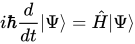
The many-body problem refers to the challenge of predicting the collective behavior and properties of a composed of more than two interacting particles, where exact analytical solutions become impossible for N3N \geq 3 due to the exponential increase in with the number of particles. This problem originated in efforts to understand interactions in but extends broadly across physics to describe complex systems in both microscopic and macroscopic scales. Its scope spans classical and quantum regimes: in the classical domain, it focuses on deterministic trajectories governed by Newtonian laws, whereas in , it deals with probabilistic descriptions via wavefunctions that capture entangled states and correlations among particles. A key distinction lies in the transition from few-body to many-body systems. The is analytically solvable by reducing it to an equivalent one-body problem through center-of-mass separation, allowing exact orbits or states to be determined. In contrast, for N>2N > 2, the coupled interactions lead to non-integrable dynamics in the classical case and an exponentially large in the quantum case, necessitating approximate methods to extract meaningful predictions about system properties such as energy levels, phase transitions, or transport behaviors. Mathematically, the classical many-body problem is formulated using the Hamiltonian H=i=1Npi22m+1i<jNV(rirj),H = \sum_{i=1}^N \frac{\mathbf{p}_i^2}{2m} + \sum_{1 \leq i < j \leq N} V(\mathbf{r}_i - \mathbf{r}_j), where pi\mathbf{p}_i and ri\mathbf{r}_i are the momentum and position of the ii-th particle, mm is the mass, and VV is the pairwise interaction potential; Hamilton's equations then yield the equations of motion. In the quantum regime, the system's evolution is governed by the time-dependent Schrödinger equation iψt=H^ψ,i \hbar \frac{\partial \psi}{\partial t} = \hat{H} \psi, with the many-body Hamiltonian H^\hat{H} incorporating kinetic energy operators 22mi2-\frac{\hbar^2}{2m} \nabla_i^2 for each particle and the same interaction potential V(rirj)V(\mathbf{r}_i - \mathbf{r}_j), resulting in a high-dimensional wavefunction ψ(r1,,rN,t)\psi(\mathbf{r}_1, \dots, \mathbf{r}_N, t).

Historical Context

While the many-body problem in classical mechanics was first formulated in the 17th century, fundamental limitations in solving systems of interacting particles were revealed in the late 19th century. In the 1890s, Henri Poincaré analyzed the three-body problem within Newtonian gravity, demonstrating through qualitative methods that it lacks a general analytic solution and exhibits chaotic behavior, thereby establishing non-integrability for broader N-body systems. This work, detailed in his treatise Les Méthodes Nouvelles de la Mécanique Céleste, shifted focus from exact integrability to qualitative dynamics, laying groundwork for understanding complex interactions beyond two bodies. A pivotal milestone came with the introduction of statistical mechanics, which addressed the intractability of exact solutions by averaging over ensembles of many-body configurations. In 1902, Josiah Willard Gibbs formalized this approach in Elementary Principles in Statistical Mechanics, providing a probabilistic framework to describe thermodynamic properties of large particle assemblies without solving individual trajectories. This method proved essential for treating classical many-body systems in gases and liquids, bridging microscopic interactions to macroscopic observables. The advent of quantum mechanics in the 1920s and 1930s transformed the many-body problem, extending classical challenges to wave-like particle behaviors and indistinguishability. Werner Heisenberg's matrix mechanics, developed in 1925, enabled initial applications to atomic systems, while his subsequent work in the mid-1920s explored multi-electron configurations in atoms like helium, highlighting correlation effects. Paul Dirac advanced this further in 1929 with his antisymmetrized wavefunction for many-electron systems, incorporating exchange interactions to align theory with atomic spectra. In the 1930s, Hans Bethe applied these quantum ideas to nuclear physics, developing models for nucleon interactions and shell structures that captured many-body effects in atomic nuclei. Post-World War II research intensified focus on condensed matter, where many-body quantum effects dominate material properties. Felix Bloch and contemporaries like John Bardeen shifted emphasis to solid-state systems, building on Bloch's earlier wave theorems to investigate electron correlations in crystals and metals during the late 1940s and 1950s. Concurrently, Richard Feynman's path integral formulation, introduced in 1948, offered a new quantum tool for summing over all possible particle histories, facilitating treatments of interacting many-body states in both non-relativistic and field-theoretic contexts. These developments marked a transition from isolated atomic studies to unified frameworks for diverse physical regimes.

Classical Many-Body Problem

Newtonian Formulation

In the Newtonian formulation of the classical many-body problem, a system consists of NN particles, each with position vector ri(t)\mathbf{r}_i(t) and mass mim_i, interacting through pairwise forces derived from a potential energy function V({rj})V(\{\mathbf{r}_j\}). The motion is governed by Newton's second law applied to each particle: mid2ridt2=iV({rj}),m_i \frac{d^2 \mathbf{r}_i}{dt^2} = -\nabla_i V(\{\mathbf{r}_j\}), where i\nabla_i denotes the gradient with respect to ri\mathbf{r}_i, and the total force on particle ii arises from the negative gradient of the potential, assuming conservative interactions. This set of 3N3N second-order differential equations describes the deterministic evolution of the system in three-dimensional Euclidean space, with the potential VV typically depending on the relative distances between particles, such as in gravitational or electrostatic interactions. The Lagrangian formulation provides an alternative, coordinate-independent approach to derive these equations. The Lagrangian LL is defined as the difference between the total kinetic energy T=i=1N12mir˙i2T = \sum_{i=1}^N \frac{1}{2} m_i |\dot{\mathbf{r}}_i|^2 and the potential energy VV: L=TV.L = T - V. Using generalized coordinates qjq_j (which may include the Cartesian components of ri\mathbf{r}_i), the Euler-Lagrange equations yield the dynamics: ddt(Lq˙j)Lqj=0\frac{d}{dt} \left( \frac{\partial L}{\partial \dot{q}_j} \right) - \frac{\partial L}{\partial q_j} = 0 for each j=1,,3Nj = 1, \dots, 3N. The Hamiltonian formulation, obtained via a Legendre transform, introduces conjugate momenta pi=mir˙i\mathbf{p}_i = m_i \dot{\mathbf{r}}_i, resulting in the total energy as the Hamiltonian: H=i=1Npi22mi+V({rj}).H = \sum_{i=1}^N \frac{|\mathbf{p}_i|^2}{2 m_i} + V(\{\mathbf{r}_j\}). Hamilton's equations then govern the evolution: r˙i=Hpi\dot{\mathbf{r}}_i = \frac{\partial H}{\partial \mathbf{p}_i} and p˙i=Hri\dot{\mathbf{p}}_i = -\frac{\partial H}{\partial \mathbf{r}_i}, preserving the symplectic structure of phase space. For few-particle systems, the many-body problem simplifies significantly. In the two-body case, the equations decouple into center-of-mass motion R=miri/M\mathbf{R} = \sum m_i \mathbf{r}_i / M (with total mass M=miM = \sum m_i) and relative motion r=r2r1\mathbf{r} = \mathbf{r}_2 - \mathbf{r}_1, reducible to an effective one-body problem with reduced mass μ=m1m2/(m1+m2)\mu = m_1 m_2 / (m_1 + m_2) and potential V(r)V(|\mathbf{r}|). This yields closed-form solutions for central potentials, such as elliptical orbits in gravity. For three or more bodies, no such general reduction exists, and the full 3N3N-dimensional system must be solved, highlighting the onset of complexity even at small NN. In isolated systems with no external forces or torques and time-independent potentials, several quantities are conserved. Linear momentum P=mir˙i\mathbf{P} = \sum m_i \dot{\mathbf{r}}_i is preserved due to translational invariance, angular momentum L=ri×pi\mathbf{L} = \sum \mathbf{r}_i \times \mathbf{p}_i due to rotational invariance, and total energy E=T+VE = T + V (or HH) due to time independence. These ten integrals (six for center-of-mass motion, three for angular momentum, one for energy) constrain the dynamics but are insufficient for N>2N > 2 to yield complete integrability.

Integrability and Non-Integrability

In classical , a system with NN , possessing a $2Ndimensional[phasespace](/page/Phasespace),isdeemedcompletelyintegrableifitadmits-dimensional [phase space](/page/Phase_space), is deemed completely integrable if it admits N$ independent integrals of motion that are in involution with respect to the , allowing the motion to be solved via and quadratures. This criterion, formalized by the Liouville-Arnold theorem, ensures that the foliates into invariant tori on which trajectories are quasi-periodic, providing a complete qualitative and quantitative description of the dynamics. The two-body problem under inverse-square gravitation, equivalent to the Kepler problem, exemplifies integrability, as it possesses the required independent conserved quantities: total energy, angular momentum vector, and the Laplace-Runge-Lenz vector, enabling exact elliptic solutions. In contrast, the general NN-body problem for N3N \geq 3 is non-integrable, as established by the Bruns-Poincaré theorem, which proves that no additional independent algebraic integrals exist beyond the ten classical ones (energy, total momentum, center-of-mass position, and angular momentum). Henri Poincaré's investigations into the three-body problem further illuminated this non-integrability by revealing the absence of uniform first integrals beyond the known ones, laying groundwork for qualitative analysis of irregular orbits. For systems near integrability, such as the NN-body problem with small perturbations from exactly solvable cases, the Kolmogorov-Arnold-Moser (KAM) theorem demonstrates that most invariant tori persist, resulting in quasi-integrable behavior where a positive measure of retains quasi-periodic motion, though interspersed with chaotic regions. Chaos emerges prominently in non-integrable many-body dynamics, quantified by , which measure the exponential divergence of nearby trajectories; the largest positive Lyapunov exponent λ1>0\lambda_1 > 0 indicates local instability, with the spectrum scaling in a manner that reflects the system's approach to thermalization in the classical limit. These properties imply that exact analytical solutions are unattainable for the classical NN-body problem when N>2N > 2, necessitating numerical integration of the equations of motion to study individual trajectories, while for large NN, the prevalence of ergodic behavior on energy surfaces underpins the development of statistical mechanics to describe ensemble averages rather than precise orbits.

Quantum Many-Body Problem

Wavefunction Description

In quantum mechanics, the many-body wavefunction ψ(r1,,rN,t)\psi(\mathbf{r}_1, \dots, \mathbf{r}_N, t) provides a complete description of the state of a system consisting of NN identical particles, where ri\mathbf{r}_i denotes the position vector of the ii-th particle and tt is time. This function evolves according to the time-dependent Schrödinger equation and encodes all observable properties of the system through its probability density ψ2|\psi|^2, which gives the likelihood of finding the particles at specific positions. For identical particles, the principle of indistinguishability requires the wavefunction to transform in a specific way under particle exchange: it must be totally symmetric for bosons (integer-spin particles like photons) and totally antisymmetric for fermions (half-integer-spin particles like electrons). The antisymmetric form for fermions is commonly expressed as a Slater determinant, a mathematical construct that automatically enforces the required exchange symmetry while incorporating single-particle orbitals. The domain of the many-body wavefunction is the 3N3N-dimensional configuration space, formed by the Cartesian coordinates of all NN particles, which introduces an exponential scaling in the as NN increases. This high dimensionality underlies the computational intractability of exact solutions for large systems, as the wavefunction must be specified over a vast whose volume grows exponentially with NN. In contrast to the classical many-body problem, where trajectories are determined in 3D , the quantum configuration space captures superposition and delocalization effects inherent to wave-like behavior. For stationary states, the time-independent governs the energy eigenfunctions: H^ψ=Eψ\hat{H} \psi = E \psi, where H^\hat{H} is the many-body Hamiltonian operator. Explicitly, for non-relativistic particles of equal mm, H^=22mi=1Ni2+i<jNV(rirj)+i=1NVext(ri),\hat{H} = -\frac{\hbar^2}{2m} \sum_{i=1}^N \nabla_i^2 + \sum_{i < j}^N V(|\mathbf{r}_i - \mathbf{r}_j|) + \sum_{i=1}^N V_{\text{ext}}(\mathbf{r}_i), with the first term representing the kinetic energy (via the Laplacian i2\nabla_i^2 acting on the ii-th particle's coordinates), the second term the two-body interaction potential VV, and the third any external potentials VextV_{\text{ext}}. This formulation generalizes the single-particle to account for interactions, highlighting the challenge of solving for ψ\psi in high dimensions. A key feature of many-body wavefunctions is quantum entanglement, where the state of the entire system cannot be separated into independent states for subsystems, leading to non-local correlations. For few-particle systems, such as two qubits, entanglement is exemplified by Bell states like 12(0110)\frac{1}{\sqrt{2}} (|01\rangle - |10\rangle)
Add your contribution
Related Hubs
User Avatar
No comments yet.