Hubbry Logo
Matter and MemoryMatter and MemoryMain
Open search
Matter and Memory
Community hub
Matter and Memory
logo
8 pages, 0 posts
0 subscribers
Be the first to start a discussion here.
Matter and Memory
Matter and Memory
from Wikipedia

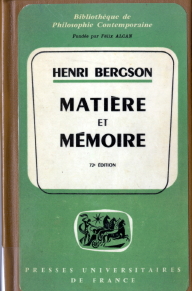
Cover from a 1965 French language edition.

Matter and Memory (French: Matière et mémoire, 1896) is a book by the French philosopher Henri Bergson. Its subtitle is Essay on the relation of body and spirit (Essai sur la relation du corps à l’esprit), and the work presents an analysis of the classical philosophical problems concerning this relation. Within that frame, the analysis of memory serves the purpose of clarifying the problem.

Matter and Memory was written in reaction to the book The Maladies of Memory by Théodule Ribot, which appeared in 1881. Ribot claimed that the findings of brain science proved that memory is lodged within a particular part of the nervous system; localized within the brain and thus being of a material nature. Bergson was opposed to this reduction of spirit to matter. Defending a clear anti-reductionist position, he considered memory to be of a deeply spiritual nature, the brain serving the need of orienting present action by inserting relevant memories. The brain thus being of a practical nature, certain lesions tend to perturb this practical function, but without erasing memory as such. The memories are, instead, simply not 'incarnated,' and cannot serve their purpose.

Various forms of memory

[edit]

Bergson distinguishes between two different forms of memory.

  1. The first category consists of memories concerning habitude, replaying and repeating past action — not strictly recognized as representing the past, but utilizing it for the purpose of present action. This kind of memory is automatic, inscribed within the body, and serves a utilitarian purpose. Bergson takes as an example the learning of a verse by rote — i.e., a recitation tending toward non-reflective and mechanical repetition. The duration of habitual recitation tends toward the regular, and one may compare this kind of memory to practical knowledge or habit. "It is habitude clarified by memory, more than memory itself strictly speaking."
  2. Pure memory, on the other hand, registers the past in the form of "image-remembrance," representing the past, recognized as such. It is of a contemplative and fundamentally spiritual kind, and it is free. This is true memory. Bergson takes as his example the remembrance of the lesson of learning the same verse — i.e., a dated fact that cannot be recreated. Pure memory or remembrance permits the acknowledgment that the lesson has been learned in the past, cannot be repeated, and is not internal to the body.

Metaphysical consequences

[edit]

Bergson accused classical metaphysics of misrepresenting its assumed problems, and of being guilty of posing secondary problems as being principal. The problem posed by Bergson was thus well known, but he redefined the way of posing it. Each of his four main works follows the same principle — responding to a precisely posed problem; in Matter and Memory, Descartes's problem of spirit and body — stated as being two substances with different attributes. Descartes's fault lies in defining matter and memory as substances or res, thus not separating them distinctly.

Bergson really does distinguish the spirit from the body, but as opposed to in Descartes's classical philosophy, the distinction resides in the temporal domain, not in the spatial. The spirit is the abode of the past; the body of the present; the soul or spirit always anchored in the past, not residing in the present; lodged in the past, and contemplating the present. To have or take consciousness of anything, means looking at it from the viewpoint of the past, in light of the past. Contenting oneself with reacting to an external stimulus means being unconscious of the act; an existence within the sheer presence of the body. Consciousness means, invariably, delaying reaction to stimuli; the interval accompanied by the conscious awareness that the spirit is anchored within the past. One becomes conscious while being anchored in the past, in light of the past, in view of appropriate action directed towards the immediate future. The articulation of time — past, present, future — finds place through the union of spirit and body. The more the spirit descends into the past, the more one becomes conscious. The more one acts automatically, the more one exists in the present, in the temporal domain of the body. And one always stays within one domain or the other. True awareness necessitates the united action of body and spirit. According to Bergson, the "impulsive person" suspends his consciousness and stays within the unreflective domain of automatism.

The role of affection

[edit]

Bergson contended that we do not know our bodies only "from without" by perceptions, but also "from within" by affections.

Modern cognitive science

[edit]

Present developments of modern selectionist theories of memory in cognitive science seems to confirm Bergson's theories.[1] Selectionist models offer new and potentially useful approaches to a theory of remembering. On the model of natural selection, these selectionist theories require at least two processing components: a device which generates a range of memory representations and a selection process which preserves a subset of those representations. Bergson shows how the subjective experience of remembering might be understood within a selectionist framework.

The book is considered to be a major philosophical contribution to the analysis of implicit memory.[2]

Editions

[edit]
  • Matter and Memory, 1990 (Matière et Mémoire, 1896), translators N.M. Paul and W.S. Palmer. Zone Books ISBN 978-0-942299-05-2
  • Matter and Memory 2004. [Republication of the 1912 MacMillan edition, translators N. Margaret Paul and W. Scott Palmer. Dover Publications. ISBN 0-486-43415-X.]

References

[edit]
[edit]
Revisions and contributorsEdit on WikipediaRead on Wikipedia
from Grokipedia
Matter and Memory (French: Matière et mémoire) is a foundational philosophical treatise by the French thinker , first published in 1896, which examines the relationship between the material world and the spiritual dimensions of consciousness, focusing on the mechanisms of and to bridge the gap between body and mind. In the work, Bergson challenges traditional dualisms in by arguing that matter and spirit are not opposed realities but interconnected through a continuum of images and experiences. He introduces the concept of "pure ," positing that arises as a direct, unfiltered apprehension of the universe's images, which is then narrowed by the practical needs of the living body into utilitarian representations. This approach critiques both realism, which reduces to mere sensation, and , which detaches it from external reality, instead affirming that is embedded within the things perceived themselves. Central to Bergson's analysis is his distinction between two forms of memory: habit-memory, an automatic, bodily repetition of actions learned through conditioning, akin to a motor mechanism; and pure memory (or mémoire pure), a dynamic, spiritual preservation of the past in its full, qualitative multiplicity, independent of material traces. He illustrates this with the famous "memory cone" model, where the inverted cone's base represents the vast, unconscious accumulation of past experiences, tapering to the apex at the present moment of perception, emphasizing memory's role in the temporal flow of duration (durée). These ideas culminate in metaphysical implications, suggesting that memory enables a direct intuition of reality beyond spatialized intellect, influencing later developments in phenomenology and cognitive science.

Publication and Context

Original Publication Details

Matière et mémoire: Essai sur la relation du corps à l'esprit was first published in 1896 by Félix Alcan in . The work, subtitled Essay on the Relation of Body to Spirit, represents Henri Bergson's second major philosophical text following his 1889 Essai sur les données immédiates de la conscience (Time and ). The book emerged as a direct response to Théodule Ribot's Les Maladies de la mémoire (1881), which advanced reductionist interpretations of as a -based rooted in physiological mechanisms. Bergson critiqued these views for oversimplifying 's spiritual dimensions, aiming instead to integrate philosophical inquiry with the nascent findings of . In the preface, he articulated the core intent: to affirm the reality of both spirit and while elucidating their relation through an analysis of and , without subordinating the former to the latter. Upon release, Matière et mémoire garnered attention within French intellectual circles, where it was seen as extending Bergson's earlier explorations of duration and from Time and Free Will. Early reviews, such as Victor Delbos's assessment in the Revue de métaphysique et de morale (1897), highlighted its innovative approach to mind-body problems amid contemporary psychological debates.

Historical and Intellectual Background

In the late 19th century, Henri Bergson's Matter and Memory (1896) emerged amid intense debates in and concerning the nature of and . Physiological theories, such as Hermann Helmholtz's signal theory, which likened nervous transmission to a telegraph system and emphasized sensory differentiation in specific locations, provided a mechanistic framework that Bergson critiqued for reducing to mere physiological signals. Similarly, Théodule Ribot's associationist , as outlined in works like Les maladies de la mémoire (1881) and Mécanisme de l'attention (1888), treated memory as a biological fact tied to cerebral mechanisms, influencing Bergson's analysis of pathological cases while prompting his rejection of deterministic . These debates, rooted in empirical studies of , , and sensory processes, shaped Bergson's effort to reconcile scientific observation with metaphysical inquiry. Bergson positioned his work in opposition to the prevalent in thinkers like and Thomas Huxley, who viewed as an epiphenomenon of mechanical processes. Spencer's (1855) promoted evolutionary determinism, portraying emotions and actions as adaptive responses without true autonomy, a view Bergson countered by asserting the irreducibility of spirit to matter. Huxley's automata hypothesis (1874) further exemplified this , treating humans as complex machines, which Bergson challenged through principles that emphasized life's creative dynamism over inert mechanisms. This opposition underscored Bergson's , which privileged intuitive experience and qualitative multiplicity against mechanistic explanations. Building on his doctoral thesis Time and Free Will (1889), Bergson introduced precursors to concepts like —the vital impetus driving creative evolution—through the notion of durée, or qualitative duration, which distinguished real temporal experience from spatialized, quantitative time. In Time and Free Will, Bergson argued against Kantian and positivist spatializations of time, using examples from hypnotism and bodily heterogeneity to defend psychological , ideas that directly informed Matter and Memory's exploration of memory as a non-material preservation of the past. This earlier work's emphasis on over intellect laid the groundwork for Bergson's later vitalist ontology. The intellectual milieu of the , marked by positivist reforms under the laws (1880s) and a push for scientific education, contrasted with emerging that Bergson both engaged and critiqued. , inspired by , promoted empirical unity across sciences but fragmented knowledge into specialized domains, a trend Bergson opposed by advocating philosophical synthesis. by at the Salpêtrière Hospital, including demonstrations of somnambulism and dissociated states (e.g., Leçons du mardi, 1887–1888), provided pathological evidence of memory's independence from brain function, influencing Bergson's discussions of hysterical amnesias as cases where recollections persist beyond cerebral lesions. These developments, amid debates between the Salpêtrière and Nancy schools on suggestion, highlighted the Republic's tension between secular science and spiritualist philosophy. Following the publication of Matter and Memory, Bergson's appointment to the Chair of Greek and Latin Philosophy at the in 1900 amplified his ideas' impact, as his lectures drew large audiences and fostered discussions on , , and . These talks, beginning in 1900 and continuing until 1914 (with preserved courses on topics like and metaphysics), extended the book's themes into public discourse, bridging academic with broader cultural shifts away from strict . He later transferred to the Chair of in 1904.

Core Philosophical Framework

Perception and the Material World

In Henri Bergson's philosophical framework, emerges not as a mere representation of external but as an active selection from a vast reservoir of pure perceptions inherent in itself. Pure , in its theoretical form, constitutes an instantaneous and memory-free apprehension of the material world, wherein aligns directly with the aggregate of images that comprise . This process centers on utility for action, as isolates only those aspects of objects that correspond to the body's potential movements and needs, effectively measuring the possible reactions of the upon its surroundings. Bergson posits that without this selective centering, would overwhelm the with an undifferentiated totality of images; instead, it functions as a practical discernment, prioritizing elements conducive to survival and adaptation. Central to this theory is Bergson's "cone of memory" metaphor, which illustrates the dynamic interplay between perception, memory, and matter. The cone, denoted as SAB, positions the apex S as the point of pure perception—coinciding with the body's immediate contact with the present plane P of material reality—while the base AB represents the expansive totality of past memories, virtually preserved in their entirety. Along the cone's sides, memory-images contract or expand depending on their relevance to the present action, bridging the inert multiplicity of matter at the base with the directed perception at the apex. This structure underscores perception's role in actualizing select memories from the virtual past, ensuring that consciousness navigates matter not through passive observation but through a graduated synthesis oriented toward future possibilities. Bergson further delineates as a homogeneous multiplicity, characterized by spatial extension and quantifiable divisibility, akin to a of uniform vibrations or a perpetual recommencement of the present. In contrast, spirit manifests as a heterogeneous multiplicity, rooted in temporal duration and qualitative interpenetration, where conscious states unfold in an indivisible, creative flow irreducible to spatial metrics. , thus, operates at the intersection of these realms, translating the spatial homogeneity of into the temporal heterogeneity of spirit by selecting and synthesizing images in accordance with the organism's indetermination. This opposition highlights Bergson's rejection of a simplistic , affirming 's reality while elevating spirit's dynamic essence. The body plays a pivotal role in this perceptual economy, serving as a filter that delimits the influx of sensations to those pertinent to practical exigencies. As a "center of indetermination," the body reflects external images back upon themselves, absorbing only affections that prepare motor responses and disregarding extraneous details—such as the subtle vibrations of distant stars or the molecular agitations of unseen objects—which hold no immediate utility for action. This filtering mechanism ensures that remains economical, attuned to the body's sensori-motor apparatus rather than an exhaustive enumeration of the material world, thereby preserving the organism's freedom to respond adaptively. Bergson critiques empiricist conceptions of perception, as advanced by thinkers like and , for portraying it as a passive aggregation of unextended sensations projected onto an external canvas. He argues that such views misconstrue perception as a subjective fabrication or weakened internal state, divorced from the objective interplay of images, thereby failing to account for its active, action-oriented essence. Berkeley's idealism, which reduces to mind-dependent ideas, and Locke's realism, which treats sensations as discrete and speculative, both overlook the body's role in discerning and utilizing perceptions as integral to the material aggregate. In Bergson's account, perception transcends this passivity, embodying a direct immersion in things themselves.

The Body-Spirit Relation

In Henri Bergson's philosophical framework in Matter and Memory, the body and spirit are not opposing substances in a dualistic conflict but interconnected aspects of a unified reality, resolved through the intermediary role of . The body serves as a center of action that inserts a delay between and response, enabling deliberation rather than automatic reaction. This indetermination distinguishes living beings from inert , allowing the body to select and channel impressions into purposeful movements. As Bergson states, "My body is a centre of action: it is a point of view upon the ; this point of view brings about a division of the into three parts... the body, always turned towards action, has for its essential function to limit with a view to action, the of the spirit." The spirit, in contrast, emerges as the cumulative repository of experiences, comprising recollections that transcend immediate materiality. These memories form an expansive reservoir, independent of physical storage in the , which instead acts merely as a selector and actualizer for action-oriented recall. Bergson illustrates this with the of a , where the base represents the totality of accumulated recollections remaining virtual and motionless, while the apex—linked to the present—es forward, synthesizing and present for future utility. "Spirit being in already , and declaring itself more and more as a prolonging of the into the present, a , a true ," Bergson explains, emphasizing how pure maintains independence from cerebral mechanisms yet interfaces with them for practical ends. Bergson explicitly rejects —the notion of a strict correspondence where bodily states mechanically cause or mirror spiritual ones—arguing instead for their mutual implication within the flow of duration. The functions not as the origin or container of but as an "instrument of action, and of action only," akin to a "central telephonic exchange" that facilitates or inhibits communication between perceptions and motor responses. This setup avoids causal , as spirit infuses matter with freedom through memory's selective insertion, while the body grounds spirit in concrete exigencies. As Bergson critiques, such parallelism amounts to "hypotheses which are and can be nothing but disguised statements of the fact." Clinical examples like and underscore this coordination without implying memory's destruction. In , patients may retain the ability to recall song lyrics flawlessly despite impaired speech production, indicating a disruption in the body's motor pathways rather than a loss of spiritual recollections themselves. Similarly, —such as psychic blindness—does not eliminate but hinders its integration into recognizable action, revealing the brain's role in linking sensory input to memory-driven responses. Bergson notes that in these cases, "psychic blindness does not hinder seeing, any more than psychic deafness hinders hearing," and the disorders diminish the overall vitality of remembering rather than erasing specific memories. This body-spirit dynamic has profound implications for , as elevates beyond mechanical . By drawing on accumulated past experiences, the spirit enables choices that synthesize sensations and ideas, transcending reflexive necessity. "Freedom is not hereby... reduced to sensible spontaneity," Bergson asserts; instead, in the thinking being, the free act arises from 's capacity to multiple moments of duration, thereby "free[ing] us from the movement of the flow of things, that is to say, from the of necessity." Thus, the body's indetermination, empowered by spiritual , fosters genuine in response to the world.

Theories of Memory

Habitual Memory

In Henri Bergson's Matter and Memory, habitual memory is defined as a motor mechanism acquired through repetition, consisting of automatic behaviors that integrate past experiences into present actions without conscious representation. It operates as a set of intelligently constructed mechanisms fixed in the , ensuring appropriate responses to recurring demands by blending recollections seamlessly with ongoing bodily movements. This form of memory emphasizes utility over preservation, transforming repeated efforts into quasi-instantaneous habits that prolong past perceptions into efficient reactions. Habitual memory forms through the decomposition and recomposition of movements in analogous situations, embedding lessons from into sensori-motor systems via successive practices. Its primary function lies in immediate practical utility: by automatizing routine actions, it frees from mechanical tasks, allowing attention to focus on novel or higher-order concerns. For instance, it narrows the scope of recollection to align with bodily needs, guiding motor responses for and recognition in the present moment. This type of memory bears a close relation to instinct, resembling the automatic, survival-oriented behaviors observed in animals, where responses prioritize useful generalities over individual details. Unlike innate instincts, however, habitual memory arises from learned repetition in humans, yet it shares an unreflective, action-bound character that contrasts with more contemplative forms of recall. Bergson illustrates this through examples such as learning to play the piano, where initial efforts evolve into fluid motor habits, or reciting a poem effortlessly after repeated imitation, reenacting past actions without evoking their original context. Another case is walking or navigating familiar paths mechanically, where the body executes ingrained patterns independently of deliberate thought. Habitual memory depends heavily on cerebral mechanisms for its sensori-motor coordination, with the brain serving as an instrument that directs and sustains these motor diagrams. Lesions or damage to the brain disrupt this equilibrium, impairing automatic actions—such as causing apraxia, where coordinated movements fail—while leaving deeper recollections intact, as the brain does not store memories but facilitates their practical actualization. In brief contrast, this bodily, present-focused memory differs from pure memory, which preserves the past virtually and independently of physical structures.

Pure or Spiritual Memory

In Henri Bergson's philosophy, pure or spiritual memory constitutes a non-material repository of the past, comprising virtual memory-images that persist independently of physical embodiment or spatial constraints. These memory-images are not degraded perceptions but complete, self-sufficient recollections stored in a "pure past," a metaphysical domain beyond the spatio-temporal framework of matter, where the past endures as a real, actualized existence coexisting with the present in a heterogeneous multiplicity. This pure past forms a continuous, qualitative duration, unextended and indivisible, contrasting with the discrete, quantitative spatiality of the material world. Bergson posits that an infinite array of such memory-images coexists within this pure past, forming a dynamic multiplicity where recollections are not mechanically stored in cerebral cells but subsist in the virtuality of duration itself. Selection among these memories occurs through a process of actualization driven by the needs of the present moment, such as utility for action or the demands of consciousness, rather than any exhaustive retrieval mechanism. The brain functions merely as a selective apparatus, actualizing only those relevant images by linking them to current perceptions and motor responses, without serving as their ontological locus. This independence from matter underscores Bergson's critique of materialist theories of memory, asserting that the does not generate or house memories but filters and inserts them into practical life. In cases of or cerebral lesions, access to pure memories is obstructed—due to disrupted pathways for voluntary or —but the memories themselves remain intact in the pure past, unaffected in their existence. Thus, spiritual memory preserves the totality of personal history as a latent spiritual reservoir, accessible variably depending on the organism's state. Illustrative examples highlight this virtual nature: recalling a landscape evokes a memory-image of it as it precisely was in the past, unadulterated by present utility or bodily sensation, emerging purely from duration without requiring spatial reconstruction. Similarly, in dream states, pure memories surface spontaneously without attachment to bodily action, allowing forgotten scenes—such as childhood vignettes—to materialize on expansive planes of , detached from the brain's selective constraints and revealing the unhindered flow of the spiritual past.

Role of Affection and Recognition

Affection in Perception

In Henri Bergson's Matter and Memory, affection is defined as the internal aspect of perception, encompassing subjective states such as pain or pleasure that emerge from the body's localized sensations, distinct from the external, objective character of pure perception. These affections constitute the "inner side" of perceptual experience, where external excitations are transformed into felt invitations to act without compelling immediate movement, thereby interposing between stimulus and response. Unlike sensations that are purely external images of matter, affection involves the real action of the body upon itself, often manifesting as an emotional or qualitative coloring tied to bodily needs. Affection plays a crucial role in the acquisition of about the body, serving as the primary means through which apprehends its own material insertion into the world. By revealing the body's capacities and limitations through these internal states, discloses the presence of spirit within , bridging the gap between objective and subjective . It enriches perceptual by adding a layer of personal, qualitative depth that pure alone lacks, allowing the perceiver to measure their body's power to absorb or resist external influences. In this way, affections highlight the body's role as a center of action, where spirit manifests through material interactions. In contrast to pure perception—which Bergson describes as an unalloyed, immediate of the external , detached and objective—affection introduces subjectivity by mingling the body's internal conditions with perceptual , often intertwining it with mnemonic elements for a more holistic . Pure perception operates as a virtual selection of images for potential action, extended across space, whereas affection is contracted and localized, representing an impurity that personalizes and qualifies the perceptual field. This blending underscores how in lived is never purely material but always infused with the spirit's qualitative influence, transforming raw sensations into meaningful, embodied encounters. A representative example of this distinction occurs when touching a hot object: the external perception registers the image of the object's heat and form as an objective reality, while the affection emerges as the internal, burning pain—a localized effort of the body to restore equilibrium, prompting withdrawal without fully determining the response. Such affections, while vivid in their immediacy, remain vague in their spatial extent and intensity, lacking the precision of external outlines. This vagueness limits their standalone utility, requiring the clarifying role of memory to sharpen and contextualize them for effective action and recognition.

Mechanisms of Recognition

In Bergson's , recognition emerges as a dynamic process whereby of an object or is translated into action through the intermediary roles of and habitual . Affection, residing in the body as a qualitative sensation, alerts the to the practical significance of the perceived , prompting a selection of relevant motor responses. Habitual memory, consisting of ingrained sensori-motor associations formed from past experiences, then facilitates this translation by supplying automatic, quasi-instantaneous adaptations that bridge the gap between sensory input and bodily movement, ensuring the organism's practical engagement with the world. Bergson distinguishes two primary types of recognition, differing in their degree of and involvement of . Automatic recognition operates habitually and unconsciously, relying solely on motor mechanisms where directly elicits pre-established actions, such as navigating a familiar path without deliberate thought; this form fuses resemblance to past objects with immediate contiguity, bypassing reflective analysis. In contrast, attentive recognition is deliberate and effortful, incorporating pure images that coalesce with the current to yield a deeper, subjective understanding, often requiring inhibition of automatic responses to allow for conscious synthesis. Central to this process is the brain's function as a selective "keyboard" or central exchange, which does not store memories but instead filters and activates them based on signals from . By corresponding to sensory and motor regions, the enables the insertion of pertinent habitual memories into the perceptual field, materializing virtual actions into real ones while preserving the independence of memory images in a broader spiritual domain. Pathologies such as , termed "psychic blindness" by Bergson, exemplify disruptions in these mechanisms, where remains intact but the link between affection and fails, leading to impaired recognition without actual loss of memories. For instance, in cases of associative agnosia, patients can see objects clearly yet cannot interpret or act upon them due to damaged sensori-motor pathways or inability of memory images to integrate with affectional cues, highlighting that the deficit lies in the translation process rather than memory storage. Ultimately, recognition unveils as the vital interval between pure and automatic action, where affection and interplay to introduce and depth, allowing the past to infuse the present and enabling deliberate over mere reaction. This interval, enriched briefly by contributions from pure , underscores recognition's role in sustaining the organism's adaptive freedom.

Metaphysical and Temporal Implications

Critique of Dualism

In Matter and Memory, critiques ' substance dualism for positing mind and body as two fundamentally distinct, spatially extended substances, thereby ignoring the temporal dimension of reality and creating an unbridgeable chasm between them. This dualism, Bergson argues, oscillates unresolved between and , failing to account for how spirit and interact without reducing one to the other. Instead, he reframes the tension not as a spatial opposition but as a temporal one, with the spirit aligned to the past (through ) and the body to the present (through action-oriented ). Bergson proposes an alternative in the form of a grounded in duration (durée), where is a continuous flux of time rather than static substances, and serves as the unifying between body and spirit without subsuming either. In this view, pure preserves the qualitative multiplicity of the past, bridging the material body's practical immediacy and the spirit's virtual depth, thus avoiding the reductive pitfalls of traditional . This synthesis integrates perception's role in selecting images for action with 's retention of unselected possibilities, maintaining the of both and spirit. Opposing interactionist theories of dualism, Bergson contends that there is no causal gap requiring miraculous intervention; rather, the spirit influences the body through the indetermination inherent in , which introduces and unpredictability into action. Cerebral states, he explains, merely prolong or inhibit perceptions but do not produce , as operates independently of brain mechanisms to insert the past's virtuality into the present. Bergson extends his critique to historical precedents, targeting Baruch Spinoza's parallelism, which he rejects for conceiving mind and body as predetermined, parallel attributes of a single substance that preclude genuine reciprocal influence and temporal dynamism. Similarly, he faults Immanuel Kant's distinction between phenomena (spatiotemporal appearances) and noumena (things-in-themselves) for spatializing time, thereby subordinating to deterministic science and neglecting its preparatory function for free action. The outcome of this critique is a conception of as the survival and actualization of the past within the present, where ensures the continuity of duration and enables the spirit to permeate bodily action without spatial separation. This temporal unity resolves the dualistic by affirming 's irreducible role in bridging and spirit.

Memory and Duration

In Henri Bergson's philosophy, as elaborated in Matter and Memory, duration (durée) represents the qualitative, heterogeneous flow of inner time, contrasting sharply with the spatialized, quantitative divisions of clock-time that reduce experience to measurable intervals. This lived duration is not a succession of discrete instants but an indivisible continuity, where past, present, and future interpenetrate in a dynamic multiplicity. Memory serves as the essential mechanism for preserving this duration, safeguarding the past in its full, virtual reality rather than as fragmented records. Central to this preservation is pure memory, which Bergson describes as a spiritual repository of the entire past, existing independently of material traces in the and capable of contracting into the present to enrich . Unlike habitual memory, which mechanizes actions through repetition, pure memory maintains the past's qualitative depth, allowing it to descend progressively into actualized recollections that inform current experience. This contraction process ensures that duration remains fluid and integral, avoiding the spatial homogenization that would render time merely mechanical. Bergson vividly illustrates the structure of memory through his inverted cone diagram, where the broad base symbolizes the totality of pure —the virtual, unconscious past—tapering to the narrow apex at the present moment of and action. As the intersects the plane of the present, sections of the past are selected and actualized based on the needs of the moment, creating a continuum from virtual recollection to embodied response. This geometric underscores memory's role in bridging the infinite expanse of duration with the exigencies of immediate reality. Metaphysically, Bergson posits that reality itself is memory-laden, with duration's continuity depending on memory's conservation of the past; absent memory, existence would dissolve into isolated instants devoid of genuine becoming. This framework establishes freedom as emergent from memory's mobility, enabling creative action that transcends deterministic causality by drawing on the full qualitative weight of prior experiences. Without such preservation, temporal continuity—and thus the possibility of novel, indeterminate choices—would collapse. A representative example is the personal recollection of a childhood event, which Bergson views not as a static measured in seconds but as a lived intensity embodying the heterogeneous duration of that moment's and sensations. Such memories resist spatial quantification, instead revealing time's qualitative through their immersive, non-chronological revival. These ideas culminate in profound metaphysical implications: the appears as an interlinked whole of durations, where spirit functions as the enduring conservation of , sustaining reality's creative beyond mere material . Bergson's vision thus reframes metaphysics around time's inner , with as its vital, unifying force.

Reception and Modern Relevance

Early 20th-Century Influence

Henri Bergson's Matter and Memory (1896) exerted significant influence on early 20th-century phenomenology, particularly through its exploration of as intertwined with bodily experience. engaged with Bergson's ideas on time and in (1927), critiquing yet drawing upon the notion that disrupts linear presence to reveal a more primordial temporality, where past experiences persist in a non-representational mode akin to Bergson's "pure ." Similarly, incorporated Bergson's distinction between habitual —embodied and motoric—and pure into his , emphasizing the body as a site of sedimented past actions that shape present awareness, as elaborated in (1945). These links positioned Matter and Memory as a bridge between vitalist and phenomenological accounts of lived embodiment. In psychoanalysis, Bergson's conception of pure memory as an unconscious reservoir of virtual pasts resonated with Sigmund Freud's developing theory of the unconscious, though Bergson rejected Freudian in favor of creative . Freud's (1900) parallels Bergson's idea of memory traces as dynamic and non-localized, with the unconscious functioning as a storehouse of latent recollections that influence action without full conscious access. Bergson, however, critiqued mechanistic interpretations of the psyche, arguing in Matter and Memory that memory's spiritual dimension escapes causal reduction, influencing later psychoanalysts who sought to integrate vitalist elements against strict . The book's ideas on found literary expression in Marcel Proust's (1913–1927), where sensory triggers evoke immersive recollections that transcend voluntary recall. Proust's famous madeleine episode embodies Bergson's "pure ," a spontaneous resurgence of the past that integrates affection and perception, transforming narrative time into a durational flow. This inspiration shaped modernist literature's emphasis on subjective temporality over linear plot. In debates on , Matter and Memory informed Alfred North Whitehead's , particularly the view of as a flux of becoming where memory-like prehensions preserve past actualities in novel syntheses. Whitehead's (1929) echoes Bergson's anti-mechanistic stance, portraying memory not as static storage but as a creative force opposing behaviorist reductions of mind to observable responses. Bergson's critique of and in the text bolstered vitalist opposition to , which gained traction in the by insisting on the irreducibility of inner duration to external stimuli. Criticisms of Matter and Memory were pronounced in Anglo-American philosophy, where dismissed Bergson's memory theory as mystical and solipsistic, arguing it conflated subjective images with objective reality in a way that undermined empirical analysis. This led to limited uptake in analytic circles, as Russell's 1912 critique reinforced a divide favoring over Bergson's intuitive metaphysics, confining the book's influence primarily to continental traditions until mid-century.

Connections to Contemporary Cognitive Science

Bergson's distinction between habitual memory and pure memory in Matter and Memory anticipates contemporary cognitive science's division between implicit and explicit memory systems. Habitual memory, characterized as automatic and action-oriented, parallels procedural or nondeclarative memory, which involves skills and habits without conscious recollection, as outlined in Larry Squire's taxonomy of multiple memory systems. Conversely, pure memory, described as a spiritual reservoir of past experiences accessible through conscious effort, aligns with declarative or episodic memory, enabling the mental re-experiencing of specific events. This non-unitary view of memory, where experiences are not uniformly stored but differentially processed, prefigures Endel Tulving's framework, particularly his concept of autonoetic consciousness in episodic retrieval, which involves self-aware mental time travel mirroring Bergson's emphasis on detaching from the present to access virtual pasts. Modern provides empirical support for Bergson's portrayal of the not as a storage site for memories but as a selector that filters and reconstructs experiences for action. imaging studies confirm the hippocampus's role in and episodic encoding, yet fail to localize fixed traces, echoing Karl Lashley's engram experiments that demonstrated memories' distributed nature across cortical areas rather than discrete storage. Lashley's inability to pinpoint engrams after decades of studies validates Bergson's of materialist , suggesting the modulates a broader, reconstructive field of potential memories rather than containing them. Recent engram theories, such as those proposing hippocampal indexing of cortical patterns, further align with this selector model by emphasizing dynamic retrieval over static storage. Gilles Deleuze's 1966 Bergsonism revitalized interest in Matter and Memory by interpreting Bergson's memory as a virtual multiplicity, where pure recollections coexist as indeterminate potentials influencing the present without being reduced to it, influencing post-structuralist and process-oriented philosophies. In the 21st century, has extended these ideas through her concept of , critiquing Bergson's telephonic exchange metaphor for the while linking plasticity's creative reshaping of neural pathways to the dynamic interplay of matter and spirit in memory formation. Malabou argues that plasticity embodies Bergson's by allowing the to generate novel forms, bridging philosophical intuition with synaptic adaptability observed in . Criticisms from reductionist neuroscience, such as Patricia Churchland's eliminative materialism, persist in challenging Bergson's anti-reductionism by positing that mental states, including memory, emerge fully from neural mechanisms without spiritual residues. However, these views are contested for overlooking Bergson's "tension of consciousness," where memory involves irreducible qualitative durations beyond computational models. Quantum consciousness theories, like Stuart Hameroff and Roger Penrose's Orchestrated Objective Reduction (Orch OR), echo Bergson's notion of indetermination by proposing that consciousness arises from non-algorithmic quantum processes in microtubules, introducing genuine novelty into material causation akin to pure memory's virtuality. Post-2000 scholarship addresses gaps in earlier interpretations by integrating Bergson's ideas with , as developed by from the 1990s onward, which combines first-person experiential accounts with third-person brain data to explore without reducing it to neural correlates, resonating with Bergson's emphasis on perception's subjective depth. Tulving's 2002 refinements to further parallel pure memory by highlighting episodic recall's role in subjective time awareness, supported by fMRI evidence of prefrontal and hippocampal activation during self-referential past simulation. Recent developments as of 2025 continue to affirm Matter and Memory's relevance, with works exploring Bergson's theories in relation to simulationist models of memory—where recollection involves constructive simulation rather than literal replay—and panpsychist approaches to in . For instance, a 2023 volume dialogues Bergson's metaphysics with contemporary scientific themes on time and memory, while a 2025 analysis questions whether Bergson's memory theory aligns with empirical findings in simulationism. These integrations bridge and empirical , underscoring the book's enduring impact.

References

  1. https://en.wikisource.org/wiki/The_Philosophy_of_Bergson_%28Russell%29
Add your contribution
Related Hubs
User Avatar
No comments yet.